String of Hearts Light Needs: Best Window, Sun & Warning
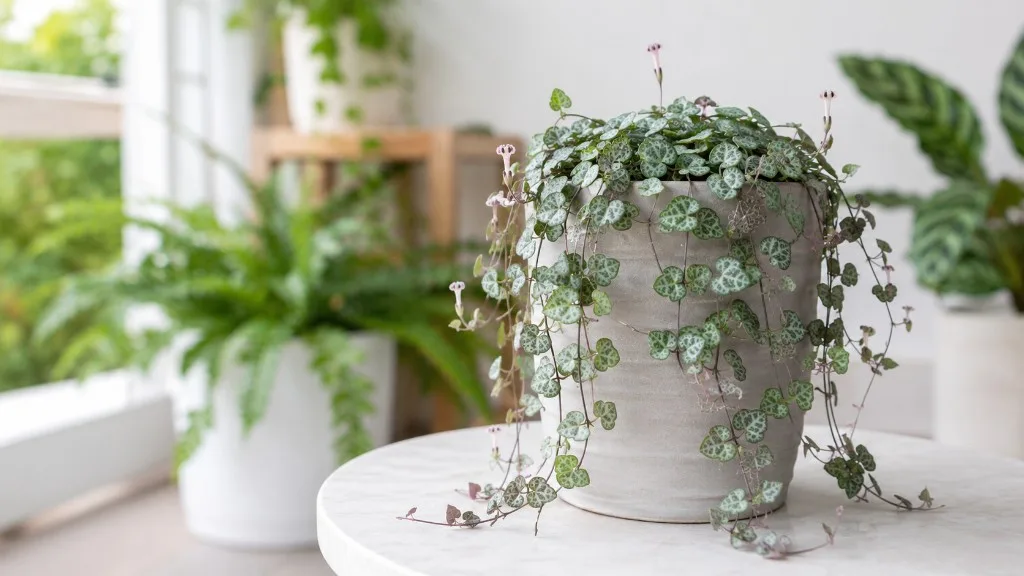
String of Hearts Light Needs: Best Window, Sun & Warning Signs
String of Hearts Light Needs: Best Window, Sun & Warning Signs
String of hearts looks delicate enough to live anywhere you hang it, which is exactly why so many pots end up in the wrong light. Ceropegia woodii - the species behind the common name string of hearts - is a trailing semi-succulent vine with coin-shaped leaves, tuberous roots, and a tolerance for neglect that plant shops routinely translate into “low-light friendly.” That label sells baskets. It does not grow dense silver-marbled vines.
The practical goal is straightforward: give string of hearts enough bright light for compact leaf spacing, firm new growth, and steady vine production without scorching the thin foliage or baking tubers against hot glass. That usually means 4 to 6 hours of bright, indirect light daily, often with 1 to 2 hours of gentle direct morning sun, or a supplemental grow light when your room layout cannot deliver real brightness year-round. SANBI’s PlantZAfrica profile notes that in cultivation, string of hearts grows well on a sunny windowsill, with leaves becoming more strongly colored and marbled in good light - and noticeably paler when light is insufficient. (PlantZAfrica - Ceropegia linearis subsp. woodii)
This guide focuses on placement decisions you can make today: which window, how much direct sun, when to add a grow light, and how to read the plant’s own warning signs before sparse vines and root stress take over.
How Much Light String of Hearts Actually Needs
String of hearts is not a shade houseplant that happens to trail. It is a high-bright-indirect vine that stores water in leaves and tubers, slows dramatically in dim conditions, and stretches toward whatever photons it can find. Outdoors in frost-free climates it tolerates real sun when acclimated. Indoors, the usable target for most growers is bright indirect light - NC State Extension lists dappled sunlight as the cultural norm - for roughly 4–6 hours per day, with optional gentle morning sun on an east exposure.
Foot-candles sound technical, but the translation is simple. A spot 2–3 feet (60–90 cm) from an unobstructed east or west window on a clear day usually lands in the right zone. A pot hanging in the center of a bright living room - far from any pane - often reads bright to human eyes and weak to the plant. String of hearts does not need greenhouse intensity, but it needs consistent, plant-facing brightness, not ambient room glow.
The plant’s semi-succulent physiology reinforces the point. Tuberous roots and fleshy leaves buffer short droughts, which is why string of hearts survives mediocre light longer than a true tropical foliage plant. Survival is not thriving. A dim plant may keep existing leaves for months while internodes lengthen, new leaves shrink, and the silver-green marbling fades. By the time the vine looks obviously sparse, light has been limiting growth for a long time.
The Short Answer for Busy Growers
If you only remember three rules, use these. At a window: hang or place the pot 2–3 feet from an east-facing window for ideal morning sun plus bright indirect light the rest of the day, or 3–4 feet from a west window with sheer filtering in hot summers. Daily target: aim for 4–6 hours of bright indirect light, with 1–2 hours of gentle direct morning sun as a bonus, not a requirement. Without enough natural light: add a full-spectrum LED grow light 12–18 inches (30–45 cm) above the canopy and run it 12–14 hours daily on a timer.
Judge success by new growth, not old damage. Within three to four weeks of better light, new leaves should be closer together on the vine, firmer in texture, and richer in the silver-green patterning that makes String of Hearts overview worth displaying.
Why String of Hearts Is Not a Low-Light Plant
Retail categories are not botanical facts. String of hearts lands in the “easy trailing plant” aisle because it tolerates irregular watering and does not collapse overnight in a mediocre office. That tolerance masks a clear preference: this species wants brightness.
The mechanism is etiolation. When photosynthetically useful light falls below what the plant needs for compact growth, string of hearts allocates energy toward stem elongation - searching for a brighter source - rather than toward dense leaf production. Internodes stretch. Leaves shrink. The characteristic heart shape may flatten or pale. The vine still lengthens, which creates the illusion of health because the plant is visibly growing. What you are actually seeing is a stress response, not vigorous culture.
Light intensity also affects leaf color chemistry. In strong indirect light, the silver marbling along leaf veins becomes pronounced. In weak light, leaves turn uniform pale green and the plant loses the contrast that makes it decorative. Variegated pink cultivars show the same pattern more dramatically: without enough brightness, pink fades toward green. The plant is not being dramatic. It is reporting energy availability.
Finally, light sets the pace for water use. A bright string of hearts photosynthesizes actively, dries its mix faster, and uses stored tuber reserves efficiently. A dim plant grows slowly, holds moisture longer, and becomes more vulnerable to root problems if you keep watering on a schedule built for a sunny window. Light is the throttle for the whole care system, not a separate aesthetic preference.
Understanding String of Hearts in Its Native Habitat
Botanical context prevents the two most expensive mistakes: treating string of hearts like a deep-shade forest floor plant, and blasting a low-light-adapted specimen with midsummer afternoon sun on day one. Ceropegia woodii is native to South Africa, Eswatini, and Zimbabwe, with wild populations in Limpopo, Mpumalanga, KwaZulu-Natal, and the Eastern and Western Cape. (PlantZAfrica)
In habitat, plants grow on rocky ledges, cliff edges, and woodland outcrops from roughly 100 to 1,180 meters elevation, often rooted in thin soil over rock with humus-rich loam or sandy mixes. SANBI describes the species as typically found in shaded places - but with an important nuance shared by many Ceropegia species: plants often climb among bushes that shade and humidify the base while vegetative growth reaches into brighter light above the understory. The tuber sits protected. The leaves work in filtered brightness.
That architecture explains indoor behavior. String of hearts accepts some protection from the harshest rays but still wants the canopy in real light. It is not a candidate for a dark hallway just because the tuber stores water.
Where Ceropegia woodii Grows in the Wild
Wild string of hearts experiences frost-free climates with moderate to high rainfall - roughly 600–1,000 mm annually in parts of its range - and average temperatures that favor year-round growth in the open. PlantZAfrica lists recommended aspects for cultivation as shade, morning sun (semi-shade), and afternoon sun (semi-shade), reflecting the dappled-exposure reality of ledge and woodland habitats rather than full desert sun or deep forest gloom.
The species was introduced to cultivation after John Medley Wood collected material from Groenberg Mountain in Western Cape in 1881; living plants later flowered at Royal Botanic Gardens, Kew, confirming its suitability as a hanging basket subject. Its global popularity rests on trailing form and tolerance of intermittent neglect - not on minimal light demand.
What That Habitat Means for Indoor Light
Translate habitat into home terms with two rules. Rule one: give the leafy canopy bright, filtered light for a substantial part of the day - not just a brief sunbeam at dawn. Rule two: protect against sudden intensity jumps that the current leaves did not develop under.
A north-facing room with no supplemental light violates rule one in most northern-hemisphere homes. A south window with unfiltered July afternoon sun against leaves that grew all winter three feet from the glass violates rule two. The plant can handle sun in principle - outdoor growers in warm climates move pots outside in summer with acclimation - but leaf tissue adapted to lower indoor intensity will scorch if thrust into harsh direct exposure without transition.
PlantZAfrica specifically recommends acclimatizing houseplants moved outdoors gradually to prevent sunburn, and bringing them back indoors before cold weather, keeping them relatively warm and drier in winter. The same gradualism applies when you move a pot from a dim shelf to a bright west window indoors. Habitat tells you the species tolerates brightness. Your plant’s current leaves tell you how fast you can get there.
Best Window Placement for String of Hearts
Indoor string of hearts fails most often because the basket hangs where the room looks bright rather than where the leaves receive enough daily light. Window direction matters, but distance, outdoor obstructions, glass coatings, and season matter just as much. A trailing vine adds another variable: the top of the pot may sit near the glass while the lower canopy hangs in shadow.
Place string of hearts on the sunniest unobstructed window available, adjusted for heat. In the northern hemisphere, that is often east for the best balance of gentle direct morning sun and all-day indirect brightness, west or south for total intensity with summer heat caution, and north only if you accept that supplemental lighting will likely be necessary for compact growth.
Keep the growing crown - the point where new leaves emerge - within a few feet of the pane without pressing foliage against cold winter glass or scorching summer glass. Hot window surfaces can damage leaves even when ambient room temperature feels fine.
East, West, South, and North Windows Compared
An east-facing window is the default best choice for string of hearts in most homes. Morning sun tends to be bright but cooler than late-day sun. One to two hours of direct eastern exposure plus strong indirect light through midday matches both cultivation guidance and the species’ semi-shade aspect preferences. Many kitchens and bedrooms with east exposure produce excellent vines from spring through autumn without scorch.
A west-facing window can perform very well when the pot sits 3–4 feet (90–120 cm) back from the glass, especially in summer. Late-afternoon sun carries heat that can bleach or crisp thin leaves. A sheer curtain during peak summer weeks often converts a risky west exposure into an excellent one. Watch leaf margins in July and August; they report heat stress before you notice room temperature.
A south-facing window delivers the strongest winter sun at mid-latitudes and the most intense summer afternoon rays. South works when you manage distance seasonally: 4–6 feet back in summer, 2–3 feet in winter as the sun angle drops. South-facing rooms that stay bright all day can grow dense string of hearts without grow lights if you monitor for scorch and adjust hanging height.
A north-facing window rarely provides enough direct or reflected brightness for compact growth on its own. North may sustain slow, pale vines in summer at high latitudes, but treat north windows as grow-light-required if you want the silver-marbled display this plant is grown for - not a thin green trailer you keep out of obligation.
Rotate or reposition the pot every week or two if growth leans hard toward the glass. Leaning is the plant reporting directional light, which all windows provide.
Distance From the Glass and Hanging Placement
Compass labels are shortcuts. A south window blocked by a neighboring building may lose to an unobstructed east window. A west window with a deep overhang behaves differently from an open balcony door. Use a field test instead of folklore: on a clear day, check whether direct sunbeams touch the leaf canopy for more than a brief spell, and whether leaves feel hot to the touch by mid-afternoon.
For hanging baskets, distance is measured from the upper leaves to the glass, not from the pot rim. A long trailer can leave the top few inches in adequate light while the lower half lives in shade that does not matter much for this species - new growth comes from the crown and nodes along the upper vine. If the crown is too far from the window, the entire plant sparse-out over time regardless of how long the dangling strands grow.
Indoor light also lacks the sky brightness that helps outdoor plants on ledges. A string of hearts on a windowsill receives strong directional light from one side. The side facing the room stays darker. Rotating helps slightly; a small overhead LED helps more, especially in winter when photoperiod and intensity both drop.
Use this practical distance guide as a starting point, then adjust based on new growth:
| Window direction | Starting distance from glass | Notes |
|---|---|---|
| East | 2–3 ft (60–90 cm) | Best overall; gentle morning sun |
| West | 3–4 ft (90–120 cm) | Filter harsh summer afternoon rays |
| South | 4–6 ft summer; 2–3 ft winter | Brightest; manage seasonal scorch risk |
| North | Grow light recommended | Insufficient for dense growth year-round |
Direct Sun: How Much String of Hearts Can Handle
String of hearts can take direct sun in measured doses, especially morning exposure, but it is not a full-sun succulent like many desert cacti. The leaves are small and relatively thin. Intense midday or afternoon sun through unfiltered glass can bleach tissue, crisp margins, and stress tubers if the root zone overheats. The correct question is not “sun or no sun” but which sun, for how long, and on leaves acclimated to what prior intensity.
Short bursts of direct morning sun through an east window are beneficial for many plants and rarely cause damage. They can deepen leaf color and support compact spacing. What to avoid is sudden exposure to strong afternoon sun on vines that developed in lower light - the classic scorch scenario after a well-meaning “give it more light” move in June.
Morning Sun vs Afternoon Sun
Morning sun differs from afternoon sun in both intensity curve and heat load. East exposure gives direct rays when ambient temperatures are lower and when the plant has not yet spent hours under accumulating heat at the window. That matches the PlantZAfrica aspect note of morning sun (semi-shade) as a favorable condition.
Afternoon sun - especially west and south - arrives when air and glass are warmer. For string of hearts, heat plus high PAR often produces marginal burn before the plant can acclimate metabolically. Sheer curtains, moving the pot back a foot, or shifting to an east exposure for summer weeks are reasonable responses when you see bleaching on the sun-facing leaf surfaces.
Outdoor summer culture is possible in frost-free climates. PlantZAfrica notes houseplants can move outside in summer with gradual acclimation. Begin with one hour of early morning outdoor sun, increase over two to three weeks, and avoid placing a low-light-grown plant directly into midday exposure. The species tolerates sun in principle; your specific leaves tolerate only what they were built under.
Acclimating to Stronger Light Safely
Acclimation is non-optional when upgrading light significantly. Move the plant closer to the window by a few inches every three to five days, or introduce direct sun in 15–30 minute daily increments if jumping from a dim shelf to an east sill. Watch the newest leaves first. Old scorched tissue does not recover, but new hearts should emerge firm and properly colored within two weeks of a successful transition.
Do not stack stressors. If you are increasing light, keep watering, fertilizer, and String of Hearts repotting guide stable until new growth confirms the plant accepted the change. Changing light, pot size, and String of Hearts watering guide simultaneously makes every symptom harder to diagnose and often ends in tuber rot or mass leaf drop.
If acclimation fails - crisp patches spread on new leaves, not just old ones - retreat to softer indirect light and restart more slowly. Some cultivars accept brightness faster than others; variegated forms may need intermediate steps because paler tissue burns more easily.
Low-Light Limits and What Happens When Light Is Too Dim
String of hearts can persist in low light longer than many houseplants. It should not live there if you want the look that made you buy it. Low light does not usually kill this species quickly. It converts it into a thin, pale trailer with weeks between new leaves - exactly the plant people describe when they say “string of hearts is boring” or “mine never gets full.”
The retail myth that string of hearts is a low-light plant comes from survivability, not performance standards. Tuber reserves finance slow survival. They do not finance dense ornamental growth indefinitely.
Etiolation and Sparse Vine Growth
Etiolation is the technical name for stretched growth under insufficient light. On string of hearts, the signature is unmistakable: large gaps between leaf pairs along the vine, smaller hearts, lighter green color, and reduced tuber formation along stems. The plant may still produce new leaves at nodes, but each leaf invests less in pigment and structure because energy budgets are tight.
Sparse vines are almost always a light problem before they are a watering, fertilizer, or propagation problem. If you are considering the butterfly method - pinning nodes to soil to encourage rooting and fuller pots - fix light first. Pinning nodes in dim conditions produces rooted but still etiolated growth. Brightness is what makes pinned sections worth the effort.
Low light also slows drying. A dim string of hearts in a large pot is a common root-rot setup: the mix stays wet near tubers while the owner waits for visible wilt that semi-succulent storage delays. If you must keep a plant temporarily in lower light, reduce watering frequency and do not interpret “still alive” as “appropriately placed.”
Variegated Cultivars Need Even More Light
Variegated string of hearts - pink, cream, or silver-white sectors on the leaves - needs the same baseline bright indirect light as the species type, and often more to hold color. Variegated tissue contains less chlorophyll per square centimeter. The plant must receive enough total light for the green portions to support the whole leaf without the pink or cream sections fading back toward green.
Growers of pink-variegated cultivars often report that strong bright indirect light preserves the pinkest show, while dim conditions push reversion toward standard green hearts. Direct scorch risk is slightly higher on pale sectors, so the winning placement is usually bright east exposure or filtered south/west rather than unshaded hot afternoon sun. If variegation fades despite apparently bright rooms, move the crown closer to the glass or add a grow light before assuming the cultivar is “reverting” genetically.
Grow Lights for String of Hearts When Windows Fall Short
When a window cannot deliver enough daily brightness - common in north rooms, winter months, office settings, or apartments with deep overhangs - a full-spectrum LED grow light is the most reliable fix. LEDs run cooler than older HID fixtures, fit above hanging baskets on adjustable hooks, and integrate easily with timers for consistent photoperiod.
String of hearts does not need flowering-stage red spectra for basic vine health. A full-spectrum white LED rated for houseplants or seedlings is sufficient. The goal is raising total daily light exposure into the bright-indirect zone, not mimicking desert noon.
Fixture Choice, Distance, and Daily Hours
Pick a fixture designed for horticultural use, not a standard room bulb optimized for human visibility. Practical options include clip-on grow bulbs, bar lights, and small panel LEDs sized to cover the crown and upper six to twelve inches of vine where new growth occurs.
Distance: start with the light 12–18 inches (30–45 cm) above the top of the canopy. If leaves bleach only under the lamp and not at the window, raise the fixture or shorten the photoperiod slightly. If the plant leans toward the lamp with long internodes, lower it incrementally or extend hours - but not both at once.
Hours: run the light 12–14 hours daily on a timer. String of hearts does not require ultra-long photoperiods for vegetative growth, but short winter days often need supplementation to reach the equivalent of 4–6 hours of strong natural brightness. Combine window light plus supplemental light when possible; the plant benefits from natural spectrum variation.
Coverage: trailing growth means the crown matters most. Light that hits only the bottom of dangling strands does little for overall vigor. Position the fixture above the pot, not beside the longest vine tip.
Heat management matters in small rooms. Modern LEDs rarely cook leaves at proper distance, but enclosed fixtures near glass can create hot spots. Feel the leaf surface after a few days at a new height. Warm is acceptable; crisping is not.
Warning Signs Your String of Hearts Has the Wrong Light
Plants report light errors earlier than most owners expect if you know which signals belong to light versus water or pests. Use newest leaves and active nodes as your primary evidence. Old lower leaves naturally senesce; they are poor guides for current placement quality.
Signs of too little light include internodes longer than roughly one leaf width between pairs, new hearts noticeably smaller than older ones, loss of silver marbling with uniform pale green color, vines growing toward the window in sharp arcs, and very slow node activation along dangling strands. In marginal light, tubers along stems form less readily because the plant has less surplus energy to store. Flowering - small tubular pink-cream blooms in favorable conditions - is uncommon indoors but even less likely in dim rooms.
Signs of too much light or heat stress include bleached white or tan patches on sun-facing leaf surfaces, dry brown crisping at leaf margins, curling or folding during the brightest hours, and sudden widespread damage within days of a placement change. If only the leaves touching hot glass show damage, heat and light are coupled problems; pull the pot back or diffuse the window.
The new-growth test is the simplest ongoing diagnostic. After any placement change, wait three to four weeks and inspect the youngest leaves. Firm texture, appropriate heart shape, good marbling, and shorter internodes mean the light level works. Continued stretching on new growth means the plant still wants more brightness or longer daily exposure - even if the room feels adequately lit to you.
When symptoms conflict - pale leaves plus soggy mix, for example - check moisture at the tuber zone first, then reassess light. Dim plants and overwatered plants both yellow, but etiolation plus wet soil is the low-light overwatering signature that resolves only when you brighten and dry out together, not when you add fertilizer.
Conclusion
String of hearts rewards one clear decision: treat it as a bright-indirect trailing vine, not a dim-corner survivor. Aim for 4–6 hours of strong filtered light daily, prioritize east windows or well-managed west and south exposures at the distances that keep new growth compact, and add a full-spectrum LED for 12–14 hours when natural light cannot carry the plant through winter or a north-facing room. A little gentle morning sun helps when leaves are acclimated; harsh unfiltered afternoon sun on unprepared tissue is where scorch begins.
Judge your placement by new hearts, not old strands. Compact spacing, firm leaves, and strong silver-green patterning mean the light is right. Long bare stretches between leaves mean the plant is still searching - and you still have an easy fix before watering problems and disappointment pile on. Change light gradually, link brighter conditions to slightly faster dry-down checks, and give each move a few weeks before you overhaul everything else. Get light right and string of hearts stops being a sparse hanger and starts doing what it was collected for on that South African ledge: trailing beautifully in real brightness.
When to use this page vs other String of Hearts guides
- String of Hearts overview - Start here for whole-plant context before deep-diving this topic.
- String of Hearts problems hub - Jump to symptom-specific fix guides when this care topic does not resolve the issue.
- Leggy Growth on String of Hearts - Escalate here when light adjustments are not enough.
- Sunburn / Scorched Leaves on String of Hearts - Escalate here when light adjustments are not enough.
- Leaf Drop on String of Hearts - Escalate here when light adjustments are not enough.
Related String of Hearts guides
- String of Hearts overview
- String of Hearts watering
- String of Hearts soil
- String of Hearts propagation
- String of Hearts fertilizer
- String of Hearts repotting
- Leggy Growth on String of Hearts
- Sunburn / Scorched Leaves on String of Hearts
- Leaf Drop on String of Hearts
- String of Hearts problems
Related tool
Try the Plant Problem Diagnosis Tool with string-of-hearts pre-selected to estimate needs for your setup.