String of Hearts Repotting: When and How
String of Hearts Repotting: When and How
String of Hearts Repotting: When and How
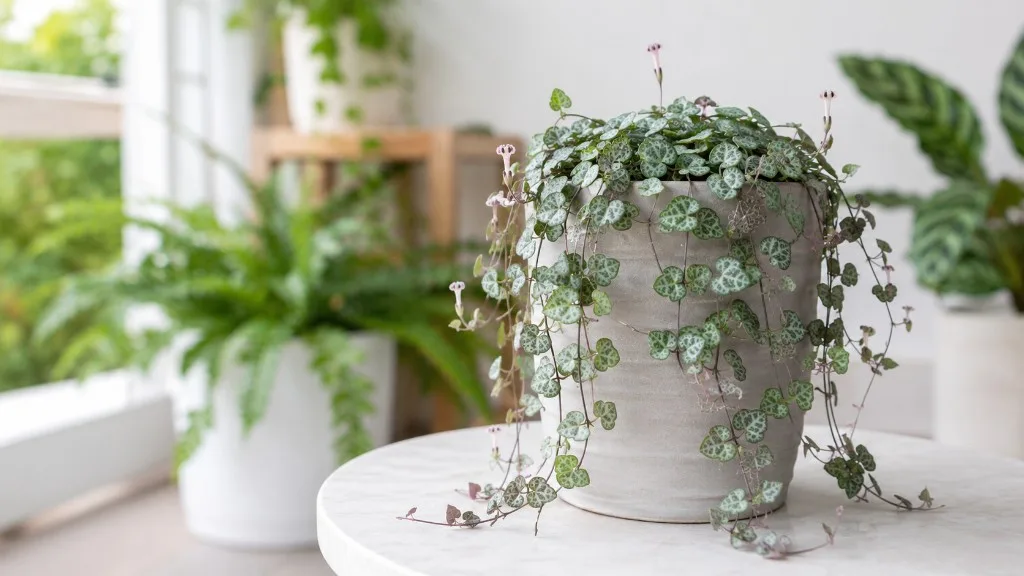
String of Hearts (Ceropegia woodii) is one of those houseplants that punishes eager caretakers. Give it a huge fresh pot, disturb every root hair, water heavily the same afternoon, and you will likely watch perfectly good vines stall for weeks while the root zone struggles to find its balance. Give it a slightly crowded home in fast-draining mix, repot only when a real trigger appears, and handle the wiry stems like glass - and the same plant rewards you with beaded vines, silver-marbled hearts, and aerial tubers that root on contact with soil.
Repotting is not a yearly chore for String of Hearts overview. It is a targeted intervention you perform when roots, soil structure, or plant stability demand it. The sections below walk through how Ceropegia woodii actually uses its root system, the signs that justify a move, the pot and mix choices that prevent the most common failures, a step-by-step transplant workflow, and the aftercare rhythm that separates a smooth recovery from a slow rot spiral.
Understanding String of Hearts Root Habit
Before you reach for a bigger pot, it helps to understand what String of Hearts is doing underground. Unlike many tropical foliage plants with deep, moisture-loving root mats, Ceropegia woodii carries a shallow, fine root network anchored to tuberous storage organs. The wiry pink stems you see trailing from a hanging basket emerge from these tubers, and along the stems themselves you will notice bead-like aerial tubercles - the structures that give Rosary Vine its nickname. Those tubercles are not decorative quirks. They are backup propagation points and water-storage nodes that root easily when they touch moist mix.
North Carolina State Extension notes that String of Hearts likes to be crowded and that repotting should be deferred until necessary. That single sentence explains more indoor failures than most care guides admit. A slightly root-bound container keeps the soil-to-root ratio tight enough that water moves through predictably rather than sitting in unused mix. When every millimeter of pot space is occupied by functioning roots, the plant dries on a rhythm you can learn. Upsize too early or too aggressively, and you introduce a wet dead zone the small root system cannot colonize fast enough - which is where rot usually starts.
Why Slight Root-Binding Helps Growth
Root-bound does not mean strangled. There is a useful middle ground where roots fill the pot comfortably, circle lightly at the edges, and still have access to oxygen between waterings. In that state, String of Hearts often produces its densest foliage and shortest internodes because the root zone and canopy are in balance. You are not fighting an empty pot that alternates between bone-dry surface mix and a soggy core.
The trouble begins when binding crosses from comfortable to restrictive. Roots that spiral densely against the pot wall, emerge from drainage holes, or dominate the soil volume leave almost no room for fresh mix to hold moisture evenly. At that point the plant may dry out within 24 to 36 hours of a thorough watering - not because you are underwatering on purpose, but because there is simply no soil left to retain water. That rapid dry-down is one of the clearest repot triggers, and it is easy to misread as a watering-schedule problem if you never inspect the root ball.
Another reason slight crowding helps: trailing succulents hate wet feet in unused space. Ceropegia woodii evolved in South African conditions where drainage is sharp and root zones stay compact. A pot that is proportionally too large behaves like a swamp around a seedling - except your seedling is a mature vine with storage tubers that expect dry recovery time between drinks.
Aerial Tubers and Underground Storage
The underground tubers are the plant’s primary reserve tank. They store water and carbohydrates that keep vines alive through inconsistent watering - which is why String of Hearts tolerates missed drinks better than many thin-leaved tropicals. The aerial tubercles along the stems serve a parallel function: they can root and establish a new plant if a stem segment contacts soil, and they add redundancy when the main root zone is stressed.
During repotting, tuber handling matters more than most guides suggest. Underground tubers should return to the same depth they occupied before - buried enough to anchor the plant but not sunk so deep that moisture lingers around them. Aerial tubers should stay at or slightly above the soil line, barely covered or left exposed. Burying them invites the same rot that kills stem cuttings planted too deep. If your plant has developed a cascade of aerial tubers along hanging vines, that is normal. You do not need to pack soil around every bead during a repot. Focus on stabilizing the main root mass and let aerial structures continue doing their job above the surface.
Signs It Is Time to Repot
The hardest part of String of Hearts repotting is knowing when to act. Calendar repotting - doing it every spring because the date arrived - creates more problems than it solves for a species that prefers stability. Instead, watch for compound signals that the root zone or soil structure is limiting the plant.
Clear Triggers You Should Not Ignore
Several triggers, alone or together, justify repotting:
- Roots circling the pot bottom or emerging from drainage holes. A few visible tips are not an emergency, but dense circling with minimal soil visible at the root ball edge means the plant has outgrown its container volume.
- Water runs straight through without absorbing. If you water thoroughly and the mix channels instantly out the bottom while the root ball feels dry minutes later, the soil structure may be gone or roots have displaced it.
- Extremely fast dry-down. When a plant that used to need watering every 10 to 14 days suddenly needs attention every two or three days despite unchanged light and temperature, inspect the roots. Severe root-binding exhausts available soil moisture quickly.
- Soil older than two to three years with visible compaction. Bark-heavy and peat-based mixes break down over time. Compacted mix holds less air, drains unevenly, and encourages anaerobic pockets after watering.
- Growth stall despite good light and appropriate feeding. If vines stop lengthening, new leaves arrive smaller than older ones, and spacing between hearts widens while care has not changed, a root-zone constraint is a reasonable suspect - after you rule out low light first.
- Instability in the pot. A top-heavy trailing plant that wobbles or lifts partly out of its container needs a slightly larger anchor pot even if roots are not yet escaping.
One trigger that overrides season: active root rot on String of Hearts. Soft, dark, mushy roots and a sour smell from the mix mean you should repot immediately into fresh, dry gritty mix, trim damaged tissue, and adjust watering - even in winter. Rot is an emergency; crowding is a schedule.
Situations Where Waiting Is Smarter
Equally important is knowing when not to repot. If the plant is actively pushing new vine tips, the current pot still has reasonable soil volume, and String of Hearts watering guide is steady, leave it alone - even if you have owned it for two years and feel you “should” refresh the mix. String of Hearts often thrives in the same container for two to three years without complaint.
Wait if:
- The plant is in winter slow-growth mode and none of the urgent triggers above are present. Cooler temperatures and shorter days mean roots repair slowly. A non-urgent repot can wait until spring.
- You just brought it home from a nursery. Give it two to four weeks to acclimate to your light and humidity before repotting - unless roots are already bursting from the pot or the nursery mix is clearly waterlogged and sour.
- The plant is recovering from pest treatment, sunburn, or recent overwatering stress. Repotting adds another layer of shock. Stabilize the canopy first, then address the pot.
- You are repotting only because a leaf yellowed once. Yellow leaves have many causes. A single lower leaf senescing on an otherwise healthy vine is not a repot signal.
If you are on the fence, slide the root ball out of the pot and look. More roots than soil around the perimeter means go ahead. Plenty of mix visible and white firm roots with no circling at the drainage layer means wait.
Best Season for Repotting
Timing matters because repotting is root surgery, however gentle. Ceropegia woodii repairs damaged root tips and colonizes fresh mix fastest when temperatures are warm, days are lengthening, and the plant is entering active growth.
Spring and Early Summer Timing
Late spring through early summer is the safest window for elective repotting in most homes. Soil temperatures in the pot rise, new vine growth accelerates, and roots have months of favorable conditions ahead before autumn slowdown. If you live in the Northern Hemisphere, think March through June as your primary zone - adjusted for your local climate and indoor heating patterns.
Early summer repotting is still reasonable if you missed spring and the plant is clearly root-bound. Avoid the hottest weeks of midsummer only if your home lacks air conditioning and pots become heat sinks on sunny windowsills. Heat plus fresh wet mix plus disturbed roots can compound stress.
Winter repotting should be reserved for emergencies - root rot, a pot that physically cannot hold the plant, or a nursery situation so dire that waiting guarantees loss. In winter, roots grow slowly if at all. Transplant shock lingers longer, and the temptation to overwater a wilted-looking plant is higher when you are indoors more often. If winter repotting is unavoidable, keep the plant in String of Hearts light guide, hold off on fertilizer for at least a month, and water more conservatively than you would in spring. Expect recovery measured in weeks, not days.
Fall sits between those poles. If early autumn still shows active growth and your home stays warm, a repot is acceptable. Once you see clear slowdown and reduced watering demand, prefer top-dressing - scraping out the top inch of degraded mix and replacing it with fresh gritty soil - over a full transplant.
Pot, Soil, and Drainage Choices
The right container and mix do more work than careful vine handling. String of Hearts is not picky about aesthetics, but it is precise about drainage geometry and pot volume relative to roots.
Shallow Pots and the One-Size-Up Rule
Choose a pot that is only one size larger than the current container - roughly 1 to 2 inches (2.5 to 5 cm) wider in diameter, not a dramatic jump. A common failure is moving a 4-inch nursery pot into an 8-inch decorative bowl because it looks better on the shelf. That bowl will stay wet in the center long after the surface appears dry, and your trailing succulent will sulk.
Shallow, wide pots outperform deep narrow ones for this species. Think bulb pan or azalea-pot proportions rather than a standard tall nursery pot. The natural root mass spreads horizontally more than it dives deep. A shallow container keeps the water table closer to where roots actually are, which makes dry-down more predictable.
Drainage holes are non-negotiable. One hole is minimum; three or more is better for wider pots. Terracotta and unglazed ceramic help moisture escape through the walls and are excellent choices if you tend to water generously. Plastic and glazed ceramic work fine if you adjust watering downward and verify saucers are emptied after every drink. Do not add a gravel layer at the bottom believing it substitutes for drainage holes - it does not change how water behaves in saturated mix above it.
If the plant hangs in a basket, you can repot into a lightweight plastic inner pot that fits the basket liner, which makes future inspections easier without disturbing the display arrangement.
Gritty Mix Recipes That Work Indoors
String of Hearts wants fast-draining, airy mix similar to what you would use for succulents or cacti - not rich, water-retentive peat compost on its own. The goal is a medium that drains in seconds at the bottom of the pot while holding just enough moisture near fine roots for a few days.
Three reliable indoor recipes:
- Equal blend: 50% quality potting mix + 50% drainage amendment (perlite, pumice, or coarse horticultural sand).
- Succulent base: 2 parts cactus or succulent potting mix + 1 part perlite or pumice + 1 part orchid bark.
- Bark-forward: 1 part houseplant potting mix + 1 part orchid bark + 1 part perlite.
Orchid bark creates macropores that resist compaction over time - valuable in a plant you may not repot again for years. Perlite and pumice add air space. The cactus or succulent base ensures the overall blend does not stay wet for days after a thorough watering.
Avoid garden soil, heavy compost, moisture-control crystals, and dense peat formulas marketed for “tropical foliage.” They suffocate fine Ceropegia roots. If you reuse mix components, sterilize or buy fresh for repotting - old mix may harbor fungus gnat larvae or root-rot pathogens, especially if the previous plant struggled.
Repotting String of Hearts Step by Step
When triggers and season align, gather materials and work methodically. Rushing this transplant is how vines snap and tubers end up buried too deep.
What you need: new shallow pot one size up, fresh gritty mix, sterilized scissors or pruning snips, a hand trowel, optional chopstick for settling mix, and a clean work surface where you can lay trailing stems without tangling them.
Prep timeline: Water lightly one to two days before repotting - not the morning of. A slightly hydrated root ball holds together, but soggy mix smears and tears fine roots. If the plant is in very dry mix, a light pre-water is still better than wrestling a brittle root mass.
Unpotting Without Breaking Delicate Vines
String of Hearts stems are wiry and deceptively fragile. They snap when pulled, not when supported.
- Clear space on a table and gently lift or lower the hanging pot so vines can rest on the surface without tension.
- Tip the pot on its side, supporting the root ball with one hand.
- Squeeze or tap flexible nursery pots to loosen. For rigid pots, run a chopstick around the inner edge before sliding the plant out.
- Never yank from the stems. If the plant resists, loosen the pot edge and try again. Patience beats broken vines.
- Once free, brush away loose surface mix with your fingers. Do not power-wash or bare-root unless rot forces you to - stripping every particle of old soil damages fine absorbing roots.
If vines tangle during the process, untangle before lifting rather than after. A few snapped stems are not fatal - they can become propagation cuttings - but losing half the display cascade turns a routine repot into a pruning project you did not plan.
Root Inspection and Tuber Placement Depth
With the root ball exposed, inspect systematically:
- Healthy roots are white to tan, firm, and flexible.
- Unhealthy roots are black, brown, mushy, or hollow. Trim them with clean scissors until you reach solid tissue.
- Circling roots at the bottom and sides can be gently teased outward with your fingers. You do not need to destroy the entire root ball - loosen the outer layer so roots grow outward into fresh mix rather than continuing the spiral.
Place a small mound of fresh mix in the new pot and set the plant so the primary tubers sit at the same depth as before - typically with the crown just below the rim and enough room for a light top-water without overflow. Fill around the sides in stages, tapping the pot or using a chopstick to settle mix into gaps without compacting it into concrete.
Position aerial tubers at or above the soil line. If beads along stems rest on the surface, that is ideal. Do not mound mix over trailing vines to “tidy” the pot - buried nodes rot.
Water lightly after repotting - just enough to settle the mix around roots. Then wait five to seven days before the first thorough watering. That pause lets microscopic root tears callus and reduces rot risk in the fresh medium. Keep the plant in bright indirect light, out of direct sun that can desiccate stressed leaves.
Post-Repot Aftercare and Recovery
The repot is only half the job. The two to six weeks after transplant determine whether the plant resumes trailing or sits stalled while roots quietly fail.
Water, Light, and Fertilizer Pause
Watering: For the first week, the mix should stay barely moist near the root ball, not saturated. After the pause, resume your normal check-the-mix-first rhythm - typically allowing the top inch or two to dry before watering thoroughly until runoff exits the drainage holes. Empty the saucer. In the first month, err slightly dry rather than wet. Disturbed roots absorb less water; excess moisture is the primary post-repot killer.
Light: Bright indirect light is ideal. Avoid south-facing direct sun on a freshly repotted plant. If you must move the plant for access during repotting, return it to roughly the same light level - drastic upgrades or downgrades compound shock.
Fertilizer: Hold all feeding for at least four weeks, and six is safer if growth is slow. Fresh mix usually contains enough residual nutrients for a light feeder, and fertilizer salts on healing roots cause burn. Resume half-strength balanced liquid feed only when you see new vine tips forming at a normal pace.
Humidity: Average household humidity is fine. Misting does not help roots and can encourage fungal spotting on leaves in stagnant air.
What normal shock looks like: Mild wilting for a few days, a brief pause in new growth, or one or two older leaves yellowing and dropping. That usually clears within one to two weeks in spring. Full root re-establishment takes four to six weeks before the plant is back to its pre-repot growth rate.
Red flags: Sustained wilting beyond two weeks, multiple leaves yellowing from the base up, stems turning soft, or mix that stays wet while the plant looks thirsty. Those patterns suggest rot, a pot still too large, or buried tubers - inspect immediately, trim affected roots, and repot into drier mix if needed.
While the plant recovers, check for mealybugs and scale along stem joints and tuber nodes. Repotting is the best time to spot pests hiding under leaves against the soil line. Wipe with alcohol on a cotton swab or rinse with insecticidal soap if you find colonies, and quarantine from other plants until clean.
Common Repotting Mistakes
Even experienced growers slip on the same few points with Ceropegia woodii. The mistakes are predictable; so are the fixes.
Mistake: repotting on a calendar instead of on triggers. Fix: inspect roots annually, but move the plant only when binding, soil breakdown, or instability demands it.
Mistake: bare-rooting and aggressively shaking off all old soil. Fix: keep a soil buffer around fine roots unless rot requires full cleaning.
Mistake: fertilizing or heavy watering immediately after transplant. Fix: pause both. Let roots heal in slightly dry, bright conditions.
Mistake: repotting during peak winter dormancy for convenience. Fix: wait for spring unless rot forces your hand.
Mistake: choosing a tall deep pot for aesthetic reasons. Fix: switch to shallow wide geometry matched to horizontal root spread.
Oversized Pots and Burying Tubers Too Deep
The two mistakes that cause the most rot are related: too much empty soil and tubers sitting in wet mix too far from the surface.
An oversized pot holds moisture the root system cannot use quickly. The center stays damp while you think the plant is dry because the surface looks pale. Roots in the saturated zone lose oxygen, pathogens activate, and stems above look wilted - which prompts more watering. If your String of Hearts stalls for weeks after repotting and mix stays cold and wet deep in the pot, undersize at the next intervention. Trim any mushy roots, move to a appropriately small container with fresh gritty mix, and dry out slightly.
Burying aerial tubers or sinking primary tubers deeper than they grew before has the same effect on a smaller scale. Tubers are storage organs, not anchors meant for constant moisture. Keep them high, stable, and visible when possible. If you want fuller soil coverage for aesthetics, mound only around the sides, not over the crown or beads.
Short, stubby new growth after repotting often means the plant is recovering from one of these errors - or from a light drop. Once roots re-establish in correctly sized, dry-draining mix, internodes usually lengthen again.
Conclusion
String of Hearts repotting is less about upgrading décor and more about restoring balance between a shallow root system, fast-draining mix, and a container that respects how Ceropegia woodii actually grows. The plant tolerates - and often prefers - being slightly root-bound, so your default should be patience. Repot when roots circle drainage holes, mix collapses, dry-down becomes extreme, or stability fails, and do the work in spring or early summer when roots can heal quickly.
Choose a shallow pot one size up, fill it with gritty succulent-style mix, unpot by supporting the root ball rather than pulling vines, keep tubers at or near the surface, water lightly and then wait, and hold fertilizer for at least a month. Mild shock for a week or two is normal; rot from an oversized wet pot is not. Inspect roots before you act, handle stems gently, and treat repotting as a precise repair - not a seasonal ritual - and your Rosary Vine will keep trailing hearts on schedule.
When to use this page vs other String of Hearts guides
- String of Hearts overview - Start here for whole-plant context before deep-diving this topic.
- String of Hearts problems hub - Jump to symptom-specific fix guides when this care topic does not resolve the issue.
- Repotting Stress on String of Hearts - Escalate here when repotting adjustments are not enough.
- Root Rot on String of Hearts - Escalate here when repotting adjustments are not enough.
Related String of Hearts guides
- String of Hearts overview
- String of Hearts watering
- String of Hearts light
- String of Hearts soil
- String of Hearts propagation
- String of Hearts fertilizer
- Repotting Stress on String of Hearts
- Root Rot on String of Hearts
- String of Hearts problems
Related tool
Try the Pot Size Calculator with string-of-hearts pre-selected to estimate needs for your setup.