Rust Disease on String of Hearts: Causes, Checks & Fixes
Quick answer
Suspect rust when you lift a trailing strand and orange, yellow, or brown powder rubs off heart undersides onto white tissue-often with pale yellow spots on the leaf face above. White or gray dust on upper leaf surfaces instead points to powdery mildew, not rust. First step: isolate the basket and snip heavily spotted leaves before you mist, repot, or spray.
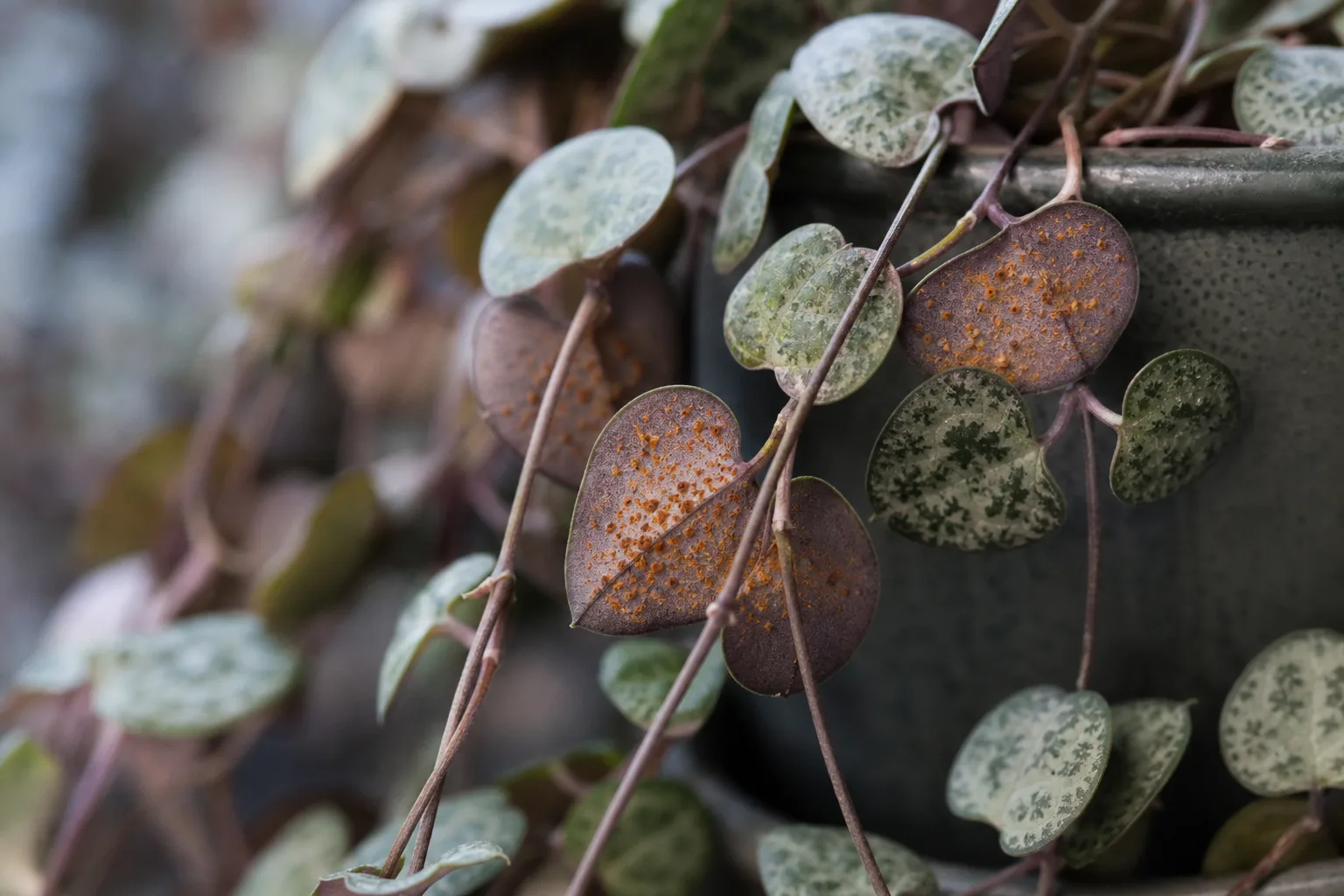
Rust Disease on String of Hearts: Causes, Checks & Fixes
This guide covers rust disease on String of Hearts. See also the general Rust Disease guide, watering, and light pages for this plant.
Rust Disease on String of Hearts: Causes, Checks & Fixes
Quick answer
Use this page when orange, yellow, or brown powder rubs off heart undersides onto white tissue after you lift and separate trailing strands. That rub-off pattern on the lower leaf face-often with pale yellow spots directly above on the upper surface-is the hallmark of rust on String of Hearts (Ceropegia woodii).
White or gray dusty patches on upper leaf faces without orange underside pustules point to powdery mildew on String of Hearts instead. Waxy cotton at stem nodes suggests mealybugs. Route to those guides before you treat for rust.
First step: isolate the basket and snip off heavily spotted leaves and stem sections before you change watering, repot, or spray anything. On this trailing semi-succulent, removing infected tissue and separating the basket from neighbors stops spore spread faster than fungicide alone-and avoids soaking tuberous roots while you treat foliage.
What rust disease looks like on String of Hearts
Rust fungi produce raised pustules of powdery spores on leaf undersides, often in orange, yellow, or brown colors. On String of Hearts the signs are easy to miss until the trailing mass is opened up:
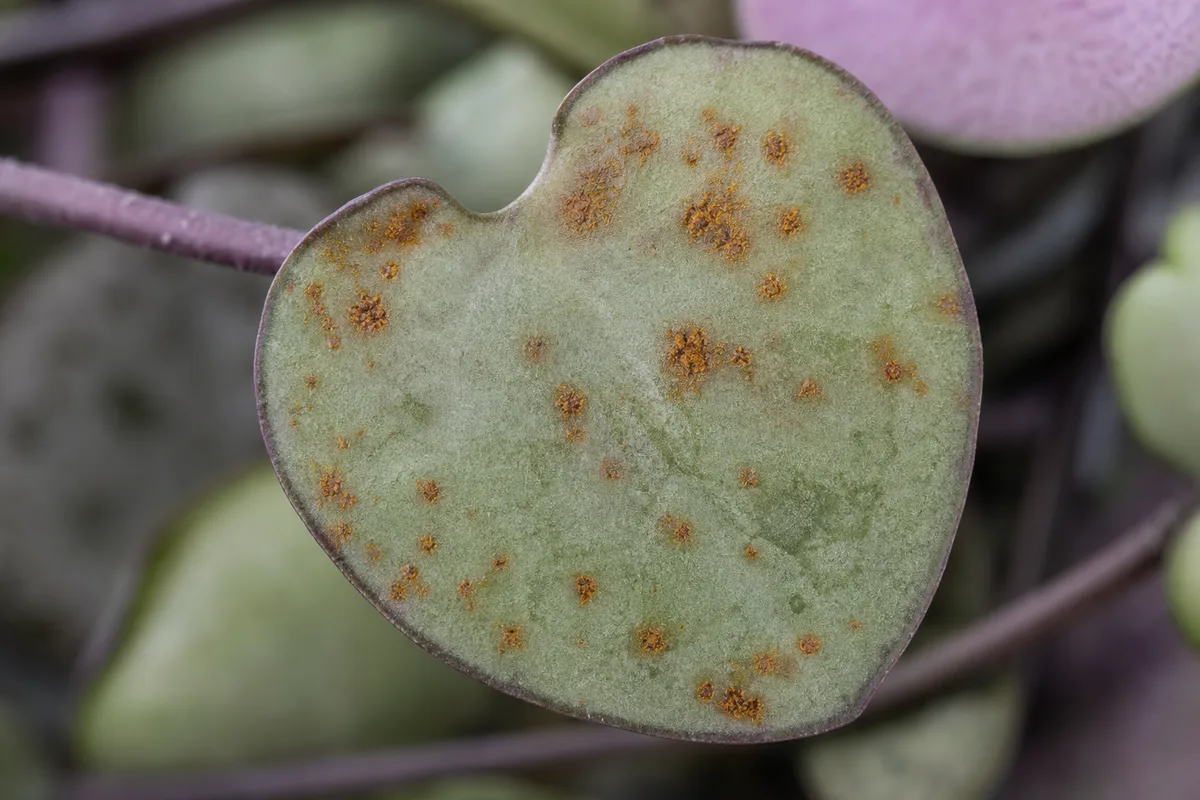
Rust Disease symptoms on String of Hearts - compare with healthy tissue on the same plant.
- Orange, yellow, or rust-brown powder on the underside of heart-shaped leaves, sometimes extending onto the slender pink stem between leaf pairs
- Pale yellow or chlorotic spots on the upper leaf surface directly above pustules-the classic rust pairing of upper-surface chlorosis with lower-surface spore masses
- Rub-off spore powder on a white tissue when you gently wipe an infected underside-spores appear as colorful powder on hands or tissue
- Ringed or clustered pustules along veins on small leaves; several spots may merge as infection spreads along a strand
- Premature leaf drop on heavily infected hearts; severe rust can cause defoliation and reduced vigor
- No sticky honeydew, webbing, or waxy cotton at nodes-those point to sap feeders, not rust
String of Hearts leaves are small-about an inch long-so even a few pustules can cover much of one heart’s underside. Because strands drape and cross in hanging baskets, the inner layer of the curtain often shows rust first while sun-facing outer hearts stay clean on top. Lift and separate vines during inspection instead of only glancing at the top layer.
Compare strand tips with older sections. Rust pustules on lower, shaded hearts inside a dense tangle while outer growth stays clean strongly suggests trapped humidity and poor airflow rather than a whole-plant watering failure.
Recovery case: bathroom misting on a dense hanging basket
A common indoor pattern: a full String of Hearts curtain hung above a shower or misted twice weekly develops orange powder only on inner heart undersides where strands overlap-the outer cascade looks fine from across the room. After isolation, removal of every spotted inner leaf, spacing baskets four inches apart, and stopping all leaf misting, clean new hearts often appear at strand tips within two to three weeks. Old spotted tissue does not re-green; success is measured by pustule-free new growth, not by fading marks on pruned areas.
Why String of Hearts gets rust disease
Ceropegia woodii is a drought-tolerant semi-succulent with tuberous roots that store water and normally prefers bright indirect light with some morning sun in fast-draining mix. That profile does not make it immune to rust. Rust fungi are obligate parasites that need living plant tissue and spread when spores land on wet foliage and germinate-a process that can start with a short period of leaf wetness from dew, mist, or splash.
String of Hearts adds plant-specific risk:
- Trailing overlap. Dozens of wiry stems cross in a hanging basket, trapping humid air against small leaf undersides the way a dense shrub canopy would outdoors.
- Misting and overhead watering. Wet foliage that dries slowly-especially on inner hearts-gives rust spores the surface moisture they need to infect. NC State notes overwatering causes rot and yellowing, but chronic leaf wetness from misting favors rust even when roots are correctly dry.
- Weak or distant light. Large gaps between hearts and pale washed-out leaves mean the vine is stretching per our light guide; inner shaded leaves inside the mat stay damp longer and are first targets for spore landing.
- Crowded plant shelves. Multiple hanging baskets touching or sharing a humid corner let windborne spores spread between plants on neighboring Ceropegia strands.
- Stressed vines. Plants recovering from repotting, root issues, or prolonged underwatering have less reserve to outgrow infection once pustules establish.
Rust is less common on String of Hearts than on fuchsias, pelargoniums, or hollyhocks-groups with well-documented rust species-but it appears when culture turns the trailing mass into a cool, shaded, humid pocket with wet leaf surfaces. Winter bathroom humidity can raise pressure; summer air-conditioning dryness often lowers it if you are not misting.
How to confirm the cause
Work through these checks before buying fungicides or repotting:
- Underside rub test - Orange or brown powder transfers to a white tissue from the leaf underside; upper surface may show matching yellow chlorosis above the spot. If dust rubs off from the top of the leaf only, switch to the powdery mildew guide.
- Location pattern - Pustules on inner, shaded heart undersides inside the trailing mass point to rust; uniform crispy scorch on sun-facing outer leaves without powder underneath suggests sunburn.
- Hand lens or bright phone light - Raised blister-like pustules on the underside support rust; mealybugs show distinct cottony bodies with legs at stem joints.
- Humidity context - Recent misting, bathroom placement, humid weather, or several crowded baskets match rust timing; bone-dry mix and firm tubers without underside powder suggest another issue.
- Spread check - Matching orange pustules on plants sharing a shelf or pruned with the same unsanitized shears increases suspicion.
- Powdery mildew cross-check - Powdery mildew forms white or gray dust primarily on upper leaf surfaces and germinates without free water on the leaf; String of Hearts with orange powder strictly on undersides fits rust better.
If spore powder rubs off from leaf undersides and inner leaves show pustules while mealybug nodes stay clean, treat as rust even before lab confirmation.
First fix for String of Hearts
Move the basket away from other plants, then cut off leaves and stem sections with heavy pustule coverage using clean, sharp scissors. Bag trimmings and discard them in household trash-not indoor compost where spores can spread.
This is the right opening move because:
- Spores travel on air currents and splashing water between overlapping hanging baskets; isolation limits new infections on neighbors.
- Removing spotted tissue drops the spore load before you adjust culture or spray.
- You avoid soaking the pot on day one-important for a plant whose roots rot easily in soggy mix.
Sanitize scissors with rubbing alcohol before moving to another plant. Do not repot, fertilize, or drench the root zone until you have finished pruning and the vine has had a few days to dry in quarantine.
Step-by-step recovery
Once isolation and pruning are done, follow this sequence based on severity:
Light spotting on a few inner leaves
- Finish removing every visible pustule-covered leaf and any stem section more than half affected.
- Improve airflow - Separate hanging baskets by several inches; run a fan on low nearby if the room is still.
- Move to brighter indirect light with some morning sun so outer and inner leaves dry faster; avoid jumping straight into harsh midday window sun on a stressed vine.
- Water at soil level when mix is mostly dry per our watering guide; do not mist foliage or splash leaves when watering.
- Monitor weekly. If new hearts emerge clean for two weeks, cultural fixes may be enough.
Moderate spread across multiple strands
- Complete the pruning pass, working from soil line to strand tips; thin inner crossings that block air inside the curtain. Do not remove more than one-third of leaves at once unless infection is severe on each strand.
- Hold fertilizer until new growth stays pustule-free for two weeks-lush nitrogen-driven shoots are easier for rust to colonize on stressed vines.
- If pustules return on new leaves after cultural cleanup, apply a houseplant-safe fungicide labeled for rust or ornamental foliage per label directions. Fungicides protect healthy tissue but do not cure existing infections-so pruning must come first.
- Repeat sprays on the label interval for the remainder of the growing season as new hearts expand.
- End quarantine only after two consecutive weekly inspections show no new pustules.
Heavy infection or repeated failure
If most hearts are spotted, growth is stunted, and clean new tips fail after two treatment cycles:
- Cut back to short sections of stem with clean, unspotted tissue near tubers or the soil line.
- Consider propagating from healthy aerial tubers or unspotted cuttings on a separate pot rather than nursing a fully infected basket through another humid season. Sanitize tools and quarantine new pots two weeks-spores can hitchhike on cuttings from partially infected parents.
- Discard severely infected plant material rather than composting it indoors.
Do not stack heavy pruning, repotting, and strong fungicide sprays on the same day-complete removal and isolation first, then let the plant stabilize before the next stressor.
When cultural control is not enough: fungicide options
If clean new hearts still pick up pustules two weeks after pruning and airflow fixes, UMN Extension notes fungicides are rarely needed in home gardens but can protect high-value plants with repeated infection. On String of Hearts, choose products labeled for rust or ornamental foliage and apply only to healthy green tissue after infected leaves are removed:
- Copper-based sprays (e.g., fixed copper formulations) act as broad-spectrum protectant fungicides on leaf surfaces; follow label rates and avoid applying to wet foliage on cool days when phytotoxicity risk rises.
- Sulfur dust or spray prevents spore germination on contact; do not use when temperatures exceed about 90°F (32°C) or within two weeks of oil-based sprays-sulfur can burn tender succulent leaves.
- Neem oil is listed by UC IPM as a preventive option at first signs of rust on some ornamentals; test on one strand first because semi-succulent hearts can show spray burn in strong sun.
Spray in the morning so leaves dry before evening. Tilt the basket so runoff does not pool on soil and saturate tuberous roots. String of Hearts is non-toxic to cats and dogs, but keep pets away from freshly sprayed vines until sprays dry completely.
Recovery timeline
Rust recovery on String of Hearts is measured in weeks of clean new growth, not hours. Unlike underwatering-which can plump leaves within a day once watered-fungal pustules clear only as uninfected tissue replaces old hearts.
What to expect:
- Days 1–3: Pruned areas look bare; remaining pustules may look unchanged until spore spread stops.
- Week 1–2: New hearts at strand tips should emerge without orange powder if airflow and light improved; old spotted leaves will not turn green again.
- Week 3–4: With repeat sprays when needed, rust should stop appearing on fresh growth; trailing length rebuilds slowly because Ceropegia woodii is not a fast vine.
- Week 6+: Two clean weekly inspections justify returning the basket to the main collection.
Signs treatment is working: no new pustules on emerging hearts, firm leaf texture, normal silver marbling on new growth, stable tubers at nodes.
Signs rust is winning: powder spreading to every new flush despite pruning and sprays, widespread leaf drop from soil line upward, or matching pustules on quarantined neighbors.
Lookalike symptoms
Several problems mimic rust on String of Hearts. Use the rub test and location on the leaf to route quickly:
| What you see | Likely cause | How to tell apart | First treatment step |
|---|---|---|---|
| Orange powder on leaf undersides, rubs off | Rust disease | No insects; pustules on underside; yellow upper spots above | Isolate; prune spotted leaves; improve airflow |
| White dust on leaf faces, rubs off | Powdery mildew | Upper-surface coating; no orange pustules underneath | Isolate; improve airflow; see mildew guide |
| White cotton at stem joints | Mealybugs | Waxy clusters at nodes; honeydew; alcohol dab exposes pests | Isolate; dab or rinse pests at nodes |
| Hard brown bumps on stems | Scale insects | Does not wipe away; no uniform leaf powder | Isolate; scrape or treat labeled for scale |
| Fine webbing with speckled leaves | Spider mites | Webbing at tips; mites move when shaken over paper | Isolate; rinse undersides; increase humidity away from heat |
| Brown crispy patches on sun-facing outer leaves | Sun scorch | No powder on underside; follows sudden bright exposure | Move to filtered light; do not prune healthy tissue |
| Tiny translucent bumps on leaf edges | Edema | No spore powder; linked to overwatering and cool nights | Dry soil longer; fix drainage |
Getting the diagnosis right matters because mealybugs and rust both warrant isolation, but rust needs dry foliage and pustule removal while mealybugs need contact insect removal at nodes.
Mistakes to avoid
- Misting infected leaves. Extra moisture on foliage feeds rust spore germination; String of Hearts does not need leaf misting for normal indoor humidity.
- Treating only the top layer. Rust hides on undersides of inner hearts; lift the trailing mass fully before deciding the plant is clean.
- One-and-done spraying. A single fungicide pass misses spores on newly expanded hearts; plan for multiple cycles on label intervals.
- Soaking the pot while treating. Overwatering rots tuberous roots; rinse or spray foliage without leaving mix saturated for days-see root rot if tubers soften.
- Repotting on day one. Surface rust often clears with pruning and airflow alone; repot only if mix is sour or roots are mushy.
- Returning the plant too early. Two weeks pustule-free is a safer quarantine minimum than a single clean day after treatment.
- Composting infected trimmings indoors. Spores can spread from compost bins in the same room as your collection.
- Letting fungicide runoff saturate mix. Semi-succulent tubers can rot if repeated sprays drain into soggy soil-water at soil level only when the mix has dried per our watering guide.
String of Hearts care cross-check
While you treat rust, keep baseline care steady-large swings stress a vine that is already losing photosynthetic leaf area. For full culture detail, see the String of Hearts overview.
- Light: Bright indirect light with some morning sun supports recovery and helps inner leaves dry faster. Weak light slows the clean new growth that tells you treatment worked.
- Water: Water when mix is mostly or completely dry; tubers store moisture and rot in soggy soil.
- Soil: Fast-draining cactus-style mix with sharp drainage-matching NC State’s well-drained sandy potting recommendation.
- Humidity: Low to moderate room humidity (about 30–50%) is normal for this plant; raise airflow instead of misting if the room feels stale.
- Fertilizer: Hold feeding until rust is controlled and new hearts look normal.
String of Hearts is non-toxic to cats and dogs, but keep pets away from freshly sprayed vines until sprays dry.
How to prevent rust disease next time
- Skip leaf misting entirely on String of Hearts; water at soil level when mix dries per our watering guide.
- Space hanging baskets so trailing strands from adjacent pots do not touch and form a continuous humid layer.
- Inspect leaf undersides weekly by lifting the curtain of vines instead of only viewing the top layer.
- Maintain bright placement-leggy gaps between hearts signal light stress and shaded inner tissue that stays damp longer; see our light guide.
- Quarantine new plants two weeks before hanging them beside established baskets.
- Sanitize pruners between plants when trimming strands or harvesting tuber cuttings.
- Follow UMN Extension guidance on spacing plants for air movement, avoiding overhead irrigation, and removing infected material at first sign.
Prevention on this species is mostly about microclimate inside the trailing mass. The decorative overlap that makes String of Hearts beautiful is the same structure that traps stale air until you deliberately open it up.
When to worry
Treat as urgent when:
- Orange pustules spread to new strands daily despite isolation and pruning
- Most hearts on multiple vines show rust and new growth fails to emerge clean
- Neighboring plants on the same shelf develop matching pustules within a week
- Strands yellow and die back from several nodes at once after heavy infection
Salvage or discard?
| Situation | Best path |
|---|---|
| A few inner hearts spotted; firm tubers; clean strand tips after prune | Keep basket in quarantine; cultural fixes often enough |
| Moderate spread; some clean stem sections and aerial tubers remain | Prune to clean tissue; consider fungicide on label if new hearts reinfect |
| Most hearts spotted; repeated six-week treatment cycles fail | Propagate from clean aerial tubers on a separate pot; discard infected curtain |
| Tuber base softens; widespread collapse from soil line | Treat as root rot risk; salvage only firm upper vine and tubers |
Propagation from a clean aerial tuber on a separate pot is often less work than saving a fully infected curtain-especially before another humid winter bathroom season.
Related String of Hearts guides
- String of Hearts overview
- String of Hearts watering
- String of Hearts light
- Powdery Mildew on String of Hearts
- Mealybugs on String of Hearts
- Root Rot on String of Hearts
- String of Hearts propagation
- All String of Hearts problems
What to do next
Use this page when orange powder rubs off heart undersides inside a trailing curtain. If symptoms match a sibling problem instead, open the linked guide before stacking fungicide, repotting, or heavy pruning. When most of the basket is infected but firm aerial tubers remain, start a quarantine propagation pot rather than nursing spore-loaded foliage through another season.