Whiteflies on String of Hearts: Causes, Checks & Fixes
Quick answer
Whiteflies on String of Hearts show as tiny white moth-like insects that burst from trailing vines when disturbed, plus flat pale nymphs on purple leaf undersides and sticky honeydew on hearts below. First step: isolate the hanging basket and rinse every strand thoroughly, undersides included, before applying any spray.
Whiteflies on String of Hearts: Causes, Checks & Fixes
This guide covers whiteflies on String of Hearts. See also the general Whiteflies guide, watering, and light pages for this plant.
Whiteflies on String of Hearts: Causes, Checks & Fixes
Quick answer
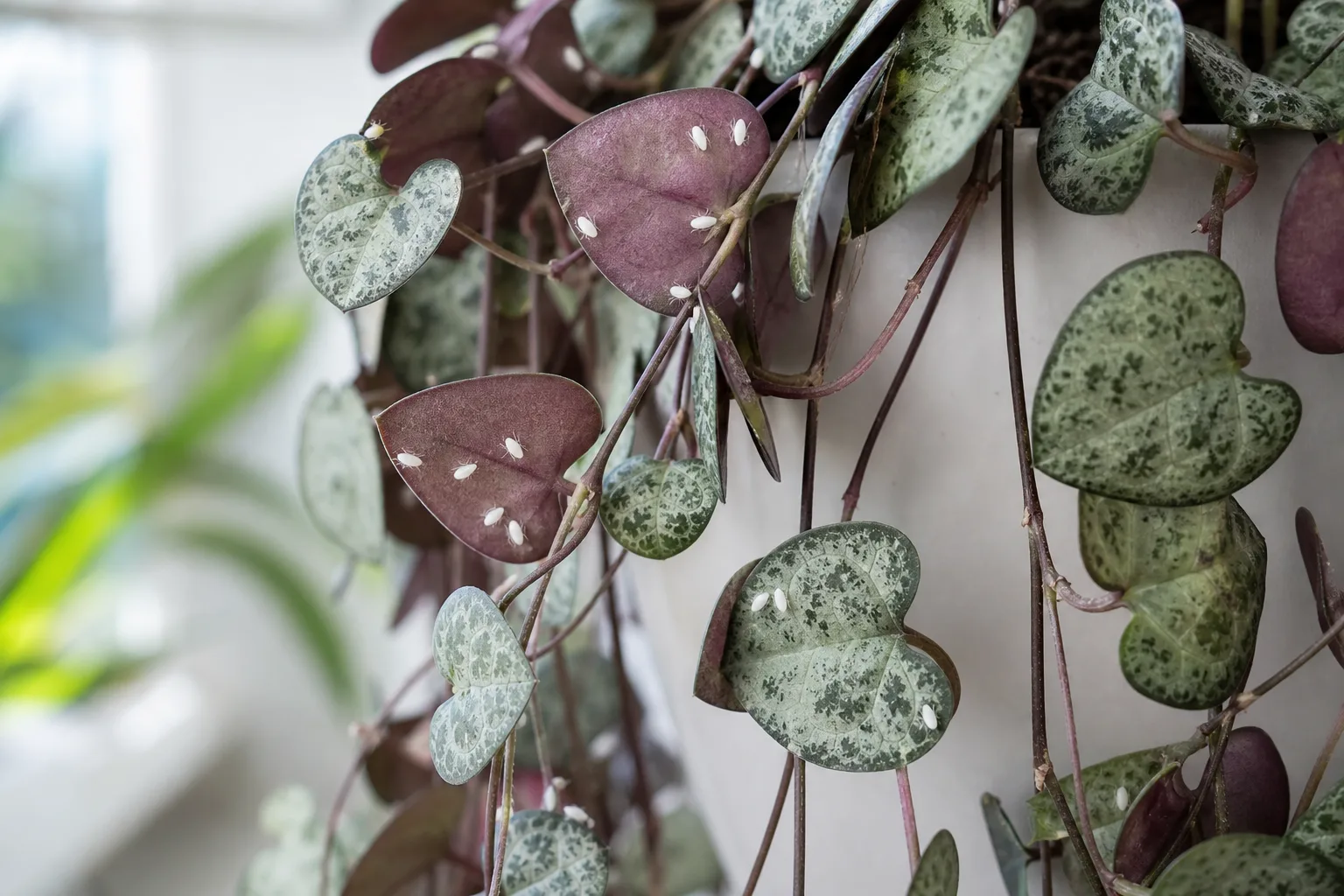
Whiteflies on String of Hearts (Ceropegia woodii) announce themselves when you water or brush the trailing mass and a small cloud of tiny white insects flies up from the vines. Adults look like powdery white moths about one-sixteenth of an inch long. Immature nymphs cling as flat, pale disks on the purple undersides of heart-shaped leaves, sucking sap and dripping sticky honeydew onto the hearts below.
First step: move the hanging basket away from neighbors and rinse every trailing strand with a forceful stream of lukewarm water, targeting leaf undersides directly. Confirm live nymphs or flying adults before reaching for sprays. One rinse rarely clears an outbreak because eggs and nymphs survive in cycles-plan on repeated washing or labeled contact treatments while you keep the plant isolated.
What whiteflies look like on String of Hearts
String of Hearts carries opposite, heart-shaped leaves roughly an inch long-dark green with silver marbling on top and purple underneath-spaced along long pink wiry stems. Whiteflies exploit that purple underside surface: adults rest tent-like with wings held roof-like over their bodies, and nymphs look like immobile flat ovals glued near veins.
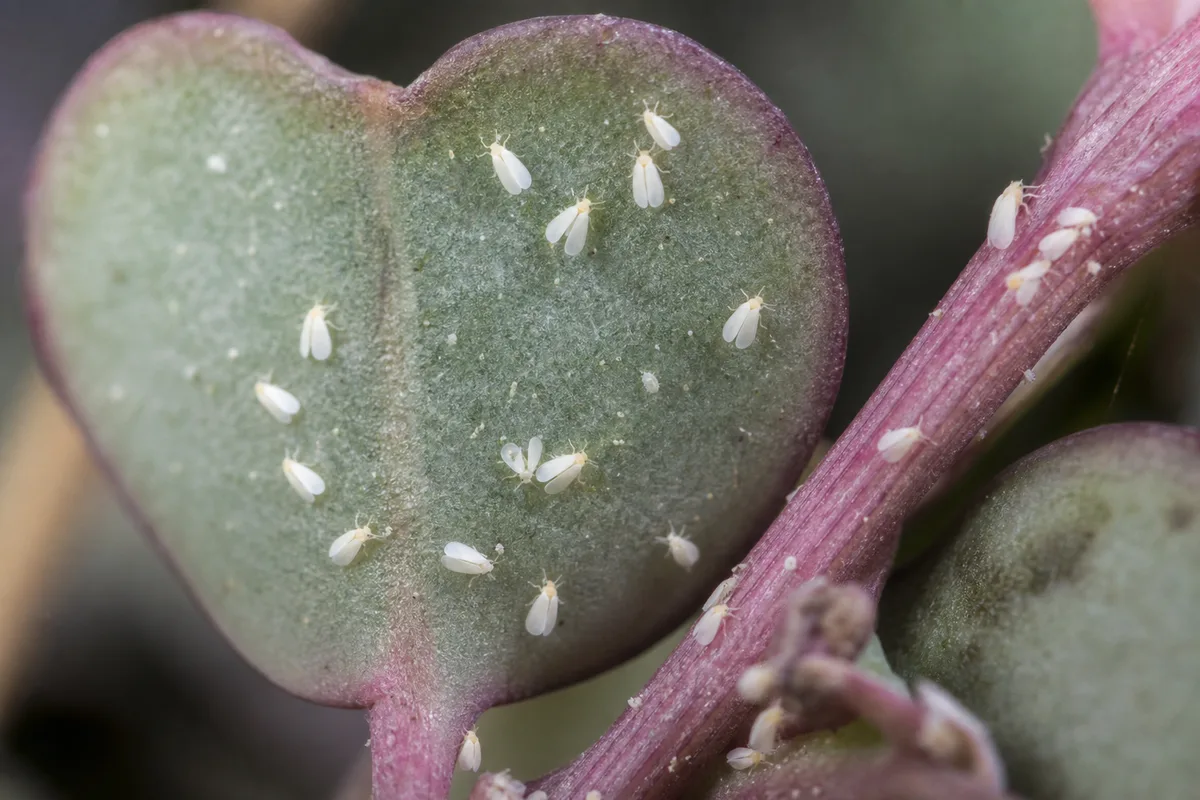
Whiteflies symptoms on String of Hearts - compare with healthy tissue on the same plant.
Because the plant trails in dense cascades from a hanging basket, the first sign is often behavioral, not visual. Tap the pot rim or mist a strand and watch the outer vines. If white specks lift off and flutter, you have adults. On a quiet day you may notice them only as pale dust that moves.
Other signs to watch for:
- Flat, pale or tan scabs on purple leaf backs-immobile nymphs and pupal cases, often in loose arcs near veins
- Sticky, shiny honeydew on leaves below infested strands; honeydew can support black sooty mold that coats marbled tissue
- Yellowing or dull hearts on strands with heavy feeding, especially soft new growth at tips
- Ant trails on basket hooks or pot rims-ants harvest honeydew and may protect whitefly colonies
- A faint white powder on leaf undersides from wax some species secrete
Whiteflies are not fungus gnats. Gnats hover at the soil surface and rarely colonize wiry trailing foliage. They are not mealybugs, which form white cottony clusters at nodes rather than flying clouds. Disturb the plant: whiteflies burst upward; mealybugs stay put.
Why String of Hearts gets whiteflies
Whiteflies are common indoor pests on many ornamentals. Greenhouse whitefly and silverleaf whitefly are the two species most often found on houseplants, and both look similar to the naked eye-small, white, and quick to fly when leaves move.
String of Hearts adds plant-specific risk. A mature hanging basket can carry hundreds of small leaves across overlapping strands. Each purple underside is a feeding site, and the dense tangle makes full coverage hard during treatment. Long wiry stems cross and recross in the hanger, so nymphs on inner strands stay hidden while outer vines still look clean.
Warm, stable indoor temperatures let whiteflies reproduce year-round. Unlike outdoor gardens, houseplant collections lack the parasitic wasps and predators that often keep whiteflies in check outside. A single infested nursery plant, unquarantined trade, or basket moved indoors from a summer patio can seed a collection within weeks.
Crowded displays accelerate spread. String of Hearts often shares a hook with pothos, hoya, or other trailing plants whose leaves touch. Whiteflies fly short distances and colonize neighboring soft-leaved plants. One infested basket on a crowded shelf can become a room-wide problem if nobody inspects undersides.
Stress does not cause whiteflies, but it makes damage show sooner. Ceropegia woodii grows more slowly than many vines once it fills a pot. When whiteflies drain sap from a plant also adjusting to a recent move, inconsistent drying of its fast-draining mix, or a heat draft, yellowing and sticky residue appear before you notice how large the population has grown.
Dusty, static indoor air near HVAC vents works against you on trailing plants that rarely get rinsed. Dust does not create whiteflies, but it blocks light on small hearts and makes routine inspection easy to skip-exactly where nymphs build unnoticed on purple backs.
How to confirm the cause
Work through these checks in order before you treat:
- Disturbance test - Tap the pot or gently shake an outer strand. A cloud of tiny white flying insects strongly confirms whiteflies. Static white dust that does not fly is something else.
- Underside inspection - Follow the longest trailing strands and flip hearts toward the light. Look for flat oval nymphs on purple leaf backs, especially near veins and on soft new tips. A 10× hand lens makes pale scabs and T-shaped pupal cases easier to see.
- Honeydew check - Feel lower leaves for stickiness or look for glossy residue and black sooty mold on marbled tissue. Honeydew points to sap feeders-whiteflies, aphids, or mealybugs-not underwatering alone.
- Pattern and placement - Whiteflies often cluster on the most sheltered inner strands and on growing tips where tissue is soft. Underwatering on String of Hearts produces pale, thin, flat hearts on limp strands with very dry, lightweight pot weight-not flying adults with tacky residue below.
- Neighbor scan - Inspect trailing and soft-leaved plants within reach on the same hook or shelf. Whiteflies rarely stay on one basket once adults are flying.
- Soil moisture check - Confirm the cactus-style mix is not waterlogged. Overwatering causes yellowing, soft tubers, and sour-smelling mix-not white insects and honeydew. String of Hearts should dry mostly or completely between deep waterings.
If you see flying adults plus nymphs on purple undersides, you have confirmed whiteflies-not spider mites, thrips, or a watering mistake.
First fix for String of Hearts
Move the hanging basket away from neighbors and rinse every trailing strand with a forceful stream of lukewarm water, targeting purple leaf undersides and growing tips.
Wrap the pot in plastic or a bag if you shower the plant in a sink so the fast-draining mix does not turn to mud. Lift strands with one hand and spray upward with the other so water hits leaf backs directly. Let foliage dry in String of Hearts light guide the same day; avoid leaving wet vines dripping in a dark corner overnight.
This single step knocks down flying adults and dislodges some nymphs before sprays. Do not apply oil or soap in the same session as a heavy rinse unless the product label allows it-you need confirmation that live nymphs remain after the wash.
Do not repot, prune heavily, or fertilize on day one. Ceropegia is already stressed; stacking interventions makes recovery harder. Do not solve pest pressure by overwatering the pot-that invites root rot on String of Hearts on tuberous roots while barely reaching nymphs glued to foliage.
Step-by-step recovery
After the initial isolation and rinse:
- Repeat rinses weekly while populations persist. Nymphs hatch on a cycle; one wash rarely clears an infestation completely.
- Add yellow sticky traps near the basket to monitor adult flight and catch some adults. Traps alone do not eliminate whiteflies, but they show whether numbers are falling between rinses.
- Apply insecticidal soap or horticultural oil labeled for whiteflies on ornamentals if rinses alone do not reduce new nymphs on fresh hearts within one week. Cover every leaf surface, especially purple undersides and strand intersections. Repeat at label intervals-typically every five to seven days-for at least three cycles to catch newly hatched crawlers before they settle.
- Prune only heavily coated or yellowed strands that no longer photosynthesize well. Bag and discard clippings; do not compost infested tissue near other houseplants.
- Treat or inspect neighboring hanging plants on the same hook. Whiteflies on one String of Hearts often mean early colonies elsewhere.
- Keep watering on the dry side of soggy while recovering. Water when the mix is mostly or completely dry; wet, stagnant roots plus damaged foliage invite secondary problems this succulent does not forgive easily.
If you use oils or soaps, avoid applying them during the brightest midday window on sun-stressed hearts. Morning or evening treatment is safer. Excellent underside coverage matters more than product choice-you must control the immatures on leaf undersides because nymphs do not walk to treated tissue.
Recovery timeline
Expect fewer flying adults within two to three days after a thorough rinse if the infestation is moderate. Yellowed or sticky hearts do not revert to glossy marbling; that damage is permanent on affected tissue. Judge progress on new leaves emerging without fresh nymphs along growing tips and tuber nodes.
A full soap or oil course often takes two to four weeks with label-interval repeats. Clean new growth for several weeks-not a single quiet day-means control is working. Slow Ceropegia may pause new hearts briefly after treatment; resume scouting once strands push growth again.
Clouds of adults that return within days, widespread yellowing on the newest hearts, or daily fresh honeydew mean escalation-treat the whole nearby collection and consider whether a severely infested plant should be discarded to protect others.
Lookalike symptoms to rule out
Fungus gnats are small dark flies that hover near wet soil, not white moths that burst from foliage. Their larvae live in moist organic mix-not on purple leaf backs.
Mealybugs show as white cottony masses at leaf nodes and in the dense tangle of strands. They do not fly in clouds when disturbed.
Aphids cluster on soft new tips as pinhead-sized green, black, or pink insects without powdery wings. They may produce honeydew but do not create white moth-like swarms.
Powdery mildew sits as flat white dust on leaf faces, not flying insects or flat nymphs on undersides.
Dust on trailing vines dulls marbling but wipes off with a damp cloth and shows no nymphs on a hand-lens check.
Underwatering produces pale, thin, flat hearts on limp trailing strands with a very lightweight, dry pot. The tissue looks dehydrated overall-not tacky with honeydew and flying white adults.
Mistakes to avoid
Do not stop after one rinse because adults “disappeared.” Nymphs glued to undersides keep feeding and maturing indoors year-round.
Do not spray only the silver-marbled tops of hearts. Whitefly nymphs live on purple undersides and along wiry stems.
Do not return the basket to a crowded hook before you have seen clean new growth for at least two weeks.
Do not rely on yellow sticky traps alone. They monitor adults but miss the immobile nymphs that drive reinfestation.
Do not overwater the pot to “help a sick plant.” String of Hearts rots tuberous roots in soggy mix.
Do not use outdoor pesticide products indoors without a houseplant label. Read the label for ornamental foliage and whitefly species.
Do not compost heavily infested vine sections near outdoor gardens or shared indoor bins.
String of Hearts care cross-check
While treating whiteflies, keep the basics stable. Ceropegia woodii needs bright indirect light with some direct morning sun to hold sharp marbling. If the basket sits on a heat register or sun-baked sill, shift it a few inches back so stressed hearts are not also sun-scorched.
Water when the fast-draining mix is mostly or completely dry-roughly every ten to fourteen days in active summer growth, less in winter dormancy. Pest-stressed plants need consistent-not extreme-moisture at the root zone.
Maintain moderate airflow without blasting heat directly on trailing foliage. Stagnant, humid corners invite fungal issues; hot dry drafts stress recovery.
String of Hearts is generally considered pet safe for cats and dogs. Wash hands after handling infested or treated vines and keep wet sprays off surfaces pets lick.
How to prevent whiteflies next time
Inspect purple leaf undersides weekly during warm months and after any new plant joins the collection. Quarantine newcomers for at least two weeks before placing them beside a trailing basket.
Rinse trailing vines occasionally when indoor air is dusty. A light shower removes buildup and gives you a regular look at new hearts along growing tips.
Keep hangers spaced so strands from different pots do not touch. Whiteflies spread more easily when vines overlap.
When moving baskets indoors in fall, treat the transition as a pest risk window. Inspect every strand before it returns to a shared hook.
Hang a yellow sticky trap near new acquisitions for the first month. A sudden spike in trapped adults is an early warning before nymphs coat inner strands.
When to worry
Treat as urgent when clouds of adults rise from multiple strands, honeydew spreads daily, or new hearts yellow as they unfurl. Ceropegia rebuilds trailing length slowly; severe sap loss may leave a thin basket that takes months to refill.
Discard and bag a plant only when most strands carry heavy nymph loads, growth has stopped, and repeated labeled treatments fail-especially if the collection hangs nearby. Cover the basket with a bag before moving it to limit adult flight to neighbors.
Early adults on one or two outer strands is manageable. Widespread nymphs across inner layers with daily honeydew is not-act the same day.
Conclusion
Whiteflies on String of Hearts show up as flying white adults when you disturb trailing vines and flat nymphs glued to purple leaf undersides, often with sticky honeydew on hearts below. Isolate, rinse undersides first, confirm live pests, then repeat washes or labeled contact treatments on a schedule that catches new crawlers. Old yellowed or sticky leaves will not heal-watch new hearts on growing tips. That path protects a slow, tuber-backed trailing plant without drowning its roots in unnecessary water on day one.
When to use this page vs other String of Hearts guides
- String of Hearts watering guide - Use for routine moisture checks before assuming whiteflies is the main issue.
- String of Hearts problems hub - Browse all 45 common issues on this species.