Small Flowers on String of Hearts: Causes, Checks & Fixes
Quick answer
String of Hearts flowers are naturally small-tubular blooms under 2.5 cm are normal on Ceropegia woodii. First step: compare open flowers to a mature reference photo; if tubes look stubby, pale, or fail to open fully while leaves are stretched, move the pot within 60–90 cm of your brightest east or filtered west window.
Small Flowers on String of Hearts: Causes, Checks & Fixes
This guide covers small flowers on String of Hearts. See also the general Small Flowers guide, watering, and light pages for this plant.
Small Flowers on String of Hearts: Causes, Checks & Fixes
Quick answer
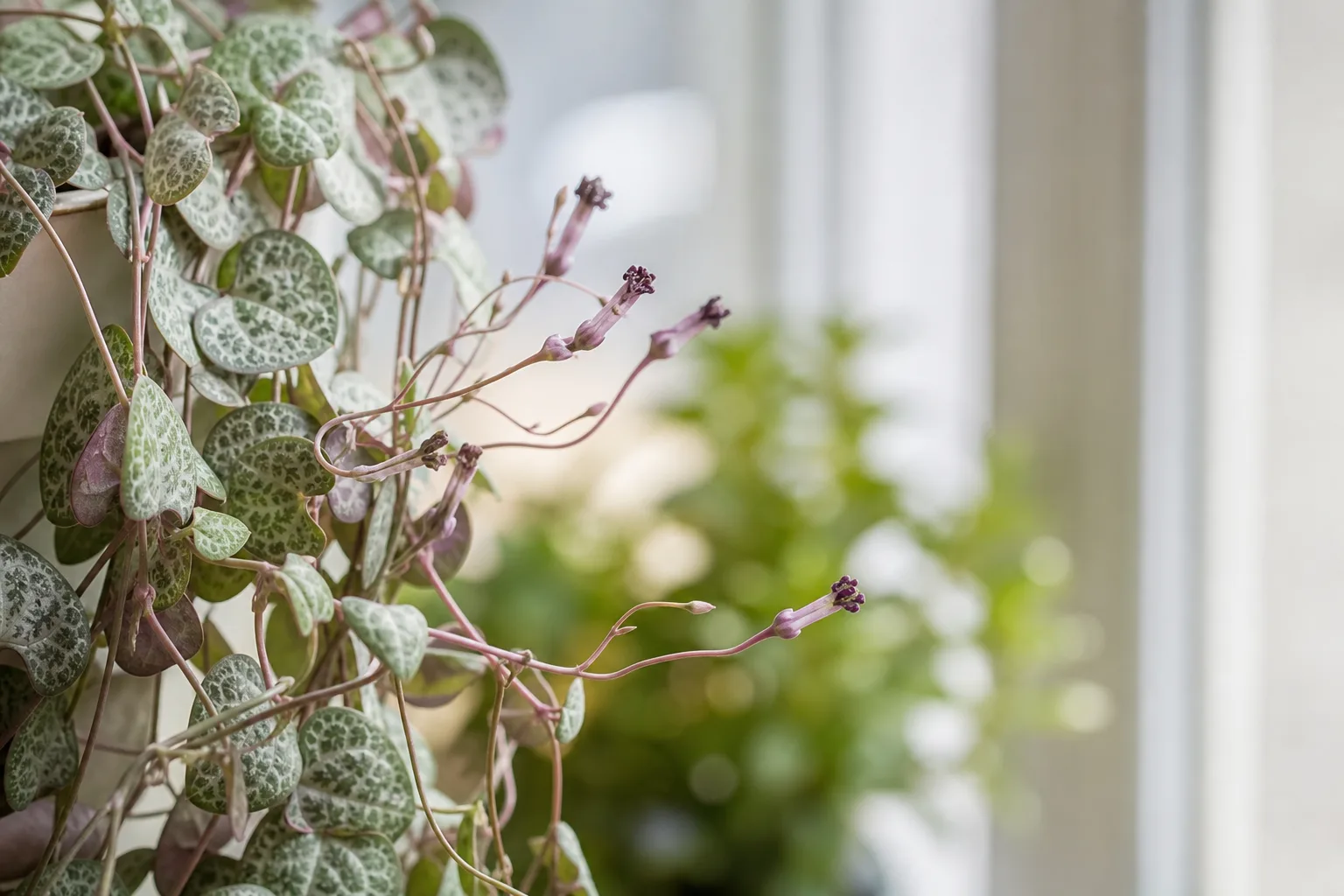
Small flowers on String of Hearts (Ceropegia woodii) often start with an expectation mismatch, not a care failure. This trailing semi-succulent is built for modest blooms-tubular purple to purplish-white flowers less than one inch long at vine nodes in summer and fall. They are interesting up close, not showy like hoya clusters or orchid spikes.
First step: compare open blooms to species norm before changing care. If tubes are waxy, cage-shaped lanterns roughly under 2.5 cm (1 inch) with decent purple-pink color and firm leaves nearby, the plant is blooming normally. If buds open stubby, washed-out, or fail to expand while vines show wide gaps between leaves and pale marbling, treat it as undersized stress blooms-and move the pot within 60–90 cm (2–3 feet) of your brightest east or filtered west window. Do not repot, fertilize heavily, or relocate again on the same day.
What small flowers look like on String of Hearts
Ceropegia woodii flowers are tubular with a bulbous base and fused cage-like lobes-a waxy inverted lantern on pink wiry stems between heart-shaped leaves and bead-like aerial tubers. Flower tubes run roughly 18–25 mm long on healthy specimens. That scale is the baseline, not a problem to fix.
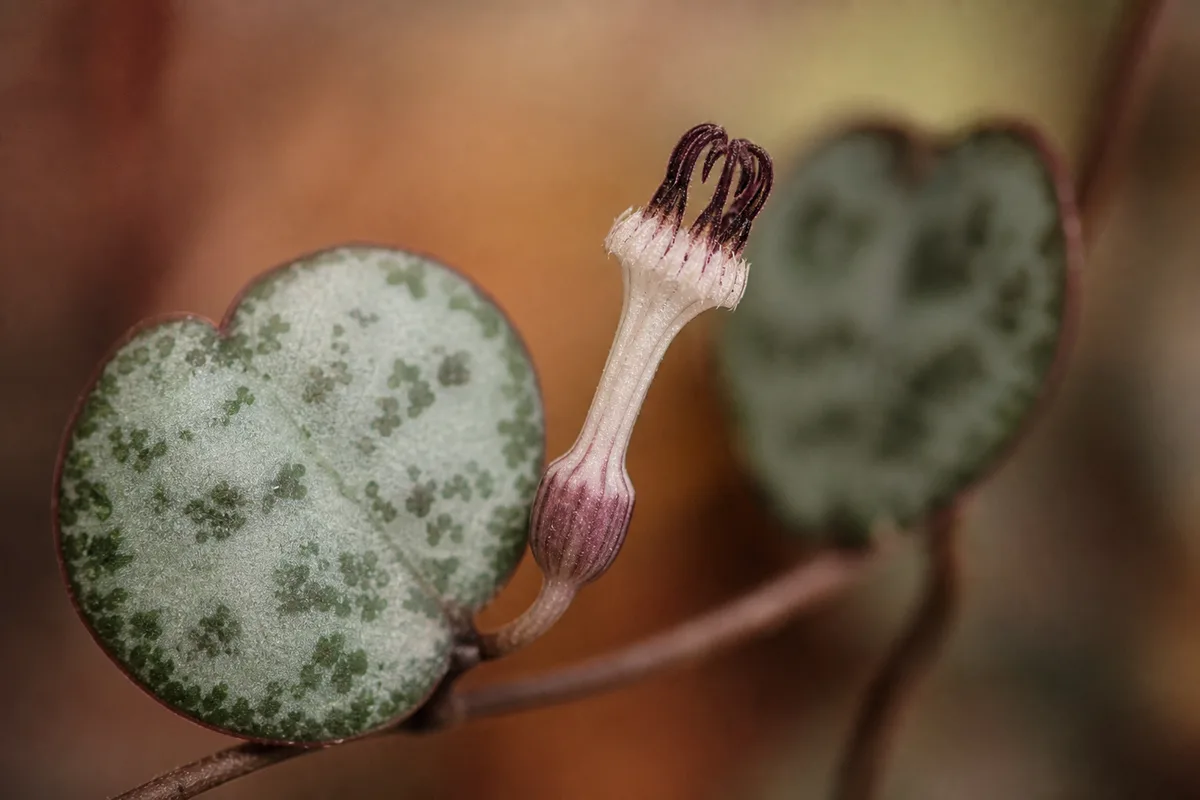
Small Flowers symptoms on String of Hearts - compare with healthy tissue on the same plant.
Normal small flowers (species-typical):
- Tubular blooms under 2.5 cm - purple, pink, or purplish-white waxy tubes at nodes
- Cage-like fused petal tips - lantern shape easy to miss on a long cascade
- Brief display - each bloom opens, holds color a few days, then fades (see faded-flowers guide if color washes out fast)
- Compact leaves alongside blooms - silver-marbled hearts with tight spacing; firm tubers on the vine
Stress-related undersized or weak flowers:
- Stubby, pale tubes - buds open but look shrunken, thin-walled, or barely colored compared with earlier blooms on the same plant
- Buds that stall before full expansion - closed tubes stay tiny and dry at the tip
- Concurrent vine weakness - wide leaf gaps, thin pink stems, faded marbling, or soft flat hearts while flowers form
- Fewer blooms on long vines - one or two weak flowers on a mature cascade that previously bloomed more freely
- Bud loss after shock - undersized blooms abort after String of Hearts repotting guide, relocation, or a cold draft
What is not small flowers:
- No blooms at all - that is a no-flowers problem, usually weak light or youth
- Normal senescence - open tubes fading to lavender or tan after a few days
- Comparing to hoya, jasmine, or petunia - Ceropegia woodii is intentionally demure
Why String of Hearts produces small or weak flowers
When blooms fall below the species norm or look stunted, culture-not genetics-is usually limiting bud energy.
Insufficient bright light. This is the dominant indoor cause. Ceropegia woodii evolved on sun-exposed hillsides in Southern Africa and needs bright, indirect sunlight with some gentle direct morning sun. Indoors, at least three to four hours of direct sun daily helps stems stay sturdy and supports full flower development. Weak light produces stretched vines with pale leaves-and buds that open small or not at all.
Underwatering during bud formation. This semi-succulent stores water in tubers, but prolonged drought while buds swell can produce thin, pale, or aborted flowers. Soft flat hearts plus undersized blooms point here-not a plant that merely has naturally tiny flowers.
Excess nitrogen fertilizer. Heavy nitrogen pushes soft leafy growth at the expense of reproductive tissue. Lush foliage with weak, sparse blooms often traces to feeding, not species limits.
Recent repotting, move, or draft stress. Shifting rooms or repotting during active growth can abort or shrink buds. String of Hearts likes to be somewhat crowded and tolerates being root-bound; unnecessary repotting during bud set resets flower quality.
Young or immature vines. Short starter strands under 30 cm may produce first blooms that look smaller until the plant matures. Patience matters on young specimens.
Cool winter conditions. The plant is dormant over winter with reduced growth. Expect fewer or weaker flowers in cool, short-day months even when summer blooms looked fine.
Wrong comparison plant. Social posts often show close-up macro shots that make these blooms look larger than they appear on a full hanging basket. A healthy indoor String of Hearts with properly small tubular flowers is succeeding-not failing.
How to confirm the cause
Work through these checks before buying bloom booster or upsizing the pot:
- Species norm check - Measure an open tube against 2.5 cm. Under that with good color and firm leaves nearby is normal. Clearly stubby or pale versus earlier blooms on the same vine is stress.
- Window direction and distance - Note east, west, south, or north exposure and distance from glass. Within 60–90 cm of an east or filtered west window supports full buds; more than 1.5 m back is suspect.
- Leaf spacing - Gaps over 7 cm between three consecutive leaf pairs confirm light is too weak for quality blooms-not just aesthetics.
- Soil moisture during bud swell - Mix bone-dry for weeks while buds form suggests underwatering; mix wet two weeks after watering in dim light suggests overwatering plus weak light.
- Recent stress - Repotting, room changes, or heat vents within four weeks can explain weak blooms without a permanent problem.
- Fertilizer history - Frequent high-nitrogen feed with lush but weak flowers implicates feeding.
- Plant age - Long mature cascades with firm tubers that suddenly produce weaker blooms point to culture. Short young strands may simply need time.
If blooms match species photos and leaves are compact, stop chasing bigger flowers-the plant is doing what Ceropegia woodii does.
First fix for String of Hearts
If flowers are species-normal size: no fix needed-adjust expectations and enjoy the lantern blooms.
If blooms are clearly undersized or weak: move the pot to the brightest suitable window-east or filtered west preferred-and place it within 60–90 cm of the glass.
That single placement change addresses the most common root cause of stunted buds. East windows offer gentle morning sun plus String of Hearts light guide the rest of the day. West windows work if the plant sits back enough to avoid harsh afternoon scorch on leaves adapted to dappled light.
Do not jump straight to a south-facing sill in midsummer if the plant lived in dim light for months-acclimate over five to seven days.
Skip repotting, heavy pruning, and bloom fertilizer on day one. A stretched plant needs stable light first-not a stack of interventions.
After two to four weeks in better light, if the plant is actively growing and soil dries on a normal schedule, you may add a diluted balanced liquid fertilizer at quarter to half strength once during spring or summer. Do not feed a dormant or stressed plant.
Step-by-step recovery
Once light is corrected-or confirmed adequate:
- Acclimate over one week - Increase exposure gradually so pale leaves do not burn in sudden direct sun.
- Match watering to dry-down - Water only when mix is mostly or completely dry-roughly every 10–14 days in summer, less in winter rest. Do not let the pot go bone-dry for weeks while buds are swelling.
- Rotate the pot weekly - Even light keeps growth balanced and supports uniform bud development along the vine.
- Add supplemental lighting if needed - A full-spectrum LED or fluorescent grow light 30–45 cm above foliage for 12–14 hours daily can substitute for a weak north window.
- Hold off on repotting - String of Hearts often flowers better when slightly crowded. Repot only when roots clearly outgrow the pot-preferably after a bloom cycle.
- Deadhead only spent tubes - Snip faded blooms at the node; do not cut healthy swelling buds hunting for bigger replacements.
Do not increase watering to “plump up” flowers-that raises rot risk on tuberous roots without enlarging blooms beyond species limits.
Recovery timeline
Expect patience measured in weeks to one warm season, not overnight size jumps. Ceropegia woodii will not produce dramatically larger flowers than its genetics allow-recovery means fuller, darker, better-formed tubes, not hoya-scale clusters.
After a light upgrade, new leaves should look darker and more tightly spaced within three to six weeks in active growth. Improved flower quality-if it comes-often shows on the next bud flush in late spring through fall when warmth and daylight peak.
Already-open stubby blooms will not enlarge. Judge progress by new buds at nodes and vine vigor, not by old spent flowers.
If two full warm seasons pass in strong light with stable care and blooms remain species-normal but small, accept that outcome. That is success on String of Hearts overview.
Lookalike symptoms to rule out
No flowers means buds never formed-usually weak light or youth, not undersized blooms.
Faded flowers means open tubes lose color quickly-often normal senescence or stress fading, not small size at opening.
Bud drop means buds formed but fell before opening-often after repotting or drafts. Small flowers means buds open but look weak or below prior quality.
Leggy growth shares the same light cause-fix placement once; both stretched vines and weak blooms respond to brighter stable light.
root rot on String of Hearts shows yellowing leaves, soft tubers, and sour soil-flowers are irrelevant until roots recover.
Mistakes to avoid
Do not compare String of Hearts to heavy bloomers and assume small tubular flowers mean failure.
Do not apply full-strength bloom fertilizer to a dry, dormant, or newly moved plant hoping for bigger tubes.
Do not repot into a larger pot during bud formation-unnecessary upsizing often delays or weakens flowers.
Do not keep the plant on a decorative hook centered in a bright-looking room far from glass-buds will stay weak or absent.
Do not underwater for weeks while buds swell because “it is a succulent”-tuber storage helps, but prolonged drought still shrinks blooms.
Do not interpret species-normal under-2.5 cm flowers as a problem requiring rescue.
String of Hearts care cross-check
Flower quality sits on the same foundation as everyday care: bright indirect light with some morning sun, fast-draining cactus-style mix, and watering only when the pot is mostly dry. Tubers along the vines store water-a dim plant watered on a summer schedule often sits wet too long while producing weak blooms.
Temperature comfort runs about 18–27°C (65–80°F). Low humidity is fine; this is not a humidity-driven bloom-size problem. The plant tolerates being somewhat root-bound, so resist upsizing pots unless drainage or crowding clearly fails.
How to prevent small or weak flowers next time
Choose window placement before basket style. An east or filtered west window within arm’s reach of the glass beats a high corner where light intensity drops sharply with distance from windows.
Clean windows seasonally and pull back obstructions that block morning or afternoon light.
Track winter daylight-supplement with grow lights from late fall through early spring if stretched spacing returns.
Feed lightly and only during active growth; skip nitrogen-heavy products.
When buying, pick plants with tight leaf spacing and firm tubers-a basket already stretched with 10 cm gaps was likely grown in light too weak for quality future blooms.
Avoid repotting during peak summer growth unless the mix is failing.
When to worry
Undersized blooms alone are not an emergency when they still match species scale and leaves stay firm. Many indoor String of Hearts produce only occasional small flowers-or none-and remain excellent foliage plants.
Act promptly when weak shriveled buds combine with wet, sour soil and soft tubers-that pattern can slide into root rot on stored-water roots. Also investigate if every bud aborts during a repot or move while soil stayed soggy.
Chronic species-normal small flowers with compact, marbled growth and firm tubers is a win, not a rescue case.
Conclusion
Small flowers on String of Hearts usually means one of two things: normal species-typical tubular blooms under 2.5 cm, or stress-shrunk buds on a vine that needs brighter light and steadier care. Compare open flowers to reference photos first. If blooms are genuinely weak-not merely small by nature-move the pot to real brightness, stabilize watering through bud formation, and wait for the next warm-season flush. Ceropegia woodii will never match showy bloomers-and dense, silver-marbled cascades with occasional lantern flowers are still a thriving plant.
When to use this page vs other String of Hearts guides
- String of Hearts watering guide - Use for routine moisture checks before assuming small flowers is the main issue.
- String of Hearts problems hub - Browse all 45 common issues on this species.