No Flowers on String of Hearts: Causes, Checks & Fixes
Quick answer
String of Hearts often skips flowers indoors when light is too weak, the plant is still young, or buds were stressed by repotting or winter rest. First step: move the pot to your brightest east or west window within 60–90 cm of the glass and confirm tight leaf spacing-not stretched vines.
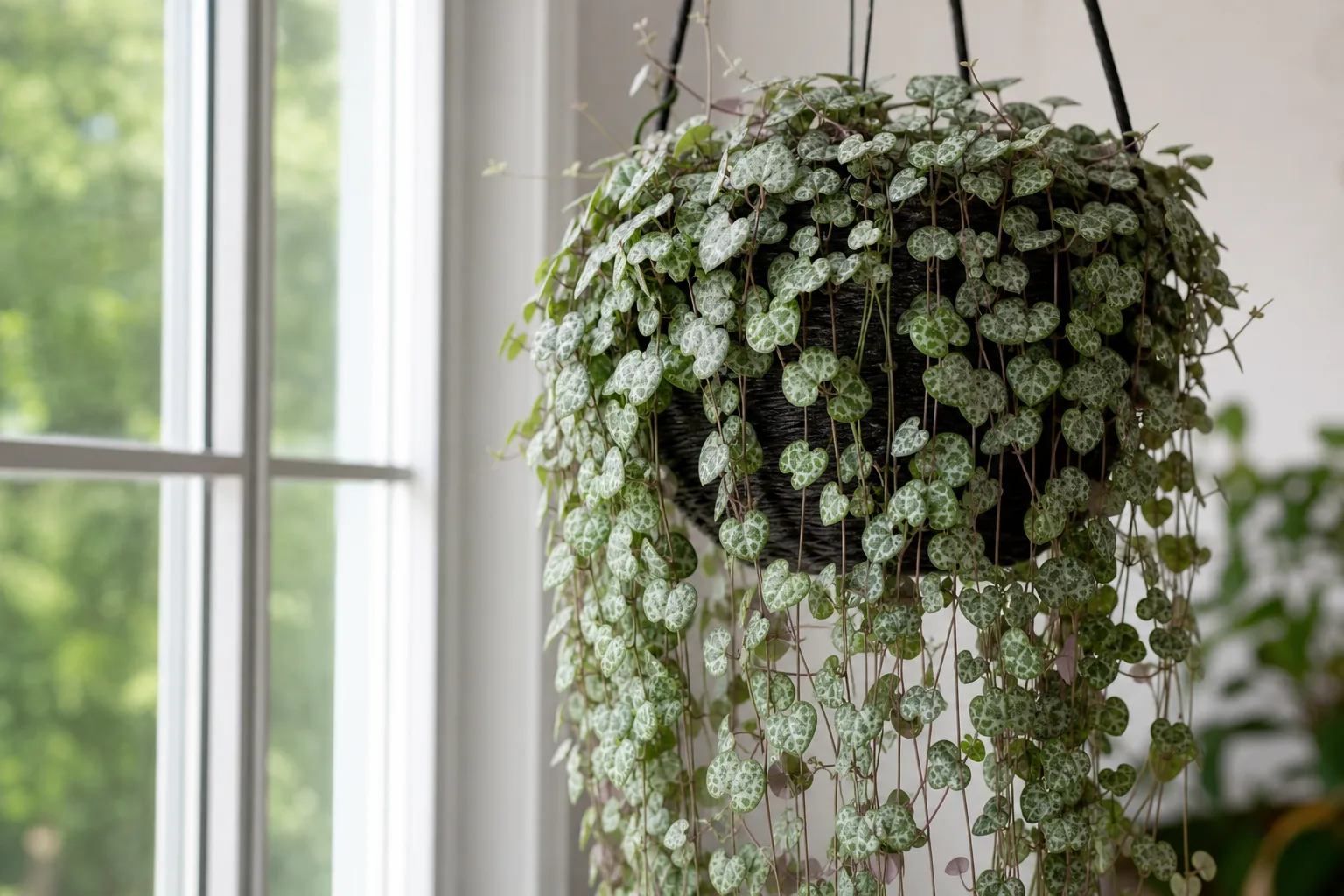
No Flowers on String of Hearts: Causes, Checks & Fixes
This guide covers no flowers on String of Hearts. See also the general No Flowers guide, watering, and light pages for this plant.
No Flowers on String of Hearts: Causes, Checks & Fixes
Quick answer
No flowers on String of Hearts (Ceropegia woodii) means the plant grows trailing vines and heart-shaped leaves but produces few or no blooms-not a single winter pause when growth slows. Under weak indoor photons, this semi-succulent stores energy in tubers and leaves instead of reproduction; buds never form until light, warmth, and maturity align.
First step: move the pot to your brightest east or west window, within about 60–90 cm (2–3 feet) of the glass. Ceropegia woodii needs real brightness to flower-not a dim shelf where it merely survives. Do not repot, fertilize heavily, or move the plant again on the same day. Give corrected light one full warm season before deciding the plant will never bloom.
Many healthy String of Hearts never flower indoors, and that is normal. A dense, marbled cascade with firm tubers is a thriving plant even without tubular blooms. For proactive window placement before problems start, see the String of Hearts light guide.
This page vs. sibling guides: Use not enough light when stretch and pale marbling are your main worry; use leggy growth when vines elongate with wide gaps but you are not focused on blooms; use bud drop when buds formed and fell before opening. This page covers zero buds on otherwise healthy vines.
What no flowers looks like on String of Hearts
True no-flowers is about missing bloom cycles on an otherwise healthy vine, not winter rest or youth.
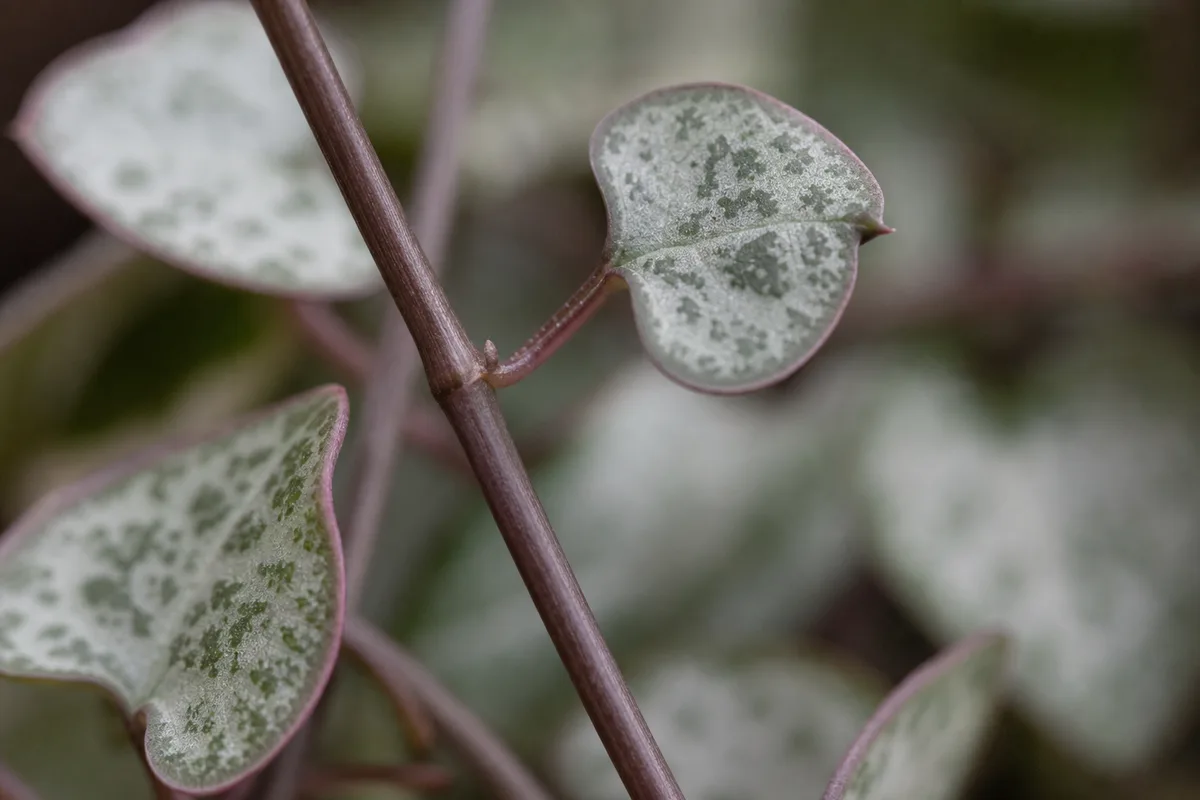
No Flowers symptoms on String of Hearts - compare with healthy tissue on the same plant.
Typical no-flowers signs:
- Long trailing stems with marbled hearts but zero tubular blooms through spring, summer, and fall
- Never bloomed despite years of care in a north window, back shelf, or hanging hook far from glass
- Leggy vines with wide gaps between leaves-the same light stress that prevents compact growth also blocks flowering
- Lush foliage after heavy nitrogen feed but no purple-pink flowers at stem nodes
- Buds that formed once, then vanished after repotting, relocation, or a dry-air draft episode
What is normal-not no flowers:
- No blooms in cool winter months when the plant rests and watering drops
- A young plant under one to two years that grows steadily but has not reached flowering size
- Sparse, occasional flowers on an otherwise healthy mature plant-indoor bloom is unreliable on this species
- Small tubular blooms less than 2.5 cm long that open briefly along the vine-easy to miss on a long cascade; see small flowers if blooms are present but undersized
Ceropegia flowers are tubular and purple to purplish-white, appearing at nodes along wiry pink stems. They are showy up close but modest compared with hoya or orchid displays.
Bloom-outcome vignette
A mature cascade hung on a decorative hook roughly 2.4 m from the nearest east window produced zero tubular blooms over 18 months despite steady trailing growth. Leaf gaps on new sections averaged 9–10 cm. After moving the pot to an east windowsill at 70 cm from the glass-without repotting or heavy feed-and holding watering on a dry-down rhythm through one full warm season, the first small purple tubular blooms appeared at stem nodes in late summer. New growth leaf gaps tightened to 4–5 cm within six weeks of the move.
Why String of Hearts won’t flower
String of Hearts flowers when light, warmth, maturity, and stable care align. When any pillar fails, the plant keeps storing energy in tubers and leaves instead of producing blooms.
Insufficient bright light. This is the dominant indoor cause. Ceropegia woodii evolved on sun-exposed hillsides in Southern Africa and needs bright, indirect sunlight with some gentle direct morning sun. Indoors, less than about 3–4 hours of direct sunlight daily causes stems to elongate and leaves to lose marbling-conditions that rarely support reliable flowering. Large gaps between leaves, faded marbling, and slow growth are the same signals that predict no flowers. A spot that looks bright to your eyes may read as medium or low light for a succulent vine that needs brighter light than typical rainforest understory houseplants.
Plant still juvenile. Young specimens often grow vines and aerial tubers for a year or more before their first flowers. A small starter pot with short strands may simply need time-not a crisis.
Wrong season or winter dormancy. String of Hearts is dormant over the winter and naturally slows in cooler, shorter days. Expect fewer or no flowers from late fall through winter even in good light. In habitat, wild plants flower mainly summer to autumn; NC State lists bloom time as fall and summer. Peak bloom potential runs through warm months when daylight is longest.
Recent repotting, move, or bud stress. Shifting rooms, repotting into fresh mix, or knocking vines during handling can abort buds that were forming. String of Hearts likes to be crowded and tolerates being somewhat root-bound; unnecessary repotting during active growth can reset the bloom clock.
Overwatering combined with weak light. Soggy mix in a dim corner keeps tubers stressed. A plant fighting root moisture problems will not channel energy into reproduction. See root rot if tubers soften on wet soil.
Excess nitrogen fertilizer. Heavy nitrogen pushes soft leafy growth at the expense of flowers. This species needs only light feeding during active growth-not weekly full-strength doses.
Consistent indoor temperatures. Some growers report more blooms when day and night temperatures differ slightly through the growing season. A home held at one steady thermostat setting year-round may bloom less than a plant near a window with natural swings-though light still matters more.
Variegated cultivars. C. woodii ‘Silver Glory’ and other heavily variegated forms often need brighter placement than standard marbled vines to hold color and flower indoors.
How to confirm the cause
Work through these checks before buying bloom booster or repotting:
- Window direction and distance - Note east, west, south, or north exposure and how far the pot sits from glass. Within 60–90 cm of an east or filtered west window is ideal; more than 1.5 m back is suspect for flowering.
- Leaf spacing and marbling - Measure gaps between three consecutive leaf pairs. Gaps over 7 cm with pale, thin hearts confirm light is too weak for blooms-not just aesthetics.
- Plant age and vine length - Short starter strands under 30 cm may not be mature enough yet. Long, dense cascades with firm tubers that never bloom point to culture, not youth.
- Season context - Is it warm active growth season, or cool winter rest? Expect no flowers during dormancy even after you fix light.
- Recent stress events - Repotting, room changes, or drafty heat vents in the last four weeks can explain vanished buds without a permanent problem.
- Soil moisture pattern - Mix that stays damp two weeks after watering in a dim spot suggests overwatering plus low light-a double block on flowering.
- Fertilizer history - Frequent high-nitrogen feed with lush but flowerless growth implicates feeding, not pest or disease.
If spacing is tight, marbling is strong, tubers are firm, and the plant still has not bloomed after two warm seasons in a bright window, you may simply have a non-blooming indoor specimen. That is acceptable.
First fix for String of Hearts
Move the pot to the brightest suitable window-east or filtered west preferred-and place it within 60–90 cm of the glass.
That single placement change addresses the most common root cause. East windows offer gentle morning sun plus bright indirect light the rest of the day. West windows work if the plant sits back enough to avoid harsh afternoon scorch on leaves adapted to shade.
Do not jump straight to a south-facing sill in midsummer if the plant has lived in dim light for months-acclimate over five to seven days to prevent scorched hearts.
Skip repotting, heavy pruning, and bloom fertilizer on day one. A stretched plant needs stable light first-not a stack of interventions.
After two to four weeks in better light, if the plant is actively growing and soil dries on a normal schedule, you may add a diluted balanced liquid fertilizer at quarter to half strength once during spring or summer. Do not feed a dormant or stressed plant.
Step-by-step recovery
Once light is corrected:
- Acclimate over one week - Increase exposure gradually so pale leaves do not burn in sudden direct sun.
- Match watering to new dry-down - Brighter light means faster evaporation. Water only when mix is mostly or completely dry-roughly every 10–14 days in summer, less in winter rest.
- Rotate the pot weekly - Even light keeps growth balanced and prevents one-sided lean.
- Add supplemental lighting if needed - A full-spectrum LED or fluorescent grow light 30–45 cm above foliage for 12–14 hours daily can substitute for a weak north window. See the String of Hearts light guide for fixture height and photoperiod detail.
- Hold off on repotting - String of Hearts often flowers better when slightly crowded. Repot only when roots clearly outgrow the pot-preferably after a bloom cycle, not during bud formation.
- Avoid moving the plant while buds swell - If flowers finally appear, leave the pot in place until blooms finish.
Do not increase watering to “encourage” blooms-that raises rot risk without triggering flowers.
Recovery timeline
| Phase | What to expect |
|---|---|
| Weeks 1–3 | New leaves should look darker and more tightly spaced in active growth after a light upgrade |
| Weeks 4–6 | Leaf gaps on new sections often shrink; tubers stay firm on corrected watering |
| Late spring–fall | First flowers-if they come-often appear when warmth and daylight peak |
| Winter rest | Few or no blooms even after light improves; judge foliage quality, not daily flower checks |
| Two warm seasons | If still no blooms with compact growth in strong light, accept foliage-only success as common indoors |
A plant moved in winter may show improved foliage long before any bloom attempt. Judge progress by new growth quality and firm tubers, not daily flower checks.
Lookalike symptoms to rule out
Leggy growth without flowers shares the same light cause-fix placement once; both problems respond to the same first step. See leggy growth for stretch-focused diagnosis.
Bud drop means buds formed but fell before opening-often after repotting, drafts, or watering swings. No flowers means buds never appeared at all. See bud drop.
Faded or brown flowers is a different problem on spent blooms or cold-damaged buds-not the same as never flowering.
Slow winter growth with firm tubers and dry soil is dormancy. Do not chase blooms in December; wait for lengthening days.
Root rot shows yellowing leaves, soft tubers, and sour soil-sometimes in dim, wet corners. Fix moisture and light together; flowers are irrelevant until roots recover. See root rot.
Nutrient deficiency is rare in fresh fast-draining mix. Do not guess fertilizer before correcting light and watering.
Not enough light overlaps heavily with no flowers when stretch is the main symptom-this page focuses on zero buds; that guide focuses on light stress signs broadly.
Mistakes to avoid
Do not repot into a larger pot hoping to “give the plant energy to bloom.” Unnecessary repotting often delays flowers.
Do not apply full-strength bloom fertilizer to a dry or dormant plant.
Do not keep String of Hearts on a decorative hook centered in a bright-looking room far from glass-it will stay flowerless and stretched.
Do not assume every String of Hearts must bloom to be healthy. Indoor culture rarely matches native cliff ledges where vegetative growth reaches into brighter light above the understory.
Do not interpret one summer without flowers as permanent failure after a single week of better light.
Do not move the plant repeatedly hunting for magic placement-pick the brightest stable spot and leave it through a full season.
String of Hearts care cross-check
Flowering sits on top of the same foundation as everyday care: bright indirect light with some morning sun, fast-draining cactus-style mix, and watering only when the pot is mostly dry. Tubers along the vines store water-a dim plant watered on a summer schedule often sits wet too long.
Temperature comfort runs about 18–27°C (65–80°F). Low humidity is fine; this is not a humidity-driven bloom problem. The plant tolerates being somewhat root-bound, so resist upsizing pots unless drainage or crowding clearly fails. Start from the String of Hearts overview when any pillar of care is uncertain.
How to prevent no flowers next time
Choose window placement before basket style. An east or filtered west window within arm’s reach of the glass beats a high corner where light intensity drops sharply with distance from windows.
Clean windows seasonally and pull back obstructions that block morning or afternoon light.
Track winter daylight-supplement with grow lights from late fall through early spring if your brightest window still produces stretched spacing.
Feed lightly and only during active growth; skip nitrogen-heavy products.
When buying, pick plants with tight leaf spacing and firm tubers-a basket already stretched with 10 cm gaps was likely grown in light too weak for future blooms.
Avoid repotting during peak summer growth unless the mix is failing.
When to worry
Flowerlessness alone is not an emergency. Many indoor String of Hearts never bloom and remain excellent foliage plants.
Act promptly when stretched vines combine with wet, sour soil and soft tubers-that pattern can slide into root rot on stored-water roots. Lift the pot, sniff the drainage hole, and squeeze aerial tubers: firm and dry means patience; soft and mushy on wet mix means stop watering and inspect roots per the root rot guide. Also investigate if buds appeared and dropped during a repot or move while soil stayed soggy.
Chronic no flowers with compact, marbled growth and firm tubers is a patience problem, not a rescue case.
Related String of Hearts guides
- String of Hearts overview
- String of Hearts light
- String of Hearts watering
- String of Hearts fertilizer
- String of Hearts repotting
- Not Enough Light on String of Hearts
- Leggy Growth on String of Hearts
- Bud Drop on String of Hearts
- Small Flowers on String of Hearts
- Root Rot on String of Hearts
- All String of Hearts problems
Conclusion
Use this page to confirm zero buds on String of Hearts-then fix window placement first and wait through a warm season. When symptoms overlap with sibling pages, follow the linked guide for stretch, bud loss, or root stress before stacking fertilizer or repotting.