Manjula Pothos Care Guide: Light, Water & Variegation
Epipremnum aureum 'Manjula'
Manjula Pothos needs bright indirect light to maintain white variegation, well-draining soil watered every 7–10 days, and moderate humidity. Slow grower - new leaves unfurl over 1–2 weeks.
Manjula Pothos Care Guide: Light, Water & Variegation
Start with wateringThe most common care mistake for Manjula PothosWatering guide →Manjula Pothos care essentials
Light
bright indirect light
Water
Allow the top 3–5 cm of soil to dry before watering. Every 7–10 days in summer, every 10–14 days in winter. Well-draining soil is essential.
Soil
Standard potting mix with 20–30 % perlite. Well-draining, airy mix. pH 6.0–6.5.
Humidity
40–60%
Temperature
18–29°C (65–85°F)
Fertilizer
Use balanced liquid fertilizer at half strength and stop if the plant is stressed, newly repotted, or not actively growing. Over-fertilizing.
About Manjula Pothos
Manjula Pothos is native to Cultivar developed at the University of Florida, typically reaches Up to 2 m trailing length indoors, with moderate growth. Manjula Pothos has a trailing growth habit and part of the Araceae family. It is also known as Happy Leaf Pothos and HANSOTI14.
| Detail | Information |
|---|---|
| Also known as | Happy Leaf Pothos, HANSOTI14 |
| Native region | Cultivar developed at the University of Florida |
| Mature size | Up to 2 m trailing length |
| Growth rate | Moderate |
| Growth habit | Trailing |
| Scientific name | Epipremnum aureum 'Manjula' |
| Family | Araceae |
Manjula Pothos Care Guide: Light, Water & Variegation
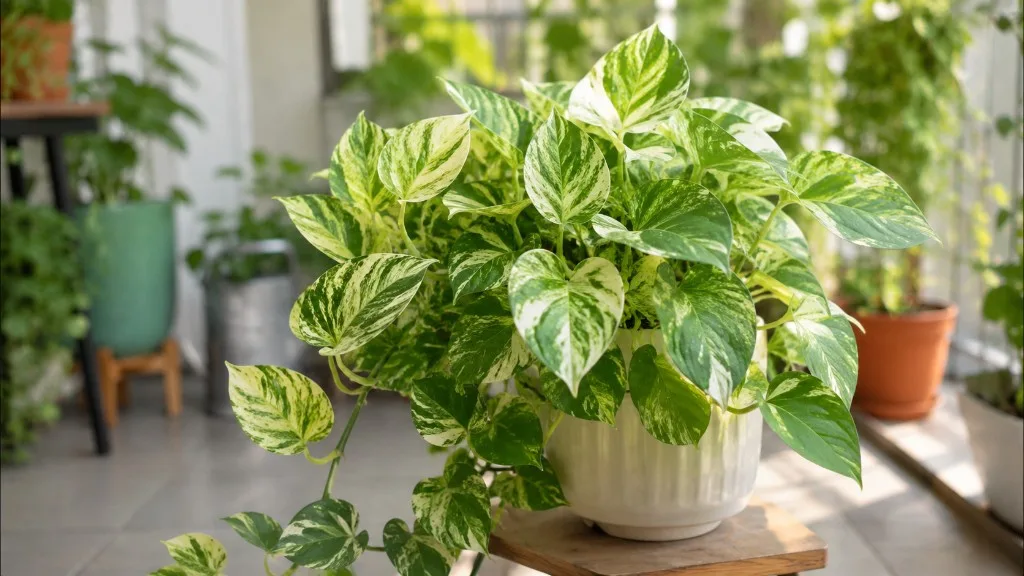
Walk into a plant shop looking for a pothos with real personality and you will probably pass a dozen Golden Pothos before you find a Manjula. That is the point. Manjula Pothos (Epipremnum aureum ‘Manjula’, sold under the breeder code HANSOTI14 and sometimes labeled Happy Leaf Pothos) is a patented cultivar with broad, wavy, heart-shaped leaves splashed in cream, white, silver, and green - and no two leaves look exactly alike. It is slower than Golden or Neon pothos, more demanding about light than solid-green varieties, and absolutely not a plant to keep within reach of a chewing cat or dog. This guide covers what Manjula actually is, how it differs from the pothos you already know, and the practical indoor routine that keeps its variegation bright without drowning the roots.
The goal is simple: by the end you should know where to place the plant, how to water it based on the pot rather than a calendar, what soil and humidity it wants, how to prune and repot it, what propagation is realistic at home, and what to do when leaves yellow, brown, or lose their white patches.
What Manjula Pothos Actually Is
Manjula Pothos is not a separate species. It is a cultivar of Epipremnum aureum, the same species behind Golden Pothos, Marble Queen, and Neon Pothos. The parent species is a tropical climbing vine in the Araceae family. North Carolina State Extension’s Plant Toolbox describes pothos as native to the Society Islands, with trailing stems that can reach 40 feet in nature and juvenile heart-shaped leaves that stay smaller in pots. Penn State Extension notes the species is also called Devil’s Ivy and has been grown as a houseplant for more than a century because it tolerates a wide range of indoor conditions - though variegated cultivars like Manjula are less forgiving than the plain green form.
What makes Manjula distinct is human selection, not wild mutation. The cultivar was discovered in India and patented as PP27,117 under the breeder denomination HANSOTI14, with Ashish Hansoti credited as the discoverer. Costa Farms, a major commercial grower, notes the plant was put under patent protection in 2010 and that commercial propagation is prohibited without a license. That patent status matters if you are buying cuttings to resell; it does not stop a home grower from rooting a stem cutting for personal use, which we will cover later.
Visually, Manjula stands out for three traits extension sources and growers consistently mention. First, the leaves are larger and broader than typical Golden Pothos at the same age, with wavy, undulating edges rather than flat, pointed blades. Second, the variegation is painterly: large cream and white patches mixed with silvery green, with each leaf showing a different pattern. Third, the internodes are tighter - the spaces between leaves are shorter than on Golden Pothos - which gives the plant a fuller, more compact look even when growth is slow. Clemson HGIC’s 2025 pothos factsheet lists Manjula as a slower-growing cultivar with broad, upright leaves and a bushy habit, though many home growers still train it as a trailer or on a moss pole with good results.
Indoors, expect a moderate grower that trails up to roughly 2 meters over time in bright light, with new leaves unfurling over one to two weeks rather than popping open overnight. That slower pace is normal, not a sign you are failing - but it does mean light and watering mistakes show up on the leaves for longer before new growth replaces them.
How Manjula Differs from Other Pothos Cultivars
All pothos share the same basic biology: they are understory vines that want bright filtered light, well-drained soil, and a dry-down cycle between waterings. Where cultivars diverge is how much light they need to keep their color, how fast they grow, and what shape the leaves take. Manjula sits in the high-variegation, higher-light, slower-growth group alongside Marble Queen, Snow Queen, and Pearls and Jade - not in the low-light-tolerant group with Neon and Jessenia.
Manjula vs Marble Queen and Snow Queen
Marble Queen has pointed, heart-shaped leaves with fine white-and-green marbling throughout the blade. Clemson HGIC notes it requires more light than most pothos varieties and grows faster than Snow Queen, with more green remaining in each leaf. Snow Queen pushes variegation further: predominantly white leaves speckled with green, with no large green patches, and it needs lots of bright, indirect light to grow well at all.
Manjula differs in leaf architecture more than color alone. Its leaves are wider, more rounded, and distinctly wavy at the margins. The variegation tends toward large cream and white fields with green edging rather than fine speckling across the whole surface. Growth is slower than Marble Queen in most homes. If you are choosing between them, pick Marble Queen for faster coverage and Manjula for broader, sculptural leaves and a softer, watercolor variegation effect.
Manjula vs Pearls and Jade and Golden Pothos
Clemson HGIC describes Manjula as similar in coloring to Pearls and Jade, another patented cultivar with green speckling and large white spots on smaller, teardrop-shaped leaves. Manjula’s leaves are noticeably larger and wavier, and the plant generally looks fuller because of its tighter internodes. Golden Pothos is the baseline: wide green leaves with yellow variegation, fast growth, and the highest tolerance for lower light. If your room only offers medium or dim light, Golden or Neon will perform better. Manjula will survive for a while in medium light, but the white sections will shrink and new leaves will emerge greener - the plant’s way of producing more chlorophyll where light is scarce.
Light: Bright, Indirect, and Variegation-Safe
Light is the single most important variable for Manjula Pothos. The white and cream portions of each leaf contain little to no chlorophyll. They are beautiful, but they do not photosynthesize. The plant compensates by needing more total light than a solid-green pothos while still avoiding harsh direct sun that burns those pale sections.
Clemson HGIC recommends bright, indirect light for pothos generally and specifically notes that lower light causes variegated varieties to lose coloring. Penn State Extension puts it plainly: pothos wants moderate to bright light, direct sun yellows leaves, and variegated cultivars eventually lose their desirable foliage qualities in low light. Wisconsin Horticulture adds that low light results in loss of variegation and that direct sunlight should be avoided.
A practical placement for Manjula: within 2 to 6 feet of an east- or north-facing window, or behind a sheer curtain at a south- or west-facing window. Morning sun for an hour or two is usually fine. Midday or afternoon sun through bare glass will bleach white patches to tan and leave brown, papery scorch marks. If you are using a grow light, a full-spectrum LED positioned 12 to 18 inches above the foliage for 10 to 12 hours daily works well.
Read the plant before you read the room. Healthy Manjula new growth is firm, wavy, and shows clear white or cream alongside green. Long spaces between leaves, smaller new blades, and predominantly green emerging foliage mean the plant wants more light. Pale, washed-out leaves with brown crispy patches mean too much direct exposure or a sudden move from dim to blazing conditions without acclimation. Shift light gradually over one to two weeks whenever you relocate the pot, and rotate the plant a quarter turn weekly so both sides receive similar exposure. Pothos stems lean toward light sources; regular rotation keeps growth balanced.
Watering: Let the Pot Dry, Not the Calendar
Manjula Pothos is an aroid that prefers its roots to cycle between moist and slightly dry, not sit wet continuously. The species is famously forgiving of missed waterings - Penn State Extension notes pothos is better kept too dry than too wet - but variegated cultivars in bright light can still wilt if you let the pot go bone dry for too long. The skill is reading the pot, not obeying a schedule.
The starting rule from LeafyPixels plant data and Clemson HGIC guidance: allow the top 3 to 5 cm (about 1 to 2 inches) of soil to dry before watering. In many homes that works out to roughly every 7 to 10 days in summer and every 10 to 14 days in winter, but pot size, material, light intensity, and humidity all shift that interval. A small plastic pot in a bright south room may need water twice a week in July. A large ceramic pot in a cool north room in January may go three weeks between drinks.
When you do water, soak thoroughly until water runs from the drainage holes, then empty the saucer within 30 minutes. Shallow, frequent sips that never reach the lower roots are a common cause of weak growth and upper-soil salt buildup. In winter, stretch the interval and never feed a plant that is barely drying out - cool, dim conditions mean slow water use and a high risk of root rot on Manjula Pothos if you keep summer habits.
How to Check Soil Moisture Before You Water
The finger test remains the most reliable tool. Push your index finger to the second knuckle. If the soil at that depth feels cool and damp, wait. If it feels dry and the pot is noticeably lighter than it was after the last watering, it is time. A bamboo chopstick pushed to the bottom of the pot and left for ten minutes works too: damp soil stains and clings; dry soil leaves little residue.
Watch the plant’s body language. Soft, drooping stems on dry, lightweight soil mean underwatering on Manjula Pothos. Water thoroughly and the plant usually perks up within hours. Yellowing leaves on soil that stays wet for days, plus a sour smell or fungus gnats, point to overwatering. Fix the environment before you water again. Manjula’s thick leaves can hide drought stress until the whole stem flops, so do not rely on foliage alone - touch the soil.
Humidity and Temperature Indoors
Manjula Pothos is a tropical houseplant, but it is not as humidity-obsessed as some aroids. Clemson HGIC lists pothos’ preferred humidity at 50 to 70%, with average home levels of 30 to 60% tolerated. LeafyPixels data targets 40 to 60% as a practical comfort zone. Below 30%, leaf tips may brown and spider mites become more likely, especially in winter when heating dries the air.
Raise humidity in ways that actually work. A pebble tray with the pot sitting above the water line, grouping plants together, or a small humidifier near the plant are all effective. Misting the leaves is a poor substitute: the humidity bump lasts minutes, and wet foliage in low airflow can invite fungal spotting on variegated sections.
Temperature is straightforward. Clemson HGIC recommends 60 to 70°F (15 to 21°C) at night and 70 to 85°F (21 to 29°C) during the day. Penn State Extension cites a comfortable range of 60 to 80°F. Avoid sustained exposure below 50°F (10°C) and protect the plant from hot or cold drafts - air-conditioning vents, open winter windows, and heat registers can damage leaf cells within hours. Manjula is adaptable to normal indoor temperatures; the danger is sudden change, not the exact thermostat setting.
Soil Mix and Container Choice
Drainage is non-negotiable for any pothos, and Manjula is no exception. Clemson HGIC advises potting pothos in an airy, well-draining soil mix. North Carolina Extension recommends a well-drained potting medium that dries between waterings. Wisconsin Horticulture suggests a well-aerated growing medium and allowing the soil surface to dry before watering again.
A reliable home recipe: standard peat- or coco-based potting mix with 20 to 30% perlite added. LeafyPixels plant data targets pH 6.0 to 6.5, which most quality bagged indoor mixes already approach. The perlite keeps air around the roots and prevents the mix from compacting into a waterlogged brick over time. Some growers add a small portion of orchid bark for extra chunk, but it is optional for a trailing pothos in a hanging basket.
The pot matters as much as the mix. Use a container with drainage holes, never a sealed decorative cachepot without an inner liner you can remove. Terracotta dries faster and forgives heavy-handed waterers; plastic and glazed ceramic retain moisture longer and suit growers who tend to underwater. When Manjula Pothos repotting guide, go up only one size - typically 1 to 2 inches of additional diameter. An oversized pot holds water the root system cannot use, and that is the fastest route to root rot after repotting.
Fertilizer Schedule for Slow, Steady Growth
Manjula Pothos is not a heavy feeder. Clemson HGIC suggests fertilizing with a houseplant fertilizer every other month during spring and summer if yellowing suggests low fertility. Wisconsin Horticulture recommends feeding every other month except in winter when growth is inactive. For a slow-growing variegated cultivar, less is usually more.
A safe home approach: apply a balanced water-soluble fertilizer at half the label strength once a month from spring through early fall, and pause from late fall through winter. Always fertilize after a normal watering so the solution distributes through moist soil without burning roots. Skip feeding entirely if the plant was recently repotted into fresh mix with starter nutrients, if it is recovering from root rot or pest damage, or if it is not producing new leaves.
Over-fertilizing shows up as brown leaf tips, crusty white salt on the pot rim, and yellowing despite appropriate watering. Flush the pot with plain water until it runs clear from the drainage holes, empty the saucer, and skip the next two feedings. Healthy new wavy leaves are the only feedback that matters.
Pruning and Training for Fuller Plants
Manjula Pothos responds well to pruning, and regular trimming is often necessary because pothos concentrates leaves at stem tips over time while bare internodes develop lower on the vine. North Carolina Extension notes that leaves yellow and fall off with age, concentrating foliage at the ends of stems, and recommends pruning stems back to maintain a bushy habit.
Cut just above a node - the small bump where a leaf meets the stem - using clean scissors or pruners. Each node is a potential growth point. Pruning the longest trailers encourages side shoots and keeps the plant looking full rather than stringy. Remove yellowed or scorched leaves at the base anytime; they will not re-green.
Training options depend on your space. Manjula can trail from a shelf or hanging basket, which is the most common display. It can also climb a moss pole or trellis; pothos develop brown aerial roots along stems that cling to supports, and Clemson HGIC notes that growing vertically can produce larger leaves over time. Because Manjula grows slower than Golden Pothos, do not expect a ceiling-length vine in year one. Consistent light and patient pruning build the best shape.
Repotting Without Disturbing Variegation
Repot Manjula Pothos roughly every one to two years, or when you see roots circling the drainage holes, water running straight through without soaking in, or the pot drying out unusually fast. Clemson HGIC says most pothos can be repotted once every year or two depending on growth rate; Manjula’s slower pace often pushes that toward the longer end.
Spring is the best season, as the plant enters active growth and can fill the new pot with roots before winter slowdown. Water the day before repotting so the root ball is pliable. Choose one size up, use fresh well-draining mix, and set the plant at the same depth as before. Water lightly after repotting and keep the plant in bright, indirect light without direct sun stress for the first week.
Do not repot on day one after bringing a new plant home unless the soil is clearly failing or pests are present. A fresh nursery plant is adjusting to your humidity and light; repotting stacks stress on top of acclimation. Wait at least two to four weeks unless there is an urgent reason.
Propagation: Home Cuttings and Patent Restrictions
Pothos is one of the easiest houseplants to propagate. Clemson HGIC and North Carolina Extension both confirm that stem cuttings root readily in water or soil as long as each cutting includes at least one node. For Manjula, take a healthy stem, snip below a node, and place the node underwater or bury it in moist, well-draining mix. Roots typically form in two to four weeks in warm, bright conditions. Keep water fresh weekly if rooting in a jar, and transplant to soil when roots are 2 to 5 cm long.
The patent adds a legal wrinkle, not a horticultural one. Because Manjula is protected under PP27,117, commercial propagation and sale without a license is prohibited. Costa Farms explicitly notes this obligation. Home gardeners routinely root cuttings for personal use; the restriction targets unlicensed nursery production, not a hobbyist filling out their own collection. If you are unsure, check current patent status and local regulations before selling rooted cuttings.
For best variegation in propagated plants, take cuttings from stems showing strong white-and-green balance, not from reverted all-green sections. All-green cuttings root easily but produce green plants. Variegation in pothos is generally stable in cultivars like Manjula, but low light on the parent can skew what you clip.
Toxicity to Cats, Dogs, and People
Manjula Pothos is toxic to pets and mildly toxic to humans if chewed or ingested. This is a species-level trait, not a Manjula-specific surprise: all Epipremnum aureum varieties contain the same irritant compounds.
What Calcium Oxalate Does to Pets
The ASPCA lists Golden Pothos (Epipremnum aureum) as toxic to dogs and toxic to cats. The toxic principle is insoluble calcium oxalates. Clinical signs include oral irritation, intense burning of the mouth, tongue, and lips, excessive drooling, vomiting, and difficulty swallowing. Manjula is not separately listed under its cultivar name, but as an E. aureum cultivar it carries the same compounds in leaf and stem tissue.
Clemson HGIC’s pothos factsheet confirms that all pothos parts are mildly toxic if ingested, causing mouth and throat irritation, vomiting, and swallowing difficulty, and recommends keeping plants out of reach of children and pets. The risk is generally moderate rather than life-threatening for a small nibble, but cats that chew repeatedly can develop significant oral pain and gastrointestinal upset. If you suspect ingestion, call the ASPCA Animal Poison Control at (888) 426-4435 (a consultation fee may apply) and contact your veterinarian promptly.
For households with curious cats or dogs, Manjula belongs on a high shelf, in a hanging basket well above jump height, or in a room the pet does not access. It is a poor choice for floor pots or coffee-table trays. Choose a non-toxic trailing alternative if you cannot guarantee distance.
Humans handling the plant may experience skin irritation from sap in sensitive individuals. Wash hands after pruning, especially before touching your face or eating.
Common Problems and Practical Fixes
Most Manjula problems are environmental, and the diagnostic order is the same every time: soil moisture first, then light, then pests, then water quality. Patience matters because slow growth means damaged leaves linger longer than on a fast Golden Pothos.
Yellow leaves are the top complaint. If soil stays wet and stems feel soft, overwatering and possible root rot are the prime suspects. Unpot, trim mushy roots, and repot in fresh mix if rot is present. If soil is dry and the plant droops, underwatering is more likely. Uniform yellowing on older leaves at the base can be normal senescence - remove them and move on. Yellowing with green veins on new growth in an otherwise well-watered plant may indicate low fertility; feed cautiously at half strength. Clemson HGIC also links yellow leaves to overwatering and low fertility.
Fading or shrinking variegation on new leaves almost always means insufficient light. Move the plant closer to a bright window or add a grow light, and avoid expecting reversal on old leaves - only new growth will show improved color. A fully reverted green stem should be pruned if you want to preserve variegation on the rest of the plant.
Brown leaf tips and edges usually point to low humidity, underwatering, or salt buildup from tap water or excess fertilizer. Raise humidity, water thoroughly when dry, and flush the pot periodically with plain water. Trim brown edges for appearance if you want; they are cosmetic once the tissue is dead.
Leggy, bare vines mean the plant needs more light, pruning, or both. Cut back long naked stems to a node to force branching, and improve light so new internodes stay tight.
Root rot develops when soil stays soggy. Signs include wilting on wet soil, black mushy roots, and a sour smell. Act fast: unpot, cut away rotten tissue, repot in fresh airy mix, and withhold water until the plant stabilizes. Prevention - drainage holes, appropriate mix, and a dry-down cycle - is far easier than rescue.
Curling leaves can mean too much direct sun, underwatering, or cold drafts. Cross-check placement and soil moisture before assuming pests.
Pests That Target Pothos Indoors
Pothos are generally pest-resistant indoors, but Clemson HGIC and Wisconsin Horticulture both note occasional problems with spider mites, mealybugs, and scale. Dry winter air makes spider mites the most common Manjula pest. Look for fine webbing, stippled yellow speckling, and dusty-looking leaf surfaces. Raise humidity, shower the plant to knock mites off, and treat with insecticidal soap or horticultural oil per label directions.
Mealybugs appear as white cottony clusters in leaf axils and stem joints. Dab them with 70% isopropyl alcohol on a cotton swab, then follow with insecticidal soap weekly until clear. Scale looks like hard brown bumps on stems; scrape gently and treat the same way. Fungus gnats hover near soil that stays too wet - let the top layer dry, use sticky traps for adults, and address overwatering rather than only spraying adults.
Quarantine new plants for two weeks before placing them near your collection. Weekly leaf checks catch infestations before they spread to every pothos on the shelf.
Buying Manjula Pothos and the First Month at Home
Manjula is widely available at garden centers, grocery stores, and online sellers, often alongside Marble Queen and Pearls and Jade. Choose a plant with firm, undamaged new growth, clean leaf undersides, and no yellowing pattern spreading from the soil line upward. Avoid pots with sour-smelling soil, sticky residue on stems, or collapsed vines - those suggest root problems or active pests.
Verify the label when possible. You want Epipremnum aureum ‘Manjula’ or HANSOTI14. Manjula is sometimes confused with Pearls and Jade or with generic “variegated pothos” labels. Manjula’s leaves are larger and wavier than Pearls and Jade; they lack the sharp pointed look of Marble Queen.
The first month should be boring in a good way. Do not repot immediately unless necessary. Place the plant in bright, indirect light, water when the top 3 to 5 cm of soil dries, and watch how fast the pot dries in your conditions. Learn its rhythm before you change pot size, fertilizer, or placement. Quarantine from other plants if you have many specimens. If problems appear, fix light or watering first rather than stacking repotting, pruning, and feeding in the same week.
Signs the plant is settling in: new wavy leaves unfurling with balanced variegation, firm stems, and a stable drying cycle. Early brown tips or one yellow lower leaf are not emergencies - they often reflect shipping stress or adjustment. Persistent decline after three weeks means something in the environment still does not match what the plant needs.
Conclusion
Manjula Pothos rewards growers who treat it as a variegated, slower, light-hungry cultivar - not as “just another pothos.” The essentials are Manjula Pothos light guide to keep white and cream patches strong, well-draining soil with 20 to 30% perlite watered only when the top 3 to 5 cm dries, 40 to 60% humidity and normal indoor warmth between 65 and 85°F, modest half-strength feeding in the growing season, and annual or biennial repotting when roots outgrow the container. Prune to manage leggy vines, root stem cuttings for yourself if you want more plants, and keep the pot out of reach of cats and dogs because all Epipremnum aureum varieties contain insoluble calcium oxalates.
If you can give Manjula steady light and a patient watering hand, its wavy, painterly leaves are among the most distinctive foliage displays in the pothos world. If your room is dim or your pets chew plants, a faster, greener, or non-toxic trailing species is the more honest choice. Match the plant to the conditions you actually have, and Manjula will tell you quickly whether the fit is right.
When to use this page vs other Manjula Pothos guides
- Manjula Pothos overview - Canonical hub for this species - care topics and problems branch from here.
- Manjula Pothos problems - Symptom-first path when you already know something is wrong.
Related Manjula Pothos guides
- Manjula Pothos watering
- Manjula Pothos light
- Manjula Pothos soil
- Manjula Pothos propagation
- Manjula Pothos fertilizer
- Manjula Pothos repotting
- Manjula Pothos pruning
- Black Spots on Manjula Pothos
- Compacted Soil on Manjula Pothos
- Brown Tips on Manjula Pothos
- Cold Damage on Manjula Pothos
- Curling Leaves on Manjula Pothos
How to care for Manjula Pothos?
How much light does Manjula Pothos need?
bright indirect light
- bright indirect light - bright indirect light.
When should you water Manjula Pothos?
Allow the top 3–5 cm of soil to dry before watering. Every 7–10 days in summer, every 10–14 days in winter. Well-draining soil is essential.
- Top 4–5 cm dry before watering - Allow the top 3–5 cm of soil to dry before watering.
- Drain excess water - Allow the top 3–5 cm of soil to dry before watering.
What soil works best for Manjula Pothos?
Standard potting mix with 20–30 % perlite. Well-draining, airy mix. pH 6.0–6.5.
- potting mix - Standard potting mix with 20–30 % perlite.
- perlite - Standard potting mix with 20–30 % perlite.
Grower notes for Manjula Pothos
What matters most with Manjula Pothos
Manjula Pothos is forgiving, but its variegation and leaf size tell you whether the placement is actually working. Long bare vines usually mean the plant needs pruning, stronger light, or a support, not just more fertilizer. In practice, the care checkpoint is simple: bright indirect light. Pair that with standard potting mix with 20–30 % perlite. Well-draining, airy mix; pH 6.0–6.5, and avoid changing water, pot size, and placement all at once.
Best placement in a real home
Manjula Pothos belongs where bright indirect light is realistic for most of the day, not only where the pot looks good. Allow the top 3–5 cm of soil to dry before watering. Every 7–10 days in summer, every 10–14 days in winter. Well-draining soil is essential. If the pot stays wet longer than expected, move the plant into better light or reassess the mix before watering again. Humidity target: 40–60%. Temperature comfort zone: 18–29°C (65–85°F).
Before you buy this plant
Choose Manjula Pothos with firm new growth, clean leaf undersides, and soil that does not smell sour or feel compacted. Be cautious if you see yellow-leaves, sticky residue, collapsed crowns, or a pot that is wet in poor light. Cosmetic old-leaf damage is less worrying than weak roots or active pests.
First month after bringing it home
Do not repot Manjula Pothos on day one unless the mix is failing or pests are obvious. Quarantine it, learn how fast the pot dries, and keep care boring while it adjusts. Watch especially for yellow-leaves, brown-tips, and root-rot. If problems appear, correct the condition first rather than stacking fertilizer, repotting, and pruning together.
Safety note for Manjula Pothos
Manjula Pothos is not a plant to keep within reach of pets or children. The database flags it for cats and dogs. Use gloves if sap or plant tissue is irritating, and pick a pet-safe alternative for floor pots or low shelves.
How to tell Manjula Pothos is settling in
Also sold as Happy Leaf Pothos and HANSOTI14, this plant should be judged by stable new growth rather than label names alone. If you plan to multiply it later, common methods include Stem cuttings in water and Stem cuttings in soil. Repot only when you see root-bound and very fast drying. If brown-tips shows up early, inspect light, watering, and roots before assuming the plant is permanently weak.
Is Manjula Pothos safe for pets?
Manjula Pothos is toxic to cats and dogs. Insoluble calcium oxalate crystals cause oral irritation, drooling, and vomiting. Keep out of reach of pets.
Like all Epipremnum aureum varieties, Manjula Pothos contains insoluble calcium oxalate crystals that cause oral irritation, swelling, and gastrointestinal upset in cats and dogs. Position out of reach.
Watering Manjula Pothos
For Manjula Pothos, top 4–5 cm dry before watering and water every 7–14 days. Reduce in winter.
| Detail | Information |
|---|---|
| How often | Every 7–14 days |
| How to check | Top 4–5 cm dry before watering |
| Seasonal changes | Reduce in winter |
Signs of overwatering
- yellowing leaves
- soggy soil
Signs of underwatering
- wilting
- dry soil
Soil & potting for Manjula Pothos
Use a mix of potting mix, perlite for Manjula Pothos. Good. Target soil pH around 6.0–6.5. Repot every 1–2 years, ideally in spring.
| Detail | Information |
|---|---|
| Recommended mix | potting mix, perlite |
| Drainage | Good |
| Soil pH | 6.0–6.5 |
| Repotting frequency | Every 1–2 years |
| Best season to repot | Spring |
Signs it needs repotting
- root-bound
- very fast drying
Humidity & temperature for Manjula Pothos
Manjula Pothos prefers 40–60%, though normal home humidity is usually fine. Keep temperatures around 18–29°C (65–85°F).
| Detail | Information |
|---|---|
| Humidity | 40–60% - normal home humidity is fine. |
| Ideal temperature | 18–29°C (65–85°F) |
Fertilizer & pruning for Manjula Pothos
Use use balanced liquid fertilizer at half strength and stop if the plant is stressed, newly repotted, or not actively growing. Over-fertilizing. for Manjula Pothos.
| Detail | Information |
|---|---|
| Fertilizer type | Use balanced liquid fertilizer at half strength and stop if the plant is stressed, newly repotted, or not actively growing. Over-fertilizing. |
Common problems on Manjula Pothos
Black Spots
MediumLikely cause: Jun 18, 2024 · Black spots on Manjula Pothos leaves can be alarming. They're not part of the plant's natural variegation, which includes a mix of white, cream, yellow, and green swirls. True black spots are typically circular or irregular i
Quick fix: Confirm diagnosis on your Manjula Pothos, then address the most likely care or pest factor described in current extension guidance.
Full fix guide →Compacted Soil
MediumLikely cause: Jun 18, 2024 · Compacted soil can strangle your Manjula Pothos, preventing proper root expansion and water penetration. If your plant's growth has stalled, it's time to check for soil that's as dense as last year's fruitcake.
Quick fix: Confirm diagnosis on your Manjula Pothos, then address the most likely care or pest factor described in current extension guidance.
Full fix guide →Brown Tips
LowLikely cause: Low humidity or fluoride in water
Quick fix: Increase humidity; use filtered water
Full fix guide →Cold Damage
MediumLikely cause: Jun 4, 2024 · In this article, we're going to explore what to do when your Manjula Pothos experiences cold damage . We'll cover everything from identifying signs of distress to nursing your plant back to health.
Quick fix: Confirm diagnosis on your Manjula Pothos, then address the most likely care or pest factor described in current extension guidance.
Full fix guide →Curling Leaves
MediumLikely cause: Oct 9, 2022 · This article will guide you through the possible reasons why your Manjula Pothos leaves might be curling . We'll explore common causes like watering mishaps, lighting issues, and even pest problems.
Quick fix: Confirm diagnosis on your Manjula Pothos, then address the most likely care or pest factor described in current extension guidance.
Full fix guide →Crispy Leaves
MediumLikely cause: Feb 7, 2026 · The Manjula Pothos is a stunning variegated cultivar with heart-shaped leaves swirled in cream, white, silver-green, and green. Developed by the University of Florida, it's become a collector favorite for its painterly variega
Quick fix: Confirm diagnosis on your Manjula Pothos, then address the most likely care or pest factor described in current extension guidance.
Full fix guide →Draft Stress
MediumLikely cause: The Manjula pothosplant is a cultivated variety of the Epipremnum pinnatum that originated in India. Its scientific name is Epipremnum aureum, and people also refer to it as the happy leaf pothos . It was created by natural selection of ove
Quick fix: Confirm diagnosis on your Manjula Pothos, then address the most likely care or pest factor described in current extension guidance.
Full fix guide →Faded Leaves
MediumLikely cause: Feb 7, 2026 · Too little light: New leaves come out mostly green (reverting). Existing variegation may fade . Growth becomes leggy with long gaps between leaves . The plant stretches toward the light source. Too much direct sun: Brown, cris
Quick fix: Confirm diagnosis on your Manjula Pothos, then address the most likely care or pest factor described in current extension guidance.
Full fix guide →Deformed New Growth
MediumLikely cause: Feb 7, 2026 · The Manjula Pothos is a stunning variegated cultivar with heart-shaped leaves swirled in cream, white, silver-green, and green. Developed by the University of Florida, it's become a collector …
Quick fix: Confirm diagnosis on your Manjula Pothos, then address the most likely care or pest factor described in current extension guidance.
Full fix guide →Fertilizer Burn
MediumLikely cause: Mar 5, 2023 · While Manjula Pothos isn’t a heavy feeder, it does appreciate some nutrients now and then. Over- fertilizing can lead to salt buildup in the soil, which can cause leaf burn and browning at the edges.
Quick fix: Confirm diagnosis on your Manjula Pothos, then address the most likely care or pest factor described in current extension guidance.
Full fix guide →Flowers Turning Brown
MediumLikely cause: Dec 19, 2025 · It’s disheartening, isn’t it? You nurture your plants, admire their vibrant foliage, and then one day, you notice those dreaded brown spots creeping onto the leaves of your beloved Manjula Pothos. It’s a common experience for
Quick fix: Confirm diagnosis on your Manjula Pothos, then address the most likely care or pest factor described in current extension guidance.
Full fix guide →Heat Stress
MediumLikely cause: Jun 16, 2024 · Let's dive into understanding what you can do to rescue your Manjula Pothos from the grips of heat stress . In this article, we'll explore the signs of heat damage in Manjula Pothos and discuss practical ways to prevent and t
Quick fix: Confirm diagnosis on your Manjula Pothos, then address the most likely care or pest factor described in current extension guidance.
Full fix guide →Leaf Spot Disease
MediumLikely cause: Aug 29, 2024 · Recognizing and treating common diseases is key to keeping your Manjula Pothos thriving. In this article, we'll tackle some of the most common ailments that can affect your Manjula Pothos .
Quick fix: Confirm diagnosis on your Manjula Pothos, then address the most likely care or pest factor described in current extension guidance.
Full fix guide →Leggy Growth
MediumLikely cause: Insufficient light causes long gaps between leaves
Quick fix: Move to brighter indirect light; pinch back to encourage branching
Full fix guide →No Flowers
LowLikely cause: Apr 11, 2024 · The rare and beautiful manjula pothos (Epipremnum aureum ' Manjula ') is a great addition to any home. Learn how to grow them successfully indoors. Oct 21, 2022 · Here's the big question: do Manjula Pothos actually produce fl
Quick fix: Follow extension or botanical guidance for Manjula Pothos no flowers; adjust care before applying broad treatments.
Full fix guide →Leggy Seedlings
MediumLikely cause: Apr 11, 2024 · As the vines on manjula pothos grow, its oldest leaves may die and fall off, which is normal. To avoid this, prune long, leggy vines with sharp, clean scissors. This will inspire the plant to put out new growth points, possib
Quick fix: Follow extension or botanical guidance for Manjula Pothos leggy seedlings; adjust care before applying broad treatments.
Full fix guide →No New Growth
MediumLikely cause: Feb 7, 2026 · The Manjula Pothos is a stunning variegated cultivar with heart-shaped leaves swirled in cream, white, silver-green, and …
Quick fix: Confirm diagnosis on your Manjula Pothos, then address the most likely care or pest factor described in current extension guidance.
Full fix guide →Low Humidity
LowLikely cause: Jan 20, 2024 · This article will walk you through everything you need to know about how humidity affects Manjula Pothos . From understanding what humidity levels are ideal, to practical tips for maintaining those levels, we've got you cover
Quick fix: Confirm diagnosis on your Manjula Pothos, then address the most likely care or pest factor described in current extension guidance.
Full fix guide →Not Enough Light
MediumLikely cause: Learn how to care for Epipremnum Manjula ( Epipremnum aureum Manjula ) indoors with light , watering, humidity, soil, repotting, propagation, and safety tips.
Quick fix: Confirm diagnosis on your Manjula Pothos, then address the most likely care or pest factor described in current extension guidance.
Full fix guide →Plant Leaning
MediumLikely cause: Feb 7, 2026 · The plant produces more chlorophyll (green) to compensate for low light. Move to a brighter location and prune fully reverted vines to encourage variegated growth.
Quick fix: Confirm diagnosis on your Manjula Pothos, then address the most likely care or pest factor described in current extension guidance.
Full fix guide →Nitrogen Deficiency
MediumLikely cause: Aug 8, 2022 · Over time, the soil's nutrient levels deplete, and your plant might start to show signs of nutrient deficiency . By fertilizing, you're essentially giving your Manjula Pothos a boost, encouraging healthy growth and vibrant fol
Quick fix: Confirm diagnosis on your Manjula Pothos, then address the most likely care or pest factor described in current extension guidance.
Full fix guide →Purple Leaves
MediumLikely cause: Apr 11, 2024 · The rare and beautiful manjula pothos (Epipremnum aureum 'Manjula') is a great addition to any home. Learn how to grow them successfully indoors. The Manjula Pothos leaves are more white than green, whereas the pearls and jad
Quick fix: Follow extension or botanical guidance for Manjula Pothos purple leaves; adjust care before applying broad treatments.
Full fix guide →Nutrient Lockout
MediumLikely cause: The Manjula pothosplant is a cultivated variety of the Epipremnum pinnatum that originated in India. Its scientific name is Epipremnum aureum, and people also refer to it as the happy leaf pothos . It was created by natural selection of ove
Quick fix: Confirm diagnosis on your Manjula Pothos, then address the most likely care or pest factor described in current extension guidance.
Full fix guide →Root Rot
MediumLikely cause: Persistently waterlogged soil
Quick fix: Repot in fresh draining mix; reduce watering
Full fix guide →Poor Root Growth
MediumLikely cause: Feb 7, 2026 · The Manjula Pothos is a stunning variegated cultivar with heart-shaped leaves swirled in cream, white, silver-green, and …
Quick fix: Confirm diagnosis on your Manjula Pothos, then address the most likely care or pest factor described in current extension guidance.
Full fix guide →Root Bound
MediumLikely cause: Sep 19, 2023 · Manjula Pothos, like their Pothos cousins, prefer a snug fit but not a straitjacket. When they're slightly root bound , they seem to maintain a good growth rate and leaf production.
Quick fix: Confirm diagnosis on your Manjula Pothos, then address the most likely care or pest factor described in current extension guidance.
Full fix guide →Potassium Deficiency
MediumLikely cause: Apr 11, 2024 · The rare and beautiful manjula pothos ( Epipremnum aureum ' Manjula ') is a great addition to any home. Learn how to grow them successfully indoors. Jan 3, 2025 · In this quick guide, I’ll show you how to keep your manjula po
Quick fix: Follow extension or botanical guidance for Manjula Pothos potassium deficiency; adjust care before applying broad treatments.
Full fix guide →Soil Too Acidic
MediumLikely cause: Jun 18, 2024 · Manjula Pothos plants have a sweet spot when it comes to soil pH, preferring slightly acidic to neutral conditions. The ideal range is between 6.1 and 6.5. This is crucial because the wrong pH can lock out essential nutrients
Quick fix: Confirm diagnosis on your Manjula Pothos, then address the most likely care or pest factor described in current extension guidance.
Full fix guide →Soil Too Alkaline
MediumLikely cause: Jan 20, 2024 · Speaking of pH, it's worth mentioning that Manjula Pothos prefers a slightly acidic soil , with a pH range of about 6.0 to 6.5. This range is ideal because it allows the plant to absorb nutrients effectively.
Quick fix: Confirm diagnosis on your Manjula Pothos, then address the most likely care or pest factor described in current extension guidance.
Full fix guide →Spider Mites
MediumLikely cause: Jan 24, 2025 · In this article, we'll explore ways to tackle spider mites on your Manjula Pothos effectively. From identifying these pests to implementing practical solutions, you'll find everything you need to reclaim your plant's health a
Quick fix: Confirm diagnosis on your Manjula Pothos, then address the most likely care or pest factor described in current extension guidance.
Full fix guide →Sticky Leaves
MediumLikely cause: Feb 27, 2024 · Just snip a piece of vine with 2-3 leaves , pull off the lowest leaf , and stick that bare node (the bump on the stem) in a glass of water. In a few weeks, you’ll see roots, and once they’re an inch or two long, you can plant
Quick fix: Confirm diagnosis on your Manjula Pothos, then address the most likely care or pest factor described in current extension guidance.
Full fix guide →Stunted Growth
MediumLikely cause: Nov 19, 2023 · In this article, we'll explore five common reasons why your Manjula Pothos might be lagging behind in the growth department. From lighting issues to incorrect watering practices, we'll cover what you need to know to help your
Quick fix: Confirm diagnosis on your Manjula Pothos, then address the most likely care or pest factor described in current extension guidance.
Full fix guide →Thrips
MediumLikely cause: Nov 11, 2024 · In this article, we’ll explore how to identify thrips on your Manjula Pothos , why it’s important to get rid of them, and most importantly, how to effectively kick them out of your plant’s life.
Quick fix: Confirm diagnosis on your Manjula Pothos, then address the most likely care or pest factor described in current extension guidance.
Full fix guide →Slow Growth
LowLikely cause: Feb 7, 2026 · Under-fertilization: Slow growth (slower than usual for Manjula ), pale leaves, smaller new leaves than expected. If you've gone overboard with fertilizer, flush the soil by running water through it for several minutes.
Quick fix: Confirm diagnosis on your Manjula Pothos, then address the most likely care or pest factor described in current extension guidance.
Full fix guide →Thin Stems
MediumLikely cause: The Manjula Pothos is bright green foliage cascading down like a waterfall of lush greenery that you can’t help but love! This popular houseplant is easy to care for and offers an exotic beauty to any home or office. Not only does the Manju
Quick fix: Confirm diagnosis on your Manjula Pothos, then address the most likely care or pest factor described in current extension guidance.
Full fix guide →Transparent Leaves
MediumLikely cause: Feb 7, 2026 · The Manjula Pothos is a stunning variegated cultivar with heart-shaped leaves swirled in cream, white, silver-green, and green. Developed by the University of Florida, it's become a collector favorite for its painterly variega
Quick fix: Confirm diagnosis on your Manjula Pothos, then address the most likely care or pest factor described in current extension guidance.
Full fix guide →Underwatering
MediumLikely cause: Mar 31, 2026 · Recognizing the signs of underwatering in your Manjula Pothos is crucial for ensuring its health and vitality. This article will delve into the telltale signs that your plant is thirsty and provide guidance on how to revive i
Quick fix: Confirm diagnosis on your Manjula Pothos, then address the most likely care or pest factor described in current extension guidance.
Full fix guide →White Spots
MediumLikely cause: The Happy Leaf Manjula Pothos is cultivated via mutations from the Epipremnum pinnatum ‘Compacta’ plant by Ashish Hansoti. The patented scientific name is named after him as Manjula pothos Epipremnum ‘HANSOTI14’. The Manjula Pothos grows wa
Quick fix: Confirm diagnosis on your Manjula Pothos, then address the most likely care or pest factor described in current extension guidance.
Full fix guide →Wilting
MediumLikely cause: Oct 5, 2024 · We'll explore why your Manjula Pothos might be wilting after being repotted and how to nurse it back to health. From the stress of transplanting to environmental changes, we'll cover it all.
Quick fix: Confirm diagnosis on your Manjula Pothos, then address the most likely care or pest factor described in current extension guidance.
Full fix guide →Yellow Leaves
MediumLikely cause: Overwatering or insufficient light
Quick fix: Allow soil to dry at 3–5 cm; move to brighter indirect light
Full fix guide →Aphids
MediumLikely cause: Aphids on Manjula Pothos cluster on soft new growth and unfurling variegated leaves, causing curling and sticky honeydew that dulls cream marbling. First step: isolate the plant and rinse leaf undersi
Quick fix: See plant-specific guide for step-by-step fixes.
Full fix guide →Drooping Leaves
MediumLikely cause: Drooping leaves on Manjula Pothos mean lost turgor-usually from dry soil and thirst, or wet soil and failing roots. Lift the pot and check moisture at 3–5 cm before you water; white variegation often
Quick fix: See plant-specific guide for step-by-step fixes.
Full fix guide →Fungus Gnats
MediumLikely cause: Fungus gnats on Manjula Pothos mean the soil surface stays wet too long-common when patchy variegated growth meets frequent watering or low light. First step: stop watering until the top 4–5 cm of mix
Quick fix: See plant-specific guide for step-by-step fixes.
Full fix guide →Mealybugs
MediumLikely cause: Mealybugs on Manjula Pothos show up as white cottony clusters in leaf axils and stem nodes on trailing variegated vines. First step: isolate the plant and dab every visible insect with 70% isopropyl a
Quick fix: See plant-specific guide for step-by-step fixes.
Full fix guide →Mold on Soil
MediumLikely cause: Mold on soil surface on Manjula Pothos is usually harmless white or gray fungus on chronically damp mix-not a leaf disease. First step: scrape the surface, stop watering until the top 4–5 cm feel dry,
Quick fix: See plant-specific guide for step-by-step fixes.
Full fix guide →Overwatering
MediumLikely cause: Overwatering on Manjula Pothos shows as limp vines on wet mix, yellow lower leaves, and fading cream variegation on new growth. First step: stop watering until the top 4–5 cm dries, move to brighter i
Quick fix: See plant-specific guide for step-by-step fixes.
Full fix guide →