Manjula Pothos Fertilizer: Schedule, NPK & Variegation Tips
Manjula Pothos Fertilizer: Schedule, NPK & Variegation Tips
Manjula Pothos Fertilizer: Schedule, NPK & Variegation Tips
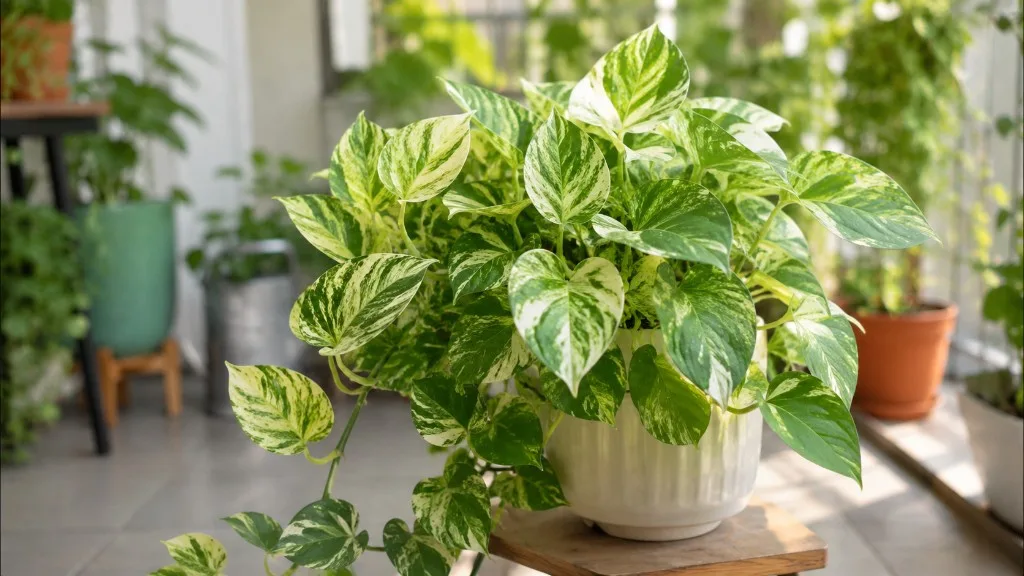
Manjula pothos fertilizer is one of those topics where species-level advice is almost right - and almost enough to damage a heavily variegated plant. Epipremnum aureum ‘Manjula’ (marketed as HANSOTI14, US Plant Patent PP27,117) is not a separate species and not a heavy feeder. The patent describes a slow, compact cultivar with distinctive green and yellow-green variegation, discovered as a branch mutation by Ashish Arvind Hansoti in 2010 (US PP27,117). Clemson HGIC lists Manjula among E. aureum cultivars as slower-growing, with broad upright leaves and coloring similar to Pearls and Jade but in a distinct patchwork pattern (Clemson HGIC - pothos cultivars). Those pale sectors contain far less chlorophyll than solid-green pothos tissue, which means Manjula builds new leaves more slowly, uses nutrients more conservatively, and shows fertilizer burn on white and cream patches before green areas when salts accumulate.
The practical default for most homes: balanced or foliage-weighted liquid fertilizer at half the label strength, every four to six weeks from mid-spring through early fall, applied only to moist soil, with a complete winter pause unless strong grow lights keep the plant actively producing variegated new growth.
Author: sai-ananth · Reviewed by: LeafyPixels Review Board · Updated: 2026-06-15
Methodology: recommendations here are checked against extension references (UF/IFAS EP151, Clemson HGIC, Wisconsin Horticulture), the HANSOTI14 patent description, and LeafyPixels Manjula Pothos overview care data before publication. Claims in this guide were fact-checked against authoritative sources; see the validation summary at the end of this file.
Manjula Pothos Fertilizer: Quick Answer
Feed Manjula Pothos during active growth - when you see new leaves unfurling with stable cream-and-green patterning - using a balanced water-soluble formula such as 10-10-10 or a foliage-weighted 3:1:2 ratio, diluted to half the bottle’s houseplant strength. For most indoor setups in bright indirect light, that means every four to six weeks from April through September, not every watering and not full label strength. Water the plant the day before or ensure the mix is already moist, then apply until a little drains from the bottom and discard saucer runoff. Pause entirely from late fall through winter in typical room-grown plants. Resume in spring when new variegated growth returns. Skip feeding for four to six weeks after repotting or whenever leaves show salt crust, sudden tip browning on pale sectors, or stress from drought, cold, or root problems.
If you need shared Epipremnum aureum biology and a longer genus-level schedule discussion, see our pothos fertilizer hub and golden pothos fertilizer guide. This page focuses on what changes for Manjula’s variegation, slower metabolism, and burn sensitivity.
Why Manjula Pothos Needs Lighter Feeding Than Green Pothos
Manjula belongs to the same species as Golden Pothos, Marble Queen, Neon, and Pearls and Jade - all are Epipremnum aureum cultivars in the arum family (NC State Extension - Epipremnum aureum). Clemson HGIC describes Manjula specifically as a slower-growing cultivar with broad, upright leaves, bushier habit, and coloring similar in palette to Pearls and Jade but with a distinct patchwork pattern rather than fine speckling (Clemson HGIC - pothos cultivars). That slower growth rate is not cosmetic. Less photosynthetic tissue per leaf means the plant pulls fewer nutrients per week than a solid-green Golden Pothos in the same pot and window.
Commercial interiorscape guidelines for Epipremnum recommend fertilizers with an N:P:K ratio of 3:1:2 or 3:1:3 because these are foliage crops, not flowering plants (UF/IFAS EP151 - Cultural Guidelines for Commercial Production of Interiorscape Epipremnum). The same publication notes that variegated cultivars lose color and produce smaller leaves when shade exceeds 80% - a reminder that fertilizer cannot fix low light. Manjula’s heavy white sectors make that relationship sharper: without adequate bright indirect light, the plant reverts toward green, grows even slower, and cannot use a monthly feeding schedule designed for fast vines in bright offices.
Conservative feeding is therefore a cultivar match, not timidity. Manjula tolerates skipped months far better than it tolerates salt buildup in a small pot. Wisconsin Horticulture Extension recommends fertilizing pothos every other month except during winter when the plant is not actively growing (Wisconsin Horticulture - pothos care). Clemson suggests every other month during spring and summer for pothos generally (Clemson HGIC). Those bi-monthly defaults align well with Manjula’s metabolism. Growers in bright light with fast dry-down may lean toward four-week intervals; dim-shelf specimens often do better at six to eight weeks - or not at all until light improves.
How Manjula’s White and Cream Variegation Changes Fertilizer Risk
Variegation is not just color. White and cream leaf sectors have reduced chlorophyll and therefore lower capacity to process sugars and tolerate physiological stress. UF/IFAS EP151 documents that burned, necrotic patches confined to variegated areas can result from high light or heat on variegated Epipremnum tissue (UF/IFAS EP151). The same pale tissue is often the first to show fertilizer salt damage indoors: margins crisp, patches brown, and newest leaves emerge smaller or with shrunken white sectors while green areas still look acceptable.
That pattern matters for diagnosis. If only the cream and white portions brown after a feed, suspect salt burn or concentrated application to dry roots, not sun scorch - unless the plant also sits in direct afternoon sun. If entire leaves yellow while soil stays wet, look at watering and roots before adding fertilizer. If new leaves emerge mostly green in a dim corner, the problem is almost always light, not hunger; feeding heavily in low light can accelerate reversion by pushing chlorophyll production without improving variegation stability.
Manjula’s variegation pattern - patchy swirls of cream, white, silver-green, and deep green with wavy leaf margins - is distinct from Marble Queen’s streaky two-tone marbling. For feeding purposes, treat Manjula like other high-variegation E. aureum selections: lighter doses, longer intervals, and success judged on newest leaves, not older vines that cannot recover lost white tissue.
Diagnostic photo - fertilizer burn on newest Manjula leaf: Cream and white patches along the wavy margin show dry brown speckling and crisped tips while adjacent green sectors still look plump. Soil rim may show white salt crystals. Timing: typically two to three weeks after a full-strength feed or a feed applied to dry soil. Original macro photos of this pattern on Manjula will be added to this guide in a future update.
Diagnostic photo - healthy variegation after conservative feeding: The youngest fully unfurled leaf shows stable patchwork of cream, silver-green, and deep green with flexible pale sectors and no brown edging. Prior leaf one node back may still show old burn - judge the newest leaf only. Original comparison photos will be added in a future update.
Editorial observation (June 2025): A 15 cm Manjula in bright east light showed pale-sector tip burn after one full-strength monthly feed. After three plain-water flushes and six weeks at quarter strength, the third new leaf unfurled with clean cream margins - confirming that recovery feedback lives on the youngest leaf, not older damaged tissue.
Sun Scorch vs. Fertilizer Burn on Pale Sectors
Both problems brown Manjula’s white patches, but the pattern, timing, and context differ enough to triage without guessing.
Fertilizer salt burn usually appears within two to three weeks of feeding, especially if the dose was full strength, the soil was dry at application, or the pot is small. Brown edges often follow leaf margins on pale sectors first, sometimes with white crust on the soil surface. Multiple leaves of similar age may show margin burn. The plant was recently fed or sits in old mix with accumulated salts. Flush protocol applies (University of Maryland Extension - Fertilizer Toxicity).
Sun scorch appears after light increases - a move to a south window, removal of a sheer curtain, or summer afternoon sun through glass. Damage is often bleached, tan, or papery patches on the sun-facing side of leaves, not uniform margin burn on every pale sector. Soil may look normal; feeding history is irrelevant. Fix by moving to bright indirect light per Manjula light guidance; do not flush for scorch alone.
Quick rule: Burn that tracks a recent feed + crusty soil = salts. Bleaching on the window side after a light move = scorch. When both apply - you fed heavily and moved to harsh sun - fix light first, then flush if crust remains.
Best Fertilizer Type and N-P-K for Manjula Pothos
The best Manjula pothos fertilizer for most homes is a complete water-soluble houseplant formula with nitrogen adequate for leafy growth, moderate phosphorus, and potassium for overall vigor. UF/IFAS commercial production uses 3:1:2 or 3:1:3 for Epipremnum (UF/IFAS EP151). At home, that translates cleanly to products labeled 9-3-6, 24-8-16, or the simpler 10-10-10 and 20-20-20 balanced liquids most growers already own.
What works well
- Balanced 10-10-10 or 20-20-20 liquid, diluted to half strength - simple and effective for foliage maintenance
- Foliage-weighted 3:1:2 formulas when you want nitrogen-forward feeding without bloom booster phosphorus
- Organic liquids such as diluted fish emulsion at half strength or weaker - gentler release, lower burn risk; apartment growers should note odor and apply near an open window
What to skip
- High-phosphorus bloom boosters - pothos rarely flowers indoors; excess phosphorus adds salts without matching metabolism
- Slow-release granules in small pots unless you stop liquid feeding for months - unpredictable release stacks with liquid feeds and burns variegated tissue first
- Foliar feeding as a routine - uneven coverage on wavy Manjula leaves creates spotted burn patterns and does not replace sound soil feeding
- Fertilizer-pesticide combos unless you have a diagnosed pest issue and follow label directions precisely
Liquid formulas win for Manjula because dose control matters. You can skip a month, dilute further after tip burn, and flush salts without digging products out of the soil. That precision suits a slow cultivar in a 15–20 cm pot far better than time-release pellets sized for floor palms.
Balanced 10-10-10 or 3:1:2 at Half Strength (Worked Dilution Example)
Half strength is the single most important number on this page. Houseplant labels often assume a range of species and pot sizes. Manjula in a container is a light to moderate feeder with high salt sensitivity on pale leaf tissue. Cutting the label rate protects roots and white variegation while still replacing what watering leaches away.
Worked example: Suppose your bottle reads 1 teaspoon (5 ml) per gallon (3.8 L) of water for houseplants.
- Full label strength: 1 tsp per gallon
- Half strength for Manjula: ½ tsp per gallon
- Quarter strength (reasonable after burn recovery or for dim-light plants): ¼ tsp per gallon
Measure with a spoon or syringe - not a splash from the bottle. Mix in a watering can, stir, and use immediately for soil application. For a 15 cm pot, you typically need enough solution to moisten the root ball thoroughly without flooding the saucer repeatedly; discard runoff so salts do not wick back.
If the label gives 1 tablespoon (15 ml) per gallon for outdoor annuals, half strength for Manjula is 1½ teaspoons (7.5 ml) per gallon - not the full tablespoon. When in doubt, go weaker and watch the next one or two new leaves for stable variegation rather than crisped white edges.
Seasonal Schedule: Spring Through Winter
Timing follows growth, not guilt. Feed when Manjula is producing new leaves with good turgor and stable variegation. Stop when growth stalls - even if old leaves still look fine.
| Month (temperate indoor climate) | Growth phase | Manjula feeding guidance |
|---|---|---|
| March–April | Waking up; first new leaves | Start half-strength liquid if active variegated growth is visible |
| May–August | Peak leaf production | Every 4–6 weeks in bright indirect light; 6–8 weeks in moderate or low light |
| September | Slowing | Taper to one light feed if still growing, or skip |
| October | Wind-down | Pause unless under strong grow lights with new shoots |
| November–February | Low growth typical indoors | No fertilizer for most setups |
| Late February–March | Spring return | Resume when new cream-and-green leaves appear |
This table reconciles monthly and four-to-six-week advice. Some pothos guides say “monthly in spring and summer.” Others, including our golden pothos fertilizer page, use four to six weeks for actively growing container plants. Both can be correct if strength and light match the plant. For Manjula, treat monthly at half strength as the upper limit in bright light - not a minimum. In moderate light, six-week intervals are often safer. Wisconsin Extension’s every-other-month rhythm (Wisconsin Horticulture) is a good starting point for dimmer homes.
Winter exception: If you grow under strong grow lights that keep Manjula pushing variegated new leaves through winter, you may feed lightly at half strength every six to eight weeks and watch for white crust on the soil. Even then, skipping winter feeds is safer than forcing growth with nutrients the roots cannot process (Clemson HGIC).
Step-by-Step: Fertilize on Moist Soil
Follow this seven-step routine each time you feed:
- Check the calendar and the plant. Confirm it is spring through early fall, or a grow-light winter exception with active new leaves. If the plant was repotted within four to six weeks, stop here.
- Inspect soil moisture. If the top 4–5 cm are dry, water with plain water first and feed the next day - never apply fertilizer concentrate to dry roots (Clemson HGIC).
- Look for salt crust - white crystals on the soil surface or rim - and tip burn on pale leaf sectors. If present, flush instead of feeding (see below).
- Mix fertilizer at half strength using the worked dilution above. Stir thoroughly.
- Apply evenly across the soil surface, not as a single dump on one side. Avoid splashing concentrate on leaves; wipe any spills on variegated tissue.
- Water until a little drains from the holes, then discard saucer water so concentrated salts do not re-enter the root zone.
- Log the date and watch the next unfurling leaf for variegation quality over the following two to three weeks - your best feedback loop.
Matching Feed to Light, Water, Soil, and Container Size
Fertilizer is the last variable to tune, not the first. Manjula only uses nutrients efficiently when light, watering, and soil already support slow, steady growth.
Bright indirect light, warm room, chunky aroid mix: Roots work actively; four- to five-week intervals at half strength are reasonable if new variegated leaves keep arriving. This is the closest scenario to generic “monthly in growing season” advice - but still not full strength.
Moderate north or east window: Growth is slower; stretch to six weeks or use Wisconsin’s every-other-month cadence. Watch for green reversion on new leaves before increasing feed frequency.
Dim shelf or interior office: Fix light before feeding. If you must feed at all, quarter to half strength every eight weeks at most - many dim-shelf Manjulas need no supplemental fertilizer in their first year if potting mix still carries starter charge.
Small pot (10–12 cm) vs large hanging basket: Small pots concentrate salts faster. Large pots dilute errors but stay wet longer - pair with airy mix and conservative feeding in both cases.
Hard tap water: Calcium and magnesium in hard water add to the salt load. If white crust appears despite conservative feeding, flush more often and consider filtered water for both watering and mixing fertilizer.
Signs Your Routine Is Working (Variegation on Newest Leaves)
Generic pothos advice says to look for “deep green leaves.” That misses Manjula entirely. Judge success on the newest fully unfurled leaves:
- Stable patchwork of cream, white, silver-green, and deep green - not solid green reversion in a bright spot
- Crisp but flexible pale sectors without brown speckling along margins
- Leaf size consistent with recent growth - not progressively smaller new leaves
- Internodes reasonably short for the light level - not stretched gaps with pale mini-leaves
- Soil surface free of heavy white crust; pot does not smell sour
- Vines lengthen slowly but steadily through summer - Manjula will never match Neon or Golden speed, and that is normal (Clemson HGIC - Manjula slower growth)
Older leaves do not regain white tissue lost to burn or age. Always read the youngest leaf after each feed cycle.
Over-Fertilizing, Salt Buildup, and Flush Recovery
Over-fertilizing is more common than under-fertilizing on Manjula. Symptoms include brown tips and patches on cream and white sectors first, white crust on soil, sudden leaf drop, stunted new growth with burnt edges, and wilting despite moist soil as roots die back from soluble salts (University of Maryland Extension - Fertilizer Toxicity).
Flush protocol
- Stop feeding immediately.
- Place the pot in a sink or tub. Run plain room-temperature water through the mix until it drains freely.
- Repeat two to three times, using roughly a pot volume of water per flush (University of Maryland Extension).
- Let the plant drain completely; empty saucers.
- Pause fertilizer four to six weeks. Resume at half strength - or weaker - only when the next new leaf looks clean.
For chronic tip burn, see our fertilizer burn problem page and brown tips guide. Consider repotting into fresh well-draining mix if three flushes over six weeks fail to stop new burn on successive leaves.
Do not stack a monthly feed and a monthly flush on autopilot. If crust returns quickly, the dose or frequency is too high - reduce feeding first; flush when crust or tip burn appears, or two to three times per growing season as preventive maintenance in hard-water homes.
Under-Fertilizing vs. Light, Water, and Root Problems
Pale, slow Manjula does not always need more fertilizer. Use this decision order before increasing dose:
- Light: Is the plant in bright indirect light? Low light produces pale, small, green-leaning leaves UF/IFAS associates with insufficient production light (UF/IFAS EP151).
- Water: Is soil staying wet too long or chronically dry? Both stall growth and mimic hunger.
- Roots: Any sour smell, mushy stems, or recent repot shock? Fix roots first.
- Age of mix: Has the plant been in the same peat-heavy mix 18+ months? Nutrients may be depleted - but salts may also be high; inspect before feeding.
- Season: Is it winter without grow lights? Slow growth is normal; do not force feed.
True under-fertilization on an otherwise healthy Manjula in bright light shows overall smaller new leaves, uniform paleness including green sectors, and very slow vine extension over many weeks - after light and water are confirmed good. Even then, increase interval conservatism (half strength, not double dose).
Clemson notes yellow leaves can reflect low fertility but also overwatering (Clemson HGIC). Yellowing with wet soil is not a fertilizer problem.
Deficiency vs. Burn vs. Low Light: Decision Table
| What you see | Soil / history | Likely cause | First action | Urgency |
|---|---|---|---|---|
| Brown only on cream/white sectors, margins crisp | Fed recently; possible crust | Fertilizer salt burn | Flush 2–3×; pause feed 4–6 weeks | Medium - stop feeding |
| Bleached tan patches on sun-facing side | Recent window move or curtain removed | Sun scorch | Move to bright indirect light | Medium - no flush needed |
| Mostly green new leaves in dim spot | Low light; may have fed recently | Light stress / reversion | Improve light; do not increase nitrogen | High - feeding worsens reversion |
| Uniform small pale leaves; no margin burn | Bright light; no feed in 6+ months | Possible under-fertilization | Half-strength feed after moisture check | Low |
| Yellow leaves; soil wet and heavy | Overwatering pattern | Root stress, not hunger | Fix watering and drainage | High |
| Wilting; soil wet; sour smell | Chronic soggy mix | root rot on Manjula Pothos | Stop feed; inspect roots | High - may need repot |
| White crust; brown pale sectors | Monthly feed + monthly flush cycle | Dose too high | Reduce feed interval/strength before next flush | Medium |
Common Manjula Pothos Fertilizer Mistakes
Feeding on a calendar without checking growth. Manjula in a dim room in July may not be growing fast enough to use monthly nutrients.
Using full label strength because “the bottle says houseplants.” Variegated cultivars in small pots need half strength or less.
Applying to dry soil after forgetting to water - concentrates burn at root tips and shows up on white leaf patches days later.
Chasing green reversion with nitrogen - high nitrogen pushes chlorophyll; it does not restore artistic variegation without better light.
Feeding immediately after repotting - roots need time to heal. Wait four to six weeks, matching commercial guidance to avoid stressing newly placed interiorscape plants (UF/IFAS EP151).
Ignoring runoff - saucer water wicks back and concentrates salts against variegated leaves’ root supply.
Monthly feed plus monthly flush on the same calendar - flushing is recovery, not permission to feed heavily. If salts rise fast enough to need monthly leaching, reduce the dose or frequency first.
Heavy nitrogen on a variegated cultivar - excess nitrogen in bright light can produce larger but greener new leaves with reduced white patch area. A balanced or 3:1:2 foliage formula at half strength matches UF/IFAS commercial Epipremnum guidance better than high-nitrogen lawn or tomato products (UF/IFAS EP151).
Nutrition sits on top of the rest of the care stack. Manjula watering that keeps soil soggy prevents roots from absorbing any fertilizer safely. Bright indirect light determines whether Manjula can metabolize feeds and hold variegation on new leaves. Chunky, well-draining soil buffers salt spikes and oxygenates roots between feeds.
Manjula Pothos vs Golden Pothos: Which Guide to Use
Use the golden pothos fertilizer guide for species-level E. aureum biology, longer flush protocols, and comparison when you grow multiple pothos cultivars. Use this Manjula page when you need variegation-specific burn patterns, slower-interval defaults, and success metrics based on cream-and-white newest leaves. Use the genus pothos fertilizer hub when you want shared schedule language across cultivars.
Manjula is not a heavier feeder than Golden Pothos - if anything, it needs lighter, less frequent feeding in the same home. Golden’s faster green growth can justify slightly shorter intervals; Manjula’s pale sectors punish salt mistakes first.
Cultivar Feeding Comparison Table
| Cultivar | Typical interval (bright indirect light) | Strength | Success metric | Burn pattern |
|---|---|---|---|---|
| Manjula | Every 4–6 weeks (6–8 in moderate light) | Half strength or weaker | Newest leaf cream/white sectors stable | Pale patches brown before green |
| Golden Pothos | Every 4–6 weeks | Half strength | New leaves firm, chartreuse variegation | Tips and margins on older leaves first |
| Marble Queen | Every 4–6 weeks; often every-other-month | Half strength; light-sensitive | White streaks stable on new leaves | High white areas burn under excess salts + low light |
| Pearls and Jade | Every 6–8 weeks typical | Half strength | Speckled pattern on small leaves | Similar to Manjula; smaller leaf mass |
Repotting, Propagation, and When to Pause Feeding
After repotting: Hold fertilizer four to six weeks while roots establish (UF/IFAS EP151). Fresh mix often includes starter fertilizer anyway. See our repotting guide for timing and mix.
During propagation: Rooted cuttings in water do not need fertilizer until they transition to soil and show new growth. Soil propagations get no feed until the mother plant would be fed - usually several weeks after roots set. Details on our propagation page.
During stress: Skip feed for drought recovery, cold damage, pest treatment, or major pruning until new leaves appear.
Pet and child safety: Manjula Pothos is toxic to cats and dogs. Like other Epipremnum aureum cultivars, it contains insoluble calcium oxalate crystals that cause oral irritation, drooling, vomiting, and difficulty swallowing if chewed (ASPCA - Golden Pothos). Concentrated fertilizer solution and crusty soil are also unsafe if ingested. Keep plants, runoff, and stored products out of reach; contact your veterinarian if symptoms appear after plant ingestion. For concentrated fertilizer ingestion, contact Poison Control (US) or your local poison helpline.
Frequently Asked Questions
Does Manjula Pothos need fertilizer?
Yes, but lightly. Manjula benefits from conservative feeding during active growth in spring and summer because container watering leaches nutrients over time. It is not a heavy feeder, and heavy white variegation means it uses nutrients more slowly than solid-green pothos. Skip fertilizer in fall and winter when growth slows, and never feed a stressed, dry, or newly repotted plant until stable new variegated leaves appear.
How often should I fertilize Manjula Pothos?
Feed every four to six weeks from mid-spring through early fall with half-strength balanced or foliage-weighted liquid fertilizer when the plant is actively producing new cream-and-green leaves. In moderate or low light, stretch to every six to eight weeks or follow an every-other-month rhythm. Pause entirely in late fall and winter for typical indoor setups. Resume in spring when new variegated growth returns.
What type of fertilizer is best for Manjula Pothos?
Use a complete water-soluble houseplant formula such as 10-10-10 or 20-20-20, or a foliage-weighted 3:1:2 ratio matching UF/IFAS commercial Epipremnum guidelines, always diluted to half the label strength for houseplants. Avoid high-phosphorus bloom boosters and routine slow-release granules in small pots. Organic liquids like diluted fish emulsion work if applied conservatively.
Why are the white parts of my Manjula leaves browning after I fertilized?
Pale cream and white sectors often show fertilizer burn before green tissue because they have less chlorophyll and tolerate salt stress poorly. Common causes are feeding at full strength, applying to dry soil, feeding too often in a small pot, or winter feeding when the plant is not growing. Flush the soil with plain water two to three times, pause feeding four to six weeks, and resume at half strength or weaker only when the next new leaf unfurls clean. If browning is bleached and sun-facing only after a window move, treat as sun scorch - improve light quality, not flush.
Should I use this guide or the golden pothos fertilizer page?
Use this Manjula guide for variegation-specific burn patterns, slower feeding intervals, and success metrics based on newest cream-and-white leaves. Use the golden pothos fertilizer guide for broader Epipremnum aureum biology, detailed flush protocols, and comparison when you grow multiple cultivars. Use the genus pothos fertilizer hub for shared schedule language. Manjula generally needs lighter, less frequent feeding than fast-growing golden pothos in the same home.
Conclusion: When to Flush, Repot, or Switch Guides
Use this escalation ladder when Manjula’s pale sectors brown after feeding or growth stalls despite good care:
- First-line - flush and pause: Brown only on cream/white after a recent feed, with or without soil crust → flush two to three times, pause feed four to six weeks, resume at quarter to half strength. Stay on this Manjula guide.
- Second-line - fix the care stack: Green reversion, pale small leaves in a dim spot, or yellowing on wet soil → improve light and watering before any dose increase. Feeding harder will not restore white patches in low light.
- Third-line - repot: Three flushes over six weeks still produce burnt newest leaves, sour soil smell, or crust returns within days → repot into fresh chunky mix, trim mushy roots, hold feed four to six weeks. See repotting.
- When to open the golden pothos guide: You need genus-level flush math, grow multiple pothos cultivars, or want the full E. aureum comparison framework → use golden pothos fertilizer alongside this page. Manjula-specific intervals and burn-on-pale-sector logic stay here.
Manjula rewards patience measured on the newest leaf, not vine length. Half strength, moist soil, and a winter pause beat a calendar copied from faster green cultivars every time.
When to use this page vs other Manjula Pothos guides
- Manjula Pothos overview - Start here for whole-plant context before deep-diving this topic.
- Manjula Pothos problems hub - Jump to symptom-specific fix guides when this care topic does not resolve the issue.
- Fertilizer Burn on Manjula Pothos - Escalate here when fertilizer adjustments are not enough.
- No Flowers on Manjula Pothos - Escalate here when fertilizer adjustments are not enough.
- Nitrogen Deficiency on Manjula Pothos - Escalate here when fertilizer adjustments are not enough.
Related Manjula Pothos guides
- Manjula Pothos overview
- Manjula Pothos watering
- Manjula Pothos light
- Manjula Pothos soil
- Manjula Pothos propagation
- Manjula Pothos repotting
- Fertilizer Burn on Manjula Pothos
- No Flowers on Manjula Pothos
- Nitrogen Deficiency on Manjula Pothos
- Manjula Pothos problems
Related tool
Try the Fertilizer Dilution Calculator with manjula-pothos pre-selected to estimate needs for your setup.