How to Propagate Manjula Pothos: Stem Cuttings Step by Step
How to Propagate Manjula Pothos: Stem Cuttings Step by Step
How to Propagate Manjula Pothos: Stem Cuttings Step by Step
Manjula pothos propagation turns one painterly trailing vine into several matching plants - the practical reason collectors root this cultivar. A short stem section with a sound node can form adventitious roots in warm, bright conditions within one to three weeks, sometimes a bit slower than all-green golden pothos because cream and white leaf sectors carry less chlorophyll . Clemson Cooperative Extension lists Manjula among patented Epipremnum aureum cultivars and confirms that stem cuttings in water or soil need at least one node to root properly. University of Vermont Extension groups pothos among vining houseplants that root easily in water. Whether you are cloning variegation for a fuller basket, refreshing a leggy parent, or sharing a cutting with a friend, success depends on clean cuts, submerged nodes, and steady warmth without soggy stagnation - not on a secret technique.
The two dependable home methods are stem cuttings in water and stem cuttings in moist perlite or airy soilless mix. Both produce vegetative clones that duplicate the parent’s marbled cream, white, and green pattern - the whole point of propagating Manjula rather than buying another golden pothos. Seeds do not preserve a specific cultivar look; cuttings do. Water gives visible roots and easy monitoring; soil or perlite gives a smoother path into long-term potting mix. For shared Epipremnum mechanics, see the golden pothos propagation guide; this page focuses on Manjula variegation, patent context, and cultivar-specific decisions.
Reviewed by LeafyPixels Review Board · Methodology: recommendations checked against extension references and LeafyPixels plant-care data · Last reviewed 2026-06-15
Why Manjula Pothos Is Worth Propagating (Variegation Cloning)
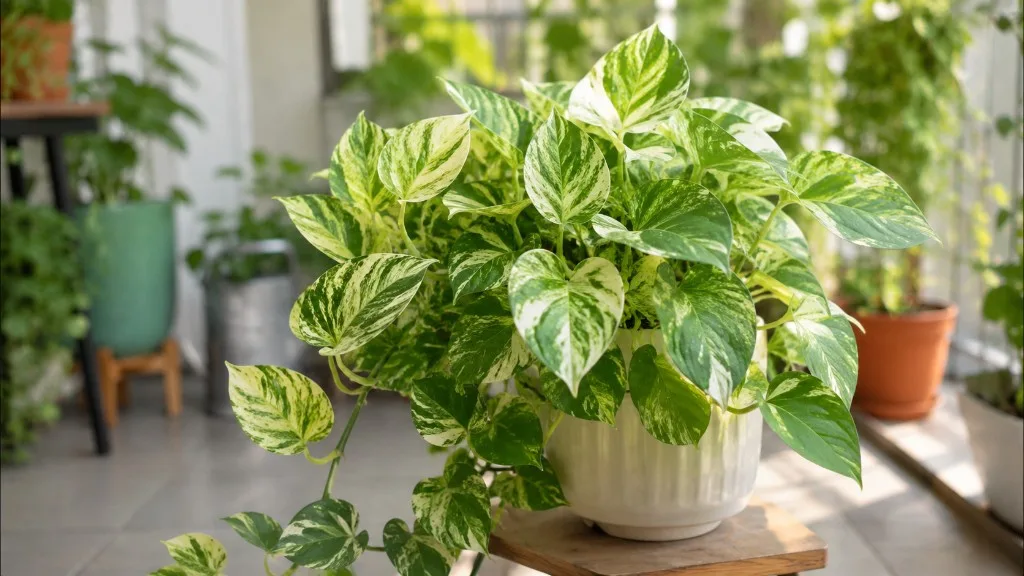
Manjula pothos (Epipremnum aureum ‘Manjula’, also sold as HANSOTI14) is a trailing Araceae vine with broad, softly wavy leaves marbled in cream, white, silver, and green. Unlike uniform golden pothos, each Manjula leaf varies - wide green patches on one, heavy flecking on the next - which makes vegetative cloning the only reliable way to duplicate a look you love. Clemson Cooperative Extension describes Manjula as a patented cultivar (PP27,117) discovered in India, with painterly variegation that collectors propagate to preserve.
Propagation also solves display problems specific to trailing Manjula specimens. Long bare internodes between leaves usually mean the plant wants stronger light or pruning - not more fertilizer. Rooting leafy tip cuttings or dividing a long vine into node sections lets you replace leggy growth with compact new pots while keeping the same variegation pattern. Take two or three cuttings rather than one when variegation quality matters; redundancy costs only an extra jar and protects against a single failed stem.
How Manjula Stem Propagation Works
Stem propagation asks wounded tissue to prevent water loss through leaves while building a new root system from nodes along the stem. A Manjula cutting without roots still transpires moisture from its broad leaf surfaces, including cream sectors that photosynthesize less efficiently than all-green tissue. If it loses water faster than the stem can replace, it wilts, yellows, or rots at the submerged end. Your setup must close that gap: enough leaf area for modest photosynthesis, enough water contact or soil moisture at the node, and enough oxygen that microbes do not consume the cutting before roots appear.
Adventitious roots form from cells at or near nodes - the joints where leaf petioles attach to the stem. On Manjula, nodes look like slight swellings, sometimes with small brown aerial root nubs already visible along the vine. Submerging or burying at least one node gives root initials a place to emerge. Upper leaves continue modest gas exchange, supporting rooting before the new root system is functional. Smooth internodal stem between nodes does not reliably produce roots and will soften underwater without a node at that level.
Nodes, Aerial Roots, and What Actually Roots
A node is non-negotiable. A Manjula leaf detached with no stem segment - or a stem segment with no node - may stay green for weeks but cannot become a full vine. This is the most common beginner mistake: a pretty leaf in water and months of waiting for a plant that never arrives. Clemson Cooperative Extension states plainly that pothos cuttings need at least one node to root properly in water or soil. If a leaf breaks off with a tiny stem piece that includes a node, treat it as a very short node cutting; a leaf alone is not a propagation method.
For a standard tip cutting, aim for two or more nodes on the portion you will submerge or bury. Keep the top one or two leaves and remove everything on the lower half that would sit underwater or underground. Manjula leaves are broader than golden pothos; you rarely need to halve them unless the cutting is very short. If aerial roots are already present at a node, include that node in the submerged zone - those tissues often extend into water roots faster than a node never exposed to humidity.
Choosing the Best Manjula Pothos Cuttings
Start with a healthy parent plant actively growing, not drought-stressed, pest-ridden, or recovering from root rot. Manjula shows stress through limp leaves, faded variegation, and stalled tips. Weak parent tissue produces weak cuttings. If the plant looks tired but you still want to try, take material from the firmest new growth at the vine tip rather than woody lower sections with long bare internodes.
Prefer vines with firm stems, normal marbled variegation for the cultivar, and no black mushy spots at nodes. Avoid stems with recent sun scorch, mechanical damage, or pest residue. When cloning a specific variegation pattern, select cuttings from vines whose leaf coloring you want to duplicate - heavily cream-splashed parents tend to produce similarly patterned offspring, while cuttings from reverted all-green sections root into plain green vines.
Which Vines to Cut and Which to Skip
Take cuttings from terminal shoots - soft growing tips - or from mid-vine sections when deliberately dividing a long trailing plant into multiple starts. Arkansas Cooperative Extension advises a healthy 2- to 4-inch terminal cutting with several leaves, cut just below a node; home growers often take 4- to 6-inch (10–15 cm) sections to capture two or three nodes. Make the cut with a sharp, clean blade so you do not crush stem tissue.
Reject stems that are mushy, blackened at the base, coated in sticky residue, or chewed by pests. Avoid cuttings taken immediately after the parent sat in bone-dry soil or waterlogged anaerobic mix. When refreshing a leggy Manjula, cut the long bare vine into individual node sections, each with one leaf if possible, rather than trying to root a foot of leafless internode - that tissue lacks the nodes roots need and tends to rot.
Best Timing for Manjula Pothos Propagation
Manjula pothos roots fastest during active growth, when temperatures are warm and days are reasonably long. Propagate during active growth in spring and summer when light and warmth support rooting. Room temperatures roughly 18–29°C (65–85°F) - the same comfort range Manjula prefers in mature care - support steady rooting better than a cold windowsill that drops at night.
Use plant readiness, not only the calendar. The parent should show firm new tips, stable variegation, and no active pest outbreak. If the plant is mid-recovery from Manjula Pothos repotting guide, shipping, or severe wilt, wait until new growth looks stable. You can propagate year-round indoors if light and warmth stay consistent, but most growers see the fastest water roots in late spring and summer when the parent is already pushing new leaves.
Tools, Materials, and Safety During Propagation
You need very little equipment: sharp bypass pruners or scissors, a clean jar or small pots with drainage holes, fresh water or moist propagation mix, optional clear plastic bag or dome for soil-method humidity, labels if running multiple batches, and 70% isopropyl alcohol for disinfecting blades. Bypass cuts heal cleaner than crushing anvil pruners on soft stems. Disinfect before cutting and between plants if pests or rot have been an issue.
For water propagation, any clear glass or jar works if it supports the cutting without submerging leaves. For soil propagation, use a light, airy mix - straight perlite, half perlite and half peat or coco coir, or standard potting mix amended heavily with perlite per the Manjula soil guide. Dense garden soil stays wet too long and invites stem rot at the node.
Keep cuttings away from pets and children. The ASPCA lists Epipremnum aureum as toxic to dogs and cats, with ingestion causing oral irritation, vomiting, and difficulty swallowing due to calcium oxalate crystals in the sap. Wear gloves if sap irritates your skin when trimming stems. Place jars and rooting trays out of reach and discard trimmings promptly.
Preparing Manjula Pothos Cuttings Step by Step
Preparation is where propagation succeeds or fails before the cutting meets water or soil. Work on a clean surface, assemble containers first, and decide water versus medium before you cut - fresh wounds should not sit on the counter while you hunt for a jar.
Step 1: Select and cut. Choose a healthy vine and cut 4 to 6 inches (10–15 cm) of stem - or shorter node sections when dividing a long vine - slicing just below a node at a clean single cut. Avoid sawing or tearing.
Step 2: Strip lower leaves. Remove all leaves from the lower half of the cutting. Any leaf sitting in water will rot and foul the jar within days. Any leaf pressed into wet soil without airflow can mildew.
Step 3: Confirm node placement. Identify at least one node on the submerged portion; two or three nodes improve redundancy. If aerial roots are present, orient that node into the water or medium.
Step 4: Rooting hormone (optional). Manjula pothos roots readily without hormone. Iowa State University Extension lists rooting powder as optional for stem cuttings generally; easy rooters like pothos succeed without it.
Step 5: Insert immediately. Place the cutting in water or pre-moistened medium within minutes. Delay increases dehydration and contamination risk.
Method 1: Water Propagation Step by Step
Water propagation is the most visible route and the one University of Vermont Extension recommends for vining plants including pothos. You can watch roots emerge, catch stem rot early, and share the process without mixing soil indoors. The trade-off is a water-to-soil transition later, because roots formed in water are adapted to aquatic oxygen levels and can struggle if moved to dense wet soil without acclimation.
Place the cutting in enough water to cover the zone where lower leaves were removed, ensuring at least one node is fully submerged while all leaves stay above the waterline. Use room-temperature water - tap water is fine in most municipalities. Set the jar in bright, indirect light, not direct midday sun that overheats the water, promotes algae, and can bleach cream variegation.
Water Changes and Root Monitoring
Choose a container you can keep clean. Algae and bacterial film accelerate rot. Change water when it looks cloudy, smells stale, or develops slime on the glass; many successful growers change it every three to seven days, while others top up evaporation and replace only when quality declines. Remove any leaf that falls into the water immediately.
Expect visible root initials in about one to three weeks under warm, bright conditions - sometimes toward the longer end for heavily variegated Manjula cuttings with large cream sectors. University of Florida IFAS cites roughly three to four weeks for commercial pothos rooting under production conditions; home growers in warm rooms often see roots sooner. Cool rooms, dim corners, or stressed cuttings stretch that schedule. Do not fertilize the water; the cutting is not ready to metabolize salts until it has roots and later soil.
When roots reach roughly 2.5 cm (1 inch) long - some growers pot at 1.3 cm (½ inch) to ease the soil transition - the cutting is ready for transplant. Waiting until water roots grow 10 cm (4 inches) or more often makes the shift to soil harder.
Method 2: Soil or Perlite Propagation Step by Step
Soil - or more accurately, a soilless propagation medium - hides roots but produces them in conditions closer to the final pot. Iowa State University Extension recommends inserting stem cuttings into moist medium with one or two nodes buried and checking progress after several weeks. Roots typically form in three to five weeks in medium, somewhat slower than water in many homes, but transplant shock is often lower.
Fill a small pot or tray with pre-moistened perlite or perlite-heavy mix. Use a pencil to make a planting hole so you do not scrape tissue off the stem when inserting. Bury at least one node; two nodes below the surface improves redundancy. Firm the medium lightly so the stem stands upright without packing so tightly that air is excluded.
Water once to settle the medium, then manage moisture so it stays evenly damp like a wrung-out sponge, never saturated mud. Use pots with drainage holes. A clear plastic bag or humidity dome over the pot - supported so plastic does not touch leaves - reduces wilting during the first week. Vent daily to prevent mold. After three to four weeks, give the stem a very gentle upward tug; resistance suggests roots have anchored.
Water Versus Soil for Manjula Cuttings
Both methods work for Manjula pothos. Your choice should match how you like to monitor progress and how soon you need a potted plant.
| Factor | Water rooting | Soil or perlite rooting |
|---|---|---|
| Root visibility | Excellent | Limited unless you unwrap |
| Typical speed in warm homes | Often 1–3 weeks | Often 3–5 weeks |
| Rot risk | Stagnant water, submerged leaves | Oversaturated compacted mix |
| Transition step | Required before long-term potting | Usually minimal |
| Best for | Beginners, visual learners, quick shares | Growers who want direct potting |
| Variegation watch | Easy to inspect stem health | Harder until tug test |
Choose water if you want fast feedback or plan to pot within weeks. Choose soil or perlite if you dislike water changes or tend to leave cuttings in jars too long. Many experienced growers root in water for speed, then pot into mix once roots are 1–2.5 cm (½–1 inch) long.
When to Transplant from Water to Soil
Moving a water-rooted Manjula to soil is where many projects fail - not because roots were absent, but because the pot stayed too wet after transplant. Use a small pot with drainage, roughly 9–10 cm (3.5–4 inches) for a single cutting, filled with moistened well-draining mix matching the Manjula soil profile. Make a hole, place the cutting so roots hang naturally, and backfill gently. Bury the node that was submerged in water.
Water once to settle the mix, then allow the top 2–3 cm to approach dryness before watering again - young transplants need a slightly gentler version of the Manjula watering rhythm. Water-rooted pothos is easy to overlove; drowning new roots recreates anaerobic conditions similar to stagnant jar water. Expect temporary wilt for a few days after transplant, especially from water roots, but new growth should resume within one to two weeks in bright indirect light. Hold fertilizer until fresh leaves open.
Building the Right Rooting Environment
Roots respond to warmth, light, oxygen, and stable moisture more than to secret additives. A cutting on a bright kitchen counter at 21°C (70°F) usually outperforms a darker shelf with rooting powder but cold nights.
Light, Temperature, and Humidity for Rooting
Place cuttings in bright, indirect light. An east window, a few feet back from a south window behind sheer curtain, or a moderate grow light works well. Direct sun through glass can overheat water jars and bleach Manjula’s cream variegation before roots form. Too little light slows rooting and encourages variegation reversion - new growth pushes greener as the cutting struggles for energy. That is a critical Manjula-specific risk: cuttings rooted in dim corners often produce plainer green leaves even when the parent was heavily marbled.
Keep temperatures above about 18°C (65°F) and ideally near 21–27°C (70–80°F) for fastest results. RHS notes pothos prefers warm room conditions generally. Humidity matters most for soil-rooted cuttings without domes and for cuttings in very dry air-conditioned rooms; grouping jars together or keeping cuttings away from heating vents reduces edge wilting.
Aftercare for Newly Rooted Manjula Plants
During rooting, patience beats interference. Do not pull cuttings daily to photograph roots. Do not increase water when progress seems slow unless leaves are visibly limp. For water jars, stability matters; for soil, consistent light moisture matters more than a rigid schedule.
After transplant, treat young Manjula like a gentler version of the parent: bright indirect light, soil that dries partially between waterings, and protection from cold drafts. Wait until new top growth is obvious - often two to four weeks post-transplant - before feeding with a dilute balanced fertilizer at half strength per the fertilizer guide.
Watch the variegation on first new leaves as your success signal. Healthy Manjula cuttings in adequate light should open leaves with some cream or white patterning similar to the parent. If new leaves emerge solid green, move the plant to brighter indirect light before the vine fully reverts. Pinch the tip once rooted and growing if you want a bushier pot rather than a single long runner. Rooting several cuttings in one pot produces a fuller display faster - useful when replacing a leggy parent.
Signs Propagation Is Failing (and What to Do)
Most failures trace to missing nodes, contaminated water, submerged leaves, cold, dim light, or oversaturated mix - not to Manjula being difficult. Diagnose from the stem and leaf, not from impatience alone.
Black mushy stem base in water means rot. Discard the soft portion, recut to healthy tissue above the next node if enough stem remains, clean the jar, and restart with fresh water. If rot repeats, switch to perlite method or improve warmth and light.
Green stem but no roots for weeks usually means the node was not submerged or the cutting lacks a node entirely. Confirm a node sits below the waterline.
Wilting with firm stem often indicates low humidity or excessive leaf surface for the root system. Move away from dry heat vents or use a humidity dome for soil cuttings.
Cream sectors browning while stem stays firm can mean the cutting is losing moisture faster than roots replace it - common on heavily variegated material in dry air. Improve humidity slightly and ensure only one or two leaves remain on the cutting.
New growth solid green in low light signals variegation reversion, not rooting failure. Move to brighter indirect light promptly; reverted sections will not regain marbling on old leaves, but new leaves can show pattern again if light improves.
When rot and wilting coincide, start over with a new section from a healthier vine rather than nursing a slimy stem for weeks.
Manjula vs Golden Pothos Propagation
Manjula and golden pothos share the same Epipremnum aureum stem-cutting biology - nodes, water rooting, soil rooting, and the single-leaf myth all apply equally. Golden pothos often roots slightly faster because its leaves carry more green photosynthetic tissue; Manjula’s broad cream and white sectors can slow energy production during rooting, so expect timelines toward the longer end of the one-to-four-week range in identical conditions. Golden pothos is more forgiving of dim rooting corners; Manjula cuttings in low light are more prone to reversion toward plain green growth.
The practical difference is why you propagate: golden pothos for reliable fast fills; Manjula to clone a specific marbled pattern you cannot buy cheaply off a generic nursery bench. For step-by-step Epipremnum mechanics with additional extension detail, cross-reference the golden pothos propagation guide.
Know Your Plant: Epipremnum aureum ‘Manjula’
Manjula pothos (Epipremnum aureum ‘Manjula’, patented as HANSOTI14, PP27,117) is a trailing patented cultivar discovered in India, with moderate growth and vines that can reach up to 2 m (about 6–7 feet) trailing length indoors - far less than the 40-foot potential NC State cites for favorable tropical conditions, but enough that mature specimens need periodic pruning. Young Manjula plants often look fuller and more mounded than standard trailing pothos before long vines develop.
Manjula is protected by a U.S. plant patent held by the breeder’s licensing chain (Costa Farms distributes it commercially). Personal home propagation for your own collection is standard practice among houseplant growers; commercial propagation or resale of patented plants without a license violates patent law. This guide addresses home propagation only.
For ongoing care after rooting, see the Manjula pothos overview, plus dedicated guides on light, watering, soil, and pruning. If problems appear post-transplant, check root rot, leggy growth, not enough light, and wilting before changing several variables at once.
Conclusion
Propagating Manjula pothos from stem cuttings with nodes is straightforward because the plant shares golden pothos biology: take a 4–6 inch section with at least one node (two or three is better), remove lower leaves, and root in clean water or moist perlite-heavy mix in warm bright indirect light. Water gives speed and visibility; soil gives a head start on long-term potting conditions. Transplant when roots are about 1–2.5 cm (½–1 inch) long, keep the first pot small and well drained, and watch variegation on new leaves as proof that light is adequate.
Whether you are cloning a favorite marbled pattern, filling a hanging basket, or turning one leggy vine into several fresh starts, the logic stays the same - healthy material, submerged nodes, clean conditions, moisture without stagnation, and enough light to preserve Manjula’s painterly variegation. Master that chain and propagation becomes one of the most reliable skills in your Manjula care toolkit.
When to use this page vs other Manjula Pothos guides
- Manjula Pothos overview - Start here for whole-plant context before deep-diving this topic.
- Manjula Pothos problems hub - Jump to symptom-specific fix guides when this care topic does not resolve the issue.