Heat Stress on Manjula Pothos: Causes, Checks & Fixes
Quick answer
On Manjula Pothos, heat stress usually shows as papery brown cream margins and afternoon wilt on the vine touching sun-heated glass-while soil in the top 3–5 cm stays moist. First step: move the pot away from hot windows, vents, and radiators before you change watering.
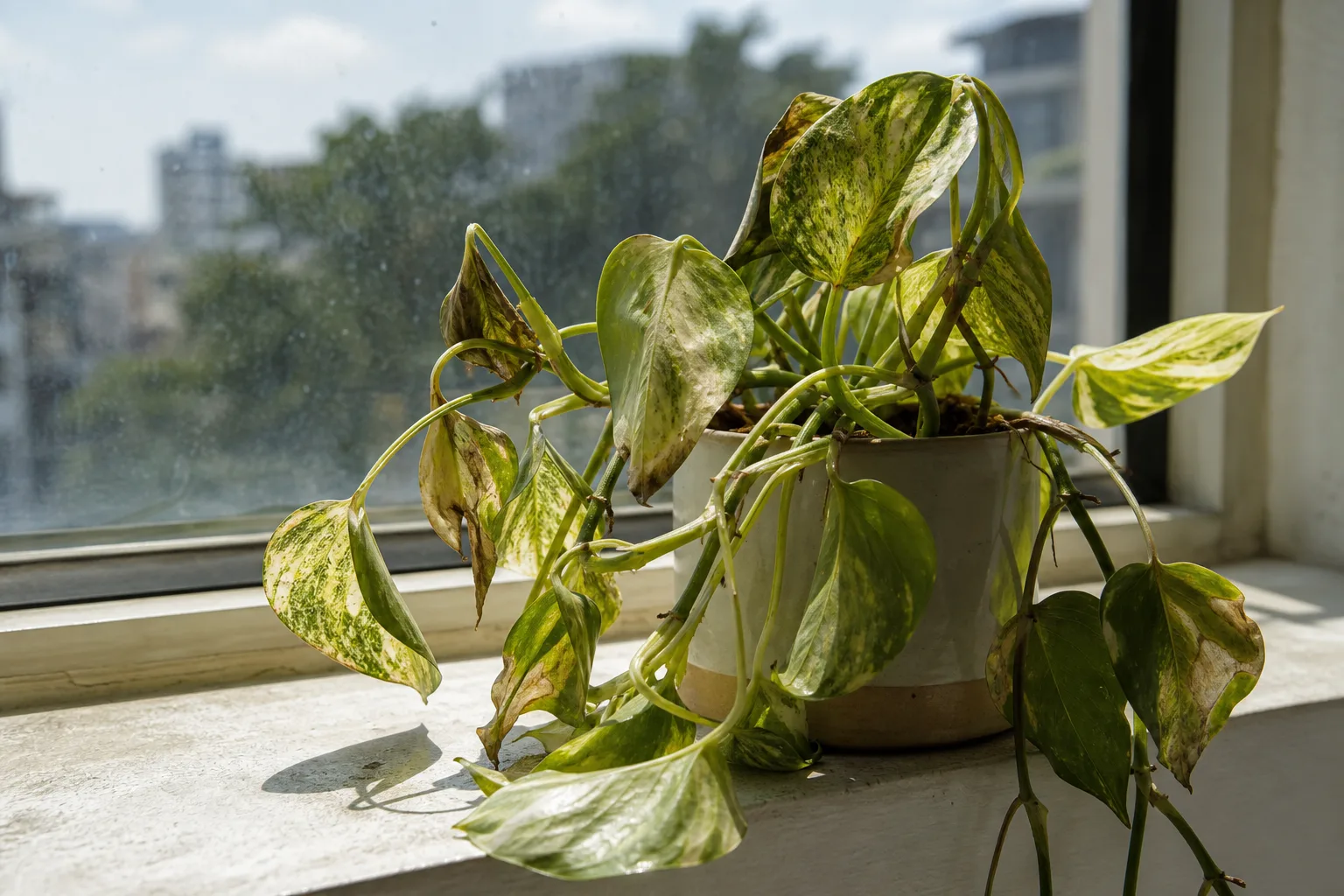
Heat Stress on Manjula Pothos: Causes, Checks & Fixes
This guide covers heat stress on Manjula Pothos. See also the general Heat Stress guide, watering, and light pages for this plant.
Heat Stress on Manjula Pothos: Causes, Checks & Fixes
Quick answer
Manjula Pothos (Epipremnum aureum ‘Manjula’, HANSOTI14 / PP27,117) is built for bright rooms-not hot micro-climates. Its broad, wavy leaves expose more cream and white surface area than flat golden pothos foliage, so pale variegation scorches to papery brown while green tissue still looks firm. Afternoon wilt on moist soil is the other hallmark.
First step: move the pot to a cooler, stable spot away from sun-heated window glass, radiators, and heat vents, with bright indirect light but no direct afternoon sun. Leave your watering rhythm unchanged until the plant sits in stable air for several days.
Warning: Do not water heavily when soil is already moist. Heat-wilted Manjula in soggy warm mix is the fastest path to root rot-not recovery from afternoon droop.
Use this page when cream margins brown on the outer vine while stems stay firm. For whole-vine collapse with soft nodes, see wilting. For bone-dry soil wilt, see underwatering. Generic pothos heat biology also lives on our pothos heat-stress guide-this page covers Manjula variegation scorch and slower recovery only.
What heat stress looks like on Manjula Pothos
Heat damage on Manjula is localized and timing-dependent, not a sudden whole-plant collapse-unless the plant cooked in a closed car or against blazing glass.
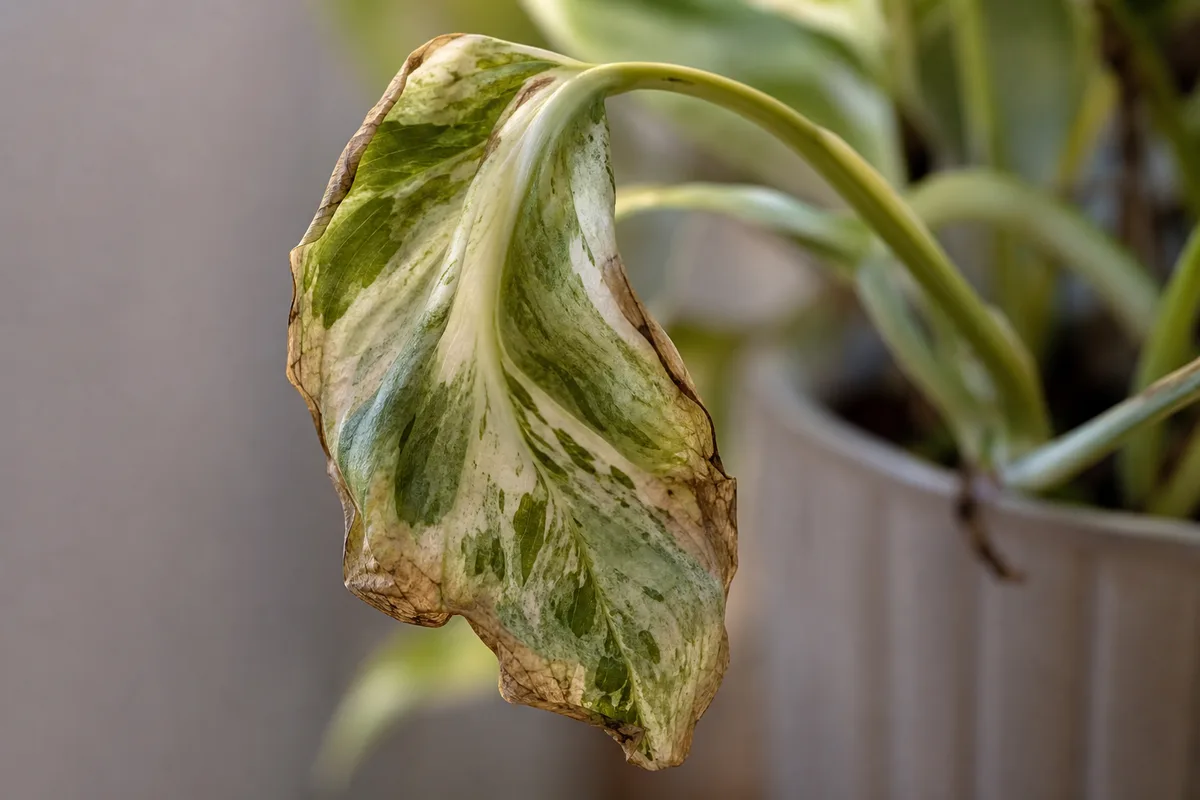
Heat Stress symptoms on Manjula Pothos - compare with healthy tissue on the same plant.
Typical signs include:
- Afternoon wilting that eases overnight when the room cools, while soil in the top 3–5 cm still feels lightly dry to normal-not bone dry throughout
- Crispy tan or brown edges on cream and white variegation before solid green areas brown
- Bleached, papery patches on the palest sections facing a window
- Leaf curl or slight cupping on exposed vines during the hottest hours
- Scattered brown patches in leaf centers after a sudden drop from extreme heat to air-conditioned cool-abrupt temperature swings can cause scattered brown patches on pothos leaves
- Premature yellowing and drop of older leaves on the most exposed vine after several hot days
- Damage clustered on the side nearest a west-facing window, radiator, or heat register
What heat stress does not look like: sour-smelling wet soil with mushy stems, uniform underwatering wilt with dust-dry mix top to bottom, sticky residue with stippling (spider mites), or black spreading spots with yellow halos (disease).
Manjula’s wavy, heart-shaped leaves carry more exposed variegated surface than compact golden pothos. White and cream tissue lacks chlorophyll and loses water and overheats faster than green sections-so heat scorch often appears as a variegation problem before the whole vine looks distressed. On a trailing basket, the outer vine resting on sun-heated west glass is the classic first casualty while inner stems stay untouched.
Why Manjula Pothos gets heat stress
Pothos evolved in warm, humid tropical understories. Indoors, Manjula performs best between roughly 70°F to 85°F during the day (about 18–29°C) with bright indirect light. Extended exposure above about 32°C (90°F), especially with low humidity or direct sun, pushes the plant past what its leaves can regulate.
Variegation tissue overheats first
Chlorophyll-deficient cream and white zones cannot photosynthesize or cool themselves as efficiently as green tissue. When heat and light stack on a west sill, pale margins desiccate hours before green centers show stress-unlike solid-green Golden Pothos on the same windowsill, where damage spreads more evenly.
Manjula vs. Golden Pothos recovery speed
Manjula is a patented cultivar with broad, upright leaves and a slower growth habit than most pothos. That slower replacement rate-documented on the PP27,117 cultivar-means scorched leaves linger visually even after you fix the environment. Cosmetic trimming patience runs longer here than on neon or golden pothos.
Manjula-specific heat triggers stack quickly:
- South- or west-facing window glass that heats foliage like a greenhouse panel by mid-afternoon
- Heat vents and radiators blowing dry warm air across trailing vines-hot air can dry leaves and damage plant cells
- Dark pots on sunny sills where the root zone overheats even when air temperature seems acceptable
- Summer relocation from a shaded nursery bench to a bright windowsill without acclimation
- Hot cars or porches during transport-Manjula replaces damaged leaves less quickly than faster cultivars
- Combined heat and direct sun-Manjula needs bright light for variegation but does not tolerate much direct sunlight; heat plus UV scorches pale sections within hours
- Hanging-basket dynamics-trailing vines draped against glass heat faster than the pot core; the damage face may be the only vine you see from across the room
Dry air amplifies heat stress. When humidity drops during heat waves-common with air conditioning-leaves lose moisture faster. Spider mites also multiply faster when humidity is low and temperatures are warm, and their stippling can overlap with heat damage on stressed vines.
Symptom lookalike comparison table
| Pattern | Soil / stems | Timing | Key Manjula cue | Next page |
|---|---|---|---|---|
| Heat stress | Moist top 3–5 cm; firm stems | Afternoon wilt, overnight recovery | Cream margins brown before green | This page |
| Underwatering | Bone dry throughout; light pot | All-day wilt until watered | Even variegation collapse, not one-sided | Underwatering |
| Overwatering / rot | Wet, sour; soft nodes | Worsens daily | Yellow from petiole up, not papery cream only | Overwatering |
| Direct sun scorch | Normal moisture | After light move | Large bleached patches, moderate temps | Light guide |
| Low humidity | Normal moisture | Winter heating | Even tip burn, no afternoon cycle | Low humidity |
| Spider mites | Normal moisture | Dry warm corner | Stippling, webbing, gritty undersides | Spider mites |
| Not enough light | Normal moisture | Weeks in dim spot | New growth mostly green, not papery scorch | Not enough light |
How to confirm heat stress is the cause
Work through these checks in order:
- Timing pattern - Note whether wilting appears only in late afternoon and improves by morning. That daily cycle fits heat; wilt that never eases suggests watering or root problems.
- Placement audit - Map every heat source within a metre of the pot: window glass, radiator, oven-adjacent counter, heat register, grow-light panel, or reflected warmth from dark surfaces.
- Pot temperature test - Touch the container exterior at midday. Uncomfortably hot sides mean roots are stressed even if the room thermostat reads normal.
- Soil moisture check - Insert a finger into the top 3–5 cm. Moist or normally drying soil plus heat-time wilting supports heat stress. Bone-dry soil with limp leaves points to underwatering as the main driver-or both.
- Variegation pattern - Brown or bleached damage starting on cream and white sections while green tissue stays firm strongly implicates light-plus-heat scorch on variegated tissue.
- Recent events - Heat stress often follows a move, a heat wave, AC failure, or a day left in a sunny car. Tie symptoms to a date when possible.
- Pest cross-check - Flip leaves for stippling, webbing, or grit. Mites thrive in the same dry heat that burns Manjula margins.
If soil stays wet for weeks, stems soften, and leaves yellow from the petiole outward, prioritize root health over heat diagnosis.
First fix for Manjula Pothos
Move the pot to a cooler location at least one metre from heat vents and radiators, positioned away from direct heat sources, out of direct sun on window glass, with bright indirect light stable throughout the day.
This single relocation costs nothing and addresses the most common cause. Pull trailing vines back from hot panes so leaves do not rest against sun-heated glass. If the only bright spot is a blazing west window, filter it with a sheer curtain or set the plant a metre back from the sill per Manjula light guidance.
Grow-light and window-glass heat traps
Manjula needs more light than all-green pothos to hold variegation-which pushes many growers toward windowsills and grow lights. During summer heat waves, ambient room temperature can look fine while leaf-surface temperature beside glass or a LED panel does not.
- Window glass - West and south panes exceed room air by several degrees at midday; trailing vines in contact with glass cook before the thermostat registers stress.
- Grow lights - LED fixtures still radiate heat. Keep panels at least 30–45 cm above foliage during hot weather, shorten photoperiod if the room already runs warm, and avoid stacking a heat wave with a newly lowered lamp. Do not increase intensity to “fix” bleached variegation-that signals light stress or deficiency, not heat relief.
- Dark ceramic pots - Root-zone heat on sunny sills can wilt leaves even when you watered correctly yesterday.
What not to do the same day
Do not water heavily as your first response when soil is already moist-soggy roots in warm soil invite rot on a plant that is already stressed. Do not mist leaves at midday in bright light; wet foliage plus intense sun can worsen scorch.
Wait three to five days in the new spot before any other intervention. Manjula handles one careful move better than a stack of repotting, pruning, and fertilizer.
Step-by-step recovery
After relocation:
- Maintain normal watering - Allow the top 3–5 cm to dry before watering per summer check-first rhythm. Heat increases evaporation from the pot surface, so check a day earlier than in winter, but never keep soil constantly wet to “help” wilting leaves.
- Raise humidity modestly if air is dry-run a humidifier or use a pebble tray to reduce leaf-edge desiccation. Target 40–60% at leaf height without keeping foliage constantly wet.
- Filter intense windows with sheer curtains during summer heat waves so Manjula keeps bright indirect light without direct rays on white sections.
- Trim fully brown or papery leaves with clean scissors once the plant is stable. Cosmetic only; trimmed tissue will not regreen.
- Hold fertilizer and repotting until new growth looks clean for at least two weeks. Stressed Manjula vines need boring stability.
- Inspect weekly for spider mites while conditions are hot and dry. Rinse undersides in the shower if you see stippling.
If the root zone overheated in a dark pot on a sill, moving to a cooler spot may be enough. If roots were kept wet during the heat spell, slide the plant from the pot and check for brown mushy roots before assuming heat alone caused the damage.
Recovery timeline
Afternoon wilting often eases within two to four days once the pot leaves the hot zone. Visible proof of recovery is clean new leaves-Manjula’s slower growth means new unfurling foliage may take three to five weeks to show unblemished cream margins.
Old scorched tissue stays brown permanently. Judge success by new growth and firm stems, not by damaged leaves turning green again.
If four weeks pass in stable temperatures and new leaves still emerge bleached or curled, revisit light intensity-too much direct sun and too little light both distort Manjula variegation, but only sun-plus-heat produces papery brown scorch on pale sections.
Lookalike symptoms to rule out
Underwatering - Whole-vine limpness with bone-dry soil throughout the pot and lightweight container. Wilting does not improve overnight until you water thoroughly. See underwatering.
Overwatering and root rot - Yellowing from petiole outward, soft stems at nodes, sour soil smell. Opposite of firm stems with moist soil and heat-time wilting. See overwatering.
Direct sun scorch without extreme heat - Large bleached patches on variegation after a sudden move to stronger light, even at moderate temperatures. Fix by pulling back from the window, not by adding water.
Low humidity alone - Dry brown tips on firm leaves in dry winter air, often near vents but without afternoon wilt cycles. See low humidity.
Spider mites - Yellow stippling, fine silk, gritty leaf undersides. Requires pest treatment, not just cooler placement.
Mistakes to avoid
Do not overwater heat-wilted plants with already-moist soil-Manjula’s biggest indoor killer is soggy mix, and warm wet roots rot faster.
Do not move the plant daily between rooms; temperature swings from AC to hot windows stress variegated cultivars more than stable slightly-warm placement.
Do not place Manjula in full direct sun to “fix” slow growth-pale sections scorch while green tissue survives briefly.
Do not fertilize during active heat stress; salts on warm, stressed roots burn margins further.
Do not repot on day one unless roots are clearly rotting. Heat recovery does not require fresh mix.
Do not expect old leaves to heal-wait for new growth as your signal.
Do not lower grow lights onto heat-stressed vines hoping to restore variegation-that worsens radiant heat load.
How to prevent heat stress next time
- Keep Manjula in bright indirect light, never direct afternoon sun on variegated leaves-see light placement
- Position pots at least one metre from heat vents and radiators year-round
- Pull trailing vines away from window glass in summer-glass heats well above room air
- Raise grow lights during heat waves; shorten photoperiod before lowering the fixture onto pale leaves
- Acclimate new purchases slowly when moving from a shaded shop to a bright home; hold other care changes for two weeks
- Avoid leaving plants in hot cars or closed sunny rooms during transport or moves
- Use lighter-colored pots on sunny sills if root-zone heat is recurring
- During heat waves, check soil one day earlier but water only when the top 3–5 cm is dry
- Monitor new leaf margins each summer-they scorch before the rest of the vine shows distress
When to worry
Heat stress alone is medium severity on established Manjula with healthy roots-you rarely need emergency repotting for crisp variegation edges if stems stay firm.
Escalate when:
- Wilting persists through cool mornings despite moist soil-inspect roots for rot; see wilting
- Stems soften at multiple nodes while mix stays wet
- Variegation reverts entirely to green on new growth-that usually signals insufficient light, not heat alone; see not enough light
- Spider mites spread across vines during prolonged hot dry conditions
- Multiple vines collapse within a week after extreme heat with no overnight recovery
If only older leaves on the window-facing vine show scorch and new growth after relocation is clean, the plant is stable. Trim cosmetic damage or tolerate it on long trailers.
If new growth stays bleached after four weeks in stable cool placement, contact your local Cooperative Extension office with photos-chronic failure may point to root disease or repeated light misplacement, not heat alone.
Related Manjula Pothos guides
- Manjula Pothos overview - cultivar context, temperature comfort band, and full care map
- Light guide - bright indirect without hot afternoon sun on white sections
- Watering guide - summer check-first rhythm after heat correction
- Wilting - full collapse when stems soften
- Underwatering - whole-vine dry-down, not one-sided cream scorch
- Overwatering - heat plus moist soil overlap
- Low humidity - even tip burn without afternoon wilt cycle
- Spider mites - stippling and webbing in dry warm corners
- Not enough light - green reversion on new growth vs. heat scorch
- Pothos heat stress - generic Epipremnum heat biology when Manjula-specific variegation detail is not needed
Conclusion
Heat stress on Manjula Pothos announces itself through afternoon wilting, bleached cream variegation, and crispy edges while stems stay firm and soil dries normally. Move away from hot glass, vents, and close grow lights first; keep watering disciplined; and watch new leaves-not old scorch-for proof the environment is right. Manjula recovers slowly; stable placement beats a pile of quick fixes.
Related tool
Use the Plant Problem Diagnosis Tool to narrow causes for heat stress on this plant before changing multiple variables at once.