Faded Leaves on Manjula Pothos: Causes, Checks & Fixes
Quick answer
Faded leaves on Manjula Pothos usually mean too little light dulling the white-and-cream swirls, or too much direct sun bleaching pale patches. Check whether vines stretch toward a dim window or show crispy brown on the sun-facing side. First step: move to bright indirect light if the spot is dim; pull back from harsh rays if white sectors look bleached.
Faded Leaves on Manjula Pothos: Causes, Checks & Fixes
This guide covers faded leaves on Manjula Pothos. See also the general Faded Leaves guide, watering, and light pages for this plant.
Faded Leaves on Manjula Pothos: Causes, Checks & Fixes
Quick answer
Faded leaves on Manjula Pothos (Epipremnum aureum ‘Manjula’, HANSOTI14) mean the painterly white, cream, and silver-green swirls have lost contrast-they look dull, washed out, or bleached instead of crisp. On this cultivar, fade almost always traces to light at the wrong intensity, not random aging. Lower light may cause variegated pothos varieties to lose coloring as the plant produces more chlorophyll; harsh direct sun bleaches pale tissue that lacks protective pigment.
First step: read the window. If vines stretch toward glass with long bare gaps and new leaves open mostly green, move the pot to bright indirect light within about 1–3 feet of an east window or a filtered south window. If white patches on the window-facing side look papery or crisp brown, pull the plant back from direct rays or add a sheer curtain. Do not fertilize, repot, or prune every vine until you know which light problem you have.
This page is the variegation fade and sun-bleach diagnostic guide-dull or bleached pattern on existing leaves. If stretch and long bare stems dominate before washout is obvious, start with not enough light on Manjula Pothos. For year-round window placement and grow-light specs, use the Manjula light guide.
What faded leaves look like on Manjula Pothos
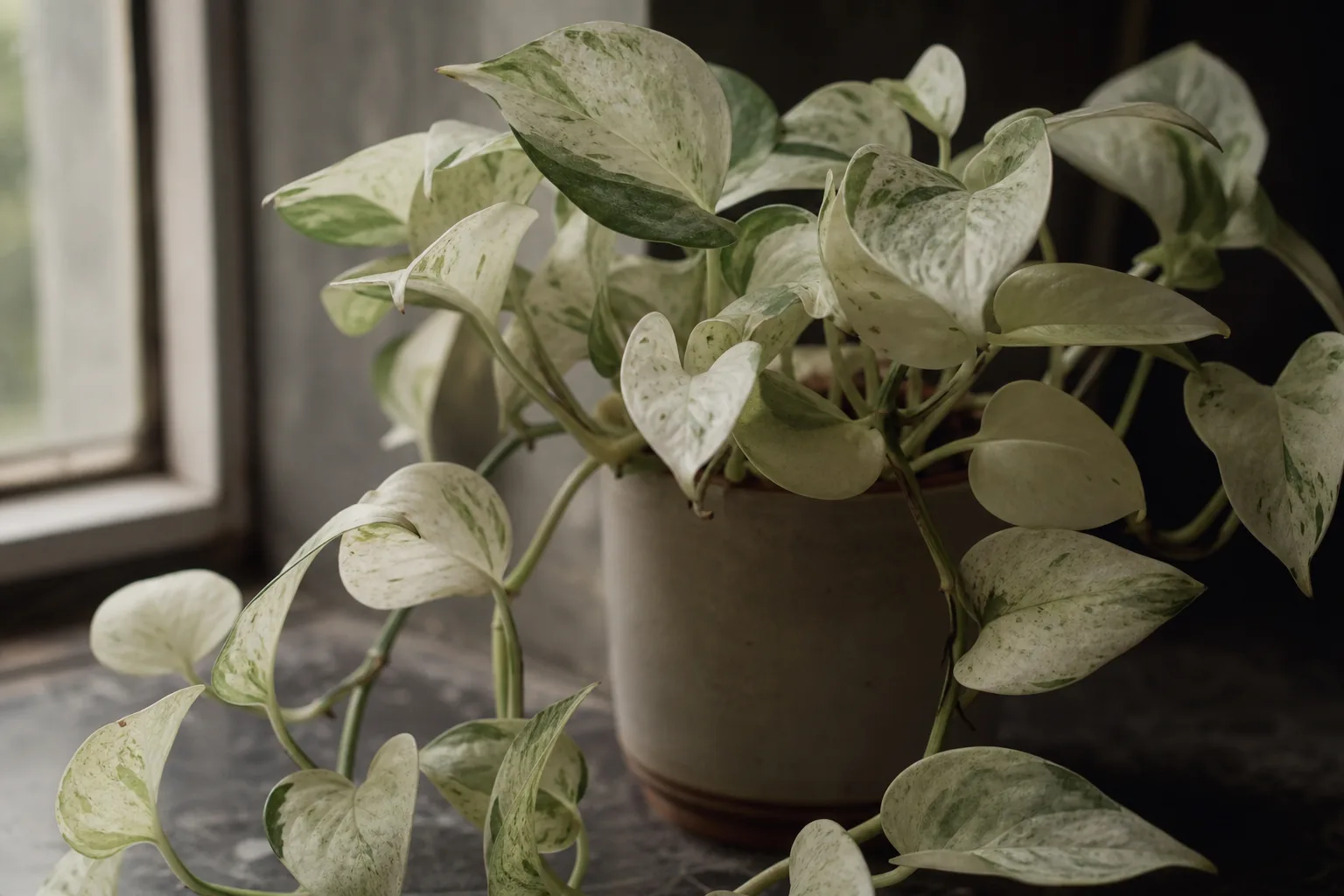
Healthy Manjula foliage shows bold swirls of white, cream, silver-green, and green on broad, wavy heart-shaped leaves. Faded leaves break that pattern in ways you can separate from yellowing or brown tips:
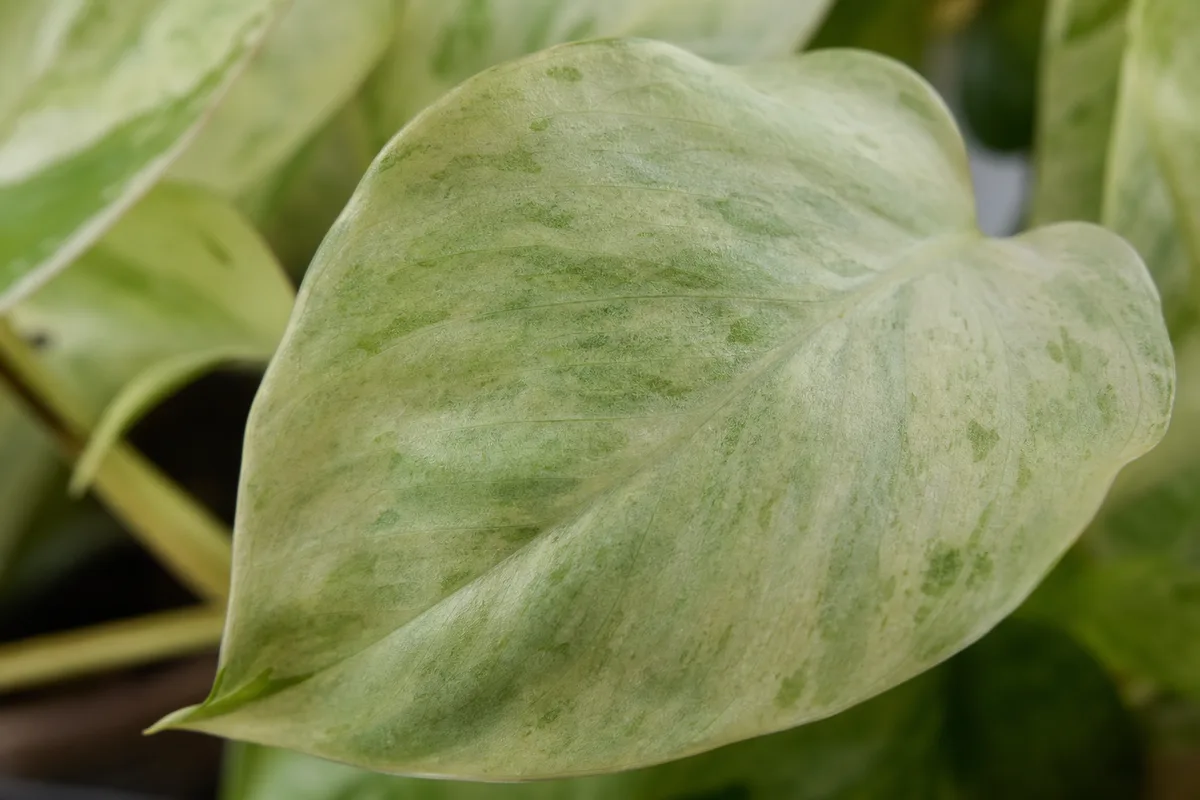
Faded Leaves symptoms on Manjula Pothos - compare with healthy tissue on the same plant.
Low-light fade
- Older leaves look dull and uniformly washed out-white and cream sectors lose their sharp contrast and read as pale gray-green
- New leaves open with thin white edges or mostly solid green, a step toward reversion rather than the bold pattern you bought
- Internodes stretch into long gaps between small leaves; vines lean toward the brightest window
- Growth slows; leaves that do unfurl may stay smaller than mature foliage on the same vine
Too-much-sun fade
- White and cream patches on the window-facing side look bleached, papery, or translucent-not merely dull
- Brown crispy patches or scorch marks appear on pale sectors within hours to days of a sudden move into direct sun
- Green portions may look fine while only the variegated zones wash out-unlike low-light fade, which dulls the whole leaf evenly
What fade is not
- Uniform yellowing on lower leaves with wet soil points to overwatering more than light fade alone
- Dry crispy tips without dull variegation often mean low humidity or water quality issues-see brown tips if margins alone are affected
- Natural aging drops the oldest leaf on a long vine occasionally; fade affects pattern and vibrancy across multiple leaves at once
Symptom photo reference
Without a labeled photo in hand, use these field marks. Healthy Manjula shows crisp marbled swirls with white and cream sectors sharply defined against green-bright, distinct marbled variegation is the cultivar’s signature. Low-light fade dulls that contrast evenly: the whole leaf looks gray-green and tired, like a watercolor left in the sun too long, while new tips trend greener. Sun bleach is asymmetric-only the glass-facing pale patches turn papery white or tan-brown while the shaded half of the same leaf still shows normal pattern. Photograph your plant at midday with a coin beside a affected leaf; compare window-facing vs shaded halves before you move the pot.
Why Manjula Pothos gets faded leaves
Manjula was developed as a heavily variegated cultivar with large pale leaf sectors. Those white and cream areas contain little chlorophyll, so the plant depends on green tissue-and adequate light hitting it-to photosynthesize. Variegated cultivars lose color when light is too low; light levels below about 150 foot-candles produce small new leaves and faded variegation on pothos indoors.
In dim corners, Manjula compensates by pushing greener new foliage to capture more energy. Existing variegation on older leaves dulls as the plant reallocates resources. Because Manjula is a slower-growing, bushier cultivar than Golden pothos, fade can creep in for weeks before you notice-especially if the pot still looks “fine” from across the room. Dim light also slows water use, so fade often pairs with damp mix-a pattern covered in the watering guide.
Too much light causes a different fade. Pale sectors have thinner tissue and less pigment protection than green areas. Unfiltered midday sun through a south or west window can bleach white patches before chlorophyll damage shows on green zones. Place pothos in moderate to bright light and avoid direct sun-Manjula’s cream swirls scorch faster than solid-green Jade pothos leaves.
Secondary factors that make fade worse:
- Seasonal daylight drop in winter, when a summer placement becomes too dim without the pot moving
- High display shelves where top leaves get light but lower nodes on the same vine sit in shade
- Dirty glass, heavy sheers, or tinted windows that cut usable light more than owners expect
How to confirm the cause
Work through these checks in order before you change watering or reach for fertilizer:
- Shadow test at the pot. At midday, hold your hand between the window and the foliage. A sharp shadow means usable light; a faint blur with stretched vines strongly suggests low-light fade.
- Window-facing leaf inspection. Bleached or papery pale patches only on the side toward glass confirm sun stress. Even dulling on all sides of the plant points to insufficient light.
- New growth color. Compare the last three leaves on the longest vine. Mostly green new foliage with faded older leaves confirms low light. Bold variegation on new leaves with bleached window-side patches confirms too much direct sun.
- Soil dry-down. Probe 3–5 cm into the mix. Damp soil for 10–14 days without recent watering pairs with low-light fade and slow photosynthesis-not a sun-only problem.
- Distance from glass. Light intensity decreases rapidly with distance from the source. A bright living room can still deliver low light if the pot sits more than 6–8 feet from the window.
- Recent moves. Fade after shifting closer to a south window within days suggests sun bleach; gradual dulling over months in the same spot suggests creeping low light.
If both dim soil and bleached patches appear, address the more acute issue first-pull back from scorching sun before moving a sun-stressed plant deeper into a room.
First fix for Manjula Pothos
Make one placement correction based on what you confirmed:
For low-light fade: Move the entire pot to bright indirect light-within roughly 1–3 feet of an east-facing window, or a south- or west-facing window with sheer curtain. Leave watering, fertilizer, and major pruning alone for one week while the plant adjusts. If the spot is still marginal, see the light guide for grow-light placement.
For sun-bleach fade: Shift the pot back from direct rays immediately-several feet from the glass or behind filtered curtain. Do not compensate by moving into a dim corner; aim for bright indirect light, not shade.
After seven days, check whether the top 3–5 cm of mix dries on a normal schedule. Brighter indirect light increases water use; pulling back from scorching sun stops further bleaching on new unfurling leaves.
Acclimating to brighter light
When moving from a dim corner to a brighter spot, increase exposure gradually over one to two weeks rather than jumping straight to a south sill. Week one: place 4–6 feet from the target window or behind sheer curtain. Week two: move to the final 1–3 foot bright-indirect position. Watch each new unfurling leaf-if pale sectors bleach or crisp, back the pot up 30–60 cm and filter harder. The opposite mistake-rushing dim Manjula into direct afternoon sun to “fix” dull leaves-burns cream patches permanently.
Step-by-step recovery
Once placement is corrected, work in this order:
- Wait two to four weeks. Watch new leaves, not old ones. Existing faded or bleached tissue will not regain contrast.
- Adjust watering to the new light level. Allow the soil to dry between waterings-water when the top 3–5 cm feels dry. Brighter spots dry faster; do not keep the old calendar from a dim corner.
- Rotate the pot weekly. Turn the container weekly so all sides receive similar exposure and fade does not return on the shaded face.
- Prune after new growth responds. Cut fully reverted green-only vine tips back to a node with visible variegation once two or three new leaves show improved pattern. Remove sun-scorched leaves only if they are mostly damaged and the vine is otherwise stable.
- Add grow light if windows are insufficient. Hang a full-spectrum LED 30–45 cm above foliage for 12–14 hours daily in north rooms or offices. Aim for roughly 150 foot-candles or more at the leaf surface-a 15–25 watt LED grow bulb or a 20–40 watt panel at that distance usually reaches extension-recommended pothos brightness indoors; raise the lamp if leaves show heat stress. See the light guide for duration and placement bands.
- Hold fertilizer until growth looks steady. Feed monthly at half strength only after new leaves show stronger color for two to three weeks. Fertilizer does not restore variegation on a light-starved plant.
Recovery timeline
| Phase | What to expect |
|---|---|
| Week 1 | No visible change on old faded leaves. Sun-bleached patches stop spreading if the plant is pulled back from direct rays. Mix may dry faster in brighter indirect light. |
| Weeks 2–4 | First new leaf after correction shows the real response-sharper white and cream if light is adequate; still dull or mostly green if the spot remains too dim. |
| Weeks 4–8 | Several new leaves with improved contrast; selective pruning encourages bushier shoots. Leggy sections fill in slowly-see leggy growth if bare stems dominate. |
| 2–3 months | Plant looks noticeably more vibrant if light stays consistent. Old faded leaves remain dull unless you remove them for aesthetics. |
If new leaves stay washed out after four weeks in what you believe is bright indirect light, the spot is still too dim-move closer to the window or add supplemental light rather than increasing fertilizer.
Reversion vs. fade: when to prune
Fade and reversion share low light as a root cause but call for different urgency:
Fade is cosmetic dulling-existing leaves lose swirl contrast but may still photosynthesize while you correct placement. Pruning is optional until new growth proves the fix.
Reversion is functional-vine tips push solid green leaves because the plant cannot sustain pale tissue. If the last three new leaves are mostly green with widening internodes, light correction alone may not be enough; you will need selective pruning after two weeks in a brighter spot.
Prune green-only tips back to the nearest node that still shows white or cream on the stem or an adjacent leaf. Do not strip the entire plant-leaves that look dull but still carry some variegation help the vine recover energy. If one vine in a multi-stem pot has fully reverted while others hold pattern, cut that vine back harder so variegated shoots are not shaded out. Detailed angles and timing: pruning guide.
Do not move a sun-stressed plant into a dim corner as “recovery”-that trades bleach for reversion. Bright indirect light is the target for both fade types.
Lookalike symptoms
| What you see | Likely cause | What to check | Read next |
|---|---|---|---|
| Dull washed-out swirls, green-leaning new leaves, even dulling all around leaf | Low-light fade | Shadow test; distance from glass | Not enough light if stretch is mild; this page if pattern dulling is primary |
| Long bare internodes, small pale leaves, lean toward window | Etiolation from dim placement | Internode length on longest vine | Leggy growth |
| Papery bleached patches on window-facing pale sectors only | Sun bleach | Which side of leaf faces glass | This page-pull back from direct rays |
| Chartreuse-to-yellow lower leaves, wet heavy pot | Overwatering | Soil moisture at depth; stem firmness | Yellow leaves |
| Uniform paleness without stretch or lean | Nutrient or root stress | Feeding history; root firmness | Fertilizer guide |
| Dry crispy margins only, swirl pattern intact | Humidity or water quality | Tip pattern vs whole-blade dulling | Brown tips |
| Stippling and webbing on undersides | Spider mites | Inspect in bright dry conditions | Spider mites |
Wet soil plus dull variegation usually means both low light and too much water-fix light first, then match watering to the new dry-down speed.
Mistakes to avoid
- Moving Manjula into direct sun to “fix” dull leaves quickly. Pale sectors bleach and scorch; increase indirect light gradually over one to two weeks.
- Accepting fade as normal winter behavior without a light plan. Seasonal dimming is predictable-add a grow light or move closer to glass rather than waiting for spring.
- Fertilizing to bring back white swirls. Variegation contrast is a light response, not a nitrogen fix on an otherwise healthy vine.
- Pruning all faded leaves before correcting light. Leaves still photosynthesize while the plant adjusts; remove only fully scorched or reverted tips after new growth improves.
- Watering on the old schedule after a light upgrade. Faster drying in brighter light needs a new check rhythm, not the same volume on a fixed calendar.
- Expecting old leaves to re-variegate. Only new growth reflects corrected light.
- Hiding a sun-stressed plant in a dim corner. That stops bleach but invites reversion on the next vine tips.
When handling cut vines, keep debris away from pets-pothos sap contains insoluble calcium oxalates that irritate mouth tissue.
How to prevent faded leaves next time
Place Manjula where it receives bright indirect light for most of the day-close enough to maintain variegation, far enough from glass to avoid scorching pale patches. Rotate weekly and clean windows seasonally.
In dark rooms, run supplemental LEDs on a timer rather than accepting slow dulling as inevitable. Match watering to how fast the top 3–5 cm dries at that light level. When buying, choose plants with crisp variegation on the newest leaves, not only on older foliage from a bright grow bench.
When to worry
Cosmetic dulling without rot is not an emergency-correct placement and patience restore new leaf color over weeks. Escalate when:
- Bleached or faded patches spread to most new leaves within days despite moving the plant
- Stems soften at nodes while soil stays wet for many days
- Yellow leaves climb multiple vines within a week
- Sour smell from the pot or mushy roots when you inspect
Those signs mean light stress may have overlapped with moisture problems threatening roots. Improve placement and reduce watering frequency; follow the root rot guide if roots are mushy.
Related Manjula guides
- Manjula Pothos overview
- Light needs - window placement, grow lights, sun limits
- Watering - dry-down rhythm after light changes
- Not enough light - placement diagnostic when stretch precedes washout
- Leggy growth - bare stems and pruning recovery
- Yellow leaves - wet-soil yellowing vs variegation dulling
- Pruning - reversion cuts and shaping
- Fertilizer
- Root rot - when dim light slowed water use into rot risk
Conclusion
On Manjula Pothos, faded leaves are the plant telling you where light went wrong-dull even washout means brighter indirect exposure; papery bleach on the window side means less direct sun. Run the shadow test, compare new-leaf color, and move the pot once. Recovery shows up on the next leaves that unfurl, not on the ones already faded. Link the symptom to the right guide above if stretch, yellowing, or wet soil overlap, and let new growth be your scorecard.