No New Growth on Manjula Pothos: Causes, Checks & Fixes
Quick answer
When Manjula Pothos produces no new leaves, shoots, or nodes for eight or more weeks during spring or summer, move it to brighter indirect light first-this variegated cultivar needs more light than all-green pothos to fuel new tissue. If soil stays wet and stems soften, stop watering and inspect roots before fertilizing or repotting.
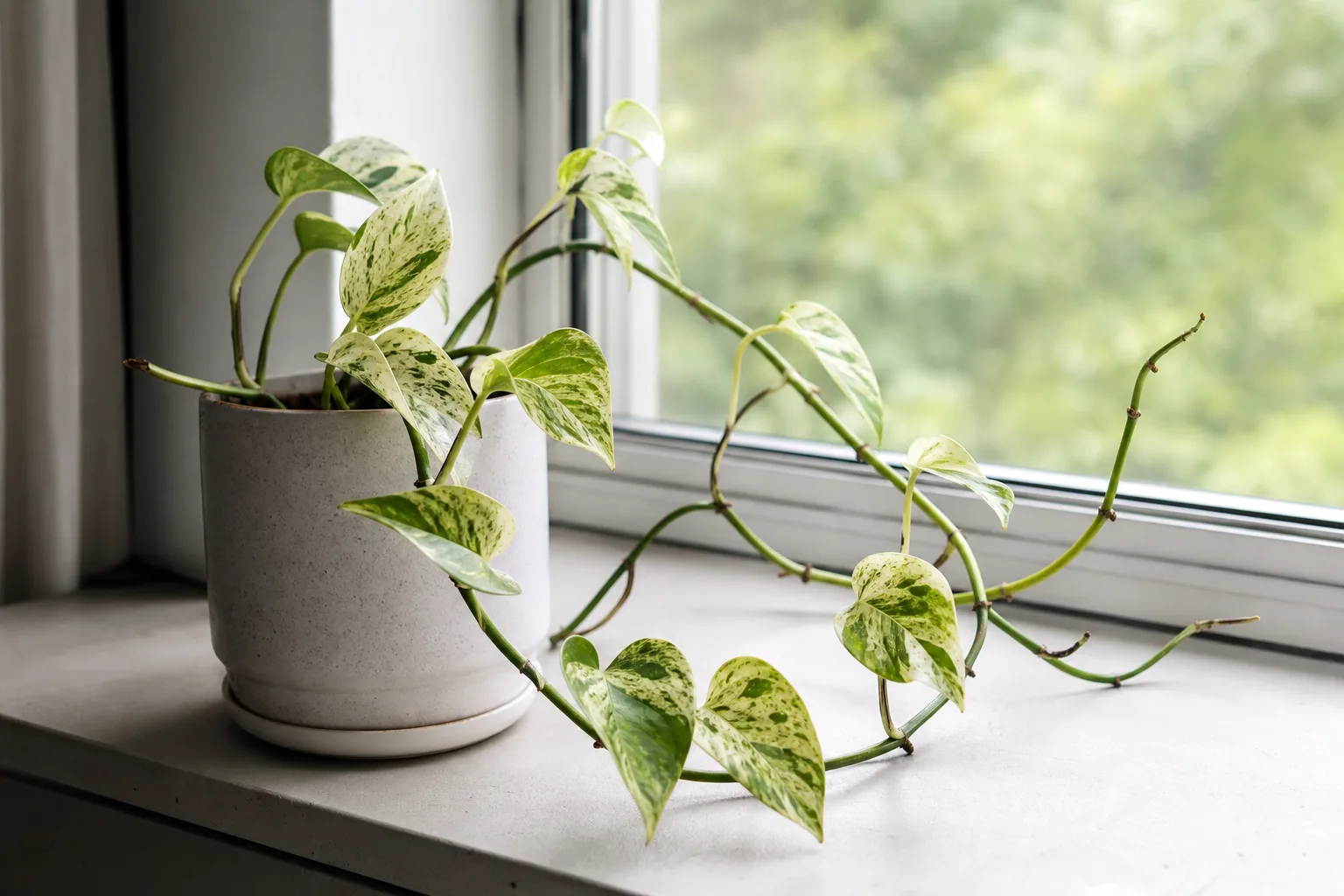
No New Growth on Manjula Pothos: Causes, Checks & Fixes
This guide covers no new growth on Manjula Pothos. See also the general No New Growth guide, watering, and light pages for this plant.
No New Growth on Manjula Pothos: Causes, Checks & Fixes
Quick answer
No new growth on Manjula Pothos (Epipremnum aureum ‘Manjula’) means the plant has stopped producing leaves, shoots, or extending nodes-not merely growing slowly. During spring and summer, a healthy Manjula should unfurl a marbled leaf every few weeks. When nothing emerges for eight or more weeks in warm, bright months, something is limiting the plant.
First fix: move Manjula to the brightest indirect light available in your home. This cultivar carries heavy cream-and-white variegation with less chlorophyll than golden pothos, so dim placement often triggers a full growth pause-not just smaller leaves. Only after light improves should you adjust watering rhythm or inspect roots if soil stays soggy.
This page owns complete zero-output stall. If your Manjula still produces occasional leaves at a steady pace, start on slow growth. If each new leaf opens smaller than the last, see stunted growth. For long bare gaps between leaves that still produce occasional foliage, see leggy growth.
Zero growth vs. slow vs. stunted vs. leggy on Manjula Pothos
These four slugs overlap in symptoms but answer different questions. Use this table before diving into causes:
| Pattern | Leaf size trend | New leaf output | Internode pattern | First fix | Read next |
|---|---|---|---|---|---|
| No new growth (this page) | N/A-nothing unfurls | Zero leaves, shoots, or nodes for 8+ weeks in warm months | Bare tips, no extension | Bright indirect light; inspect roots if soil stays wet | - |
| Slow growth | Stable size-new leaves match recent ones | One leaf every 2–4 weeks in summer | Compact, bushy habit | Light upgrade if pace drops below baseline | Pace baseline for this cultivar |
| Stunted growth | Each new leaf smaller than the last on the same vine | Occasional tiny leaves, then stall | Short gaps but plant stays doll-sized | Bright indirect light + dry-down watering | Progressive shrinkage |
| Leggy growth | Leaves may stay normal size | Sparse leaves on long stems | Long bare gaps between nodes | Light + prune back to nodes | Stretch, not zero output |
What no new growth looks like on Manjula Pothos
Separate normal pause from true stall:
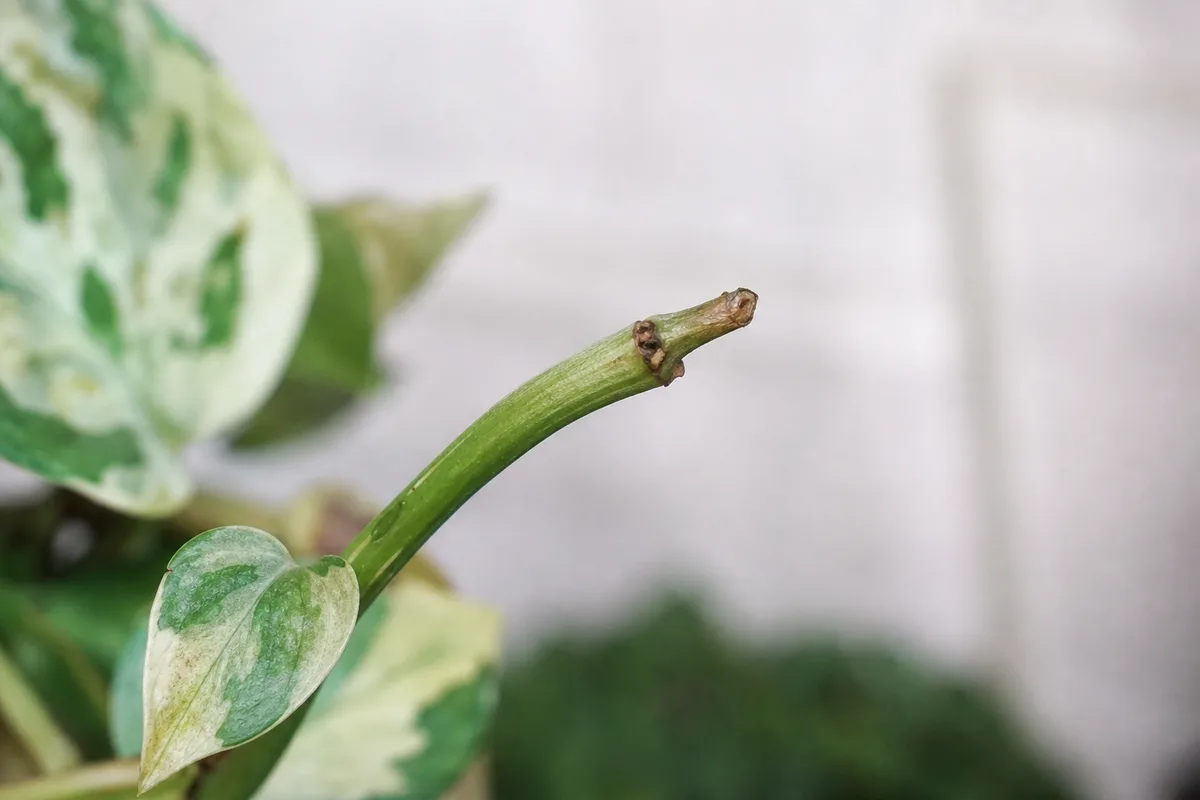
No New Growth symptoms on Manjula Pothos - compare with healthy tissue on the same plant.
Normal for this cultivar:
- Little or no new foliage from late fall through early spring when days are short
- Existing leaves stay firm and marbled while the pot dries between waterings
- Slow unfurling when leaves do appear-one to two weeks is cultivar-normal
- Bushy, compact habit rather than rapid trailing (Manjula vines less aggressively than golden pothos)
Signs growth has stopped completely:
- No new leaf, shoot, or node for eight or more weeks during March through September
- Vine tips stay bare with no swelling at nodes
- Newest leaves on the plant are months old; nothing unfurling at vine ends
- Long bare gaps between the last few leaves while vines lean toward windows
- Variegation on the newest existing leaves fading to mostly green
- Soil that stays damp a week or more between your usual waterings
- Yellowing lower leaves while the surface never dries
Healthy Manjula leaves are broad, wavy-edged, and splashed with cream, silver-green, and green. When growth halts entirely, check whether any node along a vine shows a pinhead bud. Total absence points to environmental limits or root failure, not normal cultivar slowness.
Worked example: tape-mark confirmation
Place a small piece of tape on the newest vine tip in early June. Check weekly:
- Week 1–4: Tape unchanged; no pinhead bud at the tip; soil dries normally between waterings → likely light limit, not dormancy.
- Week 5–8: Tape still on the same bare node; golden pothos in the same room added two leaves → confirms zero-output stall, not slow Manjula pace.
- After east-window move in week 9: First pinhead swelling appears by week 11; marbled leaf unfurls by week 13 → recovery on track.
Winter pause with firm stems and appropriate dry-down does not need tape-resume tracking when day length increases in March.
Why Manjula Pothos stops producing new growth
Insufficient light (most common fixable cause)
Pothos prefers bright, indirect light and becomes a vigorous grower under those conditions. Manjula needs even more light than average because lower light may cause variegated varieties to lose coloring as the plant produces greener tissue to capture energy.
In survival-level light, Manjula can hold existing foliage for months without adding new leaves. White patches photosynthesize poorly, so the plant conserves energy instead of pushing shoots. Low light also slows water use-soil stays wet longer, which compounds the stall. For placement diagnostics before a full pause, see not enough light on Manjula Pothos and the Manjula light guide.
If your brightest spot is still marginal-a north-facing room with no east window-add a full-spectrum LED 30–45 cm above the foliage for 10–12 hours daily. Grow lights supplement weak natural light; they do not replace correcting soggy soil or rotting roots.
Overwatering and root failure
Epipremnum aureum should have potting medium that dries between waterings. When mix stays saturated, roots lose oxygen. Damaged or rotting roots cannot supply water or nutrients to support new leaves, so top growth stops even though you keep watering on schedule.
Manjula in a dim corner plus frequent watering is a classic zero-growth pattern: the plant is not photosynthesizing enough to drink, but the calendar says water Tuesday. Yellow leaves on wet soil with soft stems point to root rot, not simple pause.
Seasonal winter rest
Pothos is dormant in winter and should be fertilized every other month except during that rest. Short days naturally pause or nearly stop new leaves from late fall through early spring. That pause is normal if stems stay firm and soil dries between drinks-resume worrying when day length increases and still nothing emerges.
Recent repotting or care shock
Repotting, a sudden move to a colder room, or stacking fertilizer, pruning, and relocation in one week can pause growth for four to eight weeks while the plant stabilizes. If you changed three variables at once, wait before adding more interventions. See the repotting guide for timing after disturbance.
Severely root-bound or exhausted mix
Pothos can stay slightly snug, but when roots circle densely and little soil remains, uptake stalls. Repot when roots show through drainage holes or the plant dries out within a day of every watering. For circling roots without full rot, see root-bound.
Nutrient depletion (after light and water are right)
Pale, small existing leaves on a well-lit plant in two-year-old mix may signal depleted nitrogen. Yellow leaves are often caused by overwatering or low fertility. Feed only once light and watering support active growth-fertilizer on waterlogged roots does not restart a stalled Manjula. For salt injury from feeding a stressed plant, see fertilizer burn.
Pests draining vigor
Spider mites and mealybugs can slow or stop growth before obvious webbing appears. Inspect leaf undersides and stem joints if growth halts while stippling, sticky residue, or fine webbing shows up.
How to confirm the cause
Work through these checks in order:
- Season - Is it late fall or winter? Firm stems and no new leaves for six to ten weeks may be dormancy, not failure.
- Light at the plant - Can you read comfortably next to the pot without a lamp for several hours daily? If not, light is likely limiting. Fading variegation on the newest existing leaves supports low light.
- Node inspection - Run your finger along vine tips. Swollen nodes with no unfurling leaf suggest the plant has energy but light or roots are blocking progress. Flat, inactive nodes for months confirm stall.
- Soil moisture - Stick a finger 3–5 cm (1–2 in) deep. Wet mix more than seven days after watering in moderate indoor temperatures suggests overwatering or poor drainage-not a feed problem.
- Pot weight and drainage - Lift the pot. Heavy, cold mix with no dry-down window fits root stress. Confirm drainage holes are open and no saucer water sits beneath the pot.
- Root spot-check (if soil stays wet) - Slide the plant out gently. Healthy pothos roots are firm and white or tan. Brown, mushy roots mean rot-new growth will not resume until roots are addressed.
- Recent changes - Note repotting, moves, or pest treatments in the last three months. Shock alone can explain a temporary pause.
- Pest scan - Check leaf backs and stem joints with a hand lens for mites, mealy fluff, or scale bumps.
If light is adequate, soil dries on schedule per the watering guide, and the plant still produces nothing through summer, consider repotting or light fertilizer-not the reverse order.
First fix for Manjula Pothos
Move the plant to the brightest indirect light available in your home.
Place Manjula within a few feet of an east-facing window, or three to five feet from a south or west window filtered by a sheer curtain. Avoid direct sun that scorches variegated leaves-white patches burn easily-but do not leave it in a dim hallway and expect new leaves.
Give the plant one to two weeks in the new spot before changing anything else. Brighter light increases photosynthesis and water use, which often restarts growth without repotting or fertilizer on day one.
If soil is soggy and stems feel soft at nodes, let the top half of the mix dry before the light move, then inspect roots if no dry-down occurs within ten days.
Step-by-step recovery
After the light upgrade:
- Reset watering to dry-down - Water only when the top 3–5 cm (1–2 in) of mix feels dry. In better light, the pot will dry faster; adjust frequency upward, not volume per drink.
- Hold fertilizer for two weeks - Let the plant respond to light and corrected moisture before feeding. Skip feed entirely if soil was recently waterlogged.
- Prune to wake nodes - After light is stable for one to two weeks, cut bare, stretched stems 1–2 cm above a node. Manjula branches from nodes when conditions support new growth; bare sections without leaves will not refill on their own.
- Repot if roots are circling or mix is compacted - Move up one pot size in spring using airy potting mix with perlite per the soil guide. Do not jump to an oversized container-extra wet soil around a small root ball invites rot and further stall.
- Feed lightly in active growth - After the first new leaf appears, apply balanced liquid fertilizer at half strength once monthly through summer. Stop feeding when the plant is dormant in winter.
- Treat pests if found - Rinse leaf undersides and isolate until populations clear; pest stress keeps growth halted even with perfect light.
Do not repot, fertilize, and relocate to a new room on the same day. Manjula responds better to one clear change at a time.
Recovery timeline
In spring or summer, brighter indirect light often produces a visible new leaf within three to six weeks. Unfurling still takes one to two weeks-that is cultivar-normal, not a sign the fix failed.
Bare vine sections stay bare until you prune above a node; judge recovery by fresh marbled foliage emerging after the light change, not by old stretched stems refilling.
Winter corrections may show little until day length increases. Judge progress by new leaf frequency from March onward, not January stall.
If no new growth appears eight weeks after confirmed good light and dry-down watering in summer, inspect roots for rot or repot into fresh mix.
Lookalike symptoms to rule out
Slow growth, not zero growth - Occasional new leaves every few weeks is cultivar-normal slowness, not a stall. See slow growth on Manjula Pothos when leaves still appear but infrequently.
Leggy growth without total stall - Long gaps between leaves but occasional new foliage usually means low light alone. Fix light and prune; growth has not fully stopped. See leggy growth.
Stunted growth - New leaves open smaller than older ones on the same vine while output is sparse. See stunted growth for progressive shrinkage.
Dormancy - Leafless pause in cool, short-day months with firm stems and dry soil is seasonal rest, not disease.
Root rot - Yellow leaves, soft stems at soil line, and sour smell mean wet roots, not simple pause. New growth will not resume until decay is trimmed and watering corrected. See root rot.
Underwatering - Crisp, curling leaves and very light pot weight mean drought. Growth slows or stops, but soil is bone dry throughout-not damp for days.
Mistakes to avoid
Do not dump fertilizer on a stalled plant in low light hoping to force leaves. Salt buildup on stressed roots worsens the stall-see fertilizer burn if tips crisp after feeding.
Do not repot into a much larger pot hoping for a growth spurt. Excess wet soil around a small root ball invites rot.
Do not place Manjula suddenly in harsh direct midday sun to restart growth. Scorched white tissue sets the plant back weeks.
Do not prune bare vines before fixing light-you waste nodes on a plant still in survival mode.
Do not panic during winter rest and stack repotting, feeding, and pruning in December.
Do not confuse Manjula’s natural slow pace with a true stall-if a new marbled leaf appeared within the last month in summer, the plant is growing.
Manjula care cross-check
When growth halts, verify the full system against the Manjula overview:
- Light: Bright indirect for most of the day; enough intensity for variegation to hold on newest leaves. See light guide.
- Water: Top 3–5 cm (1–2 in) dry before watering; reduce frequency in winter. See watering guide.
- Mix: Standard potting soil with 20–30% perlite; slightly acidic conditions around pH 6.0–6.5. See soil guide.
- Temperature: Comfortable room range roughly 18–29°C (65–85°F); avoid cold drafts below 10°C (50°F).
- Humidity: 40–60% is adequate; Manjula is less fussy about humidity than about light.
When these align, Manjula should resume producing leaves during the active season. Persistent zero growth in summer after corrections points to root damage or severe pest load.
How to prevent no new growth next time
Keep Manjula where bright indirect light is realistic all day, not only where the pot looks decorative. Rotate the pot monthly so all sides receive similar light.
Water on dry-down, not a fixed calendar. As light increases in spring, shorten the interval between drinks; as days shorten in fall, lengthen it.
Repot every one to two years in spring when roots circle or mix breaks down. Refresh perlite-heavy mix before severe compaction chokes uptake.
Feed lightly during active growth only. Skip winter feed when the plant rests.
Scout leaf undersides monthly for spider mites and mealybugs so hidden sap loss does not masquerade as a mysterious stall.
When to worry
Treat as urgent when stems soften at nodes while mix stays wet, multiple leaves yellow within a week, roots are brown and mushy on inspection, or pests coat most of the plant. Those patterns point to rot or infestation-not seasonal pause.
Seasonal winter rest with firm green stems and appropriate dry-down is not urgent. A Manjula that resumes occasional marbled leaves in spring after a winter pause is behaving normally.
Related Manjula Pothos guides
- Manjula Pothos overview - cultivar context and full care map
- Slow growth - normal cultivar pace baseline; this page owns zero output
- Stunted growth - progressive leaf-size shrinkage
- Leggy growth - long bare internodes with occasional foliage
- Not enough light - chronic dim placement before full stall
- Root rot - mushy roots and spreading yellow leaves
- Root-bound - circling roots and one-day dry-down
- Light guide - window placement for variegated Manjula
- Watering guide - dry-down rhythm after light correction
- Spider mites - hidden sap loss on variegated tissue
- Fertilizer burn - salt stress from feeding a stalled plant
Conclusion
No new growth on Manjula Pothos is not the same as slow growth-this cultivar can hold old foliage in dim light for months without adding a single leaf. When the stall runs through spring and summer, light is the first lever: move to brighter indirect exposure, then match watering to how fast the pot dries. Existing vines will not sprout retroactively; watch for a fresh marbled leaf unfurling from a node. For pace baseline when leaves still appear but slowly, see slow growth on Manjula Pothos.