Java Fern Care Guide: Aquarium Plant (Attach to Driftwood &
Microsorum pteropus
Java fern is common in aquatic turtle setups, but LeafyPixels does not treat it as a universally verified turtle-safe food or enclosure plant across species. Use it as a cautious aquarium-plant candidate, not as a feeding clearance.
Java Fern Care Guide: Aquarium Plant (Attach to Driftwood & Rock)
Start with wateringThe most common care mistake for Java FernCheck pet-safe plants →Java Fern care essentials
Light
Moderate to bright aquarium or pond light; avoid sudden harsh outdoor sun without acclimation.
Water
Keep the rhizome attached to rock or driftwood in clean aquarium water; do not bury the rhizome.
Soil
No soil needed; attach the rhizome to aquarium-safe rock, wood, or decor.
Humidity
Aquatic or constantly humid surface conditions
Temperature
18-28 C (64-82 F)
Fertilizer
Usually unnecessary in turtle tanks with normal nutrients. Aquarium-safe fertilizer only if needed, used outside the turtle tank when possible
About Java Fern
Java Fern is native to Southeast Asian streams, rivers, and humid rock margins, typically reaches 15-35 cm rhizome fern in aquariums indoors, with slow to moderate growth. Java Fern has a fern like growth habit and part of the Polypodiaceae family. It is also known as Java Water Fern and Water Fern.
| Detail | Information |
|---|---|
| Also known as | Java Water Fern, Water Fern |
| Native region | Southeast Asian streams, rivers, and humid rock margins |
| Mature size | 15-35 cm rhizome fern in aquariums |
| Growth rate | Slow to moderate |
| Growth habit | Fern Like |
| Scientific name | Microsorum pteropus |
| Family | Polypodiaceae |
Java Fern Care Guide: Aquarium Plant (Attach to Driftwood & Rock)
What Java Fern Is
Java fern (Microsorum pteropus) is one of the most widely kept freshwater aquarium plants in the hobby - and for good reason. It is slow-growing, tolerant of low light, adaptable to a wide range of water chemistries, and tough enough to survive beginner mistakes that would kill stem plants overnight. What it is not is a houseplant. Java fern belongs in submerged or partially submerged aquarium water, attached to driftwood, rock, or other hardscape, with its rhizome exposed to flow. Treating it like a potted fern on a windowsill is the fastest way to fail with a plant that is otherwise nearly indestructible.
Botanically, Java fern sits in the family Polypodiaceae/27914), the same fern family that includes many terrestrial and epiphytic species. In the wild it grows along shaded riverbanks, streams, and humid rock margins across Southeast Asia - Java, Thailand, Malaysia, and parts of southern China. There it clings to wood and stone in moving, oxygen-rich water rather than rooting in soft river silt. That ecology is the entire care manual in one sentence: give it clean water, moderate light, and a surface to grip.
The plant’s structure reflects that lifestyle. Leathery fronds (leaves) emerge from a thick horizontal rhizome - the plant’s true stem and energy store. Thin brown holdfast roots dangle from the rhizome and anchor the fern to hardscape while absorbing nutrients from the water column. Mature specimens in aquariums typically reach 15–30 cm in height depending on cultivar, with a slow to moderate growth rate. Leaves can live for many months, which is an advantage in stable tanks and a disadvantage when algae colonizes old foliage.
A Southeast Asian Riverbank Epiphyte, Not a Houseplant
If you searched “Java fern care” and landed on advice about potting mix, humidity trays, and watering when the soil dries out, you are reading the wrong plant guide. Java fern is an aquarium epiphyte in hobby cultivation. It does not need - and actively should not receive - terrestrial soil around its rhizome. It pulls the majority of its nutrition from tank water through its fronds and holdfasts, not from substrate fertilizer tabs buried under gravel.
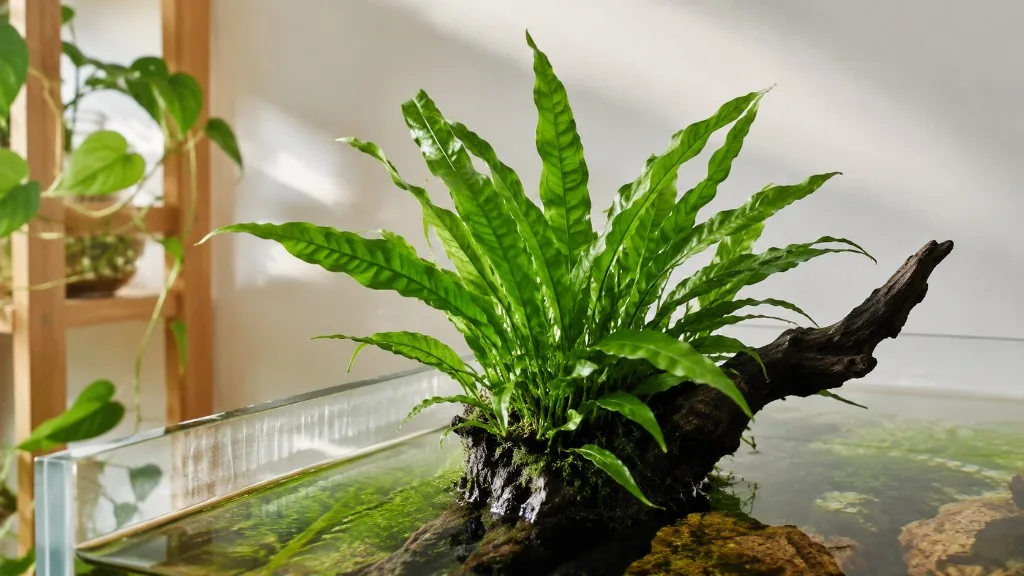
That distinction matters for search intent and for outcomes. A healthy Java fern in an aquarium looks like a clump of arching green fronds rising from a piece of driftwood or lava rock, with the scaly rhizome visible between leaf bases. A dying Java fern in a beginner tank almost always looks the same at the start - green fronds in gravel - because someone “planted” it like a sword plant. The fix is never to adjust room humidity. The fix is to lift the rhizome out of the substrate and attach it to hardscape.
Java Fern Varieties and Cultivars Worth Knowing
The species Microsorum pteropus is variable in the wild, and the aquarium trade has selected several named forms. All share the same core rules - attach, don’t bury, moderate light - but they differ in leaf shape, height, and visual impact in the aquascape.
Standard Java fern has broad, slightly rippled fronds and works as a midground to background plant in tanks 10 gallons and up. Narrow Leaf and Needle Leaf forms produce thinner fronds on shorter rhizomes; they suit smaller tanks, betta setups, and detailed nano scapes. Trident Java fern (M. pteropus “Trident”) splits frond tips into forked lobes and adds texture without demanding different care. Windelov (also sold as “Windeløv”) frays frond edges into a lace-like pattern and is a favorite on wood branches in Dutch-style layouts. Philippine and Latifolia types tend toward larger, broader leaves for tall background placement.
When buying, inspect the rhizome, not just the fronds. A firm, green-to-brown rhizome with white or green growing tips is healthy. A soft, blackened, or mushy rhizome is already rotting - often from emersed shipping stress or prior burial - and may not recover even after correct attachment. Cultivar names on labels are helpful but not always botanically precise; two pots labeled “Java fern” may differ in size. Match the form to your tank height and aesthetic, then apply the same attachment-first care to all of them.
Light Requirements for Aquarium Java Fern
Java fern is famous for surviving low light. That reputation is accurate, but it comes with a corollary beginners miss: the plant tolerates low light better than high light. In dim tanks it grows slowly and stays deep green. Under intense, unshaded LEDs it often stops looking better and starts accumulating algae, bleaching at frond tips, or melting after a sudden intensity jump.
For most community freshwater tanks, aim for low to medium intensity. Java fern does not need a “high-tech” light schedule to stay alive. It needs enough photons to produce new fronds steadily - roughly one new leaf every few weeks in a low-tech setup - without baking the existing leaves under 10-hour blasts of full-power white light. Shaded placement behind driftwood, under floating plants, or on the downstream side of tall hardscape mimics the dappled riverbank light the species evolved under.
PAR Range and Low-Tech Setups
Modern planted-tank guides measure light in PAR (photosynthetically active radiation). Java fern performs well under low light demand - roughly 0.25–0.5 W/L for easy-category plants - with hobby PAR targets often landing near 15 PAR at the low end up to about 50 PAR at the medium end, with best long-term appearance toward the lower half of that range.
| Setup type | PAR at plant | Photoperiod | Notes |
|---|---|---|---|
| Low-tech / beginner | 15–30 | 6–8 hours | Stock LED at 40–60%; ideal for longevity |
| Medium planted | 30–50 | 6–7 hours | Add floaters or shade if algae appears |
| High light + CO2 | 50+ | 8+ hours | Not ideal unless heavily shaded |
If you only have a watt-per-litre reference from older articles, 0.25–0.5 W/L in fluorescent-era terms aligns with Java fern’s comfort zone. Many current LED fixtures exceed that on default settings, so dim the light or move the fern into shade before increasing fertilizer or CO2. More light rarely speeds Java fern growth meaningfully; it more often speeds green spot algae on fronds that sit unchanged for months.
Water Parameters and Tank Conditions
One reason Java fern appears in so many tanks worldwide is chemical flexibility. It accepts soft or hard water, slightly acidic or slightly alkaline pH, and the temperature range of most tropical community setups. It is not a substitute for clean, cycled water - ammonia and nitrite will damage fronds like any other plant - but once a tank is stable, Java fern rarely quibbles over the exact number on a test kit.
Flow matters more than many guides admit. Wild plants live in moving water at the margins of streams. Gentle to moderate current across the rhizome and fronds helps deliver nutrients, prevents detritus from settling in leaf axils, and reduces stagnant pockets where algae spores germinate. A filter outlet aimed so water passes through the fern cluster is enough; you do not need a powerhead hurricane.
Temperature, pH, and Hardness
| Parameter | Ideal range | Tolerated range | Practical notes |
|---|---|---|---|
| Temperature | 72–78°F (22–26°C) | 68–82°F (20–28°C) | Avoid large cold water changes |
| pH | 6.5–7.5 | ~6.0–8.0 | Stable pH beats chasing “perfect” acidity |
| General hardness | 4–12 dGH | 3–20 dGH | Adapts to soft and hard tap water |
| Carbonate hardness | 2–8 dKH | Wide | Buffer swings gently, not abruptly |
Tropica lists Microsorum pteropus with low CO₂ demand and low light requirement - consistent with its reputation as a low-tech workhorse. Brackish tolerance is sometimes claimed for the species; in standard freshwater community tanks, treat it as a freshwater plant unless you are deliberately running a brackish biotope and have verified the specific stock’s tolerance.
The Rhizome Rule: Attach, Never Bury
The single rule that separates thriving Java ferns from melted ones is rhizome exposure. The rhizome is the thick horizontal stem from which fronds and holdfast roots emerge. It must remain fully visible and in contact with oxygenated tank water, not buried under sand, gravel, or aqua soil. Only the thin brown holdfast roots may be tucked into crevices or allowed to wander into substrate superficially - and even then, the rhizome itself stays above the surface.
This is not a stylistic preference. It is physiology. The rhizome exchanges gases and stores reserves. When buried, it sits in low-oxygen substrate pockets where anaerobic bacteria attack the tissue. Within one to three weeks, a buried rhizome softens, darkens, and dies - and fronds melt from the base upward. Aquarium store staff sometimes sell Java fern in pots with the rhizome pushed into wool or gravel for display. Before adding it to your tank, free the rhizome and attach it properly.
Why Burying the Rhizome Causes Rot
Rhizome rot is the number-one Java fern killer because it looks like “the plant was never easy.” The fronds may stay green briefly while the rhizome fails underground. By the time leaves blacken at the base, the crown is often already lost. Symptoms of burial-related failure include a mushy black rhizome, fronds detaching with a gentle tug, foul smell near the substrate, and no new growth tips on the rhizome.
Recovery depends on catching it early. If part of the rhizome is still firm and green, trim away black tissue with sharp aquascaping scissors, attach the healthy section to hardscape, and leave damaged fronds on only if they are still fully green. If the entire rhizome is black and soft, discard it and start with a healthy division or new plant - no amount of fertilizer rescues a dead crown.
How to Attach Java Fern to Driftwood and Rock
Attachment mimics wild growth and takes minutes. Choose porous hardscape - Malaysian driftwood, Mopani, spider wood, lava rock, or rough stone - so holdfasts can grip.
Method 1 - Cyanoacrylate gel glue: Dry the rhizome lightly with a paper towel. Apply small dots of gel super glue (aquarium-safe cyanoacrylate) to the underside of the rhizome or to the wood. Press the rhizome against the surface for 15–30 seconds. Do not coat the entire rhizome in glue; suffocated tissue dies. Submerge after the bond sets. Roots anchor fully in 2–4 weeks.
Method 2 - Cotton thread or fishing line: Position the rhizome where you want it. Wrap thread in loose spirals every 1–2 cm along the rhizome - tight enough to hold, loose enough not to cut into tissue. Dark thread hides better than white. Remove ties once holdfasts grip, usually 3–6 weeks.
Method 3 - Natural crevices: Wedge the rhizome into a fork in driftwood or a pocket in lava rock. No tie needed if the plant cannot float away. This looks the most natural in biotope scapes.
Floating is acceptable temporarily. Java fern can drift until holdfasts find a surface. Long-term floating often produces tangled roots and uneven frond orientation, so most aquascapers attach it deliberately. Plant weights (zinc-magnesium alloy types sold as aquarium-safe) can hold a rhizome down on rock until roots attach - never confuse weights with permission to bury the rhizome in gravel.
CO2 and Fertilizer in the Water Column
Java fern does not require injected CO₂. It grows in low-tech tanks worldwide with no carbon dioxide supplementation beyond what fish and surface gas exchange provide. CO2 injection can slightly increase growth rate in high-light setups, but it is optional, not a prerequisite for a healthy plant.
Nutrients come primarily from the water column. Because Java fern does not feed through buried roots the way Amazon swords do, root tabs in substrate do little for the rhizome itself. Liquid all-in-one fertilizers dosed at label rates for low-tech tanks supply nitrogen, phosphorus, potassium, and micronutrients fronds need. If you see pinholes in older leaves with yellow halos, suspect potassium deficiency - a common, fixable issue in heavily stocked tanks with lean dosing (Buce Plant; general aquarium plant nutrition references).
Dose after water changes on a schedule appropriate to your tank’s plant mass and bioload. Heavy feeding without corresponding water changes can raise nitrates - usually tolerable - but ammonia spikes from decay or uncycled filters burn fronds quickly. If algae competitors are absent and fronds stay pale despite good light, increase fertilizer modestly rather than blasting light. Java fern responds slowly; give any dosing change 3–4 weeks before judging results.
Placement and Aquascaping With Hardscape
Java fern shines when it follows the shape of wood and stone. Attach it to branches so fronds arch downward like a canopy, or mount it vertically on a rock face for a wall of texture. Midground placement on a horizontal log is the classic look; background placement suits larger standard and Latifolia forms. Nano cultivars work on small stones in foreground clusters without blocking sight lines.
Because growth is slow, plan spacing with future rhizome length in mind. A 5 cm rhizome today can extend 15 cm or more over a year, producing fronds that shade neighbors. That slowness is an asset in low-maintenance tanks - you are not weekly trimming like stem plants - but it means poor initial placement persists visually for months.
In Iwagumi or minimalist stone layouts, a single Java fern on one seiryu corner softens hard edges without demanding high light. In blackwater biotopes, tannins from driftwood match the plant’s native aesthetic; fronds often darken to a richer green under tannin-stained water. Avoid placing the rhizome directly under a filter intake where it can be sucked against the screen, and avoid cramming it into dead zones with zero flow - not because it dies instantly, but because detritus and algae accumulate on static fronds.
Propagation: Rhizome Division and Leaf Plantlets
Java fern propagates two ways in home aquariums: rhizome division and adventitious plantlets on fronds.
Rhizome division is the reliable method. Use sharp, clean scissors to cut a healthy rhizome into sections, each with at least one frond and several holdfast roots. Mount each section on its own piece of hardscape. Do not divide a plant that is melting or rotting - stress spreads through weak tissue. Spring and summer growth phases in heated tanks recover faster, but division works year-round in stable indoor aquariums.
Adventitious plantlets/27914) appear as tiny ferns growing from notches or black sori patches on mature fronds. Many hobbyists confuse these with disease at first; they are reproduction. Tiny plantlets with 3–5 leaves and visible roots can be gently removed and tied to wood or left to grow in place for a natural colony look. Plantlets detach easily if rushed; wait until roots are 5–10 mm long.
Spore reproduction from sori is technically possible but impractical to manage in home tanks - you will propagate by division or plantlets, not by cultivating spores on glass.
Common Problems: Melting, Black Spots, and Rot
Most Java fern “emergencies” fall into four buckets: buried rhizome, transition melt, nutrient or ammonia stress, and misread normal sori. The diagnostic order is always: check rhizome placement first, then water quality, then light, then nutrients.
Black or mushy fronds on an exposed rhizome often mean ammonia, decaying leaves left in the tank, or advanced rot from an earlier burial. Trim fully melted tissue near the rhizome with aquascaping scissors - do not pull and tear. Brown tips without mush may indicate potassium deficiency, old age, or mild burn from too much light. Yellowing on older fronds alone is often natural senescence; yellowing on new growth suggests water quality or nutrient issues.
Black spots on frond undersides deserve special attention because they panic beginners. Dense rows of dark bumps are usually sporangia - reproductive structures producing spores. They appear on healthy, mature fronds and feel firm, not slimy. If spots are fuzzy, spreading on dying tissue, or accompanied by a soft rhizome, you are looking at rot or algae, not sori.
Emersed-to-Submersed Transition Melt
Most Java fern sold online and in shops is grown emersed - above water in humid greenhouses - because it grows faster and ships better. When submerged in your aquarium, the plant switches to underwater leaf forms. Old emersed fronds often melt: turn translucent, blacken, and dissolve over 1–3 weeks. This is acclimation, not necessarily failure.
During melt, leave the rhizome firmly attached and remove only fronds that are fully dissolved slime - intact green sections still photosynthesize. New submersed fronds emerge from the rhizome with a slightly different texture - thinner, more divided, sometimes lighter green. If new growth appears within 2–4 weeks, the plant is adapting. If nothing emerges and the rhizome softens, burial, disease, or extreme shock (large cold water change, uncycled tank) is the more likely cause.
Temperature shock is an underreported melt trigger. A 50% water change with water 10°F colder than the tank can trigger mass leaf drop as the plant protects the rhizome. Match change water temperature to tank temperature.
Algae on Java Fern Leaves
Slow growth plus long-lived fronds equals an algae landing pad if tank balance is off. Green spot algae (GSA) appears as hard green dots on older leaves. Black beard algae (BBA) forms fuzzy tufts on frond edges in high-light, high-organic-load tanks. Diatoms brown new setups temporarily and often fade as the tank matures.
Fix algae on Java fern by correcting conditions, not by scrubbing every frond weekly. Reduce photoperiod to 6–7 hours, shade the plant, increase flow slightly, dose consistently, and remove decaying leaves that feed organics. Siamese algae eaters, Amano shrimp, and Nerite snails help with some algae types but will not replace light management. Avoid copper-based algae treatments if shrimp or sensitive fish share the tank - copper kills invertebrates and stresses plants.
Do not assume algae means the fern is dying. A firm rhizome with algae-covered old leaves can push new clean fronds once lighting is tamed. Trimming heavily algae-coated leaves that are already old improves appearance and redirects energy - cut at the base near the rhizome, knowing Java fern does not regrow from the middle of a cut frond.
Fish, Shrimp, and Turtle Compatibility
Java fern is compatible with most peaceful freshwater community fish. Bettas rest on broad fronds. Shrimp - Neocaridina and Caridina species - graze biofilm without destroying healthy tissue. Otocinclus and small plecos may clean algae but occasionally rasp soft new growth; watch new plantlets. Large herbivorous cichlids and goldfish may shred fronds; Java fern survives moderate picking better than delicate stem plants but not continuous attack.
In turtle tanks, Java fern is commonly listed as non-toxic and often ignored by sliders and musk turtles compared to softer plants - though individual turtles vary. Attach firmly to rock or wood so claws cannot uproot it easily. Rinse new plants to remove hitchhikers and buy from sources that do not use pesticides harmful to aquatic life. Confirm current pet-safety guidance if turtles might ingest plants.
Java fern does not provide the same oxygen production per hour as fast-growing stem plants under high light, but it adds surface area for biofilm, visual cover, and nitrate uptake at a slow steady rate - valuable in low-tech stock tanks where stability matters more than explosive growth.
Java Fern Compared to Anubias and Bucephalandra
All three are rhizome epiphytes that attach to hardscape and reject burial. The differences are size, speed, price, and aesthetics.
Anubias (Anubias barteri and varieties) has thicker, waxy leaves, extremely slow rhizome creep, and similar low-light tolerance. Nana Anubias is smaller and more compact; standard Anubias is broader. Anubias often costs more per rhizome inch but handles shade and fish pecking similarly.
Bucephalandra offers iridescent, miniature leaves prized in high-end scapes. It shares the rhizome rule but is typically slower and more sensitive to abrupt changes than Java fern. Buce belongs on wood and rock; Java fern is the better first epiphyte for beginners.
Java moss is another classic low-light epiphyte but fills vertical space as a mat rather than producing arching fronds. Pair Java fern on wood with moss on the same branch for depth.
Choose Java fern when you want height and leaf shape with minimal maintenance. Choose Anubias for broad, platform-like leaves. Choose Buce for fine texture in experienced hands. All three on one hardscape piece is a valid low-tech combination - just space rhizomes so they are not competing for the same crevice.
Conclusion
Java fern (Microsorum pteropus) earns its reputation as a beginner-friendly aquarium plant when you respect one non-negotiable rule: attach the rhizome to driftwood or rock and keep it out of the substrate. Give it clean cycled water in the 68–82°F range, low to medium light with optional shading, gentle flow, and modest liquid fertilizer, and it will slowly build into a durable focal point on your hardscape. Expect emersed-to-submersed melt on new purchases, learn to read sori as healthy spore patches, and propagate by rhizome division or leaf plantlets when you want more colonies. It is not a houseplant - it is a riverbank epiphyte that happens to thrive in glass boxes, and that distinction is the difference between a melting mystery and a tank you never have to replant.
When to use this page vs other Java Fern guides
- Java Fern overview - Canonical hub for this species - care topics and problems branch from here.
- Java Fern problems - Symptom-first path when you already know something is wrong.
Related Java Fern guides
How to care for Java Fern?
How much light does Java Fern need?
Moderate to bright aquarium or pond light; avoid sudden harsh outdoor sun without acclimation.. Low-tech aquarium light. Filtered outdoor pond light. low light
- Moderate to bright aquarium or pond light - Moderate to bright aquarium or pond light; avoid sudden harsh outdoor sun without acclimation..
- avoid sudden harsh outdoor sun without acclimation - Moderate to bright aquarium or pond light; avoid sudden harsh outdoor sun without acclimation..
- Low-tech aquarium light - Low-tech aquarium light.
- Filtered outdoor pond light - Filtered outdoor pond light.
- low light - Low-tech aquarium light.
When should you water Java Fern?
Keep the rhizome attached to rock or driftwood in clean aquarium water; do not bury the rhizome.
- Check water clarity - Keep the rhizome attached to rock or driftwood in clean aquarium water; do not bury the rhizome.
- temperature
- flow
- and leaf color rather than watering by a calendar - Keep the rhizome attached to rock or driftwood in clean aquarium water; do not bury the rhizome.
- Drain excess water - Keep the rhizome attached to rock or driftwood in clean aquarium water; do not bury the rhizome.
What soil works best for Java Fern?
No soil needed; attach the rhizome to aquarium-safe rock, wood, or decor.
- Aquarium-safe sand or gravel if rooted - No soil needed; attach the rhizome to aquarium-safe rock, wood, or decor.
- No fertilizer-rich potting soil in turtle tanks - No soil needed; attach the rhizome to aquarium-safe rock, wood, or decor.
- Attach rhizome plants to rock or driftwood - No soil needed; attach the rhizome to aquarium-safe rock, wood, or decor.
How to propagate Java Fern?
Divide the rhizome or remove plantlets from mature leaves after quarantine.
- Division - Split the root ball into smaller sections, each with stems and roots attached.
- Stem cuttings - Cut a healthy stem below a node, then root it in water or moist soil.
- Runner separation
Java Fern pet safety
Java fern is common in turtle tanks, but LeafyPixels treats pet-safety evidence for it as limited and husbandry-context-specific.
Aquarium and husbandry sources often describe Java fern as workable in turtle tanks when it is clean and untreated. That is not the same as species-wide veterinary clearance for feeding, grazing, or free access by other pets.
Watering Java Fern
For Java Fern, check water clarity, temperature, flow, and leaf color rather than watering by a calendar. and water always submerged or floating in clean water; maintain tank or pond water changes. Growth slows in cool water or short winter light; thin excess growth and keep filtration steady.
| Detail | Information |
|---|---|
| How often | Always submerged or floating in clean water; maintain tank or pond water changes |
| How to check | Check water clarity, temperature, flow, and leaf color rather than watering by a calendar. |
| Seasonal changes | Growth slows in cool water or short winter light; thin excess growth and keep filtration steady. |
Signs of overwatering
- melting stems
- yellowing leaves
- rotting crowns
- foul water smell
Signs of underwatering
- dry floating mats
- crispy leaves
- shrinking growth
- plant breaking apart
Soil & potting for Java Fern
Use a mix of Aquarium-safe sand or gravel if rooted, No fertilizer-rich potting soil in turtle tanks, Attach rhizome plants to rock or driftwood for Java Fern. Not applicable for submerged aquatic culture; prioritize clean, oxygenated water. Target soil pH around About 6.5-7.8 for most community turtle aquariums. Repot thin or reposition growth as needed rather than repotting on a schedule, ideally in warm active growth.
| Detail | Information |
|---|---|
| Recommended mix | Aquarium-safe sand or gravel if rooted, No fertilizer-rich potting soil in turtle tanks, Attach rhizome plants to rock or driftwood |
| Drainage | Not applicable for submerged aquatic culture; prioritize clean, oxygenated water. |
| Soil pH | About 6.5-7.8 for most community turtle aquariums |
| Repotting frequency | Thin or reposition growth as needed rather than repotting on a schedule |
| Best season to repot | Warm active growth |
Signs it needs repotting
- overcrowded tank surface
- plants clogging filter intake
- root mats trapping debris
Humidity & temperature for Java Fern
Java Fern prefers aquatic or constantly humid surface conditions. Keep temperatures around 18-28 C (64-82 F). Avoid letting Java Fern sit below Protect from freezing unless grown as an outdoor seasonal pond plant. Match the plant to the turtle species temperature range and quarantine new plants before use.
| Detail | Information |
|---|---|
| Humidity | Aquatic or constantly humid surface conditions |
| Ideal temperature | 18-28 C (64-82 F) |
| Minimum temperature | Protect from freezing unless grown as an outdoor seasonal pond plant |
| Temperature notes | Match the plant to the turtle species temperature range and quarantine new plants before use. |
Humidity tips
- Keep exposed roots and floating leaves from drying out
- Use a covered aquarium only if ventilation remains adequate
Fertilizer & pruning for Java Fern
Feed Java Fern usually unnecessary in turtle tanks with normal nutrients using aquarium-safe fertilizer only if needed, used outside the turtle tank when possible. The best feeding window is active growth only. Copper, pesticide residues, strong pond chemicals, and terrestrial fertilizers in turtle water.
| Detail | Information |
|---|---|
| Fertilizer schedule | Usually unnecessary in turtle tanks with normal nutrients |
| Best season | Active growth only |
| Fertilizer type | Aquarium-safe fertilizer only if needed, used outside the turtle tank when possible |
| What to avoid | Copper, pesticide residues, strong pond chemicals, and terrestrial fertilizers in turtle water |
Pruning
Thin old, melting, or excess growth before it fouls turtle water. Remove uneaten plant debris promptly.
Common problems on Java Fern
Black Spots
MediumLikely cause: However, sometimes Java fern can develop black spots on its leaves, which can be alarming if you’re not sure what’s causing them. Read on to learn about the 3 most common reasons for Java fern black spots and actionable solutions.
Quick fix: Confirm diagnosis on your Java Fern, then address the most likely care or pest factor described in current extension guidance.
Full fix guide →Chemical Damage
MediumLikely cause: May 19, 2026 · Fortunately for such a leafy plant, Java Fern foliage contains some chemicals that taste bad for plant-eating fish. This means they are one of the few safe options for keeping with almost all tropical fish. May 29, 2026 · Lea
Quick fix: Confirm diagnosis on your Java Fern, then address the most likely care or pest factor described in current extension guidance.
Full fix guide →Cold Damage
MediumLikely cause: Jul 18, 2024 · When the water gets colder , java ferns slow down their growth. Below 59°F (15°C), they might stop growing. And when it’s less than 50°F (10°C), growth really halts. In the cold , the plant changes its shape. It loses its old
Quick fix: Confirm diagnosis on your Java Fern, then address the most likely care or pest factor described in current extension guidance.
Full fix guide →Curling Leaves
MediumLikely cause: Apr 9, 2024 · Gentle water flow mimics the Java Fern's natural riverbed habitat, preventing stagnation and encouraging nutrient uptake. Too much current, however, can stress the plant, leading to—you guessed it— curling leaves .
Quick fix: Confirm diagnosis on your Java Fern, then address the most likely care or pest factor described in current extension guidance.
Full fix guide →Distorted Leaves
MediumLikely cause: Source: https://www.2hraquarist.com/ Now the question comes if your java fern is really dying or not. Well, sometimes people tend to get afraid the moment they see their fern turning yellow, brown, transparent, etc. But we need to clear it
Quick fix: Confirm diagnosis on your Java Fern, then address the most likely care or pest factor described in current extension guidance.
Full fix guide →Drooping Leaves
MediumLikely cause: Apr 9, 2024 · Solve the leaf - drop puzzle 🍂 of your Java Fern and foster an underwater paradise for its growth.
Quick fix: Confirm diagnosis on your Java Fern, then address the most likely care or pest factor described in current extension guidance.
Full fix guide →Exposed Roots
MediumLikely cause: Aug 17, 2025 · It’s all in understanding the java fern roots and the part they play with their companion, the rhizome. In this complete guide, we’ll dive deep into everything you need to know.
Quick fix: Confirm diagnosis on your Java Fern, then address the most likely care or pest factor described in current extension guidance.
Full fix guide →Faded Leaves
MediumLikely cause: Dec 20, 2025 · Java fern is a tough plant, but it gives us clear signals when something in its environment is off. Let’s look at why those lush green leaves might be changing color and, more importantly, how you can get your plant back to f
Quick fix: Confirm diagnosis on your Java Fern, then address the most likely care or pest factor described in current extension guidance.
Full fix guide →Fertilizer Burn
MediumLikely cause: Of all the available aquarium plants in the trade, Java fern (Microsorum pteropus) is one of the most popular. Praised for its hardness and adaptability, it’s a suitable cultivar for a wide variety of tanks. Java fern care is simple and thi
Quick fix: Confirm diagnosis on your Java Fern, then address the most likely care or pest factor described in current extension guidance.
Full fix guide →Iron Deficiency
MediumLikely cause: Dec 4, 2014 · I'm probably wrong or there isn't enough iron inside, because it was expected to see results 3 days after dosing, however it's already a week and they're not getting any better.
Quick fix: Confirm diagnosis on your Java Fern, then address the most likely care or pest factor described in current extension guidance.
Full fix guide →Leaf Spot Disease
MediumLikely cause: Aug 17, 2025 · By far, the most frequent cause of black spots and melting leaves on a Java fern is a potassium (K) deficiency. In the plant world, potassium is a “macronutrient” that’s vital for regulating water uptake and enzyme activation
Quick fix: Confirm diagnosis on your Java Fern, then address the most likely care or pest factor described in current extension guidance.
Full fix guide →Leggy Growth
LowLikely cause: Of all the available aquarium plants in the trade, Java fern (Microsorum pteropus) is one of the most popular. Praised for its hardness and adaptability, it’s a suitable cultivar for a wide variety of tanks. Java fern care is simple and thi
Quick fix: Confirm diagnosis on your Java Fern, then address the most likely care or pest factor described in current extension guidance.
Full fix guide →Low Humidity
LowLikely cause: Apr 9, 2024 · Watch out for limp fronds; they're a sign that your Java Fern is practically drowning in moisture . This overly damp environment is a playground for rot and fungal invaders, so if your plant's leaves feel like a soggy paper to
Quick fix: Confirm diagnosis on your Java Fern, then address the most likely care or pest factor described in current extension guidance.
Full fix guide →Mealybugs
MediumLikely cause: Apr 9, 2024 · Mealybugs leave fluffy, white deposits on Java Ferns , resembling tiny cotton balls. The sticky residue left by mealybugs can lead to sooty mold, further harming the plant's health. Blast them with water to disrupt their webs.
Quick fix: Confirm diagnosis on your Java Fern, then address the most likely care or pest factor described in current extension guidance.
Full fix guide →Nitrogen Deficiency
MediumLikely cause: Jul 19, 2024 · As someone who loves aquariums, I’ve seen that java fern nutrient deficiency symptoms usually show as odd colors on the leaves. If you spot brown spots, yellow leaves, or see transparent leaves, it might mean the plant needs
Quick fix: Confirm diagnosis on your Java Fern, then address the most likely care or pest factor described in current extension guidance.
Full fix guide →Overfertilization
MediumLikely cause: May 10, 2024 · Java Fern absorbs nutrients directly from the water through its leaves. While it can survive without additional fertilization , a liquid aquarium plant fertilizer can aid in maintaining its vibrant green hue and promote growt
Quick fix: Confirm diagnosis on your Java Fern, then address the most likely care or pest factor described in current extension guidance.
Full fix guide →Pale Leaves
MediumLikely cause: May 30, 2026 · A complete Java Fern care guide covering correct rhizome planting, easy propagation, fixing black leaves , potassium deficiency, and low-tech aquarium setup.
Quick fix: Confirm diagnosis on your Java Fern, then address the most likely care or pest factor described in current extension guidance.
Full fix guide →Plant Leaning
MediumLikely cause: Java fern is one of the most popular plants in the aquarium hobby, due to its aesthetic appeal and ease of care. Several cultivars of Java fern exist, including the "narrow leaf", "needle leaf", "Windelov", "trident", and "lance leaf" varia
Quick fix: Confirm diagnosis on your Java Fern, then address the most likely care or pest factor described in current extension guidance.
Full fix guide →Potassium Deficiency
MediumLikely cause: This can also appear as browning or holes in Java Fern Leaves. Cause: A lack of essential nutrients, especially potassium , can cause blackening or pinholes on leaves.
Quick fix: Confirm diagnosis on your Java Fern, then address the most likely care or pest factor described in current extension guidance.
Full fix guide →Purple Leaves
MediumLikely cause: The typical java fern consists of long, wavy leaves that can vary in color from medium to dark green. Some leaves may have black lines running through them, which is completely normal, or have black bumps on the surface, which indicate new
Quick fix: Confirm diagnosis on your Java Fern, then address the most likely care or pest factor described in current extension guidance.
Full fix guide →Red Leaves
MediumLikely cause: Of all the available aquarium plants in the trade, Java fern (Microsorum pteropus) is one of the most popular. Praised for its hardness and adaptability, it’s a suitable cultivar for a wide variety of tanks. Java fern care is simple and thi
Quick fix: Confirm diagnosis on your Java Fern, then address the most likely care or pest factor described in current extension guidance.
Full fix guide →Rust Disease
MediumLikely cause: Sep 28, 2023 · What does it mean when only one or 2 leaves are rust brown? I have had this plant 1 month 22 days.
Quick fix: Confirm diagnosis on your Java Fern, then address the most likely care or pest factor described in current extension guidance.
Full fix guide →Seedlings Falling Over
MediumLikely cause: Source: https://www.2hraquarist.com/ Now the question comes if your java fern is really dying or not. Well, sometimes people tend to get afraid the moment they see their fern turning yellow, brown, transparent, etc. But we need to clear it
Quick fix: Confirm diagnosis on your Java Fern, then address the most likely care or pest factor described in current extension guidance.
Full fix guide →Slow Growth
LowLikely cause: Weak light, cold water, or nutrient imbalance in a low-tech setup
Quick fix: Stabilize temperature and use moderate aquarium lighting before adding fertilizer.
Full fix guide →Transparent Leaves
MediumLikely cause: Jul 19, 2024 · If you spot brown spots, yellow leaves, or see transparent leaves , it might mean the plant needs more nutrients. Acting fast to fix these issues is key to making your plant healthy and bright again.
Quick fix: Confirm diagnosis on your Java Fern, then address the most likely care or pest factor described in current extension guidance.
Full fix guide →White Spots
MediumLikely cause: Of all the available aquarium plants in the trade, Java fern (Microsorum pteropus) is one of the most popular. Praised for its hardness and adaptability, it’s a suitable cultivar for a wide variety of tanks. Java fern care is simple and thi
Quick fix: Confirm diagnosis on your Java Fern, then address the most likely care or pest factor described in current extension guidance.
Full fix guide →Wilting
MediumLikely cause: Nov 8, 2024 · When your Java Fern starts wilting , it’s crucial to address the underlying causes promptly. Here’s a breakdown of actionable solutions tailored to each specific issue.
Quick fix: Confirm diagnosis on your Java Fern, then address the most likely care or pest factor described in current extension guidance.
Full fix guide →Yellow Leaves
MediumLikely cause: Low nutrients, poor light, dirty water, or acclimation melt after moving tanks
Quick fix: Remove melting growth, improve water changes, and adjust light gradually.
Full fix guide →Aphids
MediumLikely cause: Aphids on Java Fern appear on emersed nursery growth, moist rockwool, or paludarium leaves above water-not healthy submerged fronds. First step: quarantine the plant, strip rockwool, rinse the rhizome
Quick fix: See plant-specific guide for step-by-step fixes.
Full fix guide →Brown Tips
MediumLikely cause: Brown tips on submerged Java Fern fronds usually follow excess light, nutrient imbalance, or aging-not dry room air. Trim dead tips only after you fix light level and water quality; new fronds emerge
Quick fix: See plant-specific guide for step-by-step fixes.
Full fix guide →Fungus Gnats
MediumLikely cause: Fungus gnats near Java Fern breed in wet organic substrate, damp rockwool, or soggy paludarium soil around a buried rhizome-not on submerged fronds in open water. First step: expose the rhizome on har
Quick fix: See plant-specific guide for step-by-step fixes.
Full fix guide →Mold on Soil
MediumLikely cause: Before you vacuum anything, press the Java Fern rhizome-it should feel firm. White or gray fuzz on wet substrate touching a buried or debris-choked rhizome is surface mold or biofilm feeding on mulm,
Quick fix: See plant-specific guide for step-by-step fixes.
Full fix guide →Not Enough Light
MediumLikely cause: Java Fern tolerates low light better than most aquarium plants, but extreme dimness causes pale thin fronds and stalled growth. First step: move the exposed rhizome to a brighter zone and target rough
Quick fix: See plant-specific guide for step-by-step fixes.
Full fix guide →Overwatering
MediumLikely cause: Java Fern cannot be overwatered like a houseplant-it lives submerged. 'Overwatering' in aquariums means poor water quality, stagnant flow around a buried rhizome, or organic debris trapping against th
Quick fix: See plant-specific guide for step-by-step fixes.
Full fix guide →Root Rot
MediumLikely cause: On Java Fern, 'root rot' is rhizome rot-black mushy tissue on the horizontal stem, almost always from burying the rhizome in substrate or letting it decay in stagnant debris. Cut away rot, remount exp
Quick fix: See plant-specific guide for step-by-step fixes.
Full fix guide →Spider Mites
MediumLikely cause: Spider mites on Java Fern appear on emersed nursery growth, moist rockwool, or paludarium leaves above water-not healthy submerged fronds. First step: quarantine the plant, strip rockwool, rinse the r
Quick fix: See plant-specific guide for step-by-step fixes.
Full fix guide →Underwatering
MediumLikely cause: Submerged Java Fern cannot dry out, but nutrient drought from infrequent water changes, zero nitrate in heavily planted tanks, or open-top evaporation without topping off starves this epiphyte. Resume
Quick fix: See plant-specific guide for step-by-step fixes.
Full fix guide →