Java Fern Substrate Guide: Attach Rhizome to Wood or Rock
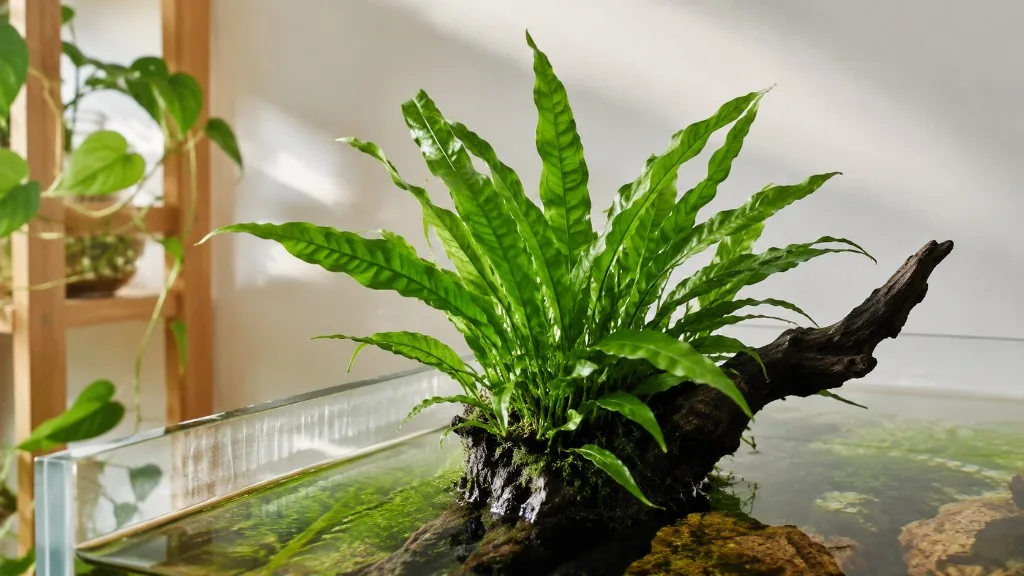
Java Fern Substrate Guide: Attach Rhizome to Wood or Rock
Java Fern Substrate Guide: Attach Rhizome to Wood or Rock
Potting soil, nutrient-rich aquasoil, and buried gravel all fail Java fern for the same mechanical reason: they cover the rhizome - the thick horizontal stem where leaves and roots emerge. Microsorum pteropus is an epiphytic water fern from tropical Asia that grows on submerged wood and rock in flowing water, not in muddy bottoms. The practical “substrate” for Java Fern overview is hardscape - driftwood, lava rock, slate - with the rhizome fully exposed to the water column. Bury that tissue in any soil product and anaerobic rot follows within days to weeks.
That single placement rule explains most Java fern deaths in home aquariums, turtle tanks, and beginner planted setups. Tropica’s culture sheet states plainly: grow it on a root or stone, attached with fishing line until it gains a hold, and never cover the rhizome if placed near the bottom. This guide covers why potting soil and buried rhizomes fail, which hardscape materials grip roots fastest, four reliable anchoring methods, when fine gravel is acceptable, and how to recover from rot. For species background and general care, see our Java Fern overview. If rot forces you to salvage tissue, our propagation guide covers plantlet and rhizome division.
Why Java Fern Does Not Belong in Potting Soil or Substrate
The word “soil” sends most plant owners toward garden mix, peat-heavy potting soil, or nutrient-rich aquasoil. For Java fern, all of those are the wrong category entirely. Microsorum pteropus is a water fern and an epiphyte - a plant that grows on surfaces rather than rooting into the ground. In Southeast Asian streams and shaded riverbanks/27914), it clings to submerged logs, rocks, and tree roots in flowing water. It was never built to sit in a muddy bottom or a terrestrial pot.
Potting soil is especially dangerous because it introduces organic matter, fertilizers, and bacteria that cloud water, spike ammonia, and trap the rhizome in anaerobic conditions. Even “aquarium soil” products designed for rooted stem plants can kill Java fern if you treat them like planting media for the rhizome itself. The plant pulls most of its nutrients from the water column through its leaves and exposed rhizome - the same feeding model described in our Java Fern watering guide - not from substrate the way a Cryptocoryne or Amazon Sword does.
The Epiphyte Habit of Microsorum pteropus
Java fern belongs to Polypodiaceae/27914), the same fern family as many terrestrial species, but its aquatic form behaves like other famous aquarium epiphytes: Anubias and Bucephalandra. Dennerle’s profile/27914) notes that it grows best when rhizomes anchor to rocks or driftwood, tolerates low to moderate light, and propagates from daughter plants on older leaves. The practical meaning for your tank setup is straightforward: you are not choosing soil chemistry or NPK ratios for this plant. You are choosing a surface - wood, stone, or decor - where the rhizome can breathe, receive gentle flow, and send anchoring roots outward over time.
Substrate in the tank may still matter for other plants and for overall aesthetics, but for Java fern specifically, the “substrate” is whatever you mount it on. Windelov and Trident cultivars follow the same rhizome rules as the standard form; their finer, lacier leaves do not change attachment biology, though the lighter fronds can tear more easily during tight thread wraps.
What the Rhizome Actually Does
The rhizome is the plant’s trunk. It is a thick, green-to-brown horizontal stem that stores energy, produces new leaves, and sends out thin brown anchoring roots. Each leaf emerges from the rhizome on its own stalk. When the rhizome is healthy and exposed, the plant can live for years, slowly spreading and occasionally producing plantlets - miniature ferns that sprout from leaf tips or along the rhizome, which you can detach per our propagation guide.
When the rhizome is buried - even partially - oxygen exchange at the surface stops. Anaerobic bacteria colonize the tissue. It turns soft, dark, and mushy. Leaves may blacken or go transparent. At that point, the plant is dying from the base up, and no amount of liquid fertilizer or light adjustment will reverse severe rot. The rhizome is not a root you can bury for stability. It is living stem tissue that must contact open water.
Best “Substrate” for Java Fern: Hardscape, Not Soil
Reframe the question. Instead of “what soil do I buy,” ask “what will my Java fern attach to for the next two years.” The best answer is almost always aquarium driftwood or inert rock with a texture the roots can grip. Both materials are stable, fish-safe when properly prepared, and mimic the plant’s native habitat.
Driftwood and rock also solve a problem that substrate cannot: elevation. Mounting the rhizome above the gravel line keeps it in the flow path where nutrients and oxygen move past the tissue. That is how epiphytes feed. A plant sitting flat on fine sand with its rhizome pressed against the grain may look fine for a week and then decline as sediment and detritus accumulate against the stem.
Driftwood and Aquarium Wood Options
Malaysian driftwood, spiderwood, and manzanita are popular choices because they offer branching shapes, crevices, and rough bark that roots penetrate over time. Cholla wood works in smaller tanks but breaks down faster - plan to reattach the fern when the wood softens, typically within a year in warm, well-lit setups. Whatever wood you choose, boil or soak it until it sinks and tannins have leached to a level you accept; one to two weeks of soaking with daily water changes is a practical baseline for dense hardwoods. Tannins are harmless to Java fern and pair naturally with blackwater layouts discussed in our watering guide.
Place the rhizome where you want long-term growth before you attach it. Tropica lists Java fern growth as slow, so moving a rooted clump later means cutting roots and restarting the attachment clock. A horizontal rhizome along a branch reads naturally in aquascapes. A vertical mount on a rock face works for background coverage. Avoid cramming the rhizome into a tight gap where future growth has nowhere to go.
Rock Types That Java Fern Roots Grip
Lava rock is the top recommendation for epiphyte attachment because its porous surface gives roots microscopic holds within days. Seiryu stone, dragon stone, and slate also work well; slate chips provide natural fissures for wedging without tools. Smooth river pebbles are usable but roots take longer to grip, which means you rely on glue or thread longer.
In turtle tanks, choose rocks too large for the animal to swallow and avoid sharp edges that could scrape a shell. Rinse all hardscape thoroughly. For turtle setups specifically, skip any wood or rock treated with pesticides, sealants, or outdoor pollutants - the plant is safe, but contaminated hardscape is not.
Porous vs Smooth Surfaces
Porous surfaces (lava rock, weathered driftwood, rough slate) let anchoring roots hook in within a few weeks under typical community-tank conditions. Smooth surfaces (glass-smooth pebbles, polished decor) may never develop a strong natural hold; the plant stays dependent on your original glue or thread until you resecure it.
Not all surfaces attach equally. The decision comes down to how long you want the plant secured by artificial means versus how quickly natural roots take over. A rough, porous surface shortens that window. Consider flow as well - a slight angle between rhizome and rock face lets water pass underneath and reduces algae buildup at the base. If you are designing an aquascape around Java fern as a permanent fixture, bias toward porous hardscape. If you are temporarily mounting a small rhizome section on a smooth ornament, super glue gel is the more reliable choice because you cannot count on roots alone.
Aquarium Gravel and Sand: When Roots Touch Substrate
Here is where “Java fern substrate” gets nuanced. The rhizome must never be buried. But thin anchoring roots growing downward into fine inert gravel or sand are acceptable and common. Many aquarists rest the rhizome on top of the substrate line and let roots find their own way into the grain. The rhizome stays exposed; only the hair-like roots disappear below the surface.
This is not the same as planting. Planting implies covering the rhizome. Resting implies the stem sits on the substrate with roots trailing down. The critical visual check: you should always see the full thickness of the rhizome above the gravel line.
Why Fine Inert Gravel Can Work
1–3 mm inert gravel or 0.5–1 mm pool filter sand works when other plants in the tank need substrate and you want Java fern in the same layout. Fine grain slows detritus from sinking into unreachable anaerobic pockets - a real problem with coarse gravel where waste rots between pebbles. Java fern does not extract meaningful nutrition from that gravel; the grain size matters for tank hygiene and root grip, not for feeding the fern.
Nutrient-rich aquasoil or ADA Aqua Soil beneath the rhizome does not benefit Java fern directly because it is a water-column feeder. You can run aquasoil for other species and still mount Java fern on wood above it. Do not bury the rhizome in aquasoil thinking you are helping it. You are applying rooted-plant logic to an epiphyte.
What Happens When the Rhizome Gets Buried
Partial burial fails as often as full burial. A rhizome with its top edge peeking out and its underside pressed into gravel still loses surface area for gas exchange. Sand drift from fish digging, turtle substrate disruption, or a careless replant can cover the stem overnight. Within a week, the buried section softens. Black spots on leaves may follow - though note that black spots on the underside of healthy leaves are often sporangia (reproductive structures), not disease.
If you discover a buried rhizome, gently lift it free, trim any mushy tissue with sharp scissors, and reattach it to hardscape immediately. A rhizome with firm green-brown tissue and white or green growing tips can recover. A rhizome that smells foul and collapses when pinched is gone; salvage any healthy leaf plantlets if present.
How to Attach Java Fern to Wood and Rock
Attachment is the real “planting” step for Java fern. Four methods cover nearly every situation: super glue gel, cotton thread or fishing line, crevice wedging, and plant weights for temporary positioning. All share one rule: the rhizome stays exposed, secured lightly, with room to grow.
Before you start, inspect the rhizome. Trim dead leaves. Identify the growing direction - rhizomes creep horizontally, and leaves emerge from the top side. Mounting the rhizome upside down does not always kill the plant, but it slows growth and looks wrong for months.
Super Glue Gel Method
Cyanoacrylate super glue gel (not liquid) is aquarium-safe once cured and is the fastest permanent mount. Aquarium Co-Op recommends gel super glue for Java fern: apply a bead to the decor, hold the rhizome for about 30 seconds, and let it cure briefly before submerging. Use a pea-sized dab on the hardscape, press the rhizome against it for 20–30 seconds, and release. The gel cures underwater. Do not coat the entire rhizome - too much glue blocks gas exchange and can suffocate tissue the same way burial does.
Apply glue to the underside of the rhizome or to the hardscape contact point, not to leaves. Leaves glued to rock cannot photosynthesize normally and often die back. Gel formulas stay where you put them instead of running into the water column. Plain cyanoacrylate gel without accelerators is standard hobby practice. In very small closed tanks, brief glue odor during cure is normal; increase surface agitation or run the lid open for a few minutes if fish seem stressed.
Thread and Fishing Line Method
Black cotton thread or clear fishing line wraps around the rhizome and hardscape together. Tie snug enough to hold position, not tight enough to cut into tissue. Cotton rots away in a few weeks, by which time roots usually grip the surface on their own.
Fishing line is nearly invisible but must be removed manually if roots lag. Check monthly. If the plant detaches during a water change, rewrap with fresh thread rather than forcing a rotting knot tighter. Zip ties work on large driftwood but look bulky in small tanks; clip the tail flush and plan to cut them when roots attach.
Crevice Wedging Without Tools
Natural cracks in driftwood, fissures in slate, and gaps between stacked stones can hold a rhizome without glue or thread. Tuck the rhizome in, let roots do the work. This method suits experienced aquascapers who already built crevices intentionally. It fails if the gap is too loose - the plant floats out on day one - or too tight, which crushes the rhizome.
For a low-effort version, place a small smooth rock on top of one section of rhizome resting on the substrate, weighting it down while roots anchor. Remove the rock once grip is established so the rhizome is not permanently compressed.
Attachment Method Comparison
Choosing a mount method is a trade-off between speed, visibility, skill, and how easily you can undo a mistake. This table summarizes what works in most home aquariums:
| Method | Time to secure | Typical root grip | Reversibility | Best for |
|---|---|---|---|---|
| Super glue gel | Immediate (30 sec hold) | Weeks to months on porous rock | Low - must cut rhizome to move | Permanent focal mounts, smooth surfaces |
| Cotton thread | 2–5 minutes | 3–6 weeks; thread rots away | High - snip and remount | Natural-looking wood branches |
| Fishing line | 2–5 minutes | 3–6 weeks; line stays until cut | Medium - must remove line manually | High-flow tanks, invisible ties |
| Crevice wedge | 1 minute | 2–8 weeks depending on fit | High - lift out freely | Pre-planned aquascape gaps |
| Small rock weight | 30 seconds | 2–4 weeks | High - remove weight after grip | Temporary positioning on gravel |
Timelines are approximate. Warm water, gentle current, and porous lava rock shorten the grip window; cold water and smooth pebbles extend it. Mark your calendar when you first attach a new rhizome - if it still slides freely after two months on porous lava rock, check whether flow is blocked or the surface is too smooth for roots to hook.
Rhizome Rot: Causes, Signs, and Recovery
Rhizome rot is the terminal diagnosis when stem tissue collapses. It is almost always caused by burial in substrate, partial sand coverage, or excessive glue covering too much rhizome surface. Less often, physical damage from tight thread or a sharp rock edge opens tissue to infection.
Early signs include a soft, darkened rhizome section, leaves detaching with minimal tug, and a foul smell when you lift the plant from the tank. Transparent or blackening leaf tissue can follow. Do not confuse sporangia - small dark bumps on the underside of healthy leaves - with rot on the rhizome itself.
Recovery steps: remove the plant, trim all mushy rhizome tissue back to firm material, remount on hardscape with minimal glue, and maintain stable water quality per our watering guide. Severe rot leaves nothing to save; propagate from plantlets on healthy leaves or from a firm rhizome section if any remains - see propagation for clean cut lines.
Common Mistakes With Java Fern “Soil” and Placement
The most frequent error is treating Java fern like a stem plant - pushing the rhizome into gravel because it “looks more natural planted.” Retail pots sometimes arrive with rock wool or a small weight at the base, and beginners assume the whole bundle goes under the substrate. Unpack scenario: a pet-store Java fern in a plastic pot with rock wool at the base. Remove the pot, gently tease away rock wool without tearing roots, expose the full rhizome, and mount it on driftwood or lava rock the same day. Leaving rock wool bundled around the rhizome traps debris and mimics partial burial - the stem softens within two to three weeks even when the leaves still look green. Many retail ferns are grown emersed (leaves in humid air, roots in moisture) and melt partially after submersion; substrate choice does not fix that transition - stable water parameters and moderate light do. Mount correctly first so melt is not mistaken for burial rot.
Emersed-to-submersed confusion trips up beginners who buy a lush potted fern, bury it for stability, and blame “bad soil” when leaves transparent and the rhizome softens. The melt phase and rot phase can overlap visually. Always expose the rhizome before judging whether the plant is adapting or dying.
Potting soil in turtle tanks is a separate hazard. Terrestrial soil clouds water, harbors pathogens, and buries the rhizome simultaneously. Turtle setups should use inert aquarium substrate if any is used at all, with Java fern mounted on hardscape above the digging zone.
Other mistakes: using too much super glue; wrapping thread like a tourniquet; placing the fern in dead flow behind a filter intake where debris collects; and assuming aquasoil will rescue a buried plant. Floating Java fern is valid - the species survives floating indefinitely - but uncontrolled floaters block light and look messy in display tanks. Attachment gives you design control and keeps the rhizome where you can inspect it during routine water changes.
Comparison: Java Fern vs Anubias Attachment Needs
Both Java fern and Anubias are epiphytes with the same core rule: never bury the rhizome. The attachment methods - glue, thread, wedging - are interchangeable between the two. Differences are subtle and matter when you mount both on the same hardscape piece.
| Factor | Java Fern (Microsorum pteropus) | Anubias (Anubias barteri spp.) |
|---|---|---|
| Rhizome shape | Thinner, more creeping | Thicker, slower-spreading |
| Rhizome burial | Fatal - rot within days to weeks | Fatal - same mechanism |
| Best mount surface | Driftwood, lava rock, slate | Driftwood, lava rock, stone |
| Leaf texture | Thin, prone to algae in bright light | Thick, tougher during handling |
| Cultivar note | Windelov/Trident: same rules, finer leaves | Nana petite: tighter gaps needed |
| Growth rate | Slow; plantlets on leaves | Very slow; rhizome division |
If you already keep Anubias correctly mounted on wood, Java fern follows the same playbook. For Anubias-specific grain sizes and anchoring detail, see our Anubias substrate guide. Mount both on the same hardscape piece for a low-maintenance epiphyte zone that never needs replanting.
Conclusion
Java fern does not need potting soil, garden soil, or buried aquasoil. It needs an exposed rhizome attached to aquarium-safe wood or rock, with anchoring roots optionally reaching into fine inert gravel below. Bury the rhizome in any substrate and rot follows predictably. Mount it on hardscape with glue, thread, or a natural crevice, keep the stem in gentle flow, and inspect the rhizome during each water change.
Before you close the tank, run one check: can you see the full rhizome above the substrate line? If yes, you have solved the entire “soil” question for this plant. If no, lift it, trim any soft tissue, and attach it properly - then link forward to propagation if you need to salvage plantlets from trimmed material.
When to use this page vs other Java Fern guides
- Java Fern overview - Start here for whole-plant context before deep-diving this topic.
- Java Fern problems hub - Jump to symptom-specific fix guides when this care topic does not resolve the issue.