Java Fern Light Requirements: LED PAR and Photoperiod
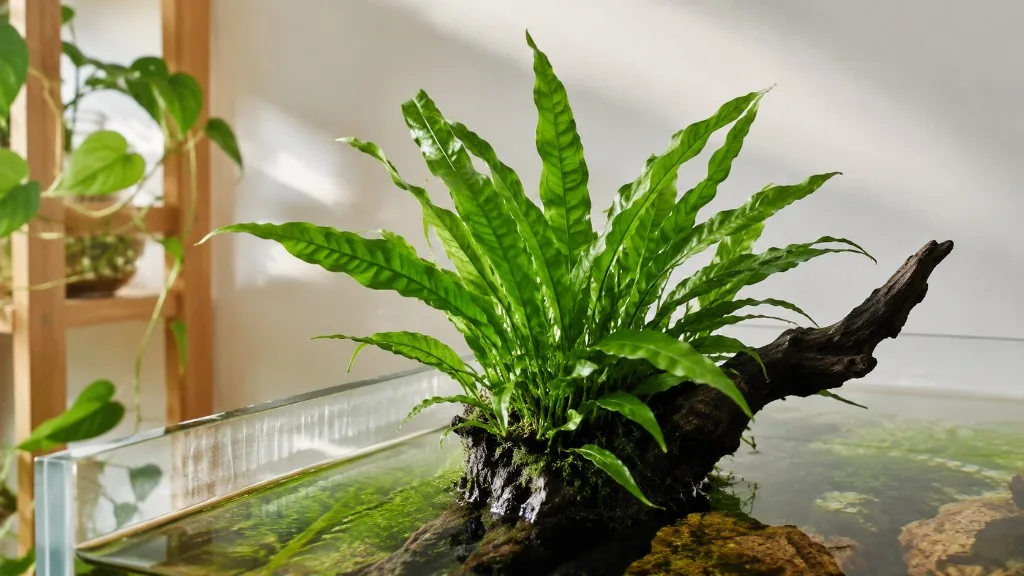
Java Fern Light Requirements: LED PAR and Photoperiod
Java Fern Light Requirements: LED PAR and Photoperiod
Java Fern needs low light to moderate aquarium LED light - roughly 15 to 50 µmol/m²/s PAR at the leaf surface and a 6 to 8 hour daily photoperiod in most low-tech tanks. It does not want window sunlight, and treating it like a windowsill houseplant is one of the fastest ways to trigger algae blooms, temperature swings, and the transparent leaf melt that makes beginners think their fern is dying. Microsorum pteropus evolved under filtered canopy light along shaded Southeast Asian stream banks. Your job is to recreate that stability with a controllable LED - not to gamble on whatever the sun delivers through glass.
This guide covers PAR targets adjusted for tank depth, why window light fails even when it looks dim to you, photoperiod rules for single-species and mixed planted tanks, spectrum and Kelvin choices that matter less than intensity, shade strategies using hardscape and floating plants, fixture selection from stock LEDs to dimmable planted-tank lights, and a 14-day dial-in plan for new setups without algae explosions.
Why Java Fern Thrives in Shaded Stream Conditions
Southeast Asian habitat and epiphyte growth
Java Fern is not a substrate-rooted plant that reaches upward for maximum photons. It is an epiphyte - the rhizome anchors to rock, driftwood, or stream-bank debris while leaves extend into diffused light beneath overhanging vegetation. Buce Plant’s Java fern care guide notes that the species hails from shady river and waterfall margins in Southeast Asia, where canopy cover filters direct sun. That ecology explains why Tropica and other aquatic plant references classify Java Fern as an easy, low-demand plant that tolerates a wide range of water parameters but prefers restrained light.
The leaves are thick, leathery, and reinforced with silica - a trait that makes them nearly inedible to cichlids and goldfish but also means they replace slowly. A leaf that burns under excess light stays on the plant for weeks, giving algae time to colonize the damaged surface. Slow metabolism plus durable foliage is the central reason Java Fern rewards conservative lighting rather than the intense PAR that drives red stem plants or carpeting species.
Low-to-moderate PAR in practical terms
Aquarium writers describe low light for Java Fern as roughly 15 to 50 µmol/m²/s PAR at the leaf, depending on the source. Aquaterra Obsession’s Microsorum care profile recommends 15–30 µmol for healthy daily growth, while Biology Insights and Recifart’s planted-tank lighting guide extend the comfortable band to 30–50 µmol for denser foliage. The spread is normal - fixture optics, water clarity, and whether you measure at the substrate or mid-tank all shift readings.
For Java Fern, treat low-to-moderate as 15 to 50 µmol/m²/s at the leaves you care about (hobby PAR guidance), with 20 to 40 µmol as the comfortable operating zone - while Tropica’s Easy-plant lighting guide targets roughly 0.25–0.5 W/L for most home aquariums and anything consistently above 60 µmol without shade as high-risk for leaf burn and algae on slow epiphytes. You are not trying to maximize growth speed. You are trying to maintain deep green, intact fronds month after month.
Target PAR Levels for Healthy Java Fern
The 15–50 µmol range and reconciling sources
PAR - photosynthetically active radiation, measured in micromoles per square metre per second (µmol/m²/s) - describes the photons plants actually use for photosynthesis. Watts tell you electricity draw. Lumens describe brightness to human eyes. Kelvin describes colour temperature. None of those replace PAR when you are deciding whether a Java Fern on driftwood is getting too much or too little light.
Independent references converge on a similar band, with minor variation at the upper end:
| Light level | PAR at leaf (µmol/m²/s) | Typical Java Fern response |
|---|---|---|
| Very low | 10–15 | Survives indefinitely; growth nearly stalls |
| Ideal | 20–40 | Steady growth; dark green fronds; occasional plantlets |
| Tolerated | 40–50 | Denser foliage; watch upper leaves for burn |
| High-risk | 60+ | Transparent patches, brown burn, algae on leaves |
Aquarium Co-Op’s Java fern guide emphasizes that Java Fern will live under almost any aquarium light but does best at low to medium intensity and can burn or melt at the very high end. Canton Aquatics’ 2026 Java fern guide specifically recommends 15–30 PAR for the healthiest, darkest green leaves. If you lack a PAR meter, start a dimmable LED at 30 to 40 percent power on tanks 45 cm deep or less, run 6 hours, and observe for two weeks before increasing anything.
Measuring at the leaf, not the substrate
Light intensity drops with depth. A fixture delivering 55 µmol at the water surface may deliver only 20 µmol at the substrate of a 45 cm tank - which can be perfect for a Java Fern tied low on driftwood - while the same fixture fries a Windelov cultivar mounted near the surface. Always think about PAR at the leaf, not at the glass top or tank bottom.
A practical depth cheat sheet:
- Shallow tanks (under 30 cm): Stock or budget LED is often sufficient; dim or shorten photoperiod if upper leaves show transparent patches.
- Standard height (30–45 cm): Aim for 20–40 µmol at the Java Fern leaf; use fixture height and hardscape placement to fine-tune.
- Tall tanks (45 cm+): Either raise Java Fern on tall driftwood toward mid-level light, or accept very slow lower-tank growth and rely on shade from floating plants rather than cranking intensity.
If lower fronds stay dark green but never produce plantlets while upper fronds develop brown patches, you likely have a gradient problem - not too little light overall, but the wrong intensity at the rhizome level versus the leaf tips.
Why Aquarium LED Beats Window Light for Java Fern
Intensity swings, algae, and temperature stress
Beginners often ask whether a tank near a sunny window can skip buying an aquarium light. For Java Fern specifically, the answer is no - and the reasons go beyond convenience. Direct sunlight delivers far more photosynthetically active radiation than a typical planted-tank LED. On a bright day, window sun can deliver far higher intensity than a standard LED fixture - enough to overwhelm a low-light epiphyte evolved for shaded stream margins. Java Fern did not evolve for that dose. What looks like gentle morning light through glass can spike to levels that trigger transparent leaf melt within days.
Window light is also unpredictable. Cloud cover, season changes, and shifting sun angle mean your Java Fern might receive 2 hours of intense direct sun on Tuesday and 6 hours of diffuse grey light on Wednesday. Aquarium Co-Op’s lighting balance guide warns that this variability makes it nearly impossible to balance a planted tank because light input changes daily while nutrient and CO2 levels stay relatively stable. Algae - which reproduces faster than slow-growing ferns - exploits those spikes long before Java Fern can respond.
Temperature adds another failure mode. A tank in direct sun can swing several degrees Fahrenheit in a single afternoon. Java Fern tolerates a wide temperature range - roughly 22 to 28°C/27914) (68 to 82°F) is the common hobby target - but rapid swings stress fish and weaken plant tissue, making leaves more vulnerable to melt and infection. LED fixtures add minimal heat to water. You maintain stable temperatures regardless of lighting schedule.
Timers, dimming, and predictable photoperiod
The practical advantage of LED over window light is control. A basic aquarium timer gives Java Fern the same 6 to 8 hours of light every day, year-round. A dimmable planted-tank LED lets you start conservative - 30 percent brightness, 6 hours - and increase only when leaves look healthy and algae stays absent. Window light offers none of that. You cannot dim the sun, and blackout curtains are a workaround that still leaves you guessing at actual PAR reaching the fronds.
If your tank currently sits near a window and Java Fern shows algae, transparent patches, or persistent diatoms, move the tank or block all direct sun first. Then add a full-spectrum LED with a timer. Do not try to compensate for window light by shortening photoperiod alone - the intensity spikes on sunny days will still overwhelm a shade-adapted fern. LED first, window light never.
Photoperiod Basics for Java Fern Tanks
Java Fern does not need a long day. For tanks without CO2 injection and without demanding stem plants, 6 to 8 hours of LED light per day is the standard recommendation across Java Fern-specific guides and general low-tech planted-tank advice. Aquaterra Obsession and Buce Plant both land on 6–8 hours. Aquarium Store Depot’s Java fern guide allows up to 10 hours at moderate intensity, but that upper bound assumes stable nutrients, good flow, and willingness to adjust downward at the first sign of algae.
Use an outlet timer or the built-in scheduler on a smart LED. Consistency matters more than total hours - a Java Fern that gets 7 hours daily at the same time will outperform one that gets 5 hours one day and 11 hours the next because irregular cycles stress plants and favor algae. If you run a mixed planted tank with moderate stem plants alongside Java Fern, you can extend to 8 hours but shade the fern under hardscape or floating plants rather than extending photoperiod to compensate for dim placement.
When algae appears, shorten photoperiod before you reach for algaecides. Dropping from 8 hours to 6 hours for two weeks often clears green spot algae on fern leaves while you address the underlying imbalance. Photoperiod is the fastest lever you control.
Spectrum, Kelvin, and Full-Spectrum LEDs
Java Fern is not picky about spectrum the way high-light stem plants can be. Most references recommend a daylight-balanced LED in the 5,500K to 6,500K range - Biology Insights and Aquaterra Obsession both cite this band - because it mimics natural daylight and renders fish and green foliage well. Aquarium Co-Op mentions 6700K specifically. Aquarium Source’s Java fern guide widens the acceptable range to 5,000–7,500K.
Kelvin affects how the tank looks to you more than whether Java Fern photosynthesizes. What actually drives growth is PAR intensity and photoperiod length. A 6,500K full-spectrum LED at 25 µmol is better for Java Fern than a 10,000K high-PAR reef light at 80 µmol. If your fixture lets you adjust RGB channels independently, prioritize balanced white output over red-heavy presets designed for red plants. Blue light contributes to compact leaf structure - Recifart notes its role in broad-leaf development - but excess blue at high intensity still burns shade-adapted species.
Recognizing Too Little Light on Java Fern
Java Fern is famous for surviving neglect, which makes under-lighting harder to diagnose than over-lighting. A fern in a dim corner may look fine for months because existing leaves persist long after growth has stalled. Signs that light is genuinely too low include pale or yellow-green new fronds, extremely slow or absent plantlet production, thin, elongated leaves on cultivars that normally grow broad, and lower leaves that darken while no new growth appears at the rhizome.
Very low PAR - below 10–15 µmol - will not kill Java Fern quickly. It will survive in a bucket under ambient room light, as many aquarists have discovered by accident. But survival is not the goal. If you want steady plantlet production, dense Windelov branching, or a background wall of Trident fronds, you need at least 20 µmol at the leaf. Raise intensity gradually: increase dimmer by 10 percent or add 30 minutes of photoperiod, then wait two weeks.
Under-lighting rarely causes melt. If your fern is dissolving, look at light excess, rhizome burial, or sudden parameter swings before assuming you need more light.
Recognizing Too Much Light on Java Fern
Too much light is the more common Java Fern failure in planted tanks, especially when hobbyists upgrade to powerful LEDs and run them at full brightness for 10–12 hours because carpet plants demand it. Warning signs include transparent or glassy patches on fronds, brown or black burn spots that spread across leaf tissue, yellowing at the tips followed by tissue death, and algae coating leaves that the fern cannot outgrow because leaf turnover is slow.
Buce Plant lists excessive light exposure as a primary cause of black spots and leaf burn, recommending reduced intensity and a 6–8 hour photoperiod. Canton Aquatics notes that intense lighting produces brown or transparent patches distinct from the reproductive black spots on leaf undersides - spore patches are normal and localized; burn patches spread and kill tissue.
Do not confuse reproductive spores with damage. Java Fern produces dark spots on leaf undersides as part of normal propagation. Those spots develop plantlets. Burn damage appears on the upper surface, spreads irregularly, and turns tissue translucent or mushy. If you are unsure, reduce light for two weeks. Spore spots remain stable; burn damage stops spreading once intensity drops.
Shading Java Fern Without Starving It
Shade is Java Fern’s friend when the rest of your tank needs more light than the fern can handle. Effective shade methods include placing the rhizome under overhanging driftwood, positioning the fern beneath taller stem plants or Amazon swords, adding floating plants such as Amazon frogbit, Salvinia, or red root floater to diffuse surface light, and mounting the fern on the side of hardscape rather than directly under the fixture’s brightest cone.
Shade reduces PAR without changing your photoperiod - useful in mixed tanks where Rotala or Ludwigia need 8 hours at moderate-to-high intensity but Java Fern would burn at the same exposure. A fern under frogbit might receive 25 µmol while stem tips at the surface receive 70 µmol. That gradient mirrors the natural stream-bank habitat.
Avoid shading so heavily that PAR at the fern drops below 10 µmol for weeks. If fronds become dark green but paper-thin and no plantlets appear after two months, ease back floating plants or move the fern slightly toward open water. Shade should moderate intensity, not eliminate it.
Picking an LED Fixture for Java Fern-First Tanks
For a Java Fern-focused low-tech tank, you do not need an expensive high-PAR fixture. You need consistent full-spectrum output, a timer, and ideally a dimmer. Three tiers cover most setups:
Stock or kit LEDs - Often adequate for Java Fern in shallow tanks under 30 cm. Run at full power with a 6-hour timer and watch for algae in the first month. If green spot algae appears on glass or fern leaves, add a dimmer-equipped replacement rather than fighting algae with chemicals.
Budget planted-tank LEDs - Brands like NICREW ClassicLED, Fluval Aquasky, and similar units offer planted-tank spectrums at moderate price points. Start at 30–40 percent brightness on dimmable models. These fixtures often exceed Java Fern’s needs at 100 percent power on standard-height tanks.
Dimmable planted-tank LEDs - Finnex Planted+, Chihiros WRGB, ONF Flat One, and comparable fixtures give precise control. For Java Fern-first aquascapes, this category is the best long-term investment because you can grow the tank’s ambition - adding moderate stems later - without replacing the light.
Aquarium Co-Op recommends starting around 20–40 percent brightness on programmable fixtures and increasing only when no algae appears. For Java Fern, stay in the lower half of that range unless you have confirmed low PAR with a meter.
Placement on Driftwood, Rocks, and Hardscape
Light and placement interact because Java Fern is an epiphyte. The rhizome must stay above substrate - burying it causes rot - and the frond orientation determines which tissue receives direct LED exposure. Tie the rhizome to driftwood faces that angle away from the fixture, rock crevices under ledges, or the shadowed side of hardscape structures. Avoid mounting Java Fern flat on the tank bottom directly beneath a pendant light unless you have confirmed low PAR at that depth.
Vertical placement matters in tall tanks. A fern at the substrate of a 60 cm tank may receive adequate light from a moderate LED while the same fern at mid-water on a tall branch receives double the PAR. When you attach Java Fern, think about where the leaf tips will sit relative to the light cone, not just where the rhizome looks aesthetically pleasing.
Rotate or relocate ferns that show burn on upper fronds but healthy lower tissue - a sign the top of the plant has entered the high-intensity zone. You do not always need to dim the entire fixture. Sometimes moving one rhizome 5 cm lower on the wood solves the problem.
Algae on Java Fern Leaves and Light’s Role
Algae on Java Fern is a light problem dressed as a nutrient problem. Slow-growing leaves stay in the water column for months, giving green spot algae, diatoms, and beard algae a stable surface to colonize. When light exceeds what the fern can use for photosynthesis, excess energy feeds algae instead. High photoperiod compounds the issue - 10 hours of moderate light on a low-tech tank often produces GSA on fern fronds even when nitrates and phosphates look normal.
A practical response sequence:
- Shorten photoperiod to 6 hours for two weeks.
- Reduce LED intensity by 20–30 percent or raise the fixture 5–10 cm.
- Add floating plants to diffuse surface light if stem plants above the fern demand longer photoperiod.
- Gently remove algae from leaves with a soft toothbrush - do not scrub with metal tools on delicate fronds.
- Add algae grazers - Amano shrimp, Nerite snails, and Otocinclus handle spot algae without damaging healthy tissue.
Only after light adjustments should you tweak fertilization. Dosing more iron into an over-lit tank often worsens GSA. Balance light downward first, then evaluate whether NPK or micronutrient adjustments are needed.
Java Fern Compared to Anubias, Moss, and Crypts
Java Fern sits in the same low-light epiphyte category as Anubias and mosses, with slightly more tolerance for moderate PAR than Anubias barteri nana in some setups. All three prefer LED over window light and all three suffer when slow growth meets excess intensity.
| Species | PAR sweet spot (µmol/m²/s) | Photoperiod (low-tech) | Window light risk |
|---|---|---|---|
| Java Fern | 20–40 | 6–8 hours | High - leaf melt, algae |
| Anubias | 20–40 | 6–8 hours | High - GSA on leaves |
| Java moss | 15–30 | 6–8 hours | High - algae overgrowth |
| Cryptocoryne | 30–50 | 7–8 hours | Moderate - melt from stress |
Cryptocoryne wendtii and similar species tolerate slightly more light and can serve as a midground screen that shades Java Fern behind them. Stem plants like Hygrophila or Rotala need higher PAR and longer photoperiod - plan shade accordingly when mixing species. The rule for mixed tanks: light for the highest-demand plant, then shade the epiphytes rather than lighting for the fern and starving everything else.
Conclusion
Java Fern aquarium lighting is not complicated, but it is specific. Use a low to moderate full-spectrum LED, target 20 to 40 µmol/m²/s PAR at the leaf, run 6 to 8 hours on a timer, and keep the tank away from window sunlight. Window light fails because intensity swings daily, heats water unpredictably, and overwhelms a shade-adapted epiphyte that replaces leaves slowly. LED succeeds because you control intensity, photoperiod, and consistency.
Mount the rhizome on shaded hardscape, diffuse excess light with floating plants when mixing species, and adjust downward at the first sign of transparent patches or algae on fronds. Java Fern forgives water parameter mistakes more readily than lighting mistakes. Get the LED right, and Java Fern overview will reward you with dark green fronds and plantlets for years.
When to use this page vs other Java Fern guides
- Java Fern overview - Start here for whole-plant context before deep-diving this topic.
- Java Fern problems hub - Jump to symptom-specific fix guides when this care topic does not resolve the issue.
- Leggy Growth on Java Fern - Escalate here when light adjustments are not enough.
Related Java Fern guides
- Java Fern overview
- Java Fern watering
- Java Fern soil
- Java Fern propagation
- Java Fern fertilizer
- Java Fern repotting
- Leggy Growth on Java Fern
- Java Fern problems
Related tool
Try the Plant Problem Diagnosis Tool with java-fern pre-selected to estimate needs for your setup.