Java Fern Water Care: Aquarium Parameters and Water Changes
Java Fern Water Care: Aquarium Parameters and Water Changes
Java Fern Water Care: Aquarium Parameters and Water Changes
If you searched “Java fern watering” and found advice about checking soil moisture or waiting until the top inch dries out, you are reading the wrong care model entirely. Microsorum pteropus is an epiphytic aquatic fern - it lives fully submerged, attached to rock or driftwood, absorbing water, minerals, and nitrogen compounds through its leaves and exposed rhizome. It does not sit in potting mix. It does not get a watering can. What it needs is stable aquarium water chemistry, gentle flow, and consistent partial water changes that keep dissolved waste and nutrients in a range where the rhizome stays firm and the leaves stay dark green. This guide covers the parameter targets that work in community tanks, blackwater biotopes, turtle setups, and low-tech planted aquariums, plus the change schedule and testing routine that prevent the brown-leaf, mushy-rhizome problems most beginners blame on the plant when the water was the issue.
Why Aquarium Water - Not Houseplant Watering - Controls Java Fern Health
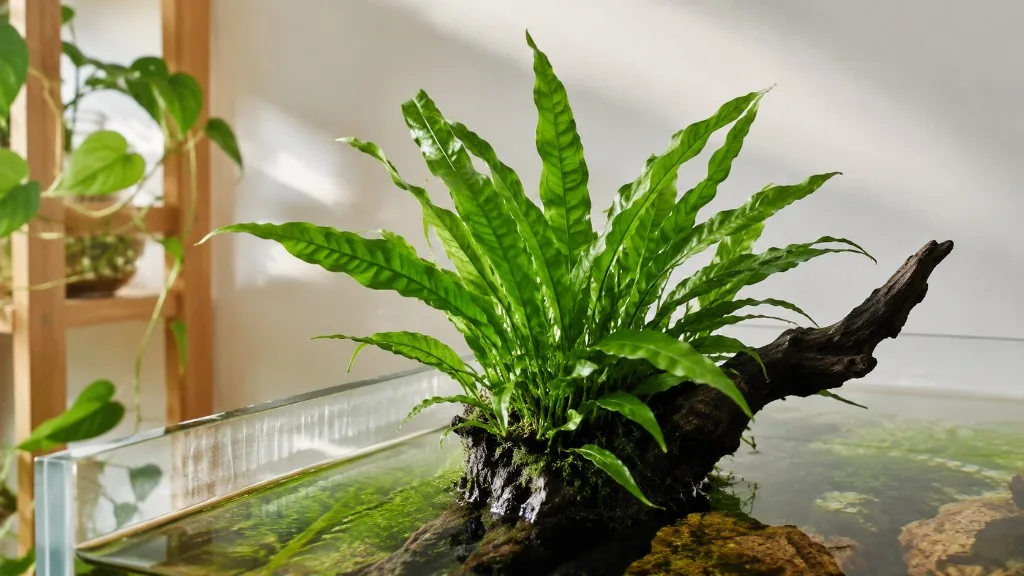
Java fern belongs to Polypodiaceae/27914), the same fern family as many terrestrial species, but its wild habitat tells you everything about how water actually reaches the plant. Native to Southeast Asian streams, river margins, and humid rock faces in Thailand, Malaysia, and Indonesia, it grows with its rhizome anchored to stone or wood in slow-moving, shaded water. Tannins from leaf litter often stain that water tea-brown. Flow is gentle but continuous. The rhizome stays exposed to moving water - never buried in sediment, which would suffocate the tissue and trigger rot.
In an aquarium, that biology translates to three non-negotiable rules. First, keep the rhizome above substrate - tie it to driftwood, lava rock, or suction-cup mounts; do not plant it like a sword in gravel. Second, manage the water column the way you would for a fish, because the plant drinks from that same column. Third, replace a portion of that water on a schedule so nitrate, dissolved organics, and trace minerals stay balanced. Skipping water changes because “the plant looks fine” is the aquatic equivalent of never changing the soil leachate in a potted fern - eventually something accumulates.
The confusion comes from SEO overlap. Java fern is sold as a “plant,” and plant-care templates default to soil moisture schedules. Tropica lists it as an easy epiphyte for beginners; Dennerle and Aquarium Co-Op describe the same species as a water-column feeder that tolerates wide parameters but hates rhizome burial and sudden chemistry swings. When leaves brown or black spots appear, the fix is almost never “water it less.” It is test the nitrate, check whether the rhizome got buried during a rescape, confirm the last water change did not dump cold dechlorinated tap water in all at once, and verify flow is moving water across the rhizome without blasting new plantlets off the parent leaf.
The Ideal Temperature Range for Java Fern
Temperature sets the metabolic pace for this slow-growing fern. Across nursery databases and aquarium references, the consensus range is 68–82°F (20–28°C), with the mid-70s°F band producing the steadiest leaf color and rhizome firmness. Dennerle lists 22–28°C/27914) as the practical optimum. Java fern is not a cold-water specialist like some temperate mosses, but it is also not a high-heat plant - prolonged temperatures above 80°F tend to pair with thinner leaves, more algae on older fronds, and faster deterioration of damaged tissue.
Stability matters as much as the number on the heater dial. A tank that holds 74°F year-round outperforms one that swings from 70°F overnight to 79°F on a sunny afternoon. Use an adjustable heater sized for your tank volume, and verify the set point with an independent thermometer probe or stick-on strip rather than trusting the heater’s factory calibration. After a water change, match replacement water to tank temperature within 2°F before adding it - temperature shock is one of the fastest ways to stress an epiphyte that cannot retreat into dry soil while it recovers.
Cold Limits and Heater Failure Risks
Below 65°F (18°C), growth nearly stalls. The plant usually survives short cool spells - unheated rooms in winter, a heater failure overnight - but leaves develop slowly and existing damage takes weeks to replace rather than days. Sustained temperatures below 60°F weaken tissue and invite fungal spotting on older fronds in some setups. If your tank runs cold because livestock prefers it (certain hillstream setups or unheated goldfish tanks in cool rooms), Java fern will persist but look static; do not interpret slow growth as a nutrient crisis until you confirm temperature is back in the 68°F+ range.
Heater failure during winter is the practical cold risk. Java fern will not die in 48 hours at 62°F, but a week at 58°F combined with a skipped water change and rising nitrate produces the brown, melting-edge leaves people post in forums. Keep a backup heater or room-temperature stability plan for tanks below 20 gallons, where temperature crashes faster.
Warm Community Tanks and Turtle Aquariums
Standard tropical community tanks at 76–78°F are well inside Java fern’s comfort zone. Red-eared slider and other turtle aquariums often run 75–80°F, which is tolerable but increases the importance of frequent water changes because warm water holds less dissolved oxygen and turtle bioload drives nitrate up faster than fish-only tanks. Java fern in turtle setups frequently survives grazing - turtles often ignore it - but only when water quality keeps pace. Plan 30–40% weekly changes in warm, heavily stocked turtle tanks rather than the 20% minimum that might suffice in a lightly stocked betta aquarium.
Above 80°F, watch for combo stress: warm water plus bright light plus high nitrate produces algae-coated leaves faster than the fern replaces them. You do not need to chill a valid tropical tank just for Java fern, but you do need to test nitrate weekly and trim algae-covered fronds so new growth gets light without scraping the rhizome.
pH: Acidic Blackwater to Neutral Community Tanks
For standard community aquariums, pH 6.0–7.5 is the widely cited ideal, with slightly acidic to neutral water supporting the steadiest color. Dennerle documents pH 5–8 tolerance/27914) for Java Fern overview. Java fern is one of the few popular aquarium plants that also thrives in blackwater biotopes where tannins pull pH toward 5.5–6.5 and soften hardness - within the pH 5–8/27914) range Dennerle documents for Microsorum pteropus.
In practice, that means you do not need to fight tannins if you are building a Southeast Asian blackwater scape with Indian almond leaves, alder cones, and driftwood. Java fern’s low-light tolerance and leathery leaves suit stained water better than most stem plants. You do need to avoid rapid pH swings - dumping a large volume of high-pH tap water into a tannin-buffered tank at pH 6.2 can stress fish and fern alike even if both endpoints are “safe.”
Stable pH vs Chasing a Single Number
The most useful pH lesson for Java fern keepers is identical to the lesson for fish: stability beats precision. A tank that holds pH 7.2 ± 0.2 week after week will grow healthier ferns than a tank that alternates between pH 6.8 after a big water change and pH 7.6 three days later as CO₂ off-gasses. If you run CO₂ injection, limit overnight pH rebound with consistent timing and adequate KH buffering. If you run low-tech with botanicals, expect gradual pH drift downward as leaves decompose - that is normal in blackwater; replace spent botanicals on a schedule rather than panicking at each 0.1 drop.
Chasing pH with phosphate buffers or repeated pH-up/pH-down doses creates the swings that cause translucent leaf patches and blackened edges on older fronds. Pick a biotope direction - community neutral or blackwater acidic - and manage water changes so new water matches the direction you chose.
General Hardness (GH) and Carbonate Hardness (KH)
General hardness (GH) measures calcium and magnesium; carbonate hardness (KH) measures the bicarbonate buffer that stabilizes pH. Java fern is genuinely adaptable on both fronts. Hobby references commonly cite GH 3–8 dGH and KH 3–8 dKH as the easy-growth zone, with tolerated extremes from very soft blackwater (2 dGH) up to moderately hard tap water (15–18 dGH). Dennerle lists very soft to hard water/27914) as acceptable.
The practical pattern: in soft, RO-only water without remineralization, Java fern usually still lives, but growth stays pale and new leaves may show increased transparency until calcium and magnesium are available in the column - either from remineralized change water or from comprehensive liquid fertilizers that include micronutrients. In moderate municipal tap water across most of North America and Europe, GH and KH are already fine for Java fern with zero modification. Test once at setup; if GH is above 3 dGH and KH above 3 dKH, log the numbers and retest only after you change water sources or add CO₂.
Very hard water above 15 dGH rarely kills Java fern, but iron and other micronutrients can precipitate at high pH, showing as dull leaves despite dosing. If your tap is liquid rock and pH sits at 7.8+, focus on stable change routines and chelated micro fertilizers rather than trying to soften the entire tank unless livestock requires it.
Water Flow: Gentle Current Without Rhizome Damage
Flow is the most overlooked “water care” variable for Java fern because it does not appear on standard test kits. In nature, water moves continuously past the rhizome and leaf undersides, delivering dissolved nutrients and preventing stagnant bacterial pockets. In tanks, gentle, steady circulation - from a sponge filter, hang-on-back return baffled to reduce surface blast, or a circulation pump on low - keeps the rhizome healthy. Complete stagnation in a dead corner encourages algae mats on leaves and slows nutrient delivery to the rhizome surface.
Strong current is the opposite problem. Powerheads pointed directly at a newly tied Java fern can tear developing plantlets from parent leaves and stress tissue. Aim for visible but soft movement one to two feet from the plant - enough that debris does not settle on the fronds, not enough that the fern whips in place. In turtle tanks where filters are often oversized for bioload, deflect returns with spray bars or sponge pre-filters so the fern attached to basking decor is not hammered 24/7.
Water Change Schedule for Java Fern Tanks
Water changes are how you “water” a Java fern in the only sense that matters: you export nitrate, dilute dissolved organics, replenish trace minerals depleted by plants and bacteria, and prevent TDS creep from evaporation. The baseline for most community freshwater tanks with Java fern attached to wood is 20–30% once per week, matching the 25–50% weekly changes Tropica recommends during early tank establishment. That percentage is a starting point, not a law - adjust upward when tests say you should.
Use nitrate as your primary feedback loop. Test the day before your scheduled change. If nitrate stays below 20 ppm consistently and fish behavior is normal, your current volume and frequency work. If nitrate creeps toward 40 ppm or algae increases on Java fern leaves, increase change volume to 30–35% or add a second partial change midweek rather than letting organics accumulate. If nitrate stays below 10 ppm in a lightly stocked, heavily planted tank, you may stretch to 20% every two weeks - but still change water; even dense Java fern and floating plants benefit from fresh mineral input and organic export.
Always dechlorinate replacement water before it touches the tank. Chlorine and chloramine in municipal tap water damage beneficial bacteria and gill tissue; they do not help plants. Add conditioner to the change bucket per label dose for the volume you are adding, not the entire tank volume unless the label specifies that method.
Low-Tech Planted vs High-Tech and EI Dosing
Low-tech planted tanks - no CO₂ injection, moderate light, occasional liquid fertilizer - usually thrive on 15–25% weekly or biweekly changes when plant mass is substantial relative to fish load. Java fern’s slow growth means it is not a nitrate vacuum like hornwort; do not assume it alone justifies skipping changes.
High-tech tanks with CO₂, strong light, and Estimative Index (EI) dosing are a different case. EI assumes a 50% weekly water change to reset nutrient levels and prevent macro buildup. If you dose EI macros into a tank with Java fern, follow that reset schedule or you will fight algae on slow-growing leaves that cannot outpace green spot algae when phosphates stack. Java fern tolerates the large weekly change fine if temperature and GH/KH match - the mistake is doing 50% with mismatched cold tap, not the volume itself.
Newly cycled tanks may need extra changes while nitrite spikes clear; Java fern can survive cycling better than many stem plants, but ammonia above 0.25 ppm still damages leaves. In the first month, test ammonia, nitrite, and nitrate twice weekly and change enough to keep nitrate rising slowly rather than spiking past 40 ppm while bacteria establish.
Dechlorination, Tap Water, and RO Remineralization
Most Java fern keepers use tap water treated with a standard dechlorinator. That is appropriate. Sodium thiosulfate-based conditioners neutralize chlorine instantly and break chloramine bonds in most municipal supplies. Match temperature, add conditioner to the bucket, pour slowly or use a siphon to minimize clouding of substrate detritus stirred into the water column.
Reverse osmosis (RO) water is common in blackwater and shrimp setups where tap pH and hardness are too high for the biotope target. Java fern grows well in soft, remineralized RO water - but RO alone has near-zero GH. Blend RO with tap or remineralize with Seachem Equilibrium, Salty Shrimp, or similar products to hit at least 3 dGH and 3 dKH before using it as change water. Changing with bare RO week after week slowly strips tank hardness unless botanicals or stones buffer the column.
If your tap runs liquid rock - GH above 15, pH 8.0 - Java fern still usually grows; you do not need RO for the plant alone. Consider RO blending only when fish or shrimp require soft water. Document your blend ratio so every change repeats the same chemistry rather than alternating hard and soft batches that swing parameters.
TDS, Tannins, and Blackwater Setups
Total dissolved solids (TDS) is a composite reading - all ions plus organics - useful for tracking drift between full test sessions. A healthy planted tank might baseline at 150–250 ppm TDS depending on hardness and dosing. If TDS climbs 30–50 ppm week over week without changes, you are concentrating minerals through evaporation and export failure; a partial change brings it back in line.
In blackwater tanks, tannins from Indian almond leaves, alder cones, and driftwood add organics that stain water and modestly soften pH. Java fern is a standard recommendation for these setups because it tolerates low light and acidic water. Critical filtration note: do not run activated carbon continuously in blackwater tanks if you want to keep tannins - carbon strips humic compounds and clears the water you worked to build. Use mechanical and biological media instead; replace carbon with sponge or ceramic rings.
When tannins fade naturally after botanicals decompose, leaves stop leaching - that is not a Java fern problem. Add fresh botanicals on a staggered schedule if you maintain a permanent blackwater aesthetic. Java fern does not care about tea-colored water; it cares that pH and hardness do not lurch when you refresh botanicals and do a large change the same day.
Nitrogen Compounds and Dissolved Nutrients
Java fern absorbs nitrogen from dissolved ammonia, nitrite, and nitrate in the water column, though its slow growth rate means it is a modest nitrate exporter compared to fast stem plants. Still, 0 ppm ammonia and 0 ppm nitrite is the target for livestock health; elevated ammonia produces yellowing and stunted new leaves on the fern while fish suffer first.
Nitrate in the 10–30 ppm range supports healthy community tanks with Java fern. Below 5 ppm in a bright, CO₂-fed tank, you may see pale new growth unless you dose nitrogen; above 40 ppm, the fern may still look okay while algae coats older leaves - treat high nitrate as a water-change signal, not a plant tolerance boast.
Java fern is often sold as a plant that “needs no fertilizer.” That is half true. It survives on fish waste alone in low-light tanks, but potassium deficiency shows as yellowing margins and pinholes in older leaves; iron deficiency shows as dull green new growth. Water changes alone do not add potassium; liquid fertilizers do. If parameters are stable and leaves still look starved, the problem is dissolved nutrients, not change frequency - though increasing change volume without dosing in a lean tank can make deficiency worse by diluting what little nitrate existed.
How to Test Java Fern Water Parameters at Home
You do not need a lab. A liquid reagent kit (API, Salifert, NT Labs, or similar) covering pH, ammonia, nitrite, nitrate, GH, and KH answers every question relevant to Java fern water care. Test strips work for rough monitoring but liquid kits give better resolution on hardness and low-range pH - important in blackwater.
Suggested schedule for a tank with Java fern tied to hardscape:
- Weekly: nitrate, temperature.
- Biweekly: pH, GH, KH (weekly if you use CO₂, RO blends, or botanicals actively).
- Monthly: ammonia and nitrite spot-check in established tanks; twice weekly during the first month after cycling or major filter changes.
- Before every change: temperature-match new water; note volume replaced in a log.
Write results in a phone note for the first month. Patterns - like KH dropping 1 dKH per week in a soft blackwater tank - are easier to catch on paper than from memory when leaves start spotting.
Which Tests Matter Most for an Epiphyte Tank
If time is limited, prioritize temperature, nitrate, pH, GH. Temperature shock from sloppy changes browns leaves before you finish testing anything else. Nitrate tells you whether your change schedule matches bioload. pH and GH catch slow drifts that show up as leaf tip dieback two weeks after a rescape. KH matters most when you run CO₂ or heavy botanical dosing. Ammonia and nitrite matter during cycling and after medication wipes bacteria. TDS is optional context - helpful for RO/blend tanks, not a primary decision tool for Java fern alone.
Acclimating New Java Fern to Your Tank Water
Store-bought Java fern often arrives in water with different temperature, pH, and hardness than your aquarium - especially if you bought from a shop running high-pH tap and you run soft blackwater at home. Floating the plant in the bag for fifteen minutes is not enough for chemistry matching. Use this routine:
- Float the sealed bag in the tank for 15–20 minutes to equalize temperature.
- Open the bag and roll down the edges so it floats; add a small cup of tank water every 5–10 minutes for 30–45 minutes until the bag water is roughly half tank water.
- Inspect the rhizome - remove any cotton thread that will constrict growth, but leave aquarium-safe ties that hold the rhizome above substrate.
- Mount immediately on wood or rock; do not bury the rhizome “to help it stay down.”
- Wait one to two weeks before judging health - minor brown spots on older leaves after shipping are common; total rhizome mush is not.
If leaves blacken from the tips inward after a successful acclimation, test nitrate and verify the rhizome was not partially buried by substrate shifting from fish or turtle digging.
Aquarium vs Pond: Water Management Differences
Java fern is primarily an aquarium plant in hobby use, but some keepers attach it to submerged wood in outdoor ponds in warm climates. Ponds swing wider: rain dilutes hardness, sun drives temperature and algae, evaporation concentrates TDS, and leaf litter adds tannins. Java fern in a shaded pond corner with gentle circulation can grow well when winter lows stay above roughly 50°F; frost exposure kills above-water foliage and can damage submerged rhizomes if ice forms against them.
In ponds, you “change water” by rainfall dilution, overflow drains, and manual top-offs - very different from the bucket schedule indoors. Test pH and KH at spring startup and mid-summer; skim decaying leaves so ammonia spikes do not roll through the volume you cannot see. In closed aquariums, your seasonal enemy is room HVAC: a tank by a sunny window can exceed 82°F in summer afternoons even with a heater set lower. Check temperature at peak afternoon, not only in the morning.
Do not release Java fern into natural waterways; Microsorum pteropus is not invasive in most temperate regions the way Brazilian waterweed is, but responsible hobby practice keeps aquarium plants in closed systems.
Common Water Mistakes and How to Fix Them
The failures that kill or uglify Java fern are almost never “wrong pH by 0.3.” They are buried rhizomes, shock changes, ignored nitrate, and filter choices that strip the water chemistry you built.
Burying the rhizome in gravel or sand is the classic error - often from following terrestrial planting instincts. The rhizome rots within days to weeks, producing a foul smell when you lift the plant and black mush where firm green tissue should be. Fix: lift the plant, tie or glue the rhizome to hardscape so it sits fully exposed, trim any soft black tissue with clean scissors.
Large unmatched water changes - 60% with cold tap in winter - shock fish and fern together. Fix: return to 25–30% weekly, match temperature within 2°F, pre-mix conditioner in the bucket.
Skipping changes in planted tanks because “plants eat nitrate” - Java fern eats some, but slow growth limits export; nitrate still climbs in stocked tanks. Fix: test nitrate weekly; change before 40 ppm.
Running activated carbon in blackwater tanks strips tannins and can cause pH to rebound upward faster than the fern adjusted. Fix: remove carbon; use sponge and bio media.
Medicating with copper - Java fern is not copper-tolerant at fish-safe doses. Fix: move the plant to a quarantine tub of matched tank water during treatment.
Confusing brown spots with disease - dark bumps on leaf undersides are often developing plantlets, not rot. Fix: leave them unless the surrounding leaf tissue is translucent and falling apart; then check water quality, not fungicide.
Conclusion
Java fern does not want a watering schedule - it wants clean, stable aquarium water moving gently past an exposed rhizome. Target 68–82°F (mid-70s ideal), pH 6.0–7.5 for community tanks (lower in intentional blackwater), GH and KH around 3–8 dGH / 3–8 dKH unless livestock dictates otherwise, and 20–30% weekly water changes scaled up for turtle bioload or EI dosing. Dechlorinate every bucket, match temperature on every change, test nitrate weekly, and never bury the rhizome. Do that and Microsorum pteropus rewards you with years of slow, steady growth on wood in tanks where fussier plants melt - not because Java fern ignores water quality, but because you stopped watering it like a houseplant and started managing it like the aquatic fern it actually is.
When to use this page vs other Java Fern guides
- Java Fern overview - Start here for whole-plant context before deep-diving this topic.
- Java Fern problems hub - Jump to symptom-specific fix guides when this care topic does not resolve the issue.
- Wilting on Java Fern - Escalate here when watering adjustments are not enough.
- Drooping Leaves on Java Fern - Escalate here when watering adjustments are not enough.
Related Java Fern guides
- Java Fern overview
- Java Fern light
- Java Fern soil
- Java Fern propagation
- Java Fern fertilizer
- Java Fern repotting
- Wilting on Java Fern
- Drooping Leaves on Java Fern
- Java Fern problems
Related tool
Try the Plant Watering Calculator with java-fern pre-selected to estimate needs for your setup.