Java Fern Fertilizer Guide: Liquid Dosing and Deficiencies
Java Fern Fertilizer Guide: Liquid Dosing and Deficiencies
Java Fern Fertilizer Guide: Liquid Dosing and Deficiencies
Java Fern (Microsorum pteropus) is one of the hardiest aquarium plants you can buy, which creates a predictable trap: you read that it needs almost nothing, skip liquid fertilizer entirely, and six months later wonder why the leaves are yellowing, developing pinholes, or melting into translucent mush. The plant is forgiving, not self-sufficient. It draws nearly all of its nutrition from the water column - the dissolved nutrients circulating through your tank water - not from soil, substrate, or buried roots. That single fact reshapes every fertilizer decision you make for Java Fern overview.
If you have been searching for houseplant-style feeding advice - balanced 10-10-10 granules, slow-release pellets, foliar sprays designed for potted ferns - stop here. None of that belongs in an aquarium. What Java Fern needs is aquarium-safe liquid fertilizer dosed directly into the water, on a schedule matched to how many fish share the tank and how much light hits the leaves. Get that right and you will see steady, deep-green new growth. Get it wrong and you will chase symptoms that look like disease but are actually hunger.
Why Java Fern Fertilization Is Not Like Houseplant Feeding
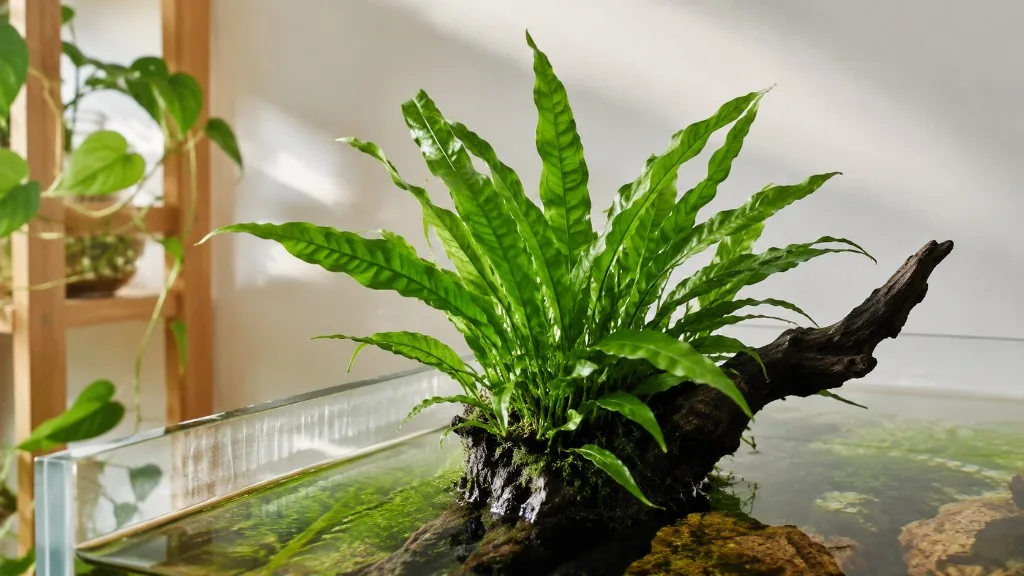
Houseplant fertilizer assumes roots buried in potting mix, where nutrients travel through soil moisture into the root system. Java Fern breaks that model completely. It is an epiphyte in nature, growing attached to rocks, driftwood, and streambed surfaces in Southeast Asian rivers. In your tank it should be tied or glued to hardscape with its rhizome - the thick horizontal stem - fully exposed above the substrate. Bury the rhizome and it rots, regardless of how premium your aquasoil is.
Because Java Fern does not root-feed, the entire category of substrate fertilizers - root tabs, nutrient-rich planted-tank soils, osmocote capsules pressed into gravel - delivers nutrition to the wrong place. The plant’s hair-like holdfast roots anchor it to surfaces; they are not the primary nutrient highway. Liquid aquarium fertilizer is the correct tool because it dissolves into the water column where leaves and rhizome tissue can absorb nitrogen, potassium, iron, and trace elements directly. This is not a preference. It is how the plant’s physiology works.
The second major difference is speed. Java Fern is a slow grower, producing perhaps one or two new leaves per month under typical low-tech conditions. Slow growth means lower total nutrient demand than a stem plant like hornwort or Ludwigia, but it does not mean zero demand. A plant that adds tissue slowly still needs a steady supply of building blocks. Skip liquid feeding in a lightly stocked tank and the fern survives on reserves for months before symptoms appear - which is why beginners often conclude fertilizer was unnecessary right up until the leaves start failing.
How Java Fern Absorbs Nutrients From the Water Column
Aquarium plants access nutrients through two general pathways: root uptake from substrate pore water and foliar uptake from the surrounding water column. Java Fern is firmly in the second camp, with supplementary absorption through its rhizome. Understanding which surfaces actually feed the plant prevents wasted money on products that never reach the tissues that need them.
Leaves and Rhizome: Your Real Feeding Surfaces
The broad, leathery leaves of Java Fern are its main nutrient interface. Dissolved macronutrients - especially nitrogen and potassium - and micronutrients like iron, manganese, and magnesium pass from tank water into leaf cells, fueling chlorophyll production, cell wall strength, and new tissue formation. The rhizome contributes as well, drawing from the water that flows around it, which is one reason good gentle water circulation matters even for a plant that tolerates low flow.
This column-feeding strategy is an adaptation to life on bare rock in flowing streams. In the wild, Java Fern sits in water constantly replenished with dissolved minerals. Your closed aquarium is a different system: nutrients enter through fish food, waste breakdown, and tap water, then get consumed by plants and bacteria until something runs low. Liquid fertilizer replaces what the closed loop depletes. Without it, the water column can look clean while the plant quietly runs out of potassium or iron.
Why Substrate Fertilizer and Root Tabs Miss the Target
Root tabs are excellent for heavy root feeders - Amazon swords, cryptocorynes, vallisneria - whose root systems actively mine the substrate. Press a tab near Java Fern’s holdfast roots and almost none of that nutrition routes into the rhizome and leaves efficiently. The product dissolves into the gravel bed below the plant’s main feeding surfaces. You might see mild indirect benefit if your tank has strong circulation that pulls substrate nutrients upward, but as a primary feeding strategy for Java Fern, root tabs are the wrong tool.
The same logic applies to nutrient-rich aquasoil. Java Fern does not need it, will not use it effectively, and gains nothing from paying premium substrate prices for a plant you attach to wood. Save aquasoil for the rooted plants in your layout and budget for a quality all-in-one liquid fertilizer instead. If you already run root tabs for other species in a mixed tank, that is fine - just do not count them as your Java Fern feeding plan.
Does Java Fern Actually Need Liquid Fertilizer?
Java Fern can survive without added fertilizer in many established community tanks, but survival and thriving are different outcomes. In a tank with moderate fish stocking, fish food and waste breakdown supply enough nitrogen and phosphorus to keep the fern alive for a long time. What fish waste often does not provide in adequate amounts - especially in soft-water regions and tanks fed sparingly - are potassium, iron, and other trace elements that keep leaves firm, green, and hole-free.
You should seriously consider liquid fertilizer if any of the following apply: your tank is lightly stocked or shrimp-only; you run RO or very soft tap water with low mineral content; you see pinholes, yellowing, or transparent melting on older leaves; you want faster, bushier growth; or you run brighter light or CO2 injection, both of which increase nutrient demand. You can reasonably skip regular dosing if your tank is heavily stocked with fish, your Java Fern shows deep green healthy new leaves, and you perform regular water changes that replenish trace minerals from tap water.
The honest answer is that most Java Fern keepers land in the middle: light, consistent liquid dosing once or twice weekly produces the best long-term appearance without pushing algae. The plant’s slow metabolism means it punishes heavy overdosing less than fast-growing stem plants do, but it also recovers slowly from chronic underfeeding. A lean water column shows up as leaf problems long before the plant actually dies.
Choosing the Right Liquid Aquarium Fertilizer
Aquarium liquid fertilizers fall into two broad categories, and picking the wrong category is the most common shopping mistake for Java Fern keepers. Trace-only products supply micronutrients - iron, manganese, boron, zinc, molybdenum - with very little nitrogen, phosphorus, or potassium. All-in-one products supply macros and micros together in one bottle. Your tank’s fish bioload determines which category makes sense.
Trace-Only Products Like Seachem Flourish
Seachem Flourish is the most widely sold trace-element supplement in the hobby. Per Seachem’s own product guidance, it is designed as a comprehensive micronutrient source, not a complete NPK fertilizer. In a heavily stocked community tank where fish waste already elevates nitrates and phosphates, Flourish alone often works well for Java Fern. It supplies the iron and trace elements that keep leaves green without dumping excess macros into a system that already has plenty.
Dose Flourish at the label rate - typically 5 mL per 60 liters (about 16 gallons) - once or twice weekly after your water change. Watch new leaf color over the next two to three weeks. If leaves emerge pale or yellow-green despite stable nitrates above 10 ppm, your tank may need more iron than Flourish alone provides, or you may need an all-in-one product instead. Seachem Flourish Iron is a targeted add-on for iron-specific chlorosis, and Seachem Flourish Potassium addresses pinholes when your macro source is otherwise adequate.
The limitation of trace-only dosing is that it assumes your tank already has macronutrients. In a betta bowl, shrimp nano, or turtle tank with minimal fish waste, that assumption fails. Beginners who dose only Flourish in a low-stock tank and still see pinholes are usually starving the plant of potassium, not iron.
All-in-One Liquids for Low-Stock and Turtle Tanks
When fish are not supplying enough macros, reach for a complete liquid fertilizer that includes nitrogen, phosphorus, potassium, and micronutrients in one formula. Three widely used options in the hobby:
- Aquarium Co-Op Easy Green - a balanced all-in-one popular in low-tech and beginner setups. Dose per label instructions, typically once or twice weekly. Good default for tanks under 30 gallons with light stocking.
- Tropica Premium Nutrition - designed for tanks with fish that supply some macros; slightly leaner on N and P than Specialised. Fits community tanks with moderate bioload.
- Tropica Specialised Nutrition - contains full macronutrient levels for tanks with few or no fish. Best match for shrimp tanks, plant-only sections, and lightly stocked turtle aquariums.
- NilocG Thrive (and ThriveC for low-tech) - comprehensive dosing system used by more experienced planted-tank keepers. ThriveC is the low-tech variant; standard Thrive suits tanks with CO2 and higher light.
For most Java Fern keepers in low-stock tanks, one all-in-one dosed once weekly after a water change is the simplest effective plan. Start at the manufacturer’s low recommended dose and increase only if deficiency symptoms persist on new growth after three weeks.
How Often to Dose Liquid Fertilizer on Java Fern
Dosing frequency should follow your tank’s nutrient consumption rate, not a rigid calendar divorced from conditions. Java Fern’s slow growth means it does not need daily feeding, but a complete stop for months eventually shows in leaf quality.
Heavily stocked community tank (20+ gallons, 8+ small fish): Dose a trace supplement like Seachem Flourish once weekly, or skip entirely if growth and color look excellent. Check nitrates - if they consistently read above 20 ppm, macros are abundant and trace-only makes sense.
Moderately stocked tank: Dose an all-in-one or trace supplement once weekly at full label strength, or twice weekly at half strength. This is the sweet spot for most Java Fern setups.
Lightly stocked, shrimp-only, or small nano tank: Dose an all-in-one like Tropica Specialised or Easy Green once weekly at full strength, or twice weekly at half strength. Monitor for algae on glass and leaf edges; reduce frequency if green spot algae increases.
Turtle tank with Java Fern attached to hardscape: Dose lightly - once weekly at half label strength of an all-in-one - because turtles add waste but also create messy, nutrient-fluctuating conditions. Avoid overdosing in small turtle tanks where algae can explode quickly.
High-tech tank with CO2 and bright light: Increase to twice-weekly all-in-one dosing, because elevated CO2 and light accelerate growth and nutrient draw across all plants, including slow growers. Balance by ensuring your CO2 and light are actually dialed in; nutrients alone cannot fix poor CO2 distribution.
Consistency matters more than perfection. Pick a schedule tied to your water-change day, dose the same amount each time, and evaluate leaf quality monthly rather than daily.
When Fish Waste Replaces Half Your Fertilizer Plan
Fish food is plant food in disguise. When fish eat and excrete waste, the nitrogen cycle converts ammonia into nitrate - a nitrogen source plants absorb directly from the water column. Phosphorus enters through fish food and waste as well. In a well-fed community tank, these macronutrients often accumulate faster than slow-growing Java Fern can use them, which is why trace-only liquid supplements work in stocked setups.
You can gauge this by testing nitrate (NO3) and, if possible, phosphate (PO4). Nitrates consistently between 10 and 30 ppm suggest your fish are carrying the macro load. Nitrates persistently below 5 ppm in a planted tank with visible Java Fern suggest macros are scarce and an all-in-one liquid fertilizer is appropriate. Phosphate readings are less commonly tested by beginners but tell a similar story: very low phosphates in a stocked tank are unusual; near-zero phosphates in a lightly stocked tank confirm the need for complete liquid feeding.
Fish waste does not reliably supply potassium in adequate amounts. Tap water in many municipalities is also low in potassium. This is why pinholes appear even in tanks where nitrates look fine - the plant has nitrogen but lacks the potassium that strengthens older leaf tissue. Liquid fertilizer with potassium closes that gap regardless of fish stocking. Do not assume a busy tank automatically covers every nutrient Java Fern needs.
Nutrient Deficiency Symptoms You Can Read at the Glass
Java Fern communicates nutrient problems through its leaves, but the symptoms overlap with other stressors - acclimation melt, excessive light, rhizome burial, and sudden parameter shifts. Read deficiencies by looking at which leaves are affected and what the damage pattern looks like, then confirm by checking whether your liquid dosing matches your stocking level.
Potassium Deficiency: Pinholes in Older Leaves
Small pinholes in older leaves that gradually enlarge are the classic signature of potassium deficiency in Java Fern and aquarium plants generally. Potassium is a mobile nutrient, meaning the plant strips it from old tissue to support new growth when supply runs short. Older leaves sacrifice first, developing tiny perforations that expand until the leaf looks moth-eaten.
Fix this with a potassium-containing liquid fertilizer or a dedicated supplement like Seachem Flourish Potassium, which raises potassium by roughly 2 mg/L per 5 mL dose in 125 liters per Seachem’s label. Dose two to three times weekly and watch the next generation of leaves - existing holes do not heal. Aquarium Co-Op guidance suggests aiming for roughly 5–20 ppm potassium in planted tanks depending on demand; Java Fern and Anubias are specifically noted as species that appreciate adequate potassium levels.
If pinholes persist after three weeks of corrected dosing, increase frequency before increasing volume. Also verify you are not using a trace-only product in a tank that lacks macro sources entirely - potassium deficiency with adequate nitrates is a potassium problem; pinholes with pale new growth and low nitrates suggest broader underfeeding.
Iron and Nitrogen Shortfalls: Yellowing and Slow Growth
Iron deficiency shows on new growth first. Emerging leaves appear pale, yellow-green, or nearly white, sometimes with darker veins - chlorosis patterns that iron-starved plants display across many species. Because Java Fern grows slowly, you may only notice iron problems when a new leaf unfurls lighter than the one before it. Chelated iron (Fe-EDTA or Fe-DTPA) in liquid form remains available across typical aquarium pH ranges better than unchelated iron, which is why quality aquarium fertilizers specify chelated forms.
Nitrogen deficiency also affects older leaves first, but instead of pinholes you see general yellowing starting at leaf tips and edges, progressing toward the base as the plant mobilizes nitrogen from old tissue. In aquariums, true nitrogen deficiency is less common in stocked tanks because fish waste supplies nitrates. It appears more often in shrimp-only or plant-heavy, fish-light setups without all-in-one liquid feeding.
Slow or stalled growth - no new leaves for two or three months - points to a combination of low light, low nutrients, or both. Before blaming fertilizer, confirm your rhizome is not buried, your light is not so dim that photosynthesis barely runs, and your temperature sits in the 22–28°C/27914) range Java Fern prefers. If conditions are sound and growth is still absent, a weekly all-in-one liquid dose is the right next step.
CO2 Injection: The Optional Growth Booster
Java Fern does not require CO₂ injection. It grows perfectly well in low-tech tanks with surface agitation and fish respiration supplying dissolved carbon. That said, CO2 supplementation in high-tech setups increases growth rate and raises total nutrient demand across the tank. A Java Fern in a CO2-enriched tank with bright light will consume water-column nutrients faster than the same plant in a dim low-tech corner.
If you run CO2, pair it with a complete liquid fertilizer dosed twice weekly rather than trace-only once weekly. The growth acceleration CO2 provides only translates into healthier plants when nitrogen, potassium, iron, and trace elements keep pace. CO2 without adequate liquid feeding produces stressed, pale plants and algae on leaf surfaces - not the lush bush you were aiming for.
For turtle tanks and beginner low-tech setups, skip CO2 entirely and focus on getting liquid fertilizer and light right. Java Fern’s value is hardiness, not speed, and the cost and complexity of CO2 systems rarely justify the modest growth increase for a plant already described as slow-growing.
Overdosing, Algae Blooms, and How to Reset
Liquid fertilizer can be overdone, especially in small tanks under 10 gallons where nutrient concentration shifts rapidly with each dose. Excess nitrogen and phosphorus do not usually burn Java Fern leaves the way houseplant fertilizer burns roots, but they fuel algae - green spot on leaves, hair algae on rhizomes, film algae on glass. If algae increases within a week of starting or doubling fertilizer, you are dosing more than the plants and bacteria can process.
Reset protocol: Perform a 30–40% water change. Cut liquid fertilizer to half your previous dose. Reduce light intensity or duration by one hour daily if algae is aggressive. Gently remove algae from Java Fern leaves with a soft toothbrush - never rip tissue. Resume half-dose feeding for three weeks and evaluate. Most algae spikes from over-fertilization resolve when nutrients drop and plant uptake catches up.
Never use houseplant fertilizer, garden fertilizer, or micronutrient supplements not labeled aquarium-safe. Copper concentrations safe for terrestrial plants can kill shrimp and harm fish. Urea-based nitrogen sources behave differently in aquariums than the nitrate and ammonium forms in aquarium liquids. If you already dosed a non-aquarium product, large water changes immediately and monitor livestock closely.
Transition melt - where existing leaves turn translucent and dissolve after buying a new plant or moving it - is often unrelated to fertilizer. New Java Fern frequently sheds leaves acclimating to different water parameters. Dose liquid fertilizer at low strength during acclimation, trim melting leaves at the rhizome, and judge your feeding plan by the health of leaves that emerge after the first month, not the ones the plant arrived with.
Fertilizing Java Fern in Turtle and Shrimp Tanks
Turtle aquariums present a specific feeding puzzle. Turtles produce substantial waste that can supply macros, but they also uproot plants, stir substrate, and create turbid conditions that stress slow growers. Java Fern survives turtle tanks precisely because it attaches to hardscape above the chaos. Liquid fertilizer dosing should stay conservative - half-strength all-in-one once weekly - because turtle tanks are often smaller than community show tanks and nutrient spikes hit harder in low water volumes.
Avoid dosing liquid fertilizer on the same day you do a large water change in a turtle tank if your turtle is sensitive to parameter swings; instead, dose 24 hours after the change when parameters have stabilized. Java Fern is widely regarded as turtle-safe and non-toxic, but fertilizer products are for the plants, not for turtles to consume. Keep bottles stored away from the tank and dose only the measured amount into the water column.
Shrimp tanks - especially Neocaridina and Caridina setups - benefit from light all-in-one dosing because shrimp bioload is tiny relative to plant mass. Use shrimp-safe products at reduced dose: half-strength Easy Green or Tropica Specialised once weekly is a common starting point. Copper is the ingredient to watch; reputable aquarium fertilizers keep copper at concentrations safe for invertebrates when dosed per label. Doubling doses “for good measure” is where shrimp problems start, not the normal labeled dose.
Balancing Light, Water Changes, and Nutrient Levels
Fertilizer does not operate in isolation. Light drives photosynthesis, which drives nutrient demand. Java Fern tolerates low light, but very dim conditions slow growth so much that nutrient problems take months to appear and corrections take equally long to show. Moderate light with 6–8 hours daily is enough for healthy growth without the algae pressure that high light brings.
Water changes both remove and add nutrients. They export accumulated nitrates, phosphates, and unused fertilizer; they import minerals from tap water including calcium, magnesium, and sometimes trace elements. A tank receiving weekly 25–30% water changes has a natural nutrient refresh cycle. Dose liquid fertilizer after the water change so plants get a consistent post-change boost rather than having fertilizer diluted out immediately.
If you change water rarely - every three to four weeks - dose lightly and watch for algae, because nutrients accumulate longer between exports. If you change water twice weekly, you may need slightly more frequent light dosing to maintain levels, because export happens often. The goal is a stable water column, not alternating feast and famine.
A Step-by-Step Liquid Fertilizer Routine
Step 1: Assess your stocking level. Count fish, note shrimp or turtles, and test nitrates if you have a kit. Heavily stocked with nitrates above 15 ppm → trace-only candidate. Lightly stocked or nitrates below 5 ppm → all-in-one required.
Step 2: Choose your product. Stocked community tank: Seachem Flourish. Low-stock or shrimp tank: Easy Green or Tropica Specialised. Mixed planted tank with rooted species: all-in-one covers both Java Fern and root feeders in the water column; keep root tabs only for heavy root feeders, not for the fern.
Step 3: Set your dose and day. Pick one day per week aligned with your water change. Measure with a syringe, not eyeballing the bottle cap in a small tank. Start at label strength for all-in-one, or label strength for trace-only in stocked tanks. For nanos under 10 gallons, start at half strength.
Step 4: Observe new growth for three weeks. Healthy new Java Fern leaves emerge green, firm, and hole-free. Adjust only if symptoms appear on new leaves, not old leaves still showing legacy damage.
Step 5: Adjust or hold steady. Persistent pinholes on new leaves → increase potassium via all-in-one or Flourish Potassium. Pale new leaves with good nitrates → add iron or switch from trace-only to all-in-one. Algae increase → halve dose and reduce light one hour. Stable green growth → keep doing exactly what you are doing.
Step 6: Trim and reset as needed. Remove old damaged leaves at the rhizome so the plant redirects energy to new tissue. Old leaves with pinholes or melt will not recover cosmetically; they are not evidence your current dosing failed unless new leaves repeat the same pattern.
Conclusion
Java Fern fertilizer is a water-column problem solved with aquarium liquid products, not a soil problem and not a root-tab problem. The plant pulls nitrogen, potassium, iron, and trace elements from the water surrounding its leaves and rhizome, which means your feeding tool is a bottle dosed into the tank - not granules pressed into gravel. In heavily stocked community tanks, fish waste may supply enough macronutrients that a trace supplement like Seachem Flourish completes the picture. In lightly stocked, shrimp, turtle, and nano tanks, an all-in-one liquid fertilizer once or twice weekly keeps leaves green, hole-free, and steadily producing new growth.
Match dose frequency to your tank’s bioload, start conservative, and read the plant’s newest leaves as your report card. Pinholes mean potassium. Pale new growth means iron or broader underfeeding. Algae means back off the dose or the light. Java Fern rewards patience and consistency more than aggressive feeding - and once your liquid routine is dialed in, this is one of the few aquarium plants that stays beautiful for years with very little fuss.
When to use this page vs other Java Fern guides
- Java Fern overview - Start here for whole-plant context before deep-diving this topic.
- Java Fern problems hub - Jump to symptom-specific fix guides when this care topic does not resolve the issue.
- Overfertilization on Java Fern - Escalate here when fertilizer adjustments are not enough.
- Fertilizer Burn on Java Fern - Escalate here when fertilizer adjustments are not enough.
- Nitrogen Deficiency on Java Fern - Escalate here when fertilizer adjustments are not enough.
Related Java Fern guides
- Java Fern overview
- Java Fern watering
- Java Fern light
- Java Fern soil
- Java Fern propagation
- Java Fern repotting
- Overfertilization on Java Fern
- Fertilizer Burn on Java Fern
- Nitrogen Deficiency on Java Fern
- Java Fern problems
Related tool
Try the Fertilizer Dilution Calculator with java-fern pre-selected to estimate needs for your setup.