Fertilizer Burn on Java Fern: Causes, Checks & Fixes
Quick answer
Fertilizer burn on Java Fern is acute liquid overdose-double dose, concentrate poured on emersed fronds, or stacked products-not granular houseplant burn. Stop dosing, change 40–50% of the water, trim melting fronds, and resume one aquarium product at half strength weekly after seven days.
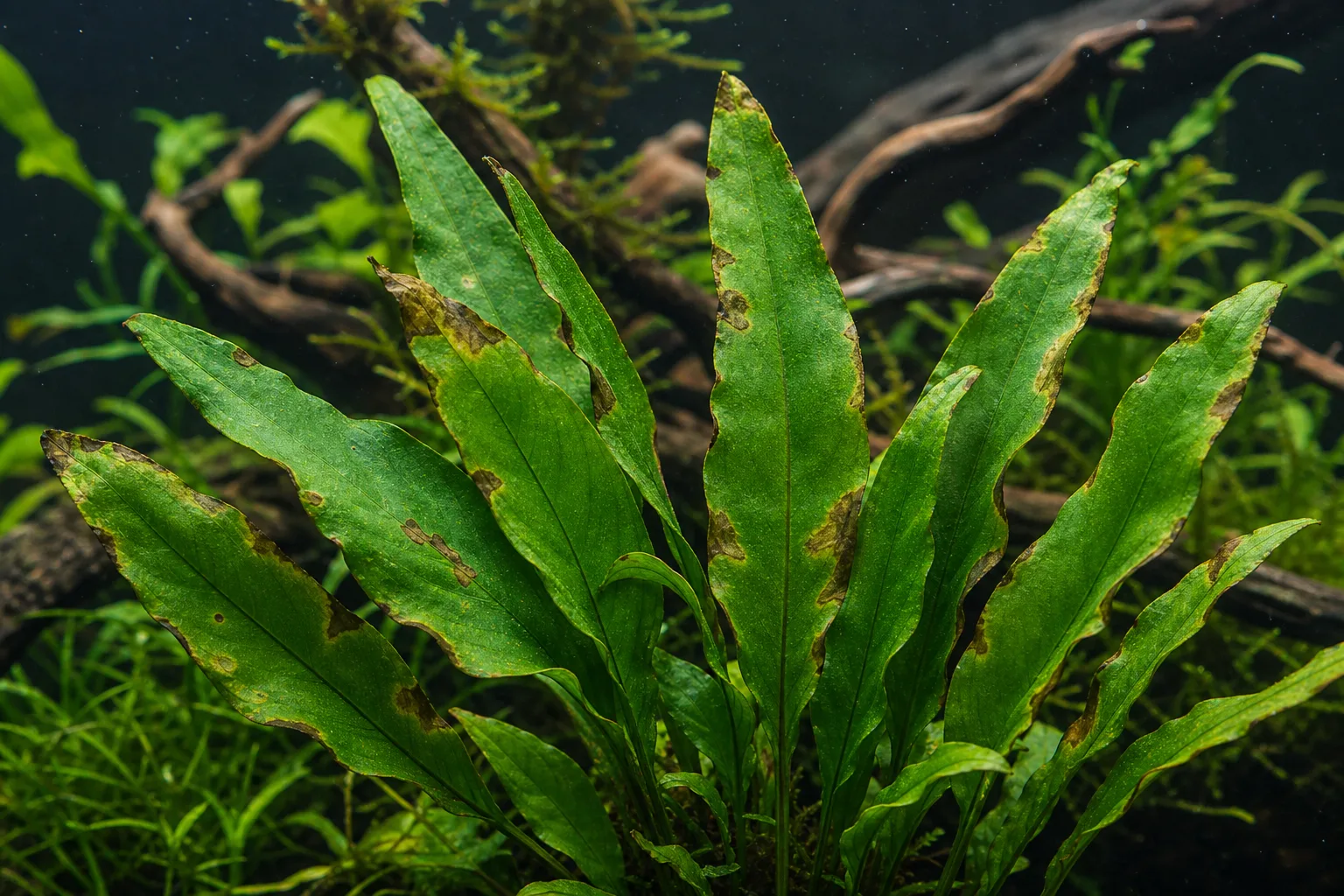
Fertilizer Burn on Java Fern: Causes, Checks & Fixes
This guide covers fertilizer burn on Java Fern. See also the general Fertilizer Burn guide, watering, and light pages for this plant.
Fertilizer Burn on Java Fern: Causes, Checks & Fixes
Quick answer
Fertilizer burn on Java Fern (Microsorum pteropus) is almost always an aquarium liquid overdose-double dosing, pouring concentrate on emersed fronds, or stacking trace-only and all-in-one products in one session-not granular houseplant burn. Houseplant guides describe crispy brown leaf edges; Java Fern more often shows translucent melt at frond margins within days of a dosing mistake.
This page covers acute burn and leaf melt tied to a specific dosing error. For chronic tank-wide nutrient surplus and algae bloom, use overfertilization instead. For baseline feeding and product choice, see java-fern-fertilizer.
First fix: stop all liquid fertilizer, perform a 40–50% water change with temperature-matched dechlorinated water, trim melting fronds at the rhizome, and wait seven days before resuming one aquarium product at half label strength dosed into the water column-not on leaves.
How aquarium burn differs from houseplant fertilizer burn
Houseplant fertilizer burn usually involves granular or slow-release salts in potting mix. Roots take up excess minerals; leaf margins turn dry, brown, and crispy. Java Fern does not root-feed from buried substrate the way potted plants do-it is a slow-growing epiphyte that absorbs nutrients from the water column through leaves and rhizome.
In aquariums, burn follows liquid concentration spikes hitting leaf tissue directly:
| Pattern | Houseplant burn | Java Fern aquarium burn |
|---|---|---|
| Product type | Granular, spike, or foliar houseplant feed | Liquid aquarium fertilizer or non-aquarium pour |
| Typical symptom | Dry brown crispy margins | Translucent melt, glassy tips, edge collapse |
| Timing | Days to weeks after soil overdose | Often 24–72 hours after liquid dose or direct pour |
| Recovery signal | New leaves without crispy edges | Firm rhizome + clean new frond without melt |
If you searched from a houseplant SERP, stop here-do not use balanced 10-10-10 granules or houseplant foliar sprays in a fish tank. That path risks livestock harm and is covered under chemical-damage.
Why Java Fern gets fertilizer burn
Java Fern tolerates lean water better than heavy feeding. Its slow growth rate means it cannot process sudden surges of nitrogen, iron, or potassium the way fast stem plants can. Because the rhizome is mounted on hardscape with no soil buffer, every nutrient spike reaches leaf tissue immediately.
Double dosing, emersed pour, and product stacking
Common acute-burn triggers:
- Double dosing after a missed week-adding a full dose on top of one already given
- Pouring liquid directly on emersed fronds during paludarium top-offs or nursery-style setups where leaves sit above the waterline
- Stacking products-for example Seachem Flourish (trace-only) plus an all-in-one macro fertilizer in the same session without checking overlap
- Using houseplant fertilizer “just once”-non-aquarium products may carry copper, urea, or other chemistry unsafe for fish and shrimp
- Compensating for pale leaves by doubling dose when the real issue is low light or potassium deficiency
In lightly stocked tanks, fish waste already supplies some nitrogen; adding full-strength macros on top can overshoot what the fern can use. Product-category rules and stacking guidance live in java-fern-fertilizer-this page focuses on fixing the mistake, not re-teaching the full feeding plan.
What fertilizer burn looks like on Java Fern
Burn rarely looks like dry brown houseplant tips. On Java Fern you more often see:
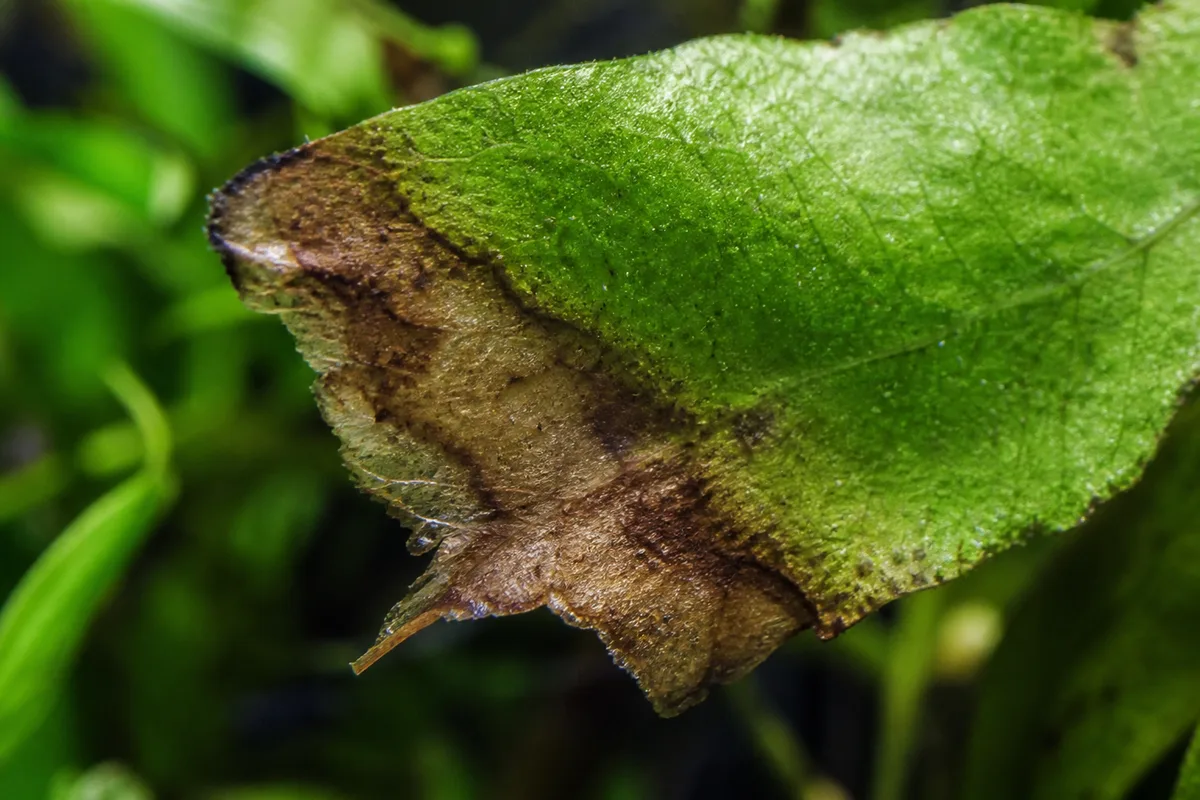
Fertilizer Burn symptoms on Java Fern - compare with healthy tissue on the same plant.
- Translucent melt at frond edges-the tissue turns glassy, then dissolves
- Pale or glassy new growth that collapses rather than expanding
- Dark patches spreading from margins inward on older fronds after a recent dose
- A light algae film on glass or older leaves within days of dosing-excess nitrogen and phosphorus can fuel algae growth in aquatic systems
The rhizome should stay firm and woody. Soft black tissue at the base is rot from burial, not fertilizer burn-see root-rot.
Sporangia vs. scorch vs. rhizome rot
Visual check before you panic:
- Sporangia: symmetrical dark bumps on the underside of healthy firm green leaves-reproductive structures, not disease
- Burn: tissue melts around dark spots; margins turn translucent; damage follows a dosing event
- Rhizome rot: soft, foul-smelling rhizome, often with burial in substrate-dose reduction alone will not fix it
Do not confuse normal sporangia with chemical scorch. Sporangia sit on firm green tissue; burn dissolves the leaf around the area.
How to confirm the cause
Build a timeline first. Did you dose within 48 hours of melt starting? Did symptoms appear right after pouring on emersed leaves?
Confirmation checklist:
- Dosing log: What product, how much, and when in the last three days? Any double dose or non-aquarium product?
- Rhizome feel: Firm rhizome supports burn recovery once water chemistry stabilizes; soft dark rhizome points to burial rot.
- Burial check: Is any part of the rhizome buried in substrate? Buried plants melt for rot reasons and need remounting, not dose math alone.
- Water tests (optional but useful): If you have kits, compare nitrate and phosphate to your usual baseline. In lightly stocked planted tanks, nitrates often sit around 10–25 ppm when macros are adequate; a spike well above your normal reading within days of dosing supports overdose. Phosphate above roughly 1–3 ppm after a heavy dose can also signal excess-see product guidance in
java-fern-fertilizer. - Scope check: Tank-wide algae acceleration over weeks without a single dosing event fits
overfertilizationbetter than acute burn.
If symptoms appeared gradually over months with no dosing change, suspect chronic underfeeding or potassium-deficiency instead-not acute burn.
Paludarium and emersed-frond mistakes
In paludariums, emersed Java Fern leaves sit above the waterline. Pouring liquid fertilizer on those dry fronds concentrates minerals on tissue that normally feeds from submerged water-local melt within 24–48 hours is common. Fix: rinse emersed leaves with tank water, perform a 40–50% water change, and never pour concentrate on leaves again-dose only into the water column below.
First fix for Java Fern
Stop liquid fertilizer immediately. Then:
- Perform a 40–50% water change with temperature-matched dechlorinated water.
- Remove melting fronds at the rhizome with clean scissors so the plant is not recycling damaged tissue.
- Increase surface agitation if fish show stress-ammonia and nitrite are toxic to fish even at low concentrations.
- Wait seven days, then restart one aquarium-safe liquid product at half label strength, dosed into the water column-not on leaves.
Easy-category plants like Microsorum need low light and modest feeding; match dose to demand, not stem-plant schedules. Do not increase light to compensate for pale leaves during recovery-that can worsen melt and algae pressure.
When fish or shrimp need emergency steps
Cosmetic leaf melt is not the same as a water-quality crisis. Treat livestock as urgent if:
- Fish gasp at the surface or show lethargy after a massive dose
- Ammonia or nitrite reads above zero on a liquid test kit
- You used a non-aquarium fertilizer with unknown copper or urea content
UF/IFAS notes that ammonia damages gills and stresses fish even at low levels, and that the only way to detect it is to test. In a crisis:
- Stop feeding for 24 hours.
- Perform 40–50% water changes-repeat within 24–48 hours if ammonia or nitrite remain elevated.
- Increase aeration and verify the filter is running.
- Resume fertilizer only after ammonia and nitrite stay at zero and new Java Fern growth looks stable.
For acute chemical injury from non-aquarium products, also read chemical-damage.
Recovery timeline
Tip melt may continue for one to two weeks after the overdose even after you stop dosing-that is residual damage, not ongoing burn. Success is a firm rhizome and at least one new green frond without edge collapse.
Optimum temperatures around 22–28°C/27914) support steady recovery; cold water below 20°C slows new leaf formation. Expect four to six weeks before the plant looks full again because Java Fern adds leaves slowly.
Lookalike symptoms
| Pattern | Timing | Rhizome | Key clue |
|---|---|---|---|
| Fertilizer burn | 24–72 h after dose or pour | Firm | Translucent tip melt tied to dosing event |
| Overfertilization | Weeks of heavy dosing | Firm | Tank-wide algae; see overfertilization |
| Acclimation melt | After purchase or tank move | Firm | No dosing event; trim and wait |
| Potassium deficiency | Gradual over weeks | Firm | Pinholes in older leaves, not sudden glassy tips |
| Iron deficiency | Gradual | Firm | Pale new growth; old leaves stay green |
| Rhizome rot | Any time rhizome buried | Soft, dark, foul | Remount; see root-rot |
| Sporangia | Stable on healthy leaves | Firm | Symmetrical bumps on underside; tissue firm |
What not to do
Do not double the next dose to “make up” for pale leaves. Do not pour liquid fertilizer on emersed fronds during a paludarium top-off. Do not use root tabs or soil fertilizer on an epiphyte-the rhizome should stay attached to wood or stone, not buried. Do not assume yellow melt means you need more fertilizer-that often worsens burn. Do not crank up light or CO₂ while the plant is melting from overdose.
How to prevent fertilizer burn next time
Dose once weekly on your water-change day into the water column only. Use products labeled for aquariums. In shrimp-only or nano tanks, start at quarter to half strength because bioload is low. Keep lighting in the 0.25–0.5 W/L range for Easy plants so nutrient demand stays modest. Log doses in a notebook or phone note-Java Fern forgives missed weeks better than it forgives doubles.
Burn vs. chronic surplus: acute mistakes need a dose pause and dilution; chronic algae-heavy tanks need the longer reset on overfertilization. Know which URL matches your pattern before you change multiple variables at once.
When to use this page vs other Java Fern guides
- Java Fern watering guide - Use for routine moisture checks before assuming fertilizer burn is the main issue.
- Java Fern problems hub - Browse all 28 common issues on this species.
- Overfertilization on Java Fern - Different entry point when symptoms overlap with fertilizer burn.
Related Java Fern guides
- Java Fern overview
- Java Fern watering
- Java Fern light
- Java Fern soil
- Overfertilization on Java Fern
- Java Fern problems
- Black Spots on Java Fern
- Chemical Damage on Java Fern
Related tool
Use the Plant Problem Diagnosis Tool to narrow causes for fertilizer burn on this plant before changing multiple variables at once.