Potassium Deficiency on Java Fern: Causes, Checks & Fixes
Quick answer
Pinholes and irregular black spots on older Java Fern fronds usually mean potassium shortage in the water column-not sporangia or fungal rust. Dose aquarium liquid potassium or a complete fertilizer weekly, trim worst leaves at the rhizome, and watch for hole-free new growth.
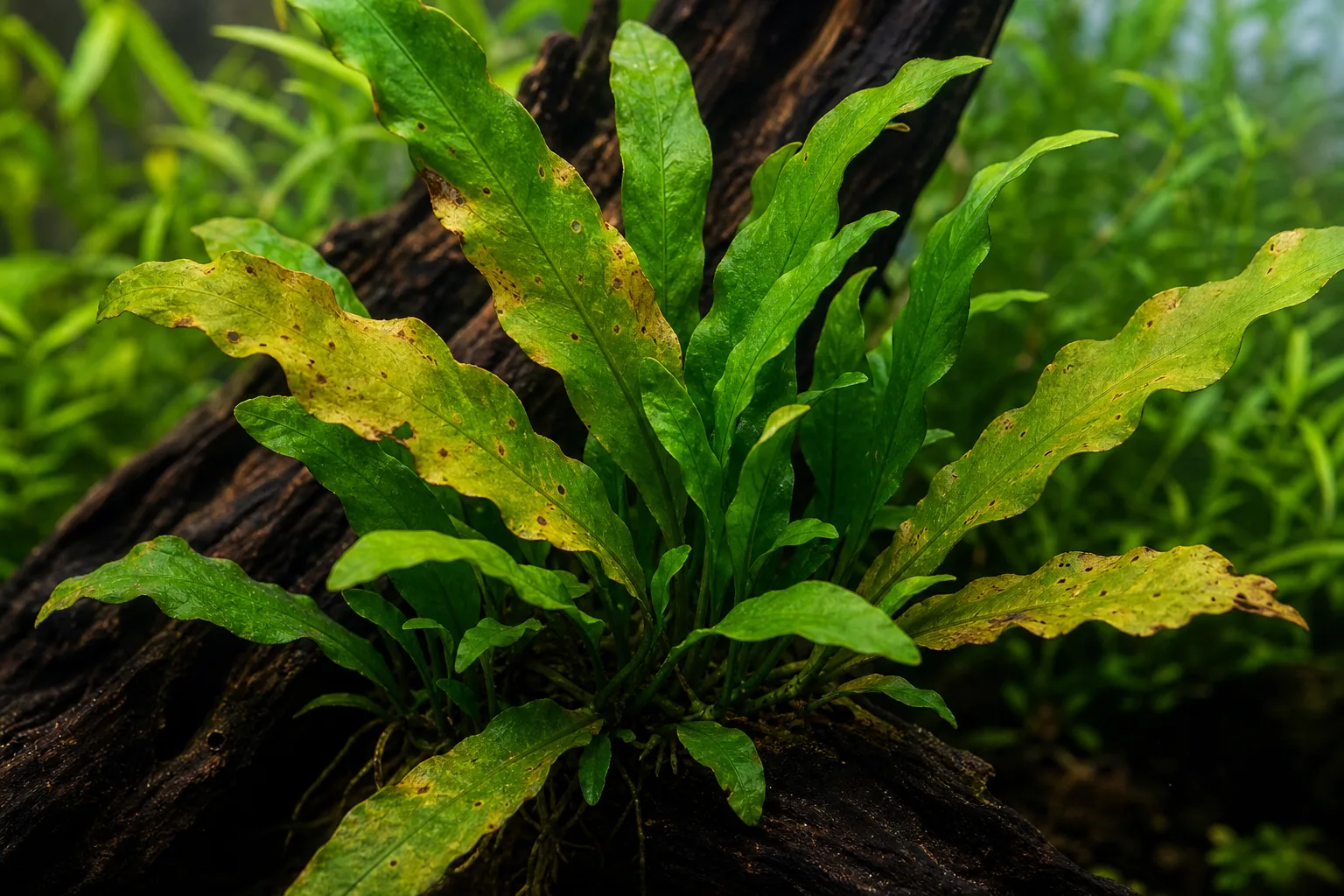
Potassium Deficiency on Java Fern: Causes, Checks & Fixes
This guide covers potassium deficiency on Java Fern. See also the general Potassium Deficiency guide, watering, and light pages for this plant.
Potassium Deficiency on Java Fern: Causes, Checks & Fixes
Quick answer
Pinholes and irregular black necrotic spots on older Java Fern fronds (Microsorum pteropus) usually signal potassium deficiency in the water column-not normal sporangia or houseplant leaf spot. Potassium is a mobile nutrient; when dissolved K runs low in a planted tank, this slow-growing epiphyte sacrifices older tissue while the rhizome stays firm. Scope: This page is for confirmed or suspected potassium shortage on older fronds-for multi-cause black-spot triage including sporangia and melt, see black spots on Java Fern.
Dose liquid potassium or a complete aquarium fertilizer at label strength once weekly after a water change, trim the worst perforated fronds, and judge recovery by new leaves without fresh holes.
Potassium deficiency vs. black spots vs. melt on Java Fern
Java Fern owners often search “black spots” before they know the nutrient name. Three patterns cover most cases:
| Pattern | Location | Leaf feel | Nitrate test | Action |
|---|---|---|---|---|
| Potassium deficiency (this page) | Pinholes on older blades | Firm except at holes | Often adequate (e.g. 10–20 ppm) | Dose K, trim worst leaves |
| Sporangia | Underside dots, symmetrical | Firm, green | Any | None |
| Melt | Spreads from midrib or tip | Soft, translucent edges | Any | Fix stress, trim melting fronds |
| Nitrogen deficiency | Uniform pale older fronds | Firm to glassy | Near zero | All-in-one liquid feed |
| Iron deficiency | Pale new growth | Firm | May be adequate | Chelated iron dose |
Key differentiator for potassium: holes punch through firm older tissue while nitrates can read fine-stem plants may have depleted K silently. Sporangia never create through-holes; melt makes surrounding tissue glassy before collapse.
Why Java Fern gets potassium deficiency
Java Fern feeds from the water column, not buried roots. Tap water and fish waste supply nitrogen and phosphate in many tanks, but potassium rarely accumulates naturally at levels fast-growing planted aquaria consume. Setups that run low:
- Heavily planted tanks where stem plants outcompete the slow fern for available K
- Trace-only dosing with Seachem Flourish or iron-focused products without macronutrients
- Large weekly water changes with potassium-poor tap water that dilutes what little fertilizer adds
- Shrimp-only nano tanks with no regular liquid feeding
- CO₂ or high-light tanks where accelerated growth increases potassium demand across all species
Because Microsorum pteropus grows slowly, deficiency can take months to appear in low-tech tanks-creating false confidence that “Java Fern needs no fertilizer.” When pinholes finally show on established fronds, the tank has often been lean on potassium for a long time. Unlike rhizome rot from burial, which blackens and softens the base, potassium starvation keeps the rhizome firm while older blades perforate.
Concrete scenario: A 15-gallon low-tech tank with Ludwigia and Java Fern on driftwood reads 15 ppm nitrate but older fern fronds develop pinholes. That pattern fits potassium shortage, not nitrogen-macros from fish waste are adequate while K from tap and trace-only dosing is not.
What potassium deficiency looks like on Java Fern
Typical patterns on submerged fronds:
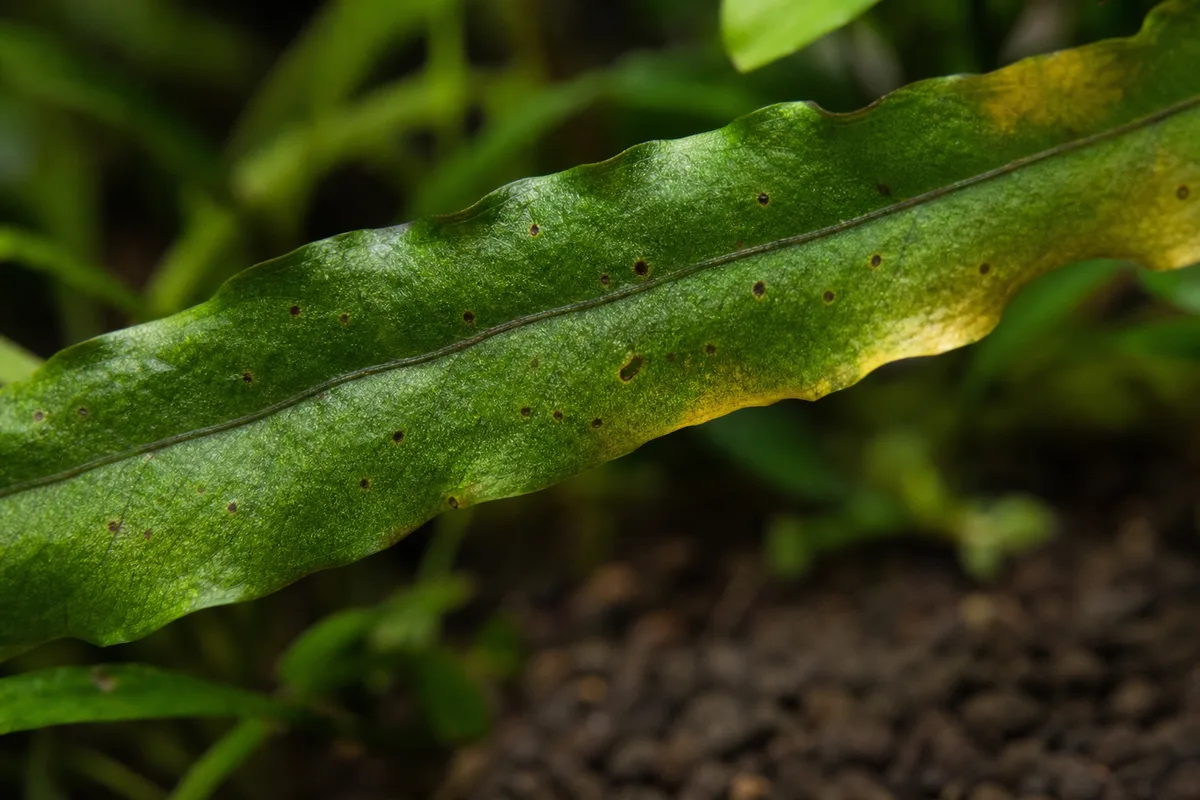
Potassium Deficiency symptoms on Java Fern - compare with healthy tissue on the same plant.
- Small pinholes in older leaves that enlarge into ragged perforations
- Irregular black or brown necrotic patches at margins or between veins on firm tissue
- Yellow halos around holes in advanced cases as cells break down
- Rhizome stays firm and new tips may still emerge green-until starvation becomes chronic
Do not confuse sporangia: dark, evenly spaced bumps on the underside of healthy green leaves are normal reproductive structures. Potassium holes punch through the blade and are irregular. Do not confuse melt: translucent brown-black tissue that spreads along the leaf-stress or rot, not a clean pinhole pattern.
Snail damage can mimic holes, but potassium necrosis shows dark margins on firm tissue; snail grazing often leaves ragged edges without the neat necrotic border common on K-starved fronds.
How to confirm the cause
- Leaf age and location-Holes on oldest fronds while newest stay intact strongly suggest mobile-nutrient shortage.
- Hole shape-Clean perforations in firm tissue vs mushy spreading black (melt/rot).
- Underside check-Sporangia only on intact green tissue; no treatment needed if that is all you see.
- Fertilizer history-Did you stop dosing, switch to trace-only products, or add many fast growers without increasing feed?
- Rhizome inspection-Must stay above substrate, not buried; buried plants melt regardless of potassium.
- Nitrate test-Pale transparent leaves with zero NO₃ suggest nitrogen deficiency instead; both can coexist in lean tanks. Adequate nitrates with pinholes still point here.
Standard hobby test kits rarely measure potassium directly-visual pattern plus dosing response is the practical aquarium diagnosis. If holes stop on new fronds within three to four weeks of corrected K dosing, you have confirmation.
First fix for Java Fern
Add potassium gradually-do not dump full-strength fertilizer on a stressed tank in one day, especially in shrimp tanks where sudden macro spikes can stress invertebrates.
- Dose an aquarium-safe liquid potassium supplement or all-in-one fertilizer with K at half to full label strength once weekly immediately after a 25% water change. In shrimp-only nanos, start at half strength for two weeks before increasing.
- Product choice: In lightly stocked or shrimp tanks, use an all-in-one such as Aquarium Co-Op Easy Green or Tropica Specialised Nutrition. In stocked community tanks already dosing Seachem Flourish trace-only, add Seachem Flourish Potassium-5 mL per 125 L raises potassium by 2 mg/L, repeatable two to three times weekly per Seachem’s label. Hobby guidance targets roughly 5–20 ppm potassium in planted tanks; Java Fern and Anubias appreciate adequate potassium.
- Trim the most perforated older fronds at the rhizome with clean scissors so the plant redirects energy to new tissue.
- Keep the rhizome mounted on wood or stone-burial causes rot no fertilizer fixes.
- If holes persist after four weeks at stable dosing, increase potassium slightly rather than stacking light and CO₂ changes on the same day.
For full product-selection logic and tank-specific dosing, see the Java Fern fertilizer guide.
Recovery timeline
Pinholed tissue will not regenerate. Watch new fronds over three to six weeks for absence of fresh holes. Growth is slow by nature, so allow at least one month before judging failure. Maintain water near 22–28°C/27914) for steady uptake. If every new leaf still holes after six weeks with confirmed firm rhizome, review nitrogen and iron balance-not potassium alone.
What not to do
Do not scrape sporangia thinking they are disease-dosing potassium will not harm them, but scraping healthy tissue does. Do not treat with copper-based fish medications-copper damages submerged foliage. Do not bury the rhizome to “feed” the plant. Do not assume pinholes mean snails without checking hole edges-potassium necrosis has dark margins on firm tissue. Do not double fertilizer and extend photoperiod simultaneously; fix potassium first at Easy-plant light levels. Do not confuse post-shipping whole-frond melt with chronic K starvation-melt affects entire fronds after rescape; pinholes typically appear on older leaves only while the rhizome stays firm.
Lookalike symptoms
Sporangia-underside dots only, no through-holes. Java Fern melt-translucent whole-frond die-back after rescape or light shock. Nitrogen deficiency-uniform pale or glassy older leaves, often with zero nitrates. Rhizome rot-black mushy base spreading upward. Algae on leaf surface-wipes off; pinholes do not. Iron deficiency-pale new fronds, not perforated older blades.
How to prevent potassium deficiency next time
Dose complete liquid fertilizer weekly in planted community tanks, especially when fast stem plants share the aquarium. Pair feeding with regular water changes that refresh minerals without zeroing all nutrients every time. In shrimp-only setups, treat potassium-inclusive liquid feed as standard care-not optional. Retest your dosing routine whenever you add nutrient-hungry plants or increase light toward 0.25–0.5 W/L for Easy plants. If you dose trace-only Flourish in a stocked tank and pinholes return, plan Flourish Potassium as a standing supplement rather than a one-time fix.
Related Java Fern guides
- Java Fern fertilizer - product choice, ppm targets, and deficiency taxonomy
- Black spots - sporangia vs pinholes vs melt triage
- Nitrogen deficiency and iron deficiency - lookalike nutrient patterns
- Java Fern overview - mounting, light, and baseline care