Pale Leaves on Java Fern: Causes, Checks & Fixes
Quick answer
Pale submerged Java Fern fronds usually mean lean tank water, iron or nitrogen shortage, or light too dim-or briefly too bright after a PAR jump. Check newest-leaf color, confirm the rhizome is exposed, then adjust light and add diluted liquid fertilizer.
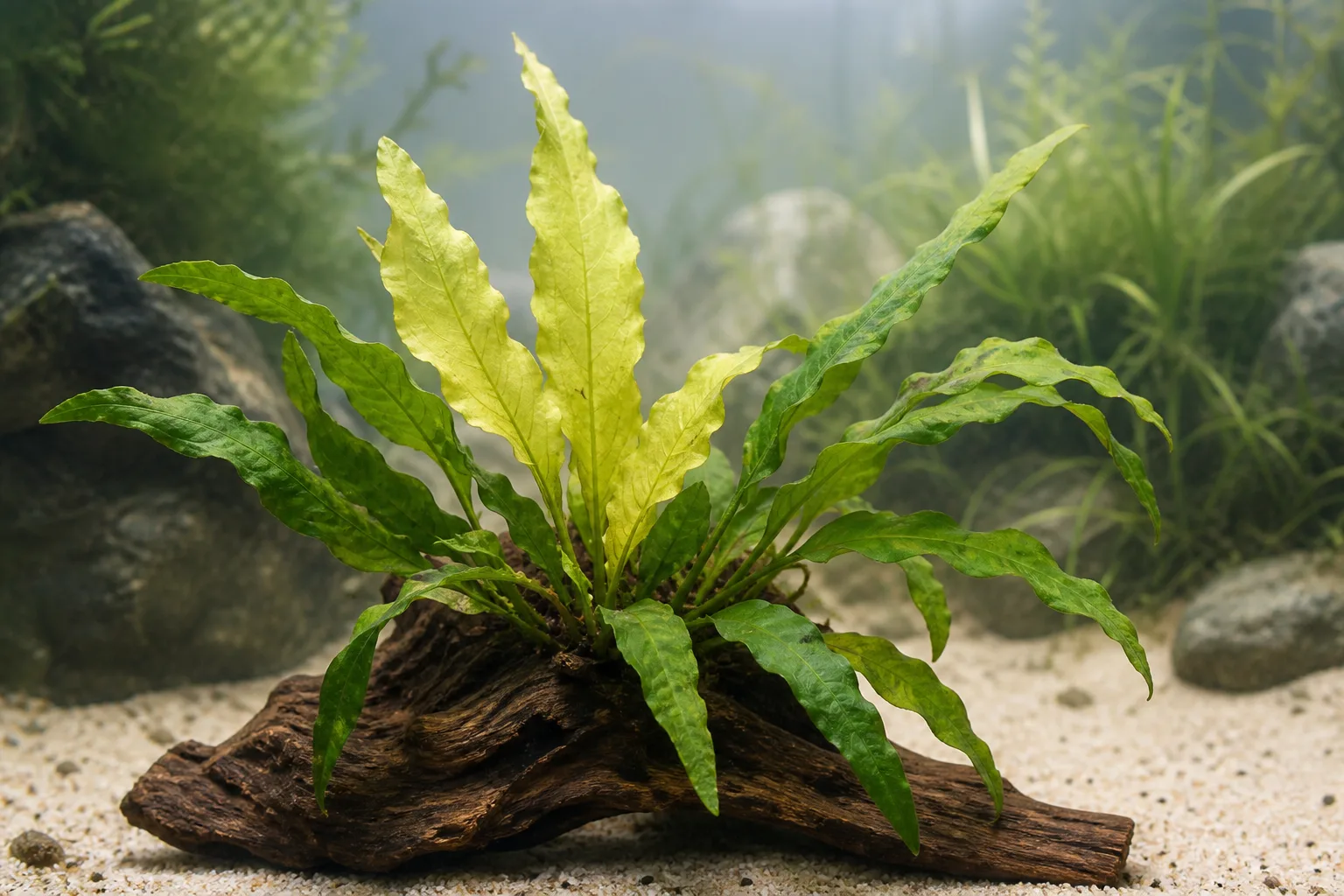
Pale Leaves on Java Fern: Causes, Checks & Fixes
This guide covers pale leaves on Java Fern. See also the general Pale Leaves guide, watering, and light pages for this plant.
Pale Leaves on Java Fern: Causes, Checks & Fixes
Quick answer
Pale, washed-out, or yellow-green fronds on submerged Java Fern (Microsorum pteropus) usually trace to nutrient-poor water, iron or nitrogen shortage, or light mismatch-too dim for chlorophyll production or too bright after a sudden PAR increase. This slow-growing epiphyte absorbs nutrients from the water column, not buried substrate.
First fix: stabilize light before fertilizing-shade the plant or shorten photoperiod if bleaching followed an LED upgrade, then confirm the rhizome stays exposed on hardscape. Judge recovery on the next frond, not the one already pale.
For species baseline and mounting, see the Java Fern overview. This page covers uniform pale yellow-green chlorosis and PAR bleaching; for washed-out gray-green tone loss, see faded-leaves. For glassy tissue before melt, see transparent-leaves.
Pale vs. faded vs. transparent on Java Fern
Hobbyists use these words interchangeably, but on submerged M. pteropus they point to different branches:
| Symptom | Color pattern | Tissue texture | Frond age pattern | Read next |
|---|---|---|---|---|
| Pale (this page) | Very light green or yellow-green chlorosis; PAR bleach looks washed on exposed surfaces | Firm, leathery | Uniform pale new growth in lean water; oldest fronds when nitrogen runs low | This page |
| Faded | Washed-out light or gray-green; loss of rich emerald tone | Firm | Often newest fronds in dim tanks; gradual dulling over months | faded-leaves |
| Transparent | Glassy, see-through patches before melt | Softening at edges | Whole fronds after purchase, rescape, or shock | transparent-leaves |
| PAR bleach | Washed tips; midrib may stay greener | Firm | Leaves closest to fixture within two weeks of LED upgrade | not-enough-light (shade fix) |
Pale means chlorophyll density dropped enough that fronds read yellow-green or bleached-not the gray-green “tired” look of fade, and not the glassy melt of transparent tissue. When only the oldest blades dull while nitrate reads zero, start on nitrogen-deficiency. When newest tips wash out between darker veins with adequate nitrate, see iron-deficiency.
Windelov and narrow-leaf cultivars show the same pale mechanics-lacey or thin fronds just make chlorosis easier to spot against dark hardscape.
Why submerged Java Fern gets pale leaves
Three causes cover most aquariums. Each fits this species’ slow growth and water-column feeding habit.
Nitrogen or iron deficiency in heavily planted low-tech tanks leaves fronds pale green or yellowish while the rhizome stays firm. Nitrogen is mobile-starvation often dulls older fronds first while new tips stay small. Iron is immobile-shortage shows on newest growth first, sometimes with darker veins on pale tissue. Java Fern pulls both from the water column, not substrate tabs.
Insufficient light prevents deep chlorophyll development. Tropica lists low light demand, but extremely dim placement-bottom third of a tall tank with stock LED at minimum-still produces uniformly pale new fronds. See the light guide for PAR targets (roughly 15–50 PAR for this species).
Excess light after a sudden LED upgrade can bleach fronds before algae coats them. Pale patches often start on leaves closest to the fixture while the midrib stays greener. This is a common post-upgrade pattern in low-tech tanks that do not need high PAR.
Because Java Fern is a slow grower, pale signals in the same tank often lag behind fast stem plants-by the time the fern looks washed-out, column nutrients or usable PAR may have been marginal for weeks.
Do not confuse normal aging: older fronds naturally fade while new tips stay green. Do not confuse juvenile translucence: brand-new submerged fronds often emerge light green before darkening over one to two weeks-that is development, not deficiency.
What pale leaves look like on Java Fern
Healthy Java Fern shows medium to dark green leathery fronds. Paleness appears as light green, yellow-green, or translucent tissue-often on newest growth first when iron or general lean water is the limiter.
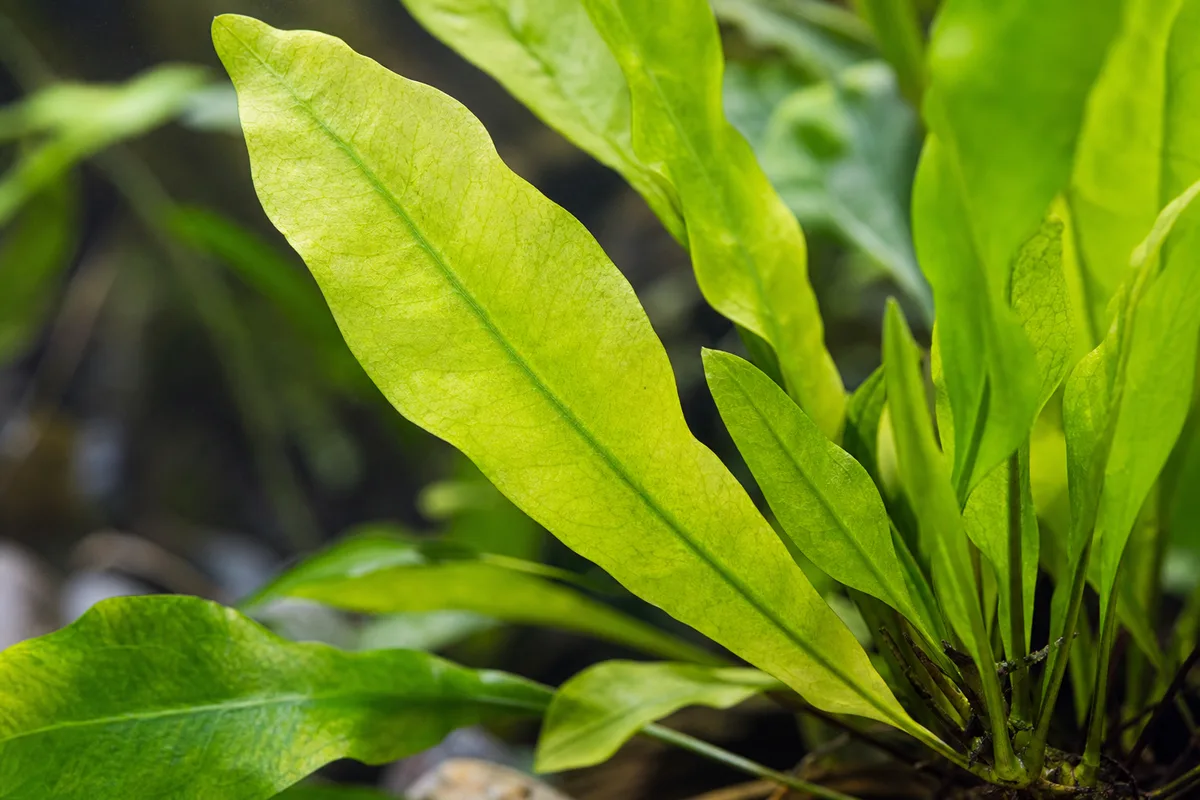
Pale Leaves symptoms on Java Fern - compare with healthy tissue on the same plant.
Newest-growth nutrient pattern vs. oldest-frond nitrogen pattern
| Pattern | First fronds affected | Nitrate trend | Rhizome | Read next |
|---|---|---|---|---|
| Iron-limited pale | Newest tips pale or yellow-green; veins may stay darker | Often 5–20 ppm in stocked tank | Firm | iron-deficiency |
| Nitrogen-limited pale | Older fronds pale first; small washed-out new tips | Zero for weeks in planted tank | Firm | nitrogen-deficiency |
| Dim-light pale | Evenly pale new fronds in deep shade | Often adequate in stocked tank | Firm | not-enough-light |
| PAR bleach | Tips on uppermost fronds under LED | Variable | Firm | This page (shade first) |
PAR bleaching looks more uniform on exposed leaf surfaces than interveinal iron chlorosis. Iron shortage on submerged tanks more often shows overall washed-out new fronds than classic terrestrial interveinal yellowing-though dark green veins on pale new tissue still point to iron. Black bumps on firm leaf undersides are sporangia, not disease.
Normal juvenile translucence vs. deficiency
A pale or slightly see-through tip on a brand-new frond that darkens within two weeks is normal juvenile tissue underwater. Deficiency shows when established fronds lose color, when every new tip stays pale for more than a month, or when pale tissue spreads while nitrate reads zero in a planted tank.
How to confirm the cause
Work through these checks in order:
- Rhizome feel - Firm woody tissue supports nutrient or light pale. Soft black base with foul smell means burial rot-read
root-rot, not this page. - Frond age map - Newest-only wash-out with adequate nitrate points to iron or excess PAR; oldest-first dulling with zero nitrate points to nitrogen.
- Lighting history - Did you increase LED intensity or photoperiod in the past two weeks? Bleaching after an upgrade is excess PAR. Start new setups around six hours of light and ramp slowly.
- Nitrate test - Chronically zero readings with pale older fronds suggest nitrogen shortage. Intentionally low nitrate in a dosed high-tech tank is a different story.
- Fertilizer review - Trace-only products without macronutrients starve Java Fern in shrimp-only tanks. See the fertilizer guide for all-in-one dosing rhythm.
- Sporangia check - Symmetrical dark bumps on firm undersides are normal reproduction; do not trim them thinking they are rot spots.
If only the oldest fronds pale while new ones stay deep green, normal turnover is likely-not an emergency deficiency.
First fix for Java Fern
Stabilize light before fertilizing-one clear first action:
- Move the plant slightly off direct fixture glare or reduce photoperiod by one to two hours if bleaching followed a lighting change.
- Confirm the rhizome stays fully exposed on wood or stone-not buried in gravel.
- After one to two stable weeks, dose a comprehensive liquid aquarium fertilizer at half label strength twice weekly in nutrient-lean tanks rather than one heavy dose.
Secondary steps only after light is stable:
- Increase water-change volume to 25–50% weekly if organic waste is high and nitrates swing wildly.
- In shrimp-only nano tanks, use a product labeled shrimp-safe at quarter to half strength-many complete fertilizers include chelated copper trace elements; overdosing on a stressed plant risks invertebrate stress. See the fertilizer guide.
- Trim persistently pale old fronds at the rhizome once new growth looks healthier.
Do not bury the rhizome hoping it will access root tabs-buried rhizomes rot. Do not blast high PAR at a pale plant to “green it up”; excess light worsens bleaching on a low-light species. Do not dose iron and potassium at full strength simultaneously on a stressed plant-introduce one change at a time.
Recovery timeline
Pale new fronds should show deeper green within three to six weeks after nutrients and light stabilize. Optimum temperatures around 22–28°C/27914) support steady recovery; cold water below 20°C slows pigment development. Old pale fronds rarely re-green-trim them at the rhizome once new growth looks healthy.
| Severity | Signs | Expected recovery |
|---|---|---|
| Mild PAR bleach | Washed tips under fixture; firm rhizome | First darker new frond in 3–4 weeks after shade or photoperiod cut |
| Moderate nutrient pale | Uniform pale new growth; zero nitrate for weeks | 4–6 weeks to greener replacement frond at stable temperature |
| LED upgrade shock | Pale patches within 10 days of new fixture | New green frond in 4–5 weeks after photoperiod reduced 8 h → 6 h |
Example recovery path: A Java Fern mounted high on driftwood under a new high-output LED showed pale bleached patches on upper fronds within ten days while the rhizome stayed firm. Nitrate read 15 ppm-nutrients were not the primary issue. The keeper shortened photoperiod from eight hours to six, moved the mount six inches from direct glare, and held fertilizer steady. A noticeably darker new frond appeared at week five; older bleached blades were trimmed once the replacement leaf stayed opaque.
Judge success by new growth color and rhizome firmness, not by rehabilitating every pale blade.
What not to do
Do not bury the rhizome hoping it will access root tabs-Java Fern does not root-feed from substrate. Do not raise room humidity for submerged plants-it does not reach underwater leaves. Do not assume every pale leaf needs more light; excess PAR on a low-light epiphyte worsens bleaching. Do not double fertilizer and extend photoperiod on the same day-fix light first, then nutrients. Do not confuse healthy sporangia with blackened rot when trimming pale tissue.
Causes to rule out
Acclimation melt after shipping can look pale before turning brown-temporary if the rhizome stays firm. Potassium deficiency more often shows pinholes in older leaves than uniform paleness-see potassium-deficiency. CO₂ crash in high-tech tanks can pale many species at once-less common on Java fern in low-tech setups. Bacterial film on leaves mimics dull color but wipes off; nutrient paleness does not. Normal old-frond turnover dulls only the oldest blades while new tips stay deep green-not an emergency. Rhizome rot from burial softens the stem first-escalate to root-rot when touch test fails.
If nitrates are adequate but only newest tips stay pale between veins, confirm on iron-deficiency before mega-dosing iron alone.
How to prevent pale leaves next time
Mount the rhizome on driftwood or rock with thread or gel per the overview mounting section, leaving it fully exposed. Maintain gentle flow across fronds so debris does not block light to leaf surfaces. Dose liquid fertilizer modestly in planted community tanks through the fertilizer guide rather than waiting for severe deficiency signs. Hold lighting in the Easy-plant range-roughly 0.25–0.5 W/L or about 15–50 PAR at the plant-unless you run CO₂ and regular nutrient dosing. See the light guide before upgrading fixtures.
When to use this page vs other Java Fern guides
- Java Fern watering guide - Use for routine moisture checks before assuming pale leaves is the main issue.
- Java Fern problems hub - Browse all 28 common issues on this species.
Related Java Fern guides
- Java Fern overview
- Java Fern watering
- Java Fern light
- Java Fern soil
- Java Fern problems
- Black Spots on Java Fern
- Chemical Damage on Java Fern
- Cold Damage on Java Fern
Related tool
Use the Plant Problem Diagnosis Tool to narrow causes for pale leaves on this plant before changing multiple variables at once.