Low Humidity on Java Fern: Causes, Checks & Fixes
Quick answer
Fully submerged Java Fern ignores room humidity. Dry air only harms emersed fronds above the waterline in paludariums, Wabi-Kusa bowls, or propagation cups-crisp brown tips there mean dry air, not a tank humidity problem.
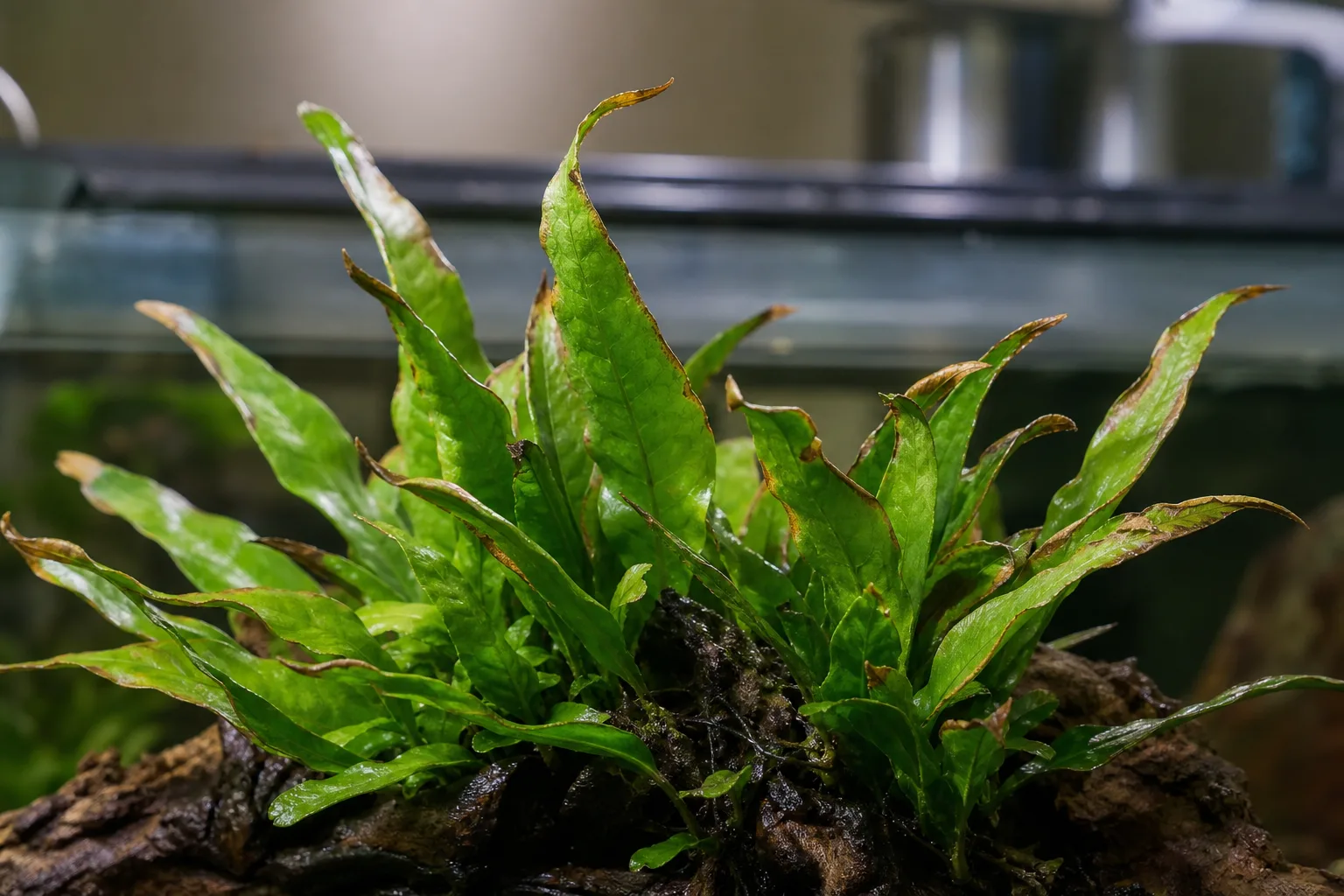
Low Humidity on Java Fern: Causes, Checks & Fixes
This guide covers low humidity on Java Fern. See also the general Low Humidity guide, watering, and light pages for this plant.
Low Humidity on Java Fern: Causes, Checks & Fixes
Quick answer
Java Fern (Microsorum pteropus) is an amphibious fern that grows submerged in most aquariums. Underwater fronds draw moisture from tank water, not from the air in your room. Winter heating that drops household humidity to 20–30% does not affect fully submerged leaves.
Low humidity becomes a real problem only when fronds grow above the waterline-open-top paludariums, Wabi-Kusa setups, emersed nursery cups, or floating mats with leaves breaking the surface. There, dry air shows up as crisp brown tips, papery edges, and fronds that feel brittle instead of leathery.
First step: check whether any fronds break the water surface before you buy a room humidifier. If everything stays submerged, redirect your diagnosis to rhizome burial, water quality, and light. If emersed tissue is drying, raise local humidity around those fronds and keep the rhizome moist.
Why room humidity rarely affects aquarium Java Fern
In nature, Java Fern occurs across tropical and subtropical Asia on rocks and wood in rivulets, waterfalls, and moist forest margins. Some populations stay permanently submerged; others grow as terrestrial plants on damp ground. That amphibious habit explains why the species works in both aquariums and humid terrarium-style setups.
Inside a standard aquarium, the water column is the humidity source. Submerged leaves sit in near-100% moisture at all times. A room humidifier changes nothing for tissue that never contacts air. This is why generic houseplant low-humidity advice-pebble trays, grouping tropicals, misting once daily-does not apply to a fern tied to driftwood six inches below the surface.
What does matter underwater is clean, oxygenated water around an exposed rhizome. Java Fern attaches by a creeping rhizome; burying that rhizome in gravel causes rot, and poor tank conditions produce melt that looks like environmental stress. Those failures mimic humidity damage but need tank fixes, not higher room RH.
What low humidity looks like on Java Fern
Dry-air injury appears only on emersed tissue-the parts of the plant exposed to air:
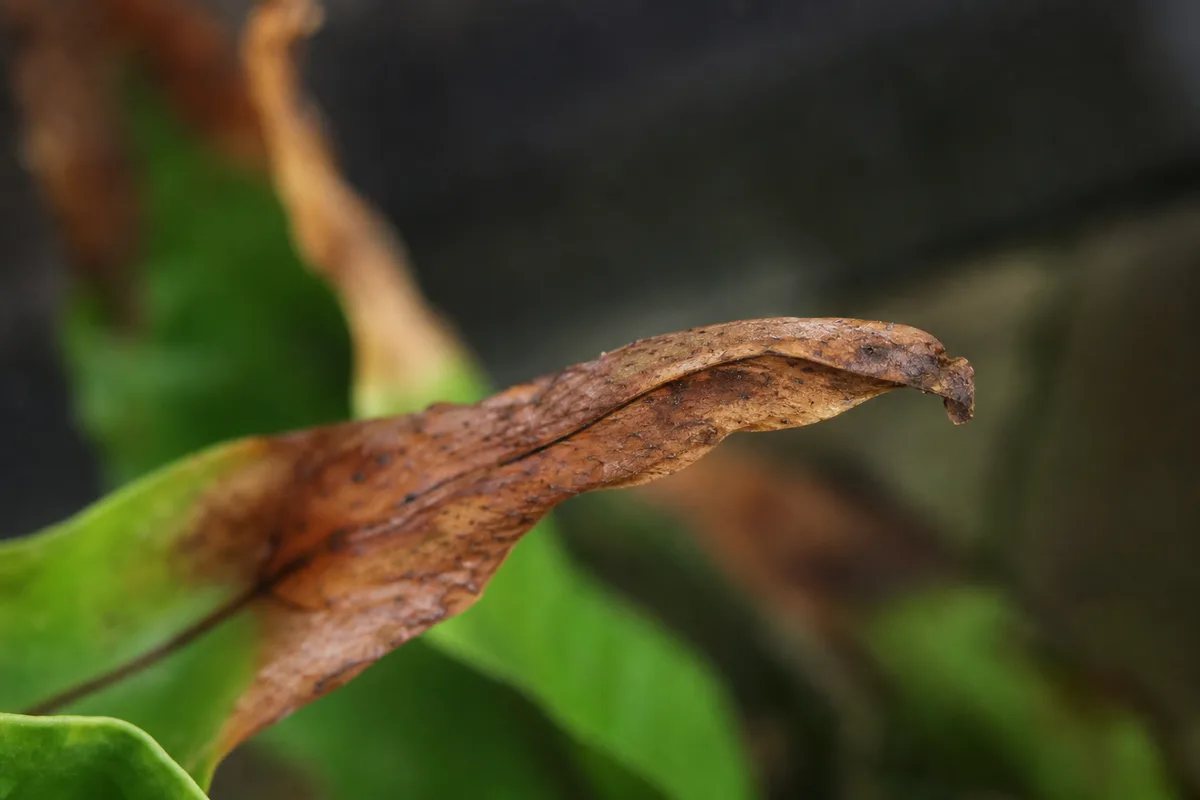
Low Humidity symptoms on Java Fern - compare with healthy tissue on the same plant.
- Crisp brown tips and margins on fronds above the waterline, often progressing inward within days
- Papery, brittle leaf texture that cracks when bent-unlike the tough, leathery feel of healthy submerged fronds
- Curling or shriveling of new emersed growth while older submerged leaves on the same rhizome stay green
- Whole-frond browning in open propagation cups or dry windowsill experiments where no water film covers the tissue
On fully submerged plants, these patterns usually mean something else. Transparent or melting leaves underwater point to acclimation, nutrient imbalance, excessive light, or a buried rhizome-not dry household air. Black spots on undersides are often normal sporangia, not humidity damage.
Why emersed Java Fern dries out
Emersed fronds lose water to air constantly. Without a protective water film, leaf tissue desiccates quickly when ambient humidity falls below what tropical fern habitats provide. Java Fern evolved as a helophyte in the wet tropical biome of Southeast Asian stream margins; emersed culture needs a similar moisture envelope.
Common triggers in home setups:
- Open-top paludariums near heating vents or air-conditioning drafts
- Propagation cups with plantlets above water and no dome or lid
- Wabi-Kusa or bowl culture where only the rhizome base touches water and leaves sit in dry air
- Floating mats pushed high enough that most foliage clears the surface
- Recent transition from submerged to emersed without a gradual, high-humidity acclimation period
The rhizome is equally vulnerable. If the rhizome dries while only roots reach water, the whole plant fails even when a few emersed tips still look green.
How to confirm the cause
Work through these checks in order:
- Waterline map - Trace each frond. Mark which leaves are fully submerged, partially emersed, or entirely above water. Humidity is only a suspect for tissue above the line.
- Texture test - Pinch a damaged leaf. Papery, crackling tissue in air-exposed sections supports dry-air injury. Soft transparent melt underwater suggests tank stress.
- Rhizome inspection - Confirm the rhizome sits on wood or rock, not buried in substrate. Press it gently-it should feel firm and moist, not shriveled or mushy.
- Setup type - Note whether the plant lives in a closed aquarium, open paludarium, propagation cup, or floating mat. Open setups with emersed growth are high-risk for low humidity.
- Room context - Winter heating, AC, and desk fans lower ambient RH. They matter only where fronds contact that air.
- Tank cross-check - If all leaves are submerged, test nitrate, confirm the rhizome is exposed, and review whether light was recently increased. Melt on submerged plants rarely traces to room humidity.
Confirmed diagnosis: dry brown emersed tips on an open setup with low ambient humidity, firm rhizome, and green submerged tissue on the same plant. Suspected but unconfirmed: any submerged melt without emersed fronds-treat as water or light issue first.
First fix for Java Fern
If emersed fronds are drying, cover the setup immediately to trap humidity around the exposed tissue.
For propagation cups, place a clear dome lid or inverted plastic cup with a few air holes over the plant. For open paludariums, add a glass lid or mist emersed portions two to three times daily until a humid microclimate forms. The goal is to stop active desiccation on the rhizome and emersed leaves-not to humidify your entire room.
Do not submerge a previously emersed plant without acclimation; that shock causes its own melt. Do not mist submerged aquarium fronds and assume you fixed a humidity problem that does not exist underwater.
If no fronds break the surface, skip humidifiers entirely. Instead, verify the rhizome is tied to hardscape above the substrate and run a partial water change while observing whether melt spreads over the next week.
Step-by-step recovery
After covering or misting emersed tissue:
- Keep the rhizome moist - In paludariums, ensure the rhizome touches water, wet rock, or constantly damp moss. Never let it sit in dry air while only leaf tips are misted.
- Maintain stable tank temperature - Java Fern grows best around 18–28°C (64–82°F)/27914). Cold or fluctuating water slows recovery on submerged portions.
- Trim fully crisped emersed leaves - Remove fronds that are entirely brown and brittle. Partial tip damage can wait until new growth appears.
- Reduce direct airflow - Move open setups away from heating vents, fans, and drafty windowsills that strip humidity from emersed fronds.
- Acclimate gradually - When shifting from submerged to emersed culture, use a closed container for one to two weeks so leaves adapt before you open the setup. Java Fern can be cultivated emersed when the substrate stays moist.
- For submerged melt - If diagnosis points to tank issues, address rhizome placement and water quality before any humidity changes. Remove melting leaves so the plant does not waste energy on dying tissue.
Recovery timeline
Emersed dryness stops spreading within two to four days once humidity stays consistently high and the rhizome remains moist. New emersed fronds may take two to four weeks to emerge; they often look narrower and lighter green than submerged leaves-a normal response to air growth.
Old crisped tissue does not revert to green. Judge success by fresh growth at the rhizome, not repaired brown edges.
Submerged melt from misdiagnosis follows a different clock. After correcting rhizome placement or water quality, new submerged leaves may appear in three to six weeks on a healthy rhizome. Slow growth is normal for Java Fern overview.
Lookalike symptoms to rule out
Submerged acclimation melt - New Java Fern often sheds older leaves after shipping or a tank move. Tissue turns transparent or brown underwater while the rhizome stays firm. Room humidity is irrelevant.
Buried rhizome rot - Rhizome pressed into gravel softens and blackens; leaves melt from the base up. Fix attachment, not air moisture.
Nutrient deficiency - Pinholes, black spots, or yellowing on submerged leaves with an otherwise healthy rhizome often trace to potassium or nitrogen imbalance in the water column.
Excessive light - Submerged leaves bleach or brown under sudden strong lighting. Java Fern prefers low to moderate aquarium light.
Normal sporangia - Dark spots under leaves are reproductive structures, not dryness or disease.
Mistakes to avoid
Do not run a room humidifier for a fully submerged aquarium and expect melt to stop.
Do not bury the rhizome to “keep it moist”-buried rhizomes rot in substrate.
Do not confuse high humidity needs for emersed culture with underwater culture. They are different growing modes on the same plant.
Do not mist emersed fronds once daily and leave the rhizome dry in open air. The rhizome needs constant moisture.
Do not pull emersed plants into full submersion without transition-expect leaf die-off either direction if you switch modes abruptly.
Do not trim every leaf when only emersed tips are crisp; submerged foliage may still be feeding the rhizome.
Java Fern care cross-check
Match your humidity strategy to how you actually grow the plant:
- Standard aquarium - Keep fronds submerged; maintain clean water, gentle flow, and rhizome on wood or rock. Room RH is optional.
- Paludarium - Emersed portions need lid, fogger, or frequent mist; rhizome at the waterline or on wet hardscape.
- Propagation cups - Dome lids until plantlets root; open cups dry out within hours on a windowsill.
- Floating mats - Allow only the amount of surface exposure you can keep misted or humidified.
Temperature stability supports both modes. Wide swings stress recovery more than a dry winter day does on submerged tissue.
How to prevent low humidity damage
Default to fully submerged culture in community aquariums-it is the lowest-maintenance path and sidesteps air-moisture problems entirely.
When growing emersed intentionally, plan the humidity system before you expose leaves:
- Fit paludariums with partial or full glass lids
- Use propagation domes for plantlets
- Keep Wabi-Kusa bowls in enclosed terrariums or mist multiple times daily
- Position setups away from HVAC vents
- Transition submerged stock to emersed only inside a closed, high-humidity chamber for the first week
For aquariums, prevention means correct rhizome attachment, routine water changes, and moderate light-habits that stop submerged melt before you ever question room humidity.
When to worry
Treat emersed dryness as urgent when fronds go from green to fully crisp within 24–48 hours, the rhizome feels shriveled, or an open propagation cup loses all green tissue. The rhizome can die soon after leaves paper over.
For submerged plants, worry when melt spreads across every leaf while the rhizome softens-that signals rot or severe tank failure, not dry air. Remove the plant, inspect the rhizome, and reattach healthy tissue to hardscape.
Do not worry about household winter dryness affecting a Java Fern that lives entirely underwater with a firm rhizome and slow but steady new growth-that is normal behavior.
Conclusion
Low humidity on Java Fern is a niche problem for emersed growth, not a standard aquarium issue. Check the waterline first: submerged fronds live in tank water, not room air. When emersed tissue dries, cover the setup and keep the rhizome moist before you change anything else. That single diagnostic split saves weeks of misdirected humidifier use and points submerged melt toward the tank fixes that actually work.
When to use this page vs other Java Fern guides
- Java Fern watering guide - Use for routine moisture checks before assuming low humidity is the main issue.
- Java Fern problems hub - Browse all 28 common issues on this species.
- Curling Leaves on Java Fern - Different entry point when symptoms overlap with low humidity.