Slow Growth on Java Fern: Causes, Checks & Fixes
Quick answer
Java Fern is naturally slow-often one new frond every four to eight weeks-but zero buds for ten or more weeks after setup is a stall, not patience. First fix: confirm the entire rhizome is exposed on hardscape, then log temperature, photoperiod, and new-frond count weekly for six weeks before changing fertilizer.
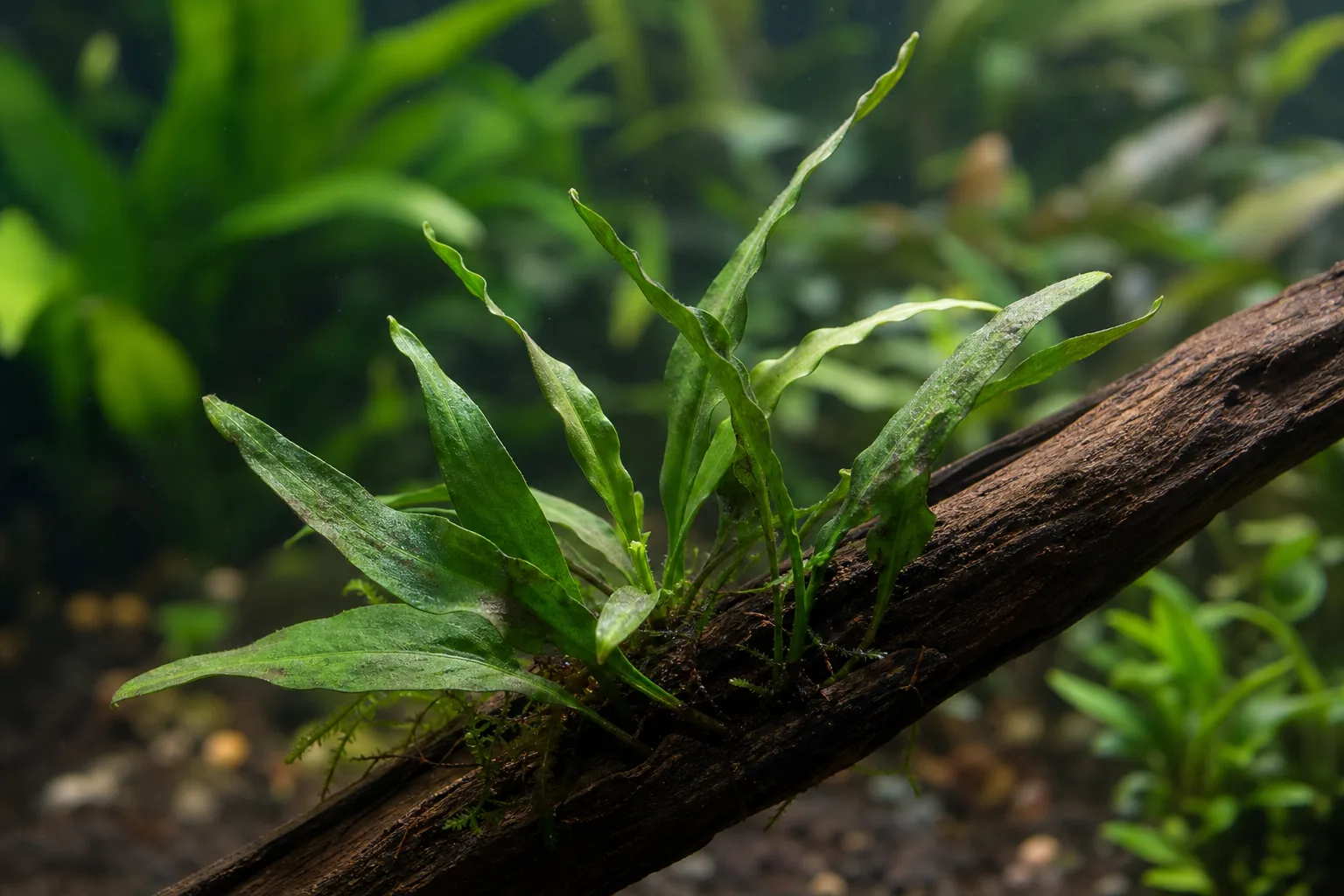
Slow Growth on Java Fern: Causes, Checks & Fixes
This guide covers slow growth on Java Fern. See also the general Slow Growth guide, watering, and light pages for this plant.
Slow Growth on Java Fern: Causes, Checks & Fixes
Quick answer
Java Fern (Microsorum pteropus) is a deliberately slow aquarium plant-one of the slowest common epiphytes in the trade. In a warm, lit tank with an exposed rhizome, one new frond every four to eight weeks is normal. Zero new buds for ten or more weeks after the plant has been in the tank at least three weeks is a troubleshooting signal, not patience.
First fix: expose the entire rhizome on wood or stone if any section is buried, submerged under detritus, or pressed into substrate. Java Fern is an epiphyte evolved for hard surfaces in tropical Asian streams; burying the rhizome causes rot and stalls growth. After remounting, log temperature, photoperiod hours, and weekly frond count for six weeks before changing fertilizer or CO₂.
Start here by symptom:
- Firm rhizome, dim zone, pale thin fronds → likely insufficient light; see not enough light after rhizome check
- Firm rhizome, bright zone, no buds for months → this page-check cold water, acclimation pause, or stacked stressors
- Mushy rhizome, foul smell, fronds detaching → rhizome rot-urgent, not slow growth
- Long gaps between leaf bases, lean toward glass → leggy growth-chronic dimness, not normal pace
- Pale new fronds in a lit zone → pale leaves after light is confirmed adequate
This page covers stalled growth on an existing mount. For baseline culture, placement, and species expectations, use the Java Fern overview and light guide.
Normal slow growth vs true stall on Java Fern
Java Fern’s slow growth rate is a feature, not a defect. It tolerates low light and low CO₂ demand, stores little excess nutrient, and advances by creeping rhizome extension rather than weekly stem explosions like Hygrophila or Ludwigia.
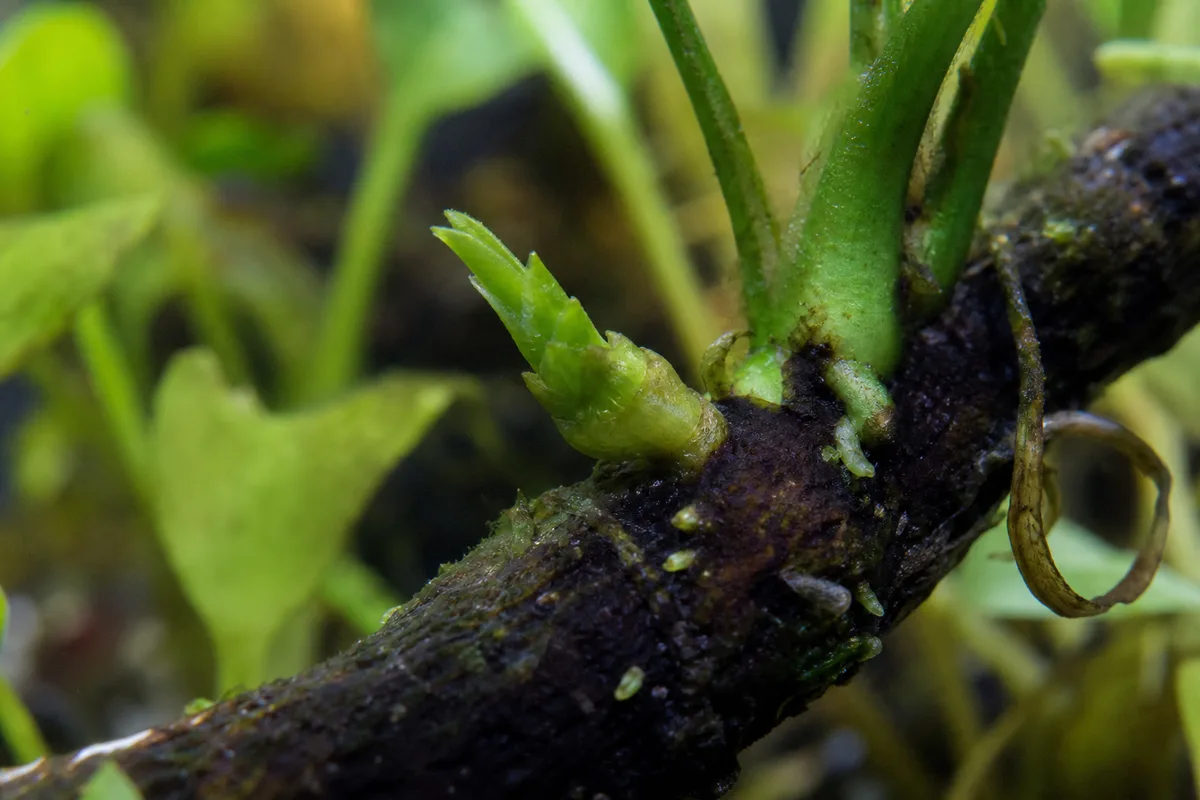
Slow Growth symptoms on Java Fern - compare with healthy tissue on the same plant.
What healthy slow growth looks like
On a firm, exposed rhizome in a heated tropical tank:
- One new frond tip every four to eight weeks-occasionally faster in warm high-light tanks, slower in cool low-tech setups
- Rhizome slowly extends along wood or stone; holdfast roots grip hardscape without burying the stem
- Older fronds age, spot algae, or develop sporangia on undersides while new tissue stays green and leathery-black sporangia are reproductive structures, not disease
- No directional lean toward one brighter corner; fronds stand roughly upright from the rhizome
- Stable leaf spacing along the rhizome-not extra-long gaps between bases
What a true stall looks like
Treat growth as pathologically stalled when all of these apply:
- Zero new frond buds for ten or more weeks after at least three weeks in the tank (post initial melt)
- Rhizome feels firm when pressed-no jelly texture or sour odor
- Water and stocking are stable-no recent major parameter swings, medication, or filter failure
- Existing fronds may look fine or slowly age-the problem is absence of replacement growth, not instant melt
A plant producing one small frond every two months in a dim cool corner may be surviving, not thriving-that borderline case belongs on the not enough light page if fronds are pale or thin.
Acclimation pause vs pathology
New Java Fern often melts emersed-grown leaves for two to four weeks after planting while the rhizome stays firm. During that window, no new submersed fronds is normal-do not remount, fertilize, or blast light on day five.
Acclimation pattern: transparent or brown patches on older nursery leaves, firm green-brown rhizome, occasional single bud within three weeks of planting, melt stabilizing rather than spreading into the stem.
Pathology pattern: mushy rhizome, fronds detaching with goo at the base, melt advancing into the horizontal stem, or ten-plus weeks with zero buds long after initial melt stopped.
If melt is active but the rhizome is firm, hold steady light and photoperiod for three weeks before diagnosing chronic stall.
Differential diagnosis by symptom combination
Use this matrix before changing multiple variables at once. One row match → one first action → wait two to four weeks → recheck.
| Symptom combination | Firm rhizome? | New fronds? | Most likely cause | First action | If no improvement by… |
|---|---|---|---|---|---|
| No growth, rhizome under gravel or moss | Yes or softening | None 10+ wks | Buried or smothered rhizome | Expose and remount on hardscape | Week 8: recheck light |
| No growth, rhizome tip in bottom third of tall tank, dim zone | Yes | None 8+ wks | Insufficient usable light | Relocate to brighter zone; 6–8 hr photoperiod | Week 6: see not enough light |
| No growth, tank 18–20°C, winter room | Yes | None 8+ wks | Cool water slowing metabolism | Raise to 22–28°C optimum range/27914) | Week 8: inspect light |
| One frond / 4–8 wks, green, upright, mid-tank | Yes | Slow but present | Normal slow growth | No fix needed-maintain consistency | N/A |
| No growth, long gaps between leaves, lean to glass | Yes | Thin tips only | Leggy etiolation | Brighter placement | Week 6: leggy growth |
| Pale thin new fronds, bright zone, firm rhizome | Yes | Present but weak | Nutrient limitation | Confirm light first; then pale leaves | Week 4 after feed trial |
| No growth 2–4 wks after purchase, melt on old leaves | Yes | Melt then pause | Acclimation stall | Hold steady; do not rebury | Week 4 post-plant |
| Soft black rhizome, sour smell, detach | No | Collapsing | Rhizome rot | Trim and remount; see root rot | Immediate |
| No growth after tank move + parameter swing | Yes | None 6+ wks | Stacked stress pause | Stabilize one variable per week | Week 8 |
| Stunted fronds, algae coat, 10+ hr photoperiod | Yes | Small twisted tips | Light/nutrient imbalance | Reduce photoperiod before adding feed | Week 4 |
Scope note: This page owns the “firm rhizome, adequate-looking placement, zero buds for months” branch. If your row points to light, rot, or pale tissue, follow that linked guide-do not stack fixes from every row.
Why Java Fern stalls in aquariums
Microsorum pteropus absorbs nutrients primarily through leaves and rhizome in the water column, not through buried roots. Growth pauses when photosynthesis, rhizome health, or temperature cannot support the plant’s already-slow metabolism.
Most common stall causes in planted tanks:
-
Partially buried rhizome - gravel, sand, aquasoil, or thick moss pressed against the horizontal stem blocks oxygen and invites decay. Even “just the back third” buried can stall the growing tip. Tropica: do not cover the rhizome.
-
Chronic shade at the rhizome tip - floaters, driftwood caves, or deep-tank bottom placement leave the growing zone below usable PAR. Java Fern survives on old leaves while the tip produces nothing. Light drops with depth.
-
Cool water - below about 20°C (68°F), metabolism slows sharply; problems may take months to show because the species is already slow. Optimum culture sits around 22–28°C/27914).
-
Short or chaotic photoperiod - under six hours daily on a timer limits total energy capture even when instantaneous light looks adequate.
-
Post-move stress stack - rescape, filter swap, heavy pruning, algae scrubbing, and light changes in the same week pause growth for four to eight weeks on this slow epiphyte.
-
Stagnant detritus on rhizome - mulm trapped in slow flow against the stem mimics burial stress without substrate contact.
-
CO₂ and flow extremes (secondary) - Java Fern does not require CO₂ injection; sudden high CO₂ or blasting flow after months of still water can shock new tissue. Lack of CO₂ alone rarely explains a ten-week stall if light and rhizome placement are correct.
Fertilizer deficiency can limit pace but rarely causes zero growth for months when nitrates are present and light reaches the rhizome. Dose only after placement, temperature, and photoperiod are verified.
How to confirm the cause (strict order)
Change one major variable at a time. Run this sequence and record results in a simple weekly log (date, frond count, rhizome firmness, tank temp).
-
Rhizome exposure audit - Unthread or lift the plant. Trace the full horizontal stem. Any section under substrate, buried in moss, or packed in detritus must be freed and remounted before light or fertilizer changes.
-
Rhizome firmness test - Press along the stem with a blunt tool. Firm and woody supports stall diagnosis on this page. Mushy, jelly-like, or foul-smelling tissue means rot-stop here.
-
Growing-tip placement - Is the rhizome tip in the lower third of a deep tank, inside a wood shadow, or under floating plants? Compare to a brighter zone in the same tank.
-
Temperature read - Measure at mid-tank depth. Chronic readings below 20°C explain multi-month stalls in unheated rooms.
-
Photoperiod audit - Confirm timer hours. Target six to eight hours daily for low-tech Java Fern per grow-in guidance; wildly swinging schedules obscure trends.
-
Acclimation history - If the plant arrived within the last four weeks and old leaves are melting, wait before declaring chronic stall.
-
Two-week trend - Mark the rhizome tip with a dot of aquarium-safe marker or note thread position. Recheck for bud emergence at days 14 and 28.
Confirmed stall on this page: firm exposed rhizome, stable water, ten-plus weeks zero buds, temperature in tropical range, photoperiod at least six hours, growing tip not in obvious deep shade.
First fix to try
Remount the Java Fern so the entire rhizome sits in open, oxygenated water on rock or driftwood-no section under substrate or compressed moss.
Use cotton thread, fishing line, or aquarium-safe gel cyanoacrylate on the holdfast zone only; do not glue over the growing tip. After remounting:
- Hold light, fertilizer, and CO₂ steady for fourteen days-let the rhizome recover from handling stress
- Log weekly: new bud yes/no, rhizome firmness, water temperature
- Remove only fully dead fronds at the rhizome base; do not mass-prune healthy tissue
This single fix resolves a large share of multi-month stalls because burial and smothering are the most common culture errors on epiphytes.
If the rhizome was already fully exposed, the first fix becomes verify six-to-eight-hour photoperiod and relocate the tip out of shade-details on not enough light if fronds are pale.
Troubleshooting case: buried rhizome after rescape
Setup: 75 L (20 gal) low-tech community tank, single LED hood, unheated room dropping to 19°C overnight, Java Fern tied to driftwood mid-tank.
Symptom: Owner reports “no growth for three months.” Old fronds intact; no new tips. Rhizome felt firm at the front but growth tip was invisible under a gravel slope added during rescape.
Week 0: Lifted plant; rear 3 cm of rhizome buried in fine gravel. Remounted on wood with full stem exposed. Timer set to seven hours. No fertilizer change.
Week 2: No visible bud; rhizome firm; one old frond developed spot algae-expected in slow flow.
Week 3: Small green bud visible at rhizome tip-first growth in eleven weeks.
Week 5: New frond unfolded, darker and thicker than aging leaves. Rhizome extended ~4 mm.
Week 8: Second bud forming. Owner raised heater to 24°C; first frond on second bud appeared week 10.
Lesson: The stall was burial plus cool water, not “Java Fern is just slow.” Measurable checkpoints (bud at week 3, leaf at week 5) separated success from endless waiting. Old fronds never improved-only new tissue showed recovery.
Six-week recovery tracker
After the first fix, use this schedule instead of changing three variables in one weekend.
| Week | What to do | What you should see | If you do not see it |
|---|---|---|---|
| 1 | Remount exposed rhizome; steady photoperiod | No dramatic change-normal | Recheck for hidden burial |
| 2 | Hold all variables; light water change routine | Rhizome stays firm | Soft tissue → root rot |
| 3–4 | Inspect tip for bud | First bud or swelling at tip | Shade or cold → relocate or heat |
| 5–6 | Leave new bud undisturbed | New frond partially unfurled | No bud → not enough light |
| 7–8 | Optional: trim one oldest frond | Second bud possible | Pale new leaf → pale leaves |
| Beyond 8 | One change only (light +1 hr/wk or modest feed) | Steady rhizome advance | Re-run matrix above |
Judge success by new frond quality and rhizome extension-not old leaf appearance. Damaged or algae-coated mature fronds rarely revert to pristine form.
Mistakes to avoid
- Expecting stem-plant speed - weekly visible expansion is the wrong benchmark for Microsorum pteropus.
- Burying the rhizome to anchor - covering the stem causes rot and stall.
- Changing light, fertilizer, flow, and placement the same week - you cannot tell which change helped or hurt.
- Dosing heavy fertilizer in a dark corner - nutrients without photons feed algae on slow leaves.
- Jumping from months of shade to maximum PAR - sudden high light can melt Java Fern; increase gradually.
- Waiting twelve-plus weeks without logging - “it feels slow” is not a diagnosis; count fronds and weeks.
- Treating firm zero-growth as rot - unnecessary trimming damages healthy rhizome.
How to prevent chronic slow growth
Mount Java Fern as an epiphyte at setup: rhizome on mid-tank hardscape in the brighter half of the aquarium, not inside a cave shadow. Run a consistent six-to-eight-hour photoperiod on a timer from day one. Keep tropical temperatures in the 22–28°C band/27914). Thin floaters before they block the rhizome tip.
Operational consistency means: same photoperiod ±15 minutes daily, water changes on a predictable weekly rhythm, one major tank change per month maximum during grow-in, and checking the rhizome stays exposed after rescapes.
For proactive PAR targets and fixture selection, use the Java Fern light guide. For fertilizer only after growth resumes, see fertilizer.
When to worry
Slow growth becomes urgent when paired with decline signals:
- Soft, black, or foul-smelling rhizome - treat as rhizome rot immediately
- Fronds detaching with goo at the base while the stem softens-rot progression, not stall
- Transparent melt on every new frond within days of a tank move-may need gradual light, not more waiting
- No bud by week eight after confirmed exposed rhizome, six-plus photoperiod hours, and 22°C+ water-escalate to light or nutrient guides, not passive patience
Low urgency: firm rhizome, green aging fronds, one new leaf every one to two months in a known low-tech tank-that may be normal species pace.
Related Java Fern pages by outcome
| After your checks… | Go to |
|---|---|
| Rhizome mushy or smelly | Root rot |
| Pale thin fronds in dim zone | Not enough light |
| Long stretch between leaf bases | Leggy growth |
| Pale new growth in bright zone | Pale leaves |
| Transparent melt on new purchase | Hold steady 3 wks; then light guide if no buds |
| Baseline culture and placement | Overview |
Conclusion
Slow growth on Java Fern is usually culture and placement, not mystery disease. Separate normal four-to-eight-week frond pace from ten-plus-week zero-bud stalls, expose the full rhizome before touching fertilizer, and log weekly checkpoints for six weeks. Recovery shows as the next frond-not repaired old blades. If the rhizome softens, stop waiting and treat rot; if the tip sits in shade, fix light before dosing.
Who reviewed this guide
This guide was written by sai-ananth and reviewed by the LeafyPixels Review Board against botanical references including Tropica Microsorum pteropus culture data, Kew POWO taxonomy and native range, Dennerle temperature parameters/27914), Aquarium Co-Op Java Fern husbandry, and LeafyPixels overview, light, root rot, and not enough light guides. The rescape case timeline is an editorial composite based on common buried-rhizome stall patterns; individual tanks vary with temperature and lighting.
Updates are made when culture guidance changes or when cluster pages add new diagnostic boundaries. Report outdated thresholds via site contact if your measured PAR or temperature range disagrees with current recommendations.
When to use this page vs other Java Fern guides
- Java Fern watering guide - Use for routine moisture checks before assuming slow growth is the main issue.
- Java Fern problems hub - Browse all 28 common issues on this species.
- Leggy Growth on Java Fern - Different entry point when symptoms overlap with slow growth.
- Yellow Leaves on Java Fern - Different entry point when symptoms overlap with slow growth.