ZZ Plant Care: Light, Water, Soil & Tips
Zamioculcas zamiifolia
ZZ plant care for low-light offices - infrequent watering, soil mix, and toxicity notes for pets.
ZZ Plant Care: Light, Water, Soil & Tips
Start with wateringThe most common care mistake for ZZ PlantWatering guide →ZZ Plant care essentials
Light
indirect light, low light, fluorescent office light, medium indirect light
Water
Water only when the soil is completely dry - ZZ stores water in rhizomes and is highly drought-tolerant.
Soil
Very well-draining, low-nutrient mix to prevent rhizome rot.
Humidity
30–50%
Temperature
18–26°C (65–79°F)
Fertilizer
Feed lightly during active growth.
About ZZ Plant
ZZ Plant has a upright growth habit.
| Detail | Information |
|---|---|
| Growth habit | Upright |
| Scientific name | Zamioculcas zamiifolia |
ZZ Plant Care: Light, Water, Soil & Tips
What Is the ZZ Plant?
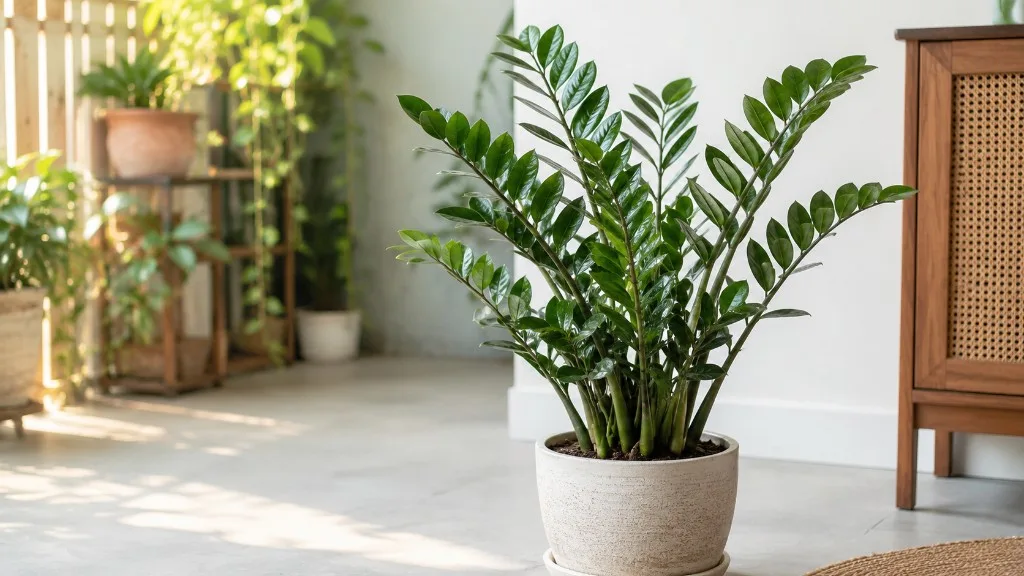
The ZZ plant - also called Zanzibar gem - is one of the most forgiving foliage plants you can grow indoors, but that reputation comes with a caveat most care guides gloss over. Its tolerance for neglect is real; its tolerance for overwatering on ZZ Plant is not. The accepted scientific name is Zamioculcas zamiifolia, the sole species in its genus, and it belongs to the family Araceae alongside peace lilies, pothos, philodendrons, and Chinese evergreens. What you see above the soil - upright stems topped with glossy, compound leaves that look almost palm-like - is only half the story. Below the surface, thick underground rhizomes store water the way a camel stores fat: slowly, efficiently, and for long dry stretches between drinks.
Indoors, a mature ZZ plant typically reaches 2 to 4 feet (60 to 120 cm) tall and wide, growing at a deliberately slow pace even in good conditions. New stems emerge from rhizomes and unfurl pairs of thick, elliptical leaflets along a central rachis, giving the plant a sculptural, architectural presence that works equally well on a desk, in a dim hallway, or as a floor specimen in a living room. The leaves are waxy, leathery, and highly reflective - one reason the plant photographs so well and why it became a staple of office interiors long before Instagram made it fashionable. Popular cultivars extend the range: ‘Raven’ matures to near-black foliage, ‘Chameleon’ opens yellow and greens with age, ‘Zenzi’ stays dwarf at roughly 10 to 12 inches, and variegated forms add cream or white patterning at a typically smaller mature size.
If you are deciding whether a ZZ plant fits your home, the honest summary is this: it rewards patience, ZZ Plant light guide, and a ZZ Plant watering guide built around dry soil - and it punishes soggy mix, oversized pots, and calendar-based watering. It is easier than a fiddle-leaf fig and more demanding than its “unkillable” marketing suggests, because the same rhizomes that make it drought-hardy also rot quickly when they sit in wet soil for weeks. The plant is beginner-friendly in the sense that it forgives missed waterings and dim corners, but beginners who water on autopilot kill more ZZ plants than experienced growers who forget to water for a month. One critical caveat for pet owners: the ZZ plant is toxic to cats and dogs if chewed, because it contains insoluble calcium oxalate crystals - the same family of compounds found in pothos, peace lilies, and philodendrons.
Botanical Background and Natural Habitat
ZZ plant is native to Eastern Africa, from Kenya south through Tanzania, Mozambique, and into South Africa, where it grows in arid, open woodland and savannah environments according to Clemson HGIC. That origin explains nearly every indoor care rule. In its native range, rainfall is seasonal and often sparse; soils drain quickly; and the plant evolved to store water in bulbous rhizomes rather than depend on constant soil moisture. When conditions turn dry, the rhizomes sustain existing stems and leaflets while new growth waits. When moisture returns, growth resumes - slowly, because the plant has no evolutionary incentive to race.
The Araceae family connection matters for two practical reasons. First, ZZ plant shares the calcium oxalate crystal defense common to many aroids - microscopic needle-shaped raphides embedded in leaf, stem, and root tissue that cause immediate oral irritation when chewed. Second, like other aroids, ZZ plant prefers well-aerated root zones and dislikes compacted, waterlogged soil. Treating it like a tropical foliage plant that wants constantly moist peat is the fastest route to rhizome rot, even though the glossy leaves look lush enough to suggest otherwise.
Despite its cycad-like appearance - the genus name Zamioculcas references its resemblance to Zamia cycads - ZZ plant is a true flowering aroid. It rarely blooms indoors, but when it does, the inflorescence is a typical arum structure: a pale green spathe surrounding a brown spadix at the base of the plant. Flowers are not the point of growing ZZ Plant overview; the foliage and the low-maintenance silhouette are.
Why the Rhizomes Define Almost Everything
The rhizomes are not decorative storage organs - they are the plant’s central survival system. Each thick, potato-like rhizome sits partially below the soil line and sends up one or more stems. Because water reserves live in the rhizomes themselves, the plant can remain visually healthy through extended dry periods that would wilt a coleus or crisp a fern. That drought hardiness is genuine and is the main reason ZZ plant survives office fluorescents and irregular watering schedules better than most houseplants.
The same biology creates the plant’s greatest vulnerability indoors. Rhizomes that stay wet for too long lose the air exchange they need, and rot spreads from the base upward. By the time stems turn mushy and yellow, the damage is often well established below the soil line. This is why experienced ZZ growers treat watering as a soil-dryness decision, not a sympathy response to a plant that still looks green. A ZZ plant can appear fine while its rhizomes are drowning, because the stored water keeps leaves glossy until the rot advances far enough to cut off supply.
Slow growth is also rhizome-driven, not a sign of poor care. ZZ plant builds biomass conservatively - new stems may take weeks to emerge and months to reach full height. In bright indirect light with correct watering, you might see a handful of new stems per growing season. In low light, new growth may nearly stop while the existing plant persists on stored reserves. Understanding that rhythm prevents the two most common owner mistakes: overwatering a plant that is not using water, and overfertilizing a plant that is not growing fast enough to need it.
For related ZZ Plant care, see Fungus Gnats on ZZ Plant, Leaf Spot Disease on ZZ Plant, Leggy Growth on ZZ Plant.
Best Growing Conditions for the ZZ Plant
ZZ plant performs best when your space approximates the bright, dry, stable rhythm of its African woodland habitat - not the dark, wet corner where many owners place it because they heard it tolerates low light. The four variables that decide almost every outcome are light, water, soil, and temperature. Align those and feeding, ZZ Plant repotting guide, and propagation become straightforward. Misalign any one - especially water in low light - and the plant declines in ways that look mysterious until you inspect the rhizomes.
Light Requirements
ZZ plant tolerates low light better than most houseplants, but it grows best in bright, indirect light. Clemson HGIC recommends locating ZZ plants anywhere except in full direct sunlight, which bleaches and scorches the glossy leaflets. A practical indoor placement is within a few feet of an east-facing window, or set back from a north-, west-, or south-facing window where the plant receives strong ambient daylight without harsh midday rays on the leaves. Fluorescent and LED office lighting can sustain the plant indefinitely - one reason it became the default corporate lobby specimen - but growth under artificial light alone stays slow and stems may lean toward the brightest source.
The distinction between surviving and thriving in low light matters. In a dim hallway, ZZ plant usually stays green because rhizomes buffer slow photosynthesis, but growth may nearly stop and stems may stretch toward the brightest source. Unlike some succulents, ZZ plant often stays green while etiolating, so leggy growth is easy to miss until leaves cluster at stem tips. For active growth, give brighter filtered light and rotate the pot 90 degrees weekly.
Direct sun scorches leaflets - especially those formed in low light if you move the plant suddenly. Acclimate over one to two weeks. Too much light shows as bleached patches and crispy edges; too little as bare stem sections and no new shoots for a full season.
Temperature and Humidity
ZZ plant prefers stable indoor temperatures above 60°F (15°C) and is sensitive to cold drafts according to Clemson HGIC. It handles normal household warmth without complaint and tolerates summer heat when soil moisture and drainage are managed correctly. The danger zone is sustained exposure below about 50°F (10°C) or sudden cold from a winter window ledge, an air-conditioning vent, or a drafty entry door. Cellular damage from cold shows up as darkened, collapsed stems that do not recover - trim them back to healthy tissue once you have moved the plant to a warmer, stable location.
Humidity is one of the few variables ZZ plant does not demand. It is adapted to arid savannah conditions and thrives at ordinary indoor humidity levels of 30 to 50%. You do not need a humidifier, pebble tray, or misting routine for this species under normal circumstances. Very dry winter air - below about 25% - can occasionally encourage spider mites on plants already stressed by low light or inconsistent watering, but humidity itself is rarely the limiting factor. Focus on light and watering before adding humidity equipment.
Soil and Drainage
Use a coarse, well-draining potting mix that dries predictably and holds air around the rhizomes. Clemson HGIC recommends a blend of roughly 50% peat moss or coir-based potting soil, 25% perlite, and 25% sand. A commercial cactus or succulent mix amended with a small amount of organic potting soil also works well. The principle matters more than a single recipe: the mix should drain freely, resist compaction, and not stay wet for days after a thorough watering. Heavy, peat-dominant indoor mixes that work for ferns will suffocate ZZ rhizomes within a few months.
Target a slightly acidic to neutral pH around 6.0 to 7.0. Hobbyists rarely need to meter pH for ZZ plant; the bigger practical issues are compaction, poor drainage, and salt buildup from hard tap water and over-fertilizing. Always plant in a container with a drainage hole. Decorative cachepots are fine only if you empty runoff after every watering and never let the bottom of the pot sit in standing water.
Pot size should match the rhizome mass, not your ambition for a bigger plant. An oversized pot holds excess wet mix around rhizomes that cannot use it, which is the most common trigger for rot after repotting. ZZ plant is comfortable slightly root-bound and often grows well for years in the same container until the rhizomes visibly crowd the soil surface or push against the pot walls.
How to Water the ZZ Plant
The general rule for ZZ plant is simple and strict: water only when the soil has dried completely from top to bottom. More precisely, check the pot - do not consult a calendar. In bright, warm conditions, that often means watering roughly every two to three weeks during active growth. In low light or during winter, once a month or less is frequently enough. Clemson HGIC describes the rhythm as watering one to two times per month, only after the potting medium has completely dried. If you find yourself watering more often than every two weeks year-round, you are almost certainly overwatering, using the wrong mix, or keeping the plant in a pot without drainage.
Use your finger, a wooden skewer, or pot weight to assess moisture. A light pot with dry mix throughout the root zone means water thoroughly until a modest amount runs from the drainage hole, then empty the saucer completely. A heavy pot with any dampness at depth means wait - the rhizomes still have reserves and the wet soil is the greater risk. The soak-and-dry method suits this plant: one full drink, complete drainage, then silence until the next dry cycle.
Watering Rhythm During Active Growth
During the warm, bright months when new stems may emerge, ZZ plant uses water on a steady but slow rhythm. The goal is full rehydration of the entire root zone followed by a complete dry-down - not permanently damp soil and not frequent shallow top-ups. After watering, the mix should go from evenly moist to dry at depth within a timeframe your light and temperature dictate. Track how many days that takes in your specific home and use that interval as a personal baseline, adjusting whenever you move the plant or change seasons.
Newly purchased plants often arrive in peat-heavy greenhouse mix that dries differently from your home blend. Do not increase watering frequency to compensate for transplant stress unless the pot is genuinely dry. Stabilize light first, then observe how the existing mix dries over two to three weeks before repotting into a better-draining blend if needed.
Seasonal Adjustments
In cooler, dimmer months, ZZ plant metabolism slows and the pot dries more slowly - sometimes dramatically so in low-light rooms. Stretch the interval between waterings and pause fertilizer until new growth resumes in spring. The most common winter failure mode is continuing a summer watering schedule in a dim corner, which keeps the mix waterlogged for weeks while the plant is barely using moisture. A ZZ plant in low light that received one watering in October may still have damp soil in January; watering again because the calendar says so is how rhizomes rot in what owners describe as “a dark room where I barely watered.”
Resume your active-season rhythm only when you see new stem emergence or consistent pot-dry cycles returning as daylight lengthens and indoor temperatures stabilize. When in doubt, wait an extra week and check weight again.
Common Watering Mistakes
The single most damaging mistake is watering on a fixed schedule without checking the pot. The second is letting the plant sit in a full saucer or cachepot, which re-wets the bottom of the mix and suffocates rhizomes even when the surface looks dry. The third is giving small daily sips instead of a full soak when the plant is genuinely dry - that wets only the top inch while the center stays parched, producing inconsistent moisture that stresses roots over time.
Owners also misread the low-light trap: a dim-office ZZ can look healthy for months on one watering while soil stays wet and rhizomes rot. Always pair visual health with a depth moisture check before adding water. underwatering on ZZ Plant is less common; wrinkled leaflets and soft stems usually recover after one thorough soak.
How to Feed the ZZ Plant
ZZ plant is a light feeder that needs modest nutrition at most. Clemson HGIC recommends fertilizing only once or twice during the growing season with a balanced houseplant fertilizer. That restraint matches the plant’s slow metabolism: it does not produce enough new tissue to use heavy or frequent feeding, and excess salts accumulate in a pot that is rarely flushed by generous watering.
A balanced water-soluble fertilizer - such as 10-10-10 or 20-20-20 - diluted to one-quarter to one-half of the label rate is sufficient. Apply to already-moist soil so the solution distributes without burning rhizomes. If your potting mix contains a slow-release starter charge, skip supplemental feeding for the first two to three months after repotting.
Hold fertilizer entirely during winter dormancy, after a major repot until new growth appears, and while the plant is recovering from root rot on ZZ Plant or pest damage. Overfeeding produces crispy brown leaflet margins and white salt crust on the soil surface that resemble drought stress but persist even when watering is correct. If margins crisp despite proper dry-down watering, flush the pot with plain water at two to three times the pot volume and pause feeding for several months.
Repotting and Root Health
Repot ZZ plant roughly every two to three years, or whenever rhizomes crowd the soil surface, roots push through drainage holes, water runs straight through without soaking in, or the mix has compacted and smells sour. The best timing is early spring as active growth resumes, giving the plant a full warm season to settle into fresh mix. ZZ plant is slow enough that many specimens stay content in the same pot longer than faster-growing tropicals - do not repot reflexively every year.
Choose a container only one size larger - typically 1 to 2 inches (2.5 to 5 cm) wider in diameter. Oversized pots are the primary cause of post-repot rot because excess wet mix surrounds rhizomes that cannot absorb it quickly enough. Use fresh, coarse, well-draining mix, plant rhizomes at the same depth they occupied before, and water lightly once after repotting rather than soaking a damaged root zone. Keep the plant in bright indirect light and withhold fertilizer until new stem growth appears.
When inspecting rhizomes during repotting, healthy tissue is firm, pale tan to white inside, and free of foul odor. Soft, brown, mushy rhizomes should be trimmed back to solid tissue with a clean knife and allowed to callus briefly before replanting in fresh mix. If more than half the rhizome mass is compromised, reduce the remaining stems to lower water demand and treat the plant as a recovery case with extra-dry soil for several weeks.
Signs It Is Time to Repot
The clearest signs are physical: rhizomes bulging above the soil line, roots visible at drainage holes, a plant that dries out within a day or two of watering because roots have consumed the mix, or water that channels through without wetting the center. Mix that has shrunk away from the pot walls, turned dense and gray, or developed a sour smell also warrants refresh even if the calendar says otherwise.
Top-heaviness alone is not always a repot signal - ZZ stems are naturally tall and arching. Combine structural imbalance with root-crowding evidence before sizing up. If the plant is healthy but the mix is tired, you can replace soil without increasing pot size by gently removing old mix from the outer root zone and backfilling with fresh blend.
Propagation Methods for the ZZ Plant
ZZ plant propagates reliably by rhizome division and stem cuttings, with leaf cuttings as a slower option for patient growers. Division is the fastest path to a new plant: during repotting, separate rhizome clusters that have their own stems and root tissue using a clean, sharp knife. Let cut surfaces dry for a few hours, then plant each division in its own small pot with well-draining mix. Keep divisions in bright indirect light, water sparingly until new growth confirms active roots - usually several weeks - and avoid fertilizer until the plant is clearly established.
Stem cuttings root in four to eight weeks in warm, bright conditions - cut near the soil line, strip lower leaflets, and root in moist mix or water. Leaf cuttings work but take three to nine months and suit patient growers more than quick propagation. Use only healthy parent plants; stressed specimens rot readily during rooting.
Common ZZ Plant Problems
Most ZZ plant problems trace back to water, light, or temperature - not mysterious diseases. The plant has few serious pest or pathogen issues indoors according to Clemson HGIC, which lists no major insect or disease problems under normal care. When something looks wrong, check the rhizomes and soil moisture before reaching for sprays or fertilizer.
Yellow Leaves, Brown Tips, and Pests
Yellow leaves most often mean overwatering and rhizome rot, especially if lower stems soften at the base and the mix smells sour. Less commonly, yellowing follows severe underwatering, cold damage, or natural senescence of older leaflets at the bottom of mature stems. Check moisture at depth first: wet mix plus yellow leaves equals stop watering and inspect rhizomes. Dry mix plus yellow, crispy leaflets equals a overdue soak. If only the oldest leaflets on long-established stems yellow and drop while new growth stays green, the plant may simply be shedding aging tissue - normal on a slow-growing perennial.
Brown leaflet tips usually point to salt buildup, fluoride or chlorine in tap water, or chronic underwatering stress rather than low humidity. Flush the pot with plain water periodically if you fertilize or use hard tap water, and switch to filtered or rainwater if tips persist despite correct dry-down watering. Brown patches on sun-facing leaflets are scorch, not a watering issue - move the plant to softer light.
Black spots on stems are often completely normal - Clemson HGIC notes that black spots on stems indicate a typical, healthy ZZ plant. Do not prune healthy stems that show scattered dark markings if tissue is firm and leaflets are glossy. Soft, mushy black stems at the soil line are rot and need immediate trimming and dry-down recovery.
Pests are uncommon but not impossible. Spider mites may appear in very dry, dusty, low-light conditions - look for fine webbing and stippled leaflets. Mealybugs hide in leaf axils as cottony clusters. Scale attaches along stems as immobile bumps. Fungus gnats signal persistently wet surface soil, which is itself a care problem to fix before treating adults. Inspect weekly, isolate infested plants, and use manual removal plus insecticidal soap for most early infestations. Correct the underlying moisture issue that attracted gnats or stressed the plant in the first place.
Leggy growth - long bare stems with leaflets clustered at the tips - means the plant wants more light, not more water or fertilizer. Move to brighter filtered exposure, rotate weekly, and prune the worst stems back to the soil line if the shape is beyond correction. New stems that emerge after the move will be more compact; old stretched stems do not fill in retroactively.
Is the ZZ Plant Safe for Pets?
No - the ZZ plant is toxic to cats and dogs if chewed or ingested. The ASPCA lists ZZ plant (Zamioculcas spp.) among common houseplants containing insoluble calcium oxalate crystals. These microscopic, needle-shaped raphides embed in leaf, stem, and root tissue. When a pet bites the plant, crystals release into the mouth and cause immediate pain, excessive drooling, pawing at the mouth, reduced appetite, vomiting, and sometimes diarrhea. Behavioral signs can look dramatic, which frightens owners - but the mechanism is physical irritation rather than systemic poisoning, and most pets stop chewing quickly because the mouth pain is immediate.
Severity is generally low to moderate for typical nibbles, and the ASPCA notes many exposures can be managed at home - but that is not permission to leave the plant within reach. Contact your veterinarian or ASPCA Animal Poison Control at (888) 426-4435 if ingestion is suspected, especially with swelling or breathing changes. Mild irritation may ease with a small amount of dairy without xylitol per ASPCA guidance. Toxicity applies to ingestion, not casual contact; wash hands after pruning if sap irritates skin. Keep ZZ plant on a tall stand or in a pet-free room rather than relying on training alone.
Conclusion
The most useful thing to know about ZZ plant is that it is an African aroid built around drought-hardy rhizomes and glossy, slow-growing foliage - not an indestructible plastic plant that tolerates any conditions. Give it bright indirect light for steady growth, or accept near-standstill in a dim office with correspondingly rare watering. Use coarse, fast-draining soil in a pot with a drainage hole, and water only when the mix is dry throughout. Feed lightly once or twice a year, repot only when rhizomes demand it, and keep temperatures above 60°F (15°C). Watch for the low-light overwatering trap, treat black stem spots as normal when tissue is firm, and move leggy plants toward brighter filtered light rather than adding more water.
If you are a beginner, ZZ plant is an excellent teacher - not because it forgives everything, but because it responds predictably when you respect its dry-cycle rhythm. If you are a pet owner, respect the calcium oxalate toxicity and place the plant accordingly. Nail light, water, soil, and temperature and the ZZ plant will sit quietly beautiful for years with minimal intervention - which is exactly what most owners wanted when they brought it home.
When to use this page vs other ZZ Plant guides
- ZZ Plant overview - Canonical hub for this species - care topics and problems branch from here.
- ZZ Plant problems - Symptom-first path when you already know something is wrong.
Related ZZ Plant guides
How to care for ZZ Plant?
How much light does ZZ Plant need?
indirect light, low light, fluorescent office light, medium indirect light
- indirect light - indirect light, low light, fluorescent office light, medium indirect light.
- low light - indirect light, low light, fluorescent office light, medium indirect light.
- fluorescent office light - indirect light, low light, fluorescent office light, medium indirect light.
- medium indirect light - indirect light, low light, fluorescent office light, medium indirect light.
When should you water ZZ Plant?
Water only when the soil is completely dry - ZZ stores water in rhizomes and is highly drought-tolerant.
- Check top 2 inches - Stick a finger or knuckle into the soil; water only when the top layer feels dry.
- Drain excess water - Water only when the soil is completely dry - ZZ stores water in rhizomes and is highly drought-tolerant.
What soil works best for ZZ Plant?
Very well-draining, low-nutrient mix to prevent rhizome rot.
- Well-draining mix - Very well-draining, low-nutrient mix to prevent rhizome rot.
Grower notes for ZZ Plant
What matters most with ZZ Plant
ZZ Plant stores water in leaves, stems, roots, or a swollen base, so overcare is usually more dangerous than short dry spells. Strong light and drainage are the safety net. In practice, the care checkpoint is simple: indirect light, low light, fluorescent office light, medium indirect light. Pair that with very well-draining, low-nutrient mix to prevent rhizome rot, and avoid changing water, pot size, and placement all at once.
Best placement in a real home
ZZ Plant belongs where indirect light, low light, fluorescent office light, medium indirect light is realistic for most of the day, not only where the pot looks good. Water only when the soil is completely dry - ZZ stores water in rhizomes and is highly drought-tolerant. If the pot stays wet longer than expected, move the plant into better light or reassess the mix before watering again. Humidity target: 30–50%. Temperature comfort zone: 18–26°C (65–79°F).
Before you buy this plant
Choose ZZ Plant with firm new growth, clean leaf undersides, and soil that does not smell sour or feel compacted. Be cautious if you see yellow-leaves, sticky residue, collapsed crowns, or a pot that is wet in poor light. Cosmetic old-leaf damage is less worrying than weak roots or active pests.
First month after bringing it home
Do not repot ZZ Plant on day one unless the mix is failing or pests are obvious. Quarantine it, learn how fast the pot dries, and keep care boring while it adjusts. Watch especially for yellow-leaves, root-rot, and slow-growth. If problems appear, correct the condition first rather than stacking fertilizer, repotting, and pruning together.
Safety note for ZZ Plant
ZZ Plant is not a plant to keep within reach of pets or children. Treat it as an inaccessible display plant. Use gloves if sap or plant tissue is irritating, and pick a pet-safe alternative for floor pots or low shelves.
How to tell ZZ Plant is settling in
If you plan to multiply it later, common methods include Leaf cuttings in water or soil, Stem cuttings, and Rhizome division. If root-rot shows up early, inspect light, watering, and roots before assuming the plant is permanently weak.
Is it pet safe?
ZZ Plant is toxic to cats and dogs.
Contains calcium oxalate crystals. Causes oral irritation, drooling, and vomiting if ingested by pets or humans. Sap may irritate skin - wash hands after handling.
Watering ZZ Plant
Water only when the soil is completely dry - ZZ stores water in rhizomes and is highly drought-tolerant.
Soil & potting for ZZ Plant
Very well-draining, low-nutrient mix to prevent rhizome rot.
Humidity & temperature for ZZ Plant
ZZ Plant prefers 30–50%, though normal home humidity is usually fine. Keep temperatures around 18–26°C (65–79°F).
| Detail | Information |
|---|---|
| Humidity | 30–50% - normal home humidity is fine. |
| Ideal temperature | 18–26°C (65–79°F) |
Fertilizer & pruning for ZZ Plant
Use feed lightly during active growth. for ZZ Plant.
| Detail | Information |
|---|---|
| Fertilizer type | Feed lightly during active growth. |
Common problems on ZZ Plant
Aphids
MediumLikely cause: Aphids feed on ZZ leaf sap, causing sticky honeydew and distorted new leaflets.
Quick fix: Wash leaves with water or spray insecticidal soap on new growth every 4–5 days.
Full fix guide →Brown Tips
LowLikely cause: Fluoride in tap water, low humidity, or over-fertilizing scorch ZZ leaflet edges.
Quick fix: Switch to filtered water; dilute fertilizer to quarter strength once per season.
Full fix guide →Damaged Roots
HighLikely cause: Rhizome rot from overwatering destroys storage roots, leaving black mushy tissue.
Quick fix: Unpot, cut away all soft rhizomes, air-dry one day, repot in gritty dry mix.
Full fix guide →Drooping Leaves
MediumLikely cause: Stems bend above the soil when rhizomes rot from waterlogged mix.
Quick fix: Check rhizome firmness; repot in dry cactus mix and withhold water two weeks.
Full fix guide →Fertilizer Burn
MediumLikely cause: Concentrated fertilizer scorches ZZ leaflet margins because the plant needs minimal feeding.
Quick fix: Flush soil and skip fertilizer until new growth is healthy; use quarter-strength feed only.
Full fix guide →Fungus Gnats
LowLikely cause: Fungus gnat larvae thrive in wet ZZ soil when pots stay moist too long indoors.
Quick fix: Let soil dry completely between waterings; use yellow sticky traps and Bti drenches.
Full fix guide →Leaf Spot Disease
MediumLikely cause: Fungal leaf spots appear on ZZ leaflets when overwatered plants sit in stagnant air.
Quick fix: Remove spotted leaflets; improve airflow and let soil dry between waterings.
Full fix guide →Leggy Growth
LowLikely cause: Very low light stretches ZZ stems and spaces leaflets farther apart.
Quick fix: Move to brighter indirect light; ZZ tolerates low light but grows fuller with more brightness.
Full fix guide →Low Humidity
LowLikely cause: Dry office air can brown ZZ leaflet tips though the plant tolerates 30–50% humidity.
Quick fix: Use filtered water and avoid placing near heating vents; misting is unnecessary.
Full fix guide →Mealybugs
MediumLikely cause: Mealybugs cluster in ZZ leaf joints and along arching stems as white cottony masses.
Quick fix: Dab colonies with 70% isopropyl alcohol; follow with weekly neem oil for one month.
Full fix guide →Mold on Soil
LowLikely cause: Surface mold appears on chronically wet ZZ potting mix lacking drainage.
Quick fix: Scrape mold, let soil dry fully, and reduce watering to monthly or less.
Full fix guide →No Drainage Hole
HighLikely cause: Pots without drainage trap water around ZZ rhizomes, causing rapid rot.
Quick fix: Drill drainage holes or repot into a container with open drainage immediately.
Full fix guide →Likely cause: Deep shade slows ZZ rhizome growth and produces thin arching stems with sparse leaflets.
Quick fix: Relocate to medium indirect or office fluorescent light for fuller new growth.
Full fix guide →Overfertilization
MediumLikely cause: Heavy feeding burns ZZ leaflet edges because rhizomes store excess salts.
Quick fix: Flush soil with water once; feed only once or twice at quarter strength in spring.
Full fix guide →Overwatering
HighLikely cause: ZZ rhizomes rot in wet soil, causing yellow stems and mushy bases despite moist soil.
Quick fix: Stop watering until soil is bone dry; unpot and remove soft rhizomes if stems yellow.
Full fix guide →Poor Drainage
HighLikely cause: Standard potting mix without grit keeps ZZ rhizomes waterlogged and prone to rot.
Quick fix: Repot in cactus mix blended with 40% bark or perlite; confirm drainage holes are open.
Full fix guide →Pot Too Large
MediumLikely cause: Oversized pots hold excess moisture that ZZ rhizomes cannot tolerate.
Quick fix: Repot into a snug container only slightly wider than the rhizome clump.
Full fix guide →Root Rot
HighLikely cause: Overwatering causes rhizome and root rot that collapses ZZ stems before visible leaf damage.
Quick fix: Unpot, remove all mushy rhizomes, dust cuts with cinnamon, repot in dry gritty mix.
Full fix guide →Likely cause: Fertilizer salts accumulate on ZZ soil surface, browning leaflet tips from root burn.
Quick fix: Scrape top inch of soil; flush pot with water; switch to quarter-strength feed once yearly.
Full fix guide →Scale Insects
MediumLikely cause: Scale insects attach along ZZ stems as hard brown bumps, weakening arching growth.
Quick fix: Scrape scales with alcohol-soaked cotton; spray horticultural oil on stems weekly.
Full fix guide →Slow Growth
LowLikely cause: ZZ plants grow slowly by nature; low light and cool temperatures further reduce new stems.
Quick fix: Move to brighter spot; apply diluted balanced fertilizer once in spring.
Full fix guide →Spider Mites
MediumLikely cause: Spider mites stipple glossy ZZ leaflets in dry heated rooms, leaving fine webbing.
Quick fix: Rinse leaflets and apply insecticidal soap; increase humidity around the plant.
Full fix guide →Stem Rot
HighLikely cause: Soft mushy ZZ stems at the base indicate rhizome rot spreading upward from wet soil.
Quick fix: Cut away soft stem sections; repot remaining firm rhizomes in dry cactus mix.
Full fix guide →Likely cause: Extended drought shrivels ZZ leaflets though rhizomes store water for weeks.
Quick fix: Water deeply when soil is completely dry; leaflets plump within days.
Full fix guide →Wilting
MediumLikely cause: ZZ stems wilt when roots rot from overwatering despite wet soil in the pot.
Quick fix: Inspect rhizomes immediately; repot firm tissue in dry mix and withhold water.
Full fix guide →Wrong Soil Mix
HighLikely cause: Rich moisture-retentive mix suffocates drought-adapted ZZ rhizomes.
Quick fix: Repot in very well-draining low-nutrient cactus or succulent blend.
Full fix guide →Yellow Leaves
MediumLikely cause: Yellow ZZ stems and leaflets almost always indicate overwatering and rhizome rot.
Quick fix: Allow soil to dry completely; unpot and remove soft rhizomes before repotting dry.
Full fix guide →Curling Leaves
MediumLikely cause: Common curling leaves pattern on ZZ Plant under indoor care stress.
Quick fix: Inspect roots, watering, light, and pests; adjust one variable and monitor new growth.
Full fix guide →Brown Leaves
MediumLikely cause: Common brown leaves pattern on ZZ Plant under indoor care stress.
Quick fix: Inspect roots, watering, light, and pests; adjust one variable and monitor new growth.
Full fix guide →Black Spots
MediumLikely cause: Common black spots pattern on ZZ Plant under indoor care stress.
Quick fix: Inspect roots, watering, light, and pests; adjust one variable and monitor new growth.
Full fix guide →Holes in Leaves
MediumLikely cause: Common holes in leaves pattern on ZZ Plant under indoor care stress.
Quick fix: Inspect roots, watering, light, and pests; adjust one variable and monitor new growth.
Full fix guide →Pale Leaves
MediumLikely cause: Common pale leaves pattern on ZZ Plant under indoor care stress.
Quick fix: Inspect roots, watering, light, and pests; adjust one variable and monitor new growth.
Full fix guide →Distorted Leaves
MediumLikely cause: Common distorted leaves pattern on ZZ Plant under indoor care stress.
Quick fix: Inspect roots, watering, light, and pests; adjust one variable and monitor new growth.
Full fix guide →Thrips
MediumLikely cause: Common thrips pattern on ZZ Plant under indoor care stress.
Quick fix: Inspect roots, watering, light, and pests; adjust one variable and monitor new growth.
Full fix guide →Whiteflies
MediumLikely cause: Common whiteflies pattern on ZZ Plant under indoor care stress.
Quick fix: Inspect roots, watering, light, and pests; adjust one variable and monitor new growth.
Full fix guide →Leaf Miners
MediumLikely cause: Common leaf miners pattern on ZZ Plant under indoor care stress.
Quick fix: Inspect roots, watering, light, and pests; adjust one variable and monitor new growth.
Full fix guide →Caterpillars
MediumLikely cause: Common caterpillars pattern on ZZ Plant under indoor care stress.
Quick fix: Inspect roots, watering, light, and pests; adjust one variable and monitor new growth.
Full fix guide →Nitrogen Deficiency
MediumLikely cause: Common nitrogen deficiency pattern on ZZ Plant under indoor care stress.
Quick fix: Inspect roots, watering, light, and pests; adjust one variable and monitor new growth.
Full fix guide →Iron Deficiency
MediumLikely cause: Common iron deficiency pattern on ZZ Plant under indoor care stress.
Quick fix: Inspect roots, watering, light, and pests; adjust one variable and monitor new growth.
Full fix guide →Magnesium Deficiency
MediumLikely cause: Common magnesium deficiency pattern on ZZ Plant under indoor care stress.
Quick fix: Inspect roots, watering, light, and pests; adjust one variable and monitor new growth.
Full fix guide →Potassium Deficiency
MediumLikely cause: Common potassium deficiency pattern on ZZ Plant under indoor care stress.
Quick fix: Inspect roots, watering, light, and pests; adjust one variable and monitor new growth.
Full fix guide →Calcium Deficiency
MediumLikely cause: Common calcium deficiency pattern on ZZ Plant under indoor care stress.
Quick fix: Inspect roots, watering, light, and pests; adjust one variable and monitor new growth.
Full fix guide →