ZZ Plant Light Needs: Windows, Office Light, and Warning
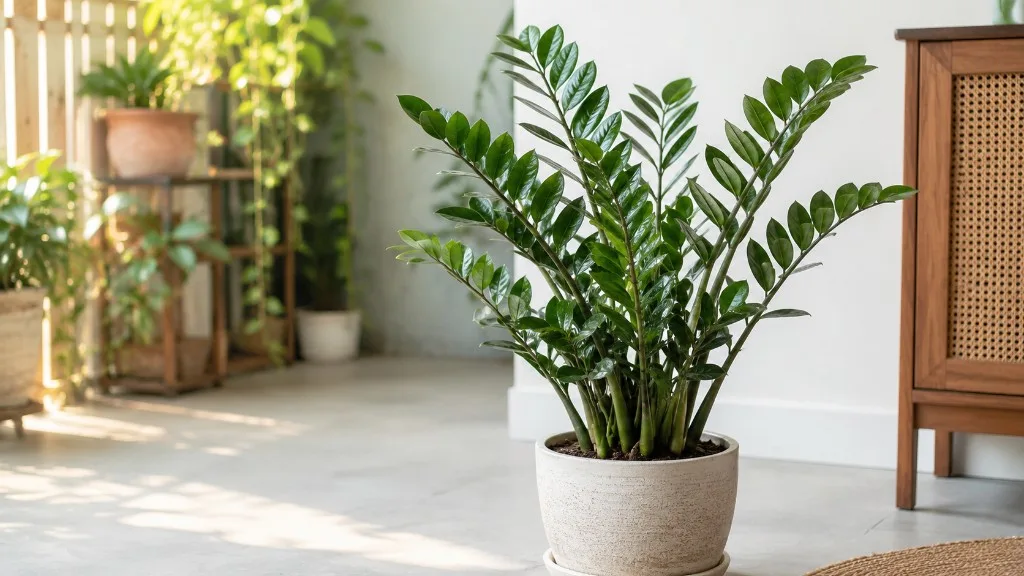
ZZ Plant Light Needs: Windows, Office Light, and Warning Signs
ZZ Plant Light Needs: Windows, Office Light, and Warning Signs
ZZ plant light requirements are wider than most houseplants - and that reputation causes more problems than it solves. Zamioculcas zamiifolia, commonly called ZZ plant or Zanzibar gem, is marketed as a low-light survivor for dim apartments, interior hallways, and office desks. That label is mostly true: a healthy ZZ can persist where many plants fail. What the label hides is performance. In very dark corners, growth slows to a crawl, new stems stretch toward any available brightness, and the same watering routine that worked near a window can leave rhizomes sitting in wet mix for weeks. Move the plant into harsh direct sun without acclimation and the glossy leaflets bleach, crisp, or collapse.
The practical target for most homes is bright, indirect light - steady ambient brightness without sunbeams hitting the foliage for hours. ZZ plants also tolerate low to medium indirect light for long stretches, which is why they work in offices under fluorescent or LED ceiling panels. What they do not tolerate well is strong direct sun on unacclimated leaves, or complete darkness with no usable photosynthetic light at all. Your job is not to find one perfect foot-candle number. It is to place the plant where new growth stays compact and firm, adjust watering when light changes, and read early stress before old damage misleads you.
This guide covers the full light range from dim corners to bright windows, direct sun scorch and how to avoid it, leggy growth in dark rooms, office and artificial lighting setups, grow light basics, safe acclimation, and how light level should change your ZZ Plant watering guide.
Why Light Still Matters for a “Low-Light” ZZ Plant
ZZ plants evolved in the open woodland and savannah margins of eastern Africa, from Kenya south toward South Africa, where they grow beneath taller tree cover and in bright but filtered conditions. Thick rhizomes store water for dry spells, and the waxy leaflets lose moisture slowly - adaptations that pair naturally with intermittent shade and drought. Clemson University’s Home & Garden Information Center notes that ZZ plants are tolerant of various light conditions and can be grown in darker rooms, but bright, indirect light speeds their very slow growth rate (Clemson HGIC - ZZ Plant). Missouri Botanical Garden describes the species as suited to bright indirect light indoors while tolerating considerable shade (Missouri Botanical Garden - Zamioculcas zamiifolia).
That combination - survive shade, perform better with brightness - defines real-world ZZ care. A plant in a dim hallway may keep its existing leaves for months because stored rhizome reserves buffer slow photosynthesis. Growers interpret that persistence as proof the spot is ideal. Then new shoots arrive spaced farther apart, leaflets look thinner, and the pot stays wet because the plant is using less water. Light was limiting growth long before the visual “legginess” became obvious. Treating ZZ as immune to light quality is how beginners overwater plants that look fine on the surface.
Light also sets the pace for every other care decision. Brighter placement increases transpiration and soil drying speed. Dimmer placement reduces water use and raises rot risk if you water on a calendar instead of checking the mix. Fertilizer response follows the same logic: a ZZ pushing visible new growth in spring light can use a light balanced feed; a plant essentially parked in shade needs little or no feeding because it is not building much new tissue. Light is the throttle, even on a plant famous for tolerating neglect.
The Ideal Light Range for ZZ Plants
If you want a single sentence to remember: ZZ plants grow best in bright, indirect light, tolerate low to medium indirect light, and should be kept out of harsh direct sun. There is no mystical perfect intensity, but there is a useful band. Bright indirect light means the plant sees the sky or a well-lit wall for much of the day without sun disks striking the leaves. Low light means the plant is farther from windows, blocked by furniture, or relying mainly on artificial room lighting - still enough to read a book by for several hours, not a closet with the door shut.
Most healthy indoor ZZ plants do well with roughly six to eight hours of usable indirect brightness daily during the growing season. That does not mean six hours of direct sun. It means consistent ambient light that lets photosynthesis run steadily. In winter, shorter days naturally reduce the total; plants slow anyway. In summer, stronger sun outside the glass may require pulling the pot back or filtering the window even if the plant looked fine in the same spot in February.
Use new growth as your proof, not room aesthetics. A ZZ can sit in a stylish dark corner while old leaves stay glossy. Only the newest stem segments tell you whether current light supports compact structure. If you are choosing between “slightly too dim” and “slightly too bright,” lean toward brighter indirect with protection from direct beams - ZZ forgives moderate shade more easily than repeated scorch, but chronic deep shade creates hidden watering problems.
Bright Indirect Light: Where ZZ Plants Look Their Best
Bright indirect light produces the ZZ most people picture from nursery photos: upright stems, closely spaced leaflets, deep green color on standard forms, and a steady but unhurried push of new shoots from the rhizome. Place the pot three to six feet from a sunny window with filtered light, or directly in an east-facing window where gentle morning sun touches the plant briefly and softer light fills the rest of the day. A north-facing window that stays bright without direct sun is often ideal. Near a south- or west-facing window, use sheer curtains or sit the plant to the side of the glass so it catches reflected brightness instead of midday beams.
In bright indirect light, soil dries on a predictable rhythm - usually faster than growers expect if they bought the plant for “low maintenance.” That rhythm is healthy. It means the root zone cycles between oxygen-rich dry periods and thorough rewetting, which suits drought-adapted rhizomes. Many ZZ problems labeled “mysterious yellowing” trace back to dim placement plus generous watering, not disease. Brighter indirect light makes watering mistakes easier to see because the pot weight changes more obviously week to week.
Bright light also supports even color on specialty cultivars. Raven ZZ (‘Raven’) develops its dark mature foliage more reliably when light is adequate; variegated forms maintain cream or white sectors without reverting or fading as quickly. None of these need full sun - they still want the same indirect principle - but they show why “survives in low light” is not the same as “displays best in low light.”
Low and Medium Light: What Tolerance Really Means
Low light tolerance is real, but the word tolerance matters. A ZZ in a dim interior room, a bathroom with a frosted window, or a bedroom far from the glass can survive with existing foliage while adding little new growth. Medium indirect light - think several feet into a room from a window but still clearly daylit - often keeps a plant stable with occasional new stems, just slower than a window-adjacent spot.
Clemson HGIC explicitly allows placement in darker rooms (Clemson HGIC - ZZ Plant). Interpre that as permission to use the plant where options are limited, not as encouragement to ignore light forever. In low light:
- Growth rate drops sharply, sometimes to one or two new leaflets per season.
- Internodes lengthen, so stems look sparse even if individual leaves stay green.
- Soil stays wet longer, increasing rhizome rot risk if watering does not change.
- Old leaves mask the problem because ZZ leaflets persist for a long time.
Complete darkness is not low light. Every green plant needs photons for photosynthesis. A ZZ in a windowless room with no artificial grow lighting will eventually decline - first stalling growth, then shedding older leaflets, then failing to replace them. Fluorescent or LED room lighting often provides enough for maintenance-level growth if the plant is reasonably close to the fixtures, which is why office use works.
If your only option is a very dark corner, you can still grow a ZZ - but adjust expectations and care together. Water less frequently, skip fertilizer unless you see active new shoots, and consider a small full-spectrum grow lamp for six to ten hours daily if you want fuller habit without moving the pot to a window.
Direct Sun: What ZZ Plants Can and Cannot Handle
Harsh direct sunlight is the main light mistake on ZZ plants. Leaflets are thick and waxy, which helps limit water loss, but that same surface heats quickly when sun hits it through glass. Unfiltered south- or west-facing afternoon sun is the most common scorch scenario indoors. Outdoors on a sunny patio without shade cloth, damage can appear in days.
A brief period of gentle early-morning direct sun - especially on an east window ledge - is sometimes tolerated, particularly if the plant developed there from the start. Midday and afternoon direct sun through clear glass is different: intensity and heat rise, and leaves that formed in lower light have no gradual hardening. Do not assume outdoor shade-plant marketing translates to “put it in the sunniest window for faster growth.” Faster damage is more likely.
Clemson HGIC advises locating ZZ plants anywhere except in full sunlight (Clemson HGIC - ZZ Plant). That is the clean rule for most growers. If you want to experiment with slightly stronger light, acclimate slowly (covered later) and watch the newest leaflets first. One scorch event rarely kills a rhizome-backed ZZ, but repeated burns weaken the plant and create entry points for secondary problems if tissue stays wet.
Reading Sun Scorch on ZZ Plant Leaves
Sun scorch on ZZ plants usually appears on the leaflets that faced the glass or outdoor sun, not randomly across the plant. Typical signs include:
- Bleached or chalky patches on dark green or Raven foliage, often on the sun-facing side.
- Crisp brown tips or margins that feel dry, not soft like rot.
- Yellowing that follows a recent move to a brighter sill within days, linking cause and effect.
- Curling or slight folding during the brightest hours, sometimes reverting overnight at first.
- Soft collapse only if scorch is severe and combined with heat stress or prior overwatering on ZZ Plant.
Scorched tissue does not green up again. Trim badly damaged leaflets for appearance if you wish, but the diagnostic value is in preventing the next leaf from burning. Move the plant back from the window, add sheer filtering, or rotate it so the same leaflets are not laser-targeted each afternoon. Then wait for new growth under softer light before judging success.
Scorch can look superficially like fertilizer burn or old age yellowing. Context separates them. Fertilizer burn often follows feeding and may show salt crust on the soil. Age yellowing hits older leaflets lower on the stem while new tips stay normal. Sun scorch follows a light change and hits exposed surfaces. If multiple leaflets on the window side match, sun is the prime suspect.
Best Window Placement for ZZ Plants Indoors
Window choice is less about compass direction alone and more about how much direct sun crosses the glass in your building, season, and latitude. A south window in Chicago winter differs from a south window in Phoenix summer. Still, direction gives a workable starting map before you fine-tune with observation.
General placement principles:
- Prioritize bright indirect exposure over decorative placement in deep shade.
- Filter strong sun with distance, sheer curtains, or offset positioning to the side of the window.
- Keep leaves from touching hot glass, which amplifies scorch even when ambient room light seems fine.
- Rotate the pot a quarter turn every few weeks if growth leans toward the window - common in medium light.
- Judge by new stems, not by how photogenic the spot is in your room layout.
A practical test without a light meter: hold your hand between the plant and the window at midday. Soft, diffuse shadow edges suggest indirect suitability. Hard, sharp shadow edges mean direct sun is hitting that zone - fine for succulents, risky for unacclimated ZZ leaflets.
Comparing East, North, West, and South Exposures
East-facing windows are often the easiest ZZ placement indoors. Morning sun is lower in intensity; afternoon light stays bright but indirect if the window does not receive late-day beams. Many ZZ plants sit on or near an east sill for years with compact growth.
North-facing windows supply consistent indirect light without direct sun in most Northern Hemisphere homes. ZZ plants typically thrive here if the window is unobstructed by porch roofs or dense outdoor planting. Very deep north rooms may still be low light, so pull the pot as close to the glass as temperature allows.
West-facing windows bring strong afternoon sun and heat. ZZ plants can work several feet back or behind filtered curtains. Unfiltered west sills are a frequent scorch location, especially in late spring through summer when solar angle increases.
South-facing windows offer the brightest indoor light - excellent for ZZ if you manage direct sun. Place the plant offset from the center of the glass or three to six feet into the room, or use sheer panels. In winter, the same south window may be perfect without filtering; revisit placement each season.
| Window exposure | Typical intensity | ZZ placement tip |
|---|---|---|
| East | Gentle morning sun, bright indirect rest of day | Often ideal; watch only if glass is uncovered and afternoon sun spills in |
| North | Soft, indirect all day | Excellent default; move closer if room feels dim |
| West | Strong afternoon direct sun | Filter or sit back; avoid unprotected sill in summer |
| South | Brightest; direct midday sun common | Offset pot or sheer curtain; great in winter, filter in summer |
If you have only one window and it is brutally sunny, distance is your friend. A ZZ six feet inside a south room often receives better-quality light for ZZ Plant overview than one pressed against the pane.
ZZ Plants Under Office and Fluorescent Lighting
Office environments are where ZZ plants earned their reputation. Ceiling fluorescent tubes, panel LEDs, and mixed architectural lighting often provide enough photosynthetically usable light for maintenance growth when the plant sits within roughly six to ten feet of fixtures and is not blocked by tall cubicle walls on all sides. A desk ZZ under typical open-office lighting may not explode with new stems, but it can hold glossy foliage for years - exactly the performance many workplaces want.
Fluorescent and office LED spectra differ from sunlight but still drive photosynthesis. The limiting factor is usually intensity and duration, not spectrum perfection. Plants under lights that run ten to twelve hours on weekdays often fare better than those in the same building near a window that receives little direct daylight because of tinted glass or neighboring towers. If your desk is far from perimeter windows and under dedicated task lighting only, expect slower growth and adjust watering downward accordingly.
Practical office tips:
- Place the pot where it catches overhead light, not only a shaded desktop corner facing a monitor.
- Avoid direct contact with hot equipment - copiers, space heaters, or sun-heated exterior glass - which stresses leaves independently of light quality.
- Do not rely on a single small desk lamp unless it is a true grow lamp left on long enough; a decorative warm LED may not provide sufficient output.
- Weekend darkness is normal; ZZ rhizomes buffer short weekly light gaps better than thin-leaved tropicals.
If an office plant becomes visibly leggy over a year - stems leaning toward the ceiling fixtures, new leaflets smaller - either move it closer to light, add a compact grow bulb on a timer, or accept it as a slow survivor and cut watering to match reduced growth. Leggy office ZZ plants are common; they are telling you the setup is at the low end of tolerance, not that the species failed.
Leggy Growth and Other Low-Light Warning Signs
Leggy growth means the plant adds stem length faster than leaf mass, producing an open, sparse silhouette. On ZZ plants, legginess shows up as longer spaces between leaflets along the rachis, thinner new stems, and sometimes leaning toward the brightest vector in the room - window, doorway, or fixture. Because older leaflets stay dark green and shiny for a long time, legginess can progress quietly until a new shoot looks noticeably stretched compared to older basal growth.
Other reliable too-little-light signals:
- Very slow or absent new shoots through an entire spring and summer indoors.
- Smaller new leaflets than older ones on the same stem.
- Pale or dull green on new growth, especially on variegated cultivars losing contrast.
- Soil that stays damp for weeks because the plant is not pulling water.
- Persistent leaning even after rotation, indicating directional light hunger.
Leggy ZZ plants are not doomed. They are under-powered for their ambitions. Fix options rank from easiest to most involved: move closer to a brighter indirect source, add a timed grow light, prune leggy stems only after light improves (so replacement growth is compact), and reduce watering immediately because low-light plants use less water. Pruning alone in the same dark corner repeats the problem.
Do not confuse legginess with normal ZZ architecture. Mature plants naturally carry leaflets spaced along upright stems. Compare new internode length to older segments on the same shoot. If the newest section is clearly more elongated, light is likely limiting. A plant that has always looked sparse but stable in the same spot may simply be expressing slow growth in acceptable low light - adjust care expectations rather than chasing impossible fullness without more brightness.
Signs Your ZZ Plant Is Getting Too Much Sun
Too much light on a ZZ rarely looks like instant death. It looks like surface damage accumulating on exposed leaflets while the rhizome stays firm - which tempts growers to leave the plant in place because “it is still alive.” Early intervention prevents a stripped, half-brown plant that no longer matches the room aesthetic.
Watch for these too-much-light patterns:
- New damage after a move toward a sunnier sill within one to two weeks.
- Bleaching on Raven or dark cultivars, where pigment washes out on sun-facing sides.
- Dry brown patches that do not spread like rot, confined to upper leaf surfaces.
- Midday leaf curl on the window side, easing overnight initially.
- Uneven stress: leaflets closest to glass burned, interior leaflets fine.
Heat amplifies light stress. A ZZ leaf touching hot glass can scorch even when ambient room light seems moderate. Summer sun angle changes can turn a safe winter perch into a summer burner without you moving the pot. Re-check window placements seasonally, especially for south and west exposures.
If you suspect excess light, step the plant back in one move rather than dragging it to a dark hallway. Going from scorch to deep shade swings the problem from light stress to low-light overwatering risk. Aim for bright indirect a few feet farther inside the room, then evaluate new growth over four to six weeks.
Using Grow Lights When Natural Light Falls Short
Grow lights fill gaps when windows are small, obstructions block sky view, or you want fuller growth in a basement office. ZZ plants are not high-light succulents; they respond well to moderate full-spectrum LEDs or T5/T8 fluorescent shop lights without needing blistering intensity. Think supplemental brightness, not sun replacement.
Starting guidelines that work for most setups:
- Distance: roughly 12 to 24 inches below a moderate LED panel or fluorescent tube bank - adjust by leaf response, not guesswork alone.
- Duration: about 8 to 12 hours daily on a timer to mimic useful day length; consistency matters more than marathon runtimes.
- Placement: center the plant under the fixture; side lighting alone often causes lean.
- Heat check: if leaflets feel warm to the touch after hours under the lamp, raise the fixture.
Grow lights are especially useful for windowless rooms and winter supplementation when natural daylight shortens. They also stabilize variegated ZZ cultivars that fade in dim corners. You do not need horticultural-grade rigs for basic maintenance; a reputable full-spectrum bulb in a desk clip lamp can support a single pot if output is adequate and runtime is long enough.
Signs the grow light setup is wrong include bleaching under the lamp (too close or too strong), continued legginess toward the bulb (too far or too few hours), or no improvement in new growth after eight weeks (insufficient output - upgrade fixture or reduce distance slightly). Change one variable at a time.
How to Move a ZZ Plant Without Light Shock
ZZ plants handle gradual change better than sudden jumps. Light shock after a move can show as yellowing leaflets, stalled new shoots, or scorch if the move was toward too much sun rather than too little. Rhizome reserves help the plant survive shock, which again hides early mistakes - leaves may stay green while root-zone watering needs shift.
When relocating:
- Make one change at a time - light first, then watering adjustments, then fertilizer.
- Avoid same-day repot plus light jump; stacked stress slows recovery.
- Expect older leaflets to lag behind new ones in showing improvement.
- Wait four to six weeks before deciding the new spot failed, unless acute scorch demands immediate retreat.
A Simple Acclimation Routine
Use this acclimation routine when moving a ZZ from low light to brighter indirect, or from indoors to a shaded patio for summer:
- Week 1: Move the pot to the new bright area for two to three hours in the morning, then return it to the old spot for the rest of the day.
- Week 2: Increase to half-day exposure in the brighter location, still avoiding harsh midday sun on south or west windows.
- Week 3: Leave the plant in the new location full-time if leaflets show no bleaching; if mild stress appears, hold at half-day another week.
- Week 4 onward: Fine-tune distance from the window or filter intensity; begin adjusting watering to the faster dry-down if brightness increased.
Moving from bright to dim is easier - no sun scorch risk - but reduce watering preemptively because the soil will stay wet longer. Moving from dim to bright requires the gradual path above plus more frequent moisture checks, not more frequent watering by default. Only water when the mix is appropriately dry for your pot size.
How Light Level Changes Watering and Feed Timing
Light and water are linked on ZZ plants more than many care charts admit. Brighter light increases transpiration and metabolic activity; dim light slows both. Clemson HGIC recommends watering only after the potting medium completely dries, roughly one to two times per month for many indoor setups (Clemson HGIC - ZZ Plant). That interval is not universal - it is a consequence of light, pot size, mix, and humidity.
Use this mental model:
- Brighter indirect light: soil dries faster; check weight weekly; watering may move toward the upper end of your personal range but still only when dry.
- Low light or office corner: soil dries slowly; stretch intervals; a wet-feeling mix after two weeks means the plant is not using water - not that it needs “a little drink to be safe.”
- After any light increase: expect faster dry-down within two to three weeks; adjust before rot sets in.
- After any light decrease: expect slower dry-down; cut volume and frequency before yellowing from root stress.
Fertilizer follows the same throttle. ZZ plants are slow growers; Clemson HGIC suggests one or two balanced feedings during the growing season (Clemson HGIC - ZZ Plant). Feed when you see active new shoots in adequate light, not on a calendar in a dim hallway plant that is essentially in stasis. Overfeeding a low-light ZZ adds salt stress without growth benefit.
Light Considerations for Raven, Variegated, and Zenzi Cultivars
All ZZ cultivars share the same no harsh direct sun rule, but they do not share identical performance in dim corners. Standard green ZZ hides low-light stress longest because fully green leaflets photosynthesize efficiently. Variegated and Chameleon forms with cream, yellow, or white sectors contain less chlorophyll per leaflet and often need brighter indirect light to maintain color contrast without reverting toward green. Raven ZZ develops deep purple-black mature foliage more reliably with adequate brightness; in deep shade, new growth may stay greener longer and look uneven.
Zenzi, the dwarf form with condensed leaf spacing, fits small desks well but still wants reasonable light for tight habit. Do not assume dwarf size means dwarf light demand - it means smaller mature dimensions, not shade-loving physiology.
If you collect cultivars, place the variegated pot closest to your best indirect source and keep standard green ZZ in the slightly dimmer backup spots. Rotate cultivars seasonally if one looks faded while another thrives in the same room - equal placement is not equal outcome.
Adjusting Placement Through Seasons
Seasonal sun angle changes indoor light more than thermostats suggest. A south-window ZZ that is perfect in November may scorch in June at the same sill. Spring is the time to reassess filtering and distance as growth resumes. Summer may require pulling plants back from west and south glass or adding sheer curtains. Fall light softens; plants that were back in the room can sometimes move closer to windows without acclimation drama. Winter short days slow growth everywhere - reduce watering and expect less new foliage even in good windows.
Outdoor summer moves - patio, balcony, shaded garden - need dappled shade only, not open midday sun. Acclimate as you would for a brighter indoor window. Bring plants back inside before cold drops below about 60 °F, which Clemson HGIC cites as a sensitivity threshold (Clemson HGIC - ZZ Plant). Light shock plus cold stress stacks badly on rhizomes.
Common ZZ Plant Light Mistakes to Avoid
Most ZZ light failures repeat a short list of patterns:
- Treating “low-light tolerant” as “light optional.” Tolerance is not preference; performance still scales with brightness.
- Judging by old leaves while new stems stretch. The plant tells the truth on its newest growth.
- Placing unfiltered on south or west sills because the room “looks bright.” Direct sun scorch follows.
- Moving to a dark corner after scorch without fixing watering. Rot replaces burn as the main risk.
- Watering on a summer schedule in a winter-dim office. Light dropped; water should too.
- Ignoring office fixture distance. A ZZ on the floor under a desk may survive on spill light alone - barely.
- Expecting variegated cultivars to thrive in the same dim spot as standard green forms. They usually will not look their best.
- Skipping acclimation when chasing “faster growth” in stronger light. Speed without adjustment becomes damage.
The forgiving fix for most mistakes is conservative: find bright indirect without direct beams, match watering to the new dry-down rate, and read the next two shoots. ZZ rhizomes give you time to correct course if you stop repeating the same placement error.
Conclusion
ZZ plant light needs are flexible but not meaningless. The species tolerates low to bright indirect light better than most houseplants, which makes it a legitimate choice for dim rooms, north windows, and office fluorescent lighting - as long as you accept slower growth and water less in those conditions. For the fullest habit, steadiest new shoots, and healthiest color on standard and specialty cultivars, aim for bright, indirect light and keep harsh direct sun off the leaflets. Watch leggy, spaced-out new growth as the early warning in dark corners, and bleaching or crisp brown patches as the warning in too much sun.
Place the plant where new growth stays compact, filter strong south and west windows, acclimate gradually when brightness increases, and tie every watering decision to how fast the pot actually dries in that light. Get those habits right and a ZZ plant stays quietly handsome for years - in a sunny living room or under office ceiling panels - without the drama that follows treating light as an afterthought.
When to use this page vs other ZZ Plant guides
- ZZ Plant overview - Start here for whole-plant context before deep-diving this topic.
- ZZ Plant problems hub - Jump to symptom-specific fix guides when this care topic does not resolve the issue.
- Not Enough Light on ZZ Plant - Escalate here when light adjustments are not enough.
- Leggy Growth on ZZ Plant - Escalate here when light adjustments are not enough.
Related ZZ Plant guides
- ZZ Plant overview
- ZZ Plant watering
- ZZ Plant soil
- ZZ Plant propagation
- ZZ Plant fertilizer
- ZZ Plant repotting
- Not Enough Light on ZZ Plant
- Leggy Growth on ZZ Plant
- ZZ Plant problems
Related tool
Try the Plant Problem Diagnosis Tool with zz-plant pre-selected to estimate needs for your setup.