Philodendron Gloriosum Care Guide: Velvet Leaves Indoors
Philodendron gloriosum
Philodendron Gloriosum needs bright indirect light, watering every 10–14 days when top 3–5 cm is dry, 60–70 % humidity for velvet texture, and a wide shallow pot for its horizontal growth.
Philodendron Gloriosum Care Guide: Velvet Leaves Indoors
Start with wateringThe most common care mistake for Philodendron GloriosumWatering guide →Philodendron Gloriosum care essentials
Light
bright indirect light, medium indirect light
Water
Every 10–14 days in summer - allow top 3–5 cm to dry. Reduce in winter. Rhizome stores some moisture.
Soil
Well-draining chunky aroid mix: potting mix + perlite + orchid bark. Wide shallow pot preferred. pH 5.5–7.0.
Humidity
High humidity (60–70%)
Temperature
18°C to 30°C (65–86°F)
Fertilizer
Feed lightly during active growth. Use monthly in spring and summer..
About Philodendron Gloriosum
Philodendron Gloriosum has a upright growth habit.
| Detail | Information |
|---|---|
| Growth habit | Upright |
| Scientific name | Philodendron gloriosum |
Philodendron Gloriosum Care Guide: Velvet Leaves Indoors
Philodendron gloriosum is the plant that teaches you, quickly, that not every philodendron wants a moss pole. It is a Colombia-native crawler with oversized velvet heart leaves, white veins that look painted on, and a thick green rhizome that advances horizontally across the soil surface like a slow-moving green train. Treat it like Heartleaf Philodendron or a climbing hybrid and you will wonder why the leaves stall, the rhizome softens, and the newest growth point disappears into wet mix. Treat it like a forest-floor crawler with humidity, airflow, and a wide shallow pot, and it becomes one of the most sculptural aroids you can grow indoors.
This guide covers the full indoor routine: what makes Gloriosum biologically different from climbing philodendrons, how Colombia’s understory ecology translates to your shelf or cabinet, light and watering rules that protect the rhizome, humidity targets for velvet texture, soil and pot geometry, feeding, Philodendron Gloriosum repotting guide, propagation, pet toxicity, and the problems that actually show up in real homes.
What Philodendron gloriosum Actually Is (A Crawler, Not a Climber)
Philodendron gloriosum is an evergreen perennial in the Araceae family, first described by French botanist Édouard André in 1876. Kew’s Plants of the World Online lists it as endemic to Colombia, growing in the wet tropical biome. The original botanical description emphasizes a creeping stem with green internodes 4–6 cm long and 1.5–2 cm thick - language that matches what collectors see in cultivation: a terrestrial, rhizomatous plant, not a free-climbing vine.
What you are looking at when you buy a Gloriosum is a terrestrial hemiepiphyte adapted to life on the forest floor. In the wild it roots into leaf litter and humus, creeping over exposed roots, fallen logs, and rocks while staying in the shaded understory. That ground-dwelling habit is the single most important fact for indoor care. The plant’s energy goes into producing one dramatic cordate leaf at a time from an advancing growth tip, not into scrambling upward toward brighter canopy light.
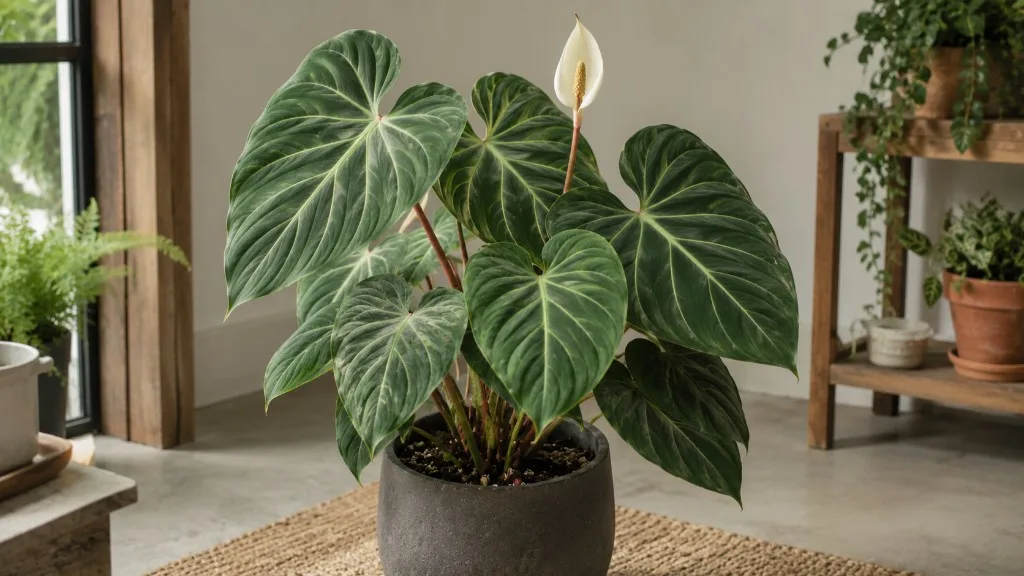
The leaves are thinly herbaceous with a cordate-ovate blade - botanist language for heart-shaped - typically 15–25 cm long in the type description, though well-grown indoor specimens and mature wild plants can produce substantially larger foliage over time. The upper surface is deep green with pale midribs and primary veins; the lower surface is paler. In commerce the texture reads as velvet, and the venation as bright white or softly pink, especially on newer leaves. The petioles carry distinctive color: green lower sections with reddish upper portions and white striations along the midrib, a detail that helps confirm you have true P. gloriosum rather than a lookalike hybrid.
Gloriosum is slow-growing compared with vining philodendrons. A new leaf can take four to six weeks - sometimes longer - to fully unfurl. That pace is normal, not a sign of failure, as long as the growth tip stays firm and above the mix. Impatience drives most of the bad advice around Philodendron Gloriosum overview: extra fertilizer, buried rhizomes, or moss poles that solve a problem the species does not have.
Colombia Native and Forest-Floor Ecology
Understanding where Gloriosum comes from prevents a lot of expensive mistakes. The species is native to Colombia, with Kew and multiple horticultural references placing it on the eastern slopes of the Cordillera Oriental and at the edges of the llanos, in mid-elevation wet tropical forest roughly 350–700 meters above sea level. It does not live in Philodendron Gloriosum light guide on a canopy branch. It lives in warm, humid, shaded understory where the soil stays lightly moist but never stagnant, where organic debris breaks down into airy humus, and where a creeping stem can advance without being smothered.
That ecology translates directly to your home setup. The plant wants bright but filtered light, not direct midday sun. It wants steady warmth without cold drafts. It wants humidity high enough to keep velvet leaves supple - think 60% and up for best results - but also enough airflow that damp leaves and crowded stems do not sit in stale air. And it wants a substrate that mimics forest-floor humus: chunky, oxygen-rich, moisture-retentive but fast-draining, not dense peat that compacts into a wet brick.
Colombia’s seasonal rhythm also explains why Gloriosum slows in winter even indoors. Lower light and cooler room temperatures reduce evaporation and metabolic demand. The rhizome stores some moisture - a useful buffer - but it cannot compensate for weeks of soggy mix or a buried growth point. When in doubt, mirror understory conditions: stable, moderate, and never waterlogged.
Crawling Rhizome vs Climbing Philodendrons
Most popular philodendrons in the trade - Heartleaf, Brasil, Micans, many hybrids - are climbers or semi-climbers that produce long internodes and attach to trees or moss poles as they reach for light. Their anatomy rewards vertical support: larger leaves often follow upward growth toward brighter filtered light.
Gloriosum does the opposite. Its rhizome creeps horizontally, producing leaves sequentially from the active tip. Aerial roots may emerge along the rhizome to anchor it and capture humidity, but the plant’s natural architecture is lateral expansion, not vertical ascent. In cultivation that means your limiting factor is usually horizontal real estate, not pole height.
The practical differences matter every week you care for the plant:
- Climbers tolerate deeper pots more easily because the stem travels upward and roots descend below.
- Crawlers need the growth point positioned on or just above the mix surface, with open space ahead of the tip for the next leaf.
- Climbers often recover from buried nodes because adventitious roots form along the stem.
- Crawlers rot quickly when the rhizome sits against wet, poorly aerated substrate.
If you have grown Philodendron melanochrysum, verrucosum, or other velvet hemiepiphytes on poles, remember that many of those species start terrestrial and then climb. Gloriosum’s wild habit is overwhelmingly ground-creeping. Copying melanochrysum’s moss-pole setup without giving the rhizome room to run is the most common category error.
Why a Moss Pole Will Not Fix a Crawler
You will see moss poles recommended for Gloriosum online, including suggestions that vertical support helps leaf size. Technically a stem can be trained upward, but that fights the plant’s default geometry and does not replace the core requirement: a wide, shallow container and a rhizome that stays on top of the mix.
A moss pole does not give the rhizome anywhere to go. Without lateral space, the growth tip circles back into old mix, leaves stack awkwardly, and the stem contacts wet substrate - the exact condition that causes rhizome rot. If you want larger leaves, invest in better light, humidity, and rhizome positioning, not a pole. If you want a climbing velvet philodendron, choose a species that actually wants to climb. Gloriosum rewards collectors who accept its horizontal personality.
The Velvet Heart Leaves That Define Gloriosum
Gloriosum’s appeal is almost entirely foliar. The leaves are large, heart-shaped, and velvety to the touch, with bold white or pale pink venation that contrasts against deep green tissue. New leaves often emerge with pinkish margins or reddish petiole coloration that fades as the blade hardens. Mature leaves on strong plants can reach 30–45 cm in length indoors, and exceptional specimens grow larger still - The Spruce notes leaves maturing to around 18 inches - but size follows age, light, humidity, and rhizome health more than any trick product.
Velvet aroid leaves are structurally different from glossy philodendron foliage. The surface traps dust, shows water spots easily, and marks if handled roughly. That is cosmetic, not fatal, but it explains why experienced growers handle new leaves as little as possible and why misting the foliage is a bad humidity strategy for this species.
Because Gloriosum produces leaves one at a time from the crawling tip, each new blade feels like an event. A stalled unfurl - leaf stuck in the cataphyll for weeks - usually means low humidity, low light, or a wet growth point, not nutrient deficiency. Fix the environment first.
Leaf Size, Venation, and What Healthy Foliage Looks Like
Healthy Gloriosum foliage is firm, velvety, and symmetrical, with veins that stand out crisply against the blade. The petiole should be rigid enough to hold the leaf horizontal or slightly angled; limp petioles on a wet pot suggest root or rhizome trouble.
Good signs: sequential new leaves of similar or increasing size; clean venation; active firm growth tip; older leaves aging gracefully at the back of the rhizome.
Warning signs: progressively smaller new leaves (often low light or exhausted substrate); stuck unfurling (humidity or wet tip); sudden yellowing on new foliage (overwatering or fertilizer burn); translucent patches (cold damage or pest feeding).
Variegated or hybrid names appear in the trade - Philodendron gloriosum ‘Zebra’, dark-form selections, and various “chonky” clones - but care stays the same: crawler physiology, velvet leaf sensitivity, Colombia-native humidity preferences. Confirm the botanical name on the tag when possible; mislabeled aroids are common.
Light: Bright, Indirect, and Filtered
Gloriosum wants bright, indirect light for most of the day. The Spruce and multiple aroid growers converge on east- or west-facing windows with morning sun and filtered afternoon light as ideal. North windows work if the room is bright; south windows need sheer curtains or several feet of setback to prevent velvet leaf scorch.
Light quality drives leaf size more than any moss pole ever will. In too little light, internodes shorten but leaves emerge smaller, petioles weaken, and the plant becomes more susceptible to overwatering because evaporation drops. In too much direct sun, blades bleach, curl, or develop brown scorch patches, especially on the velvety upper surface where moisture loss and heat stress combine brutally.
A practical placement test: within 1–2 meters of a bright window with filtered light, or under quality grow lights at moderate intensity for 10–12 hours daily. Rotate the pot quarterly for even rhizome growth, but avoid moving it between dramatically different light levels in a single week - velvet aroids sulk after sudden changes.
If you are choosing between a humid bathroom with a small window and a bright living room with drier air, pick bright room plus humidifier over dim bathroom every time. Gloriosum tolerates moderate humidity better than it tolerates chronic shade.
Watering: Moist Mix Without Wet Feet
Gloriosum is sensitive to overwatering. root rot on Philodendron Gloriosum and rhizome rot are the serious failures; underwatering is easier to correct. The LeafyPixels care baseline - every 10–14 days in summer, allowing the top 3–5 cm of mix to dry - matches The Spruce’s recommendation to wait until the top two to three inches feel dry, and GrowTropicals’ guidance to water when the top third to half of the mix approaches dryness.
The exact interval depends on pot volume, mix chunkiness, light, humidity, and season. A crawler in a wide shallow pot dries differently from a vine in a deep nursery pot. Check the mix, not the calendar.
Water thoroughly until runoff exits the drainage holes, then empty the saucer so the pot never sits in stale water. Use room-temperature water when possible. Avoid routinely wetting velvet leaves during watering - surface moisture invites water spots and fungal spotting on textured blades.
In winter, stretch the interval. The rhizome stores some moisture, growth slows, and cold dim rooms keep pots wet longer. A plant that needed water every ten days in July may need fifteen or twenty days in January. Resume the summer rhythm only when new growth is clearly active again.
Reading Moisture Without Rotting the Rhizome
The finger test remains the most reliable tool. Insert your finger to 3–5 cm depth; if the mix at that level is dry or approaching dry, water. If it still feels cool and damp, wait. Lift the pot occasionally to learn its weight dry versus wet.
Pay special attention to moisture at the growth point. The rhizome tip and emerging cataphyll should not sit against permanently wet, compacted mix. That is how unfurling stalls and soft rhizome rot starts. If the tip keeps sinking below grade as the rhizome advances, add coarse mix beneath it or repot into a wider shallow container so the leading edge stays on or just above the surface.
A moisture meter can help beginners, but verify with touch - chunky aroid mixes read inconsistently on cheap probes. When in doubt, lean slightly dry rather than wet. A slightly thirsty Gloriosum recovers fast; a rotting rhizome often does not.
Humidity and Temperature Indoors
Gloriosum is a Colombia rainforest understory plant, and it shows that heritage in humidity demand. LeafyPixels targets 60–70% relative humidity for best velvet performance. Epic Gardening and several specialist aroid sources push 60–80% for optimal growth. The plant tolerates average household humidity in the 40–50% range - many collectors keep it successfully - but expect smaller leaves, slower unfurling, and more brown edge crisping when air stays dry for months.
Below roughly 40%, spider mite risk rises and new leaves struggle to emerge cleanly. Above 70%, with warm stagnant air and poor circulation, fungal leaf issues become more likely. The goal is moderate to high humidity with gentle airflow, not a sealed terrarium with wet walls unless you are actively managing ventilation.
The most reliable humidity tools rank like this:
- Small humidifier near the plant - most consistent, best for winter heating season.
- Grouped plants on a pebble tray - modest local bump, cheap supplement.
- Cabinet or grow tent - excellent for collectors, requires fan circulation.
Misting is a poor substitute. The humidity spike lasts minutes, velvet leaves mark with water spots, and wet foliage in low airflow encourages disease. Skip the spray bottle unless you are briefly boosting a propagation box.
Temperature comfort aligns with typical indoor living: 18–30°C (65–86°F) is the practical range. The Spruce warns that regular exposure below 13°C (55°F) stresses tropical aroids. Watch cold window ledges in winter, air-conditioning vents, and drafty doorways. Heat spikes above 32°C with dry air also stress the plant - summer sun on a windowsill plus hot glass is a common silent killer.
Soil and the Wide, Shallow Pot
Soil and pot shape are where Gloriosum care diverges most sharply from generic philodendron advice. The mix should be chunky, airy, and fast-draining while holding moderate moisture - a classic aroid blend. LeafyPixels recommends potting mix plus perlite plus orchid bark, with target pH 5.5–7.0. The Spruce’s equal parts potting mix, orchid bark, and perlite recipe is a solid starting point. GrowTropicals and specialist growers often add coco coir, charcoal, and pumice for long-term structure.
The pot should be wider than it is deep. Rectangular troughs, bulb pans, and low wide containers outperform tall decorative cylinders because they give the rhizome forward travel space without burying the growth tip under an unnecessary volume of mix. Drainage holes are non-negotiable.
When potting:
- Place the rhizome on or just above the substrate surface, not buried.
- Orient the active tip toward the open side of the pot so it has room to advance.
- Backfill lightly around roots and older rhizome sections without packing mix over the leading edge.
- Top-dress with orchid bark or coarse perlite if the tip tends to sink when watered.
Repot every one to two years, or when roots circle drainage holes, mix collapses, or the rhizome reaches the pot lip with nowhere to go. Spring and early summer are safest. Jump to the next wide size, not the next deep size.
Fertilizer Schedule and Strength
Gloriosum is not a heavy feeder. It is a slow grower on a restrained root system relative to leaf mass. Feed lightly during active growth - typically monthly in spring and summer with a balanced liquid fertilizer at half strength, matching The Spruce’s once- or twice-per-season guidance scaled to indoor continuity.
Always apply fertilizer to already-moist soil so salts distribute without burning roots. Pause feeding in winter, after repotting, while recovering from rot or pest damage, and whenever the plant is not producing new leaves. Excess fertilizer shows up as salt crust on the mix, brown leaf margins, and sudden yellowing on newer foliage while roots still look wet.
Organic slow-release granules at low label rates work if you prefer fewer applications. Watch the plant, not the product schedule: if new leaves are clean and venation strong, nutrition is probably adequate. If growth is pale and slow with good light and humidity, a modest feeding trial is reasonable - after confirming you are not overwatering.
Repotting Without Burying the Rhizome
Repot Gloriosum when roots emerge from drainage holes, water runs straight through compacted mix, new leaves shrink repeatedly, or the rhizome outgrows the container lip. Because growth is slow, you may only repot every two to three years on a mature plant - but young crawlers filling a starter pot may need annual upgrades.
Best timing: early active growth season when temperatures and light are rising. Avoid repotting into cold, dim winter unless the mix is actively failing or rot is present.
Steps that protect crawlers:
- Water lightly the day before so the rhizome is pliable, not brittle.
- Slide the plant out and remove old compacted mix without breaking active roots.
- Choose a pot one size wider, not dramatically deeper.
- Mound fresh mix at the bottom and lay the rhizome horizontally with the growth tip facing open space.
- Keep the tip above grade; secure with a small stake if needed until roots anchor.
- Water lightly once, then resume normal checks after a week.
The classic repotting mistake is treating the rhizome like a buried stem - packing mix over it “for stability.” Stability comes from horizontal orientation and root attachment, not depth. A buried tip is a rot invitation.
Propagation by Rhizome Cuttings
Unlike vining philodendrons that propagate readily from stem nodes in water or moss, Gloriosum is propagated by rhizome sections with at least one node and preferably one or two leaves. The Spruce, GrowTropicals, and aroid nursery practice all converge here: find a healthy section of surface rhizome, cut cleanly, and root in moist sphagnum moss or chunky aroid mix under humidity.
Basic method:
- Select a section with healthy roots, a firm node, and active or recent leaf growth.
- Sterilize scissors or a knife; cut so each piece has minimum one node.
- Let the cut callous for a few hours on a clean surface - reduces rot entry.
- Plant horizontally in moist sphagnum or airy mix, with the node in contact but the rhizome not buried deeply.
- Cover with a clear bag or propagation box for humidity; vent every few days.
- Keep in bright indirect light at warm temperatures; roots typically form in two to four weeks, sometimes longer in winter.
- Transition to normal potting when roots resist a gentle tug and new growth appears.
Single-leaf cuttings can succeed but are slower and less forgiving than sections with established roots and stored rhizome energy. When buying, prefer a plant with a visible crawling stem and firm active tip, not just one impressive old leaf.
Do not propagate from soft, mushy rhizomes or plants with suspected rot - cuttings inherit the parent’s problems and fail at high rates.
Toxicity to Pets and People
Philodendron gloriosum is toxic to people and pets if ingested. Like all members of the genus Philodendron, it contains insoluble calcium oxalate crystals - microscopic needle-shaped raphides that pierce soft tissues on contact. North Carolina State Extension lists philodendron as causing oral irritation, pain and swelling of mouth, tongue and lips, excessive drooling, vomiting, and difficulty swallowing in humans who chew the foliage.
This is not a plant for floor-level pots in homes with chewing animals or curious toddlers. Skin contact during pruning rarely causes serious issues for adults, but sap on sensitive skin can irritate. Wash hands after handling cut rhizomes.
Cats, Dogs, and Calcium Oxalate Crystals
The ASPCA lists Philodendron as toxic to cats and toxic to dogs, with clinical signs including oral irritation, pain and swelling of mouth, tongue and lips, excessive drooling, vomiting, and difficulty swallowing. Severity is generally moderate - rarely life-threatening in small ingestions - but painful enough that veterinary guidance matters, especially for cats that chew repeatedly.
Practical rules:
- Keep Gloriosum on high shelves, in closed cabinets, or in pet-free rooms.
- Do not assume hanging baskets are safe; cats reach them.
- If ingestion is suspected, contact ASPCA Animal Poison Control at 888-426-4435 (US) and your veterinarian promptly.
If you need velvet foliage in a pet-accessible space, choose a confirmed non-toxic alternative rather than gambling on deterrence sprays.
Common Problems and Real Fixes
Most Gloriosum problems trace to water, light, humidity, or rhizome placement - not mysterious philodendron curses. Diagnose in that order before reaching for fertilizer or pesticides.
Yellow leaves. Older basal leaves yellow and die naturally as the rhizome advances - normal. New leaves yellowing while the pot stays wet points to overwatering, compacted mix, or buried rhizome. Yellowing with dry, light mix suggests underwatering. Uniform pale yellow in low light means move the plant, do not water more.
Stuck or torn unfurling leaves. Usually low humidity, wet growth point, or mechanical damage during emergence. Raise humidity with a humidifier, confirm the tip sits above wet mix, and avoid touching the cataphyll. Patience matters; forced unfurling tears velvet permanently.
Brown tips and edges. Often dry air below 40%, salt buildup, or underwatering swings. Increase humidity, flush the pot with plain water quarterly, and stabilize the Philodendron Gloriosum watering guide.
Soft rhizome. Emergency signal. Unpot, trim mushy tissue with sterile tools, repot the firm section in fresh airy mix, and keep humidity high while roots recover. Prevention - shallow pot, surface rhizome, dry-down checks - beats rescue every time.
Drooping leaves on wet mix. Likely root rot starting below. Reduce watering immediately, inspect roots, and repot if they are brown and soft. Firm mix and healthy white roots mean drooping may be temporary thirst or heat stress instead.
Pests. Spider mites in dry winter air - stippling, fine webbing, dusty leaf look. Mealybugs in leaf axils and rhizome crevices. Thrips cause silvery scarring on velvet. Treat with shower rinse, manual removal, insecticidal soap or horticultural oil, and humidity correction. Quarantine infested plants; velvet leaves are pest magnets when stressed.
Slow growth. Often normal. If months pass with no new tip activity, review light first, then rhizome burial, then temperature. Gloriosum is not a fast vine; compare progress month to month, not week to week.
Buying, Quarantine, and the First Month
Glorosum is widely available but still priced above common philodendrons because supply, slow propagation, and shipping sensitivity keep demand high. Buy for structure, not one photo leaf.
What to look for:
- Firm active growth tip visible above or at the mix surface.
- Healthy crawling rhizome - green and stiff, not brown and soft.
- Clean leaf undersides and stem nodes - no stippling, webbing, or cottony clusters.
- Mix that drains - not sour-smelling or waterlogged in the nursery pot.
Red flags: single leaf with no runner; damaged or blackened growth point; severe pest signs; pot wedged into a tall narrow container with buried tip.
After purchase:
- Quarantine two weeks away from other aroids.
- Do not repot day one unless mix is failing or pests are obvious.
- Learn how fast your pot dries in your light before changing anything.
- Watch for yellowing, stuck unfurling, and soft stem - fix environment before stacking fertilizer, repotting, and pruning together.
Cosmetic velvet marks and small old-leaf scars are acceptable; a compromised growth point is not.
Conclusion
Philodendron gloriosum rewards growers who respect its Colombia forest-floor identity: a crawling rhizome, velvet heart leaves, and humidity-aware routine in a wide shallow pot. Give it bright indirect light, water when the top 3–5 cm of mix dries, target 60–70% humidity with a humidifier when air is dry, use chunky aroid mix, keep the growth tip on or above the surface, and feed lightly in spring and summer. Skip the moss pole fantasy. Protect it from pets - calcium oxalate crystals are real - and measure success in new leaves unfurling cleanly, not weekly vine length.
Get the crawler mechanics right and Gloriosum becomes one of the most photogenic terrestrial aroids you can grow indoors. Get them wrong - buried rhizome, deep wet pot, dim corner - and it becomes a slow-motion frustration. The plant is not difficult for beginners willing to learn one non-negotiable rule: it crawls horizontally through humid air and airy mix, and every care choice should serve that habit.
When to use this page vs other Philodendron Gloriosum guides
- Philodendron Gloriosum overview - Canonical hub for this species - care topics and problems branch from here.
- Philodendron Gloriosum problems - Symptom-first path when you already know something is wrong.
Related Philodendron Gloriosum guides
- Philodendron Gloriosum watering
- Philodendron Gloriosum light
- Philodendron Gloriosum soil
- Philodendron Gloriosum propagation
- Philodendron Gloriosum fertilizer
- Philodendron Gloriosum repotting
- Philodendron Gloriosum pruning
- Ants on Plant on Philodendron Gloriosum
- Bacterial Wilt on Philodendron Gloriosum
- Brown Tips on Philodendron Gloriosum
- Bud Drop on Philodendron Gloriosum
- Calcium Deficiency on Philodendron Gloriosum
How to care for Philodendron Gloriosum?
How much light does Philodendron Gloriosum need?
bright indirect light, medium indirect light
- bright indirect light, medium indirect light - bright indirect light, medium indirect light.
When should you water Philodendron Gloriosum?
Every 10–14 days in summer - allow top 3–5 cm to dry. Reduce in winter. Rhizome stores some moisture.
- Check top 2 inches - Every 10–14 days in summer - allow top 3–5 cm to dry.
- Drain excess water - Empty the saucer after watering so the roots are not sitting in standing water.
What soil works best for Philodendron Gloriosum?
Well-draining chunky aroid mix: potting mix + perlite + orchid bark. Wide shallow pot preferred. pH 5.5–7.0.
- Well-draining mix - Well-draining chunky aroid mix: potting mix + perlite + orchid bark.
Grower notes for Philodendron Gloriosum
What makes Gloriosum different
Philodendron Gloriosum is a crawler. The stem wants to move horizontally across the surface of the mix, so a wide shallow pot supports it better than a tall narrow one. Treating it like a climbing Philodendron is the classic mistake: a pole will not fix a plant that needs room for its rhizome to advance. The payoff is big heart-shaped leaves with pale veins, but only if the newest growth point stays above the mix and out of stagnant moisture.
Gloriosum potting note
Use an airy aroid mix, then think about pot shape before pot size. A rectangular or broad low pot often works better than a deeper decorative planter because the growth front can travel without being buried. Do not pack mix around the creeping stem like a normal upright plant. If the growth point sits too wet, new leaves may stall before unfurling.
Gloriosum buying note
Look for a visible crawling stem with a healthy active tip, not just one impressive old leaf. Velvet leaves mark easily, so small cosmetic scars are acceptable, but a damaged growth point is a larger problem. Check the underside of the newest leaf and the stem nodes for pests before bringing it near other aroids. A single-leaf cutting can succeed, but it is slower and less forgiving than a plant with an established runner.
What matters most with Philodendron Gloriosum
Philodendron Gloriosum is easiest to understand by its growth habit. Climbers need support for larger leaves, self-heading types need stable root moisture, and delicate velvet forms punish stale air faster than basic green philodendrons. In practice, the care checkpoint is simple: bright indirect light, medium indirect light. Pair that with well-draining chunky aroid mix: potting mix + perlite + orchid bark. Wide shallow pot preferred; pH 5.5–7.0, and avoid changing water, pot size, and placement all at once.
Best placement in a real home
Philodendron Gloriosum belongs where bright indirect light, medium indirect light is realistic for most of the day, not only where the pot looks good. Every 10–14 days in summer - allow top 3–5 cm to dry. Reduce in winter. Rhizome stores some moisture. If the pot stays wet longer than expected, move the plant into better light or reassess the mix before watering again. Humidity target: High humidity (60–70%).. Temperature comfort zone: 18°C to 30°C (65–86°F).
Before you buy this plant
Choose Philodendron Gloriosum with firm new growth, clean leaf undersides, and soil that does not smell sour or feel compacted. Be cautious if you see yellow-leaves, sticky residue, collapsed crowns, or a pot that is wet in poor light. Cosmetic old-leaf damage is less worrying than weak roots or active pests.
First month after bringing it home
Do not repot Philodendron Gloriosum on day one unless the mix is failing or pests are obvious. Quarantine it, learn how fast the pot dries, and keep care boring while it adjusts. Watch especially for yellow-leaves, brown-tips, and root-rot. If problems appear, correct the condition first rather than stacking fertilizer, repotting, and pruning together.
Is it pet safe?
Philodendron Gloriosum is toxic to cats and dogs.
Toxic - calcium oxalate crystals.
Watering Philodendron Gloriosum
Every 10–14 days in summer - allow top 3–5 cm to dry. Reduce in winter. Rhizome stores some moisture.
Soil & potting for Philodendron Gloriosum
Well-draining chunky aroid mix: potting mix + perlite + orchid bark. Wide shallow pot preferred. pH 5.5–7.0.
Humidity & temperature for Philodendron Gloriosum
Philodendron Gloriosum prefers high humidity (60–70%), though normal home humidity is usually fine. Keep temperatures around 18°C to 30°C (65–86°F).
| Detail | Information |
|---|---|
| Humidity | High humidity (60–70%) - normal home humidity is fine. |
| Ideal temperature | 18°C to 30°C (65–86°F) |
Fertilizer & pruning for Philodendron Gloriosum
Use feed lightly during active growth. Use monthly in spring and summer.. for Philodendron Gloriosum.
| Detail | Information |
|---|---|
| Fertilizer type | Feed lightly during active growth. Use monthly in spring and summer.. |
Common problems on Philodendron Gloriosum
Likely cause: Aug 24, 2024 · In this article, we’ll cover the most common diseases that affect Philodendron Gloriosum , as well as practical steps to treat and prevent them. From fungal infections to pesky pests, we’ll ensure you’re equipped to keep your
Quick fix: Confirm diagnosis on your Philodendron Gloriosum, then address the most likely care or pest factor described in current extension guidance.
Full fix guide →Bacterial Wilt
HighLikely cause: Discover how to identify, prevent, and treat common Philodendron bacterial diseases . Protect your plants with our expert guide to healthy philodendron care. Get started now!
Quick fix: Confirm diagnosis on your Philodendron Gloriosum, then address the most likely care or pest factor described in current extension guidance.
Full fix guide →Brown Tips
HighLikely cause: Low humidity - critical issue for this species
Quick fix: Increase humidity to 60%+ consistently
Full fix guide →Bud Drop
LowLikely cause: May 2, 2025 · Old foliage at the base of the plant can start to yellow and drop as part of the natural cycle. If it's happening with newer foliage, this can be a sign of over- or under-watering or overfeeding your plant. Apr 23, 2026 · The
Quick fix: Follow extension or botanical guidance for Philodendron Gloriosum bud drop; adjust care before applying broad treatments.
Full fix guide →Calcium Deficiency
MediumLikely cause: Like most in the aroid family, the soil needs are best achieved by considering the plant’s natural habitat. The P. gloriosum ’s natural habitat is limited to five sites in Colombia, with an introduction to the Hawaiian Islands. The natural
Quick fix: Confirm diagnosis on your Philodendron Gloriosum, then address the most likely care or pest factor described in current extension guidance.
Full fix guide →Compacted Soil
MediumLikely cause: Look for these signs that suggest it's time to change the soil : roots emerging from the pot, slow growth despite proper care, and compacted or salt- crusted soil .
Quick fix: Confirm diagnosis on your Philodendron Gloriosum, then address the most likely care or pest factor described in current extension guidance.
Full fix guide →Damaged Roots
MediumLikely cause: Aug 24, 2024 · Root rot occurs when the plant’s roots sit in overly moist soil for too long, creating an ideal environment for fungal growth. Signs of root rot include yellowing leaves, wilting, and a general lack of growth. If you suspect
Quick fix: Confirm diagnosis on your Philodendron Gloriosum, then address the most likely care or pest factor described in current extension guidance.
Full fix guide →Deformed New Growth
MediumLikely cause: Dec 10, 2025 · When asking “Stunted Growth Diagnosis: Is Your Philodendron Gloriosum Dormant or Stressed?”, the answer is rarely dormancy indoors. Instead, stunted or stalled growth is almost invariably a symptom of acute environmental stre
Quick fix: Confirm diagnosis on your Philodendron Gloriosum, then address the most likely care or pest factor described in current extension guidance.
Full fix guide →Likely cause: May 2, 2025 · If your Philodendron gloriosum isn't getting enough moisture (through watering or humidity), or if it is being subject to too much direct sun, then leaf scorch can occur. Jun 17, 2024 · Philodendron gloriosum thrives in bright
Quick fix: Follow extension or botanical guidance for Philodendron Gloriosum faded flowers; adjust care before applying broad treatments.
Full fix guide →Dry Hydrophobic Soil
MediumLikely cause: Learn about the best soil for Philodendron gloriosum ( Philodendron gloriosum ). Discover optimal soil types, pH levels, drainage requirements, and soil care tips for healthy growth.
Quick fix: Confirm diagnosis on your Philodendron Gloriosum, then address the most likely care or pest factor described in current extension guidance.
Full fix guide →Exposed Roots
MediumLikely cause: Rather, P. gloriosum develops a "creeping", crawling growth habit as its root nodes adhere the plant's ever-lengthening stem to fallen trees, large roots (such as certain species of Ficus), and even rocks.
Quick fix: Confirm diagnosis on your Philodendron Gloriosum, then address the most likely care or pest factor described in current extension guidance.
Full fix guide →Fertilizer Burn
MediumLikely cause: If you overfertilize your Philodendron gloriosum , you may notice accumulations of excess fertilizer on the soil’s surface and foliage discoloration. Fertilizer burn is the most common issue you should worry about when feeding a Philodendro
Quick fix: Confirm diagnosis on your Philodendron Gloriosum, then address the most likely care or pest factor described in current extension guidance.
Full fix guide →Holes in Leaves
MediumLikely cause: Jan 7, 2025 · In this article, we'll tackle 19 common problems you might encounter with your Philodendron Gloriosum . From yellowing leaves to pest invasions, we'll explore each issue and provide practical solutions to help you keep your pl
Quick fix: Confirm diagnosis on your Philodendron Gloriosum, then address the most likely care or pest factor described in current extension guidance.
Full fix guide →High Humidity
MediumLikely cause: Jan 21, 2024 · Philodendron Gloriosum hails from the tropical rainforests of Colombia, where the air is consistently humid, and the temperatures are warm. These conditions are a far cry from the average indoor environment. In their natural
Quick fix: Confirm diagnosis on your Philodendron Gloriosum, then address the most likely care or pest factor described in current extension guidance.
Full fix guide →Iron Deficiency
MediumLikely cause: Provide balanced nutrition: Administer a balanced, iron -rich fertilizer to rectify nutrient deficiency . Optimize environmental conditions: Ensure adequate light, appropriate temperature, and optimal humidity for Philodendron gloriosum .
Quick fix: Confirm diagnosis on your Philodendron Gloriosum, then address the most likely care or pest factor described in current extension guidance.
Full fix guide →Leaf Spot Disease
MediumLikely cause: Feb 21, 2024 · Philodendron Types with Pictures and Care Guide The green heartleaf Philodendron is a vining type of plant with dark-green leaves in a heart’s shape. This type of Philodendron can be grown …
Quick fix: Confirm diagnosis on your Philodendron Gloriosum, then address the most likely care or pest factor described in current extension guidance.
Full fix guide →Leaf Miners
MediumLikely cause: Feb 21, 2024 · Philodendron Types with Pictures and Care Guide The green heartleaf Philodendron is a vining type of plant with dark-green leaves in a heart’s shape. This type of Philodendron can be …
Quick fix: Confirm diagnosis on your Philodendron Gloriosum, then address the most likely care or pest factor described in current extension guidance.
Full fix guide →Plant Leaning
MediumLikely cause: Philodendron is a large genus of flowering plants in the family Araceae. As of September 2025, the Plants of the World Online accepted 625 species; [2] other sources accept different numbers. [3][4] …
Quick fix: Confirm diagnosis on your Philodendron Gloriosum, then address the most likely care or pest factor described in current extension guidance.
Full fix guide →Root Rot
MediumLikely cause: Waterlogged soil around rhizome
Quick fix: Repot in fresh chunky draining mix
Full fix guide →Slow Growth
LowLikely cause: Insufficient light or humidity
Quick fix: Improve both for best results
Full fix guide →Thin Stems
MediumLikely cause: Feb 6, 2025 · If you are thinking of adding a philodendron to your indoor or outdoor garden, choosing the right variety can be a challenge because there are so many different options. Some are more …
Quick fix: Follow extension or botanical guidance for Philodendron Gloriosum thin stems; adjust care before applying broad treatments.
Full fix guide →Yellow Leaves
MediumLikely cause: Overwatering or root rot of rhizome
Quick fix: Allow to dry more; check rhizome health
Full fix guide →Aphids
MediumLikely cause: Aphids on Philodendron Gloriosum cluster on soft new growth at the rhizome tip and young leaf undersides. First step: isolate the plant and rinse aphids off with lukewarm water, supporting velvet leav
Quick fix: See plant-specific guide for step-by-step fixes.
Full fix guide →Drooping Leaves
MediumLikely cause: Drooping leaves on Philodendron Gloriosum usually mean underwatering if the pot is light and top mix is dry, or failing roots if soil is wet and heavy. First step: check top 3–5 cm moisture and pot we
Quick fix: See plant-specific guide for step-by-step fixes.
Full fix guide →Fungus Gnats
MediumLikely cause: Fungus gnats on Philodendron Gloriosum mean the top mix stays wet too long-often from overwatering a wide shallow pot. First step: let the top 3–5 cm (1–2 inches) dry completely and set yellow sticky
Quick fix: See plant-specific guide for step-by-step fixes.
Full fix guide →Leggy Growth
MediumLikely cause: Leggy growth on Philodendron Gloriosum is etiolation-long thin petioles and small pale leaves reaching toward a window. First step: move to bright indirect light (or add a grow light) without direct h
Quick fix: See plant-specific guide for step-by-step fixes.
Full fix guide →Low Humidity
MediumLikely cause: Low humidity on Philodendron Gloriosum shows as brown crispy leaf tips, stuck unfurling, and dull velvet texture below 50% relative humidity. First step: measure with a hygrometer at leaf height and r
Quick fix: See plant-specific guide for step-by-step fixes.
Full fix guide →Mealybugs
MediumLikely cause: Mealybugs on Philodendron Gloriosum hide in leaf axils, cataphylls, and along the creeping rhizome as white cottony clusters. First step: isolate the plant and remove visible bugs with alcohol-dipped
Quick fix: See plant-specific guide for step-by-step fixes.
Full fix guide →Mold on Soil
MediumLikely cause: White mold on Philodendron Gloriosum soil is usually saprophytic growth on damp organic mix around a surface-running rhizome-not an infection of firm tissue. First fix: scrape off the moldy top layer,
Quick fix: See plant-specific guide for step-by-step fixes.
Full fix guide →Not Enough Light
MediumLikely cause: Not enough light on Philodendron Gloriosum shows as long petioles, small pale leaves, and months without new growth. First step: move within bright indirect light of an east or filtered south/west win
Quick fix: See plant-specific guide for step-by-step fixes.
Full fix guide →Overwatering
MediumLikely cause: Overwatering on Philodendron Gloriosum happens when the top 3–5 cm stays wet too long or the rhizome sits in saturated mix. First step: stop watering immediately, verify drainage holes are clear, and
Quick fix: See plant-specific guide for step-by-step fixes.
Full fix guide →Spider Mites
MediumLikely cause: Spider mites on Philodendron Gloriosum thrive in hot, dry air and show as stippling and fine webbing on velvet leaf undersides. First step: isolate the plant and rinse all leaf surfaces-including unde
Quick fix: See plant-specific guide for step-by-step fixes.
Full fix guide →Underwatering
MediumLikely cause: Underwatering on Philodendron Gloriosum shows when the top 3–5 cm stays bone dry too long and velvet leaves go limp with crispy edges. First step: water thoroughly until runoff, empty the saucer, and
Quick fix: See plant-specific guide for step-by-step fixes.
Full fix guide →Wilting
MediumLikely cause: Wilting on Philodendron Gloriosum with a light dry pot means underwatering-water thoroughly once. Wilting with wet heavy soil means root failure-stop watering and inspect the rhizome the same day.
Quick fix: See plant-specific guide for step-by-step fixes.
Full fix guide →