Iron Deficiency on Philodendron Gloriosum: Causes, Checks &
Quick answer
Iron deficiency on Philodendron Gloriosum shows as yellow tissue between green veins on the newest velvet leaf, while older leaves often stay dark. First step: inspect the unfolding leaf at the rhizome tip, confirm interveinal chlorosis, and rule out wet mix or soft rhizome before applying chelated iron.
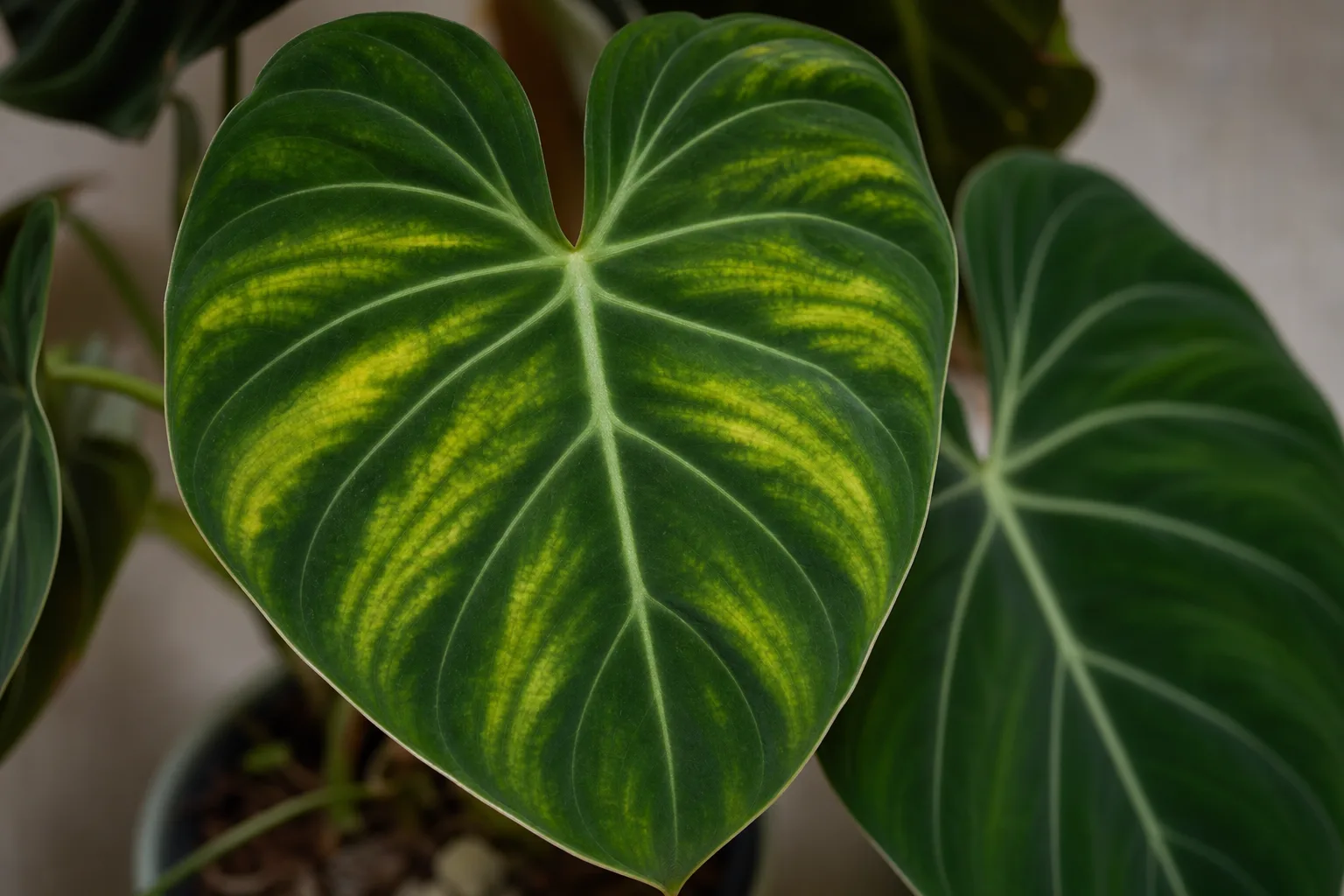
Iron Deficiency on Philodendron Gloriosum: Causes, Checks & Fixes
This guide covers iron deficiency on Philodendron Gloriosum. See also the general Iron Deficiency guide, watering, and light pages for this plant.
Iron Deficiency on Philodendron Gloriosum: Causes, Checks & Fixes
Quick answer
Iron deficiency on Philodendron Gloriosum appears as interveinal chlorosis-yellow tissue between the veins on the newest velvet leaf, while veins and older foliage often stay darker green. On this slow terrestrial crawler, that pattern is easy to miss because healthy Gloriosum leaves already show bold pale veining on dark velvet, and only one or two large leaves may be visible at a time.
First step: inspect the leaf still unfurling at the rhizome tip and confirm green veins on yellow interveinal tissue. Before adding iron, rule out soggy mix, sour-smelling soil, and mushy rhizome tissue. Overwatering is the number one reason indoor plants fail, and wet roots around a buried crawler stem cannot take up iron even when it is in the mix.
What iron deficiency looks like on Philodendron Gloriosum
The hallmark is yellowing between veins on young leaves, with veins remaining green. Healthy Gloriosum has dramatic white or cream vein tracery on deep green velvet-that is normal contrast, not chlorosis. Iron deficiency adds a sickly yellow wash in the tissue between those vein lines on the newest leaf, while the vein framework itself stays greener longer.
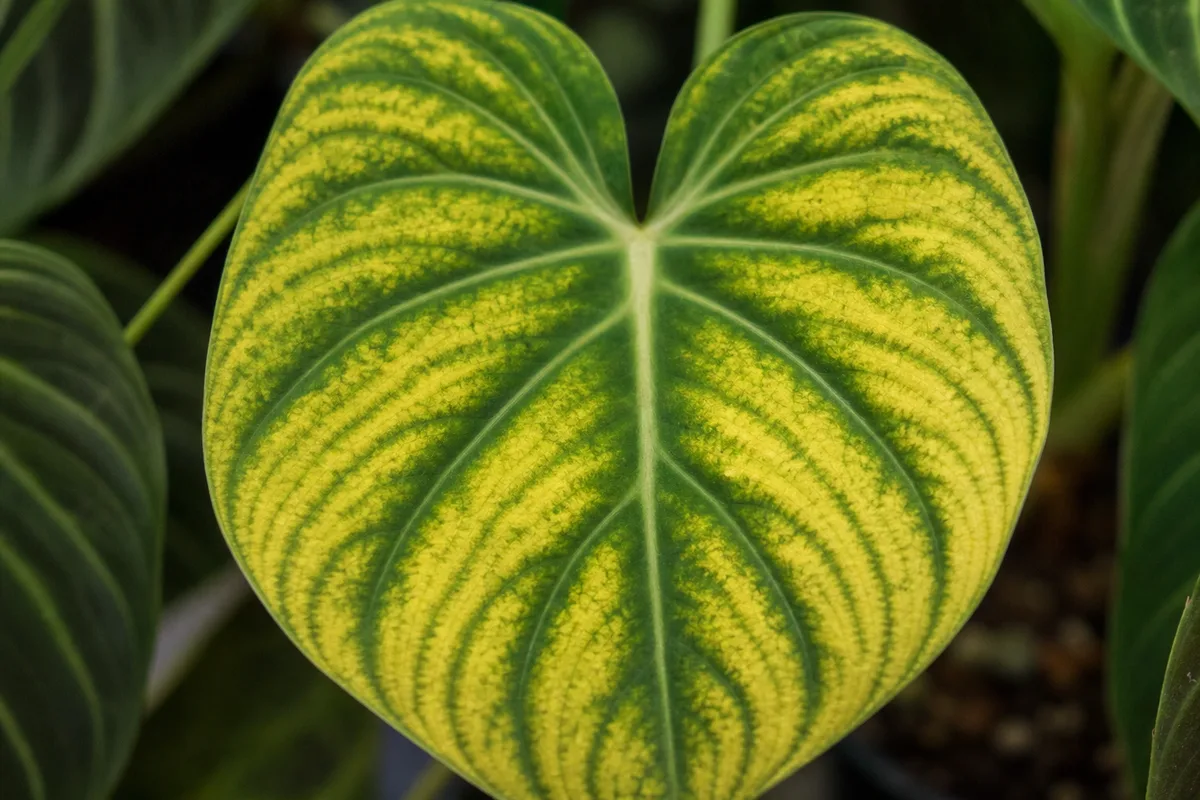
Iron Deficiency symptoms on Philodendron Gloriosum - compare with healthy tissue on the same plant.
Watch these patterns:
- New growth first - The leaf at the rhizome tip or the smallest recently unfurled blade shows chlorosis before lower mature leaves.
- Veins stay green - Tissue between veins bleaches yellow; midribs and lateral veins hold color longest on velvet foliage.
- Older leaves stay relatively dark - Because iron is relatively immobile in plant tissue, mature leaves often remain green while new ones emerge pale.
- Slow unfurling may continue - Unlike severe rhizome rot, mild chlorosis often leaves the growth tip firm early on, though new leaves may open smaller or thinner.
- No sour soil smell alone - Iron issues differ from rot, which pairs yellowing with soft rhizome, wet mix, and sour odor.
Lower leaves that yellow uniformly from the edge inward more often point to nitrogen loss, normal aging, or chronic overwatering-not classic iron chlorosis.
Why Philodendron Gloriosum gets iron deficiency
Gloriosum grows best in slightly acidic chunky aroid mix (roughly pH 5.5–7.0). When pH drifts alkaline-common in old peat-free mixes, hard tap water, or lime-heavy substrates-iron becomes less available to roots even if fertilizer contains it. Iron chlorosis (leaf yellowing with green veins) is the classic pattern when iron is unavailable for uptake.
Other Gloriosum-specific factors stack on top:
- Depleted container mix - Years of watering leaches micronutrients from peat-based or coco blends. Slow crawlers stay in the same wide pot longer than fast climbers, so exhausted soil is a frequent hidden cause.
- Rhizome and root function blocked - When the creeping stem sits buried in saturated mix, oxygen drops and nutrient uptake stops. Damaged roots cannot absorb iron regardless of what you pour on top.
- Feeding gaps during active growth - Fertilize from March through September with diluted houseplant formula. Skipping feed all spring while the plant pushes a new velvet leaf can show up as micronutrient stress on fresh foliage.
- Salt buildup - Excessive fertilizer results in the buildup of salts and can injure fine aroid roots, mimicking or worsening deficiency symptoms.
Iron deficiency is a confirmed pattern diagnosis, not the default explanation for every pale Gloriosum leaf.
How to confirm the cause
Work through these checks in order:
- Leaf age pattern - Is yellowing confined to the newest unfurling leaf with green veins? Iron chlorosis fits. Are lower old leaves solid yellow with wet soil? Look at water and rhizome health first.
- Soil moisture at top 3–5 cm - Mix wet for days with a heavy pot suggests overwatering or poor drainage-not iron shortage alone.
- Rhizome sniff and feel test - Brush mix from the creeping stem. Firm tissue supports a nutrient diagnosis; mushy black tissue at the growth zone needs rot treatment before any iron product.
- Feeding history - Has the plant received diluted fertilizer during active growth? Has the same soil sat unchanged for two or more years?
- Water quality - Hard, high-alkaline tap water repeated over months can raise mix pH and push iron out of solution in container media.
- Light level - Very dim corners slow growth and make foliage pale overall, but true iron chlorosis keeps visible green veins on yellow interveinal tissue on the newest leaf.
If interveinal chlorosis on new leaves persists after soil dries appropriately, the rhizome looks firm, and overwatering is ruled out, iron deficiency becomes the leading nutrient explanation.
First fix for Philodendron Gloriosum
Apply a chelated iron product labeled for houseplants, mixed exactly to label directions, only after you confirm new-leaf interveinal chlorosis and a firm-not rotting-rhizome.
The remedy is applying a chelated iron product according to label directions and acidifying the soil using a sulphur product. Do not use full-strength outdoor iron products indoors.
Do not fertilize with general NPK alone as the first response if the pattern matches iron chlorosis-extra nitrogen without available iron will not re-green interveinal tissue. Do not repot and iron on the same day unless the mix is clearly exhausted; pick one stressor to correct first.
Step-by-step recovery
After the first chelated iron application:
- Hold watering steady - Water when the top 3–5 cm dries, not on a calendar. Keep the rhizome on the mix surface in a wide shallow pot so it does not sit in stagnant moisture.
- Add diluted balanced feed at next watering - Once roots are functional, a half-strength monthly application during spring and summer supplies nitrogen and other micronutrients without salt shock.
- Acidify or refresh if pH is high - Philodendron Gloriosum repotting guide into fresh slightly acidic chunky aroid mix (potting mix, perlite, orchid bark) is often simpler for depleted plants than chasing pH in old exhausted soil.
- Flush salts if you overfed before - Run water through the pot several times and let it drain fully; wait four to six weeks before feeding again if burn symptoms appeared.
- Watch new leaves only - Judge success by the next one or two velvet leaves that unfurl from the rhizome tip after treatment, not by old chlorotic tissue. Iron chlorosis starts on younger leaves, so the same tissue is where recovery shows first.
Repeat chelated iron only according to product label intervals-doubling doses can harm fine aroid roots on a slow grower.
Recovery timeline
Mild chlorosis on a stable Gloriosum often shows cleaner green velvet with crisp vein contrast on the next leaf within four to eight weeks after correct iron and pH correction. Plants recovering from rhizome stress may need two to three months before a new leaf unfurls with full size.
Old yellow leaves rarely return to deep green velvet. Trim them for appearance once a newer leaf looks healthy.
Lookalike symptoms
| What you see | Likely cause | How it differs from iron deficiency |
|---|---|---|
| Lower leaves yellow with wet soil and soft rhizome | Overwatering, rhizome rot | Affects older leaves with root damage; sour smell; growth tip may soften |
| Interveinal yellow on older leaves | Magnesium deficiency | Pattern starts on mature foliage, not the newest unfurling leaf |
| Uniform pale plant in dark corner | Low light | Whole plant lacks contrast; not isolated green-vein pattern on new growth |
| One oldest leaf yellowing alone | Normal senescence | Single lower leaf on firm rhizome with active tip growth |
| Yellow leaves + sour soil + limp petioles | root rot on Philodendron Gloriosum | Rhizome damage; fix drainage before iron |
| Brown crispy tips only | Low humidity | Margins brown; center tissue may stay green without interveinal bleaching |
Spider mite stippling creates yellow dots on velvet undersides, not smooth interveinal bands between veins.
Mistakes to avoid
- Treating every yellow leaf as iron deficiency - Confirm the new-leaf, green-vein pattern first on the rhizome tip.
- Iron on a rotting rhizome - Chelated iron will not fix mushy stem tissue; unpot, trim, and repot dry first.
- Full-strength fertilizer blast - Salt burn worsens uptake problems on sensitive aroid roots.
- Burying the rhizome deeper when repotting - Fresh soil packed around the creeping stem recreates chlorosis through root failure, not mineral absence.
- Feeding in winter dormancy - Reduced light and growth in cold months mean nutrients are not needed and can accumulate as salts.
Philodendron Gloriosum care cross-check
Iron correction works only when baseline care supports uptake:
- Light - Philodendron Gloriosum light guide; too much direct sun scorches velvet, too little slows recovery and water use.
- Humidity - 60–70% reduces edge stress so you can read interveinal patterns clearly on new leaves.
- Temperature - Keep within the 18°C to 30°C (65–86°F) comfort zone; cold roots slow nutrient movement.
- Water - Allow the top 3–5 cm to dry between waterings; never let the rhizome sit in standing water.
- Soil and pot - Slightly acidic, well-aerated chunky mix in a wide shallow pot matching this crawler’s habit.
How to prevent iron deficiency next time
Feed diluted balanced fertilizer monthly during active growth with a formula that includes micronutrients. Repot every one to two years or when watering becomes unpredictable. Flush the pot occasionally if you use synthetic fertilizer regularly. Use filtered or settled water if hard tap water alkalizes your mix. Watch the rhizome tip weekly during the growing season so interveinal yellowing is caught on the first affected leaf, not after every new blade bleaches.
Conclusion
Iron deficiency on Philodendron Gloriosum is a specific pattern-yellow new velvet leaves with green veins-not a generic yellow-leaf problem. Confirm that pattern on the unfolding leaf at the rhizome tip, rule out wet mix and failing rhizome tissue, then use chelated iron at label strength and correct pH or depleted mix. Recovery appears on the next velvet leaf that unfurls with dark green tissue and crisp pale veining; older chlorotic leaves can be trimmed once the plant stabilizes.
When to use this page vs other Philodendron Gloriosum guides
- Philodendron Gloriosum watering guide - Use for routine moisture checks before assuming iron deficiency is the main issue.
- Philodendron Gloriosum problems hub - Browse all 22 common issues on this species.