Phalaenopsis Orchid Care Guide: Moth Orchid Indoors
Phalaenopsis spp.
Phalaenopsis needs bright indirect light, watering through bark every 7–10 days allowing near-complete drying, 40–70 % humidity, and 5–8 °C cooler nights in autumn to trigger reblooming. Non-toxic to pets.
Phalaenopsis Orchid Care Guide: Moth Orchid Indoors
Start with wateringThe most common care mistake for Phalaenopsis OrchidWatering guide →Phalaenopsis Orchid care essentials
Light
bright indirect light (east or north-facing window), medium indirect light
Water
Every 7–10 days - run water through bark until draining, then allow bark to dry almost completely. Silver-grey roots = dry = time to water. Bright green roots = moist.
Soil
Orchid bark chips or sphagnum moss. Never standard potting soil. Repot in fresh bark every 1–2 years.
Humidity
50–70%
Temperature
18–29°C (65–84°F)
Fertilizer
Feed lightly during active growth. Orchid-specific fertilizer at half strength ('weakly weekly') and stop if the plant is stressed, newly repotted, or not actively growing.
About Phalaenopsis Orchid
Phalaenopsis Orchid has a upright growth habit.
| Detail | Information |
|---|---|
| Growth habit | Upright |
| Scientific name | Phalaenopsis spp. |
Phalaenopsis Orchid Care Guide: Moth Orchid Indoors
You bought a Phalaenopsis orchid because the flowers lasted for months and the plant looked elegant on the kitchen counter. A year later, the blooms are gone, the tag said something about ice cubes, and the roots visible through the plastic pot have turned an alarming shade of brown. That sequence is so common it has its own name in the houseplant world: the post-bloom orchid graveyard. It is also mostly preventable. Phalaenopsis - the moth orchid - is not a difficult plant once you understand what it actually is: a tropical epiphyte that wants airy bark, a wet-then-dry Phalaenopsis Orchid watering guide, moderate humidity, and a seasonal temperature cue to flower again. This guide covers all of that in the order that matters: light, bark mix, watering (including why ice cubes are a bad idea), humidity, feeding, Phalaenopsis Orchid repotting guide, reblooming, and the problems that show up when any one of those steps goes wrong.
What Phalaenopsis Orchid Actually Is (The Moth Orchid)
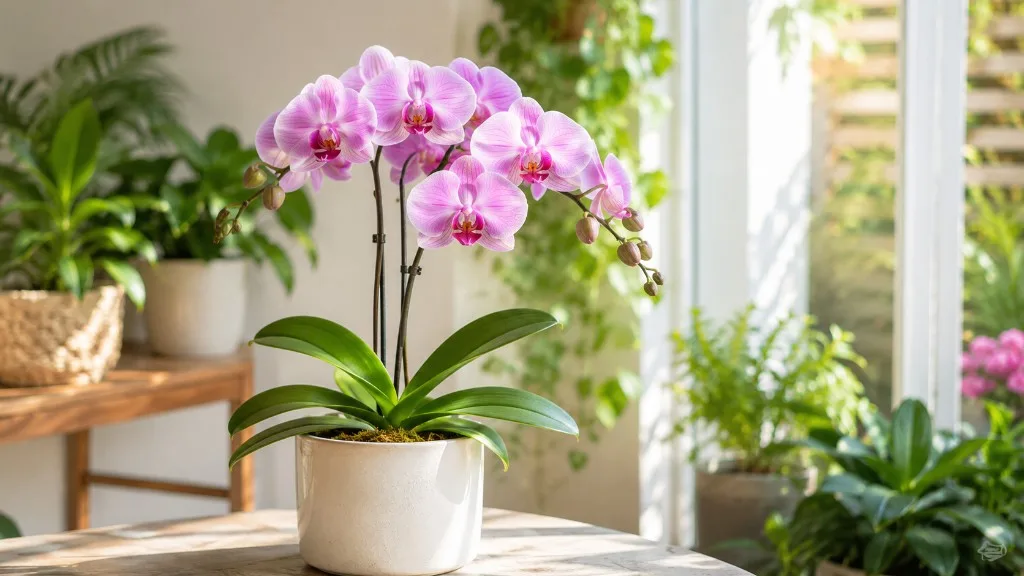
Phalaenopsis (pronounced fal-ee-NOP-sis) is the genus behind the moth orchid, moon orchid, and most of the flowering orchids sold in supermarkets, florists, and garden centres worldwide. The RHS Growing Guide for moth orchids describes them as the most popular indoor orchids, widely bred into free-flowering hybrids with long-lasting blooms in white, pink, purple, yellow, and patterned combinations. The University of Minnesota Extension notes that modern tissue culture has made them cheaper and more forgiving than ever, calling Phalaenopsis one of the easiest orchids for typical homeowners.
The single botanical fact that changes everything about care is this: Phalaenopsis is an epiphyte. In the wild it grows on tree branches in humid forests across Southeast Asia, the Philippines, and parts of Australia - not in soil on the forest floor. Its roots cling to bark, absorb moisture when rain passes through, and then dry out in open air. University of Minnesota Extension specifically notes that as houseplants, moth orchids are grown in fir bark to provide both moisture and adequate air to the roots. Pack those same roots into standard potting soil and they suffocate, stay wet too long, and rot. That is not a minor preference; it is the plant’s basic biology.
Unlike Cattleya or Dendrobium orchids, Phalaenopsis has no pseudobulbs to store water. It relies on thick leaves and roots, which means it cannot tolerate long drought or roots sitting in stale water. A healthy mature plant reaches 30–60 cm (12–24 in) tall, with arching spikes carrying a dozen or more blooms that last two to four months each.
Light: Bright, Indirect, and Stable
Phalaenopsis is often sold as a “low-light orchid,” which is only half true. It tolerates less light than a Cattleya, but it still needs bright, indirect light for most of the day to maintain firm leaves, healthy roots, and the energy reserves required for reblooming. The RHS recommends positioning moth orchids in bright light in winter to encourage flowering, with an east- or west-facing windowsill as ideal, and keeping them out of direct summer sun that can scorch the leaves. University of Minnesota Extension puts the target at roughly 70–75°F (21–24°C) during the day with cooler nights - a range that only works if the plant is receiving enough light to photosynthesize actively.
A practical placement for most homes: within 0.5–1 m (2–3 ft) of an east-facing window, where the plant gets gentle morning sun and Phalaenopsis Orchid light guide the rest of the day. A north-facing window can work if the room is bright; a south- or west-facing window needs a sheer curtain or a few feet of setback from the glass, especially from late spring through early autumn. If the only available spot is a dim interior room, the plant may survive but will grow slowly, produce fewer roots, and rebloom rarely or not at all - and no amount of fertilizer or ice-cube watering will fix that.
Artificial light is a legitimate option. A full-spectrum LED grow light placed 20–30 cm (8–12 in) above the foliage, running 12–14 hours daily, can support a Phalaenopsis in a room with no useful window. Rotate the pot a quarter turn each week so growth stays balanced. Medium green, firm leaves mean the light is about right; very dark green leaves signal too little light and poor rebloom prospects; bleached or yellow-green leaves mean too much direct sun - pull the plant back and acclimate over one to two weeks.
The Bark Mix That Keeps Roots Alive
The potting medium is not a detail you can skip. Phalaenopsis roots need open, chunky, fast-draining material that holds some moisture between waterings but dries out within a week or so in typical indoor conditions. The RHS is explicit: always use specially formulated bark-based orchid compost, and never loam-based or multipurpose compost, because those will kill moth orchids. University of Minnesota Extension adds that fir bark for epiphytic orchids provides both moisture and the air circulation roots require.
A standard commercial orchid bark mix - usually medium-grade fir or pine bark chips blended with perlite and sometimes charcoal - works well for most beginners and most homes with average humidity. A workable DIY blend for a drier home: roughly 60% medium fir bark, 20% perlite, 10% charcoal, and 10% sphagnum moss. The bark provides structure and air pockets; perlite increases drainage; charcoal absorbs impurities and reduces odour in aging mix; a small amount of moss helps retain moisture at the centre of the root ball without turning the whole pot into a wet sponge.
Never use standard houseplant potting soil. Garden soil, peat-heavy multipurpose mix, and even “orchid soil” products that contain significant peat without enough bark chunk all hold water too long for Phalaenopsis roots. The failure mode is predictable: roots go from firm and silvery to brown and mushy, leaves yellow from the bottom up, and the plant declines over weeks even though you are “watering correctly” on a calendar.
Bark breaks down. Over one to two years, fir bark decomposes, the mix compacts, air spaces collapse, and the pot stays wet longer after each watering. The RHS recommends completely changing the compost every couple of years because degraded bark holds water longer and causes root rot on Phalaenopsis Orchid. If your watering interval suddenly shrinks - you used to water every ten days and now the pot is still heavy after five - the mix is aging out, not the plant getting thirstier.
Bark vs Sphagnum Moss: Which Mix Fits Your Home
Many supermarket Phalaenopsis arrive in sphagnum moss, which retains more moisture than bark and suits the controlled conditions of a greenhouse or a very dry home where the owner tends to underwater. Moss is not wrong, but it demands a different watering rhythm: you water less frequently and must be more careful not to keep the centre permanently wet. For most beginners in average indoor humidity, bark is the safer default because its faster drying cycle is harder to overwater.
If you repot from moss into bark, expect to water more often for the first few weeks. If you repot into moss in a very dry home, check moisture at the core of the root ball, not just the surface - moss can feel dry on top while staying saturated underneath.
Watering Phalaenopsis: Soak, Drain, and Read the Roots
Watering is where most Phalaenopsis either thrive or die, and the rule is simple even if the execution takes a few weeks to learn: give the roots a thorough soak, let the pot drain completely, then wait until the bark is nearly dry before soaking again. The RHS advises watering moth orchids weekly during the growing season with a slight reduction in winter, using tepid water (preferably rainwater), never letting plants sit in water, and always allowing excess to drain away. University of Minnesota Extension adds that you can judge dryness by lifting the pot - light means dry, heavy means still moist - and that Phalaenopsis grown in bark should receive enough water to saturate the media without leaving the plant standing in runoff.
The most reliable visual check is root colour through a clear plastic pot, which is why experienced growers prefer transparent containers. Bright green roots are fully hydrated; wait to water. Silvery-white or grey roots are dry and ready for water. Shrivelled, wrinkled roots that stay silver even after watering signal chronic underwatering on Phalaenopsis Orchid or dead root tissue. Brown, black, or mushy roots mean rot - usually from overwatering on Phalaenopsis Orchid, degraded bark, or both. Check roots, not the calendar. A plant in bright light in a small bark-filled pot in summer may need water every five to seven days; the same plant in winter in a dim room may go two weeks between soaks.
The best method for most homes is the sink soak: carry the plant to the sink, run room-temperature water through the bark for 15–30 seconds until water flows freely from the drainage holes, or submerge the pot in a bowl of water for 10–15 minutes and then drain thoroughly. Let the pot sit in the sink until dripping stops - usually five to ten minutes - before returning it to its decorative outer pot or saucer. Never leave the inner pot sitting in a pool of collected water; that recreates the anaerobic conditions Phalaenopsis roots cannot survive.
Two rules matter especially. Avoid pooling water in the crown - the junction where leaves emerge - because trapped water causes fatal crown rot. Water the bark, not the leaf axils. Use tepid water, not cold tap water, which shocks tropical roots. If your tap water is softened or high in minerals, consider filtered water or rainwater; flush the bark with plain water every four to six months to prevent salt buildup.
In the active growing season - spring through early autumn - most Phalaenopsis in bark need water roughly every seven to ten days. In winter, when growth slows and homes are cooler and dimmer, stretch to every ten to fourteen days, always confirming with root colour and pot weight rather than the day of the week.
Why the Ice Cube Method Is a Myth
Supermarket orchids often ship with a tag recommending three ice cubes per week. The idea is portion control: a slow melt prevents overwatering. The concept sounds tidy, but the practice is poorly matched to how Phalaenopsis actually works, and most serious orchid growers and extension educators advise against it.
The problems stack up quickly. Ice is cold - typically at or below 0°C (32°F) when placed on the bark - and Phalaenopsis roots evolved in tropical forests where water arrives at air temperature. Ohio State University research found that ice placed on bark media does not damage roots, but the RHS and American Orchid Society still recommend tepid soak-and-drain watering for more even saturation. Ice melt does not evenly saturate bark. Water drips down channels in the mix and may leave the core of the root ball dry while the surface looks wet, which encourages a shallow root system and inconsistent moisture. Ice cubes can pool in the crown as they melt, creating exactly the stagnant water conditions that cause crown rot. And the “portion control” benefit is easily replicated by measuring a fixed volume of room-temperature water - typically 100–150 ml for a standard 10–12 cm pot - without any of the cold or uneven-saturation downsides.
If you have been using ice cubes and the plant looks healthy, switch to room-temperature soak-and-drain watering and watch root colour respond over the next few cycles.
Humidity and Temperature Indoors
Phalaenopsis prefers moderate to high humidity, with the American Orchid Society citing a target range of 50–80% relative humidity and an ideal band of 50–70% for the most robust growth and longest-lasting flowers. Many centrally heated homes sit at 30–45% in winter, which is tolerable but not optimal. The plant can survive at the lower end if watering and bark choice are correct, but you may see slower root growth, shorter flower life, and slightly wrinkled leaf tips in very dry air.
Daytime temperatures between 18–29°C (65–84°F) suit Phalaenopsis well, matching the University of Minnesota Extension range of 70–75°F days and the RHS guidance of 19–30°C (66–86°F) days with 16–19°C (61–66°F) nights. Keep plants away from radiators, heat vents, and cold drafts from frequently opened doors or window ledges in winter. Sudden temperature swings cause bud blast - flower buds that brown and drop before opening - more reliably than steady conditions that are slightly warmer or cooler than ideal.
The temperature story connects directly to reblooming, which is covered below, but even outside flowering season, a modest day-to-night drop of 6–8°C (10–15°F) mirrors the plant’s native conditions and supports healthy metabolism. A home that holds a constant 21°C (70°F) day and night year-round will keep the plant alive but makes reblooming harder.
Pebble Trays, Humidifiers, and What Not to Do
The simplest humidity boost is a pebble tray: a shallow tray filled with pebbles and water, with the pot sitting on the pebbles above the water line so roots are not submerged. Evaporation raises local humidity a few percentage points around the foliage. Grouping plants together creates a shared microclimate through transpiration and is free. A small cool-mist humidifier placed within a metre of the plant is the most reliable fix in dry winter homes and is worth the investment if you are running several humidity-sensitive plants.
What does not work well as a primary strategy: misting the leaves. The humidity bump lasts minutes, wet foliage invites fungal problems, and misting does nothing for the root zone. A humidifier or pebble tray is the better tool for winter dryness.
Fertilizer: Weakly Weekly During Active Growth
Phalaenopsis is a modest feeder. The RHS recommends feeding lightly but regularly during the growing season with a specific orchid fertiliser, flushing salts every fourth watering by watering without feed, and feeding sparingly if at all in winter. Orchid growers often summarise the approach as “weakly, weekly” - a balanced orchid or houseplant fertiliser at one-quarter to one-half the label strength, applied every one to two weeks from spring through early autumn when the plant is actively growing new roots and leaves.
Always water first, then fertilise moist bark so nutrient salts do not burn dry roots. Pause feeding after repotting, during crown or root recovery, while the plant is in full bloom if it looks stressed, and through the deepest part of winter when growth stalls. A plant that is not growing cannot use nutrients; unused salts accumulate on bark surfaces and show up as crispy leaf tips and white crust on the pot rim. If you see that, flush the pot with plain water for several minutes and skip the next two feedings.
Do not expect fertiliser to trigger reblooming - that is driven by light and temperature, not nitrogen.
Repotting Without Killing the Roots
Repot Phalaenopsis every one to two years, or whenever the bark has clearly broken down, the plant is top-heavy and unstable, or roots are crowded and pushing against the pot walls. The RHS notes that repotting is necessary once the plant has been in the same compost for two years because structure deteriorates and water retention increases. You can repot at any time of year when roots are active - look for green root tips - but spring and early summer give the plant the longest bright season to re-establish.
Remove the plant, pull away all old bark, and trim dead roots - brown, mushy, or hollow - with sterilised pruners. Healthy roots are firm and plump, silvery when dry and green when wet. Choose a pot that fits the root mass snugly; overpotting is a common post-repot rot trigger because unused bark stays wet. Repot at the same depth, firm fresh bark around the roots, water lightly, and resume normal soak-and-drain once new green root tips appear in two to four weeks.
Clear Pots and Aerial Roots
Phalaenopsis is often sold in a clear inner plastic pot inside a decorative ceramic cachepot, and that transparency is functional, not cosmetic. Many Phalaenopsis roots contain chlorophyll and photosynthesise when exposed to light, contributing energy to the plant alongside the leaves. A clear pot lets you monitor moisture and root health without disturbing the plant, and it supports root photosynthesis. Do not bury aerial roots that wander outside the pot - they are normal epiphytic growth, not a sign the plant needs a bigger container. Trimming them is cosmetic only; burying them in wet bark invites rot.
How to Rebloom Phalaenopsis Orchid
The question every moth orchid owner asks after the last flower falls: will it bloom again? Yes - if the plant is healthy, well-lit, and receives the seasonal temperature cue it expects. Phalaenopsis naturally blooms once or twice a year in cultivation, with individual flowers lasting six to twelve weeks on the spike. Rebloom is not random, and it is not primarily a fertiliser or watering trick. It is a thermoperiod response - a consistent pattern of cooler nights relative to days that tells the plant to initiate a new flower spike.
The sequence that works in most homes: ensure adequate light first - insufficient light is the most common rebloom failure. After the current bloom finishes, rest the plant with normal care for a few weeks. Then in autumn (September through November in the Northern Hemisphere), expose it to nighttime temperatures of 13–18°C (55–65°F) for four to six weeks while maintaining normal daytime temperatures. Watch for a small green nub between the leaves - the new spike. Once it is 2–5 cm tall, return to normal warm conditions and stake the spike loosely. Expect blooms three to five months after spike initiation.
Cool Nights and the Daytime Temperature Ceiling
The cool-night trigger is well documented, but there is a nuance most generic guides omit: daytime temperature during spike initiation matters as much as the night drop. Research on Phalaenopsis flowering, including work cited by Michigan State University and the American Orchid Society, shows that daytime temperatures above 28°C (82°F) can inhibit or abort spike development even when nights are cool. In warm climates or homes that stay hot through autumn, a plant near a cool window at night may still fail to spike if daytime highs near the glass exceed that ceiling. If you are running heat aggressively during the day and only dropping temperature at night, verify daytime highs at the plant’s location with a min/max thermometer placed at leaf level.
The target differential is a 10–15°F (6–8°C) drop from day to night sustained over several weeks. Two to three weeks may initiate spiking in some hybrids, but four to six weeks produces more consistent results across different specimens. A home held at a constant 21°C (70°F) day and night year-round is the single most common rebloom blocker after insufficient light.
What to Do With Spent Flower Spikes
After the last flower fades, you have two reasonable options depending on spike condition. If the spike is still green and firm, cut it above the second or third node (joint) below the lowest spent bloom. The RHS notes that a new flowering side-shoot may sprout from that node, giving you a second flush of blooms from the same spike within a few months - smaller in scale but faster than waiting for a entirely new spike. Use a sterilised blade and cut cleanly; dab cinnamon powder on the cut if you have it, as a mild antifungal.
If the spike turns yellow, brown, or dry, cut it off at the base near the leaves. Do not cut a green spike at the base unless it is clearly failing - you are removing the fastest route to more flowers.
Propagation: Keikis and Division
Most home multiplication happens through keikis - baby plants that sprout from nodes on a spent flower spike. The RHS notes that once a keiki has roots 2–5 cm long, it can be detached and potted in orchid bark. Wait until the keiki has two or three roots 3–5 cm long, cut the spike below it with a sterilised blade, and pot in a small clear container with fresh bark. Division at repotting works on large multi-lead plants but is rare on single-stem supermarket orchids. Do not propagate from a plant with root rot, crown damage, or active pests.
Pet Safety: Non-Toxic to Cats and Dogs
Phalaenopsis is one of the few popular flowering houseplants that is genuinely pet-safe by standard veterinary references. The ASPCA lists Phalaenopsis orchid as non-toxic to dogs, cats, and horses, with common names including moth orchid and moon orchid. That does not mean you should encourage pets to chew the plant - ingestion can still cause mild stomach upset in sensitive animals, and broken pots or stakes create physical hazards - but it is a reasonable choice for homes with cats that investigate shelves and windowsills.
Practical placement still matters - stable surfaces, no loose stakes, and monitoring curious pets. For rabbits, birds, or reptiles, species-specific safety data is less complete; consult an exotics veterinarian if the animal has cage access.
Common Problems and Real Fixes
Most Phalaenopsis problems trace back to a short list of environmental causes. The diagnostic order that resolves the most cases: check roots through the clear pot, then light, then bark age, then pests. Fix the underlying condition before trimming leaves or increasing fertiliser.
Yellow bottom leaves on an otherwise healthy plant are often normal senescence - older leaves die off as new ones emerge from the centre. Remove them once they are more yellow than green. Yellowing across multiple leaves with mushy roots means overwatering or degraded bark; unpot, trim rot, repot in fresh bark, and water less until new root tips appear. Wrinkled, limp leaves on a plant with silvery shrivelled roots signal underwatering or dead root mass that can no longer absorb moisture; soak thoroughly, assess whether roots need trimming and repotting, and adjust the interval.
Bud blast - buds browning before opening - usually follows drafts, sudden temperature change, or ethylene from ripening fruit nearby. Mealybugs and scale respond to alcohol swabs and insecticidal soap. Spider mites appear in very dry air as stippling and fine webbing; raise humidity and rinse the plant thoroughly.
Root Rot and Crown Rot
Root rot develops when bark stays wet too long. Roots turn brown and mushy, lower leaves yellow, and the plant wobbles in the pot. Unpot immediately, cut away dead tissue, repot in fresh bark in a snug pot, withhold water for five to seven days, then resume a cautious rhythm. Crown rot starts when water sits in the leaf junction - the growing tip turns brown and soft and the plant usually cannot recover. Prevention - never water the crown and provide airflow - is the only reliable strategy.
Conclusion
Phalaenopsis orchid care is not about memorising a weekly ice-cube ritual or treating the plant like a thirsty fern. It is about matching a tropical epiphyte to indoor conditions it can actually use: bright indirect light, chunky bark that dries between waterings, 50–70% humidity, tepid soak-and-drain watering read through root colour, light feeding during active growth, fresh bark every one to two years, and a four-to-six-week autumn period of cool nights with daytime highs below 28°C (82°F) to trigger reblooming. Get the bark and watering right and most other problems never appear. Get the light and temperature cue right and the plant rewards you with months of flowers on a spike you grew yourself.
If your moth orchid is struggling today, start with the roots visible through the pot - not the leaves, not the tag, not the calendar. Silver roots and firm green leaves in bright indirect light are the foundation everything else builds on. The ice cubes can go in the freezer. The bark cannot go in standard potting soil. And the rebloom you want is already coded into the plant’s biology; you just need to send the right seasonal signal.
When to use this page vs other Phalaenopsis Orchid guides
- Phalaenopsis Orchid overview - Canonical hub for this species - care topics and problems branch from here.
- Phalaenopsis Orchid problems - Symptom-first path when you already know something is wrong.
Related Phalaenopsis Orchid guides
- Phalaenopsis Orchid watering
- Phalaenopsis Orchid light
- Phalaenopsis Orchid soil
- Phalaenopsis Orchid propagation
- Phalaenopsis Orchid fertilizer
- Phalaenopsis Orchid repotting
- Phalaenopsis Orchid pruning
- Root Rot on Phalaenopsis Orchid
- Yellow Leaves on Phalaenopsis Orchid
- Bud Drop on Phalaenopsis Orchid
- Slow Growth on Phalaenopsis Orchid
- Brown Tips on Phalaenopsis Orchid
How to care for Phalaenopsis Orchid?
How much light does Phalaenopsis Orchid need?
bright indirect light (east or north-facing window), medium indirect light
- bright indirect light (east or north-facing window) - bright indirect light (east or north-facing window), medium indirect light.
- medium indirect light - bright indirect light (east or north-facing window), medium indirect light.
When should you water Phalaenopsis Orchid?
Every 7–10 days - run water through bark until draining, then allow bark to dry almost completely. Silver-grey roots = dry = time to water. Bright green roots = moist.
- Check top 2 inches - Stick a finger or knuckle into the soil; water only when the top layer feels dry.
- Drain excess water - Every 7–10 days - run water through bark until draining, then allow bark to dry almost completely.
What soil works best for Phalaenopsis Orchid?
Orchid bark chips or sphagnum moss. Never standard potting soil. Repot in fresh bark every 1–2 years.
- Well-draining mix - Potting mix that lets water flow through quickly instead of staying soggy around the roots.
Grower notes for Phalaenopsis Orchid
What matters most with Phalaenopsis Orchid
Phalaenopsis Orchid is easiest to grow when you judge the whole plant: new growth, root-zone moisture, light exposure, and how quickly the pot dries after watering. In practice, the care checkpoint is simple: bright indirect light (east or north-facing window), medium indirect light. Pair that with orchid bark chips or sphagnum moss. Never standard potting soil. Repot in fresh bark every 1–2 years, and avoid changing water, pot size, and placement all at once.
Best placement in a real home
Phalaenopsis Orchid belongs where bright indirect light (east or north-facing window), medium indirect light is realistic for most of the day, not only where the pot looks good. Every 7–10 days - run water through bark until draining, then allow bark to dry almost completely. Silver-grey roots = dry = time to water. Bright green roots = moist. If the pot stays wet longer than expected, move the plant into better light or reassess the mix before watering again. Humidity target: 50–70%. Temperature comfort zone: 18–29°C (65–84°F).
Before you buy this plant
Choose Phalaenopsis Orchid with firm new growth, clean leaf undersides, and soil that does not smell sour or feel compacted. Be cautious if you see root-rot, sticky residue, collapsed crowns, or a pot that is wet in poor light. Cosmetic old-leaf damage is less worrying than weak roots or active pests.
First month after bringing it home
Do not repot Phalaenopsis Orchid on day one unless the mix is failing or pests are obvious. Quarantine it, learn how fast the pot dries, and keep care boring while it adjusts. Watch especially for root-rot, yellow-leaves, and bud-drop. If problems appear, correct the condition first rather than stacking fertilizer, repotting, and pruning together.
Safety note for Phalaenopsis Orchid
Phalaenopsis Orchid is not a plant to keep within reach of pets or children. Treat it as an inaccessible display plant. Use gloves if sap or plant tissue is irritating, and pick a pet-safe alternative for floor pots or low shelves.
How to tell Phalaenopsis Orchid is settling in
If you plan to multiply it later, common methods include Keiki propagation and Division at repotting. If yellow-leaves shows up early, inspect light, watering, and roots before assuming the plant is permanently weak.
Is it pet safe?
Phalaenopsis Orchid is generally considered pet safe.
Watering Phalaenopsis Orchid
Every 7–10 days - run water through bark until draining, then allow bark to dry almost completely. Silver-grey roots = dry = time to water. Bright green roots = moist.
Soil & potting for Phalaenopsis Orchid
Orchid bark chips or sphagnum moss. Never standard potting soil. Repot in fresh bark every 1–2 years.
Humidity & temperature for Phalaenopsis Orchid
Phalaenopsis Orchid prefers 50–70%, though normal home humidity is usually fine. Keep temperatures around 18–29°C (65–84°F).
| Detail | Information |
|---|---|
| Humidity | 50–70% - normal home humidity is fine. |
| Ideal temperature | 18–29°C (65–84°F) |
Fertilizer & pruning for Phalaenopsis Orchid
Use feed lightly during active growth. Orchid-specific fertilizer at half strength ('weakly weekly') and stop if the plant is stressed, newly repotted, or not actively growing. for Phalaenopsis Orchid.
| Detail | Information |
|---|---|
| Fertilizer type | Feed lightly during active growth. Orchid-specific fertilizer at half strength ('weakly weekly') and stop if the plant is stressed, newly repotted, or not actively growing. |
Common problems on Phalaenopsis Orchid
Likely cause: Phalaenopsis (/ ˌfælɪˈnɒpsɪs /), also known as moth orchids, [2] is a genus of about seventy species of plants in the family Orchidaceae. Orchids in this genus are monopodial epiphytes or lithophytes with …
Quick fix: Confirm diagnosis on your Phalaenopsis Orchid, then address the most likely care or pest factor described in current extension guidance.
Full fix guide →Bud Drop
HighLikely cause: Cold draft, sudden temperature change, or exposure to ethylene from ripening fruit
Quick fix: Keep away from drafts and fruit; maintain stable conditions
Full fix guide →Plant Leaning
MediumLikely cause: Phalaenopsis (/ ˌfælɪˈnɒpsɪs /), also known as moth orchids, [2] is a genus of about seventy species of plants in the family Orchidaceae. Orchids in this genus are monopodial epiphytes or lithophytes with …
Quick fix: Confirm diagnosis on your Phalaenopsis Orchid, then address the most likely care or pest factor described in current extension guidance.
Full fix guide →Root Rot
MediumLikely cause: Bark broken down and staying wet, or growing in standard soil
Quick fix: Repot in fresh orchid bark; correct to wet/dry watering cycle
Full fix guide →Slow Growth
LowLikely cause: Insufficient light preventing leaf growth between bloom cycles
Quick fix: Move to brighter indirect position
Full fix guide →Yellow Leaves
MediumLikely cause: Too much direct light or overwatering
Quick fix: Filter sun with sheer curtain; allow bark to dry more
Full fix guide →