Brown Tips on Phalaenopsis Orchid: Causes, Checks & Fixes
Quick answer
Brown tips on Phalaenopsis leaves are usually environmental stress-uneven watering, fertilizer salts, or dry air-not infection. First step: check whether roots are silver-grey and dry or bright green and wet, and whether tips are crispy-dry or soft and spreading.
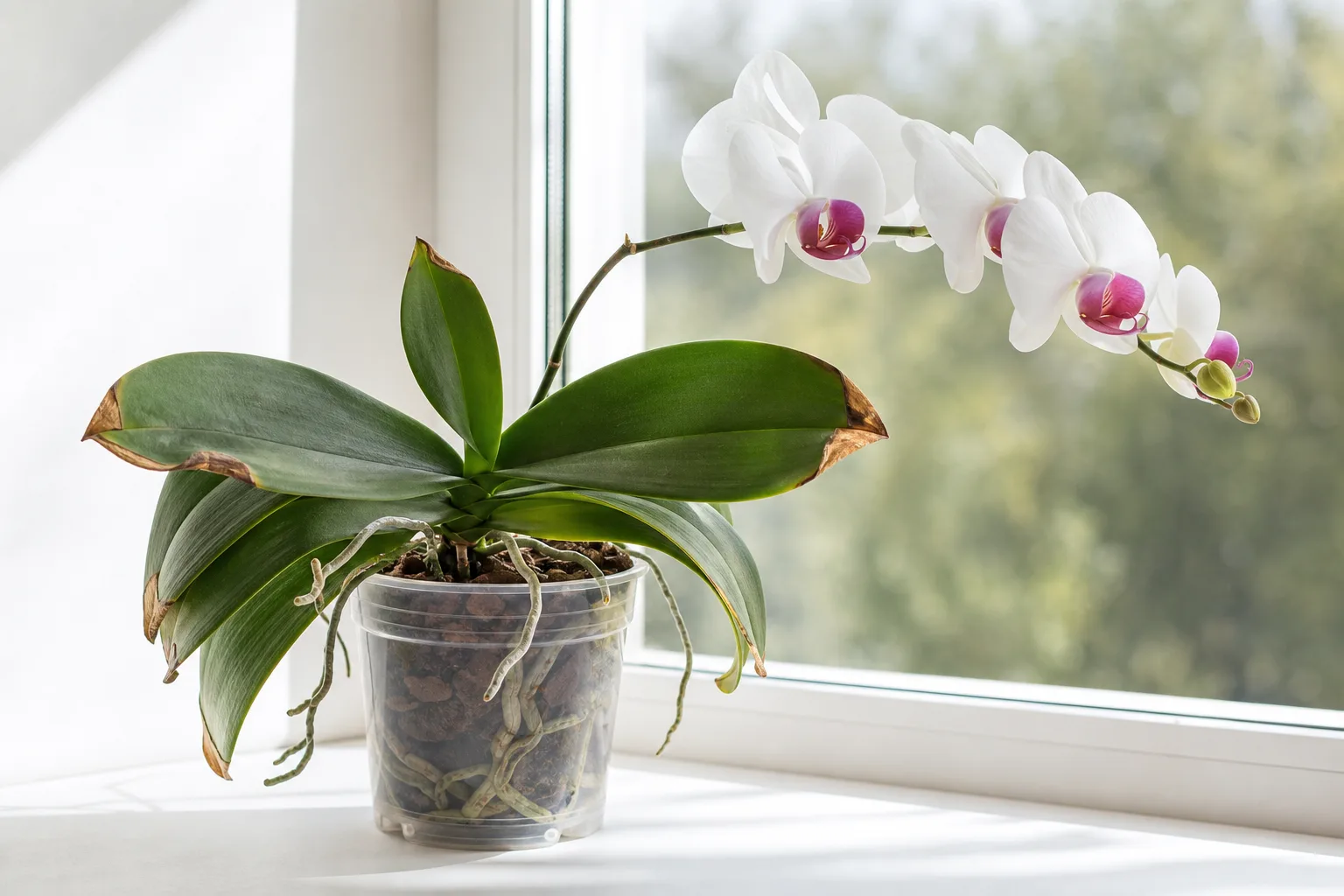
Brown Tips on Phalaenopsis Orchid: Causes, Checks & Fixes
This guide covers brown tips on Phalaenopsis Orchid. See also the general Brown Tips guide, watering, and light pages for this plant.
Brown Tips on Phalaenopsis Orchid: Causes, Checks & Fixes
Quick answer
Brown leaf tips on moth orchids are almost always a culture signal-uneven watering, salt buildup, dry winter air, or failing roots-not a contagious disease. Unlike orchids with water-storing pseudobulbs, Phalaenopsis holds moisture mainly in its thick leaves and roots, so the leaf tip-the farthest point from the water supply-dries first when something in the root zone or air goes wrong.
First step: read your roots, not just the brown edges. Lift the inner pot out of any decorative sleeve and peek through clear plastic. When aerial and pot roots look silver-grey or dull white, the bark is dry enough to water-see the watering guide for soak rhythm. When roots are bright green, the plant still has moisture; watering again often worsens tip stress from salt buildup or soggy roots. Route wet-bark limp leaves to overwatering or root rot even when tips look dry.
For year-round culture context, start with the Phalaenopsis overview.
When to use this page vs other guides
| Your situation | Start here | Related guide |
|---|---|---|
| Crispy dry tips on firm leaves; root colour unclear | This brown-tips page - tip-burn differential | Watering guide for silver-grey rhythm |
| Tips browning in heated winter rooms; no salt crust | Humidity stack | Low humidity |
| Bright green roots, wet bark, limp or yellow leaves | Not classic tip burn | Overwatering |
| Silver-grey roots, dry bark, wrinkled leaves | Thirst, not salt | Underwatering |
| Mushy roots, sour bark, soft spreading brown margins | Escalation | Root rot |
| White crust after feeding season | Salt protocol | Fertilizer guide |
| Bark spongy; tips persist after flush | Media failure | Repotting guide |
What brown tips look like on Phalaenopsis Orchid
On moth orchids, tip damage usually starts at the very end of the strap-shaped leaf and may creep a few millimeters along the margin. Healthy Phalaenopsis leaves are firm, leathery, and olive to light green when light is correct.
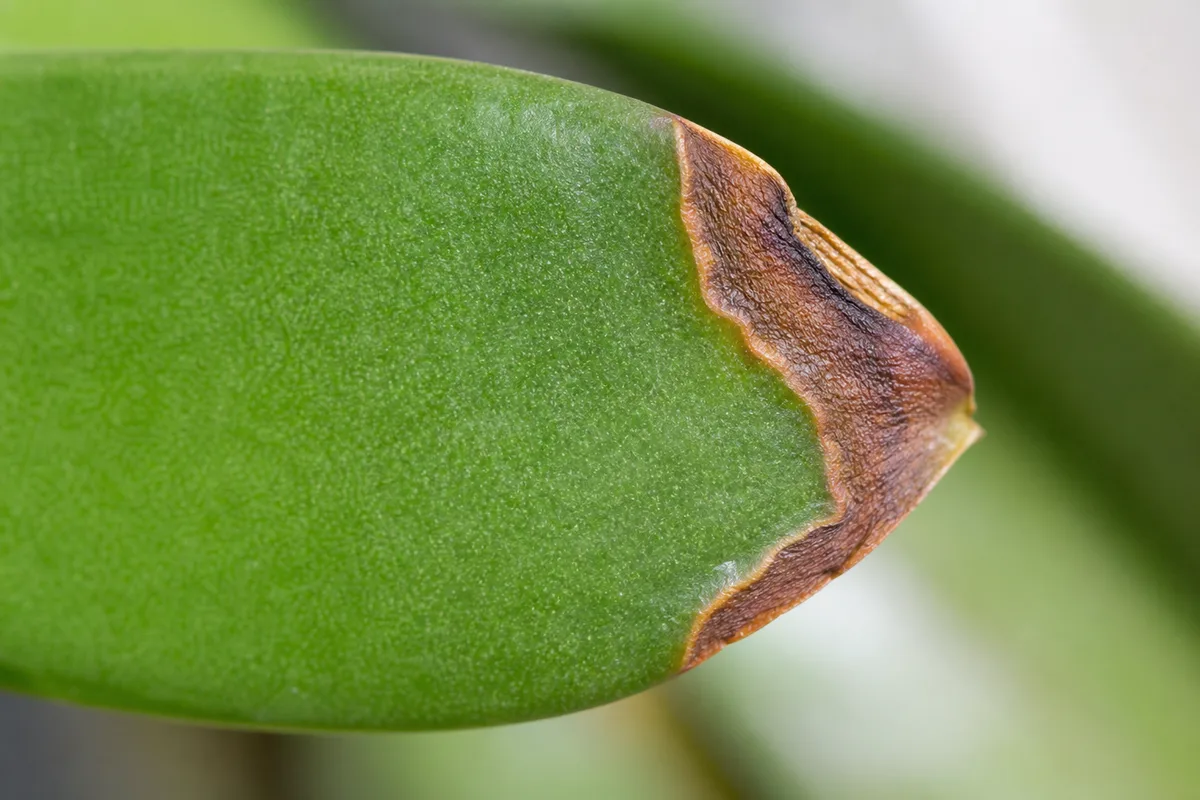
Brown Tips symptoms on Phalaenopsis Orchid - compare with healthy tissue on the same plant.
Typical environmental tip burn:
- Tips turn tan, then crisp brown; tissue feels dry and papery
- The rest of the leaf stays green and firm
- Damage appears on older lower leaves first, or on several leaves at once after a dry winter or heavy feeding
- No yellow halos, no soft wet spots, no foul smell from the leaf
Patterns that suggest a different problem:
- Soft brown patches spreading from tips or crown with wet bark → possible crown or root rot-see root rot
- Wrinkled, accordion-pleated leaves with dry silver roots → underwatering or dead roots blocking water uptake
- Wrinkled leaves with constantly green, soggy roots → overwatering or broken-down bark
- Red-tinged leaf margins with yellow-green foliage → too much direct sun (sunburn, not classic tip burn)
Phalaenopsis naturally loses its oldest bottom leaf every year or two as new leaves form at the top. A single lower leaf with a dry brown tip on an otherwise healthy plant is often old age plus minor stress-not an emergency.
Mini vs standard moth orchids: Small pots in 2–3 inch clear sleeves dry faster-mini Phalaenopsis can show tip burn after a missed weekend watering while a large specimen in old bark may tip-burn from salt crust while bark still feels moist at mid-depth.
Why Phalaenopsis gets brown tips
Moth orchids evolved as tropical epiphytes on tree branches with fast drainage and steady humidity. Indoors, several care mismatches show up first at leaf tips.
Inconsistent watering
Phalaenopsis has no major water-storage organs other than its leaves. Long dry spells followed by heavy soaking stress roots; damaged roots deliver water unevenly, and tips desiccate. Letting bark go bone dry for weeks, then flooding daily, is a common grocery-store orchid pattern that produces repeated tip burn. The watering guide covers the silver-grey-to-green cycle that prevents both extremes.
Salt and fertilizer buildup
Orchid fertilizers are salts. Hard tap water adds calcium and magnesium. Over months, residues concentrate in bark-especially when the mix is never flushed. Phalaenopsis roots are sensitive to salinity when salts accumulate in the medium. Salt-stressed root tips fail first, reducing water delivery to leaf margins. Tip burn after every feeding season or with white crust on bark or pot rims strongly implicates salts. For feeding rhythm and flush protocol, see the fertilizer guide.
Low humidity
Phalaenopsis prefers humidity of 50% or higher. Winter heating and air conditioning drop indoor humidity sharply. When air is very dry, leaves lose moisture through transpiration faster than roots replace it-tips brown while the plant otherwise looks fine. This is common on plants near heat vents or in bright south windows with dry winter air. Deep humidity fixes live on the low-humidity page; this article focuses on telling humidity tip burn from salt and watering causes.
Root problems masquerading as tip burn
Broken-down bark that stays wet causes root death. Ironically, rotting roots can also show as dry brown tips because the remaining healthy root mass cannot hydrate the foliage-even though the bark feels moist. Overwatering and underwatering both end at the same symptom on the leaf edge; root colour and bark moisture tell them apart.
Water quality
Do not use salt-softened water on moth orchids-household softeners add sodium that accelerates mineral buildup. Cold water shocks roots-another reason ice-cube watering often backfires on Phalaenopsis.
Stacked winter stressors
December through February often combines three triggers: furnace-dry air, reduced watering in dull light, and months of fertilizer without a flush. Tips that appear only in winter on firm leaves with silver-grey roots between soaks usually mean humidity plus occasional drought-not rot. Tips that worsen after every winter feeding cycle with visible white crust point to salt first.
How to confirm the cause
Work through these checks in order before repotting or cutting leaves:
- Root colour - Silver-grey or white roots with slightly wrinkled leaves and crispy tips → likely underwatering or chronic drought cycles. Bright green roots with soggy bark and soft lower leaves → likely overwatering or degraded mix.
- Bark moisture and weight - Pick up the pot. Light and dry with silver roots confirms drought. Heavy, wet bark that never dries points to overwatering or poor drainage.
- Salt clues - White or chalky deposits on bark surface, pot rim, or inside the clear pot. Did tips worsen within one to two weeks of fertilizing?
- Humidity context - Is the plant near a heating vent, fireplace, or drafty winter window? Did tips appear in December–February when indoor air is driest?
- Tip texture - Dry and static = environmental burn or salt. Soft, spreading, or smelly = escalate to rot inspection on the root rot page.
- Recent care changes - New bark, moved window, vacation drought, or doubled fertilizer? Timing often reveals the trigger.
If roots are firm and plump (white when dry, green when wet), the crown is dry, and tips are only crispy-dry, you are dealing with manageable stress-not a lost plant.
Brown-tip lookalike comparison table
| Signal | Environmental tip burn | Salt buildup | Low humidity (winter) | Root rot / wet bark | Sunburn | Old-leaf senescence |
|---|---|---|---|---|---|---|
| Tip texture | Crispy, dry, static | Crispy; may follow feeding | Crispy; often several leaves | Soft or spreading with wet bark | Bleached or red patch mid-leaf | One lower leaf only |
| Root colour | Silver-grey between soaks | Often green; crust on bark | Silver-grey between soaks | Bright green or mushy brown | Firm roots | Firm roots |
| Bark | Normal dry-down | White crust on rim/bark | Dusty dry between soaks | Wet, heavy, may smell sour | Normal | Normal |
| Season | Any | Post-fertilizer weeks | Heating season | Any; worse in old bark | Bright south/west window | Year-round on oldest leaf |
| First action | Correct soak rhythm | Flush salts; pause feed | Humidity tray; see low-humidity | Stop water; inspect roots | Filter light | None if plant otherwise healthy |
First fix for Phalaenopsis
Stabilize watering based on root colour-not the calendar.
Place the pot in the sink. If roots are silver-grey and the pot feels light, run lukewarm water through the bark in several short passes over about ten minutes until aerial roots turn pale green. Let the pot drain completely before returning it to its saucer-never let the inner pot sit in trapped sleeve water. If roots are already bright green and bark feels wet, skip watering and improve airflow instead; follow overwatering dry-down steps.
Do not mist leaves as your main humidity fix-misting usually does not provide enough moisture under indoor home conditions. Do not fertilize a plant showing active tip burn until watering rhythm is stable for two to three weeks.
Step-by-step recovery
After the initial watering correction:
- Flush salts if crust is visible or you over-fed. Run plain lukewarm water through the pot three to four times in one session, letting it drain fully each time. Resume a lighter feeding schedule only after new roots look green and plump-details in the fertilizer guide.
- Raise humidity without wetting roots. Set the pot on a pebble tray filled with water so the pot bottom sits above the water line. Group orchids together. A humidifier targeting 50–70% room humidity helps more than occasional misting. For vent placement and winter-only dryness, see low humidity.
- Trim only fully dead tissue. Snip crispy brown tips with sterilized scissors, following the natural leaf shape and leaving a tiny brown margin to avoid cutting into living green tissue.
- Adjust fertilizer. Feed actively growing plants every third or fourth watering at half label strength; skip feeding in low-light winter months. Flush bark with plain water once a month during the growing season.
- Repot only if bark is broken down or roots are mushy. Fresh coarse orchid bark restores drainage when the old mix holds water like mulch-see repotting for timing and bark selection. Trim dead brown roots with a sterile blade; keep firm white roots intact.
- Move off heat vents and out of direct midday sun. Filter harsh south or west light with a sheer curtain if leaf margins redden.
Worked recovery example
A typical salt-and-winter stack: tips appear on three leaves in January after a heavy autumn feeding schedule, with white dust on the inside of a clear sleeve and the plant on a heat vent.
- Week 1: Pause fertilizer. Soak when roots silver; run three plain-water flushes in one sink session. Move off the vent onto a pebble tray.
- Weeks 2–3: Root tips look plump and green after soaks; no new tip damage on emerging leaf.
- Weeks 4–6: New leaf at the crown opens with a clean margin; old browned tips stay trimmed or cosmetic.
Judge success by root colour cycling and clean new growth-not by old blemished foliage re-greening.
Recovery timeline
Correct watering often stops new tip damage within one to two weeks-you will see the next emerging leaf hold a clean edge. Existing brown tips remain brown permanently; they do not heal.
Salt flush benefits may take three to four weeks as new root tips regenerate. If wrinkled leaves plump up and fresh roots appear green after watering, the plant is recovering even if old tips stay trimmed.
Expect slower progress in winter when growth pauses. Judge success by root colour cycling normally (silver when dry, green after watering) and by one or two clean new leaves-not by old blemished foliage.
Mistakes to avoid
Do not keep bark constantly wet to “fix” crispy tips-that promotes root rot and can worsen edge burn.
Do not use ice cubes. Cold shocks roots and delivers too little water for a thorough soak.
Do not repot into standard plant potting mix. Phalaenopsis needs porous bark; dense peat mixes suffocate roots.
Do not cut deep into green leaf tissue when trimming tips-you create a larger wound.
Do not increase fertilizer on a stressed plant hoping to “green up” leaves-salts make tip burn worse.
Do not trim healthy aerial roots for appearance. They absorb moisture and signal when to water.
Do not hide the inner pot in a sealed decorative sleeve without drainage-that masks root colour and traps stale moisture.
How to prevent brown tips next time
Water in the morning so leaves dry by night. Use the root-colour method every time: silver-grey means drink, bright green means wait. Repot into fresh bark every one to two years before it decomposes into a wet sponge. Fertilize lightly and flush monthly. Keep humidity at moderate levels with pebble trays or a humidifier-not standing water touching the pot. Avoid salt-softened water when possible. Stable care beats a perfect calendar.
When to worry
Cosmetic dry tips on a few leaves with firm roots and active new growth are not an emergency. Worry when:
- Browning turns soft and spreads toward the crown
- Leaves wrinkle and stay limp despite wet bark
- Roots are brown, hollow, or mushy on inspection
- The plant stops producing new leaves for several months after a care shock
- Multiple leaves yellow rapidly from the base up
Those patterns mean root or crown failure-not simple tip burn-and need repotting, root trimming, and a strict dry-down cycle on the root rot page rather than more water.
Related Phalaenopsis guides
| Your situation | Start here |
|---|---|
| Silver-grey watering rhythm year-round | Watering guide |
| Winter dry air and vent placement | Low humidity |
| Wet bark, bright green roots | Overwatering |
| Dry bark, wrinkled leaves | Underwatering |
| Mushy roots, sour bark | Root rot |
| Salt crust and feeding schedule | Fertilizer guide |
| Spongy old bark | Repotting guide |
| Culture basics and bloom cycle | Overview |
Conclusion
Brown tips on a moth orchid are a root-zone and air-quality problem before they are a leaf problem. Read silver-grey vs bright-green velamen through the clear pot, use the lookalike table to separate salt, humidity, and rot, and fix one variable at a time-soak rhythm first, then flush, then humidity. Route wet-bark limp foliage to overwatering and mushy roots to root rot. Old tips stay cosmetic; success is the next clean leaf and normal root colour cycling.
FAQs
Should I trim brown Phalaenopsis leaf tips or leave them?
Trim only fully dried, papery brown edges if they bother you-dead tip tissue will not re-green. Snip along the natural leaf shape with sterilized scissors and leave a thin brown margin so you do not cut into living green tissue. Deep trimming on very dry winter days can expose fresh cuts to low humidity and slow recovery.
Brown tips after fertilizing-is that salt burn?
Often yes. Orchid fertilizers are salts that concentrate in bark when you skip monthly flushes. White or chalky crust on bark, pot rims, or inside a clear sleeve within one to two weeks of feeding strongly implicates salt buildup. Stop fertilizing until watering rhythm is stable for two to three weeks, then flush bark three to four times with plain water before resuming at half strength per the fertilizer guide.
Brown tips in winter only-humidity or watering?
Usually both stacked. Heated rooms drop humidity while you may water less often in dull light-or more if the pot sits on a heat vent. Crispy static tips on firm leaves with silver-grey roots between soaks point to dry air; see the low-humidity guide for tray and humidifier fixes. Wrinkled leaves with wet bark and bright green roots are not humidity tip burn-route to overwatering or root rot instead.
Can brown tips mean my Phalaenopsis is dying?
Cosmetic dry tips on several firm leaves with healthy root colour cycling are not a death sentence. Worry when browning turns soft and spreads toward the crown, leaves wrinkle while bark stays wet, roots go mushy brown, or the crown feels soft-those patterns mean root or crown failure. Judge recovery by the next one or two new leaves emerging with clean tips.
How do I read root colour through a decorative cachepot?
Slide the inner clear pot out of the sleeve-grocery-store orchids often hide velamen colour behind opaque wraps. Silver-grey or dull white aerial roots mean the bark is dry enough to water; bright green roots mean wait. If you cannot see roots at all, lift pot weight and smell the drain hole: light and dusty dry confirms drought; heavy and sour-smelling points to wet bark problems on the overwatering page.