Phalaenopsis Orchid Light: Windows, Leaf Color & Rebloom
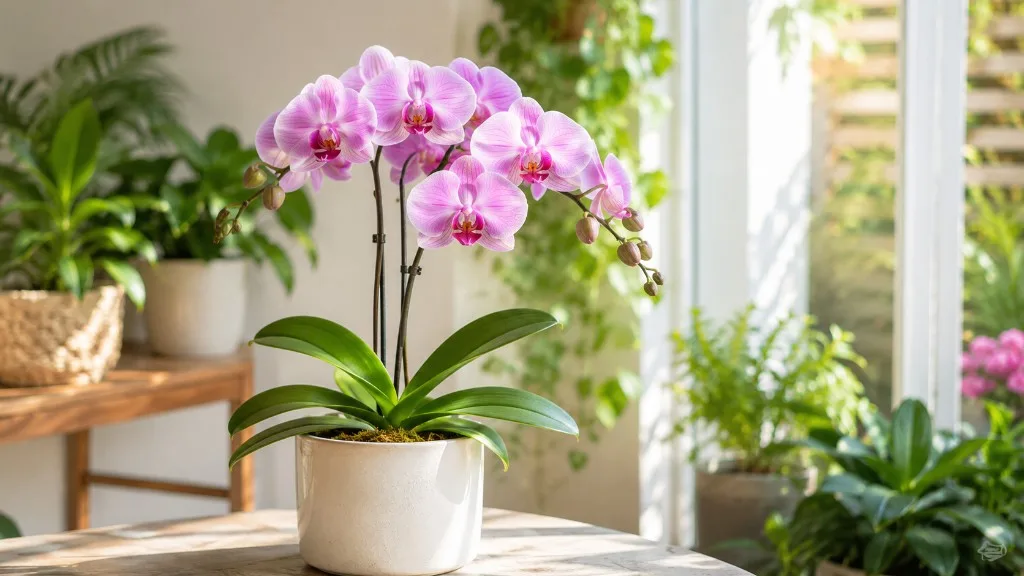
Phalaenopsis Orchid Light: Windows, Leaf Color & Rebloom
Phalaenopsis Orchid Light: Windows, Leaf Color & Rebloom
Phalaenopsis light is the variable most beginners get wrong - not because moth orchids are fussy, but because they look fine in dim rooms long after light has become limiting. A grocery-store phalaenopsis on a kitchen counter can hold its last bloom spike for weeks while leaves slowly darken, new growth stalls, and the plant quietly stops building the carbohydrates it needs to flower again. The fix is rarely more fertilizer. It is usually more usable light, placed correctly, read through leaf color rather than room brightness.
Phalaenopsis spp. are epiphytic orchids from filtered forest light in tropical Asia. Indoors they want bright, indirect exposure - strong plant-facing brightness without harsh direct sun through glass. The American Orchid Society culture sheet calls phalaenopsis a low-light orchid by greenhouse standards, yet still places the optimum around 1,000–2,000 foot-candles under shade cloth. That is brighter than most interior shelves and dim north-window corners. The RHS Phalaenopsis growing guide adds the seasonal rule beginners miss: position moth orchids in bright light in winter to encourage flowering, but keep them out of direct summer sun that scorches leaves.
This guide covers window placement, measurable intensity targets, the leaf-color gauge professionals use, grow-light setup, acclimation after a move, and the rebloom connection that separates a surviving phalaenopsis from one that flowers again.
Why Phalaenopsis Light Is Different From Regular Houseplants
Terrestrial houseplants often grow in peat mixes that forgive low light by slowing metabolism. Phalaenopsis grows in open bark with velamen-covered roots that photosynthesize in good light - a trait Missouri Botanical Garden notes when explaining why clear pots help growers read root and leaf health together. Light is not decorative for moth orchids. It is the fuel for growth, root function, and rebloom.
Epiphytic Habit and Filtered Light
In habitat, phalaenopsis clings to tree branches beneath canopy gaps where light is bright but filtered - not deep shade, not all-day blazing sun. The Missouri Botanical Garden Plant Finder describes Phalaenopsis as epiphytic orchids native to India, southern China, and Southeast Asia, typically grown indoors at 18–29°C with high humidity and bright indirect light. That ecology maps cleanly to an east-facing window indoors: gentle morning brightness plus strong ambient light the rest of the day.
Calling phalaenopsis a “low-light orchid” causes predictable mistakes. It means low relative to cattleyas and vandas, not low relative to a hallway with no window path. A plant that tolerates a north window for maintenance may still fail to rebloom there because carbohydrate production stays below the threshold flowering requires.
Why Leaf Color Is Your Best Light Gauge
Forget judging light by how bright the room feels to your eyes. Human vision adapts; plants do not. For phalaenopsis, leaf color is the field instrument. The AOS culture sheet and Missouri Botanical Garden visual guide both use leaf color as a light gauge: leaves should be olive or medium green. Darker green means the plant is producing extra chlorophyll to capture scarce light - it needs a brighter position. Red-tinged leaves mean too much light or heat. Pale, yellowing, or bleached patches point to sun stress or a sudden move to harsh exposure.
This diagnostic is more reliable than compass direction alone. A west window with sheer curtains may produce perfect medium-green leaves while a supposedly “gentle” north exposure yields slow, dark, floppy growth. Check the newest fully expanded leaf monthly. Old leaves retain scars from previous locations; new leaves tell you whether today’s placement works.
Best Light for Phalaenopsis Indoors
The practical target for most homes is bright indirect light at the leaf surface for much of the day - enough intensity that new leaves emerge firm and medium green without scorch, bleaching, or the long-term darkening that signals chronic under-lighting.
Bright Indirect Light Explained for Moth Orchids
Translate “bright indirect” with the hand shadow test the AOS culture sheet describes: hold your hand about 30 cm (1 ft) above the leaves on a clear day. For phalaenopsis you should see no shadow, or at most a very faint blurred outline - not a sharp dark shadow. A sharp shadow means direct sun or intensity high enough to risk scorch on leaves formed in lower light.
New York Botanical Garden’s phalaenopsis libguide puts the measurable range at roughly 1,000–1,600 foot-candles for this genus - aligned with AOS greenhouse shade targets. Indoors you rarely need a light meter to succeed, but the numbers explain why a plant six feet from a window often underperforms while one on an east sill thrives. Bright enough to read comfortably by daylight at the leaf surface is a workable floor; medium-green new leaves are the ceiling check that keeps you from overshooting into scorch territory.
Foot-Candles and What AOS Recommends
Greenhouse growers target 1,000–2,000 foot-candles (about 10,750–21,500 lumens per square meter) under 70–85% shade, per the AOS culture sheet. Home windows do not match greenhouse shade cloth, which is why placement skill matters. An unobstructed east window often lands in the useful range for phalaenopsis without supplemental shade. A south or west pane in midsummer can exceed it dramatically - the RHS explicitly warns against direct summer sun on moth orchid leaves.
If you own a light meter or lux app, treat 1,000 fc as a workable minimum for growth and watch leaf color above raw numbers. Species and hybrid lines vary slightly. A clone that reddens at 1,400 fc in your west window may look perfect at the same reading on an east exposure with cooler morning sun.
Best Window Placement
Window direction is a starting point, not the whole answer. Overhangs, tree shade outdoors, tinted glass, sheer curtains, and pot distance all change intensity. Still, compass orientation gives a reliable first guess in the northern hemisphere.
Place the pot where leaves receive light, not where the room looks bright. Rotate a quarter turn every two to three weeks if growth leans toward the glass - normal directional growth, not a crisis, but rotation keeps the plant symmetrical.
East, North, and Filtered South/West Compared
| Window | Typical indoor use for phalaenopsis | Season notes |
|---|---|---|
| East | Default best choice - bright morning light, cool relative to afternoon sun | Strong year-round; often needs no curtain |
| North | Acceptable for maintenance; growth and rebloom often slow | Weakest in winter; consider grow-light supplement |
| South | Use only with distance, sheer curtain, or winter-only full exposure | AOS notes full south may be needed in dull northern winters; risky in summer without shade |
| West | Viable with filtering; heat load is the main risk | Watch for bleaching and red leaf margins in midsummer |
The AOS culture sheet ranks an east window as ideal indoors, with shaded south or west acceptable. University of Maryland Extension echoes the east-first guidance and adds that south or west windows work when filtered. Distance matters as much as direction: two to three feet back from an east pane often still performs; the same offset from an unshaded south window in July may scorch.
Winter South Windows in Northern Climates
Day length and sun angle drop sharply from late autumn through early spring at mid and high latitudes. A placement that was too hot in August may become your best rebloom spot in January. The AOS culture sheet notes that in overcast northern winter climates, a full south exposure may be needed - a detail southern growers rarely mention but northern apartment owners depend on.
Move gradually. A plant that spent summer three feet from a filtered south window can often sit closer from November through February without scorch risk. When March sun strengthens, pull it back or add sheer fabric before leaf margins redden. Pair winter brightening with a watering check - brighter exposure dries bark faster even when room temperature feels unchanged.
Can Phalaenopsis Take Direct Sun?
Phalaenopsis can handle brief, gentle direct sun only when leaves were formed at similar intensity and heat load stays moderate. The RHS is clear: keep moth orchids out of direct summer sun that scorches foliage. What reads as “a little morning sun” on an east sill is different from three hours of west-glass afternoon bake.
Acclimation Steps
Sudden jumps cause the damage beginners blame on “orchids being delicate.” Leaves grown in a dim shop need time to build cuticle and pigment for brighter exposure. Use a two-week ramp:
- Week 1: Move to bright indirect one step brighter than the current spot - e.g., from five feet to two feet from the same east window, or add a sheer curtain on west while moving closer.
- Week 2: If newest leaves stay medium green with no bleaching, allow short morning direct sun on east or maintain the brighter indirect position.
- Hold other variables steady: Do not repot, change bark mix, or overhaul fertilizer during acclimation. Read the newest leaf before the next step.
If buds are present, acclimate more slowly. Sudden light plus temperature swing near glass is a common trigger for bud drop.
Scorch and Bleaching Warning Signs
Too much light or heat shows before roots fail. Watch for:
- Bleached white or yellow patches on sun-facing leaf surfaces
- Red or purple leaf margins - anthocyanin buildup from excess light
- Sudden leaf collapse within days of a window move
- Curling during peak sun hours near unshaded glass
Pull the plant back, add sheer fabric, or increase distance. Old scars do not heal; judge recovery by the next leaf only. Persistent scorch on west or south glass may mean the spot is wrong for phalaenopsis year-round regardless of acclimation.
Low Light: Survival vs Rebloom
Phalaenopsis can survive surprisingly dim conditions for months because thick leaves store water and carbohydrates. Survival is not rebloom. The difference matters more for moth orchids than almost any other common houseplant because flowering depends on light-driven carbohydrate reserves plus seasonal cues.
Why Dim Rooms Stop Flowering
The AOS rebloom article lists three rebloom requirements: plant health, sufficient stored carbohydrates, and the correct blooming cue. Light powers the photosynthesis equation that builds those carbohydrates. When light is too low, the plant prioritizes maintenance over flowering. Leaves may darken as chlorophyll increases - a sign the orchid is working harder to capture scarce photons, not a sign of health.
Rebloom also needs a day–night temperature differential - often triggered when night temperatures drop into the 10–16°C (50–60°F) range in autumn, per AOS. A phalaenopsis in the center of a constantly heated room may miss that cue even with adequate light. Light and temperature work together. Fixing one without the other leaves non-blooming plants on interior shelves.
If your plant has not rebloomed in eighteen months despite good care, compare leaf color to purchase day. Darker, larger, floppier leaves with no spike initiation usually mean increase light first, then verify cool-night exposure near a window in autumn. See also our no-flowers and not-enough-light problem guides for troubleshooting branches.
Stretching and Pale New Leaves
Chronic low light produces smaller, paler, elongated new leaves that reach toward the brightest vector in the room. Internodes stretch. The plant may look “leggy” - the same pattern described in our leggy-growth guide. Bark stays wet longer in dim corners, which invites root problems even when you water conservatively. Low light and overwatering on Phalaenopsis Orchid stack: the plant uses less water while the pot dries slowly.
Raise light before increasing water. A brighter phalaenopsis with medium-green leaves and silver-grey roots on a normal dry-down cycle is the target state.
Using Grow Lights
When natural light is weak - north apartments, winter shade from neighboring buildings, or desks far from windows - full-spectrum grow lights fill the gap. Phalaenopsis responds well to artificial light when intensity, distance, and duration match what the AOS culture sheet recommends for home culture.
Distance, Lumens, and Duration
The AOS culture sheet specifies LEDs placed 30–60 cm (1–2 ft) above the plant emitting greater than 10,000 lumens per square meter, with a floor around 2,000 lumens for growth but poorer flowering at that minimum. Fluorescent setups historically used four tubes 15–30 cm above leaves for 12–16 hours daily following natural day length.
Start conservative: 12 hours on a timer, fixture at the upper end of the distance range, then read leaf color after two weeks. Move closer or extend duration only if leaves stay medium green without reddening. Missouri Botanical Garden’s visual guide notes that phalaenopsis under lights should receive enough intensity to keep growth steady without leaf burn - the same leaf-color feedback loop as window culture.
Timer Setup and Constant-Light Caveats
Run grow lights on a timer, not manually. Phalaenopsis needs a believable day–night rhythm for rebloom cues even when light is artificial. Leaving LEDs on 24/7 stresses the plant and can interrupt normal transpiration patterns.
If the fixture runs many hours daily, intensity may need to sit below midday greenhouse maximum because duration compensates partially for peak intensity. Watch for dark green leaves under bright LEDs - paradoxically, constant moderate artificial light can still underdeliver if the fixture is too far or underpowered. Upgrade bulb output or reduce distance before adding hours beyond 16.
How to Move Phalaenopsis Safely to Brighter Light
Any placement change should be one variable at a time. Move the pot, wait ten to fourteen days, read the newest leaf, then adjust watering if dry-down speed changed. Brighter light increases evaporation from bark and leaf surfaces; a schedule that worked in a dim corner will overstay wet near a winter south window.
Avoid stacking stress: do not repot, prune spikes, or relocate to a cold draft the same week you jump from a interior shelf to an east sill. Commercial greenhouse phalaenopsis often arrive light-adapted to bench conditions; your home east window may still be a step down or up. Treat the first month as calibration, not failure.
Light and Watering: Adjust Together
Light and water are coupled for epiphytic orchids more than most beginners expect. The RHS ties healthy culture to warm conditions, good light, and regular watering in the same framework. A phalaenopsis moved to stronger light uses water faster; one moved dimmer needs longer dry-down to prevent rot.
Use the clear-pot root colour shortcut: silver-grey velamen means ready to soak; bright green means wait. In brighter light, that cycle shortens. In dim light, it lengthens - and dark green leaves from low light plus wet bark is a common path to root rot. Adjust water to the new light level, not the old calendar.
Practical Checks
New-Growth Test
After any light change, judge success by the next leaf or root tip, not old damage. Firm, medium-green, normally shaped new growth means the placement works. Continued darkening, bleaching, or stalled leaves mean adjust before touching fertilizer or repotting.
Leaf-Color Diagnostic
| Leaf appearance | Likely light status | Action |
|---|---|---|
| Medium to olive green, firm | Correct range | Hold placement; monitor seasonally |
| Dark green, larger than older leaves | Too little light | Move brighter or add grow light |
| Red margins, compact growth | Possibly too much | Increase distance or filter sun |
| Bleached patches, yellowing sun-facing areas | Direct sun damage | Pull back; acclimate more slowly next attempt |
| Pale, elongated new leaves | Chronic low light | Increase light; check for yellow-leaves from other causes |
Watering Link
Brighter plant, faster dry-down. Dimmer plant, slower dry-down. One sentence, always true for bark-grown phalaenopsis indoors.
Common Phalaenopsis Light Mistakes
Trusting room brightness instead of leaf color tops the list. Moving to a west window without acclimation causes bleaching within days. Keeping a blooming plant in a dim display spot preserves the current spike while guaranteeing poor rebloom odds. Running weak overhead room lights without a dedicated grow fixture rarely delivers enough intensity at the leaf surface. Increasing light without shortening the watering interval leaves bark waterlogged in the brighter, warmer microclimate near glass.
Related Phalaenopsis Care
- Phalaenopsis overview - full care hub
- Watering - root colour and bark dry-down
- Soil and potting mix - bark structure and clear pots
- Fertilizer - feed only when light supports growth
- Repotting - timing relative to light changes
How We Wrote and Verified This Guide
Recommendations were checked against the American Orchid Society Phalaenopsis culture sheet, AOS rebloom guidance, RHS Phalaenopsis growing guide, Missouri Botanical Garden Plant Finder - Phalaenopsis, NYBG phalaenopsis libguide, and University of Maryland Extension Phalaenopsis care. Author: sai-ananth. Reviewer: LeafyPixels Review Board. Reviewed: 2026-06-15.
Conclusion
Phalaenopsis light success comes down to three readable signals: placement (east first, shaded south or west when needed, full south only in dull northern winters), intensity (bright indirect at the leaf - roughly 1,000–2,000 foot-candles in cultivation terms, verified by medium-green leaves and a faint hand shadow), and purpose (survival light is dimmer than rebloom light). Use leaf color as your gauge, acclimate before jumping to a brighter window, pair light changes with watering adjustments, and add a timed grow light when natural exposure cannot reach the leaf surface. When new growth stays firm and olive green, you have solved the variable that stops most grocery-store moth orchids from flowering twice.
When to use this page vs other Phalaenopsis Orchid guides
- Phalaenopsis Orchid overview - Start here for whole-plant context before deep-diving this topic.
- Phalaenopsis Orchid problems hub - Jump to symptom-specific fix guides when this care topic does not resolve the issue.
- Not Enough Light on Phalaenopsis Orchid - Escalate here when light adjustments are not enough.
- Leggy Growth on Phalaenopsis Orchid - Escalate here when light adjustments are not enough.