Phalaenopsis Fertilizer: When, How, and Mistakes
Phalaenopsis Fertilizer: When, How, and Mistakes
Phalaenopsis Fertilizer: When, How, and Mistakes
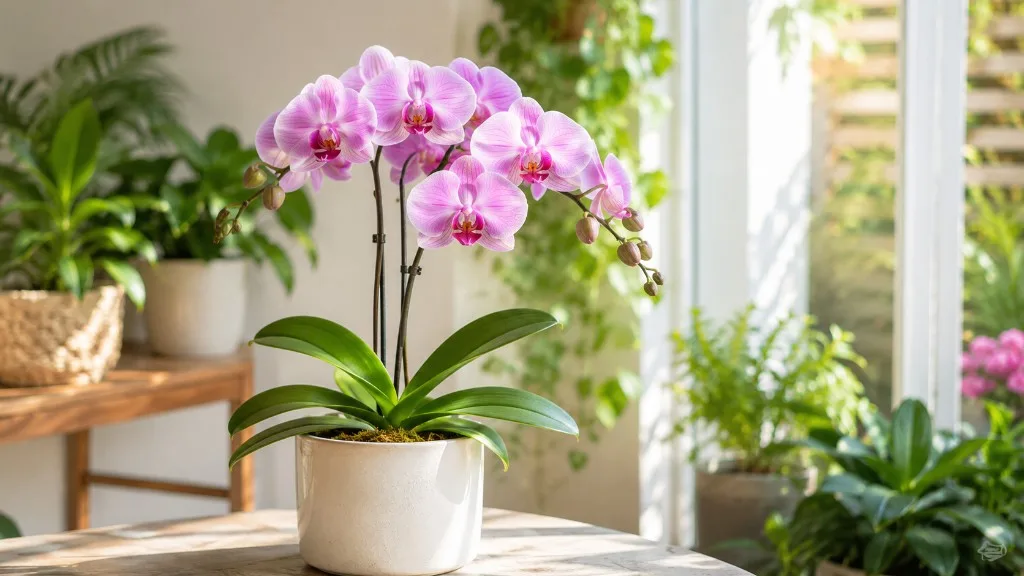
Phalaenopsis fertilizer is one of the most searched orchid care topics - and one of the easiest to get wrong because moth orchids do not grow in soil, do not go fully dormant in winter, and punish salt buildup on bark faster than most houseplants forgive it in peat. Phalaenopsis spp., the moth orchid, is an epiphytic orchid grown indoors in fir bark chips or sphagnum moss, with fleshy aerial roots that absorb moisture and nutrients from thin films of water on tree branches in nature. In a pot, those same roots sit close to concentrated fertilizer salts unless you dilute, flush, and match feeding to growth - not to a generic houseplant calendar.
The practical default for most home growers: balanced urea-free orchid fertilizer at half the label strength once weekly during active growth, with a plain-water flush on the fourth week of each month; reduce to quarter strength in winter rather than stopping entirely; and never apply fertilizer to dry roots. This guide explains the weakly-weekly rhythm, bark-versus-moss adjustments, bloom-booster timing, recovery after over-feeding, and how fertilizer connects to watering, light, and potting medium in your setup.
Why Fertilizer Matters for Phalaenopsis
Phalaenopsis is not a heavy feeder like a summer vegetable garden, but it is also not a plant that thrives on plain water forever in a small bark pot. Each watering leaches small amounts of mineral nutrients from the potting medium; new leaves, roots, and flower spikes draw nitrogen, phosphorus, potassium, and micronutrients from whatever is available in the thin moisture film around roots. Without periodic replacement, a moth orchid in the same bark for two years may push smaller leaves, pale new growth, or fewer buds - symptoms that overlap with insufficient light and underwatering, which is why diagnosis order matters.
The goal is steady, dilute nutrition during growth - not rescue feeding on a stressed plant. Fertilizer supports vigor when light, moisture, and medium structure are already correct. It does not fix crown rot, chronic soggy bark, or a plant that has sat in a dark hallway since November. Master those foundations using the linked care guides, then add nutrients at orchid-appropriate concentrations.
Phalaenopsis Biology and Salt on Bark or Moss
Understanding why moth orchids need weak feeding prevents the two classic errors: treating them like pothos in potting soil, and pausing all nutrition all winter because “orchids rest.” Phalaenopsis is monopodial - one stem grows upward from a single apex, producing leaves sequentially and flower spikes from nodes below. Aerial roots emerge from the stem and ramble over bark or out of the pot; in nature they cling to branches and absorb rain-borne nutrients in extremely dilute concentrations. They did not evolve for monthly doses of full-strength houseplant fertilizer on dry roots.
Aerial Roots and Monopodial Growth
Healthy Phalaenopsis roots should plump silvery-green after watering and turn silvery-grey as they dry - the same visual cue described in our watering guide. Fertilizer salts show up on those roots and on bark chips as white or tan crust long before the plant sends a polite email. Because the root system is exposed and airy, salt damage appears as burnt root tips, stunted new root branches, and brown leaf tips on the youngest leaves. Recovery is measured in new leaf and root-tip growth, not in greening of already-burned tissue.
Quick-Reference: Weakly Weekly Schedule
“Weakly weekly” is the standard orchid feeding mantra: apply fertilizer weekly at one-quarter to one-half the manufacturer’s recommended concentration, and on the fourth watering of each month use plain water only to flush accumulated salts from bark or moss (AOS - Fertilize Weakly Weekly). Missouri Botanical Garden phrases it as fertilizing once each week after watering, or three weeks out of four, with balanced 20-20-20 at half strength during the growing season and quarter strength in winter, plus a monthly clear-water flush (MBG Phalaenopsis guide).
| Season / phase | Frequency | Dilution | Fourth-week action |
|---|---|---|---|
| Spring–summer active growth | Weekly (or 3 of 4 weeks) | Half label strength | Plain-water flush |
| Fall transition | Weekly to biweekly | Half strength tapering | Flush if crust visible |
| Winter indoor growth | Weekly or biweekly | Quarter strength | Flush monthly |
| Post-repot / stress | None 4–6 weeks | - | Plain water only |
| Spike initiation (optional) | With weekly feed | Balanced or bloom-booster | Do not increase strength |
The table is a single reconciled schedule - not the contradictory “weekly in body, monthly in FAQ” pattern that breaks trust on templated pages. If your home is cool, dim, or the plant is blooming heavily on stored energy, lean toward the quarter-strength column even in summer.
When to Fertilize Through the Year
Phalaenopsis grown indoors under typical room conditions continues producing leaves and roots through winter, unlike many cattleyas that go visibly dormant (AOS - Fertilize Weakly Weekly). That means winter is reduced-rate feeding, not zero feeding for most moth orchids on a windowsill. Feed when you see active root tips, new leaves unfurling, or a developing spike on a plant that is otherwise healthy - and withhold when the medium is dry, the plant was recently repotted, or roots are rotting.
Spring Through Fall: Half-Strength Weekly
From roughly March through September in temperate climates - adjusted for your actual light and heating - apply half-strength balanced orchid fertilizer weekly as part of your normal watering routine. The American Orchid Society notes that on bark-based media, a high-nitrogen formula such as 30-10-10 twice monthly is sometimes used because bark decomposition consumes nitrogen; for most beginners, a balanced fertilizer at weak strength is simpler and safer. NC State Extension summarizes the rate as twice monthly at half strength or weekly at quarter strength - mathematically similar to weakly weekly at half strength three weeks plus a flush week.
Pair feeding with the weekly watering rhythm in our watering guide: water first so roots and bark are moist, then run dilute fertilizer through the pot the next morning if your schedule separates the two steps. Never let fertilizer sit in a saucer or cachepot.
Winter: Quarter-Strength, Not a Full Pause
Do not stop fertilizing Phalaenopsis all winter unless the plant is clearly stalled - no new roots, no leaf growth, and cool dim conditions. Missouri Botanical Garden instructs growers to fertilize at quarter strength during winter (MBG Phalaenopsis guide). AOS states that phalaenopsis continue growing in winter and should be fertilized, albeit at a lower rate (AOS - Fertilize Weakly Weekly). The RHS recommends feeding only sparingly, if at all, during winter months (RHS growing guide) - a conservative option for plants in cool rooms with little new growth.
Practical rule: if new leaf or root activity continues, feed quarter strength every one to two weeks; if the plant is static in a 16 °C room with short days, skip feeds for several weeks but resume at quarter strength when growth restarts - do not jump back to half strength immediately.
Best Fertilizer Type for Phalaenopsis
Choose a water-soluble fertilizer labeled for orchids or urea-free formulations intended for epiphytes. Regular houseplant fertilizer with urea as the primary nitrogen source can release ammonia in dry bark before roots absorb it, burning sensitive orchid roots - a key reason orchid-specific products exist. Look for nitrate- or ammonium-nitrogen sources on the label when possible.
Balanced vs. Bloom-Booster; Urea-Free Selection
Balanced 20-20-20 (or similar even NPK) supports year-round vegetative health and is the default recommendation in Missouri Botanical Garden and NC State guidance. The American Orchid Society suggests switching to a high-phosphorus fertilizer such as 10-30-20 when flowering is desired to promote blooming - apply at the same weak dilution, not full bottle strength. Use bloom-booster when a spike is initiating or during early spike elongation, not as a year-round replacement for balanced feed. Returning to balanced formula after the spike is set avoids excess phosphorus when the plant returns to leaf and root growth.
Avoid slow-release pellets in small 10–12 cm orchid pots unless you understand release curves - heat and frequent watering dump nutrients unpredictably. Avoid foliar feeding as your primary method; moth orchid leaves are not the main uptake surface. Avoid weed-and-feed or lawn products entirely.
Bark vs. Moss: Frequency and Flush Timing
Fir bark drains fast and shows white salt crust on chip surfaces when feeding is too strong or flush intervals are skipped. Sphagnum moss holds moisture and retains fertilizer salts more tightly, making flush-out harder (AOS - Fertilize Weakly Weekly). Moss-grown Phalaenopsis often needs more dilute fertilizer (quarter strength even in summer) and more frequent plain-water flushes - every third watering instead of every fourth if you see crust on the moss surface.
| Medium | Typical summer dilution | Flush cadence | Warning sign |
|---|---|---|---|
| Coarse bark, clear pot | Half strength weekly | Every 4th watering | White crust on bark, burnt root tips |
| Fine bark / bark mix | Half to quarter weekly | Every 4th watering | Slower drainage, sour smell |
| Sphagnum moss | Quarter strength weekly | Every 3rd–4th watering | Moss surface crust, stalled roots |
| Fresh repot bark | None 4 weeks, then quarter | Plain water only | New root tips sensitive |
If you are unsure which medium your plant uses, see our soil and potting guide. Repotting into fresh bark every one to two years resets salt load - plan a four-week feed pause after repot per our repotting guide.
Dilution: Half vs. Quarter Strength
Half strength means using half the fertilizer volume the label specifies per gallon (or liter) of water. Quarter strength means one-quarter the label volume. If the bottle says 1 teaspoon per gallon, half strength is ½ teaspoon and quarter strength is ¼ teaspoon. Measuring consistently matters more than brand loyalty - a syringe or small measuring spoon prevents the “splash and hope” method that causes burn.
Missouri Botanical Garden warns that orchids are harmed by high fertilizer concentration (MBG Phalaenopsis guide). When in doubt, dilute further and feed slightly more often rather than concentrating a monthly dose - moth orchids evolved on rain-thin nutrition, not monthly houseplant spikes.
Worked Example: One Month on Bark in a Clear 12 cm Pot
Week 1: Water Tuesday morning when roots are silvery; Wednesday apply half-strength 20-20-20 urea-free orchid fertilizer until drain runs faintly tinted. Week 2: Repeat water-then-feed. Week 3: Repeat. Week 4: Plain water only - run tepid water through bark for several minutes, discard all saucer water, check for salt crust on pot rim. Winter adjustment: same rhythm but quarter-strength solution weeks 1–3. If a new spike appears week 2, swap one feed for quarter-strength 10-30-20 bloom-booster instead of doubling the dose.
Step-by-Step: Fertilize Phalaenopsis Safely
Check roots and medium moisture - roots should be moist from a recent watering, never bone dry (RHS growing guide). Mix fertilizer at half or quarter strength in tepid water. Pour slowly through the bark or moss until it drains freely from the bottom - avoid pooling in the crown; AOS warns against water sitting in the crown. Empty saucers and cachepots immediately. Record the date on your calendar for flush week. Inspect aerial roots and bark surface monthly for salt crust. Adjust strength down if new leaf tips brown within two weeks of feeding.
Pre-Feed Checks Before Every Application
Run this 60-second checklist before every fertilizer application: (1) Are roots green or plump silvery from recent moisture - not shriveled grey on dry bark? If dry, water with plain water first and feed tomorrow. (2) Is there white crust on bark or pot rim? If yes, flush and skip feed this week. (3) Was the plant repotted in the last four weeks? If yes, wait. (4) Are leaves yellowing widely or roots mushy? If yes, diagnose root rot before feeding. (5) Is it winter with slow growth? Drop to quarter strength. (6) Is the plant blooming on a stressed root system? Feed lightly at quarter strength only if roots look healthy in the clear pot.
Signs of Good Feeding vs. Over-Fertilizing
Well-fed Phalaenopsis pushes firm, glossy new leaves at a steady interval, maintains bright green roots after watering, produces sturdy flower spikes when light and temperature cues align, and shows no white mineral crust on bark surfaces. Growth may be slower than a fertilized pothos - that is normal for orchids.
Over-fertilizing shows brown or black tips on newest leaves, white or yellow crust on bark and pot rim, burnt aerial root tips, sudden leaf drop after a heavy feed, and stunted new roots that blacken at the tip. These overlap with brown tips from fluoride or dryness - but crust on bark plus a recent full-strength feed points strongly to salts. Under-fertilizing shows pale, smaller successive leaves over months - but rule out low light and underwatering first; moth orchids in dim corners will not green up from nitrogen alone.
Flushing After Over-Feed or Salt Buildup
At the first sign of salt crust or tip burn after feeding: stop fertilizer immediately. Flush by running plain tepid water through the pot for several minutes until drain water runs clear - repeat once if crust was heavy (MBG Phalaenopsis guide). Pause feeding for four to six weeks. Resume at quarter strength for two feeds, then return to half strength if new growth looks clean. Trim only fully dead tissue; burned margins do not heal.
If crust penetrates deep into moss or bark has not been refreshed in three or more years, schedule repotting into fresh medium after the flush - old moss especially re-releases stored salts with every watering. Recovery signal: a new leaf opens without tip burn, or new root branches emerge green-tipped from the stem.
When Not to Fertilize
Never feed when: roots are dry and silvery-shriveled; the plant was repotted within four weeks; roots are rotting or the medium smells sour; the plant suffered recent bud drop or no flowers after a move - stabilize environment first; you already applied full-strength fertilizer by mistake this week; or the orchid is recovering from heat or cold shock. Fertilizer on damaged roots accelerates burn and can trigger root rot in already-compromised tissue.
Hard tap water high in dissolved minerals compounds fertilizer salts (AOS - Fertilize Weakly Weekly). If white deposits coat leaves after watering, consider rainwater or reverse-osmosis water for both irrigation and dilution, and feed at quarter strength until deposits lessen.
When to use this page vs other Phalaenopsis Orchid guides
- Phalaenopsis Orchid overview - Start here for whole-plant context before deep-diving this topic.
- Phalaenopsis Orchid problems hub - Jump to symptom-specific fix guides when this care topic does not resolve the issue.
- No Flowers on Phalaenopsis Orchid - Escalate here when fertilizer adjustments are not enough.
Related Phalaenopsis Orchid guides
- Phalaenopsis Orchid overview
- Phalaenopsis Orchid watering
- Phalaenopsis Orchid light
- Phalaenopsis Orchid soil
- Phalaenopsis Orchid propagation
- Phalaenopsis Orchid repotting
- No Flowers on Phalaenopsis Orchid
- Phalaenopsis Orchid problems
Conclusion
Phalaenopsis fertilizer rewards consistency and punishes concentration. Feed weakly weekly at half strength spring through fall, drop to quarter strength in winter while growth continues, flush with plain water on the fourth week each month, and choose urea-free balanced orchid formula - switching briefly to bloom-booster at the same weak dilution when spikes initiate. Match strength to bark vs. moss, never feed dry roots, and treat white crust on bark as an emergency flush - not a cue to feed more. Get watering, light, and medium right first; then fertilizer becomes a light seasonal supplement that supports rebloom instead of a gamble that burns the roots you depend on.