Spider Mites on Phalaenopsis Orchid: Causes, Checks & Fixes
Quick answer
Spider mites on Phalaenopsis cause stippling and sometimes fine webbing in hot, dry air near sunny windows or heating vents. First step: move the plant away from neighbors and rinse every leaf underside-including where leaves meet the crown-before applying any spray.
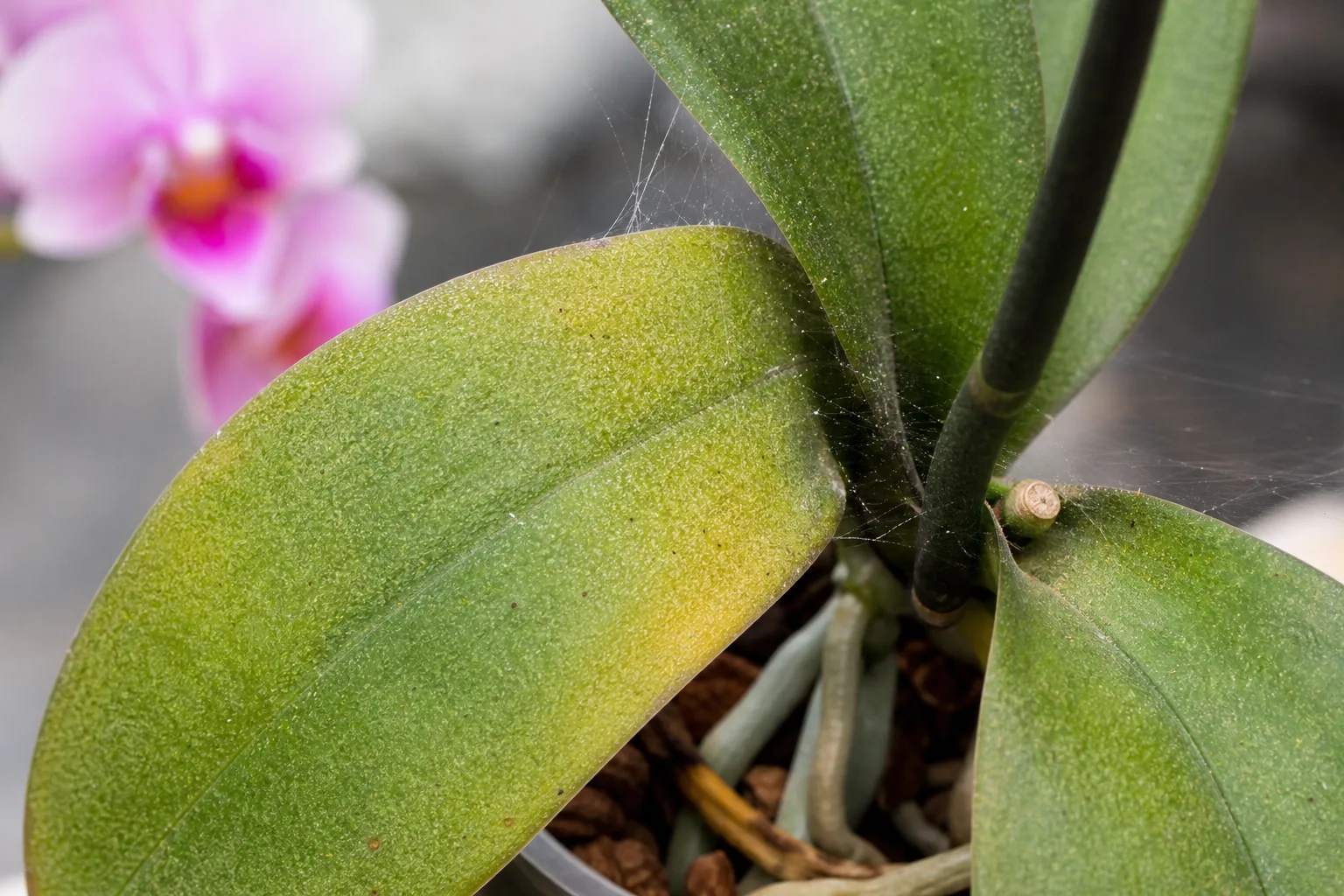
Spider Mites on Phalaenopsis Orchid: Causes, Checks & Fixes
This guide covers spider mites on Phalaenopsis Orchid. See also the general Spider Mites guide, watering, and light pages for this plant.
Spider Mites on Phalaenopsis Orchid: Causes, Checks & Fixes
Quick answer
Spider mites on Phalaenopsis (Phalaenopsis spp., moth orchid) show up as pale stippling on broad leaves, sometimes with fine silk at the crown or between leaf bases. They thrive where indoor air runs hot and dry-exactly the microclimate around a sunny window or heating vent, even though Phalaenopsis wants moderate humidity and Phalaenopsis Orchid light guide.
First step: isolate the plant and rinse every leaf underside thoroughly, including the crown junction where webbing hides. Do this before reaching for sprays. Moth orchids grow slowly, so damage on existing leaves will not fade; early rinsing stops spread before the next leaf or spike is ruined.
What spider mites look like on Phalaenopsis
Phalaenopsis leaves are thick and leathery compared with many houseplants, but mites still feed on the undersides and at the crown. Two mite groups attack orchids, and telling them apart matters on moth orchids.
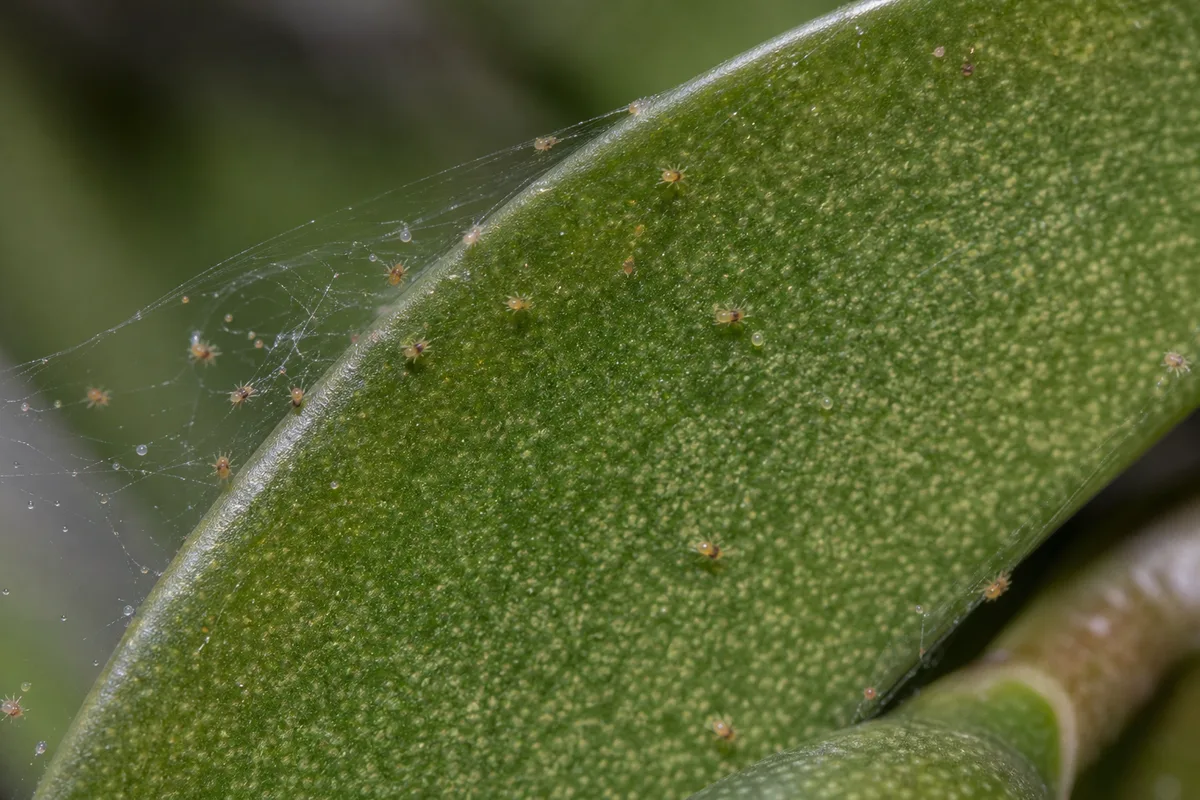
Spider Mites symptoms on Phalaenopsis Orchid - compare with healthy tissue on the same plant.
True spider mites (two-spotted spider mite, Tetranychus urticae) leave:
- Tiny yellow or white speckles that merge into bronze or tan patches on upper leaf surfaces
- Fine silk webbing between leaf bases, at the crown, or along flower spikes
- Dusty, dull foliage that no longer looks glossy
- Moving pinhead-sized dots when you tap a leaf over white paper
Flat mites include Tenuipalpus pacificus, the phalaenopsis mite-a species named because it commonly damages Phalaenopsis. Flat mites do not spin webbing. Instead you may see:
- Silvery patches that later turn rusty brown
- Pock-marked texture on leaf undersides
- White shed skins standing out against damaged tissue
Both types pierce leaf cells and drain chlorophyll. On a slow-growing monopodial orchid, even moderate stippling on two or three leaves is visible for months until those leaves are eventually replaced from the crown.
Webbing at the crown is especially risky. Phalaenopsis grows from a single growing point; heavy webbing and feeding there can stress the plant enough to delay reblooming after the current spike finishes.
Why Phalaenopsis gets spider mites
Moth orchids are epiphytes potted in coarse bark or sphagnum-not soil that holds constant moisture. That open mix does not harbor mites the way dense peat does, but it also does nothing to stop aerial spread. Mites travel on webbing strands, leaf contact between crowded pots, and air currents.
The main trigger indoors is dry air combined with warmth. Spider mites reproduce rapidly in hot, dry conditions. A Phalaenopsis on an east or south windowsill may get excellent light while the leaf surface dries out between waterings, creating a mite-friendly zone. The same plant near a winter heating vent experiences humidity well below the 50–70% range Phalaenopsis prefers, even if you water the bark on schedule.
Other Phalaenopsis-specific factors:
- Broad flat leaves give mites large feeding surfaces and sheltered undersides near the crown
- Slow leaf turnover means early colonies go unnoticed until stippling covers several leaves
- Grouped orchid displays let mites walk from pot to pot when leaves touch
- Post-bloom neglect - owners reduce attention after flowers drop just when dry winter air peaks
- Stress from wrong watering - bark kept too wet or too dry weakens leaves without causing mite stippling directly, but stressed plants show damage faster
Flat phalaenopsis mites are host-specific to orchids and ferns. If you grow multiple genera on one shelf, inspect all of them when one Phalaenopsis shows silvery damage-even without webbing.
How to confirm the cause
Work through these checks in order:
- Tap test - Hold white paper under a suspect leaf and tap the blade firmly. Moving specks confirm active mites. Red or brown streaks on the paper also suggest spider mites.
- Hand lens check - Examine leaf undersides and crown crevices at 10× magnification. True spider mites look like tiny eight-legged dots; flat mites are slower-moving and do not produce silk.
- Webbing search - Mist the plant lightly and hold it toward a light source. Fine webbing shows at leaf bases and the crown on true spider mite infestations. No webbing does not rule mites out-check for flat mite silvery patches.
- Pattern on the leaf - Random fine speckles across the blade suggest mite feeding. Even yellowing from base upward with soft roots points to overwatering on Phalaenopsis Orchid, not mites.
- Location in the home - Note heat vents, sunny glass, or fans. Mite-prone spots often match dry microclimates.
- Neighbor plants - Inspect every orchid within arm’s reach. Mites spread before every plant shows obvious webbing.
If speckling is uniform on the oldest bottom leaf only while the crown and roots look healthy, that may be normal senescence-Phalaenopsis periodically drops its lowest leaf. Mites affect multiple leaves at varied ages and concentrate damage on undersides.
First fix for Phalaenopsis
Move the plant away from other orchids and rinse all leaf surfaces with lukewarm water, targeting undersides and the crown.
Hold the pot at an angle over a sink so water runs through bark and out the drainage holes without leaving the mix soggy for days. Use your fingers or a soft cloth to wipe undersides where mites cluster. This single step knocks down adults and breaks webbing that blocks later treatments.
Do not soak the bark repeatedly in one session-Phalaenopsis roots need to dry between waterings. One thorough rinse, then let the pot drain completely and return the plant to bright indirect light with airflow.
Do not apply horticultural oil or soap before rinsing and confirming live mites. Do not increase watering to “help” a stippled plant unless the bark is genuinely dry.
Step-by-step recovery
After the initial isolation and rinse:
- Repeat water rinses every three to five days for two weeks, focusing on undersides and crown junctions. Break new webbing as soon as it appears.
- Apply insecticidal soap or horticultural oil labeled for spider mites on ornamentals if live mites remain after several rinses. Cover undersides completely. Repeat at five- to seven-day intervals for at least three cycles to catch newly hatched eggs.
- Improve humidity without waterlogging roots - use a humidifier, pebble tray (pot resting above water, not in it), or grouping plants with space between them. Target the 50–70% range moth orchids prefer.
- Adjust placement - move the plant off a hot windowsill or away from heating vents while keeping bright indirect light. An east window with sheer curtain often balances light and humidity better than bare south glass.
- Inspect the collection weekly - treat any neighboring Phalaenopsis showing early stippling even without webbing.
- Trim only heavily bronzed leaves if more than half the blade is dead tissue and the plant is stable-optional, for aesthetics. Do not strip the plant bare; each leaf still photosynthesizes.
For flat phalaenopsis mites without webbing, the same rinse-and-repeat contact treatment applies. Silvery damage will not revert, so focus on protecting new growth at the crown.
Recovery timeline
Rinse knockdown reduces live mites within a few days when populations are moderate. A full three-cycle soap or oil course typically spans two to three weeks because mite eggs hatch on staggered schedules.
Existing stippled Phalaenopsis leaves remain marked permanently-new crown leaves tell you whether control worked. Expect to see clean new tissue within three to six weeks on a healthy plant. Reblooming may pause if the crown was heavily affected; recovery of bloom timing can take one full growth cycle after mites are gone.
If stippling spreads to new leaves during treatment, escalate-extend treatment intervals or isolate more aggressively.
Lookalike symptoms to rule out
Overwatering or root rot on Phalaenopsis Orchid yellows leaves from the base upward, often with soft roots and sour bark-not stippling confined to upper surfaces with moving dots on a tap test.
Too much direct sun scorches leaf tips and produces bleached patches on exposed surfaces, not the fine evenly spaced speckles mites leave. Sunburn lacks webbing and moving specks.
Thrips cause silvery streaks and distorted new growth, sometimes with black specks of frass. Thrips are slender and jump when disturbed-different from round mites.
Mealybugs show as white cottony clusters in leaf axils, not diffuse stippling. Honeydew may feel sticky; mite damage feels dry.
Normal bottom-leaf yellowing affects only the oldest leaf before it drops. Mites hit multiple leaves at different ages simultaneously.
Mistakes to avoid
Do not keep a mite-infested Phalaenopsis on a shared orchid shelf. Isolation is the first containment step, not an optional extra.
Do not spray only the tops of leaves. Mites feed on undersides and at the crown.
Do not stop treatment after one good rinse. Eggs survive; populations rebound within a week in warm dry air.
Do not apply horticultural oil to a plant in direct midday sun or on a heat-stressed orchid-oil plus sun can burn Phalaenopsis leaves.
Do not overwater bark after repeated rinsing. Drainage matters as much as humidity for moth orchid roots.
Do not assume no webbing means no mites. Flat phalaenopsis mites cause serious damage without silk.
Phalaenopsis care cross-check
While treating mites, keep the basics stable:
- Water - Run water through bark until it drains, then let roots turn silvery-grey before the next drink. Do not keep bark constantly wet because you are rinsing foliage more often.
- Light - Bright indirect light from an east or shaded south window supports recovery. Weak light slows new leaf production, extending the time damaged foliage stays on the plant.
- Humidity - Aim for 50–70% around the plant, especially in winter. A humidifier beats misting alone for sustained levels.
- Airflow - Gentle air movement helps foliage dry after rinses and discourages fungal issues, but avoid blasting heat vents directly at the crown.
- Temperature - Phalaenopsis grows best around 18–29°C (65–84°F). Cold drafts and hot dry drafts both stress recovery.
Skip fertilizer until new growth looks clean for two weeks. Feeding a mite-stressed orchid pushes soft tissue mites prefer.
How to prevent spider mites next time
Inspect leaf undersides weekly during dry winter months when heating systems run. A ten-second hand-lens check on crown leaves catches colonies before webbing spreads.
Quarantine new Phalaenopsis purchases for two weeks before placing them beside blooming plants. Retail greenhouses and home environments vary widely in mite pressure.
Maintain moderate humidity in the room-not just near one pot. Pebble trays, humidifiers, or growing in a brighter bathroom during dry spells all help.
Rinse foliage lightly every two to three weeks in hot dry weather. This disturbs early colonies on moth orchids without replacing a full treatment cycle once infestation is established.
Space pots so leaves do not touch. Mites walk between plants faster when canopies overlap on a windowsill.
Keep bark on a proper wet-dry cycle. Roots that stay too wet or too dry weaken leaves that then show mite damage more severely.
When to worry
Treat as urgent when webbing reaches the crown, stippling appears on a flower spike, or multiple orchids on one shelf show speckling. Mite generations can complete in as little as five days under hot dry conditions-delay turns a single pot into a collection problem.
Flat mite damage that turns leaves rusty brown across most of the plant also warrants aggressive treatment even without webbing. Those leaves will not recover, and heavy feeding stresses the monopodial crown.
Consider discarding a severely defoliated, declining Phalaenopsis in a large mixed collection if three full treatment cycles fail and crown tissue softens. For a single cherished plant, persistence with isolation and repeated contact treatments is reasonable.
Light stippling on one leaf with no webbing and no neighbors affected is worth monitoring after one rinse-but recheck in three days with a hand lens.
Conclusion
Spider mites on Phalaenopsis are a dry-air and crowding problem as much as a pest problem. Isolate first, rinse undersides and the crown before spraying, and repeat treatments long enough to break the egg cycle. Old leaves keep their scars on slow-growing moth orchids-watch new crown growth for proof you won. Matching humidity to what Phalaenopsis actually needs prevents most reinfestations after you clear the current outbreak.
When to use this page vs other Phalaenopsis Orchid guides
- Phalaenopsis Orchid watering guide - Use for routine moisture checks before assuming spider mites is the main issue.
- Phalaenopsis Orchid problems hub - Browse all 20 common issues on this species.
- Low Humidity on Phalaenopsis Orchid - Different entry point when symptoms overlap with spider mites.
- Slow Growth on Phalaenopsis Orchid - Different entry point when symptoms overlap with spider mites.