Wilting on Phalaenopsis Orchid: Causes, Checks & Fixes
Quick answer
Wilting on Phalaenopsis Orchid is misleading-the same limp leaves can mean underwatering or failing roots from overwatering. Before you water, check root color through the pot: silver-grey dry roots need water; bright green roots with soggy bark and limp leaves mean stop watering and inspect for rot.
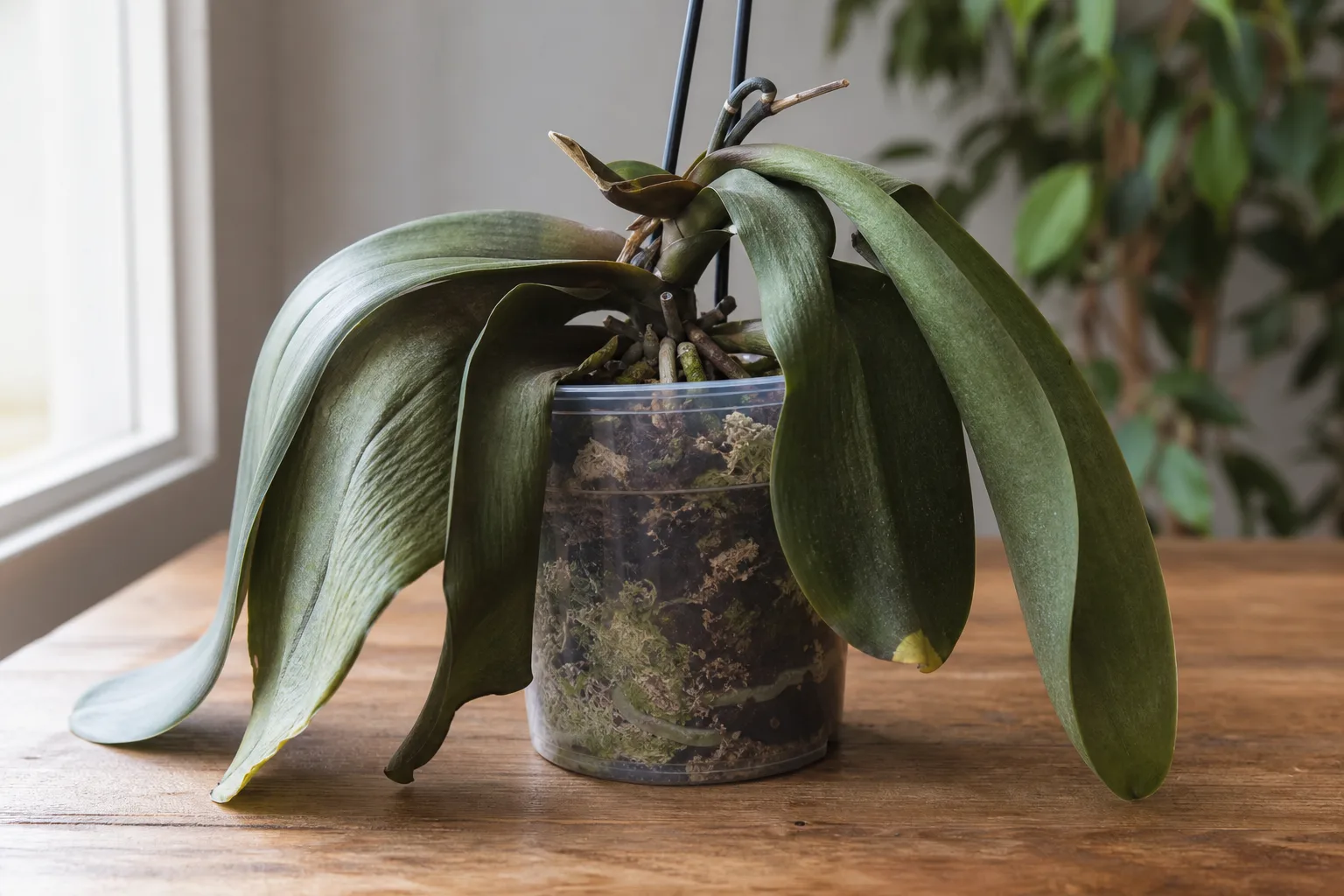
Wilting on Phalaenopsis Orchid: Causes, Checks & Fixes
This guide covers wilting on Phalaenopsis Orchid. See also the general Wilting guide, watering, and light pages for this plant.
Wilting on Phalaenopsis Orchid: Causes, Checks & Fixes
Quick answer
Wilting on a moth orchid is one of the most confusing symptoms in houseplant care because limp, wrinkled leaves look the same whether the roots are too dry or too wet and rotting. Phalaenopsis stores little water in its leaves and has no water-storage pseudobulbs to fall back on, so when roots stop working, the foliage collapses fast.
First step: check root color through the clear nursery pot before you reach for the watering can. Silver-grey roots with light, dry bark mean the plant is genuinely thirsty. Bright green roots sitting in soggy bark with limp leaves mean the opposite-roots are failing and more water will make things worse.
What wilting looks like on Phalaenopsis Orchid
Healthy Phalaenopsis leaves are thick, leathery, and hold their arch without drooping. When turgor drops, the change is obvious:
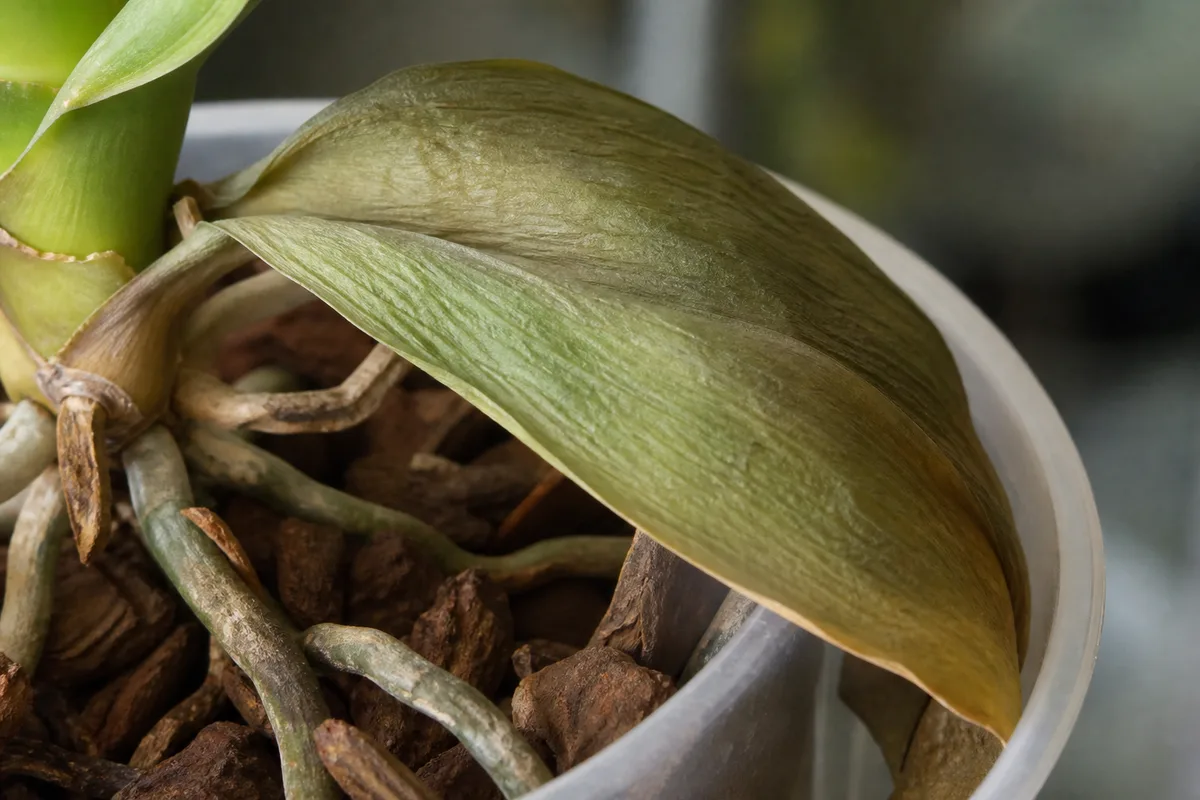
Wilting symptoms on Phalaenopsis Orchid - compare with healthy tissue on the same plant.
Dry wilt (underwatering on Phalaenopsis Orchid):
- Leaves lose firmness and develop lengthwise wrinkles or a accordion-like texture
- Lower leaves may yellow slowly from the tip inward
- Bark feels light; roots visible through the pot look silver-white or grey and may appear slightly shriveled
- Aerial roots look dull silver rather than plump green
- Crown at the base of the leaves stays firm when gently pressed
Wet wilt (overwatering on Phalaenopsis Orchid or root rot on Phalaenopsis Orchid):
- Leaves hang limp and may stay wrinkled even though bark feels wet
- Roots in the pot look bright green constantly, or turn brown to black and mushy when touched
- Bark stays heavy days after the last watering; decorative outer pots may hold standing water
- Sour or musty smell from the medium
- Crown feels soft-a sign rot may be moving upward
Temporary wilt (environmental):
- Follows a sudden move to stronger sun, a heat spike, or recent Phalaenopsis Orchid repotting guide
- Crown remains firm; root color cycles normally between silver and green
- Leaves often perk up overnight once conditions stabilize
Unlike many houseplants, Phalaenopsis is almost always sold in a clear inner pot so you can read root moisture at a glance. That visual cue is your primary diagnostic tool-not leaf touch alone.
Why Phalaenopsis Orchid wilts
Underwatering and chronic dryness
Phalaenopsis has no major water-storage organs beyond its leaves. When bark dries out completely for too long, fine roots die back and leaves wrinkle because the plant cannot pull moisture up fast enough. Low humidity and too little water will result in wrinkled leaves-dry air pulls water from leaf tissue even when some roots remain functional.
Overwatering and root rot
This is the more common reason store-bought moth orchids wilt. Bark that never dries suffocates roots. Decayed roots cannot transport water, so leaves collapse despite wet medium-the classic wilt paradox. Old bark that has broken down into mulch holds water like sponge and is a frequent hidden trigger.
Heat and light stress
High temperatures or a sudden shift to stronger light increase transpiration. If roots cannot keep pace-because they are still recovering from repotting or partially damaged-the plant may wilt in the afternoon and recover overnight. Repeated daily wilt without root color changes warrants a light check, not more water.
Failed bark and wrong medium
Phalaenopsis is epiphytic and needs coarse, airy bark. Standard potting soil or degraded bark that drains poorly keeps roots wet too long. A decorative pot with no drainage hole traps runoff and mimics chronic overwatering even when you think you watered lightly.
Crown rot
Water sitting in the leaf crown overnight can rot the growing point. Do not let water collect in the crown to prevent crown rot. Once the crown softens, the plant cannot produce new leaves and existing foliage wilts without recovery. This is distinct from root-level problems and much harder to reverse.
How to confirm the cause
Work through these checks in order:
- Root color through the clear pot - Silver-grey means dry; plump green means recently watered. Constant green with wilt suggests roots are not functioning.
- Pot weight - Lift the inner pot. Light and airy means dry; heavy and waterlogged means wet.
- Crown firmness - Press gently at the base where leaves meet. Soft tissue means crown involvement-urgent.
- Root touch test - If unsure, slide the plant partly out of the pot. Healthy roots are firm and white to green. Rotten roots are brown, black, hollow, or mushy and may smell sour.
- Recent care history - Ice cubes, watering while inside a sealed decorative pot, or bark older than two years narrows the cause quickly.
- Environmental context - New window placement, heating vent, or post-repot timing explains temporary wilt when roots look normal.
If silver roots pair with dry bark, you have dry wilt. If green or mushy roots pair with wet bark, you have wet wilt. Do not proceed until you know which.
First fix for Phalaenopsis Orchid
Look at root color through the clear pot and do nothing else until you classify dry wilt versus wet wilt.
That single pause prevents the two most damaging mistakes: drowning a rotting plant or leaving a genuinely dry one without water for another week. Once classified, act on one path only-do not combine soak-and-drain with repotting on the same day unless mushy roots are already visible.
Step-by-step recovery
If roots are silver-grey and bark is dry (underwatering)
- Place the inner pot in a sink. Run lukewarm water over bark and aerial roots in several short drenches over about ten minutes, letting each pass absorb before the next.
- Allow the pot to drain completely. Never return it to a saucer or decorative cover while dripping.
- Wait. Leaves often firm within hours to a day; deep wrinkles on older leaves may remain.
- Resume watering only when roots turn silver-grey again-not on a fixed weekly calendar.
If roots are mushy or bark stays wet (overwatering or rot)
- Stop watering immediately. More water cannot reach leaves through dead roots. Orchids are especially susceptible to root rot when media stays wet.
- Unpot gently. Trim all soft, brown, or hollow roots back to firm white or green tissue with sterilized scissors.
- Repot into fresh coarse orchid bark in a pot with drainage. Position the base of the leaves just above the medium surface.
- Wait three to five days before the first light watering so cut surfaces callous.
- Place in Phalaenopsis Orchid light guide with good air movement. Judge recovery by new root tips and firmer leaves-not by old wrinkled foliage alone.
If wilt followed a recent repot or move
Hold watering until roots show their normal silver-to-green cycle. Keep the plant out of direct sun and away from heat vents for a week. Mild afternoon limpness that resolves by morning usually needs time, not intervention.
Recovery timeline
Dry wilt from a single missed watering often shows leaf firmness returning within hours to two days after a proper soak. Chronic underwatering with shriveled aerial roots may need two to three weekly cycles before leaves look fully plump again.
Root rot recovery is slower. New root tips may appear in two to four weeks after repotting if enough healthy tissue remains. Old wrinkled leaves frequently never smooth out completely-watch new growth and root color instead. If no new roots form after six to eight weeks and the crown stays firm, the plant may still be salvageable with patience. A soft crown after corrective care usually means the plant will not recover.
Lookalike symptoms to rule out
Natural leaf aging - Lower leaves yellow and drop one at a time on healthy plants. The crown and roots stay firm; remaining leaves hold their shape.
Bud drop - Flower buds abort from drafts, ethylene, or temperature swings while leaves stay turgid. That is a flowering stress issue, not root wilt.
Sunburn - Margins turn pink, red, or yellow-green from excess light. Leaves may look stressed but roots cycle normally between silver and green.
Salt or fertilizer burn - Tip dieback on otherwise firm leaves with white crust on bark. Root inspection shows firm roots; flushing the medium addresses this, not a drought soak.
Mistakes to avoid
Do not use ice cubes. Cold partial melts do not mimic tropical rain and can chill roots unevenly.
Do not assume wilt always means thirst. Wet-soil wilt is more common on Phalaenopsis than on soil-grown houseplants.
Do not repot into standard potting soil. Epiphytic roots need bark and air.
Do not water while the plant sits inside a sealed decorative pot with no drain hole.
Do not mist the crown heavily at night. Water should run through bark in the morning and drain fully.
Do not fertilize a wilted plant hoping to perk it up. Feed only after roots are healthy and new growth is active.
Do not cut healthy aerial roots-they photosynthesize and absorb moisture from humid air.
How to prevent wilting next time
Water when roots turn silver-grey and the pot feels light, then soak and drain fully. Under normal home temperatures, that is often about once a week-but your room’s light and humidity set the real schedule.
Repot every one to two years before bark decomposes into water-retentive mulch. Choose a bark mix sized for mature plants and a pot only large enough to fit the root mass.
Keep the plant in bright indirect light-east window ideal, shaded west acceptable. Avoid sudden moves into hot south sun.
Use a clear inner pot or check roots when lifting the plant. Root color beats calendar watering every time.
Empty saucers and decorative pots within an hour of watering. Never let roots sit in standing water.
Maintain moderate humidity without flooding pebble trays under the pot-that keeps roots wet at the base while leaves look fine.
When to worry
Act immediately when wilt comes with a soft crown, black mushy roots that smell sour, or bark that stays sodden for a week despite no recent watering. Those signs mean active rot and the window for saving the plant narrows quickly.
Dry wilt with silver roots is less emergent but still needs water within a day or two-Phalaenopsis does not tolerate long drought the way succulents do.
Consider replacing the plant if, after repotting and eight weeks of stable care, no new roots appear, leaves continue to yellow from the base, and the crown begins to soften. Salvage is sometimes possible from a single healthy leaf and root, but a crownless moth orchid cannot regenerate its growing point.
Conclusion
Wilting on Phalaenopsis Orchid is a root report, not a thirst alarm. Silver-grey roots and light bark mean soak and drain; green mushy roots and wet bark mean stop watering and trim rot. Read the roots first, act on one clear path, and judge recovery by new root tips and crown firmness-not by whether every old wrinkle disappears. That diagnostic habit prevents the overwatering cycle that kills more moth orchids than underwatering ever does.
When to use this page vs other Phalaenopsis Orchid guides
- Phalaenopsis Orchid watering guide - Use for routine moisture checks before assuming wilting is the main issue.
- Phalaenopsis Orchid problems hub - Browse all 20 common issues on this species.
- Underwatering on Phalaenopsis Orchid - Different entry point when symptoms overlap with wilting.
- Overwatering on Phalaenopsis Orchid - Different entry point when symptoms overlap with wilting.
- Root Rot on Phalaenopsis Orchid - Different entry point when symptoms overlap with wilting.
Related Phalaenopsis Orchid guides
- Phalaenopsis Orchid overview
- Phalaenopsis Orchid watering
- Phalaenopsis Orchid light
- Phalaenopsis Orchid soil
- Underwatering on Phalaenopsis Orchid
- Overwatering on Phalaenopsis Orchid
- Root Rot on Phalaenopsis Orchid
- Drooping Leaves on Phalaenopsis Orchid
- Yellow Leaves on Phalaenopsis Orchid
- Phalaenopsis Orchid problems