Pothos Care Guide: Epipremnum aureum Indoors
Epipremnum aureum
How to grow pothos indoors - watering rhythm, best light, soil mix, propagation from cuttings, and fixes for yellow leaves and brown tips.
Pothos Care Guide: Epipremnum aureum Indoors
Start with wateringThe most common care mistake for PothosWatering guide →Pothos care essentials
Light
bright to medium indirect light, low light, fluorescent office light
Water
Water when the top 2 inches of soil are dry - roughly every 7–10 days in summer.
Soil
Light, well-draining potting mix with added perlite.
Humidity
40–60%
Temperature
18–29°C (65–85°F)
Fertilizer
Feed lightly during active growth. Use monthly during spring and summer.
About Pothos
Pothos has a upright growth habit. It is also known as Money Plant and Devil's Ivy.
| Detail | Information |
|---|---|
| Also known as | Money Plant, Devil's Ivy |
| Growth habit | Upright |
| Scientific name | Epipremnum aureum |
Pothos Care Guide: Epipremnum aureum Indoors
Walk into a grocery store, an office lobby, or a beginner’s first apartment and you will probably see pothos before you see almost any other houseplant. That ubiquity is misleading. The plant tolerates neglect better than most vines, but it still has preferences - and two facts rarely appear on the tag: the correct name is Epipremnum aureum, and the ASPCA lists golden pothos as toxic to cats and dogs. This guide covers genus-level pothos care, the golden pothos cultivar most people actually own, what low light really does to the plant, and how to keep it out of reach if you share your home with pets.
By the end, you should know what pothos is (and what it is often mistaken for), which cultivar you likely have, how to place it for light that matches your room, how to water without rotting roots, how to propagate from cuttings, and when this famously forgiving plant is the wrong choice altogether.
What Pothos Actually Is (Epipremnum aureum, Not a Philodendron)
Pothos is the common name almost everyone uses. Botanically, the plant sold as pothos in most stores is Epipremnum aureum, a member of the Araceae family - the same family as peace lilies, monsteras, and philodendrons. The North Carolina Extension Gardener Plant Toolbox describes it as a low-maintenance, broadleaf evergreen vine native to the Society Islands in French Polynesia, though it is now naturalized across tropical and subtropical regions worldwide.
The naming history explains why tags disagree. The plant was once sold as Pothos aureus, later as Scindapsus aureus, and only recently stabilized under Epipremnum aureum. Retailers still label it pothos, devil’s ivy, ivy arum, taro vine, Ceylon creeper, or money plant - especially across the Indian subcontinent. None of those names change the care; they do explain why two pots labeled “pothos” can look different while sharing the same species.
Devil’s ivy earned its nickname honestly. Pothos stays green in very dim conditions longer than most houseplants, which makes it feel indestructible. That hardiness is real, but it is not the same as thriving. A pothos in a dark hallway will live; it will not look like the full, glossy vine on a garden-center poster unless you give it better light and occasional pruning.
The most common mix-up is with Philodendron hederaceum (heartleaf philodendron). Both have heart-shaped juvenile leaves and trail from hanging baskets. NC State Extension notes that pothos lacks the conspicuous free stipules on new growth that philodendrons show, and pothos petioles are grooved where they clasp the stem. If you are unsure, look at a new leaf unfolding: philodendron often has a papery sheath; pothos does not show that same stipule pattern. Another lookalike is Scindapsus pictus (satin pothos), a different genus with matte, silvery-spotted leaves - similar care, different plant.
In the wild, pothos climbs tree trunks using brown aerial roots and can develop much larger, sometimes fenestrated adult leaves. Indoors, kept as a trailing or lightly supported vine, it usually stays in its juvenile leaf form indefinitely - glossy, cordate leaves on long stems. That juvenile habit is what makes it such a reliable room plant: it does not outgrow a shelf the way a mature outdoor vine eventually would.
Common Pothos Cultivars You Will See in Stores
Nearly every pothos in commerce is a cultivar of Epipremnum aureum. Care is broadly the same across cultivars - well-drained mix, dry-then-soak watering, warm indoor temperatures - but variegation changes the light math. White and yellow patches contain less chlorophyll, so heavily variegated forms need brighter indirect light to keep their pattern and growth speed. Solid-green forms tolerate lower light with fewer complaints.
Clemson HGIC and Penn State Extension both list the major cultivars sold under the pothos name. The three groups below cover what you are most likely to bring home.
Golden Pothos (Epipremnum aureum ‘Golden’)
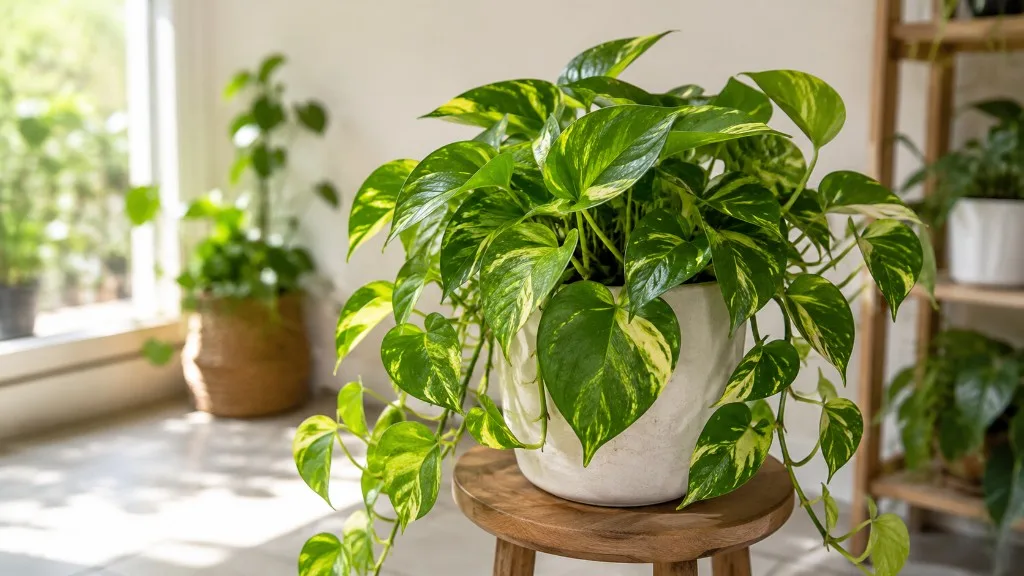
Golden pothos is the default pothos - the one in hanging baskets at big-box stores, dentist offices, and college dorm rooms. It has heart-shaped green leaves splashed with yellow or chartreuse variegation, often in irregular patches rather than neat stripes. Stems may show yellow streaking too.
Golden pothos is popular for good reason. It grows quickly in Pothos light guide, trails aggressively, roots easily in water, and holds variegation better in moderate-to-low light than white-variegated cultivars. Penn State Extension specifically notes that golden pothos can survive low light “for quite some time,” though variegation and brightness eventually fade if the plant is kept too dim for too long. If your “golden” pothos is turning mostly green, it is asking for more light - not more fertilizer.
This is also the cultivar the ASPCA lists under “golden pothos” for toxicity purposes. Any variegated or solid-green E. aureum cultivar should be treated as toxic to chewing pets, but golden pothos is the reference entry most veterinarians and poison-control databases cite by name.
Marble Queen, N’Joy, and Pearls and Jade
These are the white-variegated branch of the pothos family, and they are slower and more light-hungry than golden pothos.
Marble Queen has green leaves marbled with cream to white. Snow Queen is not a separate species - it is an highly variegated expression of the same Marble Queen lineage, with more white and less green on individual leaves. Both need bright, indirect light to maintain strong variegation; in low light they revert toward green and grow sparsely.
N’Joy (often sold as Beautifall® ‘Njoy’) has smaller leaves with crisp green-and-white patches and less speckling. Pearls and Jade - a University of Florida–released cultivar from a Marble Queen mutation - shows green leaves with white speckles and smaller overall stature. These compact forms are attractive on shelves, but they are not the best choice for very low light rooms if you want to keep the white pattern.
If you bought a “fancy pothos” and it is slowly turning plain green in a north-facing corner, the plant is not defective. It is responding to insufficient light for a cultivar with minimal chlorophyll in its pale zones.
Neon, Jade, and Solid-Green Forms
Neon pothos has vivid chartreuse to yellow-green leaves with little or no variegation. Because the entire leaf photosynthesizes, neon is often fast-growing when light is adequate - but the color itself is light-dependent. In dim conditions neon fades toward ordinary green and loses the quality that made you buy it.
Jade pothos is solid deep green with no variegation. It is the most forgiving cultivar for low light, along with golden pothos, because every cell in the leaf can capture light. If your room is genuinely dim and you still want pothos, jade or golden is a smarter pick than Marble Queen or pearls and jade.
Other names you may see include Manjula (swirled white, cream, and green - patented), Global Green, Jessenia, and Lime. All remain Epipremnum aureum for care purposes. Cebu Blue (Epipremnum pinnatum, not E. aureum) is often grouped with pothos in shops; it has narrower, silvery-blue juvenile leaves and eventually fenestrates when climbing - treat it as a close cousin, not the same species.
Light: Bright Indirect, Low Light, and What Changes
Pothos reputation as a low-light plant is earned, but it needs unpacking. The Missouri Botanical Garden and NC State Extension both describe pothos as preferring bright, indirect light while surviving long periods in lower light. Clemson HGIC lists bright indirect light as ideal with tolerance for lower conditions. Penn State Extension recommends moderate to bright light and average room temperatures, and warns that direct sun yellows leaves.
Think in three tiers:
Bright, indirect light - within a few feet of an east-facing window, or behind a sheer curtain on south or west glass - is where pothos looks its best. Leaves are larger, stems are shorter between nodes, color is richer, and variegated cultivars keep their pattern. This is the target if you want a lush trailing or climbing vine.
Medium to low indirect light - a north window, a room with no direct sun, or a spot several feet back from a bright window - is where pothos survives famously well. Growth slows. Internodes lengthen. Leaves shrink. Variegation fades on golden, marble, and pearls-and-jade forms. The plant grows toward the light, so rotate the pot every week or two for balanced foliage, as Penn State Extension recommends.
Fluorescent or LED office light - pothos is one of the few decorative plants that genuinely performs under typical office fixtures. A pot on a desk or credenza under all-day artificial light will maintain green foliage for years, which is why the species dominates commercial interiors. It will not grow as fast as near a window, but it will look presentable - exactly the use case pothos was selected for.
Direct afternoon sun is the main light mistake. Leaves bleach, yellow, or develop brown scorch patches. Morning sun through glass is often fine if acclimated gradually. If you only have a hot south window, filter the light or set the plant back.
The low-light takeaway matters for cultivar choice: pothos tolerates low light; variegated pothos does not show its best self there. Golden and jade hold up; marble queen and pearls and jade do not. Neon needs enough light to stay neon. Do not interpret “tolerates low light” as “all pothos cultivars look the same in a dark corner.”
Watering: Let the Mix Dry, Then Soak
Pothos is better kept slightly too dry than too wet. That single sentence prevents more deaths than any product label. Penn State Extension is explicit: water when the soil is dry, because too much water leads to root rot on Pothos, one of the few serious problems Pothos overview faces. Too little water may cause temporary leaf droop, which usually recovers after a thorough drink. Clemson HGIC advises allowing soil to dry between waterings, then watering thoroughly so moisture reaches all roots.
The practical target from LeafyPixels plant data and multiple extension sources aligns well: water when the top 1–2 inches of soil are dry, which often works out to roughly every 7–10 days in summer and a longer interval in cooler, dimmer months. That interval is a starting point, not a rule. A pothos in a small pot under bright light may need water twice a week; the same cultivar in a large pot in winter may go two weeks.
When you water, soak until excess runs from the drainage holes, then empty the saucer within 30 minutes. Shallow, frequent splashes keep the top moist and the middle dry - a pattern that encourages weak roots and fungus gnats. One deep watering when the plant is actually dry beats daily teaspoons.
Signs you are underwatering include limp, soft leaves that perk up after watering, dry leaf edges, and very lightweight pots. Signs of overwatering are more dangerous: yellow leaves on a plant in wet soil, blackening leaf margins, soft stems at the soil line, and a sour smell from the mix. Overwatering combined with low light is the classic pothos failure mode - the plant cannot transpire fast enough to use the water you keep giving it.
How to Check Soil Moisture Before You Water
Use your finger or a dry wooden chopstick pushed 2 inches into the mix. If the soil at that depth feels cool and slightly damp, wait. If it feels dry and the pot is noticeably lighter, water. Lifting the pot before and after a watering session a few times teaches your hands what “ready” feels like faster than any schedule app.
For top-heavy hanging baskets, the chopstick method is easier than reaching the soil surface around cascading vines. In winter, check more conservatively: shorter days and cooler rooms mean slower drying even if you watered on the same schedule that worked in August.
Humidity and Temperature Indoors
Pothos is not a humidity diva. LeafyPixels plant guidance targets 40–60% relative humidity, and Clemson HGIC notes pothos prefers 50–70% but tolerates average home levels of 30–60%. Most centrally heated apartments sit in that range without intervention. Very dry air - consistently below 30% - can encourage brown leaf tips and spider mites, especially in winter.
Raising humidity modestly helps: a pebble tray with the pot above the water line, grouping plants together, or a small humidifier near the display. Misting leaves gives a brief humidity bump and can leave wet foliage that invites fungal spotting; pebble trays or humidifiers are the more reliable fixes.
Temperature comfort for pothos is ordinary indoor life: 65–85°F (18–29°C) during the day, per Clemson and Penn State, with nights roughly 60–70°F. Avoid cold drafts from winter windows, heat blasts from radiators, and sudden drops below about 50°F (10°C), which stall growth and damage leaves. Stable room conditions matter more than hitting a perfect degree.
Soil and Pot Choice
Pothos wants a light, well-draining potting mix with enough structure to hold air around the roots. LeafyPixels recommends standard indoor mix with added perlite; Clemson HGIC emphasizes well-draining soil and proper watering to prevent rot. A workable recipe is two parts quality houseplant potting mix to one part perlite, adjusted if your home runs humid (more perlite) or very dry (slightly less).
Drainage holes are non-negotiable. Decorative cache pots without drainage are fine only if you lift the nursery pot out to water and drain. Terracotta dries faster - helpful for heavy-handed waterers. Plastic retains moisture longer - fine if you tend to underwater. Go up one pot size at Pothos repotting guide; an oversized pot holds water the root ball cannot use and is a common post-repot rot trigger.
Most bagged mixes sit in a slightly acidic to neutral pH range that pothos accepts without adjustment. Worry about pH only if you are using extremely peat-heavy mix with hard alkaline tap water and seeing persistent tip burn despite good watering habits.
Fertilizer Schedule and Strength
Pothos is a moderate feeder, not a hungry one. Feed only during active growth - typically spring through early fall. LeafyPixels plant data suggests monthly feeding in spring and summer with a balanced liquid fertilizer at half the label strength (for example NPK 20-20-20 diluted). Clemson HGIC recommends fertilizing every other month during spring and summer; NC State Extension says every other month except in winter dormancy.
Both approaches converge on the same principle: light, regular feeding while the plant is growing; none while it is resting. Never fertilize dry soil - water first, then feed moist mix so salts do not burn roots. Skip fertilizer on newly repotted plants for four to six weeks, on stressed yellowing plants until you fix the cause, and through winter if growth has clearly slowed.
If leaf tips brown and a white crust rings the pot, flush the soil with plain water until runoff runs clear, then pause feeding for a month. Excess salt is a more common “fertilizer problem” on pothos than true deficiency.
Repotting and Keeping Roots Healthy
Repot pothos roughly every one to two years, or when roots circle the drainage holes, water runs straight through without soaking in, or the plant dries out unusually fast. Spring and early summer are the safest windows - the plant has months of active growth ahead to colonize fresh mix.
Choose a pot one size larger with drainage. Tease circling roots gently, trim only black or mushy tissue with clean scissors, and replant at the same depth. Water lightly for the first week while cut roots callus, then return to your normal dry-then-soak rhythm. Avoid repotting on the same week you propagate heavily, move the plant to a new light exposure, or treat for pests - stack one stress at a time.
Over time, pothos concentrates leaves at the ends of long bare stems. Repotting alone does not fix that; pruning and propagation do, covered below.
Propagation from Stem Cuttings
Pothos is one of the easiest houseplants to propagate. NC State Extension notes vines root readily in water; Penn State lists stem cuttings as the standard approach. LeafyPixels plant data describes 4–6 inch cuttings taken just below a node, lower leaves removed, rooted in water with roots appearing in one to three weeks, then potted when roots reach 1–2 inches.
Water propagation: Cut below a node - the swollen joint where leaves and roots emerge. Strip leaves that would sit underwater. Use a clear glass in bright, indirect light. Change water weekly to limit algae and bacteria. When roots are an inch or two long, move to moist potting mix and keep humidity stable for the first week.
Soil propagation: Stick the same cutting into moist, well-draining mix, keep the medium lightly damp but not soggy, and maintain bright, indirect light. Soil propagation avoids the transplant shock some water-rooted cuttings experience, but water propagation is faster for beginners to monitor.
Single-node cuttings - a short segment with one node and one leaf - work when you want maximum multiplication from a long vine trim. Each node is a potential plant.
Propagate from healthy growth only. A vine with root rot, mealybugs, or widespread yellow leaves will pass those problems to cuttings. Fix the parent first, then take material from the newest healthy stems.
Toxicity to Pets and People
Pothos is not pet safe. Treat that as a placement decision, not a footnote.
Cats and Dogs (ASPCA)
The ASPCA lists golden pothos (Epipremnum aureum) as toxic to dogs and toxic to cats. Toxic principle: insoluble calcium oxalate crystals throughout the plant - roots, stems, leaves, and sap. Reported clinical signs include oral irritation, intense burning of mouth, tongue, and lips, excessive drooling, vomiting, and difficulty swallowing.
Severity is generally mild to moderate for typical nibbling exposures, but individual reactions vary with amount ingested and pet size. The ASPCA Animal Poison Control line is (888) 426-4435; contact your veterinarian if you suspect chewing or ingestion. Do not assume a cultivar without yellow variegation is safe - all Epipremnum aureum cultivars carry the same oxalate risk.
NC State Extension rates pothos as medium severity poison for humans and flags problems for cats, dogs, and horses. Human exposure usually means skin or mouth irritation from sap during pruning; gloves help sensitive skin.
Safe Placement in Pet Households
If you have cats that climb shelves or dogs that investigate trailing vines, pothos belongs out of reach - a high mantel with no jump points, a hanging basket cleared of furniture below, or a room the pet does not access. Trailing vines are especially risky because they invite batting and chewing as they grow longer.
Pothos is a poor fit for pet-safe homes at floor level. Choose ASPCA-listed non-toxic alternatives for low shelves and bedside tables. If you keep pothos anyway, treat long vines like exposed cords: route them along ceiling hooks or trim before they dangle into reach. Curiosity, not malice, causes most pet exposures.
Common Problems and Real Fixes
Most pothos problems are environmental. The diagnostic order is the same every time: check soil moisture, then light, then pests, then water quality.
Yellow leaves are the top complaint. If soil is wet and stems feel soft, overwatering or root rot is likely - unpot, trim mushy roots, repot in fresh mix, and reduce watering. If soil is very dry and leaves are limp, underwatering is the cause. If the plant is green but pale with long gaps between leaves, low light is the driver - especially on variegated forms losing pattern. A few yellow lower leaves on an otherwise healthy vine are often normal aging; snip them off. Uniform yellowing with stippling and fine webbing points to spider mites in dry air.
Brown tips and edges usually mean low humidity, underwatering, or salt buildup from tap water or over-fertilizing. Flush the pot, review your Pothos watering guide, and raise humidity if the air is dry.
Leggy, bare vines mean the plant is reaching for light or has not been pruned in years. Move to brighter indirect light, cut stems back to encourage branching, or propagate the long sections and replant cuttings in the same pot for a fuller look.
Root rot follows chronic overwatering, sealed pots, or heavy mix in low light. Rescue requires immediate unpotting, removal of black roots, fungicide only if you already use it on houseplants, and repot into airy mix. Severe cases may not recover - prevention is easier.
Pests: Mealybugs (white cotton in leaf axils), scale (brown bumps on stems), and spider mites (fine webbing, stippling) all occur. Isolate the plant, shower off what you can, and treat with insecticidal soap or manual alcohol swabs on mealybugs and scale. Fungus gnats mean the soil surface stays too wet - let the top layer dry and avoid overwatering.
Variegation loss on golden or marble cultivars is almost always insufficient light, not nutrient deficiency. Move the plant; do not double fertilizer.
Trailing, Climbing, and Pruning for Fuller Vines
Indoors, pothos is usually grown as a trailing vine from a hanging basket or shelf. Given a moss pole, trellis, or bark board and brighter light, it will climb using aerial roots and produce larger leaves - the first step toward mature-form foliage, though full outdoor-sized leaves are uncommon in average homes.
Long bare stems are normal on old pothos. The plant concentrates leaves at the tips as it searches for light. To refresh:
- Prune stems just above a node to encourage side shoots.
- Stick trimmed cuttings back into the same pot for a denser base.
- Rotate the pot weekly for even growth.
- Wipe leaves occasionally with a damp cloth to remove dust that blocks light, as NC State Extension recommends.
If a vine reaches the floor and into pet reach, trim it - both for appearance and for toxicity safety.
Conclusion
Pothos earns its beginner-friendly reputation, but the best results come from treating Epipremnum aureum as a vine with preferences, not as a plastic decoration. Golden pothos and solid-green jade handle low light and office fluorescents better than white-variegated marble or pearls-and-jade forms, though every cultivar grows fuller in bright, indirect light. Water when the top 1–2 inches of mix are dry, use light, well-draining soil with perlite, feed lightly during active growth, and repot every year or two as roots fill the pot.
Propagation from stem cuttings is easy - which is fortunate, because pruning and replanting cuttings is also how you fix leggy vines. The non-negotiable caveat is safety: the ASPCA classifies golden pothos as toxic to cats and dogs because of insoluble calcium oxalates, so keep vines off the floor and out of chewing range, or choose a different plant for pet-accessible spots.
Get light and watering aligned with your room, pick a cultivar that matches your light budget, and pothos will do what it has done in offices and homes for generations: grow quietly, forgive occasional neglect, and look good doing it - as long as the pets cannot reach it.
When to use this page vs other Pothos guides
- Pothos overview - Canonical hub for this species - care topics and problems branch from here.
- Pothos problems - Symptom-first path when you already know something is wrong.
Related Pothos guides
How to care for Pothos?
How much light does Pothos need?
bright to medium indirect light, low light, fluorescent office light
- bright to medium indirect light, low light, fluorescent office light - bright to medium indirect light, low light, fluorescent office light.
When should you water Pothos?
Water when the top 2 inches of soil are dry - roughly every 7–10 days in summer.
- Check top 2 inches - Water when the top 2 inches of soil are dry - roughly every 7–10 days in summer.
- Drain excess water - Water when the top 2 inches of soil are dry - roughly every 7–10 days in summer.
What soil works best for Pothos?
Light, well-draining potting mix with added perlite.
- Well-draining mix - Light, well-draining potting mix with added perlite.
Grower notes for Pothos
What matters most with Pothos
Pothos is forgiving, but its variegation and leaf size tell you whether the placement is actually working. Long bare vines usually mean the plant needs pruning, stronger light, or a support, not just more fertilizer. In practice, the care checkpoint is simple: bright to medium indirect light, low light, fluorescent office light. Pair that with light, well-draining potting mix with added perlite, and avoid changing water, pot size, and placement all at once.
Best placement in a real home
Pothos belongs where bright to medium indirect light, low light, fluorescent office light is realistic for most of the day, not only where the pot looks good. Water when the top 2 inches of soil are dry - roughly every 7–10 days in summer. If the pot stays wet longer than expected, move the plant into better light or reassess the mix before watering again. Humidity target: 40–60%. Temperature comfort zone: 18–29°C (65–85°F).
Before you buy this plant
Choose Pothos with firm new growth, clean leaf undersides, and soil that does not smell sour or feel compacted. Be cautious if you see yellow-leaves, sticky residue, collapsed crowns, or a pot that is wet in poor light. Cosmetic old-leaf damage is less worrying than weak roots or active pests.
First month after bringing it home
Do not repot Pothos on day one unless the mix is failing or pests are obvious. Quarantine it, learn how fast the pot dries, and keep care boring while it adjusts. Watch especially for yellow-leaves, brown-tips, and leggy-growth. If problems appear, correct the condition first rather than stacking fertilizer, repotting, and pruning together.
Safety note for Pothos
Pothos is not a plant to keep within reach of pets or children. Treat it as an inaccessible display plant. Use gloves if sap or plant tissue is irritating, and pick a pet-safe alternative for floor pots or low shelves.
How to tell Pothos is settling in
If you plan to multiply it later, common methods include Stem cuttings in water, Stem cuttings in moist potting mix, and Single-node cuttings. If brown-tips shows up early, inspect light, watering, and roots before assuming the plant is permanently weak.
Is it pet safe?
Pothos is toxic to cats and dogs.
Contains insoluble calcium oxalate crystals. Causes oral irritation, excessive drooling, vomiting, and difficulty swallowing in cats and dogs if chewed.
Watering Pothos
Water when the top 2 inches of soil are dry - roughly every 7–10 days in summer.
Soil & potting for Pothos
Light, well-draining potting mix with added perlite.
Humidity & temperature for Pothos
Pothos prefers 40–60%, though normal home humidity is usually fine. Keep temperatures around 18–29°C (65–85°F).
| Detail | Information |
|---|---|
| Humidity | 40–60% - normal home humidity is fine. |
| Ideal temperature | 18–29°C (65–85°F) |
Fertilizer & pruning for Pothos
Use feed lightly during active growth. Use monthly during spring and summer. for Pothos.
| Detail | Information |
|---|---|
| Fertilizer type | Feed lightly during active growth. Use monthly during spring and summer. |
Common problems on Pothos
Likely cause: Jul 5, 2023 · If you have noticed ants on your pothos plant , don’t worry – there are several effective methods to eliminate them and keep your plant healthy. In this article, we will discuss some of the most effective ways to get rid of an
Quick fix: Confirm diagnosis on your Pothos, then address the most likely care or pest factor described in current extension guidance.
Full fix guide →Brown Tips
LowLikely cause: Dry air, fluoride in tap water, or inconsistent watering causes tip browning
Quick fix: Increase humidity, switch to filtered water, and water more consistently
Full fix guide →Bacterial Wilt
HighLikely cause: Jan 6, 2024 · Here are some common pothos diseases you may need to watch out for: Bacterial wilt disease is one of the most common diseases in pothos plants. The bacteria Ralstonia solanacearum causes the leaves to turn brown and wilt . Whe
Quick fix: Confirm diagnosis on your Pothos, then address the most likely care or pest factor described in current extension guidance.
Full fix guide →Cold Damage
MediumLikely cause: Dec 1, 2025 · Keep your Pothos healthy. Learn the critical cold thresholds, diagnose damage symptoms, and use proven steps for recovery and future protection.
Quick fix: Confirm diagnosis on your Pothos, then address the most likely care or pest factor described in current extension guidance.
Full fix guide →Curling Leaves
MediumLikely cause: May 10, 2022 · See why your pothos leaves are curling and turning yellow or upwards, as well as how to fix curling leaves and whether pothos leaves uncurl.
Quick fix: Confirm diagnosis on your Pothos, then address the most likely care or pest factor described in current extension guidance.
Full fix guide →Distorted Leaves
MediumLikely cause: Aug 7, 2025 · Understanding the causes of deformed leaves is the first step toward restoring your pothos to robust health and encouraging unblemished new growth. This article identifies common issues and provides actionable solutions to kee
Quick fix: Confirm diagnosis on your Pothos, then address the most likely care or pest factor described in current extension guidance.
Full fix guide →Caterpillars
MediumLikely cause: Jun 30, 2023 · However, there are several effective methods you can use to get rid of caterpillars on your pothos plant and prevent further damage. In this article, we will explore these methods and provide you with step-by-step instruction
Quick fix: Confirm diagnosis on your Pothos, then address the most likely care or pest factor described in current extension guidance.
Full fix guide →Exposed Roots
MediumLikely cause: Epipremnum aureum is an evergreen vine growing to 20 m (66 ft) tall, with stems up to 4 cm (2 in) in diameter, climbing using aerial roots which adhere to surfaces.
Quick fix: Confirm diagnosis on your Pothos, then address the most likely care or pest factor described in current extension guidance.
Full fix guide →Fungus Gnats
LowLikely cause: Aug 4, 2025 · Solve your Pothos gnat problem. Learn effective methods to identify, remove, and prevent these persistent houseplant pests for thriving plants.
Quick fix: Confirm diagnosis on your Pothos, then address the most likely care or pest factor described in current extension guidance.
Full fix guide →Heat Stress
MediumLikely cause: Pothos ( Epipremnum aureum ) is a commonly used indoor ornamental foliage, particularly in the middle and lower regions of the Yangtze River in China. It typically grows in the tropical area, and it is yet unclear whether prolonged winter t
Quick fix: Follow extension or botanical guidance for Pothos heat stress; adjust care before applying broad treatments.
Full fix guide →Leggy Growth
LowLikely cause: Insufficient light causes long bare stems with widely spaced leaves
Quick fix: Move closer to a window; trim leggy vines to encourage branching
Full fix guide →Leaf Drop
MediumLikely cause: 01 Environmental change Most tropical plants drop leaves when they're moved to a new location, repotted, or exposed to a cold draft. It's a stress response, not death. Quick check Did you recently move the plant, repot it, or change its lig
Quick fix: Confirm diagnosis on your Pothos, then address the most likely care or pest factor described in current extension guidance.
Full fix guide →Mold on Soil
LowLikely cause: Effectively manage mold in pothos soil with these steps: Carefully remove visible mold , position your plant in a well-ventilated area, and adjust watering routines to let soil dry between waterings.
Quick fix: Confirm diagnosis on your Pothos, then address the most likely care or pest factor described in current extension guidance.
Full fix guide →Mealybugs
MediumLikely cause: Nov 15, 2024 · This complete mealybugs on pothos guide covers several methods, from simple manual removal to more robust organic treatments. You can choose the one that best fits the severity of your infestation.
Quick fix: Confirm diagnosis on your Pothos, then address the most likely care or pest factor described in current extension guidance.
Full fix guide →No Flowers
LowLikely cause: Apr 10, 2026 · No. Penn State Extension notes that pothos “rarely flowers even in its native habitat, so no hybrids exist” - there is no commercial breeding program producing flowering pothos cultivars, because there are not enough flowers
Quick fix: Confirm diagnosis on your Pothos, then address the most likely care or pest factor described in current extension guidance.
Full fix guide →Leggy Seedlings
MediumLikely cause: Jul 4, 2022 · What is a Leggy Pothos? A leggy Pothos has long vines with a small number of leaves. Instead of making new leaves or roots, the plant puts most of its growth into making long stems. This process of extending the length is call
Quick fix: Confirm diagnosis on your Pothos, then address the most likely care or pest factor described in current extension guidance.
Full fix guide →Mosaic Virus
MediumLikely cause: Potyvirus infection in pothos (most commonly Dasheen Mosaic Virus , DMV) produces characteristic mosaic patterning with alternating light and dark green patches, leaf distortion, and stunted growth.
Quick fix: Confirm diagnosis on your Pothos, then address the most likely care or pest factor described in current extension guidance.
Full fix guide →No Drainage Hole
MediumLikely cause: Dec 27, 2025 · Let’s cut right to the chase: Yes, pothos absolutely need drainage to thrive long-term. While they can survive for a short while in less-than-ideal conditions (that’s their trademark toughness!), they cannot flourish without
Quick fix: Confirm diagnosis on your Pothos, then address the most likely care or pest factor described in current extension guidance.
Full fix guide →Plant Leaning
MediumLikely cause: Feb 11, 2026 · Discover how to grow thriving pothos plants with this beginner-friendly guide covering light, temperature, varieties, pots, soil, watering, and feeding.
Quick fix: Confirm diagnosis on your Pothos, then address the most likely care or pest factor described in current extension guidance.
Full fix guide →Poor Drainage
MediumLikely cause: Dec 27, 2025 · Let’s cut right to the chase: Yes, pothos absolutely need drainage to thrive long-term. While they can survive for a short while in less-than-ideal conditions (that’s their trademark toughness!), they cannot flourish without
Quick fix: Confirm diagnosis on your Pothos, then address the most likely care or pest factor described in current extension guidance.
Full fix guide →Pot Too Small
MediumLikely cause: Jun 5, 2026 · Pothos prefer a slightly snug pot that's only 1-2 inches larger in diameter than their root ball. Getting the pothos pot size right matters more than most people realize. A pot that's too big holds excess moisture around the r
Quick fix: Confirm diagnosis on your Pothos, then address the most likely care or pest factor described in current extension guidance.
Full fix guide →Purple Leaves
MediumLikely cause: Is “ purple pothos ” real? Learn the truth about this common plant myth and find stunning purple - leaf alternatives for your collection.
Quick fix: Confirm diagnosis on your Pothos, then address the most likely care or pest factor described in current extension guidance.
Full fix guide →Potassium Deficiency
MediumLikely cause: Mar 26, 2025 · Potassium is essential for overall plant health and plays a role in water regulation, enzyme activation, and disease resistance. Signs of potassium deficiency in Pothos plants include:
Quick fix: Confirm diagnosis on your Pothos, then address the most likely care or pest factor described in current extension guidance.
Full fix guide →Poor Potting Setup
MediumLikely cause: Oct 13, 2025 · Learn when to repot pothos , what pot size and soil to use, and how to avoid shock, yellow leaves, and root rot after moving your plant.
Quick fix: Confirm diagnosis on your Pothos, then address the most likely care or pest factor described in current extension guidance.
Full fix guide →Pot Too Large
MediumLikely cause: Jun 5, 2026 · Pothos prefer a slightly snug pot that's only 1-2 inches larger in diameter than their root ball. Getting the pothos pot size right matters more than most people realize. A pot that's too big holds excess moisture around the r
Quick fix: Confirm diagnosis on your Pothos, then address the most likely care or pest factor described in current extension guidance.
Full fix guide →Scale Insects
MediumLikely cause: Dec 26, 2025 · In this complete scales on pothos guide, we’ll dive deep into what these pests are, how to spot them early, and a proven battle plan to eliminate them using effective and eco-friendly methods.
Quick fix: Confirm diagnosis on your Pothos, then address the most likely care or pest factor described in current extension guidance.
Full fix guide →Repotting Stress
MediumLikely cause: Most potting soils come with ample nutrients which plants use to produce new growth. By the time your plant has depleted the nutrients in its soil it’s likely grown enough to need a larger pot anyway. To replenish this plant's nutrients, re
Quick fix: Confirm diagnosis on your Pothos, then address the most likely care or pest factor described in current extension guidance.
Full fix guide →Root Rot
HighLikely cause: Chronically wet soil in poorly draining mix leads to rapid root rot
Quick fix: Remove from pot, trim all dark mushy roots, repot in fresh well-draining mix; do not water for one week
Full fix guide →Seedlings Falling Over
MediumLikely cause: Jul 17, 2023 · In conclusion, a pothos hanging plant falling over can be attributed to various factors such as lack of support, watering issues, inadequate light, nutrient deficiencies, overcrowded roots, or pests and diseases.
Quick fix: Confirm diagnosis on your Pothos, then address the most likely care or pest factor described in current extension guidance.
Full fix guide →Likely cause: The flowers are produced in a spathe up to 23 cm (9 in) long. This plant produces trailing stems when it climbs up trees and these take root when they reach the ground and grow along with it.
Quick fix: Confirm diagnosis on your Pothos, then address the most likely care or pest factor described in current extension guidance.
Full fix guide →Slow Growth
LowLikely cause: Feb 14, 2026 · Learn how to fix slow growth on pothos with simple adjustments to light, watering, fertilizing, and repotting to encourage faster, healthier vine development.
Quick fix: Confirm diagnosis on your Pothos, then address the most likely care or pest factor described in current extension guidance.
Full fix guide →Slugs and Snails
MediumLikely cause: Jul 20, 2023 · The Jade Pothos plant, also known as Epipremnum aureum , is a popular choice for indoor gardening due to its low maintenance and air-purifying properties. However, like any other houseplant, it is susceptible to pests, includ
Quick fix: Confirm diagnosis on your Pothos, then address the most likely care or pest factor described in current extension guidance.
Full fix guide →Likely cause: The yellowing and burning of epipremnum aureum leaves are common problems in the maintenance process. Understanding their causes and solutions is crucial for planters.
Quick fix: Confirm diagnosis on your Pothos, then address the most likely care or pest factor described in current extension guidance.
Full fix guide →Soil Too Acidic
MediumLikely cause: Jul 17, 2025 · Pothos plants prefer well-draining, slightly acidic to neutral soil, with a pH range of 6.1 to 7.0 . This type of soil allows for healthy root growth and prevents waterlogged soil, which can lead to root rot and other problem
Quick fix: Confirm diagnosis on your Pothos, then address the most likely care or pest factor described in current extension guidance.
Full fix guide →Wilting
MediumLikely cause: Dec 29, 2025 · Golden Pothos ( Epipremnum aureum ) is a hardy and adaptable houseplant that thrives in a variety of conditions. However, even this resilient plant can show signs of stress, such as wilting , if its needs are not met.
Quick fix: Confirm diagnosis on your Pothos, then address the most likely care or pest factor described in current extension guidance.
Full fix guide →Weak Stems
MediumLikely cause: Mar 1, 2026 · Healthy Pothos vines should be firm and strong, supporting steady leaf growth. When stems become thin or weak, the plant often lacks light, nutrients, or stable care conditions . This guide explains why Pothos stems become wea
Quick fix: Confirm diagnosis on your Pothos, then address the most likely care or pest factor described in current extension guidance.
Full fix guide →Whiteflies
MediumLikely cause: May 1, 2021 · White Flies Whiteflies are winged, soft-bodied fly-like insects that don’t fly. Like mealybugs, aphids, and other bugs, they suck vital fluids out of your pothos. They’re small (around 1/12-inch long) and roughly triangular, o
Quick fix: Confirm diagnosis on your Pothos, then address the most likely care or pest factor described in current extension guidance.
Full fix guide →Wrong Soil Mix
MediumLikely cause: Oct 9, 2020 · Need guidance on Pothos soil mixes ? During my 12 years of gardening, I have found 9 soil recipes that work for my Pothos . Read on to discover ideal soil types, signs of wrong soil , and DIY or store-bought options for your P
Quick fix: Confirm diagnosis on your Pothos, then address the most likely care or pest factor described in current extension guidance.
Full fix guide →Yellow Leaves
MediumLikely cause: Overwatering is the most common cause; also occurs with low light over time
Quick fix: Allow soil to dry fully; move to a brighter spot; check roots are not sitting in water
Full fix guide →