Leggy Growth on Pothos: Causes, Checks & Fixes
Quick answer
Leggy mature pothos vines are etiolation-the plant stretching toward light with long bare stems and small pale leaves. Stretched sections won't fill in on their own. First step: move to bright indirect light, wait two weeks, then prune above a node and root the cuttings.

Leggy Growth on Pothos: Causes, Checks & Fixes
This guide covers leggy growth on Pothos. See also the general Leggy Growth guide, watering, and light pages for this plant.
Leggy Growth on Pothos: Causes, Checks & Fixes
Quick answer
Leggy mature pothos (Epipremnum aureum) vines are etiolation-the plant stretching toward usable light with long bare stems, widely spaced small leaves, and often faded variegation on new growth. Pothos tolerates lower light but will not stay compact there indefinitely.
First step: move the pot to bright indirect light within a few feet of a window-or add a full-spectrum grow light for 12–14 hours daily-then wait two weeks before pruning. Stretched bare sections do not fill in on their own; you must cut back to a node and root the trimmings if you want a fuller silhouette.
This page covers leggy growth on established trailing or climbing vines. For chronic dim-room placement and the full low-light workflow, see not enough light on pothos. For thin pale starts right after rooting, see leggy seedlings on pothos. For species care baseline, see the pothos overview.
Leggy growth vs. not enough light vs. leggy seedlings
These three pothos pages overlap on light stress but answer different questions:
| Your situation | Best page |
|---|---|
| Mature hanging basket or shelf pothos with long bare runners and sparse tips | This page - leggy growth on established vines |
| Plant in a dim corner for months; you want the full placement, shadow-test, and grow-light workflow | Not enough light on pothos |
| Newly rooted cuttings or propagation-tray starts with thread-thin pale stems | Leggy seedlings on pothos |
Leggy growth on a two-year-old vine is a shape problem on tissue that already elongated. Chronic low light is the placement problem underneath it-and fixing placement is always step one.
What leggy growth looks like on pothos
Healthy pothos in good light shows firm green stems with leaves spaced relatively close along the vine. Leggy etiolation reverses that pattern on mature plants:
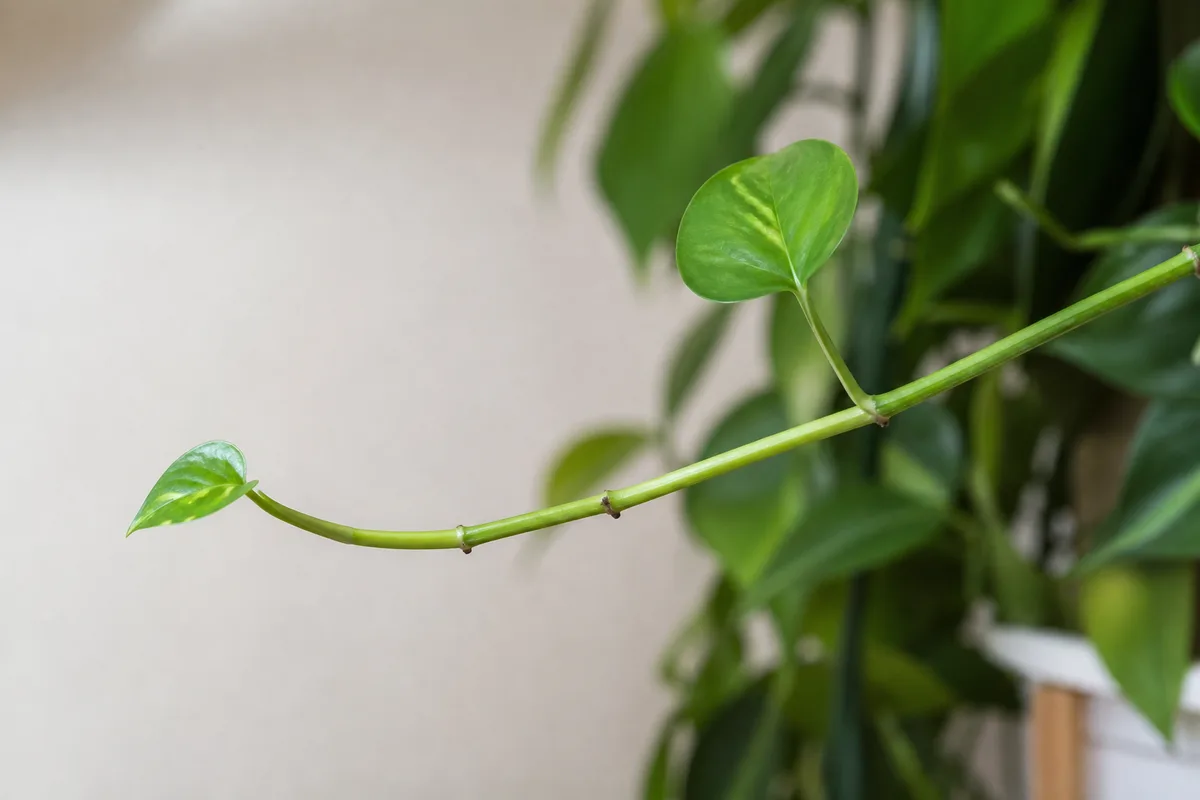
Leggy Growth symptoms on Pothos - compare with healthy tissue on the same plant.
Stretch and structure:
- Internodes of 4–8 inches (10–20 cm) between leaves on newest growth-far wider than compact sections lower on the same vine
- Vines leaning or growing toward a window, doorway, or overhead fluorescent panel instead of filling the pot evenly
- Thin, floppy stems compared with firm vines from when the plant looked full
- Office fluorescent stretch-bare runners reaching toward ceiling panels while the side facing the fixture looks slightly fuller
Leaf changes:
- Smaller new leaves than mature ones farther down the vine
- Faded variegation on Marble Queen, Pearls and Jade, and Snow Queen-new growth shifts toward solid green or pale cream
- Solid-green cultivars (Jade, Neon, Jessenia) stay green but still show long gaps and shrunken blades
- Older sections may still show normal leaf size while only the tips look sparse
Placement patterns:
- Hanging baskets leggy on the side farthest from the window while the window-facing side stays fuller
- Moss-pole plants with larger leaves on the lit face and bare runners on the shaded back-poles can produce bigger leaves in stronger light, but only where photons actually reach
These signs develop gradually. A pothos moved to a dim cubicle may look acceptable for months before internode stretch becomes obvious-compare newest growth to leaves from when you first bought the plant.
Why pothos gets leggy
Insufficient light is the primary cause. Pothos evolved as an understory climber that scrambles tree trunks toward brighter canopy patches using aerial roots. Indoors, the same survival instinct becomes etiolation: the plant lengthens stems and spaces leaves farther apart to reach usable light rather than building dense foliage.
That behavior is normal for a shade-tolerant vine, but it becomes a problem when the spot is so dim that photosynthesis cannot keep pace. Clemson Extension notes that lower light may cause variegated varieties to lose coloring-Marble Queen and Pearls and Jade need brighter placement than Neon or Jessenia in the same corner.
Variegation economics: white and cream leaf zones lack chlorophyll. Variegated cultivars need more light per leaf to photosynthesize, so they stretch faster than all-green types in identical dim conditions.
Over-fertilizing without enough light can push weak, thin growth. Fertilizer does not replace photons-feeding a light-starved plant before fixing placement can stress roots on tissue that is not growing vigorously.
Natural vine habit also plays a role. Without pruning, pothos follows apical dominance-the growing tip extends while lower nodes stay quiet, leaving bare runners over time even in moderate light. Legginess from habit alone is mild compared with etiolation from a dark office; see the pothos pruning guide for shaping cuts that wake nodes below.
Leggy growth vs. slow winter growth
Not every sparse vine is etiolation. Use this quick split:
| Pattern | Likely cause | What to check |
|---|---|---|
| Long internodes, lean toward light, small new leaves | Etiolation from insufficient light | Window distance, shadow test, office placement |
| Firm stems, normal internodes, just slower new leaves in December–February | Seasonal slow growth in shorter days | Same window as summer; optional grow-light hours |
| Yellow lower leaves on wet soil, soft stems, sour smell | Overwatering / root stress-not stretch alone | Soil moisture, root firmness → overwatering |
Winter slowdown is temporary and reversible with spring light. Chronic etiolation keeps worsening until you move the plant or add artificial light.
How to confirm the cause
Work through this numbered checklist before you repot, fertilize, or prune heavily:
- Window distance - Within 2 feet of an unobstructed east or filtered south window usually counts as bright indirect for pothos. More than 6 feet back, or in an interior room with no supplemental light, is typically too dim for compact mature growth. Full placement bands: pothos light guide.
- Hand-shadow test - At midday, hold your hand between the plant and the window. A soft, defined shadow means moderate light. A faint or absent shadow means low light by extension standards for indoor plants.
- Internode comparison - Measure spacing between the last three new leaves on the leggiest runner. Gaps over 3 inches (8 cm) on fresh growth confirm stretch; tight nodes under an inch suggest light is adequate and another cause may be involved.
- Variegation check - On a variegated cultivar, fading toward all-green or washed-out new leaves strongly supports low light over nutrient deficiency.
- Asymmetry check - Compare the side facing the window to the far side of a hanging basket. One-sided fullness with bare back-side runners confirms directional light stress.
- Water-use check - Stick a finger 2 inches into the mix. If soil stays damp 10+ days without watering in a dim room, slow growth may be compounding moisture problems-not proof against etiolation, but a rot risk to address alongside light.
- Rule out lookalikes - Confirm soil is not waterlogged, roots are not mushy, and leaf undersides have no pest clusters before blaming light alone.
Confirmation test: Move the plant to a brighter spot for two weeks. If new leaves open closer together with stronger color and larger blades, light was the primary limiter.
First fix for pothos
Relocate the pot to bright indirect light-ideally within a few feet of an east-facing window or a south- or west-facing window filtered by sheer curtains.
Do not jump straight to direct midday sun on a vine that lived in shade for months. RHS guidance for Epipremnum recommends bright light but not direct sun, and sudden harsh exposure can scorch leaves adapted to dim conditions. Acclimate over one to two weeks by stepping closer to the window or adding sheer curtains first.
If a brighter window is not available, add a full-spectrum LED grow light 10–18 inches above the foliage for 12–14 hours daily on a timer. University of Maryland Extension notes that plants stretch and lean when light reaches them from one direction-position the lamp over the canopy, not off to one side.
Make this one change first. Wait two weeks before pruning, Pothos repotting guide, or feeding so you can read the plant’s response clearly.
Step-by-step recovery
After the light move:
- Monitor new growth for two to four weeks - Look for smaller internodes and larger new leaves. That confirms the fix is working before you cut.
- Adjust watering - Brighter light means faster drying. Recheck the top 2 inches of soil before every watering instead of following an old calendar schedule. Details: pothos watering guide.
- Prune stretched vines - Cut leggy stems back to just above a leaf node with clean scissors. Pothos sprouts new side shoots from nodes below the cut. Limit routine shaping to one-third of total foliage per session-full technique on the pothos pruning guide.
- Propagate trimmings - Root healthy cuttings in water or moist mix, then plant them back into the original pot for instant fullness. Workflow: pothos propagation guide. Wear gloves when handling cut tissue-pothos contains calcium oxalate crystals toxic to cats and dogs if chewed.
- Train on a moss pole (optional) - In stronger light, climbing support can encourage larger leaves on the lit face. Rotate the pot weekly so both sides receive photons.
- Extend grow-light hours in winter - Shorter days reduce window light even if the plant stays in the same spot. Supplemental light prevents renewed stretch from seasonal drop.
Variegated cultivars may need one step brighter than solid-green types throughout recovery. Marble Queen and Pearls and Jade require more light than Neon or Jessenia per Clemson cultivar notes.
Recovery timeline
Expect visible improvement in new growth within two to four weeks of better light. Internodes on the next two or three leaves should shorten before older stretched sections look different.
Bare stem between existing leaves does not revert-those gaps stay unless you prune and wait for new shoots from nodes below. Fully faded variegation on old leaves rarely returns; judge success by variegation on new foliage, not by hoping old leaves re-pattern.
New side shoots from pruning typically appear within 2–4 weeks during active growth. Full bushy coverage on a severely bare basket may take one growing season if many stems were elongated.
If growth stays stalled after four weeks in bright indirect light plus appropriate watering, look for root-bound pots, chronic overwatering damage, or pest stress-not more light alone.
Lookalike symptoms to rule out
Overwatering and root rot on Pothos yellow lower leaves on wet soil with soft stems and sour-smelling mix. Light-starved pothos usually has firm stems and slow drying, not mushy roots-see overwatering on pothos.
Underwatering wilts leaves and crisps edges while soil pulls away from the pot. Low-light pothos more often stays limp-looking with damp soil because growth is slow.
Normal aging drops one or two bottom leaves on an otherwise full vine in good light. Low light causes wider yellowing spread up the stem over months.
Nutrient deficiency can pale leaves but rarely causes long internode stretch by itself. Fix light first; fertilize only after placement and watering are stable.
Too much direct sun bleaches or browns patches on sun-facing leaves-the opposite problem. Moving a dim pothos into unfiltered south glass without acclimation causes scorch within days-see sunburn on pothos.
What not to do
Do not add fertilizer to fix stretch-that worsens weak growth on a light-starved plant.
Do not prune heavily before confirming light is adequate-legginess returns within weeks in the same dim spot.
Do not assume a dark bathroom is “low-light tolerant” forever; pothos survives but will not look full.
Do not move instantly from deep shade to harsh direct sun. Acclimate over one to two weeks.
Do not expect pruned cuttings to bush out in the same dark corner. Root cuttings in brighter light or they will stretch again.
Do not ignore wet soil in dim corners. Slow growth plus damp mix is a common path to root rot on pothos.
How to prevent leggy growth on pothos
Provide consistent bright indirect light from day one rather than waiting for stretch to appear. Rotate the pot every one to two weeks so vines do not lean permanently toward one side.
Keep windows clean and unobstructed-sheers, tinted glass, and furniture between plant and glass cut usable light more than many owners realize.
Use grow lights in offices, north-facing rooms, and during short winter days. Audit ceiling fluorescent panels: they rarely deliver enough intensity at desk height for compact variegated pothos.
Choose cultivars that match your space. If you only have moderate light, pick Neon, Jessenia, or solid golden pothos rather than Snow Queen or Pearls and Jade.
Prune proactively once or twice a year to keep hanging baskets dense instead of letting vines run toward the nearest window indefinitely.
When to worry
Leggy growth alone is a care signal, not an emergency. Escalate when stretch pairs with:
- Wet soil for weeks and spreading yellow lower leaves
- Soft stems at the soil line or sour-smelling mix
- Pest webbing or sticky residue on new growth
- Complete stall in new growth for two months despite corrected light
In those cases, unpot and inspect roots before assuming more light will solve everything. The dim-room wet-soil trap-slow growth keeping mix damp-is documented in depth on not enough light on pothos.
Related pothos problems
Use this page as the mature-vine legginess hub; follow the link that matches what you confirmed:
- Pothos overview - species care baseline
- Not enough light on pothos - chronic dim placement deep dive
- Leggy seedlings on pothos - young cutting stretch after rooting
- Pothos light - window bands, grow lights, and warning signs
- Pothos pruning - cut placement, timing, and one-third rule
- Pothos propagation - rooting pruned cuttings to refill pots
- Overwatering on pothos - yellow leaves on wet mix in dim rooms
Conclusion
Leggy mature pothos vines are almost always etiolation from insufficient usable light-not a death sentence, but a shape problem that light alone cannot reverse on bare stems. Move placement first, confirm tighter new nodes within two weeks, then prune above nodes and propagate trimmings for fullness. Old stretched gaps stay unless you cut and regrow.
How we wrote and verified this guide: Recommendations were checked against Clemson Cooperative Extension, University of Maryland Extension, Missouri Botanical Garden, Royal Horticultural Society, and ASPCA references cited inline. Author: sai-ananth. Reviewer: LeafyPixels Review Board. Methodology: plant problem guidance is reviewed against botanical references, extension resources, and LeafyPixels plant-care data before publication. Claims validation: claims-validator-v1 pass with inline external links documented below. Last reviewed: 2026-06-16.
Practical checks
Urgency check
Cosmetic unless paired with rot or pests. Act within days if yellowing spreads quickly on wet soil, stems soften, or the pot smells sour.
Best inspection order
Newest internode spacing on the leggiest runner, variegation on the latest leaf, window distance and hand-shadow test, soil dryness at 2 inches, then roots only if wet-soil symptoms appear.
When to use this page vs other Pothos guides
- Pothos watering guide - Use for routine moisture checks before assuming leggy growth is the main issue.
- Pothos problems hub - Browse all 39 common issues on this species.
- Slow Growth on Pothos - Different entry point when symptoms overlap with leggy growth.
- Leaf Drop on Pothos - Different entry point when symptoms overlap with leggy growth.
- Yellow Leaves on Pothos - Different entry point when symptoms overlap with leggy growth.