Pothos Light Requirements: Windows, Grow Lights & Signs
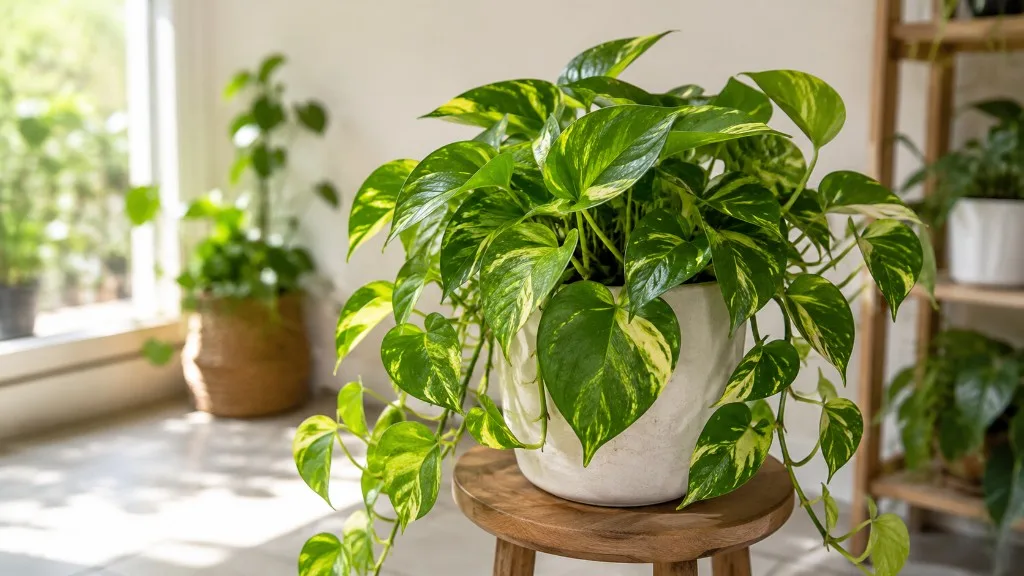
Pothos Light Requirements: Windows, Grow Lights & Signs
Pothos Light Requirements: Windows, Grow Lights & Signs
Pothos is the houseplant everyone calls unkillable - until you realize the vine on your shelf has been surviving, not thriving, for eighteen months. Epipremnum aureum tolerates dim corners and fluorescent offices better than almost any popular foliage plant, yet extension references consistently describe bright, indirect light as the target for vigorous growth, stable leaf size, and - on variegated cultivars - pattern retention. (Clemson HGIC) The gap between survival and display quality is almost always light, not fertilizer or repotting.
This genus-level guide covers how much light pothos actually needs across the low-to-bright spectrum, why it tolerates shade, how light drives variegation and leaf size across cultivars, where to place pots by window direction, when direct sun is safe, what low light can and cannot deliver, how to supplement with grow lights, and how to read warning signs before legginess or scorch becomes habit. For a cultivar-specific deep dive on Golden Pothos with extended procedural detail, see the companion golden pothos light guide - same species biology, more golden-cultivar focus.
Why Pothos Light Is Not Room Brightness
The most common pothos light mistake is judging placement by how bright the room looks to human eyes. Your living room can feel adequately lit while the leaf surface on a shelf six feet from the glass receives a fraction of the photons hitting the windowsill. Pothos photosynthesizes at the leaf, not at your sofa.
Light also sets the pace for the entire care system. A pothos in bright indirect light transpires faster and dries its pot on a shorter cycle; the same plant moved to a dim hallway may stay wet for weeks on the watering rhythm that worked near the window - a pattern that looks like overwatering but starts with insufficient light slowing metabolism. When you adjust placement, adjust watering checks in the same week, not three weeks later after yellow leaves appear.
One annotated vignette from a typical home office: a trailing pothos on a north-facing shelf roughly eight feet from the window measured about 80 foot-candles at the top leaves - enough to keep the plant alive but not enough for compact growth. Over six weeks, internodes stretched from 2 cm to nearly 5 cm and new leaves shrank noticeably. Moving the pot to an east windowsill 18 inches (45 cm) from the glass raised leaf-level brightness into the 250–400 foot-candle band; by the third new leaf - about 21 days later - internode spacing tightened and leaf size matched older foliage again. No fertilizer changed. Light did the work.
How Much Light Pothos Actually Needs
Pothos is a tropical understory climber native to the Society Islands in French Polynesia, where it scales tree trunks toward broken canopy light rather than sitting in all-day direct sun. University of Florida IFAS Extension notes that commercial pothos production targets 63 to 80 percent shade, equivalent to roughly 320 to 2,500 foot-candles, and that growth rate and variegation color decrease when shade exceeds 80 percent. (UF IFAS Extension) Translated for home growers: pothos wants bright, filtered brightness for best performance - not deep forest-floor darkness and not unshaded midday rays on a south window.
For most homes, the sweet spot is bright indirect light: strong enough that you could read comfortably near the plant without turning on a lamp, with leaves receiving that brightness rather than only the floor nearby. Penn State Extension recommends moderate to bright light while avoiding direct sun. (Penn State Extension) Missouri Botanical Garden lists pothos as preferring part shade to shade indoors - language that reflects tolerance, not a recommendation to hide the plant in a dark corner. (Missouri Botanical Garden)
The Four-Band Light Framework (Low to Bright Indirect)
Think of pothos light needs as four bands, not a single switch:
| Band | Approx. foot-candles | What pothos does | Typical placement |
|---|---|---|---|
| Deep low light | 50–100 | Survival; leggy stretch; variegation fades on new leaves | Far from windows, obstructed corners, some cubicle floors |
| Moderate indirect | 100–250 | Steady but slow growth; acceptable for solid-green types | Several feet from east/west glass; bright north rooms in summer |
| Bright indirect | 250–1,000 | Fast trails, larger leaves, best variegation retention | 12–48 inches from east or filtered south/west window; good grow light |
| Direct hot sun | Often 2,000+ at glass | Bleach and scorch risk without acclimation | Unfiltered south/west afternoon - usually avoid |
The operational rule: place pothos where new growth every two to three weeks looks firm, adequately sized, and - on variegated cultivars - still shows the expected pattern on the youngest leaf. If the newest leaves are the problem, light is the first dial to turn.
Why Pothos Tolerates Low Light but Prefers Brightness
Pothos survived office culture for a century because its physiology is unusually flexible for a tropical foliage plant. As an understory vine, Epipremnum aureum evolved to capture intermittent sunflecks and long periods of diffuse shade while climbing toward brighter strata. That history built shade tolerance that keeps the plant alive when other species decline, and positive phototropism - visible lean and stretch toward whatever light exists.
Low-light tolerance does not mean low-light preference. In deep shade, pothos switches from display mode to survival mode: longer internodes, smaller leaves, and - on variegated types - shifts toward green on new foliage because chlorophyll pays rent while white and yellow sectors photosynthesize less efficiently. NC State Extension lists low light as a cause of variegation loss. (NC State Extension)
Understory Biology and What That Means Indoors
In native habitat, pothos attaches to trunks with aerial roots and climbs until leaves intercept dappled, high-canopy light - bright overall, but rarely harsh direct beams for long stretches. Indoors, the closest analog is filtered window light or bright ambient room light where the plant sees sky brightness from a short distance without sitting in a sunbeam on the sill.
UF IFAS Extension describes interior pothos as rarely flowering and maintaining heart-shaped juvenile leaves rather than large fenestrated adult foliage seen on wild climbs - a reminder that even excellent home light rarely reproduces tropical canopy conditions. (UF IFAS Extension) You are not failing when leaves stay modest indoors; you are under-lighting if those juvenile leaves keep shrinking and spacing out.
Treat pothos like a plant that wants upward brightness even in a hanging basket. The top of the cascade receives more light than shaded inner vines; rotate the pot a quarter turn weekly or trim so growing tips stay in the brightest zone you can offer without sunburn.
How Light Affects Variegation and Leaf Size
Pothos variegation is not paint applied at the nursery; it is a light-sensitive pattern of chlorophyll and decorative pigmentation across each leaf. In bright indirect conditions, the plant can afford generous variegation because green tissue plus total photon flux still meets energy demand. In chronic low light, the plant edits the pattern toward green on new leaves - old leaves do not re-variegate after you move the pot.
Leaf size follows the same economics. Bright, consistent light produces larger heart-shaped leaves and thicker stems. Dim light produces small leaves spaced far apart - the classic leggy office pothos silhouette. Clemson Extension notes that pothos in lower lighting may lose coloring and produce smaller leaves. (Clemson HGIC)
Do not confuse natural aging with light fade. Older leaves yellow and drop from the base over time regardless of light; light problems show on new growth first. Check the top of the vine and the newest unfurling leaf before diagnosing the whole plant.
Cultivar Light Tier Ladder (Jade, Golden, Marble Queen, Neon)
All pothos cultivars share E. aureum biology, but variegation density changes light demand. Use this ladder when routing care:
| Cultivar tier | Examples | Relative light demand | Low-light behavior |
|---|---|---|---|
| Solid green | Jade Pothos | Lowest | Best choice for dim offices; slow but stable |
| Moderate variegation | Golden Pothos | Medium | Tolerates shade; gold fades on new leaves in dim rooms |
| High white variegation | Marble Queen, Snow Queen, N’Joy | High | Fades fastest; needs brighter placement |
| Chartreuse / neon | Neon Pothos | Medium-high | Color dulls toward olive-green in low light |
If you own a heavily white Marble Queen, read the dedicated marble queen pothos light guide - the genus defaults here assume a typical golden or jade pothos. Neon pothos and manjula pothos have their own light pages when color maintenance matters.
Best Window Placement by Direction
Window direction is a starting guess, not a verdict. A south window blocked by a porch roof may deliver less usable light than an open east window. What matters is how many hours of useful brightness hit the leaf surface and whether any hours are hot direct rays that scorch tissue.
Place pothos within 12 inches (30 cm) of the glass on the brightest suitable exposure when you want vigorous growth - not across the room where human eyes see daylight but leaves receive little flux. Hanging baskets are often hung too high or too far from windows; the wall above a window can still be a dark zone. Use the new-leaf test after any move.
East, North, Filtered South, and Filtered West
An east-facing window is the most reliable default for pothos in most homes. Morning sun is bright but cooler than afternoon exposure, delivering one to three hours of gentle direct light many acclimated pothos handle well, followed by bright indirect light for the rest of the day.
A south-facing window provides the strongest winter sun in the northern hemisphere and works well with the pot pulled back slightly from the pane or behind a sheer curtain. In summer, south glass can intensify heat and UV enough to bleach leaves on the window-facing side. Add diffusion or move the pot a foot farther into the room when outdoor angles sharpen.
A west-facing window delivers strong afternoon rays - the highest scorch risk for unacclimated pothos. West can work with sheer curtains, outdoor tree obstruction, or a position that receives direct light only after the sun lowers. Treat afternoon diffusion as mandatory, not optional.
A north-facing window rarely supplies enough brightness for vivid variegation and compact growth long-term, though high-latitude summer north light can maintain slow, acceptable growth. Expect stretching and green-dominated new leaves unless you add a grow light. North is workable for survival; it is weak for display-quality variegation.
Wisconsin Extension emphasizes bright indirect light alongside well-drained soil for pothos - placement and substrate work as a pair, not independent decisions. (Wisconsin Extension)
Can Pothos Take Direct Sun?
Pothos is not a full-sun houseplant indoors. Penn State Extension warns that direct sun leads to leaf yellowing, and Clemson lists leaf scorch and tip dieback among problems tied to intense light combined with low humidity. (Penn State Extension) That said, pothos in nature receives some direct sunflecks when climbing; the issue indoors is sustained, hot, unfiltered beams on leaves that formed under softer conditions.
Short periods of gentle morning direct sun through an east window often cause no damage and may speed growth. Problems cluster around midday and afternoon direct exposure, especially through south and west glass.
Acclimation Protocol (7–14 Days)
When increasing sun exposure:
- Move the plant one step brighter - slightly closer to a sheer curtain, one hour earlier into gentle east rays - not from a dim interior shelf to full afternoon sun in one jump
- Wait 7 to 14 days at each step while watching new leaves only
- Increase watering frequency slightly as brightness rises because transpiration increases
- If bleaching or crisping appears, step back to the last safe position and hold until clean new growth resumes
Leaves formed in shade cannot jump to harsh sun without this protocol. For scorch recovery detail, see sunburn on pothos.
Low-Light Limits (Office, Bathroom, Far Shelf)
Pothos will live in low light longer than most common houseplants, which is why it appears in offices, lobbies, and back bedrooms. Living is not the same as maintaining cultivar character. NC State Extension explicitly notes survival in low light as a strength while linking low light to variegation loss. (NC State Extension)
Set expectations when you choose low light deliberately: slower growth, smaller leaves, greener new foliage, higher overwatering risk, and slower recovery from stress.
Office fluorescent lighting often delivers roughly 50 to 75 foot-candles at desk height - enough for pothos to persist, especially near overhead tubes rather than on the floor in a cubicle canyon. Growth will be modest; variegation may dull over months. Solid-green Jade Pothos tolerates this band more gracefully than Marble Queen.
Bathrooms without windows work only if meaningful spill light enters from a doorway or frosted sidelight for enough hours daily, or if you run a grow light on a timer. Humidity from showers helps leaf tips but does not replace photons.
Far-from-window shelves - more than six to eight feet from the nearest glass - usually sit in the 100 foot-candle or lower zone. Pothos may survive there for years with careful underwatering discipline, but expect leggy trails. If the vine reaches toward a distant window and stretches naked stems, that is phototropism confirming insufficient light. For chronic cases, escalate to the not enough light and leggy growth problem guides.
Using Grow Lights Indoors
When windows cannot deliver enough brightness for compact growth and sustained variegation, a full-spectrum LED grow light is the most reliable upgrade. Pothos responds well to artificial light in offices, winter rooms, and interior shelves.
Choose a horticultural full-spectrum white LED rated for plant growth, not a standard room bulb optimized for human lumens. Expensive purple panels are optional for basic pothos health.
Hours, Distance, and Dial-In
A workable starting setup:
- Position the fixture 10 to 18 inches (25 to 45 cm) above the top of the canopy
- Run the light 12 to 14 hours daily on a timer for consistent photoperiod
- Choose 5000–6500 K white full-spectrum LEDs for general foliage growth
- Combine overhead LED with a nearby window when possible so growth stays balanced
Adjust using new-growth signals after two weeks. Stretchy stems and pale new leaves mean lower the fixture 2 inches or add one hour - not both at once. Bleached or curled leaf edges only under the lamp mean raise the fixture 2 to 3 inches or reduce hours. RHS notes pothos prefers temperatures of 18–29°C (65–85°F); enclosed cabinets can overheat even with modern LEDs. (RHS)
How to Move Pothos Safely Between Light Levels
Sudden light shifts - especially from dim store conditions to a bright windowsill - trigger leaf drop, curling, scorch, or stalled growth. Make one placement change, then wait 10 to 14 days before also changing water, soil, fertilizer, or pot size. Overlapping edits make diagnosis guesswork.
When moving brighter, acclimate gradually as described above and check moisture more often. When moving dimmer, extend dry-down before watering - a pothos that drank every seven days near a window may need fourteen to twenty-one days in a hallway. Season matters too: a placement perfect in June may become too dim in December when sun angle and day length drop. Re-check in late winter if growth stalls without other care changes.
Rotate the pot a quarter turn weekly on single-window placements so the vine does not lean permanently toward one side, as Penn State Extension recommends for balanced foliage. (Penn State Extension)
Warning Signs of Too Much Light
Pothos reports excess light on new tissue first. Old bleached or stretched leaves will not revert; watch the youngest leaf and the next node after any move.
White or tan bleached patches on sun-facing zones indicate photobleaching. Crisp, dry brown areas appearing suddenly after a move closer to glass suggest scorch, especially on leaves that formed in softer light. Yellowing of multiple leaves after direct sun exposure aligns with Penn State Extension’s direct-sun warning. Curling or folding during peak hours can be a protective response to excess light or leaf heat. Sudden leaf drop after relocation to harsh exposure without acclimation is a common failure mode.
Fixes: pull back from glass, add sheer diffusion, shift to east or filtered exposure, shorten direct sun hours, acclimate gradually over 7 to 14 days, and avoid leaves pressed against hot window panes. Trim old damaged foliage once new growth under safer light looks clean.
Warning Signs of Too Little Light
Long internodes and visible stretching toward the window or bulb mean the plant is escaping shade. On a trailing pothos, you may see bare stems with leaves clustered only at the ends. Smaller new leaves than older ones confirm chronic deficit. Loss of variegation on fresh foliage indicates insufficient photon flux for the pattern. Hard lean to one side shows directional starvation without rotation. Slow or absent new growth through spring and summer, despite adequate water and temperature, often traces to light before disease. Yellow lower leaves on soil that stays moist in dim cool rooms frequently couples low light to overwatering - fix light and dry-down together.
Fixes: move closer to glass, remove obstructions, shift to a brighter exposure, add or lower a grow light, extend photoperiod on the timer, rotate weekly, and pinch vine tips after light improves so side shoots emerge compact. If adjustment fails after four to six weeks in a brighter band, use the dedicated leggy growth troubleshooting page.
Pothos Cultivars and Where to Read More
This page is the genus hub for Epipremnum aureum light mechanics shared across pothos cultivars. Cultivar-specific color and pattern needs differ:
- Golden Pothos light - reference cultivar deep dive with extended procedural detail
- Marble Queen Pothos light - high white variegation and faster fade in dim rooms
- Neon Pothos light - chartreuse color maintenance
- Manjula Pothos light - multi-tone variegation and higher light demand
Related care on the pothos cluster: overview, watering, soil, propagation, repotting, and fertilizer. Pothos contains calcium oxalate crystals toxic to cats and dogs if chewed - keep vines off low shelves regardless of light placement. Author: sai-ananth. Reviewed by: LeafyPixels Review Board (2026-06-15). Recommendations were checked against NC State Extension, Penn State Extension, Clemson HGIC, UF IFAS, Missouri Botanical Garden, RHS, and Wisconsin Extension pothos references.
Conclusion
Pothos light requirements span low light at the survival floor to bright indirect light at the growth ceiling, and most disappointing plants sit in the gap between those two ideas - alive, but starved for the brightness that keeps variegation vivid and vines compact. Epipremnum aureum tolerates dim conditions better than almost any popular houseplant, yet extension guidance consistently points to bright, indirect light as the target for vigor, leaf quality, and stable patterning.
Place pothos close enough to the window that leaves receive real flux, default to east or filtered south and west exposures, treat hot afternoon direct sun as a risk, and use 12 to 14 hours of full-spectrum LED when natural light cannot carry the plant through winter or back-room placements. Read new leaves, not nostalgia for old ones; move exposure in steps; pair brighter light with adjusted watering. Get the band right and pothos becomes one of the easiest high-impact trailing plants you can grow - forgiving when you miss, but spectacular when you give it the light it has been reaching for all along.
When to use this page vs other Pothos guides
- Pothos overview - Start here for whole-plant context before deep-diving this topic.
- Pothos problems hub - Jump to symptom-specific fix guides when this care topic does not resolve the issue.
- Leggy Growth on Pothos - Escalate here when light adjustments are not enough.
- Sunburn / Scorched Leaves on Pothos - Escalate here when light adjustments are not enough.
- Leaf Drop on Pothos - Escalate here when light adjustments are not enough.