Neon Pothos Light Needs: Best Window, Sun Limits
Neon Pothos Light Needs: Best Window, Sun Limits, and Warning Signs
Neon Pothos Light Needs: Best Window, Sun Limits, and Warning Signs
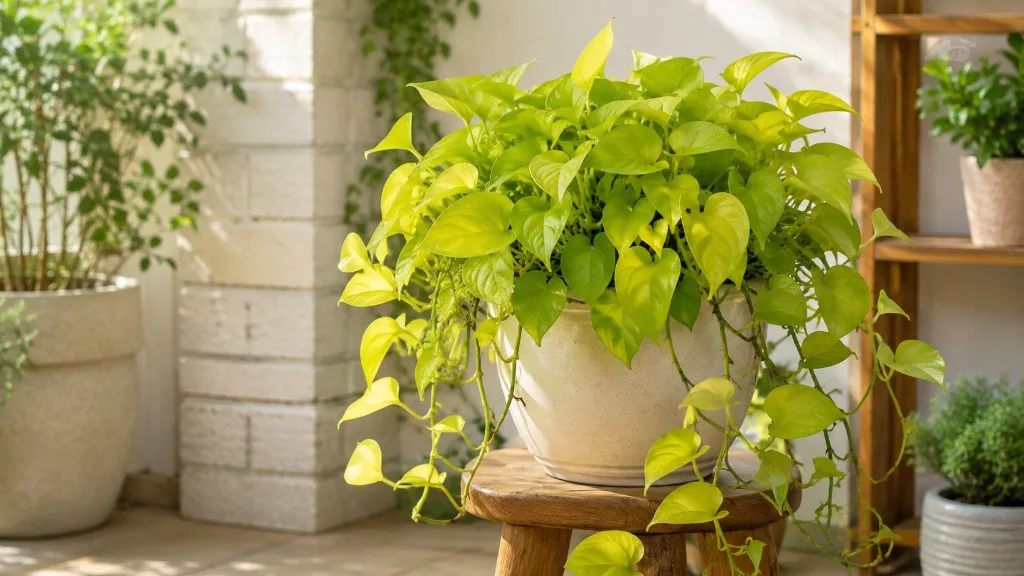
Neon Pothos is sold for one reason above all others: that electric chartreuse glow that looks lit from within on a healthy vine. Epipremnum aureum ‘Neon’ is still a pothos - tough, forgiving, and willing to live in places that would stress fussier houseplants - but its color is not forgiving. Give it bright indirect light and new leaves unfurl in vivid lime-yellow green. Park it in a dim corner and it will often survive, slowly shifting toward dull, greenish foliage as the plant builds more chlorophyll to compensate for scarce photons. Put it in harsh direct sun without acclimation and the same leaves can bleach, crisp, or fade within days.
The practical goal is not maximum survival. It is color fidelity plus steady growth: firm heart-shaped leaves, short gaps between nodes, and chartreuse new foliage that matches the nursery tag. Clemson Cooperative Extension lists bright, indirect light as the preference for pothos indoors, noting that lower light can cause variegated and specialty cultivars to lose their distinctive coloring. (Clemson HGIC) Penn State Extension recommends moderate to bright light while avoiding direct sun, and warns that prolonged low light eventually strips away the leaf qualities that define each cultivar. (Penn State Extension) University of Florida IFAS Extension notes that pothos tolerates light as low as 50 foot-candles but that variegated cultivars lose color below roughly 150 foot-candles, with 150 foot-candles or more needed to maintain color and leaf size - a threshold Neon Pothos typically needs to exceed for full chartreuse saturation, not merely avoid death. (UF IFAS Extension)
This guide focuses on placement decisions you can make today: how much light Neon Pothos actually needs, what bright indirect means in a real room, which window to choose, why low light dulls the color, how direct sun bleaches leaves, when to add a grow light, and how to read warning signs before the plant becomes a plain green pothos with a neon memory.
How Much Light Neon Pothos Actually Needs
Neon Pothos shares the same tropical understory biology as Golden Pothos and Jade Pothos - a climbing aroid from the Pacific/Southeast Asian region that scales tree trunks toward broken canopy light rather than baking in open midday sun. Indoors, the target is the same filtered brightness: strong ambient light on the leaves without sustained hot direct beams. For Neon, the difference is pigment economics. Golden Pothos loses yellow sectors in low light; Neon can lose the entire chartreuse identity on new leaves because the cultivar’s signature color is a light-sensitive expression across the whole blade, not a patch of variegation on an otherwise green leaf.
UF IFAS Extension describes commercial pothos production under 63 to 80 percent shade, roughly 320 to 2,500 foot-candles, with growth and color declining when shade exceeds 80 percent. (UF IFAS Extension) For home Neon Pothos, translate that into a practical band: bright indirect light around 200 to 800 foot-candles at the leaf surface for vivid chartreuse and compact growth; moderate indirect around 100 to 200 foot-candles for slower growth with progressive greening of new foliage; low light below roughly 100 foot-candles for long-term survival with color loss and legginess. These numbers are guides, not mandatory instrumentation - your plant’s new leaves are the better meter.
Neon Pothos is more light-demanding than Golden or Jade Pothos for display quality. Solid-green Jade tolerates dim offices gracefully; Golden fades variegation sectors but often still reads as “pothos” in low light. Neon in the same dim hall reads as ordinary green devil’s ivy within weeks to months because the plant upregulates chlorophyll across the full leaf. If chartreuse matters to you, treat Neon like a color cultivar, not like the indestructible office pothos reputation suggests.
The Short Answer for Busy Growers
If you only remember three rules, use these. Placement: put Neon Pothos within 12 to 36 inches (30 to 90 cm) of your brightest suitable window - usually east, or north/east with open sky, or south/west behind a sheer curtain - where leaves receive strong indirect brightness most of the day without hot afternoon sunbeams sitting on the foliage. Low light: accept that dim rooms will dull new leaves to greenish tones; the plant may live, but it will not stay neon. Direct sun: avoid harsh, unfiltered afternoon rays; gentle morning direct sun through east glass is often fine for acclimated plants, but south and west summer sill exposure without diffusion is a bleaching risk.
Judge success by new growth, not nostalgia for old chartreuse leaves. Within two to four weeks of better light, fresh leaves should emerge brighter yellow-green, feel firm, and show shorter gaps between nodes than the stretched stems produced in shade.
Why Neon Is More Light-Hungry Than Other Pothos
The Neon cultivar’s color is tied to lower chlorophyll density in bright conditions - the translucent, glowing chartreuse look comes from pigment balance that favors the yellow-green appearance when photons are abundant. In low light, the plant cannot afford that balance. It behaves like any shade-stressed photosynthesizer: it produces more chlorophyll to capture scarce light, and new foliage shifts toward olive or forest green. This is phenotypic adjustment, not necessarily permanent genetic reversion, which is why brighter light often restores chartreuse on subsequent leaves even when older ones stay dull.
Clemson Extension notes that heavily patterned cultivars like Marble Queen require more light than other varieties to maintain intense coloring. (Clemson HGIC) Neon fits that higher-demand group even though its pattern is solid rather than speckled - the entire leaf surface is the color feature at risk. Golden Pothos in the same window may look acceptable while Neon beside it already greening tells you the light is adequate for survival cultivars but insufficient for pigment cultivars.
There is also a watering trap in low light. A dim Neon Pothos transpires slowly. Growers who keep a bright-window Neon Pothos watering guide on a plant moved to a back shelf often see yellow leaves and sour soil - symptoms labeled overwatering that start when light slows metabolism. Brighter light increases water use; dim light demands patience before the next drink. Light sets the pace for the whole care system.
Bright Indirect Light and the Chartreuse Glow
Bright indirect light is the phrase every pothos guide repeats and few define plainly. For Neon Pothos, it means the leaf canopy receives high ambient brightness - enough that you could read comfortably near the plant without switching on a lamp - while direct sunbeams do not bake the tissue for long stretches. Think of the light under a tropical tree canopy near the edge: bright sky everywhere, sunflecks brief and filtered, not open desert noon.
A simple field test: on a clear day, hold your hand above the leaves at the plant’s height. In bright indirect conditions, you usually see a soft, fuzzy shadow - light is strong but diffused. If sharp, dark shadows form and the leaf surface feels hot within an hour, you are crossing into direct sun territory that Neon Pothos handles poorly without acclimation. If no meaningful shadow appears, you are likely below the brightness Neon needs for chartreuse new growth.
What Bright Indirect Looks Like in Your Home
Concrete placements that often work for Neon Pothos:
- East windowsill or a table within 12 inches of east glass, where morning sun may touch leaves briefly but afternoon stays bright and indirect
- North or northeast window with unobstructed outdoor view - underrated for Neon because the light is gentle and consistent; high-latitude summer north can be excellent
- South or west window with a sheer curtain, pot one to three feet back from the pane so intensity diffuses before it hits leaves
- Interior shelf three to five feet from a large window, only if the room is genuinely bright and the plant’s top leaves still receive strong sky light - not a dim corner that happens to be “near” a window by floor plan
Concrete placements that commonly fail for color:
- Hallway more than six feet from any glass, where human eyes adapt to dimness but leaves starve
- South window ledge in midsummer with leaves pressed against hot glass
- West window without diffusion in afternoon - high scorch and bleaching risk
- Overhead shelf above the window frame, where the wall blocks most sky brightness
Rotate the pot a quarter turn every week so the vine does not lean permanently toward one light source, as Penn State Extension recommends for balanced pothos foliage. (Penn State Extension)
How New Leaves Tell You the Color Story
Old leaves lie. They show past conditions and will not re-chartreuse after you fix light. Neon Pothos communicates current light quality on the youngest leaf and the next node back.
In good bright indirect light, new leaves emerge bright yellow-green, often lighter than mature leaves on the same vine, then settle slightly as they harden off - normal for Neon. Internodes stay relatively short. The growing tip pushes steadily through spring and summer without fertilizer changes.
In insufficient light, the shift appears first on new foliage: darker green at unfurling, smaller blade size, longer stem gaps, and visible reach toward the window. Within a few weeks, the vine can look like Jade Pothos with chartreuse ghosts on older tissue only.
In excess direct light, damage also shows on exposed new and mature leaves: bleached white or tan patches, crisp brown edges on the sun-facing side, or a washed-out lime that looks faded rather than glowing - paradoxically pale while the plant is getting “too much” light, because photobleaching destroys pigment faster than chlorophyll compensation restores it.
Use a two-week observation window after any move. One placement change, then read new growth before adjusting water or fertilizer.
Best Window Placement for Neon Pothos
Window direction is a starting guess, not a verdict. A labeled “south window” blocked by a porch roof may deliver less usable light than an open east window. What matters is hours of useful brightness on the leaf surface and whether any hours carry heat-heavy direct rays.
Place Neon Pothos close enough to the glass that leaves receive real flux when you want vivid color - typically within 12 to 36 inches (30 to 90 cm) on the chosen exposure. A plant on a table six feet from a south window is not getting south-window light; intensity drops sharply with distance. Hanging baskets are often hung too high or too far from windows; the wall above the frame can still be a dark zone even when the room feels bright.
East, North, West, and South Windows Compared
An east-facing window is the most reliable default for Neon Pothos in most homes. Morning sun is bright but cooler than afternoon exposure, often delivering one to three hours of gentle direct light many acclimated plants handle well, followed by bright indirect light the rest of the day. East supports chartreuse new growth without the scorch risk that unfiltered west and south windows carry in summer.
A north-facing or northeast window is stronger than its reputation for Neon. North light is consistent and soft - excellent for maintaining color without bleaching in many temperate homes, especially in summer at mid to high latitudes. Winter north may need supplementation, but north/northeast is often better for Neon color than a harsh west exposure because it avoids afternoon heat load.
A south-facing window delivers the strongest winter sun in the northern hemisphere and can produce brilliant chartreuse when the pot sits slightly back from the pane or behind a sheer curtain. In summer, south glass intensifies heat and UV; leaves touching hot glass may bleach on the window-facing side even when the room air feels fine. Watch for one-sided fade and pull the pot inward or diffuse when outdoor angles sharpen.
A west-facing window delivers strong afternoon rays - the highest bleaching and scorch risk for unacclimated Neon Pothos. West can work with mandatory diffusion - sheer curtain, partial outdoor tree shade, or a pot position that avoids peak beams - but treat unfiltered west sill placement as an experiment with a high failure rate for chartreuse leaves.
Distance, Sheers, and Seasonal Light Shifts
Distance from glass changes color outcomes as much as compass direction. Moving Neon Pothos one foot farther from a window can drop intensity enough that new leaves green within a month - especially in winter when sun angle and day length both fall.
Sheer curtains and blinds are legitimate tools, not compromises. For south and west exposures, diffusion often improves Neon outcomes by removing scorch while preserving bright indirect totals. Fully closed blinds during daylight hours starve the plant; filter, do not block.
Seasonal shifts catch growers off guard. A perfect east-window Neon in June may fade in December on the same sill because day length and sun angle drop. Winter is when grow lights earn their keep for color cultivars. Do not compensate for weak winter light by overwatering; fix photons first, then match moisture to slower growth.
Low Light Tolerance and Green Color Reversion
Neon Pothos can tolerate low light longer than many houseplants - the same shade tolerance that made pothos an office staple for decades. Tolerance is not preference. UF IFAS Extension states pothos survives 50 foot-candles but that variegated cultivars lose color at low levels, with 150 foot-candles or more recommended to maintain color and leaf size. (UF IFAS Extension) For Neon, “lose color” reads as greenish new leaves, not just smaller white sectors.
Set honest expectations when you choose a dim spot: slower growth, smaller leaves, dull green new foliage, higher overwatering risk, and loss of the chartreuse selling point. The plant may still soften a corner and clean air; it will not look like the tag photo without brighter light.
Survival vs Display Quality in Dim Rooms
In deep low light - far from windows, obstructed corners, some interior offices - Neon Pothos enters survival mode. Metabolism slows. Internodes lengthen. New leaves emerge dark green because the plant prioritizes chlorophyll over decorative yellow-green pigment. Older chartreuse leaves persist for a while, creating a two-tone vine that misleads growers into thinking the plant is still “neon enough.”
This is reversible in most cases. Move the plant to bright indirect light and wait for new leaves - not old ones - to show chartreuse again. Recovery speed depends on season, health, and how long the plant lived dim; expect three to six weeks for clearly brighter new foliage in many homes, sometimes faster in warm bright summers.
If display quality is non-negotiable and the room cannot be changed, Jade Pothos honestly matches a dim space better than fighting Neon color loss, or install a full-spectrum LED on a 12 to 14 hour timer rather than accepting green reversion.
Leggy Growth and the Chlorophyll Shift
Leggy growth - long bare stems with leaves clustered at the ends - is etiolation, the plant stretching toward photons. On Neon Pothos, legginess usually pairs with green-shifted new leaves because the same low-light stress drives both stretch and chlorophyll upregulation. Penn State Extension notes that pothos leaves grow toward light; rotation helps, but rotation without more brightness only spins a reaching plant. (Penn State Extension)
Do not confuse natural aging with light fade. Lower old leaves yellow and drop over time regardless of light. Light problems show on new growth first. Check the top of the vine and the newest unfurling leaf before diagnosing the whole plant.
When improving light after long dim placement, pinch or trim leggy tips after new compact growth appears so side shoots emerge from brighter nodes. Pinching alone in continued shade produces more stringy vine, not a bushier neon display.
Direct Sun Risks and Bleaching
Neon Pothos is not a full-sun houseplant. Penn State Extension warns that direct sun leads to leaf yellowing on pothos. (Penn State Extension) Clemson Cooperative Extension lists leaf scorch and tip dieback among problems tied to intense light combined with low humidity. (Clemson HGIC) Neon leaves are especially vulnerable to photobleaching - white or tan patches where pigment is destroyed - because the cultivar’s color balance already operates closer to the bright-light edge than solid-green Jade.
In nature, climbing pothos receives dappled sunflecks, not hours of unfiltered glass-intensified rays. Indoors, the danger is sustained direct exposure, especially afternoon south and west sun, where leaf temperature spikes and repair cannot keep pace.
Harsh Rays, Hot Glass, and Faded Leaves
Warning patterns for too much sun on Neon Pothos:
- Bleached white or tan patches on the sun-facing leaf surface, distinct from uniform green shift from low light
- Crisp brown edges or spots appearing suddenly after a move closer to glass or outdoors
- Washed-out, papery-looking chartreuse - faded rather than glowing - on leaves in direct beams
- Curling or folding during brightest hours as a protective response to excess flux or heat
- Leaves pressed against hot window panes showing one-sided damage while the shaded side looks normal
Heat amplifies light damage. Dark pots on hot sills cook roots while leaves bleach. Sheer curtains, inward pot placement, and avoiding leaf-to-glass contact prevent damage that no amount of watering fixes.
Some growers assume more sun equals more neon. For Neon Pothos, bright indirect produces the best color; harsh direct often destroys it. The goal is photon flux without tissue overheating - filtered brightness, not blazing beams.
Safe Acclimation to Brighter Spots
If you want to move Neon Pothos brighter - closer to a south window, outdoors for summer, or under a stronger grow light - acclimate in steps over 7 to 14 days per step:
- Move one increment brighter, not from a dim shelf to an unfiltered west sill in one jump
- Watch new leaves only; old scorch will not heal
- Increase watering slightly as brightness rises because transpiration increases
- If bleaching or crisping appears, step back to the last safe position and hold until clean new growth resumes
Morning direct sun through east glass is the gentlest direct exposure and often tolerated by acclimated Neon Pothos. Afternoon direct sun through south or west glass is the highest-risk exposure without diffusion.
Outdoor summer moves follow the same logic: start in open shade or dappled morning light for a week before any bright patio sun. Neon can summer outdoors in many climates, but midday patio tables in full sun are a bleaching trap even for tough pothos.
Grow Lights When Windows Fall Short
When windows cannot deliver enough brightness for chartreuse new growth - winter rooms, interior shelves, offices - a full-spectrum LED grow light is the most reliable fix. Neon Pothos responds well to artificial light; the same commercial flexibility that made Epipremnum aureum an interiorscape staple for decades applies to the Neon cultivar when spectrum and duration are correct.
Choose a horticultural full-spectrum white LED rated for plant growth, not a standard room bulb optimized for human lumens. Pothos uses photosynthetically active radiation in the same general bands as most foliage plants; expensive purple panels are optional for basic health and color retention.
Fixture Setup, Height, and Daily Hours
A workable starting setup for Neon Pothos:
- Position the fixture 10 to 18 inches (25 to 45 cm) above the top of the canopy - close enough for intensity, far enough to avoid heat spots on small setups
- Run the light 12 to 14 hours daily on a timer to approximate long-day brightness; consistent photoperiod beats irregular manual switching
- Choose 5000–6500 K white full-spectrum LEDs for general foliage growth and color maintenance
- Combine overhead LED with a nearby window when possible so growth stays balanced rather than leaning hard toward a single side source
Adjust using new-growth signals after two weeks. If stems still stretch and new leaves green or shrink, lower the fixture 2 inches or add one hour to the timer - not both at once. If bleaching or curling appears only under the lamp, raise the fixture 2 to 3 inches or reduce hours slightly. Enclosed cabinets can overheat even with modern LEDs; hold a hand near the leaves at midday lamp-on to check for uncomfortable warmth.
Winter supplementation maintains steady photosynthesis through short days; pair added light with reduced watering frequency if temperatures and growth slow seasonally. The goal is color fidelity through winter, not forcing summer elongation rates in December.
Warning Signs Neon Pothos Has the Wrong Light
Neon Pothos reports light problems on new tissue first. Make one light change, then wait 10 to 14 days before also changing water, fertilizer, or pot size - overlapping edits make diagnosis guesswork because wilt, fade, green shift, and edge crisping overlap across stress types.
Too little light - dull green new leaves, leggy vines, slow growth: Long internodes and visible stretching toward the window or bulb mean the plant is escaping shade. New leaves emerging greenish or olive instead of chartreuse confirm insufficient photon flux for pigment expression - the core Neon failure mode. Smaller new leaves than older ones indicate chronic deficit. Hard lean to one side shows directional starvation without weekly rotation. Slow or absent new growth through spring and summer, despite adequate water and temperature, often traces to light before disease. Yellow lower leaves on soil that stays moist in dim cool rooms frequently couples low light to overwatering; fix light and dry-down together.
Too much light - bleach, scorch, curl, sudden fade: White or tan bleached patches on sun-facing zones indicate photobleaching. Crisp brown areas after a move closer to glass or outdoors suggest scorch on leaves formed in softer light. Washed-out, faded chartreuse in direct beams is excess light, not healthy glow. Curling during peak hours may signal excess flux or leaf heat. Sudden leaf drop after relocation to harsh exposure without acclimation is a common acclimation failure.
Fixes for under-lighting: move closer to glass, shift to a brighter exposure, remove obstructions, add or lower a grow light, extend photoperiod on the timer, rotate weekly, and trim leggy tips after light improves so side shoots emerge compact. Fixes for over-lighting: pull back from glass, add sheer diffusion, shift to east or filtered exposure, acclimate gradually, and avoid leaf contact with hot panes. Old damaged foliage can be trimmed once new growth under safer light looks clean and chartreuse.
Conclusion
Neon Pothos light needs center on one trade: bright indirect light for vivid chartreuse, low light for slow survival with greenish dulling, and harsh direct sun for bleaching and scorch. The plant is forgiving enough to live in dim rooms, but it is not honest to call it Neon when new leaves consistently emerge green. Extension guidance consistently points to bright, indirect light as the target for pothos vigor and cultivar character, with explicit warnings that low light strips distinctive foliage qualities and direct sun damages leaves. (Clemson HGIC; Penn State Extension; UF IFAS Extension)
Place Neon Pothos close enough to the window that leaves receive real flux, default to east or filtered north/east/south/west exposures, treat hot afternoon direct sun as a bleaching risk, and run 12 to 14 hours of full-spectrum LED when natural light cannot carry chartreuse color through winter or back-room placements. Read new leaves, not old chartreuse ghosts; move exposure in steps; pair brighter light with adjusted watering. Get the band right and Neon Pothos becomes one of the most striking easy vines you can grow - still tough at the roots, but finally showing the glowing color you bought it for.
When to use this page vs other Neon Pothos guides
- Neon Pothos overview - Start here for whole-plant context before deep-diving this topic.
- Neon Pothos problems hub - Jump to symptom-specific fix guides when this care topic does not resolve the issue.
- Leggy Growth on Neon Pothos - Escalate here when light adjustments are not enough.
Related Neon Pothos guides
- Neon Pothos overview
- Neon Pothos watering
- Neon Pothos soil
- Neon Pothos propagation
- Neon Pothos fertilizer
- Neon Pothos repotting
- Leggy Growth on Neon Pothos
- Neon Pothos problems
Related tool
Try the Plant Problem Diagnosis Tool with neon-pothos pre-selected to estimate needs for your setup.