No Flowers on Pothos: Why It Is Usually Normal
Quick answer
No flowers on pothos is usually normal, not a care failure. Epipremnum aureum is grown indoors in its juvenile foliage stage and almost never blooms as a houseplant. First step: stop trying to trigger flowers and judge the plant by new leaf growth, leaf color, stem firmness, and root health instead.
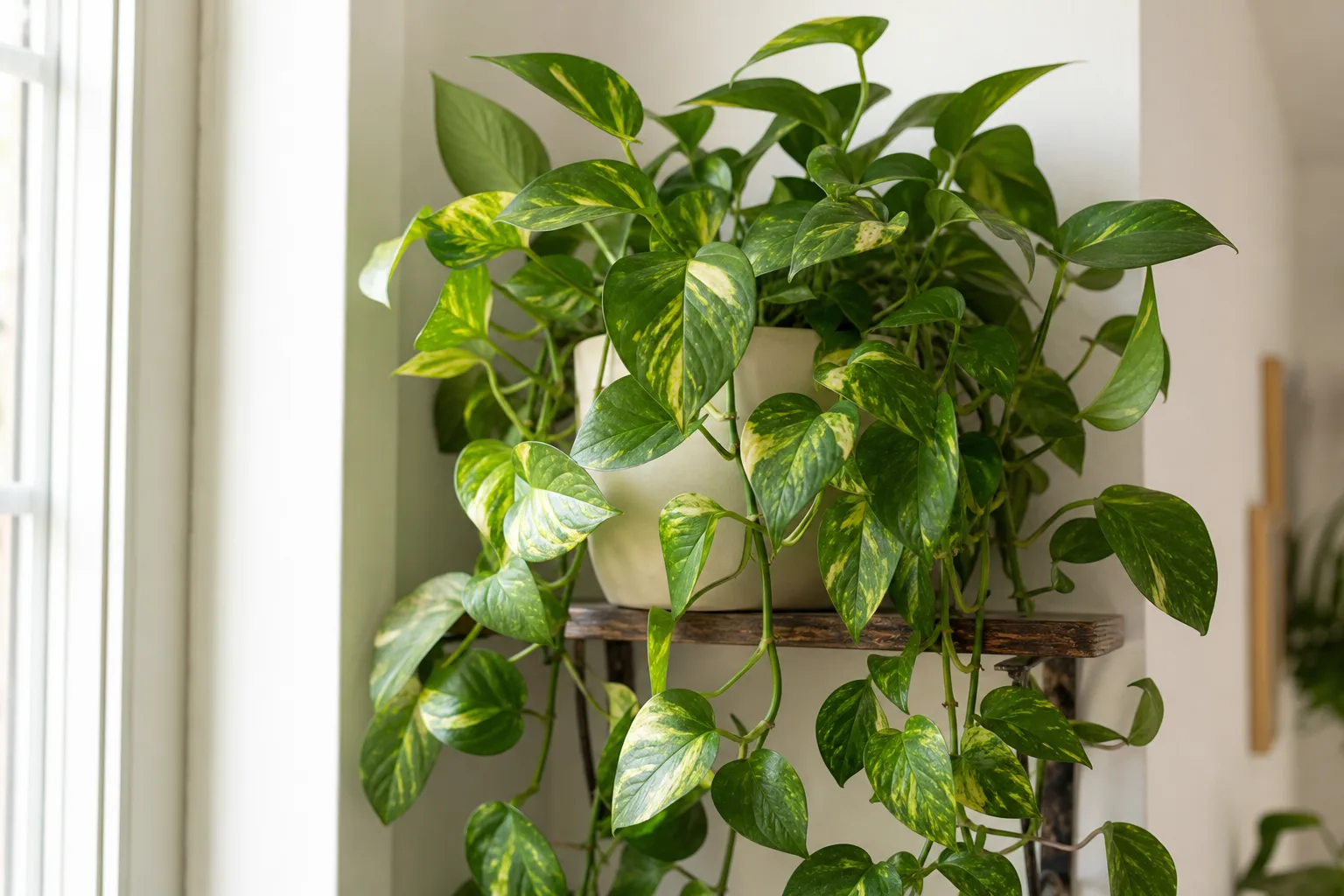
No Flowers on Pothos: Why It Is Usually Normal
This guide covers no flowers on Pothos. See also the general No Flowers guide, watering, and light pages for this plant.
No Flowers on Pothos: Why It Is Usually Normal
Quick answer
If your pothos (Epipremnum aureum) has never flowered indoors, that is usually normal biology, not a hidden care problem. This species is kept as a juvenile foliage plant in homes, offices, and hanging baskets. It almost always stays in that juvenile phase, where it makes heart-shaped leaves and vines but not the mature spathe-and-spadix flowers people associate with many aroids.
First step: stop treating flowers as the health test. Judge pothos by whether it is making new leaves in active growth, holding good color or variegation, staying firm at the nodes, and drying on a sensible watering rhythm. Those are the signals that matter on a houseplant pothos.
Why this page exists
“No flowers on pothos” sounds like a plant problem, but in most homes it is really a species-expectation question. People see that pothos belongs to the arum family, learn that peace lilies and anthuriums bloom indoors, and assume their pothos should eventually do the same. In practice, pothos is sold and grown for vines and foliage, not flowers.
That means this page is different from a typical symptom guide. The goal is not to help you force blooms. The goal is to help you confirm when flowerlessness is normal, recognize the few cases where another issue is hiding behind that search, and avoid wasting time on bloom boosters or unnecessary repotting.
Why pothos almost never flowers indoors
Indoor plants stay juvenile
Wisconsin Horticulture notes that pothos shows very different juvenile and mature growth. Indoors, most plants stay in the juvenile form: flexible vines with smaller heart-shaped leaves. In nature, mature Epipremnum aureum climbs high into tree canopies, develops much larger foliage with splits and fenestrations, and reaches the growth stage associated with flowering. A potted houseplant trailing from a shelf almost never reaches that mature architecture.
The juvenile phase is not a sign of poor care. It is the default outcome of how pothos is propagated, potted, and sold. Cuttings root easily from juvenile tissue, and growers maintain compact plants that fit on retail shelves. That commercial pipeline reinforces foliage-first culture rather than reproductive maturity.
The species is also an exceptional shy bloomer
There is more going on than life stage alone. A primary research paper published in Scientific Reports found that Epipremnum aureum has an abnormal flowering pattern linked to gibberellin biosynthesis deficiency. Gibberellins are plant hormones that regulate stem elongation and flowering in many species. In pothos, a defect in that pathway helps explain why the plant is unusually reluctant to flower even compared with many other ornamentals. Healthy, established pothos can remain flowerless in cultivation for reasons that go beyond your watering schedule.
Growers do not maintain it as a flowering crop
Commercial and home care both reinforce the foliage-first habit. Pots are kept compact, vines are pruned, and support structures are optional. NC State Extension describes pothos as a popular houseplant grown primarily for its attractive trailing or climbing vines. Even when a moss pole encourages larger leaves, the plant is still being managed as an indoor foliage vine rather than a mature reproductive climber reaching canopy height.
Juvenile vs mature growth on Epipremnum aureum
Understanding the two growth forms helps explain why flowers are so rare indoors.
Juvenile pothos — what you see in almost every home:
- Heart-shaped leaves, typically 2–4 inches long on indoor plants
- Flexible, trailing or climbing stems without thick woody tissue
- No fenestrations or splits on most common cultivars indoors
- Continuous vine extension from nodes along the stem
- The form sold as cuttings, hanging baskets, and desk plants
Mature pothos — what you would see on a wild climber high in a tropical forest:
- Much larger leaves, sometimes with splits or holes depending on species phase
- Thicker stems gripping bark with aerial roots
- Growth architecture associated with reproductive maturity in aroids
- The stage where flowering becomes biologically possible, though still rare in this species
Wisconsin Horticulture emphasizes that the dramatic difference between juvenile and mature forms is one of the defining features of Epipremnum aureum. Your living-room pothos is not “failing to mature” in a care sense. It is behaving like a cultivated juvenile vine, which is exactly what the houseplant trade selects for.
Moss pole vs hanging basket: does support help flowers?
This is one of the most common follow-up questions after “why won’t my pothos bloom?”
Short answer: a moss pole can produce larger leaves and tighter internodes, but it almost never triggers indoor flowers.
| Growth setup | What it changes | Effect on flowering |
|---|---|---|
| Hanging basket | Encourages trailing juvenile vines | No meaningful flowering benefit |
| Shelf or tabletop trail | Same juvenile habit, often in lower light | No flowering benefit |
| Moss pole or trellis | Encourages upward climb, larger leaves, shorter internodes | Better foliage architecture, still not mature enough for blooms indoors |
| Greenhouse tree-climb simulation | Theoretical mature architecture | Not practical in home settings |
A moss pole is worth using if you want bigger leaves, a fuller vertical silhouette, or tighter growth on a cultivar like Marble Queen. It is not a bloom trigger. Even pole-trained pothos in bright conservatories rarely flower indoors, and the gibberellin research suggests biology limits blooms even when plants do reach larger sizes.
Penn State Extension treats pothos as a foliage houseplant valued for easy care and attractive vines. That framing matches how the species is actually grown: optimize for leaves, not inflorescences.
What healthy, flowerless pothos looks like
Use this checklist instead of waiting for blooms:
- New leaves unfurl during spring and summer, even if growth is modest.
- Stems stay firm rather than mushy at the base.
- Variegated cultivars keep useful color instead of reverting mostly green in dim light.
- The top layer of mix dries between waterings instead of staying wet for days.
- Roots smell earthy, not sour, if you inspect the pot.
- Nodes along the vine remain plump and capable of producing new leaves or aerial roots.
- Older leaves hold color without widespread yellowing or brown spotting.
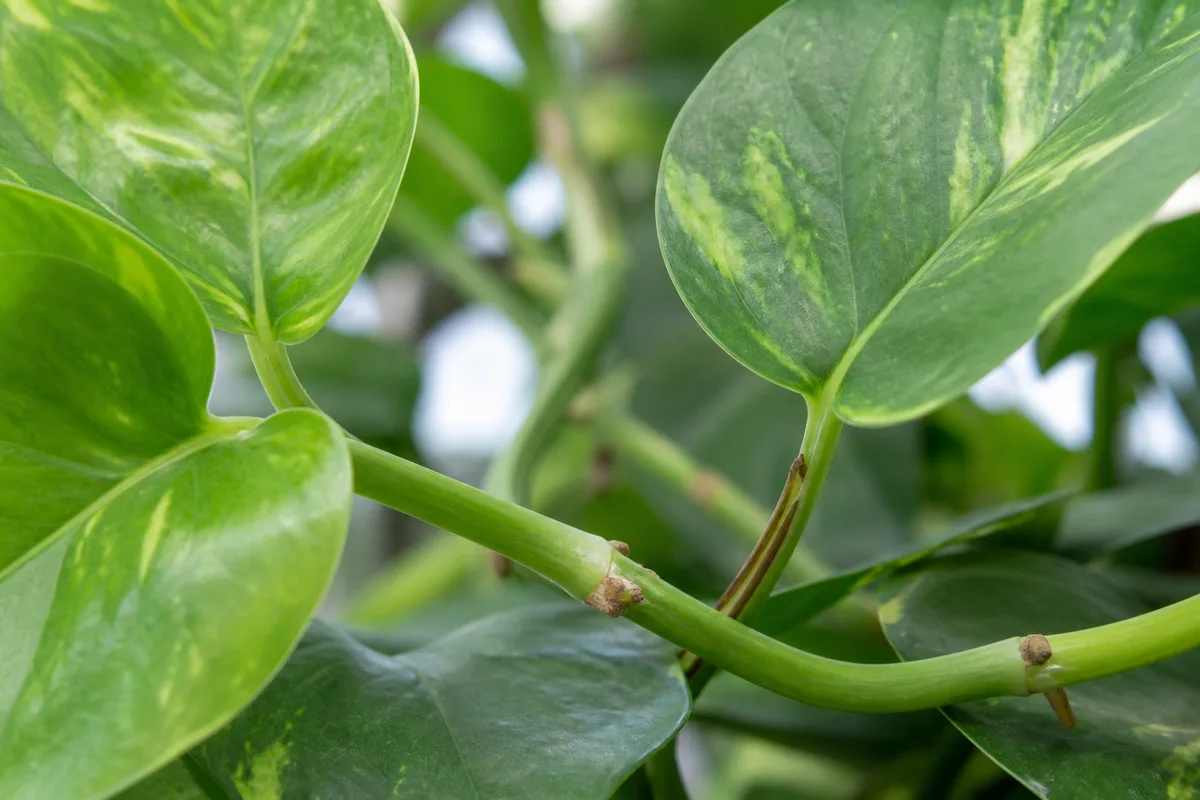
Healthy pothos can remain completely flowerless indoors and still be growing normally.
If those fundamentals are in place, the plant is doing its job. No flowers are required. A five-year-old Golden Pothos covering a bookshelf with zero spathes is a success story, not a deficiency.
Misdiagnosis table: “no flowers” vs real pothos problems
People often search “no flowers” when something else is actually wrong. Use this table to separate normal flowerlessness from problems worth fixing.
| What you notice | Is it a flowering issue? | What to investigate instead |
|---|---|---|
| Never bloomed in years of ownership | No — normal | Nothing, if growth checklist above is met |
| Healthy vines, new leaves each season, zero blooms | No — normal | Continue standard pothos care |
| No new leaves for an entire active season | No — growth stall | Slow growth, light, roots, watering |
| Long bare gaps between leaves | No — light stress | Leggy growth or not enough light |
| Yellow leaves with wet soil | No — root or moisture issue | Yellow leaves or root rot |
| Soft stems, sour soil smell | No — emergency | Root inspection before any other changes |
| Plant produced indoor spathes | Possibly misidentified plant | Confirm species — blooming aroid may not be pothos |
| Variegation fading to mostly green | No — light issue | Brighter indirect light, not bloom fertilizer |
The pattern is consistent: flowerlessness alone is never the diagnosis. It becomes a useful search term only when it leads you to check whether the plant is genuinely healthy by foliage standards.
What to check if you searched “no flowers” but the plant also looks off
Sometimes “no flowers” is just the search phrase people use before they realize the real problem is elsewhere. Check these instead:
No new leaves for months
If the plant is warm, bright enough, and still not producing new leaves for an entire active season, look at light, root crowding, and watering rhythm instead of flowers. Pothos grows best in bright indirect light and will stall when light, roots, or moisture are out of balance. Start with slow growth.
Long bare gaps between leaves
That is a light issue, not a flowering issue. Pothos in low light stretches, loses density, and may produce smaller greener leaves. Start with leggy growth or not enough light.
Yellow leaves with wet soil
That points toward overwatering or root stress. A pothos cannot flower itself out of a root problem. Start with yellow leaves or root rot.
Soft stems or sour mix
That is a root-zone emergency compared with the non-issue of missing flowers. Inspect the roots before changing anything else.
What not to do
Do not repot only because the plant has not flowered. Do not switch to bloom fertilizer hoping to trigger spathes. Do not move the plant repeatedly from window to window chasing a result the species almost never gives indoors.
Those responses are search-engine logic, not plant logic. High-phosphorus “bloom booster” products are marketed for plants that flower readily under the right conditions. Pothos is not one of them. Excess fertilizer salts can yellow leaves and stress roots without moving you any closer to an inflorescence.
The better move is to optimize pothos for the trait it is actually grown for: strong, attractive foliage. If you want indoor flowers, peace lilies, anthuriums, and many orchids are bred and managed for that outcome. Pothos is not.
When lack of flowers does matter
Flowerlessness becomes worth discussing only in two situations:
-
You may be dealing with the wrong plant. Plants sometimes get mislabeled at garden centers. If your plant has already produced indoor blooms on a regular cycle, double-check whether it is really pothos or another aroid such as a young philodendron or syngonium. True Epipremnum aureum flowering indoors is exceptionally uncommon.
-
The plant is not just flowerless, but also visibly declining. In that case, the real diagnosis is almost always light, moisture, temperature, pests, or roots — not reproductive failure. Work through the misdiagnosis table above and the linked problem pages before assuming anything about flowering.
When to investigate real problems
Treat these as action triggers. None of them involve flowers.
- Stalled growth through a full spring and summer despite adequate light and watering — investigate roots, pot size, and nutrition.
- Progressive yellowing spreading beyond one or two old leaves — check moisture rhythm and drainage first.
- Mushy stems at the soil line — inspect for root rot immediately.
- Sudden widespread leaf drop after a cold draft, repot, or fertilizer surge — trace the recent change.
- Visible pests (mealybugs, scale, spider mites) on stems or leaf axils — treat the infestation; flowering was never the issue.
If none of those apply and your pothos is producing leaves, the absence of blooms requires no intervention.
Conclusion
No flowers on pothos is usually not a symptom at all. Epipremnum aureum is a foliage vine that stays juvenile indoors and is exceptionally unlikely to bloom even when healthy. Judge success by leaf production, color, stem firmness, and root health instead. If those are good, the plant is fine. If they are not, troubleshoot the real care issue rather than trying to make pothos act like a flowering houseplant.
Related tool
Use the Plant Problem Diagnosis Tool to narrow causes for no flowers on this plant before changing multiple variables at once.