Pilea Peperomioides Care Guide: Chinese Money Plant Indoors
Pilea peperomioides
Pilea peperomioides needs bright indirect light, watering every 7–10 days when top inch is dry, rotation every 2 weeks for symmetry, and pup separation when ready. Non-toxic to pets.
Pilea Peperomioides Care Guide: Chinese Money Plant Indoors
Start with wateringThe most common care mistake for Pilea PeperomioidesWatering guide →Pilea Peperomioides care essentials
Light
bright indirect light, medium indirect light
Water
Every 7–10 days in summer - allow top inch to dry. Every 14 days in winter. Rotate fortnightly for even growth.
Soil
Standard potting mix + 15–20 % perlite. Well-draining. pH 6.0–7.0.
Humidity
Average household humidity (40–50%)
Temperature
15°C to 25°C (60–77°F)
Fertilizer
Feed lightly during active growth. Use monthly during spring and summer..
About Pilea Peperomioides
Pilea Peperomioides has a upright growth habit. It is also known as Chinese Money Plant.
| Detail | Information |
|---|---|
| Also known as | Chinese Money Plant |
| Growth habit | Upright |
| Scientific name | Pilea peperomioides |
Pilea Peperomioides Care Guide: Chinese Money Plant Indoors
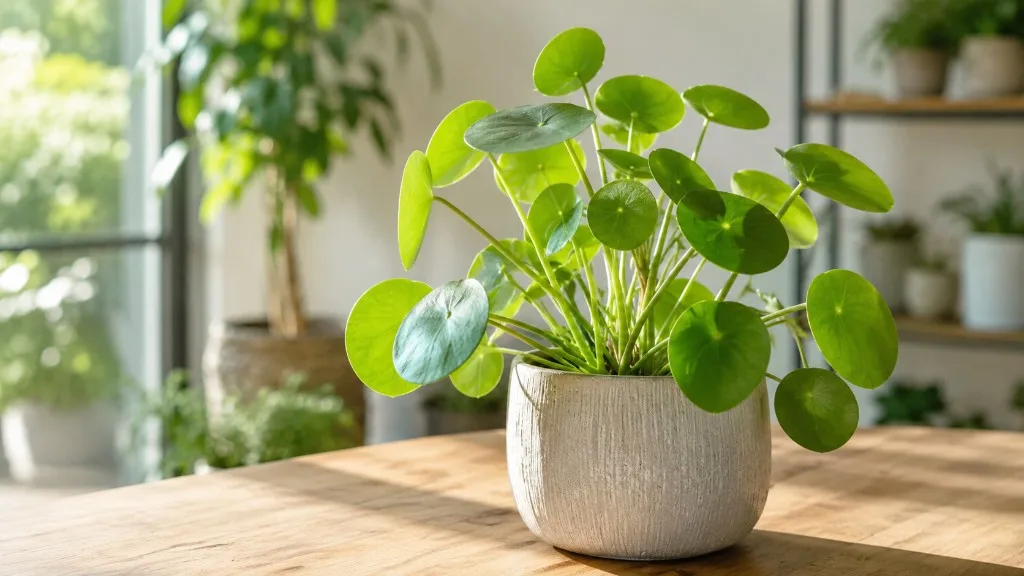
The Chinese money plant is one of those houseplants people recognize instantly: a single upright stem topped with flat, round leaves that look like green coins on long petioles. Pilea peperomioides is also one of the few popular indoor plants that stays compact without much fuss, produces baby plants you can share, and is listed as non-toxic to cats and dogs by the ASPCA. The catch is that it is picky about two things most beginners skip: Pilea Peperomioides light guide and regular rotation. Ignore either one and the stem leans hard toward the window, the leaves lose their dome shape, and watering becomes guesswork.
This guide covers what the plant actually is, where its native habitat explains its indoor needs, how to place and rotate it for a balanced silhouette, how to water and feed without rotting roots, how to separate pups at the right time, what ASPCA non-toxic status really means for pet owners, and how to fix the problems that show up on almost every mature plant at least once.
For related Pilea Peperomioides care, see Spider Mites on Pilea Peperomioides.
What Pilea Peperomioides Actually Is
Pilea peperomioides is a herbaceous perennial in the Urticaceae (nettle) family. It is not a succulent, not a peperomia, and not a fern - though its thick, slightly succulent leaves and low-maintenance reputation often get it grouped with all three in shop displays. What you are looking at on a healthy plant is a central stem with coin-shaped leaves attached by thin petioles in a layered, umbrella-like arrangement. Mature indoor plants typically reach roughly 12–15 inches (30–38 cm) tall with a similar spread when pups are left in place, though a single-stem specimen kept pup-free stays narrower.
The leaves are the whole aesthetic. A good Pilea has firm, domed, circular blades with a slight gloss, evenly spaced along the stem, with newer leaves at the top and older ones lower down. Leaves that are flat, cupped inward, or hanging like saucers are telling you something about light or water - usually both. The plant rarely flowers indoors in most homes; when it does, the inflorescence is small and inconspicuous compared to the foliage, which is why every care decision here is really about leaf and stem health.
Botanical background: Urticaceae and the coin-leaf habit
The genus Pilea contains hundreds of species, many of them creeping or bushy tropical plants with very different looks - aluminum plant (Pilea cadierei), Moon Valley pilea (Pilea mollis), and artillery plant (Pilea microphylla) share the genus but not the upright coin-leaf form. P. peperomioides is distinct because of its solitary upright stem, nearly perfect circular leaves, and habit of producing offsets (pups) from the base and sometimes from rhizomes beneath the soil.
People often confuse it with Peperomia species such as raindrop peperomia (Peperomia polybotrya) because both have glossy round leaves. The difference is structural: Pilea leaves sit on long, arching petioles from a central stem and the plant produces pups; Peperomia leaves are typically shorter-stalked, the plant clumps or trails differently, and it belongs to Piperaceae, not Urticaceae. If your plant has a pointed leaf tip, it is probably not P. peperomioides.
The Flora of China describes the species as a succulent-leaved herb with leaves that are orbicular to broadly ovate, often with a slightly wavy margin, on petioles that are slender and long relative to the blade. That leaf-on-a-stick architecture is an adaptation to catching filtered light from above and the side in its native forest-edge habitat - which is exactly why it leans toward windows indoors and why rotation is non-negotiable.
Where It Comes From and Why That Matters Indoors
Almost every indoor care mistake on Pilea Peperomioides overview comes from treating it like a low-light tropical foliage plant or like a desert succulent. It is neither. Pilea peperomioides evolved on cool, shaded, moist rock faces at elevation in southwestern China, not on a sunny windowsill in Arizona or a dark office corner.
Native habitat on shaded rocks in Yunnan and Sichuan
According to the Flora of China and GRIN-Global, the species is native to SW Sichuan and W Yunnan, growing on shaded moist rocks in forests at 1500–3000 meters elevation. That combination - cool air, high humidity relative to most homes, bright but filtered light, and excellent drainage on rock surfaces - is the template for indoor success.
The same sources note the plant is very rare and possibly endangered in the wild but widely cultivated as an ornamental worldwide. Most plants in shops descend from cultivated lines spread through European houseplant culture (often linked to a Norwegian missionary who brought cuttings from Yunnan in the 1940s), not from recent wild collection. That history matters because your plant is adapted to pot culture, produces pups readily, and tolerates average home conditions - but it still remembers the rock face: it wants light without scorch, water without stagnation, and air around the roots.
Translate the native habitat to a home and you get four non-negotiables: bright indirect light (forest-edge brightness, not cave darkness), a well-draining mix (rock-face drainage, not bog soil), moderate watering with dry-down between drinks (moist rock, not submerged roots), and stable cool-to-warm temperatures without cold shocks (mountain forest, not frost).
Light: Bright, Indirect, and Rotated
If you remember one care rule, make it this: Pilea peperomioides wants bright indirect light for most of the day. The Royal Horticultural Society lists cultivation in partial shade with shelter from hot sun - which indoors means an east- or west-facing window is ideal, or a south-facing window behind a sheer curtain or set back several feet from the glass. North windows work only if the room is generally bright; a north window in a dim room produces leggy, sparse growth with long internodes and small leaves.
Direct sun is the fastest way to damage the coin leaves. Harsh midday sun bleaches the green, produces brown crispy spots, and triggers upward leaf cupping as the plant tries to reduce exposed surface area. If you see bleaching on the side facing the glass, move the plant back or filter the light. Acclimate gradually over one to two weeks whenever you change exposure - a plant moved from a dim shelf to a bright sill without adjustment can scorch even in “indirect” conditions if the previous spot was very dark.
Low light fails more slowly but just as surely. Etiolation - stretched stems, wide gaps between leaves, pale color, and a floppy silhouette - means the plant is reaching for photons. Low light also reduces water use, which sets up root rot on Pilea Peperomioides if you keep watering on a summer schedule through a dark winter. Fix low light with a brighter position or a full-spectrum LED grow light on a 10–12 hour timer placed 12–18 inches above the foliage.
Why rotation keeps the stem upright
Pilea peperomioides is strongly phototropic: leaves and stem growth orient toward the brightest light source. Leave the pot in one position for two weeks near a window and the entire plant bends toward the glass. The stem may look like a question mark. New leaves emerge facing the window. The back side thins out. This is not disease - it is physics.
Rotate the pot a quarter turn every week (roughly every seven to fourteen days) so all sides receive similar light over time. This is the single cheapest symmetry tool you have. Pair rotation with enough total light and the plant stays upright with leaves radiating evenly. Skipping rotation while chasing more fertilizer or bigger pots is a common waste of effort.
Do not bury a leaning stem deeper at Pilea Peperomioides repotting guide to “straighten” the plant. That buries tissue meant to be above the soil line, encourages stem rot, and does not fix the light source. Correct the light level and rotation, use a small stake temporarily if needed, and let new growth come in upright. Old bend may remain cosmetic; new growth will be the proof the fix worked.
Watering: Let the Top Inch Dry
Pilea peperomioides sits in an awkward middle ground between tropical foliage plants and true succulents. The Missouri Botanical Garden groups Pilea with succulent-leaved plants that need less water than ferns or peace lilies - but “less water” does not mean “ignore until crispy.” It means let the soil dry down partially between waterings rather than keeping the mix constantly wet.
The practical rule: water when the top inch (about 2.5 cm) of soil feels dry to the touch. For many homes in active growth, that works out to roughly every 7–10 days in summer and every 14 days in winter, but pot size, mix, light, humidity, and whether pups are sharing the same container all change the interval. Check the pot, not the calendar.
When you water, water thoroughly until excess runs from the drainage holes, then empty the saucer within 30 minutes. Light daily sips are worse than an occasional deep soak because they keep the top wet while leaving dry pockets below, encouraging shallow roots and fungus gnats. A dry episode is usually recoverable; chronic soggy soil is not.
The most dangerous combination is dim light plus frequent watering. The plant photosynthesizes slowly, uses little water, and the mix stays cold and wet around the roots. That is how root rot starts - often showing up first as sudden leaf droop on wet soil, yellowing lower leaves, or a musty smell from the drainage holes. If that pattern appears, stop watering, inspect roots, and correct light before resuming a sparse rhythm.
How to read soil moisture by touch
The finger test remains the most reliable tool. Insert your index finger to the first knuckle. Dry at that depth means water soon. Cool and slightly damp means wait. A wooden chopstick or skewer pulled up after ten minutes in the mix gives the same read without dirty fingers - damp stick, wait; clean and dry, water.
Learn pot weight as a second signal. Lift the pot after a thorough watering when the mix is fully saturated; lift again when the plant is due. A dry pot is noticeably lighter. This skill matters more as you move into larger containers where the surface dries faster than the core.
In winter, lean dry. Growth slows, days are short, and the plant needs less moisture. Stretch intervals, keep the plant in the brightest safe spot you have, and resume your active-season rhythm only when you see new leaves opening in spring. If you use central heating and the air is very dry, the surface may dry quickly while the root zone stays damp - weight and the chopstick beat the surface color every time.
Humidity and Temperature Indoors
Pilea peperomioides is less humidity-demanding than calatheas or ferns. Average household humidity of 40–50% is fine for most plants. Very dry air below 30% - common in heated winter rooms - can encourage spider mites and slightly increase brown leaf edge risk, but this species is not a glass-cabinet plant unless your home is exceptionally dry.
If you need a bump, use a pebble tray (pot above water, not in it), group plants, or a small humidifier. Misting leaves is optional and short-lived; it does not replace ambient humidity and wet foliage in low airflow can invite fungal spotting. Focus on stable room humidity rather than a spray bottle ritual.
Temperature comfort tracks normal indoor living: roughly 60–77°F (15–25°C). The plant tolerates short excursions outside that band but dislikes cold drafts below about 50°F (10°C) - think winter window ledges touching cold glass, or an AC vent blowing directly on the pot. Heat stress above 85°F (29°C) combined with strong sun pushes rapid drying and leaf curl; compensate with filtered light and slightly more attentive watering checks, not more fertilizer.
Soil and Pot Choice
Use a standard well-draining houseplant potting mix amended with 15–20% perlite by volume. The goal is a mix that holds moisture long enough for roots to drink but drains fast enough that oxygen stays in the pore spaces between waterings. A workable recipe: four parts quality all-purpose indoor mix to one part perlite, blended dry before potting. Target pH 6.0–7.0; most bagged mixes already land there, and hobbyists rarely need to adjust unless persistent nutrient issues suggest a problem.
Avoid straight garden soil indoors - it compacts, suffocates roots, and stays wet too long. Cactus mix alone can work in a pinch because it drains well, but you may need to water slightly more often than in a peat-based mix with perlite. The principle beats the brand: fast drainage, moderate moisture retention.
Pots must have drainage holes. Terracotta dries faster and forgives slight overwatering on Pilea Peperomioides; plastic retains moisture longer and suits growers who tend to underwater. Decorative cache pots without holes are fine only if the inner nursery pot lifts out for watering and never sits in pooled runoff. When repotting, go up one size - typically 1–2 inches (2.5–5 cm) of additional diameter. An oversized pot holds water the root system cannot use and is one of the most common post-repurchase rot triggers.
Fertilizer Schedule and Strength
Feed only during active growth - generally spring through early fall - when new coin leaves are opening regularly. A balanced liquid houseplant fertilizer diluted to half the label strength, applied monthly, is enough. NC State Extension aligns with light feeding in spring and summer with no fertilizer in winter when growth stalls.
Two rules prevent damage. Never fertilize dry soil - water first, then feed so salts move through the root zone without burning. Pause feeding after repotting, during pest recovery, and whenever the plant looks stressed (drooping on wet soil, heavy leaf drop, recent move from a dark shop to a bright home). Unused fertilizer salts accumulate and show up as crispy leaf margins and white crust on the pot rim; flush with plain water and skip the next feeding if you see that.
Pilea peperomioides is not a heavy feeder. If light and watering are correct, growth looks compact and pups appear without aggressive fertilizing. Chasing bigger leaves with full-strength weekly feed while the plant sits in low light produces soft, pale growth that pests love - fix the environment first.
Repotting Without Slowing Pup Production
Repot every one to two years, or when roots circle the drainage holes, water runs straight through without soaking, or the plant becomes top-heavy. The best timing is early spring as new growth starts, giving a full bright season to recover. Avoid repotting in deep winter or immediately after purchase unless the mix is clearly failing or roots are rotting.
Here is the pup trade-off most articles skip: a slightly root-bound mature Pilea often produces more pups. Repotting into a much larger pot too early can delay offset production while the plant fills the new soil volume with roots. That is not bad if you want a single sculptural stem; it is inconvenient if you bought the plant hoping to propagate. If pups are the goal, let a healthy plant stay snug but not suffering - roots visible at holes, but not circling so tightly that water cannot penetrate.
When you do repot, use fresh perlite-amended mix, keep the stem at the same soil line (do not bury deeper to fix lean), water lightly, and hold fertilizer for four to six weeks. Expect a short adjustment sulk - slight droop for a few days - while roots settle. If droop persists on wet soil past two weeks, unpot and inspect for rot introduced by damaged roots or overly wet fresh mix.
Propagation From Pups at the Base
The friendship-plant reputation is earned: healthy Pilea peperomioides produces pups - baby plants - from the base of the main stem and sometimes from rhizomes under the soil. Propagation is offset separation, not leaf cuttings. A single leaf plucked and placed in water will not regenerate a plant; you need stem tissue with a growing point.
Wait until a pup has at least three to four leaves and visible roots of its own, usually when it stands 2–3 inches (5–8 cm) tall. Tiny pups with only seed leaves often die if separated too early because they rely on the mother for water and sugar. When ready, water the parent the day before, clear soil gently from the connection point, and use a clean sharp knife or snips to cut the pup free with its root segment intact. Pot immediately into a small 3–4 inch (8–10 cm) container with moist (not soggy) mix, keep in bright indirect light, and maintain even moisture for two to three weeks while the pup anchors.
Water propagation also works for pups with enough stem: root in a clear glass of water changed weekly until roots are an inch long, then transition to soil. Soil-direct is faster for experienced growers; water gives visual confirmation for beginners. Either way, resist tugging to “check” roots - that breaks fragile new tissue.
Share freely. That is culturally part of this plant’s story. Just propagate from healthy stock; pests and rot travel with offsets exactly as they do with cuttings.
When to leave pups on the mother plant
Not every pup needs immediate separation. Leave offsets in place when you want a fuller, multi-stem look in one pot, when pups are still small, or when the mother is recovering from a move or repot. Remove pups when you want a clean single-stem silhouette, when the pot is overcrowded and competition is slowing growth, or when you are ready to propagate.
Removing pups can redirect energy to the main stem and sometimes encourages more pups later - but do not strip every offset from a stressed plant hoping to force growth. The mother should be firm, green, and actively opening new leaves before you treat it as a propagation factory.
Pet Safety: ASPCA Non-Toxic Status
Good news for pet owners: the ASPCA lists Pilea peperomioides as non-toxic to cats and dogs. That makes it one of the safer popular houseplants for homes with animals that occasionally nibble greenery - unlike many arums, euphorbias, or lilies that should never be within reach.
Non-toxic is not the same as food. Ingesting any houseplant can still cause mild stomach upset simply because plant material is unfamiliar roughage, especially in quantity. Chewing also destroys the plant you are trying to grow. Practical placement still matters: a low coffee table in a kitten household is fine from a toxicity standpoint but expensive from a cosmetic one.
Cats, dogs, and practical precautions
For cats, non-toxic status means emergency vet visits for poisoning are unlikely from a nibble - still redirect chewing with cat grass and keep prized plants on shelves if the cat is destructive. For dogs, the same applies; large dogs can knock pots over rather than poison themselves. The ASPCA Poison Control line (888-426-4435, fee may apply) remains the right call if you suspect any unusual symptoms after ingestion - vomiting once is not automatically an emergency, but persistent signs warrant professional input.
If you also keep rabbits, birds, or reptiles, verify species-specific lists separately. ASPCA coverage focuses on cats, dogs, and horses; other pets may have different tolerances. For cats and dogs specifically, Pilea peperomioides is a legitimate pet-safe choice among trendy foliage plants - one reason it belongs on windowsills and desks in animal-friendly homes.
Common Problems and Real Fixes
Most Pilea problems are environmental. The diagnostic order is always the same: check soil moisture, then light, then pests, then recent changes (move, repot, heat wave). Fix the cause, then trim damaged leaves after the plant stabilizes - not before, or you remove photosynthetic surface the plant needs to recover.
Yellow lower leaves on an otherwise healthy plant are often normal senescence - older leaves at the bottom die off as new coin leaves open at the top. One or two yellow lower leaves on a firm stem is not an emergency. Widespread yellowing, especially with soft stem tissue or wet soil, points to overwatering and root rot. Pale yellow upper leaves on a stretched plant mean low light. Adjust the real cause; do not reflexively water or fertilize.
Leggy growth - long bare stem, small distant leaves - is insufficient light, full stop. Move to brighter indirect exposure or add a grow light, rotate weekly, and accept that old internodes will not shrink; new compact growth proves the fix. Leaf curl upward or cupping often follows too much direct sun or underwatering on Pilea Peperomioides stress; downward droop on dry, light pot is thirst, while droop on wet soil is rot or heat shock.
Brown spots on leaves facing the window are usually sunburn. Crispy edges may be low humidity, underwatering, or salt buildup from tap water and over-fertilizing - flush the pot and review water source. Spider mites show as fine stippling and webbing in dry winter air; shower the plant, raise humidity, and treat with insecticidal soap. Fungus gnats mean the soil surface stays too wet; let the top inch dry and avoid organic debris on the surface.
No pups on a young or recently repotted plant is normal. Mature, stable, bright-lit plants produce offsets; give time, light, and modest root snugness. If a previously pup-heavy plant stops while sitting in low light with wet soil, fix culture before assuming the plant is “spent.”
Buying a Healthy Plant and the First Month Home
At the shop, choose a plant with a firm upright central stem and leaves of several ages - not only a fresh top cluster on a bare stick. Coin leaves should be domed and springy, not wrinkled or translucent. Pups at the base are a good sign when the mother looks vigorous. Avoid pots where the stem wobbles in the mix, where many leaves are yellow at once, or where soil smells sour - those often indicate root trouble already underway.
Bring it home and quarantine for two weeks if you have other plants. Check undersides for mites and mealybugs. Do not repot on day one unless the mix is clearly wrong or roots are rotting; the adjustment period is real. Learn how fast your specific pot dries in your specific window before locking a Pilea Peperomioides watering guide. Keep care boring the first month: stable bright indirect light, rotation, careful watering, no fertilizer, no repot, no panic pruning.
Watch for yellow-leaves, leggy-growth, root-rot, and curling-leaves patterns - but change one variable at a time when correcting. Stack repotting, feeding, and moving to a new window in the same week and you will never know which change helped or hurt.
Conclusion
Pilea peperomioides rewards a simple, consistent routine: bright indirect light, quarter-turn rotation every week or two, water when the top inch of soil is dry, well-draining perlite-amended mix, light fertilizer only in active growth, and pup separation when offsets have their own roots. It is ASPCA-listed non-toxic to cats and dogs, easy to share through pups, and genuinely handsome when the coin leaves stay domed and the stem stays upright.
Treat it like the shaded rock-face plant it is - bright but filtered, moist but drained, cool but stable - and it will outgrow the label “beginner plant” by looking better than most specimens on social media. Treat it like a dark-corner afterthought or a calendar-watered succulent, and it will lean, yellow, and sulk until you fix the light and the pot. Get those two right and the Chinese money plant mostly takes care of the rest.
When to use this page vs other Pilea Peperomioides guides
- Pilea Peperomioides overview - Canonical hub for this species - care topics and problems branch from here.
- Pilea Peperomioides problems - Symptom-first path when you already know something is wrong.
Related Pilea Peperomioides guides
- Pilea Peperomioides watering
- Pilea Peperomioides light
- Pilea Peperomioides soil
- Pilea Peperomioides propagation
- Pilea Peperomioides fertilizer
- Pilea Peperomioides repotting
- Pilea Peperomioides pruning
- Yellow Leaves on Pilea Peperomioides
- Leggy Growth on Pilea Peperomioides
- Root Rot on Pilea Peperomioides
- Curling Leaves on Pilea Peperomioides
- Brown Tips on Pilea Peperomioides
How to care for Pilea Peperomioides?
How much light does Pilea Peperomioides need?
bright indirect light, medium indirect light
- bright indirect light, medium indirect light - bright indirect light, medium indirect light.
When should you water Pilea Peperomioides?
Every 7–10 days in summer - allow top inch to dry. Every 14 days in winter. Rotate fortnightly for even growth.
- Check top 2 inches - Every 7–10 days in summer - allow top inch to dry.
- Drain excess water - Empty the saucer after watering so the roots are not sitting in standing water.
What soil works best for Pilea Peperomioides?
Standard potting mix + 15–20 % perlite. Well-draining. pH 6.0–7.0.
- Well-draining mix - Well-draining.
Grower notes for Pilea Peperomioides
What makes Pilea peperomioides different
Pilea peperomioides is the coin-leaf plant with a central stem and frequent offsets. It wants bright indirect light and even rotation, because the leaves face the window and the stem can bend strongly in one direction. Unlike Moon Valley, it is prized for shape and balance as much as leaf texture. A good plant has firm round leaves, a clean central stem, and small pups starting from the base.
Pilea rotation note
Rotate Pilea peperomioides a little each week to keep the stem from leaning. If the leaves cup or droop, check whether the soil is too dry, too wet, or the light has changed suddenly. Remove pups when you want a cleaner single-stem look, or leave a few for a fuller pot. Do not bury the stem deeply to correct a lean; improve light and support the plant while it regrows.
Pilea buying note
Choose a plant with a firm upright stem and leaves of several ages, not only a top cluster. Yellow lower leaves can happen naturally, but widespread softness often means the roots have been kept wet. Pups are a good sign when the mother plant is healthy. Avoid pots where the central stem is already loose in the mix.
What matters most with Pilea Peperomioides
Pilea Peperomioides is easiest to grow when you judge the whole plant: new growth, root-zone moisture, light exposure, and how quickly the pot dries after watering. In practice, the care checkpoint is simple: bright indirect light, medium indirect light. Pair that with standard potting mix + 15–20 % perlite. Well-draining; pH 6.0–7.0, and avoid changing water, pot size, and placement all at once.
Best placement in a real home
Pilea Peperomioides belongs where bright indirect light, medium indirect light is realistic for most of the day, not only where the pot looks good. Every 7–10 days in summer - allow top inch to dry. Every 14 days in winter. Rotate fortnightly for even growth. If the pot stays wet longer than expected, move the plant into better light or reassess the mix before watering again. Humidity target: Average household humidity (40–50%).. Temperature comfort zone: 15°C to 25°C (60–77°F).
Before you buy this plant
Choose Pilea Peperomioides with firm new growth, clean leaf undersides, and soil that does not smell sour or feel compacted. Be cautious if you see yellow-leaves, sticky residue, collapsed crowns, or a pot that is wet in poor light. Cosmetic old-leaf damage is less worrying than weak roots or active pests.
First month after bringing it home
Do not repot Pilea Peperomioides on day one unless the mix is failing or pests are obvious. Quarantine it, learn how fast the pot dries, and keep care boring while it adjusts. Watch especially for yellow-leaves, leggy-growth, and root-rot. If problems appear, correct the condition first rather than stacking fertilizer, repotting, and pruning together.
Is it pet safe?
Pilea Peperomioides is generally considered pet safe.
Watering Pilea Peperomioides
Every 7–10 days in summer - allow top inch to dry. Every 14 days in winter. Rotate fortnightly for even growth.
Soil & potting for Pilea Peperomioides
Standard potting mix + 15–20 % perlite. Well-draining. pH 6.0–7.0.
Humidity & temperature for Pilea Peperomioides
Pilea Peperomioides prefers average household humidity (40–50%), though normal home humidity is usually fine. Keep temperatures around 15°C to 25°C (60–77°F).
| Detail | Information |
|---|---|
| Humidity | Average household humidity (40–50%) - normal home humidity is fine. |
| Ideal temperature | 15°C to 25°C (60–77°F) |
Fertilizer & pruning for Pilea Peperomioides
Use feed lightly during active growth. Use monthly during spring and summer.. for Pilea Peperomioides.
| Detail | Information |
|---|---|
| Fertilizer type | Feed lightly during active growth. Use monthly during spring and summer.. |
Common problems on Pilea Peperomioides
Likely cause: Too much direct sun or underwatering
Quick fix: Move from direct sun; water when top inch dry
Full fix guide →Leggy Growth
MediumLikely cause: Insufficient light causing etiolation
Quick fix: Move to brighter indirect light; rotate fortnightly
Full fix guide →Root Rot
MediumLikely cause: Persistently wet soil
Quick fix: Repot in fresh draining mix
Full fix guide →Yellow Leaves
MediumLikely cause: Overwatering or too little light
Quick fix: Allow top inch to dry; move to brighter light
Full fix guide →