Prayer Plant Care Guide: Maranta Genus Indoors
Maranta leuconeura
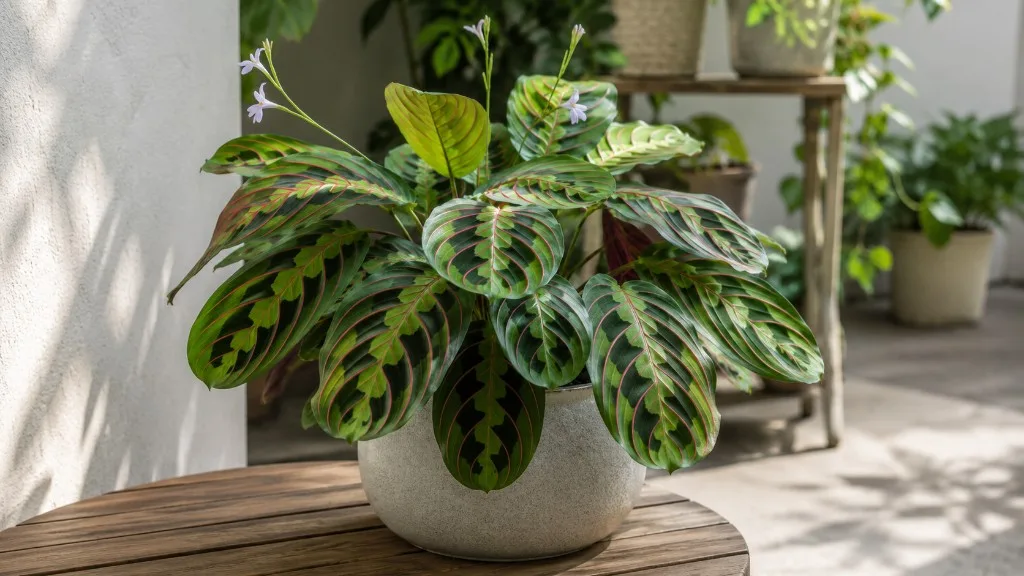
Prayer plants need consistently moist soil, high humidity (50–70%), and medium indirect light. Leaves fold upward at night. Pet-safe per the ASPCA but sensitive to dry air and tap water minerals.
Prayer Plant Care Guide: Maranta Genus Indoors
Start with wateringThe most common care mistake for Prayer PlantWatering guide →Prayer Plant care essentials
Light
medium indirect light, low indirect light, bright indirect light
Water
Keep soil consistently moist but not waterlogged - water when the top inch dries out.
Soil
Rich, moisture-retentive but well-draining potting mix.
Humidity
50–70%
Temperature
18–27°C (65–80°F)
Fertilizer
Feed lightly during active growth.
About Prayer Plant
Prayer Plant has a upright growth habit.
| Detail | Information |
|---|---|
| Growth habit | Upright |
| Scientific name | Maranta leuconeura |
Prayer Plant Care Guide: Maranta Genus Indoors
Walk into a plant shop and you will see pots labeled “prayer plant” that are actually Calatheas, Ctenanthes, or Stromanthes - all close cousins, all capable of folding their leaves at dusk, but only one genus earns the common name. Prayer plant properly refers to species in the genus Maranta, especially Maranta leuconeura, a rhizomatous tropical perennial from the Brazilian rainforest floor. This guide is built around that genus: what makes Marantas distinct, why the leaves move at night, how to keep humidity and watering in the narrow band these plants tolerate, and why the ASPCA lists prayer plant as non-toxic to cats and dogs.
By the end, you should know whether you actually have a Maranta, how to place and water it so the nightly leaf-folding keeps happening, what to do when brown tips or curling leaves show up, and how to propagate a healthy clump without killing the parent plant.
What Prayer Plant Actually Is (Maranta Genus and Marantaceae)
The prayer plant is not a single mystery cultivar - it is a member of the Marantaceae family, a group of tropical flowering plants that includes Calathea, Stromanthe, and Ctenanthe. Within that family, the genus Maranta contains roughly 40 species native to the humid forests of Central and South America and the West Indies. The name honors Bartolomeo Maranti, a sixteenth-century Venetian physician and botanist. For indoor growers, almost every plant sold as a true prayer plant is Maranta leuconeura, an evergreen, rhizomatous, low-growing perennial whose specific epithet combines Greek leuko (white) and neura (nerve or vein) in reference to the pale venation on its leaves.
The Missouri Botanical Garden Plant Finder describes M. leuconeura as typically reaching 12–15 inches (30–38 cm) tall and wide, with broad-elliptic to oval leaves up to 5 inches long, striking patterned upper surfaces, and grayish-green to purplish-green undersides. It is native to Brazil, winter-hardy only in USDA zones 11–12, and grown everywhere else as a houseplant. Small white, two-lipped flowers with purple spots may appear on slender spikes in late spring to early summer outdoors, but indoor plants bloom rarely and the flowers are ornamentally insignificant compared to the foliage - which is exactly why people buy them.
Marantas spread by shallow rhizomes rather than a deep taproot. That growth habit matters indoors for two reasons. First, the plant stays naturally compact and clump-forming, making it a strong candidate for tabletops, shelves, and hanging baskets where a trailing stem can spill over the pot edge. Second, those rhizomes are the engine for propagation: division at Prayer Plant repotting guide is reliable because each rhizome section can carry its own stems and roots. The Royal Horticultural Society classifies Maranta as an evergreen, rhizomatous perennial with blunt, broadly elliptic leaves, often attractively marked or veined in contrasting colours, and describes the genus habit as clump-forming - a useful mental model when you are deciding pot width and repot timing.
Treating a Maranta like a generic “tropical foliage” plant is the most common mistake. These are understory rainforest plants: they evolved under filtered light, steady warmth, high ambient humidity, and soil that stays moist but never stagnant. Your job indoors is not to mimic a rainforest perfectly - it is to keep those four variables inside a tolerable window long enough for new growth to look firm and patterned.
Why Prayer Plant Leaves Fold at Night (Nyctinasty)
The single most recognizable trait of a prayer plant - and the reason for its common name - is nyctinasty, sometimes called sleeping movement. During the day, leaves lie relatively flat or trail slightly over the pot rim, maximizing light capture. As evening approaches, each leaf pivots upward so the blade stands nearly vertical, like hands pressed together in prayer. The movement runs on a roughly 24-hour circadian rhythm and occurs across leaves of all ages on a healthy plant, not just on new growth.
The hinge for this motion is a specialized swollen joint at the base of each leaf petiole called the pulvinus. Inside the pulvinus, motor cells change their turgor pressure - the internal water pressure that keeps plant tissue firm - in response to light and darkness. When turgor shifts between the upper and lower sides of the pulvinus, the leaf blade rises or falls. Botanists still debate every detail of the signaling pathway, but the practical takeaway for growers is clear: nyctinasty is normal, energy-driven, and sensitive to the plant’s overall hydration and light environment. A prayer plant that stops moving is usually telling you something about water, light cycles, or stress - not that it has “forgotten” how to pray.
The Pulvinus and Turgor Pressure
Think of the pulvinus as a living swivel joint powered by water, not muscle. When the plant is well hydrated and experiencing a normal day-night light cycle, turgor builds on one side of the pulvinus in the evening and the leaf lifts. By morning, the pressure redistributes and the leaf lowers again. If turgor is weak because the soil has dried too far, cold temperatures have slowed cellular activity, or root damage has limited water uptake, the pulvinus cannot generate enough force and the movement becomes subtle or stops entirely.
Artificial light that never turns off can also disrupt the rhythm. Prayer plants kept under grow lights that run 24 hours may lose the crisp nightly fold because the circadian trigger never arrives. Give the plant at least 8 hours of relative darkness each night - close the grow lights, or move the pot away from a room that stays brightly lit around the clock - and movement usually returns within one to two weeks once hydration and temperature are also corrected. Very old leaves sometimes move less as the pulvinus loses elasticity near the end of the leaf’s life; that is normal senescence, not a care crisis, as long as new foliage still folds.
Prayer Plant vs Calathea and Other Marantaceae
Plant shops and social media routinely call any leaf-folding Marantaceae a “prayer plant.” Technically, only Maranta leuconeura and its cultivars are prayer plants in the strict common-name sense. Calathea, Stromanthe, and Ctenanthe are related and nyctinastic, but they are different genera with different leaf shapes, growth habits, and - in some cases - different hardiness in the home.
The visual ID shortcut is useful at the nursery. Marantas have broadly oval leaves with symmetrical patterning - herringbone veins, blotches, or colored midribs - on relatively short petioles, and the plant grows as a low, spreading clump. Calatheas tend toward longer, more lance-shaped or rounded leaves on a generally taller, upright clump, with patterns that can be pinstriped, medallion-like, or quilted depending on species. Stromanthe and Ctenanthe often grow more vertically and may show stronger pink, white, or silver variegation on elongated leaves. Care overlaps heavily - all want filtered light, humidity, and even moisture - but Marantas are typically more forgiving of beginner mistakes than many Calatheas, which can be faster to show crisping and permanent leaf damage from dry air or inconsistent watering.
If your goal is the classic red-veined, low-clumping plant that folds sharply at night, you want a Maranta. If you bought a “prayer plant” with long striped leaves on upright stems, you likely have a Calathea or a Stromanthe, and you should follow care guidance matched to that genus. The nightly movement is family-wide; the name is not.
Popular Maranta leuconeura Cultivars
Commercial prayer plants are almost all varieties and cultivars of M. leuconeura, distinguished primarily by leaf pattern and vein color rather than different care requirements. The Missouri Botanical Garden notes that varieties and cultivars of Prayer Plant overview are separated from the type by leaf patterns and coloration. Three forms dominate nursery benches in the United States and Europe.
Erythroneura, Fascinator, and Lemon Lime
Maranta leuconeura var. erythroneura - the herringbone or red prayer plant - is the showiest form. The Missouri Botanical Garden entry for var. erythroneura describes olive-green leaves with a bold herringbone network of showy red veins arching from the midrib to the margins, yellowish-green markings along the midrib, and reddish-purple undersides. The cultivar ‘Fascinator’ (often sold as Fascinator Tricolor) is a selected form of this variety with strong red veining and a yellow-green central zone. ‘Lemon Lime’ keeps the herringbone architecture but swaps red veins for chartreuse to yellow-green ribs - same care, different wallpaper.
Kerchoveana (Rabbit Tracks)
Maranta leuconeura var. kerchoveana - rabbit tracks or green prayer plant - trades red venation for dark green to brownish splotches on either side of the midrib against a lighter green field. The RHS lists var. kerchoveana with an Award of Garden Merit and describes dark blotches between the leaf veins. Variegated sports such as ‘Kerchoveana Variegata’ (sometimes sold as Beauty Kim) add cream or pale yellow splashes and are collector favorites with the same environmental needs as the green form. If you cannot tell which cultivar you own, match the pattern: red herringbone ribs point to erythroneura/Fascinator; splotches without strong red ribs point to kerchoveana.
Light: Bright, Indirect, and Stable
Prayer plants are understory plants. Indoors, that translates to bright, filtered, or indirect light for most of the day, with no strong direct sun on the leaves. The Missouri Botanical Garden recommends bright indoor light without strong direct sun, noting that too much sun bleaches the attractive leaf colors. The RHS similarly advises bright filtered or indirect light under glass. A practical placement is within a few feet of an east-facing window, or set back from a south- or west-facing window behind a sheer curtain. North-facing light can work if the room is bright; watch for stretching.
Low light is survivable but costly. Internodes lengthen, new leaves emerge smaller and paler, and the plant becomes more vulnerable to overwatering on Prayer Plant because it is not using moisture quickly. Leggy stems with thin, washed-out foliage mean move it closer to the window or add supplemental LED grow light for 12–14 hours daily. The opposite problem - bleached patches, brown scorched spots, or leaves that curl under at midday - means pull the plant back from direct sun or filter the window. Marantas dislike sudden light changes; if you move a plant, do it gradually over one to two weeks so the foliage can acclimate.
Watering: Even Moisture Without Soggy Soil
Prayer plants want consistently moist soil that is never waterlogged. The University of Illinois Extension prayer plant page advises keeping soil moist, growing in diffused bright light, and allowing soil to dry somewhat between waterings in winter - a seasonal rhythm, not a summer drought. A reliable summer rule is to water when the top inch (2.5 cm) of mix feels dry, then water thoroughly until it runs from the drainage holes. In many homes that works out to roughly every five to seven days during active growth and less often in winter, but the interval changes with pot size, humidity, and light, so never water on a fixed calendar without checking.
The Illinois Extension warning matters more than most care blogs admit: do not allow water to stand on the crowns - the points where stems emerge from the rhizome - because stems rot easily when water pools there. Water the soil surface directly, use a narrow spout, and empty the saucer within thirty minutes. Overhead soaking that leaves droplets sitting in folded leaf axils invites crown rot and fungal issues.
Use room-temperature water. Prayer plants are sensitive to fluoride, chlorine, and dissolved minerals in hard tap water, which accumulate in the pot and manifest as brown, crispy leaf tips that look like low-humidity damage but are chemical burn. Filtered, rainwater, or distilled water is worth the effort if your tap is hard. If you must use tap water, flush the pot with plain water monthly to wash salts through the drainage holes.
How to Read Soil Moisture by Touch
Insert your index finger to the first knuckle. If the mix at that depth feels cool and slightly damp, wait. If it feels dry, water deeply. Lift the pot occasionally to learn its weight: a freshly watered prayer plant is noticeably heavier than one ready for water. A wooden chopstick pushed two inches into the mix and left for a few minutes tells the same story - damp stick means wait; clean, dry stick means water.
In winter, lean drier. Growth slows, the pot stays wet longer in cool dim rooms, and the same summer schedule will rot roots. Let the top inch dry, reduce frequency, and resume the active-season rhythm only when new growth is clearly visible in spring.
Humidity and Temperature Indoors
Humidity is not optional for Marantas - it is the variable that separates a crisp, miserable plant from one that looks like the photos on the tag. Most sources and experienced growers target 50–70% relative humidity, with stress appearing when air drops toward 30–40% for extended periods. Below that, leaf margins brown, new leaves may emerge smaller, and spider mites - which thrive in dry air - show up on undersides.
Raise humidity where the plant actually lives, not where your thermostat reads. A pebble tray (stones in a shallow tray, water below stone level, pot sitting above the waterline) helps locally. Grouping plants raises transpiration humidity a few points. A small cool-mist humidifier is the most reliable fix in heated winter homes. Bathrooms with bright natural light can be excellent prayer plant locations because shower steam supplies ambient moisture - but only if the window supplies enough filtered light; a dark bathroom will fail the plant even if the air is humid.
Misting is a weak tool here. The humidity bump lasts minutes, wet foliage can invite leaf spot, and you do little for the room average. Invest in a tray or humidifier instead.
Temperature is the easier variable. Prayer plants prefer 65–80°F (18–27°C), matching typical indoor comfort. The Missouri Botanical Garden sets a floor around 60°F (15°C) and notes intolerance of frost. Avoid cold drafts from winter windows, air-conditioning vents pointed at the pot, and sudden drops below 55°F (13°C), which slow growth and can damage leaves. Heat stress above 85°F (29°C) without matching humidity causes rapid edge crisping.
Soil and Pot Choice
Prayer plants want a rich, moisture-retentive but well-draining potting mix - the same principle the Missouri Botanical Garden summarizes as moist, humusy, well-drained soils in part shade outdoors. Indoors, a workable recipe is two parts quality peat-free or all-purpose houseplant mix, one part perlite, and one part coco coir or fine orchid bark. The coir or bark holds moisture without collapsing; the perlite keeps oxygen around the shallow rhizomes so they do not suffocate in a wet root zone.
The RHS recommends peat-free compost for glasshouse culture and notes Maranta tolerates acid, alkaline, or neutral pH in garden terms; for pots, a slightly acidic to neutral mix (roughly pH 5.5–7.0) performs well without hobbyist adjustment. What matters more than precision pH is structure that does not compact after a year. Compacted, peat-heavy mix that stays soggy for days is one of the fastest routes to root rot on Prayer Plant.
Choose pots with drainage holes only. Terracotta dries faster - helpful if you tend to overwater. Plastic or glazed ceramic retains moisture longer - helpful if you underwater in a humid room. When repotting, go up one size only; an oversized pot holds water the rhizome system cannot use, and that mismatch causes more prayer plant deaths than any pest.
Fertilizer Schedule and Strength
Prayer plants are moderate feeders, not hungry monsters. The Missouri Botanical Garden suggests monthly fertilizer during the growing season and substantially reduced feeding from autumn through late winter. A balanced water-soluble houseplant fertilizer at half strength applied to already-moist soil every four to six weeks from spring through early fall matches what most indoor growers need. The University of Maryland Extension indoor fertilizer guidance supports the broader principle: dilute more than the label implies and skip feeding on stressed plants.
Never fertilize dry soil, a newly repotted plant, or a plant fighting pests or root rot. Unused salts accumulate and show up as crispy leaf tips and a white crust on the pot rim. If you see that, flush the pot with plain water and pause feeding for a month. Resume only when new growth is active and the Prayer Plant watering guide is stable.
Repotting Without Losing the Plant
Repot prayer plants roughly every one to two years, or when roots circle the drainage holes, water runs straight through without soaking in, or the mix has compacted and smells sour. The best timing is early spring as active growth resumes, giving the plant a full warm season to settle. Slide the root ball out, tease away old compacted mix gently, and move to a pot one size larger with fresh mix.
Because rhizomes are shallow, keep the crown at the same depth as before - burying stems too deep encourages rot. Water lightly for the first week after repotting so torn roots can callus before the mix stays consistently moist. Hold fertilizer until you see new leaves unfurling.
Propagation by Division and Stem Cuttings
The most reliable home propagation method is division at repotting. Each rhizome section with roots and at least one growing point can become a new plant. Water the parent the day before, unpot, and cut the rhizome mass with a clean knife so every division has stems, roots, and rhizome tissue. Plant divisions at the same depth, keep humidity high, and maintain Prayer Plant light guide. New growth in four to eight weeks is a fair expectation.
Stem cuttings work when you take a section with a node and root it in water or moist perlite, but they are less reliable than division for many growers because rot at the cut end is common and rooting is slower. If you try water propagation, change the water every few days, wait for roots several centimeters long, then pot into the same mix you use for the parent. Do not propagate from stressed, pest-infested, or recently collapsed plants - divisions inherit the parent’s problems.
Pet Safety: ASPCA Non-Toxic Classification
For pet owners, prayer plant is one of the genuinely good news stories in tropical foliage. The ASPCA Animal Poison Control toxic and non-toxic plants database lists Prayer Plant as non-toxic to dogs, non-toxic to cats, and non-toxic to horses, with toxic principles classified as non-toxic. That makes Maranta one of the few vividly patterned houseplants you can place in a pet-active home with reasonable confidence - though confidence is not the same as encouragement.
One caveat worth stating plainly: the ASPCA entry lists the scientific name Calathea insignis, which does not match current taxonomy for Maranta leuconeura. The non-toxic classification applies to the common-name prayer plant as sold and grown in homes; if you need legal or veterinary certainty, show your vet the plant label and the ASPCA listing together. Non-toxic also does not mean edible - large ingestions of any houseplant foliage can still cause mild gastrointestinal upset in pets, and chewed leaves are cosmetically ruined.
Cats, Dogs, and Practical Cautions
Treat ASPCA non-toxic status as permission to keep the plant in the home, not as a green light for a salad bar. Cats that chew plants still create mess and stress, and dogs that knock pots create hazards unrelated to toxicity. If a pet does eat a significant amount of any plant, call ASPCA Animal Poison Control at 888-426-4435 (fee may apply) and your veterinarian. For most households, a prayer plant on a stable side table or in a hanging basket is a safer decorative choice than many popular tropicals that are genuinely toxic.
Common Problems and Real Fixes
Most prayer plant problems are environmental and read clearly once you know the symptom map. The diagnostic order is always the same: soil moisture, then humidity, then light, then pests, then water chemistry.
Brown leaf tips and edges usually mean low humidity, accumulated salts from tap water, or underwatering on Prayer Plant. Raise humidity toward 50–70%, switch or flush water, and trim dead tips with sterile scissors for appearance only - new growth tells you whether the fix worked.
Yellow leaves can mean overwatering, underwatering, low light, natural aging of older leaves, or pests. If soil is wet and stems feel soft, reduce watering and inspect roots for brown mushy sections. If soil is dry and the pot is light, water thoroughly. Uniform yellowing on old bottom leaves alone is often normal senescence.
Curling leaves frequently signal dry air, underwatering, or cold drafts. Less often, curling during midday points to too much direct sun. Match the curl pattern to the environment rather than reaching for fertilizer.
Leaves not folding at night tie back to nyctinasty: check hydration, ensure a real dark period, confirm temperatures above 60°F, and wait two weeks after correcting. Permanent stop on old leaves only is normal; stop on all new growth is not.
Spider mites show as fine webbing, stippled yellow speckling, and bronzed undersides in dry winter homes. Shower the plant to knock mites off, raise humidity, and treat with insecticidal soap on a weekly cycle for three weeks. Mealybugs and thrips appear as cottony clusters or silvery scarring, respectively; isolate the plant and treat early.
Root rot and crown rot are the serious failures. Root rot follows chronic overwatering or compacted mix; crown rot follows water sitting on the rhizome. Unpot, cut away black mushy tissue with sterile tools, repot into fresh airy mix, and withhold water briefly. Severe rot may not be recoverable - prevention through drainage and crown dryness is far easier.
The Missouri Botanical Garden also flags cucumber mosaic virus on marantas; there is no home cure. Quarantine affected plants and discard if mosaic mottling spreads on new leaves despite good culture.
Conclusion
A prayer plant is a Marantaceae specialty act: a low, rhizomatous Brazilian perennial whose patterned leaves fold upward at night through pulvinus-driven nyctinasty, asking for bright indirect light, evenly moist well-drained soil, 50–70% humidity, and temperatures between 65–80°F. Get those variables stable and the genus is rewarding; chase them with calendar watering, dry winter air, or direct afternoon sun and the same plant looks permanently offended.
Know your cultivar - erythroneura for red herringbone veins, kerchoveana for rabbit-track splotches - but keep the care consistent. Propagate by division when the clump is healthy. Take comfort from the ASPCA non-toxic listing if you share your home with cats or dogs, while still keeping the pot out of chewing range. Fix problems in order: moisture, humidity, light, pests, water quality. When the leaves fold on schedule again, you will know the roots and the pulvinus agree that your room is finally speaking their language.
When to use this page vs other Prayer Plant guides
- Prayer Plant overview - Canonical hub for this species - care topics and problems branch from here.
- Prayer Plant problems - Symptom-first path when you already know something is wrong.
Related Prayer Plant guides
How to care for Prayer Plant?
How much light does Prayer Plant need?
medium indirect light, low indirect light, bright indirect light
- medium indirect light, low indirect light, bright indirect light - medium indirect light, low indirect light, bright indirect light.
When should you water Prayer Plant?
Keep soil consistently moist but not waterlogged - water when the top inch dries out.
- Check top 2 inches - Keep soil consistently moist but not waterlogged - water when the top inch dries out.
- Drain excess water - Keep soil consistently moist but not waterlogged - water when the top inch dries out.
What soil works best for Prayer Plant?
Rich, moisture-retentive but well-draining potting mix.
- Well-draining mix - Rich, moisture-retentive but well-draining potting mix.
Grower notes for Prayer Plant
What matters most with Prayer Plant
Prayer Plant is part of the fussy foliage group where leaf movement, crisping, and humidity stress can look dramatic before the plant is truly lost. Judge the newest rolled leaves and root moisture before reacting to every old edge mark. In practice, the care checkpoint is simple: medium indirect light, low indirect light, bright indirect light. Pair that with rich, moisture-retentive but well-draining potting mix, and avoid changing water, pot size, and placement all at once.
Best placement in a real home
Prayer Plant belongs where medium indirect light, low indirect light, bright indirect light is realistic for most of the day, not only where the pot looks good. Keep soil consistently moist but not waterlogged - water when the top inch dries out. If the pot stays wet longer than expected, move the plant into better light or reassess the mix before watering again. Humidity target: 50–70%. Temperature comfort zone: 18–27°C (65–80°F).
Before you buy this plant
Choose Prayer Plant with firm new growth, clean leaf undersides, and soil that does not smell sour or feel compacted. Be cautious if you see brown-tips, sticky residue, collapsed crowns, or a pot that is wet in poor light. Cosmetic old-leaf damage is less worrying than weak roots or active pests.
First month after bringing it home
Do not repot Prayer Plant on day one unless the mix is failing or pests are obvious. Quarantine it, learn how fast the pot dries, and keep care boring while it adjusts. Watch especially for brown-tips, curling-leaves, and yellow-leaves. If problems appear, correct the condition first rather than stacking fertilizer, repotting, and pruning together.
Safety note for Prayer Plant
Prayer Plant is not a plant to keep within reach of pets or children. Treat it as an inaccessible display plant. Use gloves if sap or plant tissue is irritating, and pick a pet-safe alternative for floor pots or low shelves.
How to tell Prayer Plant is settling in
If you plan to multiply it later, common methods include Division of root clumps at repotting and Stem cuttings in water (less reliable). If curling-leaves shows up early, inspect light, watering, and roots before assuming the plant is permanently weak.
Is it pet safe?
Prayer Plant is generally considered pet safe.
Watering Prayer Plant
Keep soil consistently moist but not waterlogged - water when the top inch dries out.
Soil & potting for Prayer Plant
Rich, moisture-retentive but well-draining potting mix.
Humidity & temperature for Prayer Plant
Prayer Plant prefers 50–70%, though normal home humidity is usually fine. Keep temperatures around 18–27°C (65–80°F).
| Detail | Information |
|---|---|
| Humidity | 50–70% - normal home humidity is fine. |
| Ideal temperature | 18–27°C (65–80°F) |
Fertilizer & pruning for Prayer Plant
Use feed lightly during active growth. for Prayer Plant.
| Detail | Information |
|---|---|
| Fertilizer type | Feed lightly during active growth. |
Common problems on Prayer Plant
Likely cause: Jul 16, 2023 · Fortunately, there are several effective methods to get rid of ants on your prayer plant and ensure its health and beauty. In this article, we will explore these methods and provide you with the necessary guidance to eliminat
Quick fix: Confirm diagnosis on your Prayer Plant, then address the most likely care or pest factor described in current extension guidance.
Full fix guide →Brown Tips
MediumLikely cause: Low humidity, tap water minerals, and dry air are the primary causes of crispy brown edges on prayer plant leaves
Quick fix: Use distilled or filtered water; raise humidity to 50%+; avoid heating vents
Full fix guide →Aphids
MediumLikely cause: Jul 21, 2023 · Aphids can cause significant damage to your prayer plant if left unchecked. By utilizing natural control methods and implementing preventive measures, you can effectively manage aphid infestations and keep your prayer plant h
Quick fix: Confirm diagnosis on your Prayer Plant, then address the most likely care or pest factor described in current extension guidance.
Full fix guide →Blight
MediumLikely cause: A severe leaf spot, turning to foliage blight , was observed on leaves of Maranta leuconeura growing in a garden in Brazil (state of Rio de Janeiro) in 2015. A dematiaceous hyphomycete bearing a morphology typical of a helminthosporoid fung
Quick fix: Follow extension or botanical guidance for Prayer Plant blight; adjust care before applying broad treatments.
Full fix guide →Cold Damage
MediumLikely cause: May 25, 2024 · This article will walk you through how to identify cold damage , what immediate actions to take, how to support recovery, and how to prevent future cold stress. We’ll also touch on how to integrate these lovely plants into yo
Quick fix: Confirm diagnosis on your Prayer Plant, then address the most likely care or pest factor described in current extension guidance.
Full fix guide →Curling Leaves
MediumLikely cause: Underwatering or low humidity causes leaves to curl inward - the plant's moisture-conservation response
Quick fix: Water immediately if soil is dry; increase humidity if soil is moist
Full fix guide →Deformed New Growth
MediumLikely cause: 1 day ago · New growth also forms as tightly curled tubes before unfurling, which looks alarming if you haven’t seen it before. A healthy new leaf uncurls smoothly over a few days; a stressed new leaf may stop partway and stay deformed . Wo
Quick fix: Confirm diagnosis on your Prayer Plant, then address the most likely care or pest factor described in current extension guidance.
Full fix guide →Distorted Leaves
MediumLikely cause: 1 day ago · Four maranta leaf problems look almost identical but need different fixes. Diagnose yours in 5 minutes using leaf position, edge texture, and the white paper test. Home » Tips » Houseplants » Maranta Leaves Curling or Browning?
Quick fix: Confirm diagnosis on your Prayer Plant, then address the most likely care or pest factor described in current extension guidance.
Full fix guide →Exposed Roots
MediumLikely cause: Aug 8, 2025 · A prayer plant becomes root -bound when its root system grows too large for its current container, restricting further growth. Common signs include roots emerging from drainage holes or circling tightly inside the pot.
Quick fix: Confirm diagnosis on your Prayer Plant, then address the most likely care or pest factor described in current extension guidance.
Full fix guide →Likely cause: Oct 2, 2024 · For prayer plants , thankfully, that is not the case. Like most tropical plants, it's uncommon for prayer plants to bloom indoors but it can happen, and a blooming prayer plant means that it is thriving. Apr 14, 2026 · Prayer
Quick fix: Follow extension or botanical guidance for Prayer Plant faded flowers; adjust care before applying broad treatments.
Full fix guide →Faded Leaves
MediumLikely cause: May 5, 2026 · Prayer plant leaves usually fade because of too much direct sun, low light over time, nutrient weakness, dry air stress, or roots that are not supporting strong color.
Quick fix: Confirm diagnosis on your Prayer Plant, then address the most likely care or pest factor described in current extension guidance.
Full fix guide →Draft Stress
MediumLikely cause: It is essential to keep your plant away from cold drafts , heating vents, or air conditioning units, which can cause temperature fluctuations that stress the plant. Maintaining a stable environment will allow your Maranta leuconeura to thri
Quick fix: Confirm diagnosis on your Prayer Plant, then address the most likely care or pest factor described in current extension guidance.
Full fix guide →Heat Stress
MediumLikely cause: Oct 3, 2023 · By maintaining consistent humidity levels, your prayer plant will be less likely to suffer from heat -related stress . The right soil and pot can also play a role in managing your prayer plant 's heat tolerance.
Quick fix: Confirm diagnosis on your Prayer Plant, then address the most likely care or pest factor described in current extension guidance.
Full fix guide →Leggy Growth
LowLikely cause: Aug 10, 2025 · Transform your sparse prayer plant into a vibrant, full specimen. Discover the causes of leggy growth and proven strategies for restoration and ongoing health.
Quick fix: Confirm diagnosis on your Prayer Plant, then address the most likely care or pest factor described in current extension guidance.
Full fix guide →Fungus Gnats
LowLikely cause: Jun 29, 2023 · By identifying the source of the infestation, removing infested soil, allowing the soil to dry out, using sticky traps, applying neem oil spray, and introducing beneficial nematodes, you can eliminate gnats from your prayer p
Quick fix: Confirm diagnosis on your Prayer Plant, then address the most likely care or pest factor described in current extension guidance.
Full fix guide →Low Humidity
LowLikely cause: Jan 30, 2026 · Yes— prayer plants thrive in 50–70% relative humidity . Learn how to measure, raise, and sustain ideal moisture levels without mold, pests, or leaf damage.
Quick fix: Confirm diagnosis on your Prayer Plant, then address the most likely care or pest factor described in current extension guidance.
Full fix guide →No New Growth
MediumLikely cause: Your prayer plant has no new growth? Don't panic — Insufficient light, low humidity, or root-bound conditions . Prayer plants prioritize…. Here's exactly how to fix it.
Quick fix: Confirm diagnosis on your Prayer Plant, then address the most likely care or pest factor described in current extension guidance.
Full fix guide →Leggy Seedlings
MediumLikely cause: Aug 10, 2025 · Transform your sparse prayer plant into a vibrant, full specimen. Discover the causes of leggy growth and proven strategies for restoration and ongoing health.
Quick fix: Confirm diagnosis on your Prayer Plant, then address the most likely care or pest factor described in current extension guidance.
Full fix guide →No Flowers
LowLikely cause: Sep 22, 2025 · The prayer plant (Maranta leuconeura ) is a low-growing tropical plant native to South America. Learn how to grow this unique and popular houseplant. View all No. Maranta leuconeura Plants are non-toxic to both humans and pet
Quick fix: Follow extension or botanical guidance for Prayer Plant no flowers; adjust care before applying broad treatments.
Full fix guide →Nutrient Lockout
MediumLikely cause: Apr 7, 2025 · Without proper fertilization, your Prayer Plant may exhibit signs of nutrient deficiency, such as yellowing leaves, stunted growth, and reduced vibrancy. It’s crucial to provide the right type and amount of fertilizer at the a
Quick fix: Confirm diagnosis on your Prayer Plant, then address the most likely care or pest factor described in current extension guidance.
Full fix guide →Nitrogen Deficiency
MediumLikely cause: Apr 16, 2026 · Yes, prayer plants definitely benefit from nitrogen , as it is crucial for their vibrant foliage growth and overall health. Nitrogen is a primary nutrient that plays a significant role in developing the lush, colorful leaves
Quick fix: Confirm diagnosis on your Prayer Plant, then address the most likely care or pest factor described in current extension guidance.
Full fix guide →Poor Root Growth
MediumLikely cause: Aug 8, 2025 · Root rot is a prevalent and serious issue for prayer plants , primarily caused by overwatering or inadequate drainage. When roots sit in consistently wet, oxygen-deprived soil, they begin to decay due to fungal or bacterial gr
Quick fix: Confirm diagnosis on your Prayer Plant, then address the most likely care or pest factor described in current extension guidance.
Full fix guide →Purple Leaves
MediumLikely cause: Sep 25, 2025 · If you’ve been praying for the perfect houseplant that’s both stunning and easy to care for, look no further than the prayer plant ! These colorful beauties feature striking leaves with eye-catching patterns, but it’s their u
Quick fix: Confirm diagnosis on your Prayer Plant, then address the most likely care or pest factor described in current extension guidance.
Full fix guide →Powdery Mildew
HighLikely cause: Aug 13, 2025 · Early detection of fungal infections is important for the health of your prayer plant . One common fungal problem is powdery mildew , which appears as a white or gray powdery coating on the leaves and stems, making the plant
Quick fix: Confirm diagnosis on your Prayer Plant, then address the most likely care or pest factor described in current extension guidance.
Full fix guide →Plant Leaning
MediumLikely cause: Jul 21, 2023 · In this article, we'll chat about why your prayer plant might be growing sideways and what you can do to encourage a more upright growth habit. We'll cover everything from light conditions and watering to potting and support
Quick fix: Confirm diagnosis on your Prayer Plant, then address the most likely care or pest factor described in current extension guidance.
Full fix guide →Red Leaves
MediumLikely cause: Nov 13, 2025 · The Maranta Red Plant, scientifically known as Maranta leuconeura ‘Erythroneura’, is a highly sought-after houseplant. It is commonly called the Red Prayer Plant due to the striking red veins contrasting with its deep green a
Quick fix: Confirm diagnosis on your Prayer Plant, then address the most likely care or pest factor described in current extension guidance.
Full fix guide →Pot Too Large
MediumLikely cause: Yes. We recommend that you replant your prayer plants every 2–3 years or when they show signs of overgrowth. As they mature, they tend to grow out their roots to the point that their pots can no longer accommodate them. It’s also worth ment
Quick fix: Confirm diagnosis on your Prayer Plant, then address the most likely care or pest factor described in current extension guidance.
Full fix guide →Root Bound
MediumLikely cause: Dec 4, 2025 · Repotting is necessary every one to two years, or when the plant is visibly root - bound , meaning the roots are tightly circling the inside of the pot. Select a pot only one to two inches larger in diameter than the current c
Quick fix: Confirm diagnosis on your Prayer Plant, then address the most likely care or pest factor described in current extension guidance.
Full fix guide →Salt Build-up
MediumLikely cause: Oct 28, 2024 · Leaching the soil which means getting rid of salt buildup and mineral build -up is also part of Prayer Plant care. Mineral buildup happens when you use water that has high salts and minerals. May 14, 2026 · If large portions
Quick fix: Confirm diagnosis on your Prayer Plant, then address the most likely care or pest factor described in current extension guidance.
Full fix guide →Slow Growth
LowLikely cause: Sep 25, 2025 · Slow growth or small leaves are common for indoor prayer plants and usually indicate a need for more bright, indirect light or occasional fertilization during the growing season.
Quick fix: Confirm diagnosis on your Prayer Plant, then address the most likely care or pest factor described in current extension guidance.
Full fix guide →Seedlings Falling Over
MediumLikely cause: Jul 14, 2023 · If your Maranta Prayer Plant is falling over , it’s essential to identify the underlying cause to restore its health and vigor. Evaluate your plant’s lighting conditions, watering routine, humidity levels, nutrient supply, an
Quick fix: Confirm diagnosis on your Prayer Plant, then address the most likely care or pest factor described in current extension guidance.
Full fix guide →Slugs and Snails
MediumLikely cause: Slugs live in the soil during the daytime when it's dry, so if you don't find a caterpillar: water your plant in the evening, put it somewhere dark, and after an hour or so turn on the light to check for slugs .
Quick fix: Confirm diagnosis on your Prayer Plant, then address the most likely care or pest factor described in current extension guidance.
Full fix guide →Likely cause: Apr 14, 2026 · Prayer plants do flower indoors — but the blooms are tiny and easy to miss. What they look like, whether to cut them, and how to encourage blooming.
Quick fix: Confirm diagnosis on your Prayer Plant, then address the most likely care or pest factor described in current extension guidance.
Full fix guide →Stunted Growth
MediumLikely cause: Too much sunlight will lead to sun scorch, with typical signs including crispy leaves, dry leaf-edges and stunted growth . Although too little light will cause over-watering issues, over-exposure will be an issue, too.
Quick fix: Confirm diagnosis on your Prayer Plant, then address the most likely care or pest factor described in current extension guidance.
Full fix guide →Likely cause: Dec 4, 2023 · Prayer plants have broad leaves that can easily become scorched if they're exposed to too much sun. Direct sunlight can cause the leaves to dry out and turn brown around the edges, which is essentially a plant’s version of get
Quick fix: Confirm diagnosis on your Prayer Plant, then address the most likely care or pest factor described in current extension guidance.
Full fix guide →Spider Mites
MediumLikely cause: Low humidity environments strongly favour spider mite colonisation of prayer plant
Quick fix: Wipe leaves with neem oil; increase humidity significantly; isolate affected plant
Full fix guide →Thin Stems
MediumLikely cause: Oct 2, 2025 · Root rot manifests through several unmistakable warning signs in prayer plants , often appearing before you’ve noticed you’re overwatering. You’ll spot yellowing leaves, starting from the outer edges and progressing inward, ac
Quick fix: Confirm diagnosis on your Prayer Plant, then address the most likely care or pest factor described in current extension guidance.
Full fix guide →Sticky Leaves
MediumLikely cause: Oct 2, 2025 · Curled and drooping leaves on your prayer plant often signal that something’s off with its basic care routine. When leaves curl inward and droop, check your humidity levels first – they should stay between 50-60%. Place a humi
Quick fix: Confirm diagnosis on your Prayer Plant, then address the most likely care or pest factor described in current extension guidance.
Full fix guide →Transparent Leaves
MediumLikely cause: Incredibly patterned leaves that move - see it for yourself. The maranta leuconeura 'Kerchoveana', which is a bit of a mouthful so we call her Louise, is a beautiful and popular plant that’s loved for its striking foliage. This plant is nat
Quick fix: Confirm diagnosis on your Prayer Plant, then address the most likely care or pest factor described in current extension guidance.
Full fix guide →White Spots
MediumLikely cause: Jan 6, 2024 · Helminthosporium leaf spot is a fungal disease that causes yellow or brown spots on Prayer Plant leaves. In addition, it can also form purple or brown lesions on the stems.
Quick fix: Confirm diagnosis on your Prayer Plant, then address the most likely care or pest factor described in current extension guidance.
Full fix guide →Underwatering
MediumLikely cause: Mar 28, 2026 · This blog post will act as a guide, helping you identify the telltale signs of an underwatered prayer plant and get it back on the road to recovery. So, let’s dive in and learn how to keep those leaves happy and healthy!
Quick fix: Confirm diagnosis on your Prayer Plant, then address the most likely care or pest factor described in current extension guidance.
Full fix guide →Wrong Soil Mix
MediumLikely cause: Discover the perfect soil mix for your prayer plant to thrive, with expert tips on drainage, nutrients, and DIY options. Apr 14, 2026 · A well-draining mix of 60% potting soil , 30% perlite, and 10% orchid bark works well. Standard potting
Quick fix: Confirm diagnosis on your Prayer Plant, then address the most likely care or pest factor described in current extension guidance.
Full fix guide →Water Stress
MediumLikely cause: Feb 28, 2025 · To sustain this healthy, bold, colorful look, consistent moisture and humidity are essential to prayer plant health. They are sensitive to watering imbalances and even tap water. Their leaves reflect stress by folding more fr
Quick fix: Follow extension or botanical guidance for Prayer Plant water stress; adjust care before applying broad treatments.
Full fix guide →Yellow Seedlings
MediumLikely cause: This detailed guide will talk about the different reasons why prayer plant leaves turn yellow , as well as effective ways to treat or avoid this common issue. What Causes Yellow Leaves on Prayer Plants ?
Quick fix: Confirm diagnosis on your Prayer Plant, then address the most likely care or pest factor described in current extension guidance.
Full fix guide →Yellow Leaves
MediumLikely cause: Overwatering, root rot, or cold temperatures cause yellowing leaves
Quick fix: Reduce watering; ensure temperatures stay above 15°C; check drainage
Full fix guide →