Leggy Growth on Prayer Plant: Causes, Checks & Fixes
Quick answer
Leggy growth on prayer plant is etiolation-long spaces between leaves on elongated petioles as the clump reaches for light. First step: confirm placement with the not-enough-light checks, move to bright indirect light, wait for one compact new leaf, then pinch bare stems above a node.
Leggy Growth on Prayer Plant: Causes, Checks & Fixes
This guide covers leggy growth on Prayer Plant. See also the general Leggy Growth guide, watering, and light pages for this plant.
Leggy Growth on Prayer Plant: Causes, Checks & Fixes
Quick answer
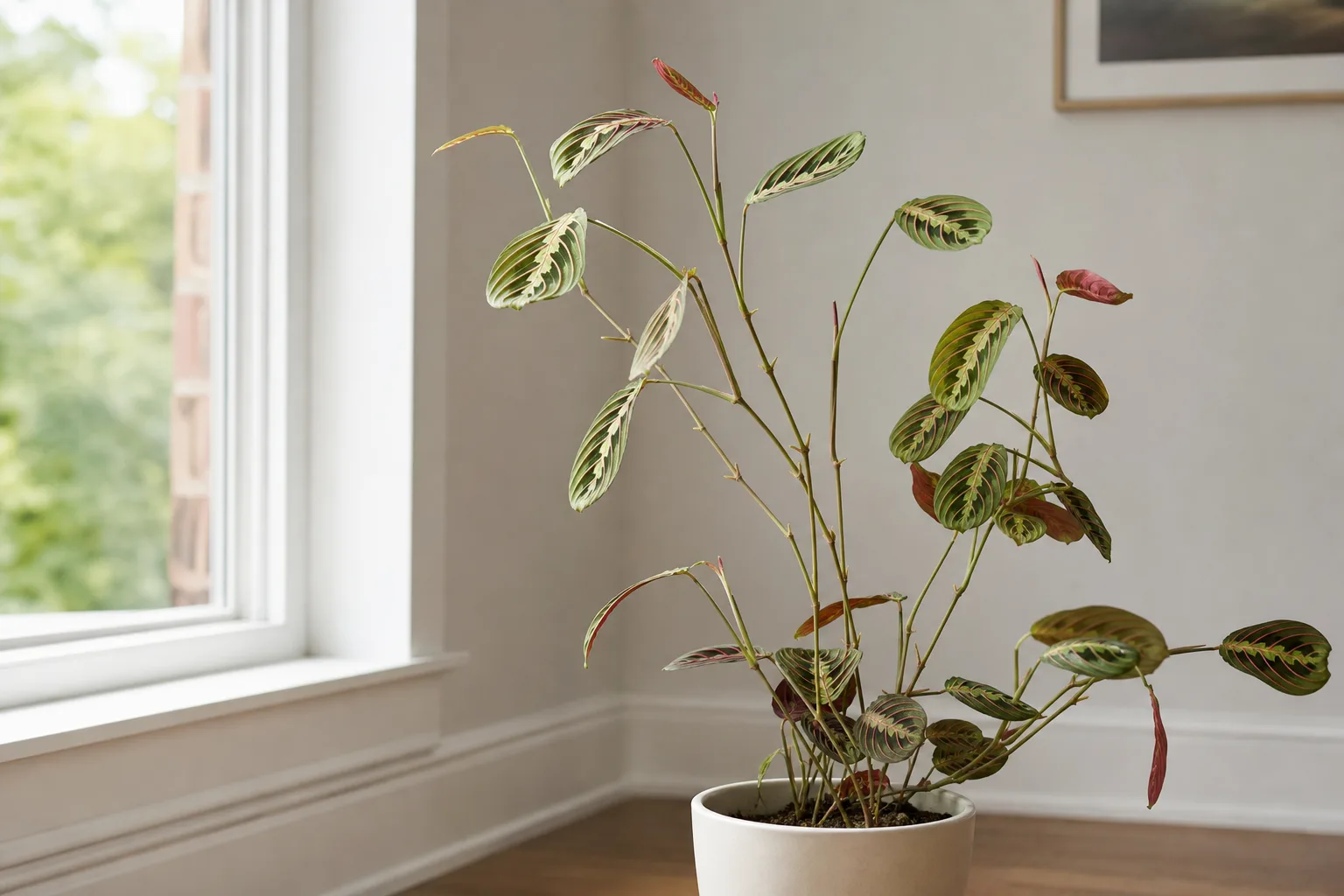
Leggy growth on prayer plant (Maranta leuconeura) is etiolation: the plant lengthens stem sections and petioles to reach usable light, leaving bare gaps between smaller leaves on a clump that should stay low and spreading. You are not watching normal horizontal spread-prayer plant spreads horizontally in good light, not upward into thin, sparse stems.
First step: confirm the placement problem, then brighten before you prune. Work through the not enough light confirmation checks if you are unsure whether light is the limiter. Once the pot sits in bright, indirect light at the canopy-not just a bright room-wait for one compact new leaf with tight internode spacing. Only then pinch or trim elongated bare stems above a node, or root the cuttings for propagation.
This page covers stretch morphology, pinching timing, and what old stems can and cannot recover. For window placement, hand-shadow tests, and grow-light distance, use the light guide and the not enough light diagnostic.
Leggy growth vs. not enough light - which guide to use
Both symptoms share the same root cause-too little light at the leaf-but search intent differs.
| Your question | Start here |
|---|---|
| ”Is my prayer plant getting enough light?” - faded herringbone, wet soil in a dim corner, stalled crown | Not enough light |
| ”Why are the stems so long with gaps between leaves?” - obvious stretch, bare petiole sections, lanky clump | This page |
| ”Where should I put it year-round?” - window direction, foot-candle heuristics, grow-light specs | Light guide |
If stretch is your main complaint, read the sections below. If you have not confirmed placement yet, run the six-step workflow on the not-enough-light page first-pinching before light improves usually creates more weak stretch, not a fuller plant.
What leggy growth looks like on Prayer Plant
Etiolation on prayer plant is easy to misread because older leaves may still look green from across the room while the crown quietly stretches.
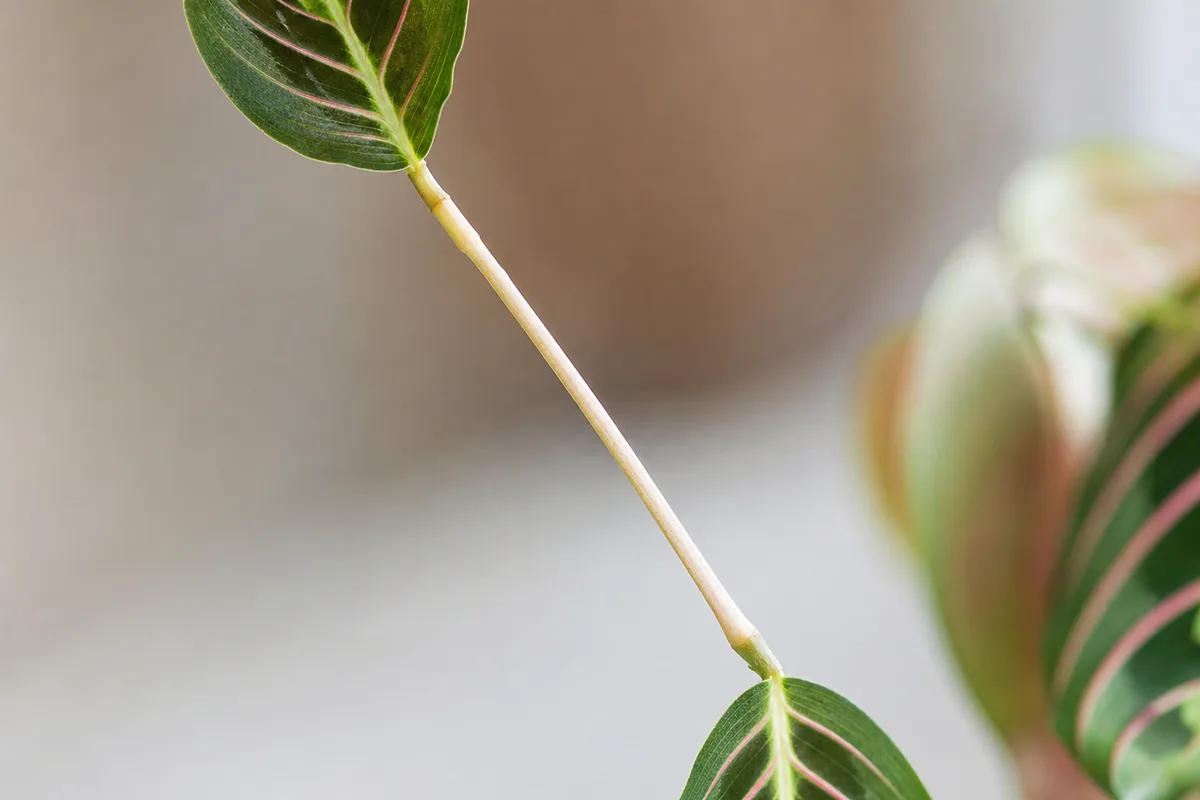
Leggy Growth symptoms on Prayer Plant - compare with healthy tissue on the same plant.
Stretch-specific signs:
- Long bare sections between leaves - elongated petioles on stretched stems, not the compact mound Maranta leuconeura normally forms indoors
- Smaller new leaves on the same stem as older, larger ones-the newest rolled tube opens smaller and paler than leaves produced when light was adequate
- Faded herringbone or fishbone red veins on stretched growth-the upper and undersides of the leaves lose color in low light before generic yellowing appears
- Strong lean toward one window or lamp as the clump actively seeks brightness
- Weakened nightly folding on thin new leaves-leaves fold upright at night in healthy plants, but thin etiolated growth may move weakly; folding alone is not a reliable primary signal
- Vertical reach without attractive spread - the plant exceeds its typical low footprint by stretching upward or outward with sparse foliage, not by healthy creeping growth
Prayer plant is not a trailing vine. If you see long bare stem sections with small leaves at the tips, that is etiolation on a clump-forming species-not normal vining habit.
Cultivar note
Vein contrast fades at different speeds across cultivars. M. leuconeura ‘Erythroneura’ (red herringbone) often shows obvious pattern wash on stretched new leaves before ‘Kerchoveana’ (green fishbone) looks equally sparse-but long internodes on any cultivar still point to insufficient light at the crown, not a variety that “naturally vines.”
Why stretch shows up before yellow leaves
On many houseplants, low light first means pale foliage. On prayer plant, internode lengthening and pattern fade on new growth often appear while older leaves still look acceptable. That split-green mature leaves above a stretched, slow crown-is characteristic of light-limited etiolation here, not a sudden nutrient crash.
Why Prayer Plant gets leggy
Low light and etiolation on a clump-forming species
When photosynthesis at the leaf surface falls below what M. leuconeura needs for compact growth, the plant allocates energy toward stem elongation-classic spindly etiolation-rather than tight new leaves. Interior shelves, bathroom corners far from glass, and pots more than a few feet from a window are common triggers. Light intensity drops sharply with distance from the source; a clump six feet from an east window is not receiving the same exposure as one on the sill.
Winter short days worsen stretch on the same placement that worked in summer. Without moving closer to glass or adding supplemental light, internodes lengthen through the dark season even if watering and humidity stay stable.
Over-fertilizing in shade
Fertilizer cannot replace missing photons. Nutrients pushed into a dim prayer plant often produce soft, floppy new stretch rather than the bushy fullness growers expect. If stems elongate while soil stays wet and growth looks weak-not vivid-suspect shade plus excess feed before adding more product.
When stretch is not the main problem
Root-bound pots, chronic underwatering on Prayer Plant, or pest damage can produce thin weak stems with different patterns. Use the lookalike table below before you pin everything on light alone.
How to confirm stretch is light-driven
Run these stretch-specific checks after you note obvious long internodes:
- Internode comparison - Measure the gap between the last two leaves on the longest stem. Compare it to an older section produced when the plant looked compact. Etiolation shows progressively longer gaps toward the growing tip.
- New-leaf size trend - Each newest rolled leaf should be roughly similar in size to the one before it in good light. Shrinking leaves on elongating stems confirm stretch.
- Lean direction - Persistent tilt toward one window or lamp means the plant is actively seeking brightness, supporting a light diagnosis.
- Pattern read on newest growth - Dull herringbone veins on the latest unfurl point to insufficient light even when older leaves still show contrast.
- Cross-check placement - If you are unsure whether the spot is bright enough, complete the hand-shadow test and window-distance steps on the not enough light page before pruning.
- Rule out lookalikes - Crown softening with sour wet soil, spider mite stippling, or bleached one-sided sun scorch each follow different rules (see table below).
If internodes are lengthening, new leaves are shrinking, and the plant leans toward light-with no crown collapse or mite webbing-you have enough evidence to fix light first, not pinch first.
The first fix to try
Move the pot to bright, indirect light at the canopy-within one to three feet of an east-facing window in the Northern Hemisphere, or to the brightest filtered spot available without direct midday sun on patterned leaves.
East exposure is the default: gentle morning sun through glass, then bright indirect light the rest of the day. If only south or west glass is available, sit the plant three to five feet back or behind a sheer curtain. Too much sun bleaches attractive leaf colors and crisps margins faster than it fixes etiolation.
Acclimate gradually over seven to ten days if the plant lived in deep shade for months-move halfway to the target window, watch for bleaching or curl, then advance. A jump from a dim corner into unfiltered south sun can scorch tissue after etiolation weakened the leaves. Full acclimation steps and hand-shadow confirmation live on the not enough light page.
Do not pinch, heavily trim, or fertilize on the same day you move the pot. Wait until at least one new leaf opens with shorter internode spacing than the stretched section above it-usually two to four weeks in the warm season.
If windows cannot stop the stretch
Add a full-spectrum LED grow light 12 to 18 inches (30 to 45 cm) above the tallest leaf, run 10 to 12 hours daily on a timer, and combine it with the best natural window you have. Photoperiod, distance, and foot-candle targets are in the light guide-this page defers to that reference rather than repeating full grow-light specs.
When to pinch, trim, or propagate stretched stems
After light is corrected and compact new growth confirms the fix:
- Identify bare stem sections - stems with long gaps and small leaves that will not revert to compact spacing.
- Pinch or cut just above a healthy node - the joint where a leaf meets the stem; new shoots branch from nodes when light is adequate.
- Remove only stretched tissue - leave firm compact sections that still carry good foliage unless the whole stem is bare.
- Root viable cuttings - stem sections with one or two nodes root easily from cuttings in moist mix or water once light is stable. See the propagation guide for humidity and potting depth-prayer plant prefers shallow pots and spreads horizontally.
- Rotate the pot a quarter turn weekly so the reshaped clump does not lean permanently toward one source.
Do not pinch before light improves. Pruning in still-dim conditions forces the plant to push another weak flush of stretch from remaining buds.
Editorial recovery note: In a warm east-window trial (April 2026), a stretched ‘Erythroneura’ produced a second rolled leaf with visibly tighter internodes four weeks after a gradual move from a dim shelf-pinch above the node on the bare section only after that compact leaf confirmed the new spot.
Recovery timeline and what improvement looks like
Judge recovery by new crown growth, not by old stretched petioles shrinking-they will not.
- Weeks 1–2: The clump may look unchanged after the move. Soil should dry slightly faster as photosynthesis increases. Hold fertilizer.
- Weeks 2–4: A new rolled leaf may appear or unfurl with tighter spacing and sharper herringbone veins than the previous leaf.
- Weeks 4–8: Two compact new leaves confirm the placement works. Old bare internodes remain long until you trim them.
Winter recovery takes longer because day length is short; a grow light often outperforms window light alone from November through February. If no healthy new leaf appears after six weeks in improved light during the warm season, revisit placement using the not enough light workflow-the spot may still fall below bright indirect at the canopy. If soil stays wet and the crown softens during that stall, inspect roots immediately per the root rot protocol rather than waiting for stretch alone to resolve.
Lookalike symptoms to rule out
| What you see | Likely cause | Why it is not pure leggy stretch |
|---|---|---|
| Long internodes, lean toward window, faded new leaves | Etiolation (this page) | Classic stretch signature; fix light, then pinch |
| Faded pattern but compact internodes on window-facing leaves | Too much direct sun | Damage is one-sided toward glass; stems are not reaching |
| Thin floppy stems with dry, pulling-away soil | Underwatering | Soil is light and dry; stretch toward light may be secondary |
| Yellowing with constantly wet, sour soil | overwatering on Prayer Plant / root stress in shade | Light is upstream, but roots may need drying and inspection-see root rot |
| Fine webbing and stippled undersides | Spider mites | Inspect with a hand lens; mites thrive in hot dry air |
| Crown softens while soil stays waterlogged | Crown or root rot | Emergency-inspect roots per root rot; not a slow etiolation pattern |
Yellow leaves in a dim corner with wet soil often mean low light slowed water use and roots stressed-a overlap covered on the not-enough-light page. Fix light and reduce watering together.
Mistakes to avoid
- Pinching before brightening - produces another weak elongated flush
- Jumping to unfiltered south or west sun after months in shade - scorches etiolated leaves
- Over-fertilizing to “fill out” a dim plant - nutrients cannot replace light and may burn stressed roots
- Expecting old internodes to shorten - only new growth tells you the fix worked
- Treating prayer plant like a vine - long bare sections are etiolation, not normal trailing growth
- Stacking Prayer Plant repotting guide, heavy pruning, and fertilizer on the same day as a light move - change one variable at a time
How to prevent leggy growth next time
- Place for the leaves, not the room aesthetic - if the clump receives no usable brightness on a shelf, it will stretch
- Reassess before winter short days - move closer to glass or add a grow light when internodes on the newest leaf begin to lengthen
- Read the next rolled leaf after any move - widening gaps mean adjust light before pruning
- Rotate weekly and wipe dust from patterned leaves so tissue captures light evenly
- Pair brighter light with adjusted watering - a prayer plant in improved light dries faster; one still in shade needs less water, not more fertilizer
For proactive placement defaults and grow-light specs, use the light guide. For the full low-light diagnostic when stretch is not yet obvious, use not enough light.
FAQs
Will old stretched petioles on prayer plant shrink back after I add light?
No. Internodes that already elongated stay long-the stretched tissue does not compress. Judge recovery by the next one or two leaves from the crown. When new rolled leaves unfurl with tight spacing and sharp herringbone veins, light is working. Trim or propagate the old bare sections after compact growth confirms the fix.
Should I pinch leggy prayer plant stems before moving to brighter light?
Not as your first move. Pinching in still-dim conditions often produces another weak flush of stretch rather than a bushy clump. Brighten placement first, acclimate over seven to ten days if the plant lived in deep shade, then pinch or trim only after you see at least one new leaf with shorter internodes than the stretched section above it.
Can I propagate the stems I trim off a leggy prayer plant?
Yes. Prayer plant roots easily from stem cuttings taken just below a node after you correct light. Place cuttings in moist well-draining mix or water until roots form, then pot shallowly-the species spreads horizontally by nature. See the propagation guide for timing and humidity during rooting.
Is leggy growth the same as not enough light on prayer plant?
Leggy stretch is usually how insufficient light shows up on Maranta, but the two pages serve different jobs. Use the not enough light guide when you need the full placement diagnostic. Use this page when stretch is already obvious and you need internode checks, pinching timing, and recovery rules for bare stem sections.
How close to a window does prayer plant need to be to stop stretching?
Bright indirect light must reach the leaf surface, not just the room. For most homes, that means within one to three feet of an east-facing window or a filtered south or west sill-not on a shelf six feet from glass. If windows fail, add a full-spectrum LED grow light 12 to 18 inches above the canopy for 10 to 12 hours daily. Year-round placement targets live in the light guide.
Related prayer plant problems
- Not enough light - full placement diagnostic when fade and wet soil accompany stretch
- Prayer plant light - window placement, grow lights, and foot-candle targets
- Slow growth - stalled crown without extreme petiole elongation
- Root rot - crown softening and sour wet soil in dim corners
- Overwatering - yellow lower leaves when dim light slows dry-down
- Propagation - rooting trimmed stem cuttings after light correction
- Prayer plant overview - species biology and baseline care
When to use this page vs other Prayer Plant guides
- Prayer Plant watering guide - Use for routine moisture checks before assuming leggy growth is the main issue.
- Prayer Plant problems hub - Browse all 17 common issues on this species.
- Not Enough Light on Prayer Plant - Different entry point when symptoms overlap with leggy growth.
- Slow Growth on Prayer Plant - Different entry point when symptoms overlap with leggy growth.
- Yellow Leaves on Prayer Plant - Different entry point when symptoms overlap with leggy growth.