Overwatering on Prayer Plant: Causes, Checks & Fixes
Quick answer
Overwatering on prayer plant keeps peat soggy around shallow rhizomes and yellows lower patterned leaves while the pot stays heavy. First step: stop watering until the top inch dries, empty standing water from saucers, and confirm bright indirect light so the mix can breathe.
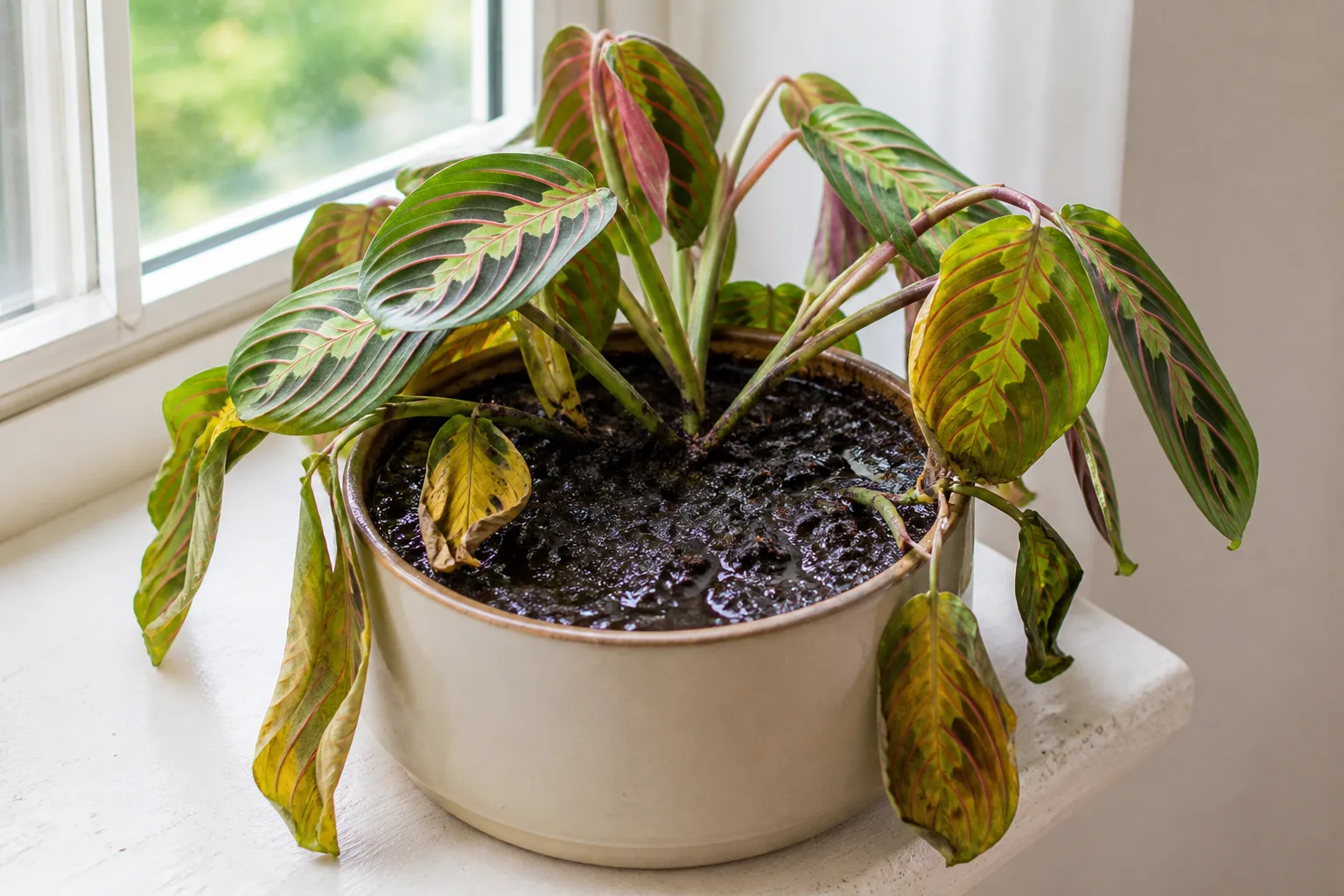
Overwatering on Prayer Plant: Causes, Checks & Fixes
This guide covers overwatering on Prayer Plant. See also the general Overwatering guide, watering, and light pages for this plant.
Overwatering on Prayer Plant: Causes, Checks & Fixes
Quick answer
Overwatering on prayer plant (Maranta leuconeura) is not about giving water too generously once-it is about keeping peat soggy around shallow rhizomes so fine roots lose oxygen. The classic trap: yellow lower patterned leaves, a pot that stays heavy for days, and limp daytime foliage while the mix is still wet. Healthy Marantaceae need moist but never stagnant soil; chronic saturation is a different failure mode.
First step: stop watering until the top inch of mix feels dry, empty any standing water from saucers or cachepots within thirty minutes of the last pour, and confirm the plant sits in bright indirect light so it can use water at a normal rate. Do not fertilize, repot into a larger container, or mist heavily on day one.
For year-round watering rhythm and water-quality notes, see the prayer plant watering guide. This page is the overwatering diagnostic and rescue workflow when wet soil is already hurting the plant.
What overwatering looks like on Prayer Plant
Overwatering on prayer plant reads differently than on a succulent because Prayer Plant overview is judged by patterned leaf quality, crown posture, and nyctinastic movement-not just whether leaves stay green from across the room.
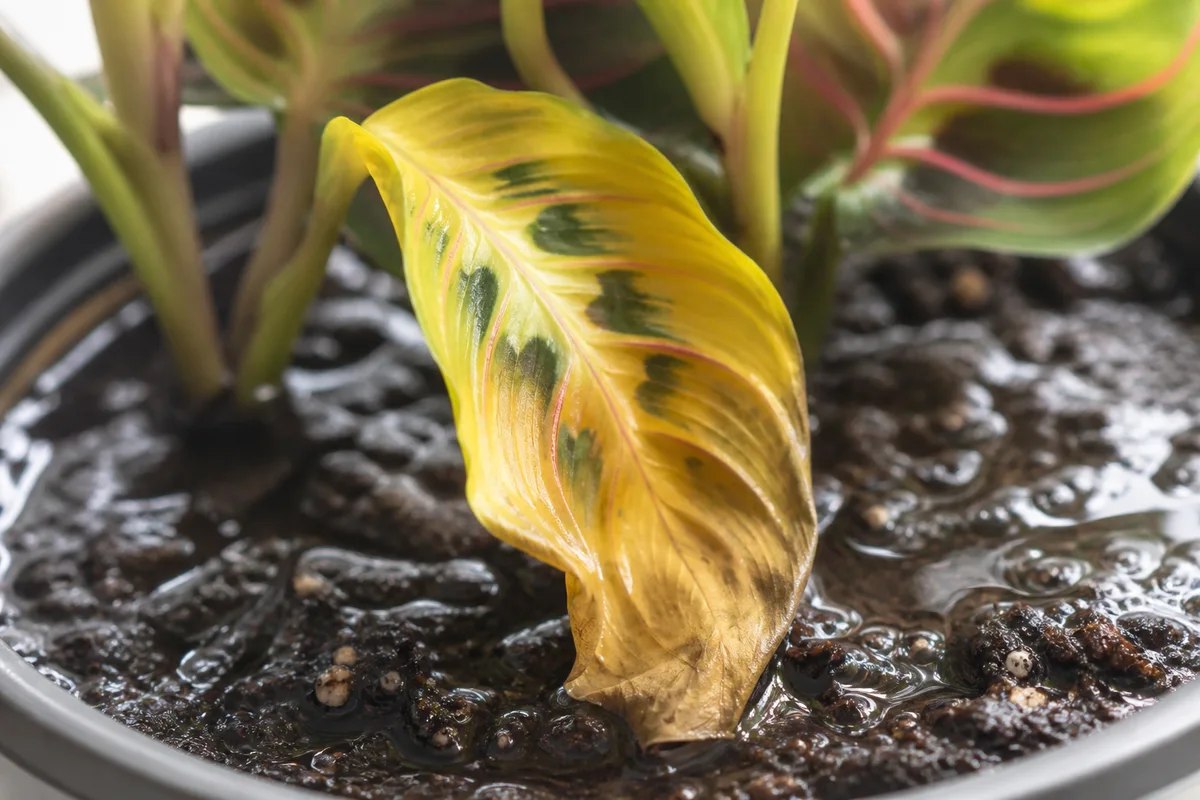
Overwatering symptoms on Prayer Plant - compare with healthy tissue on the same plant.
Typical signs:
- Yellow lower leaves with intact herringbone pattern fading on the oldest foliage first-newer rolled leaves may still look acceptable briefly
- Limp or drooping daytime posture while soil at one-inch depth stays cool, dark, and clingy
- Weak or irregular night folding-healthy prayer plants fold leaves upward at night; stress can dull that movement before widespread yellowing
- Pot that feels heavy continuously-lift after you think it should have dried; no weight drop means the root zone is still saturated
- Sour or musty smell from peat that has stayed anaerobic too long
- Fungus gnats on Prayer Plant hovering over perpetually damp surface mix-often appears alongside root rot in poorly drained soils
- Surface mold or algae on top of the mix when light is low and evaporation is slow
The wilt-with-wet-soil trap
The most dangerous misread on prayer plant: leaves look thirsty, so you water again-while roots are already failing. Wilting with moist soil often means damaged roots cannot absorb water, not that the plant needs another drink. Damaged rhizomes cannot transpire; foliage droops while media stays wet. Each extra pour deepens oxygen starvation. If limp leaves pair with a heavy, cool pot, pause watering and inspect-not pour.
Yellow lower leaves vs. other yellowing
On prayer plant, overwatering yellowing usually starts on older lower leaves while the crown still pushes rolled tubes-until root damage advances. Uniform yellowing with dry, light soil points elsewhere. Crisp brown tips with otherwise firm posture often trace to fluoride or low humidity, not soggy roots.
Why Prayer Plant gets overwatered
Maranta leuconeura evolved on the Brazilian rainforest floor with shallow rhizomes in leaf litter that stays damp but drains freely after rain. Indoors, several habits push the same biology into chronic saturation:
Fear of crisp tips and daily top-ups
Prayer plants are sensitive to dry air and minerals-brown tips trigger panic watering. But tiny daily sips wet only the surface while the center stays soggy, or keep peat permanently damp in a dim corner where the plant never transpires fast enough. Illinois Extension says to keep soil moist in bright diffused light-that means a full soak when the top inch dries, not perpetual wetness.
Oversized pots, peat-heavy mix, and shallow rhizomes
Prayer plant spreads horizontally with fine feeder roots near the surface. An oversized decorative pot holds excess water around a small root mass. Dense peat without perlite or bark retains moisture for days longer than Marantaceae fine roots tolerate. Root rot may occur with poorly drained soils-the risk rises when rich mix meets low light.
Low light, cachepots, and winter slowdown
In dim placement, prayer plant uses water slowly-soil that dried in five days in a bright east window may stay wet for two weeks on a bookshelf. Decorative cachepots without drainage trap runoff and re-saturate the bottom profile. Winter heating slows growth; Missouri Botanical Garden advises reducing soil moisture substantially from autumn to late winter while many growers keep summer watering frequency on autopilot.
Post-scare overcorrection
A prior underwatering on Prayer Plant collapse or root-rot scare sometimes pushes growers to never let soil dry-but Marantaceae need oxygen between drinks. Moist means evenly damp through the root ball after a thorough watering, not wet surface peat forever. See underwatering for the opposite failure mode.
How to confirm the cause
Work through these checks before Prayer Plant repotting guide, fertilizing, or pruning heavily:
- Top-inch finger or skewer test - Insert a finger to the first knuckle (about 2.5 cm). If mix feels cool, clingy, or dark at that depth many days after the last watering, overwatering is likely. Surface color lies on peat-heavy mixes.
- Pot-weight comparison - Lift the container. A pot that stays “heavy” for seven to ten days after one drink in a warm room suggests retention or slow use-not healthy moisture cycling.
- Smell check - Sour, musty, or rotten odor from drainage holes or when you disturb the surface points to anaerobic peat.
- Stem-base firmness - Press gently where petioles meet the rhizome at soil line. Soft, collapsing tissue suggests advancing crown involvement-urgent.
- New-growth read - The newest rolled leaf should open firm with sharp herringbone veins. Stalled, soft, or yellowing crown growth on wet soil confirms stress is active.
- Light cross-check - Soil that never dries in a dim corner may be a low-light metabolism problem compounding watering-fix placement and dry-down together.
If four or more checks point to chronic wetness-and underwatering lookalikes are ruled out-you have enough evidence to pause watering and assess root health.
Lookalike symptoms to rule out
| What you see | Likely cause | Why it is not simple overwatering |
|---|---|---|
| Inward-rolled leaves, light dry pot, mix pulling from walls | Underwatering | Pot weight drops; no sour smell; rhizomes firm when checked |
| Brown crisp tips, firm stems, soil cycles normally | Low humidity or tap water fluoride | No persistent heavy pot; see low humidity and brown tips |
| Mushy brown rhizomes, sour soil, rapid multi-leaf collapse | Advanced root rot | Needs trim and repot-not dry-down alone; see root rot |
| Limp leaves only in hot dry air, no gnats, soil dries on schedule | Heat or humidity stress | Wilting without chronic wet profile |
| Yellow leaves in dim corner, soil wet two weeks | Low light slowing water use | Fix light and reduce water together-not one without the other |
The first fix to try
Stop watering until the top inch of mix feels dry and the pot feels noticeably lighter. Empty saucers and outer cachepots so no standing water re-wicks into the root zone. Move the plant to bright indirect light if it sits in shade-slow evaporation worsens wet soil.
That single pause is the correct first action for mild overwatering when stems are still firm, smell is neutral, and yellowing has not spread past a few lower leaves. Prayer plant recovery needs consistent moisture once corrected, but not another drink while the profile is saturated.
Do not fertilize waterlogged rhizomes. Do not repot into a larger pot hoping extra soil will “absorb” moisture-that holds more water around shallow roots. Do not mist heavily to compensate for limp leaves when soil is already wet.
Moderate cases: inspect rhizomes before the next drink
If yellowing spreads, night folding stops, or the pot stays heavy two weeks after you stopped watering:
- Slide the plant from its pot gently-avoid pulling from stems.
- Brush away wet peat and rinse rhizomes lightly with room-temperature water.
- Assess texture - healthy rhizomes and roots are firm and pale cream or white; rotted tissue is brown, mushy, and may smell.
- Trim mushy sections with clean scissors; let cut surfaces air-dry thirty to sixty minutes.
- Repot only if rot is present into fresh, airy mix sized to the remaining root mass with open drainage holes-see root rot for full rescue protocol.
If roots are firm and only a few lower leaves yellowed, dry-down alone may suffice-skip repotting on day one.
Step-by-step recovery after pausing water
Once the top inch has dried and you are ready to resume careful watering:
- Water thoroughly once until runoff appears, then empty saucers within thirty minutes-one full event, not daily sips.
- Pour at the soil line, not over the crown; Illinois Extension warns do not allow water to stand on crowns-stems rot easily on this low-growing species.
- Wait for the top inch to dry again before the next drink-track pot weight alongside finger tests.
- Watch the next rolled leaf from the crown. Firm unfurling with sharp herringbone veins means the wet cycle has stopped.
- Hold fertilizer until two to three firm new leaves open-feeding stressed roots worsens damage.
- Maintain humidity at 50–70% with a pebble tray or humidifier so recovering leaves do not crisp at edges while roots rebuild-high humidity does not replace fixing wet soil.
Recovery timeline
Expect one to two weeks before you can judge whether mild dry-down worked, measured by new crown growth and stopped yellowing, not by old leaves re-greening.
- Days 3–7: Soil dries through the top profile; pot weight drops. Lower yellow leaves may not improve-they rarely re-green.
- Weeks 1–2: Daytime posture firms if roots were only mildly stressed. First new rolled leaf may appear.
- Weeks 2–4: Two clean new leaves with strong patterning confirm recovery. Over-watering commonly causes yellowing-when new foliage stays healthy, the oxygen crisis has passed.
- Beyond four weeks: If no new growth appears in warm bright conditions despite correct dry-down, inspect rhizomes for hidden rot.
Winter recovery takes longer because transpiration is slow-extend intervals between checks but never return to calendar watering without testing the mix.
Mistakes to avoid
- Watering because leaves look sad when soil is already wet-the wilt-with-wet-soil trap
- Repotting into a larger container to help soil dry faster-more volume holds more water around shallow rhizomes
- Fertilizing to “perk up” a limp prayer plant on soggy mix
- Letting the plant go bone-dry for weeks during recovery-Marantaceae fine roots hate drought shock after oxygen stress; aim for consistent moisture once the top inch dries
- Keeping summer watering frequency in winter when growth slows and pots stay heavy longer
- Ignoring cachepot standing water that re-saturates the bottom profile after every drink
- Stacking repot, prune, and fertilizer on the same day as a watering correction-change one variable at a time
- Misting instead of fixing soil moisture when gnats and mold indicate chronic dampness
Prayer Plant care cross-check
Overwatering rarely exists in isolation on prayer plant. After you pause and correct watering:
- Light: Brighter indirect exposure helps the mix dry at a healthy rate. Dim corners keep peat wet-see not enough light and the light guide.
- Soil: Peat-perlite-bark blends drain better than straight peat. Oversized pots are a common upstream cause.
- Water quality: Filtered or overnight tap water prevents tip burn that triggers panic top-ups-details in the watering guide.
- Humidity: Target 50–70% so leaves do not crisp and tempt extra watering; humidity does not fix soggy roots.
- Temperature: Cold below about 60°F (15°C) slows metabolism while soil stays wet longer-keep away from drafty winter sills.
How to prevent overwatering next time
- Water when the top inch dries, then soak until runoff-Illinois Extension top-inch rule for active growth; slightly longer dry windows in winter per NC State winter dry-down guidance
- Empty saucers and cachepots within thirty minutes of every watering
- Use a pot sized to the root mass with drainage holes-not a decorative oversized cachepot as the only container
- Read pot weight and new rolled leaves, not the calendar-summer bright-window rhythm may be every five to seven days; winter dim-room rhythm may be every ten to fourteen
- Pair realistic light with watering-a prayer plant in shade needs less water, not more misting
- Never pour on the crown when top-watering; tilt hanging baskets carefully
When to worry
Escalate to same-day rhizome inspection if:
- Crown stems soften where petioles meet the rhizome
- Soil smells sour despite surface drying
- Several leaves collapse at once while mix is wet
- Fungus gnats persist because peat never dries through the profile
- No firm new leaf appears within four weeks after corrected dry-down in warm bright conditions
Severe crown softness may be irreversible-judge salvageable tissue by firm white rhizome sections, not yellowed mature leaves. Advanced cases belong on the root rot page.
Conclusion
Prayer plant overwatering is a moisture-oxygen problem around shallow rhizomes, not a single bad watering day. Yellow lower patterned leaves, a perpetually heavy pot, and limp foliage on wet soil are the Marantaceae-specific tells-especially when healthy night folding weakens. Pause watering until the top inch dries, empty standing water, confirm bright indirect light, and inspect rhizomes only if decline continues.
Judge recovery by firm new rolled leaves with sharp herringbone veins, not by whether old yellow tissue re-greens. For year-round rhythm and fluoride notes, use the watering guide; for mushy roots and repot rescue, use root rot; for wet-vs-dry triage when you are unsure, use wilting.
The same species appears under the scientific slug maranta-leuconeura elsewhere on LeafyPixels; biology is identical. This guide sits in the prayer plant hub for growers who search by common name.
When to use this page vs other Prayer Plant guides
- Prayer Plant watering guide - Use for routine moisture checks before assuming overwatering is the main issue.
- Prayer Plant problems hub - Browse all 17 common issues on this species.
- Root Rot on Prayer Plant - Different entry point when symptoms overlap with overwatering.
- Yellow Leaves on Prayer Plant - Different entry point when symptoms overlap with overwatering.
- Wilting on Prayer Plant - Different entry point when symptoms overlap with overwatering.