Pilea Peperomioides Fertilizer: When, How, and Mistakes
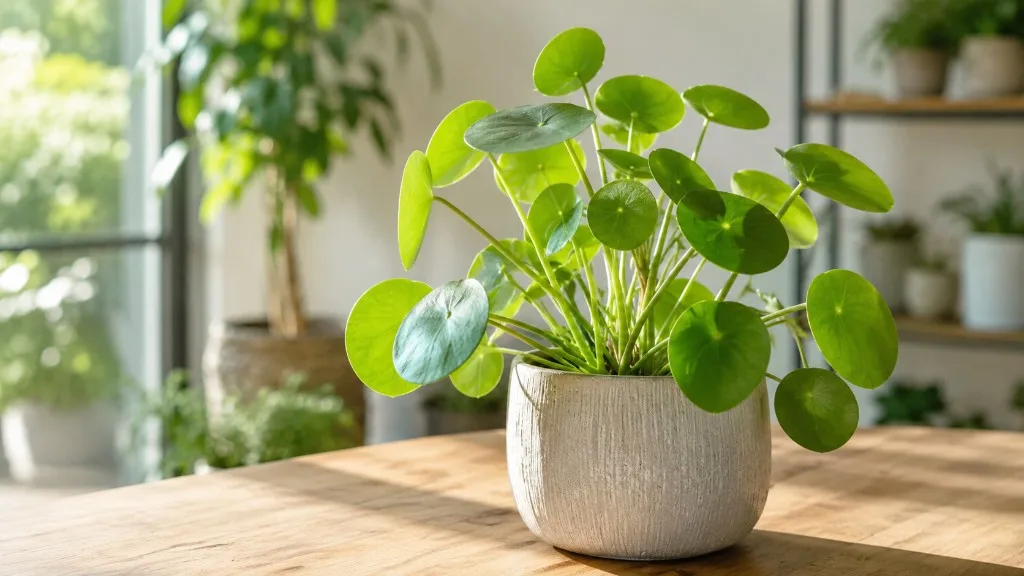
Pilea Peperomioides Fertilizer: When, How, and Mistakes to Avoid
Pilea Peperomioides Fertilizer: When, How, and Mistakes to Avoid
Pilea peperomioides fertilizer is one of the easiest houseplant feeding routines to get wrong - not because the Chinese money plant is picky about brands, but because it is a moderate feeder with coin-shaped leaves and a pup-producing growth habit that punishes enthusiasm far more than it rewards neglect. Pilea peperomioides evolved on cool, shaded moist rocks in southwestern China, where organic matter cycles slowly and drainage is excellent. Indoors, it pushes new coin leaves on a central stem, produces offsets (pups) from the base, and processes nutrients at a steady but not greedy pace. Feed it like a fast-growing tropical vine and you get the classic failure pattern: crispy coin-leaf margins, a white crust on the soil surface, sudden leaf drop, and roots sitting in a salt-heavy zone that looks wet but cannot absorb water effectively.
The practical goal for most home growers is straightforward: use a balanced water-soluble fertilizer diluted to half the label strength, apply it once a month during spring through early fall while coin leaves are opening regularly, and pause entirely from late fall through winter. Water onto moist soil only, never dry roots. Flush the pot with plain water periodically to leach accumulated salts. Pilea is not a heavy feeder - light, consistent nutrition during active growth beats any “more is better” approach.
Author: sai-ananth · Reviewer: LeafyPixels Review Board · Reviewed: June 2026. Recommendations were checked against NC State Extension, the RHS pilea growing guide, University of Maryland Extension soluble-salt guidance, and LeafyPixels pilea care data.
This guide covers when to fertilize, how much to use, which formulas work best, how to read coin-leaf growth signals, feeding rules around pups and repotting, and the mistakes that cause more damage than skipping a month ever would. For the full species picture, see the Pilea peperomioides overview.
Quick Answer
Feed Pilea peperomioides with a balanced liquid houseplant fertilizer at half the label strength, roughly once a month from mid-spring through early fall when new coin leaves are opening. NC State Extension’s container handbook recommends fertilizing indoor houseplants monthly from March through October and pausing November through February unless deficiency symptoms appear. Pause in late fall and winter when growth slows. Never fertilize dry soil - water first, then feed. Hold food for four to six weeks after repotting or pup separation, and flush salts if you see white crust on the pot rim.
Why Fertilizer Matters for Pilea Peperomioides
Pilea uses nutrients to push out new coin leaves, extend its upright stem, produce pups, and maintain root function in a container that leaches minerals with every watering. In its native habitat on shaded moist rocks, nutrients arrive slowly through decomposing organic matter and excellent drainage. Indoors, that natural replenishment is absent unless you add it. Fertilizer replaces what watering pulls out of the potting mix - but only up to the point the roots can absorb without salt damage.
NC State Extension rates Pilea peperomioides as a rapid grower indoors, typically reaching about 8–12 inches (20–30 cm) tall with orbicular, fleshy leaves on long petioles. That growth rate matters for feeding: the plant uses nutrients steadily during active seasons but does not need the heavy nitrogen pushes you might run on a coleus or outdoor tomato. Think of feeding as maintenance for a healthy, actively growing plant - not a rescue tool for a pilea that is pale and stretched because it sits in too little light, dries out repeatedly, or struggles in waterlogged mix.
Moderate Feeder, Not Heavy
Pilea peperomioides is a moderate feeder, not a heavy one. If bright indirect light and consistent watering are correct, growth looks compact, coin leaves stay domed, and pups appear without aggressive fertilizing. Chasing bigger leaves with full-strength weekly feed while the plant sits in a dim corner produces soft, pale growth that pests love - fix the environment first, then add nutrients on a conservative schedule. The RHS warns that overfeeding pileas can do more harm than good, which matches what most experienced growers see on Pilea Peperomioides overview: tip burn and salt crust long before true nutrient hunger.
When to Fertilize Pilea: Active Growth vs Rest
Timing follows the plant’s metabolism and coin-leaf emergence more than the calendar on your wall. Feed when pilea is actively producing new leaves and pups, and stop when growth slows sharply. Outdoors in warm climates, that rhythm tracks long days. Indoors, heated rooms and stable light can extend the window slightly - but most houseplant pileas still slow noticeably in late fall and winter, even when old coin leaves stay green.
A plant that looks fine through December may not be growing - unused nutrients then accumulate as salts while roots absorb water more slowly. The best feed/no-feed signal is whether new coin leaves are opening at the top of the stem, not whether the pot still looks green.
Spring and Summer Feeding Window
Start feeding when you see fresh coin-leaf development - new domed blades unfurling at the stem tip, pups with three to four leaves at the base, or roots visibly active at the drainage holes. In temperate climates, that usually means mid-spring through late summer, roughly March through September depending on latitude, room temperature, and light exposure. NC State Extension notes propagation is best in spring or early summer during active growth - the same window when feeding makes sense.
The RHS pilea guide recommends feeding every month or two from April to September with a balanced liquid fertiliser at label dilution rates - which, for most indoor growers, translates to monthly at half strength as the safer default. Growers in cooler springs can start a bit later; the signal is new tissue, not a fixed date.
| Month (temperate climate) | Growth phase | Feeding guidance |
|---|---|---|
| March–April | Waking up, coin leaves opening | Start half-strength liquid if active growth visible |
| May–August | Peak leaf and pup production | Monthly at half strength on moist soil |
| September | Slowing slightly | Final monthly feed or taper to every 6–8 weeks |
| October | Wind-down | Last light feed if still growing, then pause |
| November–February | Low growth indoors | No fertilizer for typical setups |
The table is a framework, not a law. Watch the plant: if coin leaves are opening steadily and pups are forming, the timing is right. If growth is static, solve light and water before adding food.
Fall Taper and Winter Pause
Taper feeding in early to mid-fall as day length drops. One practical approach: give a final half-strength feed in early fall if coin leaves are still emerging, then stop entirely from late fall through winter - typically November through February for most indoor setups. NC State Union County Extension notes that houseplants should receive little or no fertilizer during winter months when growth is almost at a standstill.
Do not fertilize pilea in winter under normal home conditions. Growth slows even when old coin leaves remain firm, and unused nutrients build up as harmful salts around the roots. Resume feeding in spring when new leaves open, not when you simply feel the plant “needs a boost” after a gray January.
Grow-Light Winter Exception
Exception: if you grow under strong supplemental grow lights and the plant keeps producing new coin leaves all winter, you can feed lightly - still at half strength - but extend the interval to every six to eight weeks and watch closely for salt crust on the soil or pot rim. Even then, skipping winter feeds is safer than forcing growth with nutrients the roots cannot process. Pilea tolerates a skipped season far better than it tolerates a salt-heavy root zone.
Best Fertilizer Type for Pilea
The best pilea peperomioides fertilizer for most homes is a complete, water-soluble, balanced houseplant formula with moderate nitrogen for leaf development and modest phosphorus and potassium. You want enough nitrogen to support steady vegetative growth and pup production, phosphorus for root function at low levels, and potassium for overall stress tolerance. Micronutrients on the label - iron, magnesium, manganese - matter because pale new coin leaves on otherwise well-watered plants sometimes trace to trace-element gaps rather than macronutrient hunger.
Balanced Liquids and Dilution Math
A 10-10-10 or 20-20-20 water-soluble fertilizer diluted to half strength is the default recommendation for container pilea. Equal ratios keep feeding simple when your main goal is steady coin-leaf development, not flowers - pilea rarely blooms showily indoors anyway.
Liquid formulas win for control. You mix, dilute, and apply a known dose. That matters in small pots where precision prevents localized hot spots of concentrated salts. For a typical container pilea in a 4- to 6-inch pot, mix fertilizer at half the label’s recommended strength for houseplants, then apply until a little water drains from the bottom. Discard saucer water so roots are not sitting in concentrated runoff.
Worked example: If the label says 1 teaspoon per gallon of water at full strength, use ½ teaspoon per gallon for pilea. Measure with a spoon or syringe - eyeballing concentrate from a bottle cap is how accidental full-strength feeds happen.
What to Skip and Pet Safety
Slow-release granules and fertilizer spikes are poor choices in small pots - they release unpredictably and stack with liquid feeds. Skip liquid for two to three months if slow-release is already in fresh mix. Foliar feeding is unnecessary on pilea; nutrients are taken up through roots, and wet coin leaves in low airflow can invite fungal spotting. Avoid fertilizer combined with pesticide products unless you have a specific pest problem and follow label directions exactly.
Pet note: The ASPCA lists Pilea peperomioides as non-toxic to cats and dogs. That makes it popular in pet-friendly homes. Concentrated fertilizer solution, crusty salt-heavy soil, and open bottles are still not safe for pets or children to ingest - store products out of reach and wipe spills promptly.
How Often and How Much to Feed
If you remember one number, make it half strength - never full label strength on a container-grown pilea unless you have years of experience leaching salts regularly and the plant sits in bright light with excellent drainage.
Frequency should follow growth rate, light level, container size, and salt management:
- Once a month with half-strength balanced liquid from mid-spring through late summer in bright indirect light
- Every six to eight weeks if the plant is in moderate light, a large pot, or fresh mix with starter fertilizer
- Once in early fall at half strength if coin leaves are still emerging, then stop
- No fertilizer from late fall through winter for typical room-grown plants
- Optional light feed every six to eight weeks only if the plant keeps actively growing under grow lights in winter
| Situation | Suggested frequency | Strength |
|---|---|---|
| Active growth, bright indirect light | Monthly | Half label strength |
| Active growth, low to moderate light | Every 6–8 weeks | Half label strength |
| Early fall, slowing growth | Once, then pause | Half strength |
| Winter indoors, typical light | Skip | - |
| Winter under grow lights, new coin leaves | Every 6–8 weeks | Half strength |
| After repotting into fresh mix | Wait 4–6 weeks | Then resume half strength |
| After pup separation | Wait 4–6 weeks on both plants | Then resume half strength |
| Recovering from over-fertilizing | Pause 4–6 weeks | Flush; resume at half strength |
A pilea in hard tap water carries a double mineral load - calcium, chlorine, and other dissolved solids add to fertilizer salts. If you see tip burn while feeding modestly, address water quality and flush the soil before increasing fertilizer.
Step-by-Step: How to Feed Pilea Safely
Safe feeding is mostly about order of operations. NC State Union County Extension lists moist potting mix as a basic rule: do not apply fertilizer to dry medium.
- Check the calendar and the plant. Confirm you are inside the active growth window and see new coin leaves opening or pups developing. If it is winter and nothing is growing, stop here.
- Inspect for salt crust or tip burn. White or yellowish residue on the soil surface or pot rim means skip feeding and flush instead.
- Water with plain water if the top inch feels dry. Bring the root zone to evenly moist before any fertilizer touches it. Never pour fertilizer onto dry soil - salts concentrate at the root surface and burn tissue.
- Mix fertilizer at half strength in room-temperature water in a watering can with a narrow spout.
- Apply slowly and evenly across the soil surface, directing solution away from the coin leaves. Stop when a little water drains from the bottom.
- Discard drainage from the saucer within 30 minutes.
- Mark the date on a calendar or plant note so you do not double-feed in an enthusiastic week.
Feed the day after a regular watering when possible - the root zone is hydrated and you are not stacking concentrate onto dry peat.
Signs Feeding Is Working
When your pilea fertilizer routine is dialed in, the evidence shows up on new growth, not on leaves that were already on the plant when you started feeding.
Healthy signs include:
- New coin leaves opening regularly during spring and summer - firm, domed, and deep green with a slight gloss
- Upright central stem with even spacing between leaf nodes (assuming you rotate the pot weekly)
- Pups forming at the base on mature, stable plants without forcing
- No white salt crust on the soil surface or pot rim after several months of feeding
- Steady but not explosive growth - pilea is rapid for a houseplant but not racing like a pothos in summer sun
If older lower coin leaves yellow while new growth at the top looks fine, that is often natural senescence, not a fertilizer call. Pilea drops older leaves periodically as new ones open above.
Signs of Over-Fertilizing and Salt Buildup
Over-fertilizing is the dominant fertilizer problem on pilea. Symptoms often appear one to two weeks after a too-strong or too-frequent feed, or gradually when salts accumulate from winter feeding, hard water, and never flushing.
Watch for these signals:
- Brown, crispy margins on coin leaves, especially on newer blades or shortly after a feed
- White or yellowish crust on the soil surface, pot rim, or drainage holes - classic soluble salt accumulation
- Sudden leaf drop or wilt despite moist soil - damaged roots cannot take up water effectively due to osmotic stress
- Stunted new coin leaves with burnt edges on the smallest unfolding blades
- Visible salt deposits on terracotta pots after months of tap water and fertilizer use
University of Maryland Extension explains that high soluble salts cause fertilizer toxicity symptoms that can look like drought stress even when soil is wet. Hard water plus fertilizer creates a double mineral load; flush and consider filtered water before increasing feeds.
Symptom Differential: Feed, Light, or Salts
Pale, small new coin leaves are the most misdiagnosed pilea problem. Before reaching for fertilizer, use this table:
| Symptom | Likely cause | What to check | Action |
|---|---|---|---|
| Pale, small new coin leaves; long gaps between nodes; stem leaning to window | Low light (etiolation) | Window exposure, rotation habit | Move to brighter indirect light; do not feed more |
| Crispy brown coin-leaf margins; white crust on soil; symptoms after recent feed | Over-fertilizing / salt buildup | Soil surface, pot rim, feed history | Flush; pause feed 4–6 weeks |
| Uniformly pale new leaves in bright light, slow pup production, same pot 2+ years | Possible under-feeding or depleted mix | Light and water already correct? | Resume half-strength monthly for one season |
| Brown spots on window-facing leaf side only | Sunburn | Direct sun exposure | Filter light; not a feed issue |
| Yellow lower leaves, firm stem, normal new growth at top | Natural senescence or slight overwatering on Pilea Peperomioides | Soil moisture at depth | Usually not fertilizer |
The differential saves you from feeding a plant that actually needs better light or from ignoring salt crust because you assumed the plant was “hungry.”
How to Flush Pilea After Over-Feeding
If you suspect burn, stop fertilizing immediately and leach the soil. NC State’s container handbook recommends leaching when salt accumulation appears as a white crust - slowly running water through the medium for several minutes.
- Move the pot to a sink, tub, or outdoor spot where copious drainage is acceptable.
- Water slowly with plain room-temperature water - filtered or rainwater if tap water is hard - until water runs freely from the drainage holes. Let it drain completely.
- Repeat two to four times over 30–60 minutes, using roughly three to four times the pot’s volume of water total. Allow full drainage between passes.
- Pause all feeding for 4–6 weeks while you monitor new coin-leaf emergence.
- Resume at half strength only when new leaves open without burnt margins and salt crust is gone.
Badly burned coin-leaf margins will not green up again - judge recovery by new growth, not old damage. Trim brown edges with clean scissors if they bother you aesthetically, but cut only the dead tissue.
Many experienced growers flush with plain water every six to eight weeks during active growth as preventive maintenance, even when feeding at half strength monthly. That habit matters especially for pileas kept in the same pot for years without repotting.
Feeding Around Pups, Repotting, and Propagation
Pilea’s pup-producing habit creates feeding rules that generic houseplant fertilizer pages skip.
Pup-heavy mother plants: A mature pilea with several offsets at the base shares one root mass. Feed modestly - monthly at half strength is enough. Do not chase more pup production with extra nitrogen; pups appear when light, root snugness, and overall health are right, not when you double the feed.
After pup separation: When you remove a pup with its own roots per the propagation guide, hold fertilizer on both the mother and the pup for four to six weeks while roots heal. NC State Union County Extension notes that recently purchased or disturbed plants often have sufficient nutrients in the medium for two to three months - the same conservative logic applies after division.
After repotting: Fresh well-draining mix often contains starter fertilizer. Wait four to six weeks before the first liquid feed to avoid stacking concentrates on recovering roots. Expect a short adjustment period - slight droop for a few days - while roots settle. If droop persists on wet soil past two weeks, inspect for rot before resuming any feed.
Slightly root-bound mature plants: A pilea that is mildly root-snug in a stable pot sometimes pup more readily. That is not permission to feed heavily - it is a reminder that nutrition supports existing growth, not a substitute for timely repotting when roots circle densely and water runs straight through dry channels.
Fertilizer and Other Pilea Care
Fertilizer only works when light, water, and soil are already in range. Pilea in bright indirect light uses nutrients slightly faster than one in deep shade, where pale coin leaves are usually a light problem. Missouri Botanical Garden groups Pilea with succulent-leaved plants that need less water than ferns - meaning a dim, overwatered pilea builds salts fast because it photosynthesizes slowly while the mix stays wet.
Rotation matters: A plant that leans toward the window is telling you about light, not hunger. Skipping rotation while chasing bigger leaves with fertilizer is a common waste of effort.
Cache pots: If you use a decorative outer pot, empty runoff promptly after every watering and feeding. Standing fertilizer solution in a cache pot concentrates salts around the drainage holes.
Pair conservative feeding with the rest of the hub: water when the top inch dries, rotate weekly, repot every one to two years, and separate pups when they have their own roots. Fix environment first - fertilizer becomes simple maintenance once those pieces align.
Conclusion
Pilea peperomioides fertilizer success comes down to matching a light, conservative feeding plan to real growth - not to a rigid calendar that ignores your light, pup load, and season. Use a balanced water-soluble formula at half strength, feed once a month during active spring and summer growth when coin leaves are opening, and stop in late fall and winter unless you are running strong grow lights and seeing continuous new leaves. Apply to moist soil only, flush salts periodically with plain water, and treat crispy coin-leaf margins as a salt or water-quality warning before reaching for a stronger dose.
When in doubt, less is more. Pilea tolerates a skipped month - or an entire winter without food - far better than it tolerates full-strength fertilizer, winter feeding, or slow-release spikes in a small pot. Watch new coin leaves: firm, domed blades opening cleanly mean your rhythm is working. Brown margins, white crust, and sudden leaf drop mean pull back, flush, and fix light and water before you open the bottle again.
Related guides: Pilea peperomioides overview · Watering · Light · Soil · Repotting · Propagation
When to use this page vs other Pilea Peperomioides guides
- Pilea Peperomioides overview - Start here for whole-plant context before deep-diving this topic.
- Pilea Peperomioides problems hub - Jump to symptom-specific fix guides when this care topic does not resolve the issue.