Watering Pilea Peperomioides: Schedule, Soil Checks &
Watering Pilea Peperomioides: Schedule, Soil Checks & Mistakes
Watering Pilea Peperomioides: Schedule, Soil Checks & Mistakes
Pilea peperomioides watering is less about memorizing “every Tuesday” and more about reading what your specific pot is doing today. The Chinese money plant evolved on shaded moist rocks in forests in SW Sichuan and W Yunnan, where water runs off fast and roots breathe between brief wet periods. Indoors, that biology translates into one rule: water when the top inch of mix is dry, soak thoroughly, drain completely, then wait until the root zone dries again. overwatering on Pilea Peperomioides - not drought - is why most pileas develop yellow lower leaves, limp coin-shaped foliage on wet soil, and the sour smell that precedes root rot.
This guide covers how often to water, reliable moisture checks, overwatering and underwatering on Pilea Peperomioides diagnosis, seasonal rhythm, repot and pot-size adjustments, pilea-only quirks like pup competition and cupped leaves, the mistakes section this title promises, and recovery steps when you watered once too often. For mix and drainage that make watering survivable, see the soil guide. For how light speed changes dry-down, see the light guide.
Why Pilea Watering Depends on the Pot, Not the Calendar
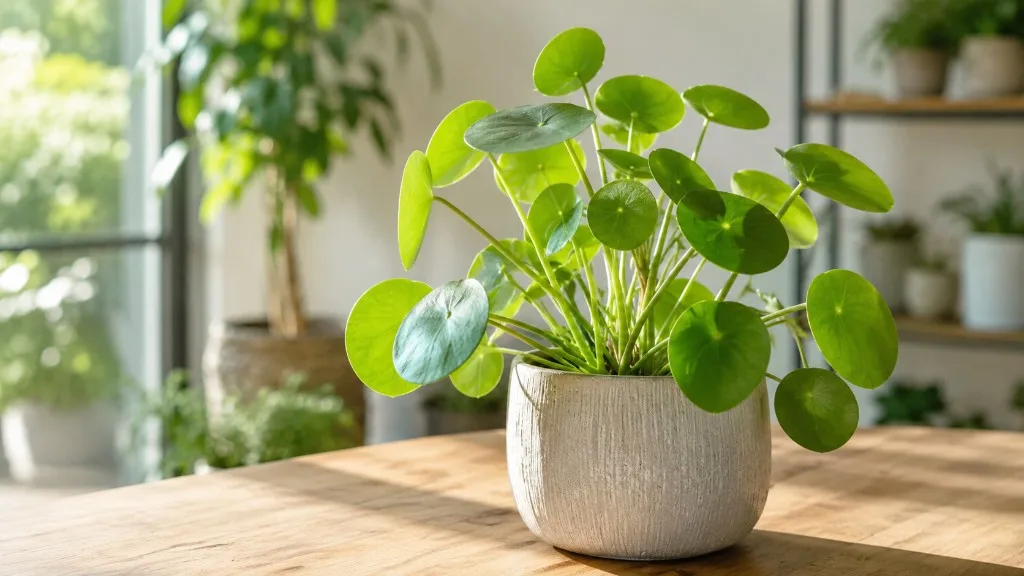
Pilea peperomioides is an upright herb in Urticaceae with peltate coin leaves on long petioles, a single central stem, and offsets (pups) emerging from the base. The root system is relatively shallow and spreading - not a deep taproot you can bury for stability. NC State Extension lists good drainage and moist but well-drained potting mix as cultural requirements, and notes the species is susceptible to root rot if overwatered.
That shallow geometry matters for watering. In an oversized pot, the top inch can look dry while the center stays damp for days - especially in peat-heavy mix without enough perlite. In a snug terracotta pot under bright light, the whole root ball may dry in five days. Missouri Botanical Garden groups pilea with succulent-leaved plants such as peperomia and begonia that need less water than ferns but still require partial dry-down between drinks - not the constant moisture peace lilies prefer.
Penn State Extension emphasizes that pilea houseplants want watering just right - no overwatering or underwatering. The practical translation: your calendar is a reminder to check, not a command to pour. Light intensity, room temperature, pot material, pup count, and season all change how fast the same volume of mix dries. Track your container for two full cycles and you will know your home’s rhythm better than any blog’s generic schedule.
Quick-Reference: When to Water
Dry-Down Decision Card
Use this triage before every major watering:
| Check | Water now? | Wait? |
|---|---|---|
| Top 2.5 cm (1 in.) of mix feels dry; pot feels noticeably lighter than after last soak | Yes - proceed to thorough soak | - |
| Top feels dry but pot still heavy; skewer shows moisture below | Wait 1–3 days; recheck | Yes |
| Leaves limp and mix is wet or cool at depth | Do not water - likely overwatering | Yes - inspect roots |
| Leaves limp and mix is dry; pot very light | Yes - full soak, then drain | - |
| Winter, cool room, no new leaves for weeks | Wait unless top inch is bone dry | Usually yes |
| Just repotted into larger pot | Check more often at first, but water less volume until roots explore | Often wait longer |
Rule of thumb: If you are choosing between slightly too dry and slightly too wet on pilea, slightly too dry is safer - provided you rehydrate with one full soak rather than weeks of drought.
How Often to Water Pilea Peperomioides Indoors
There is no honest universal interval for how often to water pilea peperomioides. What works as a starting framework - not a rule - in average bright-indirect homes:
| Season / conditions | Starting range (check first) | Notes |
|---|---|---|
| Active growth, bright light, warm room | Every 7–10 days | RHS dry-down trigger: top few centimetres dry |
| Active growth, moderate light | Every 10–14 days | Pot weight matters more than surface color |
| Winter slowdown, cool or dim room | Every 14–21 days | RHS notes less water when growth slows |
| Recently repotted, larger pot | Every 14+ days initially | Extra mix holds moisture until roots fill space |
| Terracotta, small pot, summer window | Every 5–8 days possible | Unglazed clay loses moisture faster |
Worked vignette: A healthy pilea in a 12 cm terracotta pot, east-facing window (bright indirect, no direct midday sun), four-parts mix to one-part perlite per the soil guide, often dries enough to need a full soak about every 8 days in July and every 16–18 days in January in a centrally heated home near 21°C. Your numbers will differ - the point is to log water date → light pot date → plant appearance for one month.
The Top-Inch Dry Rule for Pilea
The RHS recommends watering pilea once the top few centimetres of compost start to dry out - roughly the top inch (2.5 cm) in most homes. That depth sits in the zone where pilea’s shallow fibrous roots actively pull moisture without requiring the entire pot to go bone dry.
Do not interpret “top inch dry” as “water when the surface looks pale.” Peat-based mixes can look light on top while staying damp underneath - especially after repeated light sips instead of full soaks. Pair the finger test with pot weight every time until the combination becomes intuitive.
Finger Test and Pot Weight
Finger or knuckle test: Push into the mix to the first knuckle - about 2.5 cm. Cool, clinging soil means wait. Dry, crumbly soil at that depth means you can water.
Pot weight test: Lift the container right after a thorough drain. Note the heft. When it feels noticeably lighter and the top inch is dry, the root ball has likely dried enough for the next soak. Experienced growers often trust weight over touch because it reflects moisture through the whole column, not just the rim.
Skewer and Chopstick Checks
Push a dry wooden skewer toward the pot bottom. Darkening or soil sticking means moisture remains deep. Clean dry wood plus a light pot confirms dry-down. This check catches the oversized pot trap - dry top, wet center - that fools many pilea owners.
How to Water Pilea Cleanly
Thorough Soak and Drain Protocol
When checks pass, water slowly and evenly across the surface until water runs freely from drainage holes. That confirms the root ball received moisture throughout, not just at the rim. Missouri Botanical Garden instructs applying enough water that some drains through, then removing excess from the saucer - never letting plants sit in standing water.
Use room-temperature water. RHS notes pileas tolerate tap water but ideally prefer rainwater or filtered water. Avoid softened water when possible - salt buildup stresses roots over time.
Bottom watering - setting the nursery pot in a tray of water for 15–30 minutes - can help rewet hydrophobic dry mix after underwatering, but it is not required for routine care. Top watering with a slow pour remains the default because it flushes salts and lets you see drainage. If you bottom-water, still lift the pot out and discard tray water afterward.
Cachepot and Decorative Pot Traps
A decorative outer pot without drainage is fine only when the inner nursery pot lifts out for watering and never sits in pooled runoff. A pilea in a sealed ceramic cylinder can show a dry-looking top while the bottom inch stays sodden for weeks - prime conditions for fungus gnats and root rot. After every soak, empty the saucer or cachepot within 30–60 minutes.
Signs You Are Overwatering Pilea
Pilea overwatering announces itself in layers. Catch early signs before the stem base softens.
| Symptom | Overwatering? | Underwatering? |
|---|---|---|
| Yellow lower leaves on multiple stems | Often | Sometimes (after chronic drought) |
| Limp, drooping coin leaves with wet cool mix | Yes - classic | No |
| Limp leaves with dry light pot | No | Yes |
| Sour or rotten smell from drain holes | Yes | No |
| Soil stays dark and cool many days after watering | Yes | No |
| Fungus gnats persistent at surface | Often | Rare |
| Soft mushy tissue at stem base | Late-stage yes | No |
| Leaf cupping or curling | Both - check soil + light | Both - check soil + light |
NC State Extension lists root rot if overwatered as a primary problem. Missouri Botanical Garden overwatering guidance explains the mechanism: roots in saturated soil cannot absorb oxygen, die back, and decay - then the plant cannot take up water even though the mix is wet, which is why limp leaves on wet soil are a stop-watering signal, not a cue for more.
If several overwatering signs appear together, pause watering immediately. See the overwatering problem page for triage detail.
Root Rot From Overwatering
Root rot on pilea follows chronic wet feet, poor drainage, blocked holes, dense unamended mix, or watering on a tropical-plant schedule. Fungi such as Phytophthora colonize compromised roots in waterlogged soil per Missouri Botanical Garden. Healthy roots smell like earth and feel firm and white or tan. Rotting roots smell foul, slip apart when touched, and concentrate where water pooled.
Recovery Steps After Overwatering Pause
Early rot is recoverable if firm stem tissue remains above the damage line:
- Stop watering. Let the mix dry to the appropriate depth - do not “perk it up” with another drink.
- Unpot gently and rinse away old mix from roots.
- Trim mushy brown roots with clean scissors; keep firm white roots.
- Air-dry the root ball 2–4 hours on newspaper in shade.
- Repot into fresh perlite-amended mix in a pot with drainage - often the same size or one size smaller, not larger. See the repotting guide.
- Wait 7–10 days before the first careful soak; then return to top-inch dry-down checks.
- Salvage healthy pups with clean roots if the mother stem base is compromised - see propagation.
Full diagnostic photos and cutoff guidance live on the root-rot problem page.
Signs Pilea Is Thirsty or Underwatered
Underwatering is less common indoors but still happens after travel, winter neglect, or hydrophobic mix that repels water.
Watch for very light pot weight, mix pulling away from pot walls, crisp brown leaf edges, and drooping leaves that recover within hours after a full soak. RHS notes curling or puckering leaves can indicate too little or too much water - or insufficient light - so always pair leaf cues with soil state.
A single dry episode rarely kills pilea. Rehydrate with one thorough soak until drainage runs, discard saucer water, then resume dry-down checks. Do not compensate with daily tiny sips - that keeps the upper layer damp while never reaching deep roots and swings you toward overwatering within a week.
If leaves wilt and mix is wet, you are not underwatered. Treat as overwatering above.
Seasonal Watering Changes for Pilea
Pilea peperomioides usually needs less water in winter when growth slows. Shorter days, cooler rooms, and lower evaporation mean the same pot holds moisture longer - sometimes double the summer interval in dim north-facing rooms.
From late fall through early spring, prioritize dryness checks over habit. A pilea that drank every eight days in August may need only every eighteen days in February. Growth cues help: if no new coin leaves appear for weeks and existing leaves look firm, extend the wait.
Conversely, spring through early fall - when NC State notes rapid growth - dry-down accelerates. New leaves and pup formation increase transpiration. Increase check frequency, not blindly water volume.
Watering After Repotting and by Pot Size
After repotting: Fresh mix and extra volume hold moisture longer until roots explore the new space. Water once lightly to settle mix, then wait for the top inch to dry before the next full soak - often 7–14 days depending on pot upsize. Do not stack repot, fertilizer, and placement change the same week per the overview first-month guidance.
Pot-size reality: RHS warns that overly large pots keep compost damp too long and lead to root rot. Go up one size at repot, not three. An oversized decorative pot with no inner lift-out is a watering hazard regardless of schedule.
Terracotta vs plastic: Unglazed clay breathes and dries faster; plastic retains moisture longer. Shift your starting interval accordingly - same dry-down rule, different timing.
Pilea-Specific Notes: Offsets, Cupped Leaves, and Light
Pup competition: Multiple offsets share one soil volume. A pot crowded with four mature pups dries unevenly - center stays wet while edges dry first. Split or repot when pups overcrowd; see propagation and repotting.
Cupped or drooping coin leaves: Pilea’s peltate leaves cup when stressed. Dry mix + cupping points to thirst. Wet mix + cupping points to overwatering or sudden light drop. Dry mix + cupping + pale stretched stems often means move closer to window per the light guide - light and water must be balanced.
Phototropic lean: Pilea leaves face the window and stems bend. Weekly quarter-turn when you water helps even growth per RHS. Lean does not mean thirst - check soil before responding to posture alone.
Terrarium vs open shelf: Open-shelf pileas dry faster than enclosed terrarium plantings. Do not copy terrarium pilea schedules for a windowsill specimen.
Common Pilea Watering Mistakes and Quick Fixes
- Calendar watering without checking. Fix: set a phone reminder to check, not to pour. Use the decision card above.
- Leaving runoff in saucer or cachepot. Fix: empty within an hour every time. Standing water suffocates shallow roots.
- Tiny daily sips instead of full soaks. Fix: one deep drink per dry cycle; let oxygen return between.
- Same water volume after upsizing pot. Fix: larger mix holds more moisture - extend dry-down, do not auto-double water amount.
- Ignoring winter slowdown. Fix: expect longer intervals October–March in temperate homes.
- Watering to fix limp leaves without checking soil. Fix: limp + wet = stop; limp + dry = soak. See wilting and drooping-leaves.
- Repotting into huge decorative pot “for growth.” Fix: one-size-up nursery pot inside cachepot; lift out to water.
- Letting hydrophobic mix repel water. Fix: bottom-soak 20 minutes once, then resume top watering; refresh top inch of mix if needed per soil guide.
Before You Buy: Wet-Root Warning at the Nursery
Choose a pilea with firm upright stem, leaves of several ages, and mix that does not smell sour. Widespread leaf softness often means roots have been kept wet in low light - a pattern that continues at home unless you dry the root zone and improve drainage.
Lift the nursery pot if possible. Water should not pour out when you tilt a healthy dry-ish plant. Pups are a good sign when the mother is firm. Avoid pots where the central stem wobbles loose in saturated mix - you are buying a watering problem, not a bargain.
First Two Weeks: Establish a Baseline Dry-Down Cycle
Do not repot on day one unless mix is clearly failing or pests are obvious. Quarantine, place in appropriate light, and learn how fast this specific pot dries:
- Water thoroughly once if the top inch is dry at arrival; drain fully.
- Note the date. Check weight and top inch daily for ten days.
- Record when the pot feels light enough to soak again and how the plant looked at that point.
- Avoid changing watering, pot size, and placement all in the same week.
That baseline beats any imported schedule. If problems appear - yellow leaves on wet soil, persistent gnats - correct conditions before stacking fertilizer or repotting. Cross-check the overview first-month checklist.
Conclusion
Water pilea peperomioides when the top inch of mix is dry, soak until drainage runs, empty the saucer, and wait for the next dry-down - adjusting for season, pot size, light, and pup count. Overwatering kills more Chinese money plants than drought; limp leaves on wet soil are your emergency brake, not a cue for more water.
Related pilea guides:
- Overview - full Chinese money plant care summary
- Soil - perlite mix and drainage that make watering survivable
- Light - bright indirect light drives dry-down speed
- Repotting - when and how to move to fresh mix
- Overwatering - early triage
- Root rot - full recovery protocol
- Wilting - limp leaves with wet vs dry soil
- Drooping leaves - posture vs watering diagnosis
When to use this page vs other Pilea Peperomioides guides
- Pilea Peperomioides overview - Start here for whole-plant context before deep-diving this topic.
- Pilea Peperomioides problems hub - Jump to symptom-specific fix guides when this care topic does not resolve the issue.
- Overwatering on Pilea Peperomioides - Escalate here when watering adjustments are not enough.
- Underwatering on Pilea Peperomioides - Escalate here when watering adjustments are not enough.
- Root Rot on Pilea Peperomioides - Escalate here when watering adjustments are not enough.
Related Pilea Peperomioides guides
- Pilea Peperomioides overview
- Pilea Peperomioides light
- Pilea Peperomioides soil
- Pilea Peperomioides propagation
- Pilea Peperomioides fertilizer
- Pilea Peperomioides repotting
- Overwatering on Pilea Peperomioides
- Underwatering on Pilea Peperomioides
- Root Rot on Pilea Peperomioides
- Wilting on Pilea Peperomioides
- Drooping Leaves on Pilea Peperomioides
- Mold on Soil on Pilea Peperomioides