Pilea Peperomioides Light Needs: Best Window & Signs
Pilea Peperomioides Light Needs: Best Window & Signs
Pilea Peperomioides Light Needs: Best Window & Signs
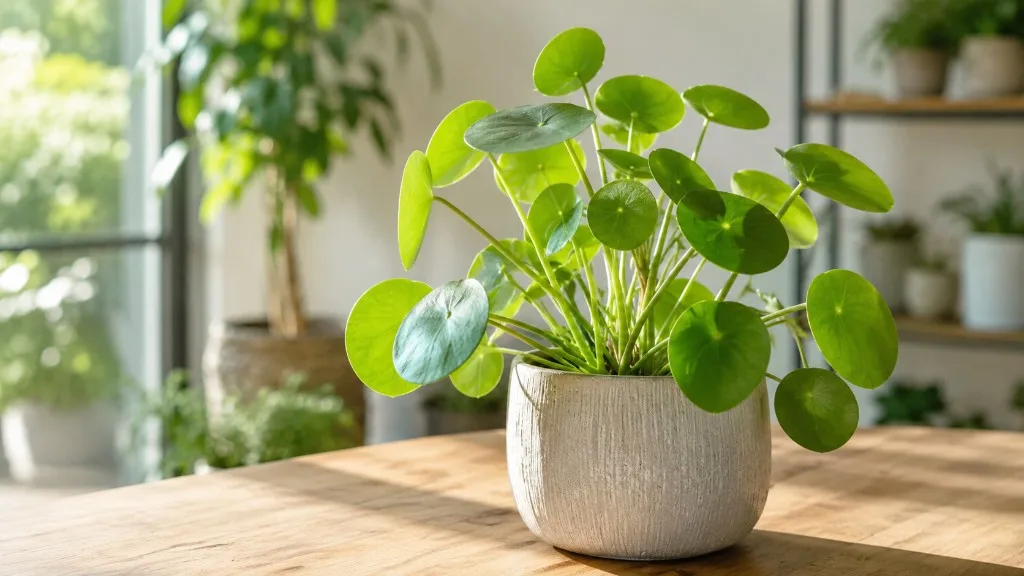
The Chinese money plant is famous for flat, coin-shaped leaves on long petioles - and infamous for bending like a question mark toward the nearest window. Pilea peperomioides is not a low-light foliage plant you can park on a dim bookshelf and forget. It evolved on shaded moist rocks in forests at elevation in southwestern China, where light is bright but filtered and stems stay upright only when illumination arrives evenly from above and the sides. Indoors, that translates to bright indirect light, weekly pot rotation, and judging placement by new coin-leaf growth - not by how bright the room looks to your eyes.
Light also sets the pace for everything else in the pilea care cluster: a brighter plant drinks faster, produces pups more readily, and tolerates Pilea Peperomioides repotting guide better than the same specimen starving in a north-corner shelf. A dim plant uses little water, stretches between leaves, and becomes vulnerable to root rot on Pilea Peperomioides if you keep watering on a summer schedule. This guide covers window-by-window placement, direct-sun limits, acclimation after nursery moves, grow-light numbers, and the warning signs that tell you to move the pot before scorch or legginess becomes permanent.
Quick Answer: Bright Indirect Light Plus Weekly Rotation
Target bright indirect light for most of the day - the kind you get one to three feet from an unobstructed east window, or several feet back from a filtered south or west pane. NC State Extension lists bright, indirect sunlight as the preferred indoor condition, with partial shade (2–6 hours of direct sun) acceptable when exposure is gentle and the plant is acclimated. The RHS recommends bright but indirect light near north-, east-, or west-facing windows, keeping south-facing plants set back from the glass especially in summer.
Rotate the pot a quarter turn every week - the RHS suggests turning bushy pileas at each watering - so phototropic growth does not bend the central stem toward one pane. Do not bury a leaning stem deeper at repotting to straighten the plant; improve light and rotation instead. Read the newest coin leaf after any move: firm, domed, correctly colored new foliage means today’s placement works. Old scorch patches and old stretched internodes never repair - they only tell you what happened last season.
Why Light and Rotation Matter for Coin Leaves
Pilea peperomioides is built like a small satellite dish farm: each peltate, orbicular leaf sits on a long petiole that attaches near the center of the blade, the way NC State Extension describes stems attaching at the center of the leaf. That architecture catches light efficiently from one direction - which is an advantage on a shaded rock face where the brightest photons arrive from a predictable sky gap - but a liability on a windowsill where the glass becomes the only sun. Leave the pot still for two weeks and the entire plant orients toward the pane: leaves face the light, the stem curves, and the back side thins out.
Unlike textured pileas such as Moon Valley (Pilea mollis), which gardeners often grow for crinkled foliage in slightly more humid, bright-indirect setups, P. peperomioides is prized for symmetry and coin-leaf balance. Light mistakes show on this species faster than on many other pileas because the aesthetic is the geometry of the stem and the dome of each leaf.
Phototropism and the Leaning Stem
Phototropism is the growth response that pushes stems and petioles toward the strongest light vector. On pilea it is strong enough to deform the silhouette within a single month in a bright window without rotation. The fix is mechanical and free: rotate the pot roughly 90 degrees every seven to fourteen days so all sides receive similar cumulative light over time. Pair rotation with enough total brightness; spinning a dim plant does not create photons.
Do not bury the stem to correct lean at repotting. Stem tissue meant to stay above the soil line rots when buried, and the bend returns on the next growth flush because the light source did not change. If a heavy crown needs temporary support, use a small stake while new upright growth establishes - then remove it once the top weight balances. For stretch that already produced a bare lower stem, see the leggy growth guide after you fix light; this page focuses on placement before structure fails.
Dome Shape as a Light Meter
Healthy pilea coin leaves are firm and slightly domed, with a soft gloss. Leaves that flatten, cup upward sharply, or hang like saucers are reporting stress - often light combined with water, but light is the variable beginners skip. Upward cupping on the window-facing side frequently follows too much direct beam as the blade tries to reduce exposed surface area. Small, pale, widely spaced new leaves on a lengthening stem point to too little light - etiolation - even when older leaves still look green.
Treat each new coin leaf as a placement audit. Old damage is historical. If the topmost leaf after a move is firmer and more domed than the one below it, you are moving in the right direction. If new leaves shrink and internodes lengthen, step brighter or add a grow light before tweaking fertilizer or repotting.
Native Habitat: Shaded Rock Faces and What That Means Indoors
According to the Flora of China and GRIN-Global, Pilea peperomioides is native to SW Sichuan and W Yunnan, growing on shaded moist rocks in forests at roughly 1500–3000 meters elevation. That is not cave darkness. Forest-edge rock faces receive filtered sky brightness for much of the day, with short periods of direct sun when the sun angle aligns with canopy gaps. The plant also experiences cool air, steady humidity, and fast drainage on rock - conditions you approximate indoors with bright indirect window light, a well-draining mix (covered in the soil guide), and careful watering (see watering).
Translating habitat to a living room gives you three non-negotiables for light: enough total daily brightness for compact internodes, no harsh midday beams on coin leaves, and even distribution via rotation so the stem does not permanently arc. A plant grown in deep nursery shade can tolerate moving to dimmer conditions more easily than jumping to harsh south glass without acclimation - shade-grown tissue lacks the protective habits of a plant hardened on a bright bench.
How Much Light Pilea Actually Needs
Pilea peperomioides prefers bright, indirect sunlight indoors. In practical home terms, that means the leaf surface receives strong ambient brightness without prolonged hot direct rays on the coin blades. The plant uses that light to build domed foliage, push pups from the base, and maintain an upright central stem. It is faster-growing than many succulents - NC State notes a rapid growth rate - which means it shows light deficits quickly through internode stretch rather than silently sitting unchanged for a year.
A useful field test on a clear day: hold your hand between the plant and the window. A soft, readable shadow with defined edges near the foliage usually indicates bright indirect light. A faint or absent shadow means low light - survivable briefly, poor long-term. A dark, crisp shadow with leaf surfaces heating up within an hour means direct exposure that may need filtering, distance, or acclimation.
Bright Indirect vs Medium vs Low Indoor Light
These bands are editorial placement guides for home windows - not laboratory targets - but they help you compare spots consistently:
| Band | Rough foot-candles at leaf (estimate) | Typical indoor placement | Pilea response |
|---|---|---|---|
| Bright indirect | ~250–800 fc | 1–3 ft from east window; 3–5 ft from filtered south; close to bright west with summer sheer | Firm domed new leaves, short internodes, regular pups on mature plants |
| Medium indirect | ~100–250 fc | Deep room near window; north window in bright room; far end of south room without curtain | Slower growth, smaller new leaves, increasing lean without rotation |
| Low light | under ~100 fc | Interior shelf far from glass; dim north room; hallway with no window path | Etiolation, long bare stem, pale small coin leaves; high rot risk if overwatered |
The University of Minnesota Extension classifies medium light as roughly 250–1,000 foot-candles and notes that plants in less light grow more slowly and use less water - a critical pairing for pilea, which many beginners overwater in dim corners. Pilea behaves like a high-medium to bright-indirect species: it wants the upper half of the medium band or better for the compact coin-leaf look most growers expect.
Best Window Placement (East, South, West, North Compared)
Window direction is a starting point, not the whole answer. Outdoor tree shade, neighboring buildings, tint, and pot distance change intensity more than compass labels alone. Still, orientation gives you a reliable first guess in the northern hemisphere.
Place the pot where leaves receive plant-facing light, not where the room looks bright. Human vision adapts to dim interiors; pilea does not. A decorative spot across the room from a window is photography; one to three feet from appropriate glass is horticulture.
At-a-Glance Window Direction Table
| Window | Direct sun (typical) | Scorch risk on coin leaves | Leggy risk | Practical starting placement |
|---|---|---|---|---|
| East | Gentle morning rays, then bright indirect day | Low | Low | Default sweet spot - 1–2 ft from pane |
| South | Strongest total daily light; harsh midday in summer | High without filter or setback | Low if bright enough | 3–5 ft back, or sheer curtain; watch summer heat |
| West | Bright afternoon direct; hot late-day load | High in summer | Moderate | Filter afternoon beam; 2–4 ft back in heat waves |
| North | Gentle indirect all day; weaker in winter | Very low | High long-term | Only in bright rooms; add grow light for compact growth |
The RHS places pileas near north-, east-, or west-facing windows and advises south-facing rooms keep plants set back so they are not in direct sunshine. That framing matches pilea’s rock-face ecology: sky brightness without leaf-scorching beams.
East-facing windows are the safest default for most homes. Morning sun is bright but relatively cool, followed by long bright-indirect day length - similar to canopy-gap light at native elevation. West windows work with sheer fabric or extra distance in summer when late-day heat through glass can bleach coin leaves in days. South windows are excellent in winter at mid and high latitudes when you manage distance; they are risky in midsummer without diffusion. North windows keep plants alive in a bright room but often land below the growth threshold for tight internodes - plan on a grow light or accept slow, sparse growth.
Distance From Glass, Sheers, and Seasonal Sun Changes
Direction fails when distance is wrong. A south window six feet away on an open floor may deliver less usable light at the leaf than an east window eighteen inches away with a pale wall reflecting brightness behind the plant.
Use distance as a dimmer switch. Closer increases intensity and heat on the sill; farther softens direct sun but can drop below the growth band if you move too far. Practical starting points: 12–24 inches (30–60 cm) from an unobstructed east pane; 3–5 feet (0.9–1.5 m) from an unobstructed south pane unless filtered; as close as practical to a north pane if that is your only option, with expectations adjusted for slower growth and a possible supplemental lamp in winter.
Sheer curtains are one of the best tools for pilea on south and west exposures. They turn harsh beams into usable bright indirect light without sacrificing total day brightness the way a dark blind does. In winter, you can move the pot slightly closer to the glass when sun angle drops and cold outdoor air is not shocking roots through the pane - but avoid letting coin leaves press against frozen or overheated glass; leaf contact with hot summer glass scorches tissue fast.
Re-check placement in late winter if growth stalls without any watering change. Day length and sun angle shift dramatically between June and December in temperate climates; a perfect July east sill may be merely adequate in January.
Direct Sun: Morning Tolerance vs Midday Scorch
Pilea peperomioides can accept partial shade - direct sunlight only part of the day, 2–6 hours per NC State Extension’s cultural ratings. Indoors, interpret that as gentle morning direct on an east sill or filtered direct through sheer fabric - not as all-afternoon baking on an unshaded south or west pane in summer.
Coin leaves scorch differently than long strap leaves. Damage shows as bleached white-yellow patches on the window-facing blade, crisp brown spots at the center of the coin, or sudden upward cupping during the brightest hours. The RHS pilea guide notes red-brown flushed leaves as a sign of too much direct sun on pileas generally - on P. peperomioides, watch instead for pale bleached zones on the flat face. Sunburn is permanent on affected tissue; recovery shows only in newer leaves after you soften exposure.
Morning direct differs from afternoon direct in heat load. East exposure gives a short manageable direct period followed by long bright indirect day length. Afternoon west or south beams through glass carry more heat per photon - dangerous for thin coin blades that cannot shed heat like succulent cylinders.
Seven-to-Fourteen Day Acclimation Protocol
Acclimate whenever you upgrade light - especially moving a shade-grown nursery plant to a bright home window. Do not combine a major light jump with repotting, fertilizing, and pup separation in the same week.
Days 1–3: Place the pot in the target room but 4–6 feet back from the final window position. Watch for midday cupping or pale spots on the topmost leaf.
Days 4–7: Move halfway to the intended distance. If the newest leaf firms and domes normally, continue. If bleaching appears, step back and hold for three more days.
Days 8–14: Settle at the final placement - typically 12–24 inches from east glass or 3–5 feet from filtered south glass. Hold there at least two weeks before judging success; read only leaves produced after day 8.
Shade-grown plants adapt down more easily than up. Bringing a bright-window pilea to a dim office rarely causes scorch; the reverse often does within days. If you must reduce light, expect slower growth and reduce watering to match - see the not enough light guide if stretch has already started.
Low Light: Leggy Stems and Small Coin Leaves
Low light is a poor long-term setup for Pilea peperomioides. Leggy growth results from inadequate light, per NC State Extension - and on this species legginess is unmistakable: long bare internodes on the central stem, tiny coin leaves at the top, pale yellow-green color, and a sharp lean toward the brightest corner of the room. The plant may survive for months on stored energy while looking increasingly unbalanced.
Low light also suppresses pup production on otherwise mature specimens. Healthy, bright-lit mothers produce offsets regularly; the same genetics in a dim north room may keep all energy on a single stretching stem. Fixing light often restarts pupping within a growth cycle or two - propagation details live in the propagation guide.
Survival is not thriving. If no acceptable new coin leaf has opened in two to three months during the growing season, you are below the useful threshold. Interior shelves more than six feet from the nearest window path rarely deliver enough plant-facing brightness without a lamp. Short-term dim placement during a move is fine; multi-year dark-corner storage is how friendship plants stop looking like the photos that made you buy one.
Grow Lights When Natural Light Falls Short
When north windows, winter day-length drop, or room layout block usable glass, full-spectrum LED grow lights are the most reliable fix. Choose a fixture labeled for houseplants or seedlings, not a standard bulb optimized for human lumens. White full-spectrum LEDs in the roughly 4000K–6500K range work well for foliage maintenance.
Fixture Distance, Hours, and Spectrum
The University of Minnesota Extension recommends 12 to 14 hours per day of supplemental light for foliage houseplants, with fixtures typically 12 to 24 inches above the canopy as a starting distance. For pilea’s compact canopy, begin around 12–18 inches (30–45 cm) above the tallest coin leaf. If new leaves stretch toward the lamp, lower slightly or extend duration. If leaf edges crisp only under the bulb, raise the fixture or reduce hours.
Run lights on a timer for consistency. Practical totals:
- Bright window plus winter top-up: 4–6 supplemental hours to extend effective day length.
- Medium north window: 8–10 hours combined natural plus lamp, or 10–12 hours lamp-heavy in deepest winter.
- No usable window: treat as last resort - 12–14 hours daily on a full-spectrum LED, with careful watering because total daily light still drives transpiration.
Integrate lamps with seasonal natural light rather than using them only in December. A mediocre north window plus a modest LED often outperforms either alone. When you add a lamp, re-check soil moisture after two weeks - brighter total daily light speeds dry-down even if the window did not change.
Warning Signs: Too Much vs Too Little Light
Pilea communicates light stress through leaf shape, color, internode length, and growth direction more than through dramatic wilt. Use a two-week observation window after any placement change. Old scars tell history; new coin leaves tell truth.
Too little light shows as elongated internodes, smaller paler new leaves, strong lean even after rotation, slow or absent pup formation, and soil that stays wet too long because photosynthesis slowed. If symptoms match, walk through the not enough light diagnostic page before repotting or feeding.
Too much light or heat shows as bleached patches on the window-facing coin face, crisp brown centers or edges, upward cupping repeating daily at peak sun, and sudden damage within days after an unacclimated move to south or west glass. Unlike low-light darkening, sunburn creates permanent cosmetic damage on affected blades.
When both seem possible - dim room but hot afternoon beam on part of the crown - remove harsh direct exposure first. Scorch can appear in a week; low-light stasis takes months. After stabilizing, reassess total brightness and add a grow light if new growth remains small or sparse.
How Light Changes Your Watering Rhythm
Light is the throttle on pilea metabolism even though watering gets blamed first. Brighter light increases photosynthesis and transpiration; dim light slows both. A rhythm that worked on a bright east sill will overwater the same plant in a dim corner because the root zone stays saturated longer - the classic setup for root rot when combined with low photosynthesis.
After any light increase, check soil moisture more often for the first month, but still follow the dry-down rule from the watering guide: water when the top inch of mix is dry, not on a fixed calendar. After a light decrease, extend dry intervals and pause fertilizer until new growth confirms the plant remains active. Do not fertilize a stretched, low-light plant hoping to force compactness - fix photons first.
Growth pace expectations should match placement. In bright indirect light, regular new coin leaves during the growing season and occasional pups on mature plants are normal. In low light, months without a acceptable new leaf may still mean the plant is alive - but it is not the look most growers want. Match expectations, watering, and rotation to that reality.
How We Wrote and Verified This Guide
By Sai Ananth · Reviewer: LeafyPixels Review Board (houseplant care) · Last reviewed: 2026-06-15
Recommendations were cross-checked against NC State Extension - Pilea peperomioides (bright indirect preference, partial shade, leggy growth from inadequate light), RHS - How to grow pilea (window placement, rotation at watering, direct-sun flushing), Flora of China - P. peperomioides (shaded moist rocks, elevation range), GRIN-Global (native SW Sichuan and W Yunnan), University of Minnesota Extension - lighting indoor plants (leggy low-light symptoms, foliage houseplant photoperiod and fixture distance), and LeafyPixels sibling pages for overview, watering, propagation, not enough light, and leggy growth.
Conclusion
Pilea peperomioides light care reduces to a pairing most beginners split apart: bright indirect exposure and weekly rotation. Place the pot where new coin leaves stay firm and domed - typically one to three feet from an east window, or set back from filtered south and west glass - and turn the container a quarter revolution every week so phototropism does not permanently arc the stem. Treat north windows and interior shelves as survival placements unless you supplement with a full-spectrum LED on a 12–14 hour timer at roughly 12–18 inches above the foliage.
Acclimate shade-grown nursery plants over seven to fourteen days before locking in a bright sill. Read the topmost leaf, not old scorch or old stretch. Link every light change to watering checks, and use the not enough light and leggy growth pages if symptoms are already advanced. For the full care picture - pups, soil, repotting - start with the pilea overview.
When to use this page vs other Pilea Peperomioides guides
- Pilea Peperomioides overview - Start here for whole-plant context before deep-diving this topic.
- Pilea Peperomioides problems hub - Jump to symptom-specific fix guides when this care topic does not resolve the issue.
- Not Enough Light on Pilea Peperomioides - Escalate here when light adjustments are not enough.
- Leggy Growth on Pilea Peperomioides - Escalate here when light adjustments are not enough.