Bird of Paradise Care Guide: Indoor & Outdoor Strelitzia
Strelitzia reginae
Bird of paradise needs the brightest available indoor light (including some direct sun), watering every 7–10 days when the top 5 cm is dry, well-draining fertile soil, and patience - it may take years to flower indoors.
Bird of Paradise Care Guide: Indoor & Outdoor Strelitzia
Start with wateringThe most common care mistake for Bird of ParadiseWatering guide →Bird of Paradise care essentials
Light
bright indirect to direct sunlight, several hours of direct sun
Water
Every 7–10 days summer (top 5 cm dry). Every 14–21 days winter. Well-draining soil. Tolerates drought better than overwatering.
Soil
Well-draining potting mix with 20–30% perlite. pH 6.0–7.5. Fertile and rich.
Humidity
50–60%
Temperature
18–27°C (65–80°F)
Fertilizer
Feed lightly during active growth. Balanced or high-phosphorus liquid fertilizer for flowering and stop if the plant is stressed, newly repotted, or not actively growing.
About Bird of Paradise
Bird of Paradise has a upright growth habit.
| Detail | Information |
|---|---|
| Growth habit | Upright |
| Scientific name | Strelitzia reginae |
Bird of Paradise Care Guide: Indoor & Outdoor Strelitzia
What Is Bird of Paradise and Why It Became a Design Staple
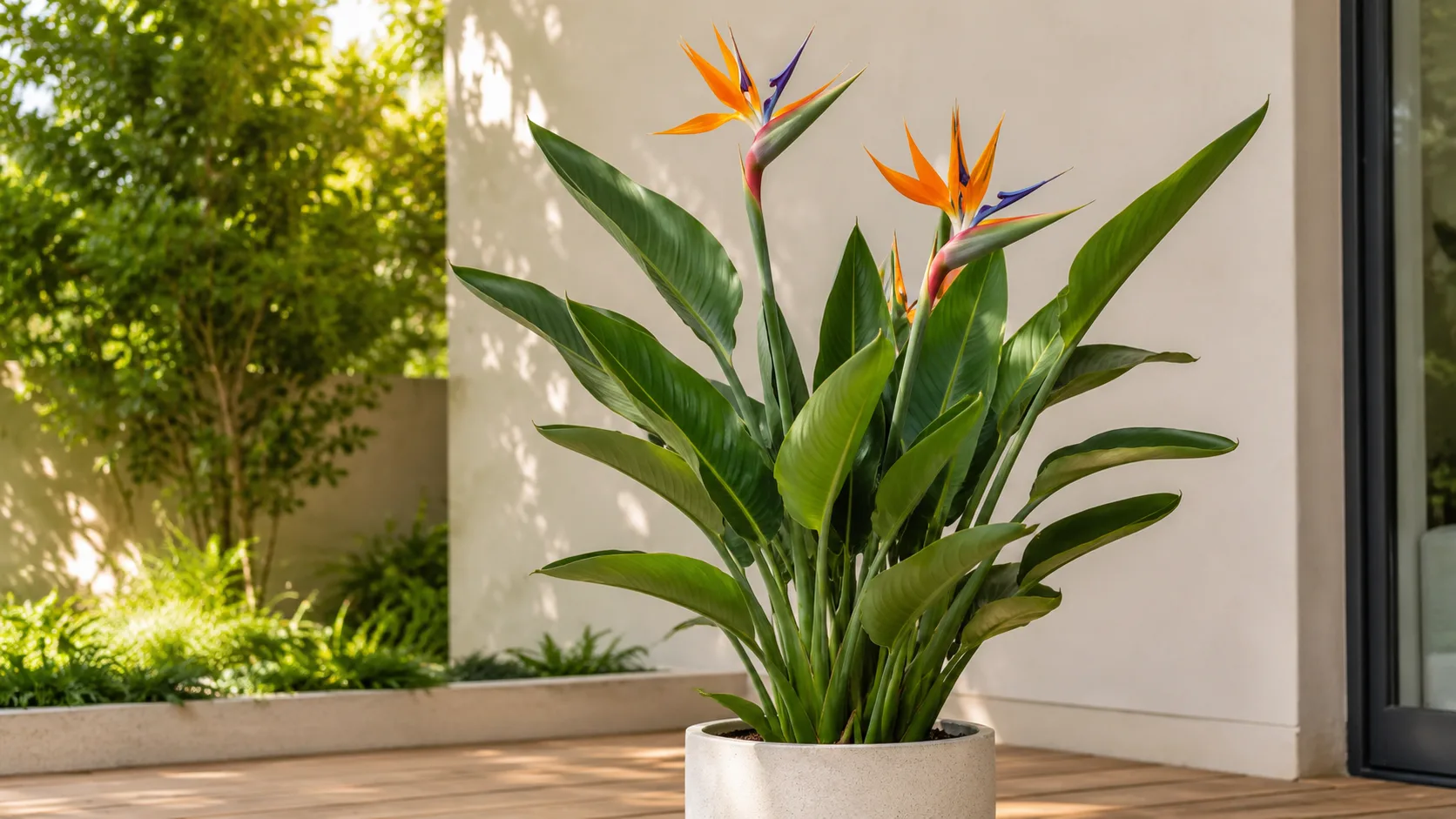
Bird of paradise is the common name for plants in the genus Strelitzia, a group of evergreen perennials in the family Strelitziaceae native to subtropical and coastal regions of southern Africa. The Royal Horticultural Society describes Strelitzia reginae as forming a clump of long-stalked, grey-green paddle leaves with orange-and-blue flowers emerging in succession from a beak-like spathe - the silhouette that gave the plant its bird-in-flight nickname. Indoors and in warm-climate gardens, it reads instantly as tropical architecture: upright stems, bold foliage, and flowers that look engineered rather than grown.
Two species dominate the houseplant trade. Strelitzia reginae, the orange bird of paradise or crane flower, stays manageable in most rooms and is the species most likely to bloom indoors under strong light. Strelitzia nicolai, the giant or white bird of paradise, is sold as a statement foliage plant with banana-like leaves that can overwhelm standard ceiling heights within a few years. Both share similar care fundamentals - bright light, warm temperatures, fast-draining soil, and a Bird of Paradise watering guide tied to how fast the pot dries - but they solve different design problems and come with very different bloom expectations.
Bird of paradise became a fixture in interior design because it delivers height and structure without the finicky humidity demands of many true rainforest plants. It tolerates brighter light than pothos or philodendron, grows visibly through the warm season, and photographs well. The trade-off is space and honesty about flowers: a well-grown plant is spectacular as foliage alone, but indoor blooms require maturity, exceptional light, and patience measured in years, not weeks.
For related Bird of Paradise care, see Spider Mites on Bird of Paradise, Mealybugs on Bird of Paradise.
Strelitzia reginae vs. Strelitzia nicolai: Which One Should You Grow?
Choosing the wrong species is the most expensive mistake in bird of paradise care, because the two plants look related in a nursery but diverge sharply in mature size and indoor flowering potential.
Strelitzia reginae typically reaches 3 to 5 feet indoors (roughly 1 to 1.5 meters), according to the RHS plant profile, with narrower grey-green leaves and the classic orange-and-blue crane-shaped inflorescence. It forms a clumping habit rather than a trunk, which makes it easier to fit beside a bright window or in a conservatory corner. This is the species to buy if you want a long-term indoor plant with any realistic chance of flowers.
Strelitzia nicolai is a different scale entirely. The University of Florida IFAS Extension describes it as a tree-like, multi-stemmed species that functions as a landscape plant in frost-free climates and can reach 6 to 9 meters outdoors. In a container indoors, it commonly hits 8 to 10 feet with individual leaves up to 5 feet long. The flowers are white and dark blue - dramatic in a botanical garden, but nicolai rarely blooms indoors because it needs years of strong light and space most homes cannot provide. In a standard-height room, the upper canopy eventually shades the lower leaves, which yellow and drop, while the plant presses against the ceiling.
A practical comparison:
- Indoor height: reginae 3–5 ft; nicolai 8–10 ft+
- Leaf character: reginae narrower, upright paddles; nicolai broad, glossy, banana-like
- Flower color: reginae orange and blue; nicolai white and blue
- Indoor bloom potential: reginae possible with maturity and light; nicolai very unlikely in most homes
- Best use: reginae for rooms and bloom ambition; nicolai for double-height spaces, atriums, or outdoor frost-free gardens
If you are shopping and the tag just says “bird of paradise,” ask for the botanical name. Retailers sometimes lump both species under the same common label, and the care advice that works for a 4-foot reginae will not prepare you for a nicolai that outgrows the room before its third birthday.
Indoors, both species grow more slowly and produce smaller leaves than they would in the ground, and blooms are harder to achieve than in frost-free gardens. Outdoors in USDA zones 10–12 or equivalent climates, growth accelerates and Strelitzia reginae can flower more reliably after 3 to 4 years in ground because light intensity and root space align with native conditions. In temperate regions, many growers move pots outdoors for summer after hardening off over 7 to 10 days, then bring plants back before night temperatures approach 12°C (54°F). Nicolai in warm landscapes functions as a multi-stemmed, tree-like specimen per UF/IFAS - valuable as outdoor architecture, overwhelming in a standard ceiling indoors.
Light Requirements: Bright, Direct, and Non-Negotiable for Blooms
Bird of paradise is not a low-light plant, and treating it like one is the fastest route to stretched stems, thin leaves, and permanent non-blooming. The RHS recommends positioning strelitzias beside a large sunny window or in a conservatory with full light and shade from the hottest midday sun. In practice that means a south- or west-facing window where the plant receives several hours of direct sun daily, especially during spring and summer.
For survival and steady foliage, Bird of Paradise light guide can work, but growth slows and flowering essentially stops. For blooming, the bar is higher: mature Strelitzia reginae typically needs 4 to 6 hours of direct sunlight on the leaves across multiple growing seasons, with total intensity well above what a plant five feet back from a window receives. Light that keeps the plant alive is not the same light that funds flower production - a distinction worth internalizing before you blame fertilizer for a bloomless plant.
Acclimation matters because leaves formed in lower light burn when suddenly exposed to harsh sun. Move the plant closer to the window over one to two weeks, adding an hour or two of direct exposure every few days, and watch for bleached patches or midday curling. If you only have moderate natural light, a full-spectrum grow light on a 12- to 14-hour timer is a more reliable long-term fix than hoping the plant adapts to a dim corner.
Two diagnostic signs tell you whether light is right. Too little: long petioles, smaller new leaves, slower opening, and a general lean toward the glass. Too much, too fast: chalky bleaching on sun-facing surfaces, crisp brown patches, or leaves that collapse after a sudden move outdoors without hardening off. New growth should look firm, properly sized for the species, and evenly colored - that is a better test than how bright the room feels to your eyes.
Watering Bird of Paradise Without Inviting root rot on Bird of Paradise
Bird of paradise prefers deep, thorough watering followed by a real dry-down, not a little water every day. The RHS advises keeping compost constantly moist but not saturated during spring and summer, then gradually reducing through autumn until, from late November onward, the mix is allowed to get fairly dry between waterings. North Carolina State Extension notes the plant is generally pest and disease free but lists root rot from overwatering on Bird of Paradise or poorly drained soils as a primary failure mode - the same pattern seen on most large-leaf tropicals grown in dense indoor mixes.
The home-grower trigger that works across seasons: water when the top 2 inches (5 cm) of mix feel dry to your finger or when a wooden skewer pulled from the center comes out mostly clean. In warm, bright summer conditions, that may mean watering every 7 to 10 days for a plant in an appropriately sized pot. In cooler, slower winter growth, stretch to 14 to 21 days or longer, especially if the plant sits away from heating vents and the pot stays heavy.
When you water, soak until excess runs freely from the drainage holes, then empty the saucer so the roots are not sitting in runoff. Bird of paradise tolerates brief drought better than chronic wet feet, which aligns with its ability to lose substantial moisture through large leaf surfaces in hot weather - the RHS specifically notes that plants may need daily watering in warm outdoor summer conditions, a reminder that the correct interval is always pot- and environment-specific.
Water quality affects leaf margins more than many guides admit. Fluoride and chlorine in municipal tap water, combined with salt buildup from fertilizer, can produce brown tips even when the watering rhythm is otherwise sound. If tips persist despite good drainage and humidity, flush the pot with several volumes of plain water monthly during the growing season, or switch to rainwater or filtered water at room temperature.
Soil and Potting Mix: Drainage Over Recipe Perfection
Bird of paradise wants a rich, fertile, fast-draining mix - not cactus grit, and not heavy peat that compacts into an anaerobic block around the roots. The RHS recommends a peat-free, loam-based compost with added grit for drainage when growing under glass, and the same principle applies to indoor containers: loam or quality potting soil amended with 20 to 30 percent perlite, pumice, or coarse bark to maintain air pockets.
A reliable home blend:
- 2 parts high-quality potting soil or loam-based compost
- 1 part perlite or pumice
- 1 part orchid bark or coarse horticultural grit
Target a slightly acid to neutral pH around 6.0 to 7.5. Exact pH chasing is rarely necessary in hobby cultivation; structure and drainage matter more. The pot must have multiple drainage holes, and decorative cachepots without drainage should be avoided unless you treat them as saucers and lift the grow pot out after every watering.
Because strelitzias produce thick, fleshy roots, compacted old mix is a common hidden problem. If water runs straight through the pot without soaking in, or the surface stays wet for days while lower roots may still be dry, the mix has likely broken down. Refresh the substrate at Bird of Paradise repotting guide rather than endlessly compensating with a skewed watering calendar.
Temperature and Humidity in Ordinary Homes
Strelitzias are tender tropicals that expect warmth year-round. The RHS states temperatures should never fall below 10–12°C (50–54°F) and recommends good ventilation once temperatures exceed 20°C (68°F). For active growth indoors, 65 to 85°F (18 to 29°C) is the comfortable band most homes already provide - until winter windowsills, AC vents, and seasonal outdoor moves introduce swings the plant reads as stress.
Cold drafts are more damaging than many growers assume. A pot on a winter window ledge can experience root-zone temperatures far below the room thermostat reading, triggering yellowing leaves and stalled growth even when the foliage looks fine for a week or two. Keep the plant at least a foot back from cold glass in winter, or insulate with a buffer of other plants and sheer curtain. In summer, avoid blasting dry air from AC directly across the canopy; it lowers effective humidity and invites spider mites.
Humidity in the 50 to 60 percent range suits bird of paradise well, and higher is welcome during active growth. Very dry winter air - common below 30 percent when heating runs - can accentuate brown leaf tips alongside watering and water-quality issues. A humidifier near the plant is the most dependable fix. Pebble trays and grouping with other tropicals help at the margins. The RHS suggests misting leaves regularly or standing the pot on damp gravel; misting alone is a supplement, not a substitute, in arid homes, and wet foliage overnight can encourage fungal spotting in poorly ventilated rooms.
If you move the plant outdoors for summer, harden it off gradually over 7 to 10 days, increasing sun and wind exposure in steps. Strong wind can shred leaves - which relates to the plant’s natural splitting habit - and gusts can topple top-heavy pots. Bring it back indoors before night temperatures approach 12°C (54°F).
Fertilizing for Strong Foliage and Eventual Flowers
Bird of paradise is a heavy feeder during active growth, not a set-and-forget foliage plant. The RHS recommends applying a balanced liquid houseplant feed fortnightly through spring and summer. Under glass, the RHS plant profile also notes monthly balanced liquid fertilizer during growth, with top-dressing annually - a useful reminder that container plants exhaust nutrients faster than garden specimens.
For indoor growers, a practical schedule is a balanced water-soluble fertilizer (such as 10-10-10 or 20-20-20) at one-quarter to one-half label strength every two weeks from April through September, applied to already-moist soil so roots are not burned by concentrated salts. Pause entirely from October through March unless the plant sits in a very bright, warm room with visible new leaf production - feeding a plant that is not using nutrients adds salt without benefit.
Phosphorus-forward “bloom booster” products are optional and only meaningful once the plant is mature, well-lit, and slightly root-bound. Fertilizer cannot substitute for insufficient light or immaturity. If leaf edges crisp despite reasonable humidity, suspect salt buildup first: flush the pot with plain water before increasing feed strength.
Repotting: When to Upsize and When Restraint Helps Blooming
Repot bird of paradise every 2 to 3 years in spring, or when roots circle the pot surface, emerge from drainage holes, or water runs through without absorbing. The RHS advises repotting every second year under glass and notes that plants generally flower better when slightly pot-bound - a critical detail for growers chasing blooms.
Choose a new container only one size larger (1 to 2 inches wider in diameter). Oversized pots hold excess moisture relative to the root mass and are a leading cause of post-repotting rot. Use fresh, well-draining mix, maintain the same planting depth, water lightly for the first week, and withhold fertilizer for 4 to 6 weeks while roots heal.
If you have a mature Strelitzia reginae in strong light and are within a year or two of plausible bloom age, avoid repotting unnecessarily. A plant that just moved into a spacious new pot often redirects energy into roots and leaves for a full season rather than flowers. Bloom-focused growers sometimes keep a healthy plant in the same pot until roots are clearly crowded, refreshing only the top inch or two of mix instead of upsizing.
Propagation by Division and Seed
The most reliable home propagation method is division in spring. The RHS lists propagation by division of rooted suckers in spring as the standard approach for strelitzias. Mature clumps produce offsets at the base; these can be separated when they have their own roots and at least one healthy leaf.
To divide: water the parent 24 hours ahead, slide it from the pot, and identify natural separation points between offsets. Use a clean, sharp knife if roots are tightly fused, ensuring each division retains roots and foliage. Pot divisions into snug containers with fresh mix, water lightly, and keep them in bright indirect light until new growth confirms establishment - usually several weeks to a few months depending on division size.
Seed propagation is possible but slow. The RHS notes seeds can be sown March to April but require soaking to penetrate a very thick seed coat before germination. Seed-grown plants may take 3 to 6 years or longer to reach blooming size, which is why most houseplant owners prefer division or buying a partially mature specimen.
Do not propagate stressed, pest-infested, or recently repotted plants. Weak divisions fail at much higher rates, and problems in the parent transfer to the offspring.
Why Bird of Paradise Leaves Split (And When to Worry)
Splitting along leaf veins is normal for bird of paradise, not a humidity defect or pest symptom. In habitat, the perforations and splits allow wind to pass through large paddle leaves instead of snapping petioles or uprooting the plant. Both reginae and nicolai develop these splits as leaves mature, especially when air movement is regular - from fans, open windows, or outdoor exposure.
New leaves that tear along one side while unfurling may indicate physical damage or low humidity during emergence, but symmetric splits on established leaves are cosmetic. Do not increase watering or misting to “fix” splitting; instead, ensure the plant is not repeatedly whipped by a closing door or HVAC blast that causes mechanical tearing, which looks different - ragged, one-sided, or localized - from orderly vein splits.
If splits appear suddenly alongside yellowing, spotting, or sticky residue, look to pests or fungal issues rather than the plant’s natural architecture.
Realistic Bloom Expectations for Indoor Growers
Indoor bird of paradise blooms are possible but overpromised in marketing copy. The RHS states plants may take a few years to bloom and will do so only with adequate light and feed, generally performing better when slightly pot-bound. From a typical nursery-sized Strelitzia reginae, expect roughly 4 to 7 years to reach blooming maturity, sometimes longer under moderate light.
Several conditions must align simultaneously:
- Species: Strelitzia reginae, not nicolai
- Maturity: age and root establishment, not a fresh 6-inch pot seedling
- Light: multiple hours of direct sun daily over consecutive seasons
- Root status: slightly crowded, not freshly repotted into a large pot
- Nutrition: regular balanced feeding during growth
- Optional bud-set cue: some growers report improved flowering after a cool winter rest with nights around 50–55°F (10–13°C) for several weeks, mimicking subtropical winter - but never expose the plant to frost
The bloom window for reginae is typically late winter to early spring when conditions have been favorable. If your plant meets light and maturity thresholds and still does not bloom, it may simply need more time - a well-grown bird of paradise is worth keeping for foliage alone.
Common Problems: Yellow Leaves, Brown Tips, and Curling
Most bird of paradise problems map to a short list of environmental causes. Diagnosis starts with moisture in the pot, then light, then pests - not the other way around.
Yellow Leaves
Yellow leaves can mean overwatering, underwatering on Bird of Paradise, natural senescence of older lower leaves, cold stress, low light, or nutrient deficiency. Check the root zone first: if the mix is wet and the pot feels heavy while lower leaves yellow, suspect rot or chronic saturation. If the mix is dust-dry and leaves yellow from the edges inward with crispness, underwatering or extreme dry air is more likely.
A few yellow bottom leaves on an otherwise healthy clump are often normal aging as the plant drops older foliage to support new growth at the center. Remove them cleanly at the base for appearance and airflow. Widespread yellowing after a move indoors from outdoors often reflects light reduction and watering lag - adjust both rather than feeding.
Brown Tips and Crispy Edges
Brown tips usually trace to low humidity, inconsistent watering, fluoride or salt buildup, or underwatering during rapid growth. They rarely indicate disease on their own. Flush salts, stabilize the watering trigger, raise humidity if the air is dry, and accept that damaged tip tissue will not green up - watch new leaves for improvement.
Direct sun scorch produces pale or tan patches on sun-facing areas, distinct from uniform tip browning. Move the plant slightly back or filter midday sun if scorch appears after acclimation.
Root Rot and Persistent Wilting
Wilting with damp soil is the signature of root failure, often misread as thirst. If you water and the plant still looks limp within a day, slide it out and inspect roots: healthy strelitzia roots are firm and pale; rotted roots are black, mushy, or foul-smelling. Trim damaged tissue with sterilized scissors, repot into fresh, coarse mix, water lightly, and withhold fertilizer for several weeks. Prevention beats rescue: fast drainage, dry-down between waterings, and warm roots.
Pests: Scale, Mealybugs, and Spider Mites
Bird of paradise is usually robust, but the RHS lists possible pests including scale insects, glasshouse red spider mite, and mealybugs. NC State Extension similarly notes monitoring for mealybugs, scale, and spider mites. Large leaves provide plenty of hiding surface area, so inspect leaf undersides, petiole bases, and stem joints weekly.
Scale appears as immobile brown or tan bumps; wipe with alcohol-dipped cotton swabs and follow with horticultural oil or insecticidal soap. Mealybugs form white cottony clusters in axils; treat the same way and repeat weekly until clear. Spider mites cause fine stippling and webbing, especially in dry air - raise humidity, rinse foliage, and apply soap or neem on a 5- to 7-day cycle for at least three weeks.
Quarantine affected plants before treatment. Bird of paradise recovers well from early infestations but struggles if pests compound existing root or light stress.
Toxicity to Pets and the Caesalpinia Confusion
The ASPCA lists Strelitzia reginae (bird of paradise flower, crane flower, bird’s tongue flower) as toxic to dogs, toxic to cats, and toxic to horses, with toxic principles classified as GI irritants. Clinical signs include mild nausea, vomiting, and drowsiness, caused mainly by fruit and seeds rather than casual leaf contact. The ASPCA explicitly warns Bird of Paradise overview should not be confused with Caesalpinia or Poinciana gilliesii, also sold as bird of paradise, which is more toxic.
NC State Extension rates poison severity as low, with similar GI symptoms. That does not mean pets should chew the plant freely - ingestion warrants a call to your veterinarian or the ASPCA Animal Poison Control Center at (888) 426-4435 (a consultation fee may apply). Position pots out of reach of curious cats and dogs, especially if the plant flowers and develops seed pods indoors.
For humans, handling pruning debris and washing hands after repotting is sensible practice. The primary risk scenario is pet ingestion of seeds or fruit, not touching intact foliage.
Seasonal Care Calendar
| Season | Light | Watering | Humidity | Fertilizing | Temperature |
|---|---|---|---|---|---|
| Spring | Increase direct sun; harden off if moving outdoors | Resume top-2-in dry trigger; water more as growth accelerates | Aim for 50–60%+ | Start fortnightly balanced feed at ¼–½ strength | 65–85°F; repot/divide if needed |
| Summer | Peak light; protect from scorch only if newly acclimated | Most frequent; may need weekly in bright heat | Maintain 50–60%; humidifier if AC dries air | Continue feeding schedule | 70–85°F; ventilate above 68°F |
| Fall | Maintain brightness; bring indoors before chill | Gradually reduce frequency | Monitor dry heating air | Taper feed by late fall | Do not allow below 50–54°F |
| Winter | Maximize window light; supplement with grow light | Allow longer dry-down; avoid wet cold mix | 40–50% minimum; higher if heating dries air | Pause feed unless actively growing in warm bright room | Keep away from cold glass; optional cool rest for bloom induction |
Spring is the window for repotting, division, and major placement changes. Summer is peak growth - match watering to faster drying and consider outdoor time in frost-free periods. Fall demands a plan to move plants back indoors before damaging nights. Winter slows metabolism; reduce water, stop feeding, and protect from drafts. Growers experimenting with bloom induction may provide a short cool period without frost, then return to normal warmth as days lengthen.
Conclusion
Bird of paradise care becomes straightforward once you match the plant to the right species and light budget. Strelitzia reginae fits most indoor rooms and offers a realistic, if patient, path to flowers. Strelitzia nicolai belongs in large spaces or frost-free landscapes where its size is an asset, not a ceiling problem. Both need bright light, warm stable temperatures above 50–54°F, fast-draining fertile soil, and deep watering when the top of the mix dries - never a passive weekly schedule disconnected from the pot’s weight and the season.
Treat leaf splitting as normal architecture, not a crisis. Treat yellow leaves as a moisture-and-light signal before reaching for fertilizer. Treat blooms as a reward for maturity, direct sun, and restraint with repotting, not a default first-year outcome. Outdoors in warm climates, the same plant becomes faster, larger, and more floriferous; indoors, spectacular foliage is the honest baseline.
If you are starting fresh, buy the species that fits your room height, place it in the brightest spot you can sustain, use a chunky mix in a pot with drainage, and check the soil before every watering. Get those decisions right and bird of paradise becomes one of the most architectural, satisfying tropical plants you can grow - with or without a crane-shaped flower on the stalk.
When to use this page vs other Bird of Paradise guides
- Bird of Paradise overview - Canonical hub for this species - care topics and problems branch from here.
- Bird of Paradise problems - Symptom-first path when you already know something is wrong.
Related Bird of Paradise guides
- Bird of Paradise watering
- Bird of Paradise light
- Bird of Paradise soil
- Bird of Paradise propagation
- Bird of Paradise fertilizer
- Bird of Paradise repotting
- Bird of Paradise pruning
- Root Rot on Bird of Paradise
- No Flowers on Bird of Paradise
- Yellow Leaves on Bird of Paradise
- Brown Tips on Bird of Paradise
- Overwatering on Bird of Paradise
How to care for Bird of Paradise?
How much light does Bird of Paradise need?
bright indirect to direct sunlight, several hours of direct sun
- bright indirect to direct sunlight, several hours of direct sun - bright indirect to direct sunlight, several hours of direct sun.
When should you water Bird of Paradise?
Every 7–10 days summer (top 5 cm dry). Every 14–21 days winter. Well-draining soil. Tolerates drought better than overwatering.
- Check top 2 inches - Every 7–10 days summer (top 5 cm dry).
- Drain excess water - Well-draining soil.
What soil works best for Bird of Paradise?
Well-draining potting mix with 20–30% perlite. pH 6.0–7.5. Fertile and rich.
- Well-draining mix - Well-draining potting mix with 20–30% perlite.
Grower notes for Bird of Paradise
What matters most with Bird of Paradise
Bird of Paradise is easiest to grow when you judge the whole plant: new growth, root-zone moisture, light exposure, and how quickly the pot dries after watering. In practice, the care checkpoint is simple: bright indirect to direct sunlight, several hours of direct sun. Pair that with well-draining potting mix with 20–30% perlite; pH 6.0–7.5. Fertile and rich, and avoid changing water, pot size, and placement all at once.
Best placement in a real home
Bird of Paradise belongs where bright indirect to direct sunlight, several hours of direct sun is realistic for most of the day, not only where the pot looks good. Every 7–10 days summer (top 5 cm dry). Every 14–21 days winter. Well-draining soil. Tolerates drought better than overwatering. If the pot stays wet longer than expected, move the plant into better light or reassess the mix before watering again. Humidity target: 50–60%. Temperature comfort zone: 18–27°C (65–80°F).
Before you buy this plant
Choose Bird of Paradise with firm new growth, clean leaf undersides, and soil that does not smell sour or feel compacted. Be cautious if you see root-rot, sticky residue, collapsed crowns, or a pot that is wet in poor light. Cosmetic old-leaf damage is less worrying than weak roots or active pests.
First month after bringing it home
Do not repot Bird of Paradise on day one unless the mix is failing or pests are obvious. Quarantine it, learn how fast the pot dries, and keep care boring while it adjusts. Watch especially for root-rot and no-flowers. If problems appear, correct the condition first rather than stacking fertilizer, repotting, and pruning together.
Safety note for Bird of Paradise
Bird of Paradise is not a plant to keep within reach of pets or children. Treat it as an inaccessible display plant. Use gloves if sap or plant tissue is irritating, and pick a pet-safe alternative for floor pots or low shelves.
How to tell Bird of Paradise is settling in
If you plan to multiply it later, common methods include Division and Seeds. If no-flowers shows up early, inspect light, watering, and roots before assuming the plant is permanently weak.
Is it pet safe?
Bird of Paradise is toxic to cats and dogs.
ASPCA lists Bird of Paradise as mildly toxic to cats and dogs. Ingestion causes mild nausea, vomiting, and drowsiness.
Watering Bird of Paradise
Every 7–10 days summer (top 5 cm dry). Every 14–21 days winter. Well-draining soil. Tolerates drought better than overwatering.
Soil & potting for Bird of Paradise
Well-draining potting mix with 20–30% perlite. pH 6.0–7.5. Fertile and rich.
Humidity & temperature for Bird of Paradise
Bird of Paradise prefers 50–60%, though normal home humidity is usually fine. Keep temperatures around 18–27°C (65–80°F).
| Detail | Information |
|---|---|
| Humidity | 50–60% - normal home humidity is fine. |
| Ideal temperature | 18–27°C (65–80°F) |
Fertilizer & pruning for Bird of Paradise
Use feed lightly during active growth. Balanced or high-phosphorus liquid fertilizer for flowering and stop if the plant is stressed, newly repotted, or not actively growing. for Bird of Paradise.
| Detail | Information |
|---|---|
| Fertilizer type | Feed lightly during active growth. Balanced or high-phosphorus liquid fertilizer for flowering and stop if the plant is stressed, newly repotted, or not actively growing. |
Common problems on Bird of Paradise
Root Rot
MediumLikely cause: Overwatering or waterlogged dense soil - bird of paradise prefers to dry significantly between waterings.
Quick fix: Allow the top 5 cm to dry before watering. Use well-draining mix. Reduce frequency significantly in winter.
Full fix guide →No Flowers
MediumLikely cause: Insufficient light or a pot too large for the root system - bird of paradise flowers best when slightly root-bound.
Quick fix: Move to the brightest available indoor position. Ensure the pot is not much larger than the root ball.
Full fix guide →Yellow Leaves
MediumLikely cause: Common on this plant type; confirm with recent watering, light, and root checks.
Quick fix: Inspect the plant and correct the most likely care stressor before stacking treatments.
Full fix guide →Brown Tips
MediumLikely cause: Common on this plant type; confirm with recent watering, light, and root checks.
Quick fix: Inspect the plant and correct the most likely care stressor before stacking treatments.
Full fix guide →Overwatering
MediumLikely cause: Common on this plant type; confirm with recent watering, light, and root checks.
Quick fix: Inspect the plant and correct the most likely care stressor before stacking treatments.
Full fix guide →Underwatering
MediumLikely cause: Common on this plant type; confirm with recent watering, light, and root checks.
Quick fix: Inspect the plant and correct the most likely care stressor before stacking treatments.
Full fix guide →Spider Mites
MediumLikely cause: Common on this plant type; confirm with recent watering, light, and root checks.
Quick fix: Inspect the plant and correct the most likely care stressor before stacking treatments.
Full fix guide →Mealybugs
MediumLikely cause: Common on this plant type; confirm with recent watering, light, and root checks.
Quick fix: Inspect the plant and correct the most likely care stressor before stacking treatments.
Full fix guide →Aphids
MediumLikely cause: Common on this plant type; confirm with recent watering, light, and root checks.
Quick fix: Inspect the plant and correct the most likely care stressor before stacking treatments.
Full fix guide →Leggy Growth
MediumLikely cause: Common on this plant type; confirm with recent watering, light, and root checks.
Quick fix: Inspect the plant and correct the most likely care stressor before stacking treatments.
Full fix guide →Slow Growth
MediumLikely cause: Common on this plant type; confirm with recent watering, light, and root checks.
Quick fix: Inspect the plant and correct the most likely care stressor before stacking treatments.
Full fix guide →Wilting
MediumLikely cause: Common on this plant type; confirm with recent watering, light, and root checks.
Quick fix: Inspect the plant and correct the most likely care stressor before stacking treatments.
Full fix guide →Drooping Leaves
MediumLikely cause: Common on this plant type; confirm with recent watering, light, and root checks.
Quick fix: Inspect the plant and correct the most likely care stressor before stacking treatments.
Full fix guide →Low Humidity
MediumLikely cause: Common on this plant type; confirm with recent watering, light, and root checks.
Quick fix: Inspect the plant and correct the most likely care stressor before stacking treatments.
Full fix guide →Not Enough Light
MediumLikely cause: Common on this plant type; confirm with recent watering, light, and root checks.
Quick fix: Inspect the plant and correct the most likely care stressor before stacking treatments.
Full fix guide →Fungus Gnats
MediumLikely cause: Common on this plant type; confirm with recent watering, light, and root checks.
Quick fix: Inspect the plant and correct the most likely care stressor before stacking treatments.
Full fix guide →Mold on Soil
MediumLikely cause: Common on this plant type; confirm with recent watering, light, and root checks.
Quick fix: Inspect the plant and correct the most likely care stressor before stacking treatments.
Full fix guide →Bud Drop
MediumLikely cause: Common on this plant type; confirm with recent watering, light, and root checks.
Quick fix: Inspect the plant and correct the most likely care stressor before stacking treatments.
Full fix guide →Small Flowers
MediumLikely cause: Common on this plant type; confirm with recent watering, light, and root checks.
Quick fix: Inspect the plant and correct the most likely care stressor before stacking treatments.
Full fix guide →Faded Flowers
MediumLikely cause: Common on this plant type; confirm with recent watering, light, and root checks.
Quick fix: Inspect the plant and correct the most likely care stressor before stacking treatments.
Full fix guide →Curling Leaves
MediumLikely cause: Common curling leaves pattern on Bird of Paradise under indoor care stress.
Quick fix: Inspect roots, watering, light, and pests; adjust one variable and monitor new growth.
Full fix guide →Brown Leaves
MediumLikely cause: Common brown leaves pattern on Bird of Paradise under indoor care stress.
Quick fix: Inspect roots, watering, light, and pests; adjust one variable and monitor new growth.
Full fix guide →Black Spots
MediumLikely cause: Common black spots pattern on Bird of Paradise under indoor care stress.
Quick fix: Inspect roots, watering, light, and pests; adjust one variable and monitor new growth.
Full fix guide →Holes in Leaves
MediumLikely cause: Common holes in leaves pattern on Bird of Paradise under indoor care stress.
Quick fix: Inspect roots, watering, light, and pests; adjust one variable and monitor new growth.
Full fix guide →Pale Leaves
MediumLikely cause: Common pale leaves pattern on Bird of Paradise under indoor care stress.
Quick fix: Inspect roots, watering, light, and pests; adjust one variable and monitor new growth.
Full fix guide →Distorted Leaves
MediumLikely cause: Common distorted leaves pattern on Bird of Paradise under indoor care stress.
Quick fix: Inspect roots, watering, light, and pests; adjust one variable and monitor new growth.
Full fix guide →Scale Insects
MediumLikely cause: Common scale insects pattern on Bird of Paradise under indoor care stress.
Quick fix: Inspect roots, watering, light, and pests; adjust one variable and monitor new growth.
Full fix guide →Thrips
MediumLikely cause: Common thrips pattern on Bird of Paradise under indoor care stress.
Quick fix: Inspect roots, watering, light, and pests; adjust one variable and monitor new growth.
Full fix guide →Whiteflies
MediumLikely cause: Common whiteflies pattern on Bird of Paradise under indoor care stress.
Quick fix: Inspect roots, watering, light, and pests; adjust one variable and monitor new growth.
Full fix guide →Leaf Miners
MediumLikely cause: Common leaf miners pattern on Bird of Paradise under indoor care stress.
Quick fix: Inspect roots, watering, light, and pests; adjust one variable and monitor new growth.
Full fix guide →Caterpillars
MediumLikely cause: Common caterpillars pattern on Bird of Paradise under indoor care stress.
Quick fix: Inspect roots, watering, light, and pests; adjust one variable and monitor new growth.
Full fix guide →Nitrogen Deficiency
MediumLikely cause: Common nitrogen deficiency pattern on Bird of Paradise under indoor care stress.
Quick fix: Inspect roots, watering, light, and pests; adjust one variable and monitor new growth.
Full fix guide →Iron Deficiency
MediumLikely cause: Common iron deficiency pattern on Bird of Paradise under indoor care stress.
Quick fix: Inspect roots, watering, light, and pests; adjust one variable and monitor new growth.
Full fix guide →Magnesium Deficiency
MediumLikely cause: Common magnesium deficiency pattern on Bird of Paradise under indoor care stress.
Quick fix: Inspect roots, watering, light, and pests; adjust one variable and monitor new growth.
Full fix guide →Potassium Deficiency
MediumLikely cause: Common potassium deficiency pattern on Bird of Paradise under indoor care stress.
Quick fix: Inspect roots, watering, light, and pests; adjust one variable and monitor new growth.
Full fix guide →Calcium Deficiency
MediumLikely cause: Common calcium deficiency pattern on Bird of Paradise under indoor care stress.
Quick fix: Inspect roots, watering, light, and pests; adjust one variable and monitor new growth.
Full fix guide →