Brown Tips on Bird of Paradise: Causes, Checks & Fixes
Quick answer
Brown tips on Bird of Paradise (Strelitzia reginae and S. nicolai) usually trace to tap-water fluoride and mineral buildup, dry winter air, underwatering, or fertilizer salts - not disease. First step: check soil moisture at 5 cm depth and scan the soil rim for white crust before changing water source or humidity.
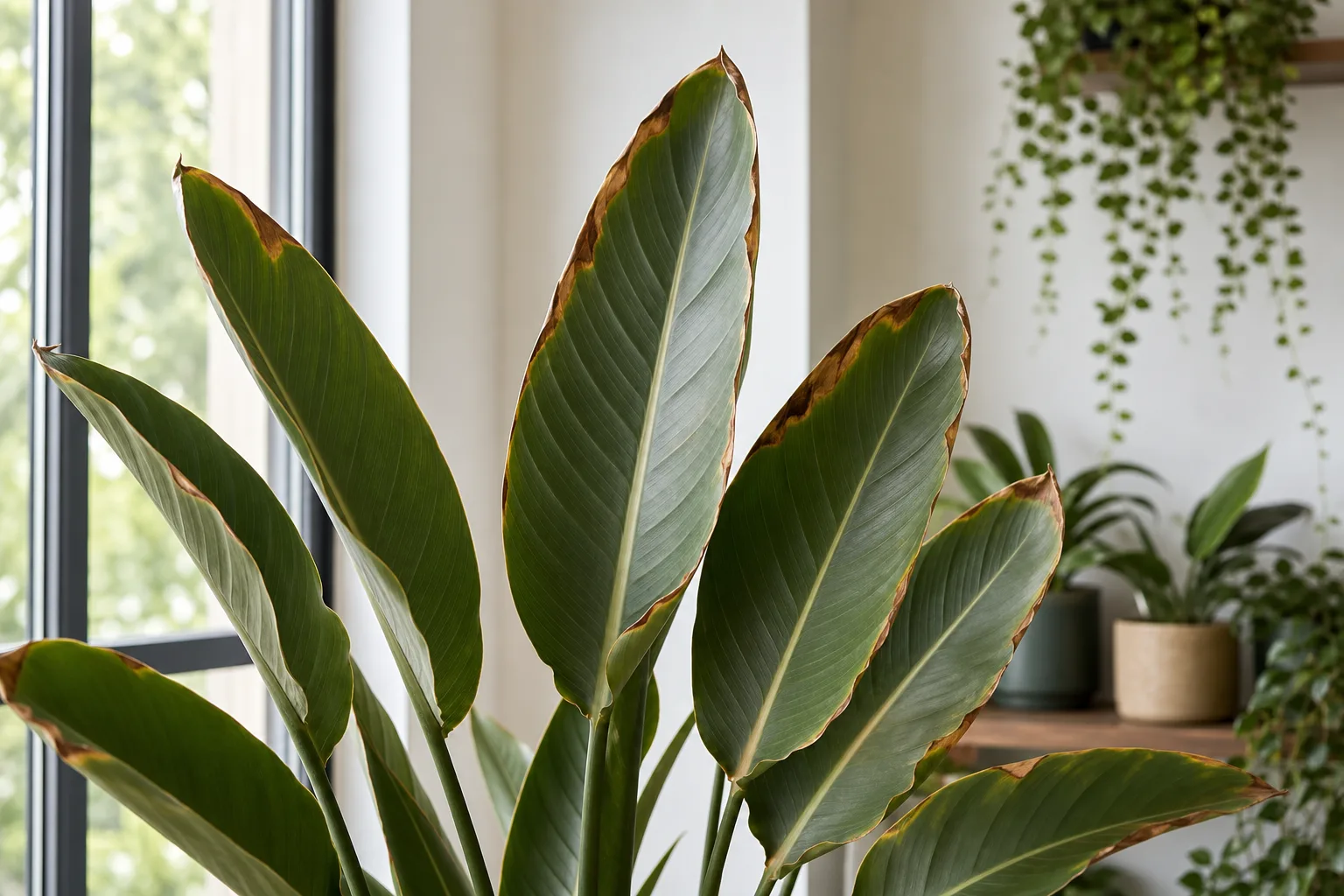
Brown Tips on Bird of Paradise: Causes, Checks & Fixes
This guide covers brown tips on Bird of Paradise. See also the general Brown Tips guide, watering, and light pages for this plant.
Brown Tips on Bird of Paradise: Causes, Checks & Fixes
Quick answer
Brown tips on Bird of Paradise - Strelitzia reginae and Strelitzia nicolai - are almost always environmental stress, not a fungal disease. Large paddle leaves lose moisture and accumulate minerals at the farthest point from the roots first, so tips and margins brown before the midrib zone collapses.
First step: insert your finger 5 cm into the mix near the pot edge and look for a white mineral crust on the soil surface. Dry mix throughout plus a light pot points to underwatering. Moist soil with sharp brown lines on many paddles and crust on the rim points to tap-water minerals or fertilizer salts. Moist soil with papery margins in a heated winter room points to low humidity.
Fix one confirmed cause before stacking filtered water, humidifier, and repot on the same week. Existing brown tissue will not turn green - judge recovery by the next unfurling paddle.
What brown tips look like on Bird of Paradise (and what is normal splitting)
On Strelitzia, tip burn shows as dry, tan-to-brown necrosis at the leaf apex or along the outer margin. Tissue feels papery or crispy, not soft or wet. Damage is usually symmetrical on the affected zone - a dead triangle at the tip or a crisp line following the margin - while the midrib area stays gray-green and firm.
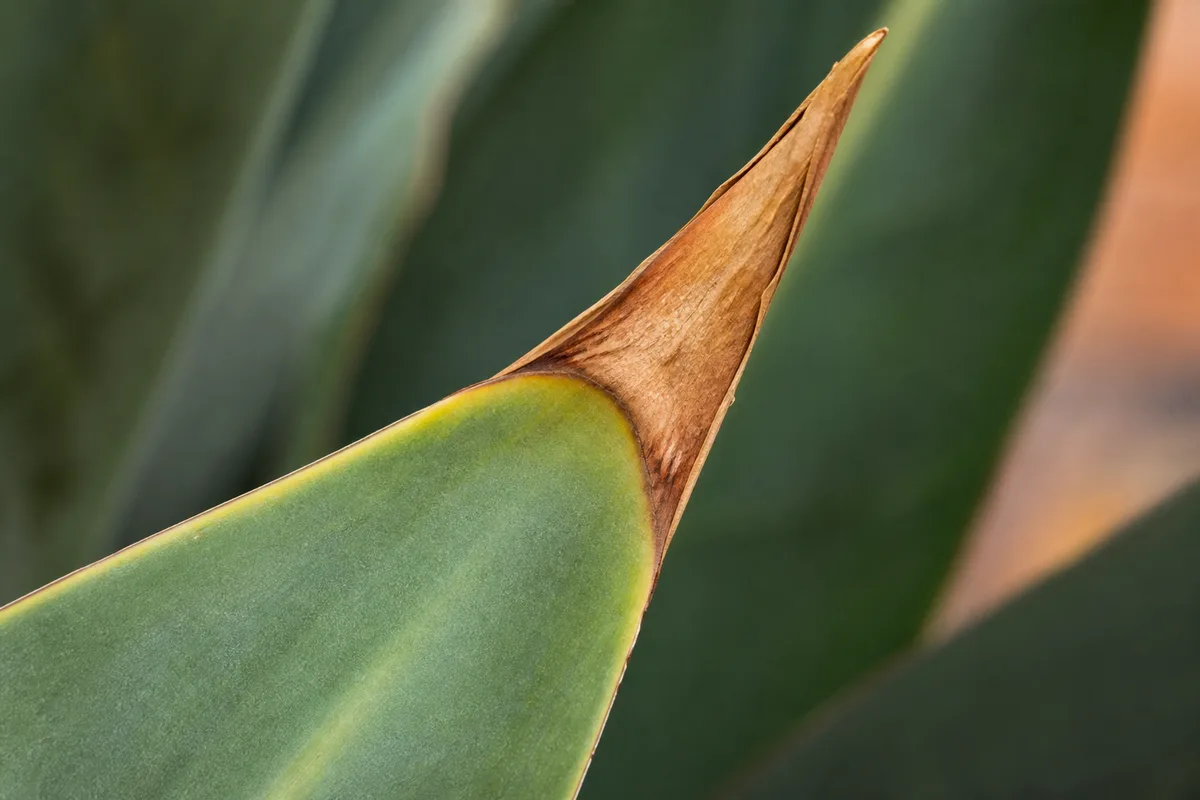
Brown Tips symptoms on Bird of Paradise - compare with healthy tissue on the same plant.
Early tip-burn patterns
- Sharp brown lines at the very tip, sometimes advancing slowly inward over weeks
- Uniform edge crisping on several paddles at once, often worst on the largest or oldest leaves
- Brown tips paired with inward margin curl when the pot is genuinely dry and light
- One-sided tan patches on the leaf half facing a heat vent, radiator, or hot afternoon window glass
- White or chalky crust on the soil surface or pot rim while margins stay sharp and dry
Established damage
- Tips brown on most fans in the clump, with newer spears emerging already edged in tan
- Margins stay crisp even after careful watering - a sign water quality or salts may dominate
- Bleached silvery patches mixed with brown on the window-facing side after a sudden move to harsh sun
Normal splitting - not brown tips
Mature bird of paradise leaves naturally split along veins as paddles widen. The RHS notes shredded leaves when Strelitzia is exposed to wind outdoors - indoors, clean vein splits on established paddles are structural, not tip burn. Those splits are usually green-edged, symmetrical, and stable. Brown-tip failure adds dry necrosis at the apex or margin, often on newest unfurling growth or across many leaves after a care shift - not clean splits on mature leaves alone.
Why Bird of Paradise gets brown tips
Strelitzia carries large leathery paddles on long petioles that transpire heavily in the bright direct light the plant prefers. Tips sit at the end of the water pathway; any stress that limits root uptake, desiccates air, or concentrates salts in tissue shows there first.
Tap-water fluoride and mineral buildup
Municipal water may contain fluoride and other additives that negatively affect sensitive houseplants, including plants prone to edge burn. Fluoride does not dissipate when water sits overnight the way chlorine can. With each watering, minerals travel with transpiration and concentrate at leaf margins as water evaporates from the blade surface.
Bird of paradise is not as famously fluoride-sensitive as dracaena or spider plant, and many growers use tap water successfully for years - our watering guide notes routine tap is often fine when rhythm and drainage are correct. When tips keep browning despite correct dry-down timing, white crust on the soil rim, and otherwise firm rhizomes, water quality deserves investigation.
Low humidity in heated indoor air
Strelitzia prefers a humid atmosphere indoors, yet winter heating drops whole rooms toward 20–30% relative humidity. Large paddles lose water faster than roots replace it when air is that dry - especially beside sunny winter glass. See our dedicated low-humidity guide when margins crisp while soil stays cool-damp.
Underwatering and moisture stress
Thick rhizomes store water, so Strelitzia tolerates short dry spells better than constant soggy soil - but repeated drought still crisp tips. Inward curl, a light pot, and dry mix at 5 cm depth fit underwatering better than mineral burn. NC State Extension recommends watering freely in active growth while keeping Strelitzia drier in winter - missing the winter slow-down or skipping depth checks still produces edge dieback on fast-transpiring leaves.
Fertilizer and salt accumulation
Fertilizers are salts; half-strength feeding helps avoid excess buildup that shows at leaf tips. Heavy feeding on a plant already stressed by dry air or irregular watering accelerates salt crust on the soil surface and sharp margin burn. Do not fertilize to green up browned tips.
Heat vents, drafts, and direct-sun scorch
Hot forced air and radiator ledges desiccate margins on one side of the paddle. Clemson HGIC warns that tropical houseplants near vents suffer when heaters run. Sudden moves into harsh midday sun without acclimation can add bleached or tan patches on the window-facing side - overlapping with but distinct from slow fluoride lines. Our light guide covers acclimation and scorch recovery.
Diagnostic table: humidity vs. fluoride vs. underwatering vs. salts vs. sun vs. drafts
| What you observe | Soil / pot check | Other signs | Likely cause | First direction |
|---|---|---|---|---|
| Crisp tips on many paddles; moist soil; RH below 40% at canopy | Cool-damp at 5 cm; moderate pot weight | Ragged unfurling in heated winter room | Low humidity | Humidifier toward 50–60% RH |
| Slow inward creep of sharp brown lines; white crust on soil rim | Moist; moderate weight | No dramatic wilt; damage uniform across fans | Tap-water minerals / fluoride | Filtered or rain water + flush |
| Crispy tips + inward curl; pot very light | Dry throughout at 5 cm | Leaves soften after deep soak | Underwatering | Deep water + reset check rhythm |
| Brown tips after heavy feeding; crust on surface | Often moist | Recent fertilizer spike | Salt buildup | Flush salts; pause feed |
| Tan patch on one side only | Variable | Near vent, radiator, or hot glass | Heat draft / localized scorch | Relocate off vent |
| Bleached patch + brown edge after sudden sunny move | Variable | Window-facing side only | Sun scorch | Filter light; acclimate |
| Clean green-edged splits on mature leaves only | Normal | Stable conditions | Normal Strelitzia splitting | No tip-burn fix needed |
How to confirm the cause
Work through these checks in order - stop when one pattern clearly fits:
- Soil moisture at 5 cm depth and pot weight - Bone dry throughout and a light pot confirm drought stress. Cool-damp mix with crisp margins shifts suspicion to humidity or water quality, not thirst.
- Soil rim and drainage holes - White or chalky crust strongly supports salt or mineral accumulation. No crust does not rule it out, but crust plus sharp lines is a strong pair.
- Hygrometer at canopy height - Sustained readings below ~40% RH near leaves support dry-air crisping when mix is not dry throughout. Above 50% with ongoing sharp lines, prioritize water source and salts.
- Watering and feed history - Recent heavy fertilizer, softened water, or months of hard tap without flushing fits salt and mineral burn. Winter watering on a summer calendar fits drought crisping.
- Placement audit - Note HVAC vents, radiators, fireplaces, and hot afternoon glass. One-sided damage implicates localized heat or scorch.
- Newest spear - A firm rolled leaf browning at the tip in moist soil often stacks humidity and mineral stress. Soft mushy crown tissue means rot - not this page.
- Split vs. burn - Green-edged vein splits on mature paddles alone are normal. Dry tan necrosis at tips or margins on multiple fans is the problem this guide addresses.
If soil cycles correctly per the watering guide, RH stays adequate, water is filtered, and the next leaf unfurls clean, the acute tip-burn phase has passed - maintain prevention habits below.
First fix for Bird of Paradise (by confirmed cause)
Apply one primary fix based on what you confirmed - not all fixes at once.
If soil is dry throughout and the pot is light
Give one thorough soak until excess runs from drainage holes, drain fully, then reset checks at 5 cm depth. Match the seasonal rhythm in our watering guide - roughly every 7–10 days in active growth and every 14–21 days or longer in slow months, always confirming with finger and weight rather than a fixed calendar.
If white crust, sharp lines, and moist soil dominate
Switch to filtered or rainwater for the next four to six weeks and flush the pot once during active growth - slow water through the mix until runoff runs clear for several minutes, empty the saucer, and hold fertilizer until new growth looks stable. UMN Extension recommends filtered or saved rainwater for sensitive plants when municipal additives cause tip damage.
If RH below ~40% at canopy with cool-damp soil
Run a room humidifier toward 50–60% RH at leaf height and move the pot off radiator covers. Full ladder in our low-humidity guide.
If one-sided damage tracks a vent or hot window
Relocate at least 60–90 cm (2–3 feet) from forced-air blasts or filter peak sun while keeping bright exposure. Acclimate over 7–14 days if moving to a much sunnier spot.
If recent over-fertilizing matches crust and tip burn
Flush salts as above and skip feed for two to three weeks while watching the next unfurling leaf. Resume at half strength only when growth is firm and seasonal.
How to trim brown tips without damaging green tissue
Trimming is cosmetic - it does not heal the underlying stress. Wait until the cause is corrected and stable for one to two weeks.
Use clean scissors or secateurs. Follow the natural curve of the paddle and remove only fully dead crispy tissue. Leave a thin brown margin (about 1–2 mm) rather than cutting into healthy green - cuts through living tissue often develop a new brown line as cells desiccate. The RHS advises removing browning leaves at the base with secateurs to keep Strelitzia looking its best - for partial tip damage, shaped edge trim is enough; whole-leaf removal is optional when most of the paddle is dead.
Do not trim normal green-edged vein splits. Do not pull torn tissue by hand - tearing invites larger wounds on stiff Strelitzia blades.
Recovery timeline
Tip-burn corrections show in new growth, not old paddles. After the right single fix:
- Underwatering - Turgor often returns within hours to a day after a thorough soak; new tips stay clean on the next leaf if checks stay consistent.
- Water-quality or salt flush - Sharp lines stop advancing on existing leaves within two to four weeks; visibly cleaner margins on the next unfurling spear may take four to eight weeks.
- Humidity - Less tearing on unfurling leaves within one to two weeks of stable 50–55% RH; full cosmetic recovery across the clump may take one to two growing seasons as older leaves age out.
- Heat or scorch relocation - New paddles avoid repeat scorch within two to three weeks if light is adjusted; old bleached patches remain permanent.
Brown tissue already dead will not turn green again. Success means firm rhizomes, stable soil rhythm, and clean tips on the newest growth.
What not to do
Do not overwater because tips look dry when soil is already moist - bird of paradise root rot follows overwatering or poorly drained soils and soggy mix will not fix mineral or humidity burn.
Do not fertilize stressed plants to force green tips - salts worsen margin burn.
Do not cut brown tips back into healthy green expecting a clean edge - you often create a new brown line.
Do not stack Bird of Paradise repotting guide, flushing, humidifier setup, and pruning on the same day unless rot is confirmed. Change one variable, then read the next leaf.
Do not mist once daily as the only humidity fix on large paddles - brief wetting evaporates in minutes; see the low-humidity guide for sustained fixes.
Do not treat normal vein splitting as tip burn and keep changing water or feeding unnecessarily.
How to prevent brown tips next time
Match watering to depth checks and season, not a calendar - top 5 cm dry before the next soak in active growth, longer intervals in winter.
Use filtered or rainwater if your tap chronically produces crust and sharp margin lines despite correct rhythm. Flush the pot two to three times per volume occasionally during active growth when feeding regularly.
Run a humidifier from the first heating season cold snap when Strelitzia sits in bright light - transpiration and dry air stack fast on large paddles.
Feed at half strength during growth and skip dormant months. The RHS recommends regular feeding in spring and summer but reduced watering from late November - align feed with actual growth, not browned tips.
Keep pots off vents and hot glass. Wipe dust from broad leaves monthly so light and humidity fixes work efficiently.
Inspect newest spears weekly - one old tip is cosmetic; repeated brown unfurling means the environment still needs work.
When to worry
Treat as urgent when:
- Tips brown rapidly on every new spear while soil stays wet and the rhizome feels soft or smells sour - inspect for root rot
- Fine webbing and stippling cover paddles - dry stress may have invited spider mites
- Brown spreads with limp wilt and wet soil - opposite of drought; pull back on water and inspect roots
Lower urgency when a few margin tips appear after winter heat kicks on and the next leaf unfurls clean once water source or humidity is corrected. Minor edge wear on older paddles is common; judge health by the newest paddle.
Bird of Paradise care cross-check
| Factor | Tip-burn risk when wrong |
|---|---|
| Water quality | Hard tap or softened water + crust on soil rim |
| Humidity | Winter RH below ~40% at canopy |
| Watering | Chronic drought or compensatory overwatering |
| Light / heat | Scorch + dry vent air on window-facing margins |
| Feeding | Salt buildup from heavy fertilizer |
Cross-link your routine: overview hub for placement; watering for wet-dry cycles; low-humidity when air is dry with damp soil; light for scorch and acclimation.
Conclusion
Brown tips on bird of paradise are a diagnosis problem, not a mystery disease. Large Strelitzia paddles telegraph water quality, humidity, drought, salts, and heat stress at the leaf apex first. Check soil at 5 cm depth, scan for white crust, measure humidity at the canopy, and apply one matched fix. Old brown tissue stays brown - clean new unfurling tells you the correction worked.
Related Bird of Paradise problems
- Low humidity - crisp margins when soil stays moist in dry winter air
- Underwatering - dry pot and inward curl when mix is bone dry throughout
- Overwatering - yellow leaves and soft rhizome when wet soil persists
- Yellow leaves - lower-leaf yellowing that sometimes overlaps with moisture stress
- Bird of Paradise overview - Strelitzia biology, 50–60% humidity target, and baseline care
When to use this page vs other Bird of Paradise guides
- Bird of Paradise watering guide - Use for routine moisture checks before assuming brown tips is the main issue.
- Bird of Paradise problems hub - Browse all 20 common issues on this species.
- Low Humidity on Bird of Paradise - Different entry point when symptoms overlap with brown tips.
- Underwatering on Bird of Paradise - Different entry point when symptoms overlap with brown tips.
- Overwatering on Bird of Paradise - Different entry point when symptoms overlap with brown tips.