Underwatering on Bird of Paradise: Causes, Checks & Fixes
Quick answer
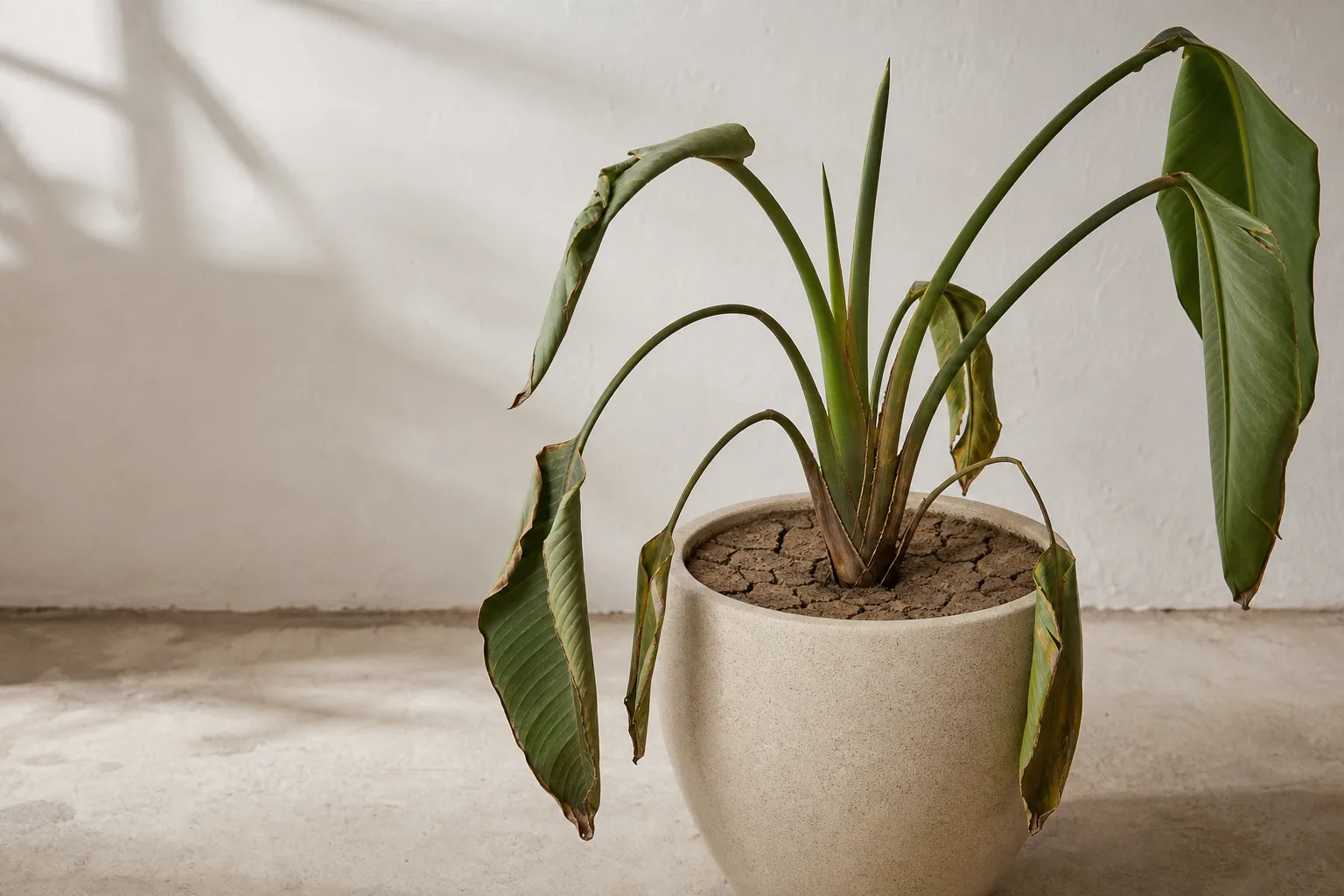
Underwatering on Bird of Paradise shows up as a light dry pot, inward-curling paddle leaves, and crisp brown edges - not limp leaves on wet soil. First step: stick your finger 5 cm into the mix and lift the pot. If dry throughout with a firm rhizome, give one thorough soak until runoff, drain fully, then reset your check rhythm.
Underwatering on Bird of Paradise: Causes, Checks & Fixes
This guide covers underwatering on Bird of Paradise. See also the general Underwatering guide, watering, and light pages for this plant.
Underwatering on Bird of Paradise: Causes, Checks & Fixes
Quick answer
Underwatering on Bird of Paradise (Strelitzia reginae and Strelitzia nicolai) is moisture deficit at the root zone - not a vague “needs water” feeling from limp leaves alone. On this clumping rhizomatous plant with large paddle blades, the early signal is usually inward leaf curl on still-firm gray-green tissue, a noticeably light pot, and dry mix at 5 cm depth - before full soft wilt sets in.
First step: probe soil moisture at 5 cm near the pot edge and lift the container at the same time. Dry throughout with a firm rhizome at the soil line confirms thirst. Wet heavy mix with limp leaves means stop - that is overwatering or root stress, not underwatering, even when paddles look desperately thirsty.
If dry checks pass, give one thorough soak until runoff, drain fully, then wait for the top layer to dry again before the next drink. Do not stack Bird of Paradise repotting guide, fertilizer, and daily sips on day one. Full species context: Bird of Paradise overview.
What underwatering looks like on Bird of Paradise
Underwatering on Strelitzia follows recognizable patterns tied to large-leaf architecture and rhizome storage - not the same signs as a fern or moisture-loving calathea.
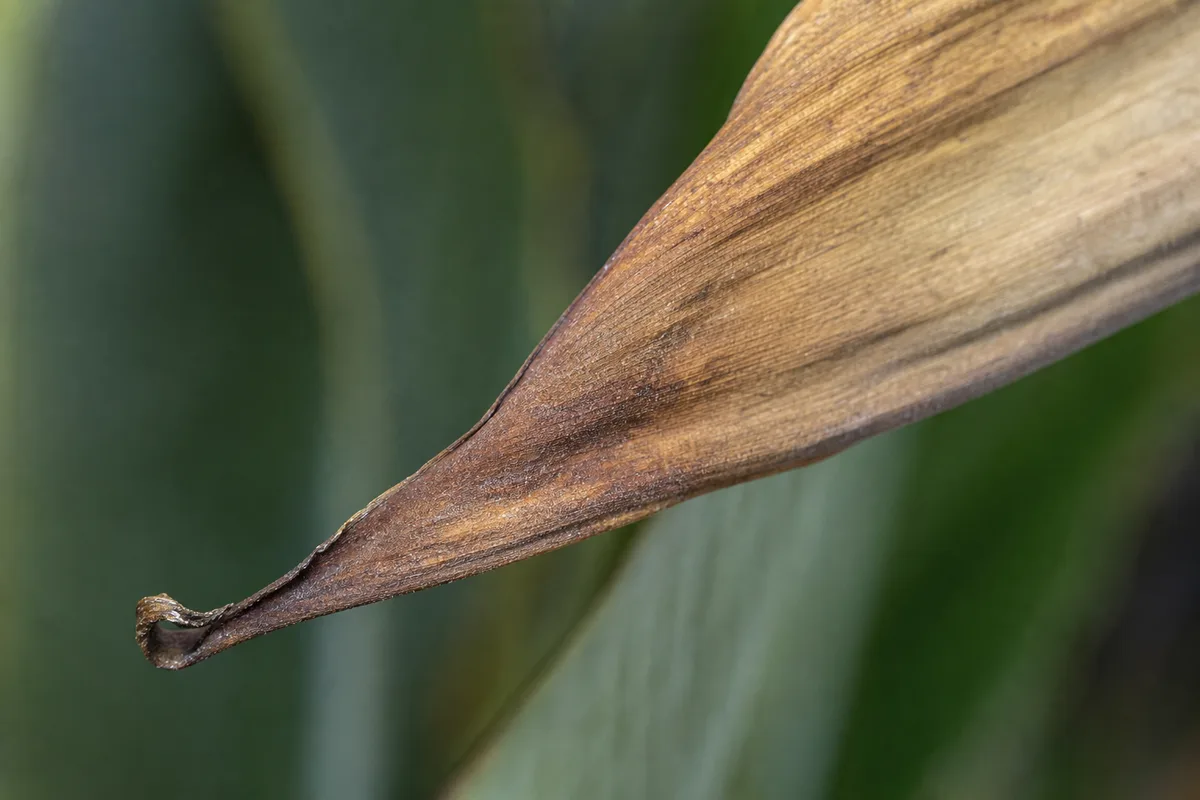
Underwatering symptoms on Bird of Paradise - compare with healthy tissue on the same plant.
Early underwatering (most useful window to catch it):
- Inward curl along paddle length - leaf edges roll inward while the blade still feels somewhat firm
- Pot feels light compared to how it felt right after the last thorough watering
- Top 5 cm (about 2 inches) of mix dry; deeper mix also dry in moderate pots
- Mix may pull slightly away from the pot wall after prolonged drought
- Rhizome press at soil level feels firm, not spongy
Advanced underwatering:
- Soft limp hang with lost turgor - see overlap with wilting page
- Crisp brown edges or yellowing on outer fans farthest from the root crown
- New leaf spears may stall or brown at tips if drought persists through active growth
- Dusty dry surface; saucer empty and pot weight clearly low
What underwatering does not look like:
- Limp paddles with heavy, cool, damp mix for days after watering
- Sour smell, fungus gnats, or soft dark rhizome at the base
- Lower yellow leaves with wet soil - that branch is overwatering, not thirst
Bird of paradise is more drought-tolerant than it looks - thick fleshy rhizomes store water and can survive short dry spells. Chronic or repeated drought still damages fine roots, makes peat-heavy mix harder to rewet, and reduces clean new leaf production.
Inward curl vs. full wilt vs. droop
These three get conflated constantly:
| Symptom | What you see | Soil clue | Typical cause |
|---|---|---|---|
| Inward curl | Edges roll inward; blade may still feel firm | Dry, light pot | Early underwatering |
| Wilting | Soft limp hang, lost stiffness | Very dry OR persistently wet | Advanced drought OR root failure |
| Drooping leaves | Downward angle; may stay firm | Variable | Light, posture, chronic imbalance - see drooping leaves |
Curl is Strelitzia’s early moisture-conservation move - reduce leaf surface area before turgor collapses. Wilt means uptake has already failed. Droop without soft collapse is often chronic, not acute thirst.
Species note: reginae vs. nicolai
Strelitzia reginae - the orange-flowering bird most often grown indoors - has stiff gray-green paddles on moderate petioles. It may show curl for several days before full wilt if rhizome reserves buffer the deficit.
Strelitzia nicolai - giant white bird - carries more leaf surface and often sits in larger, deeper pots. It may curl and wilt faster in summer heat and bright sun because transpiration demand is higher in absolute terms. The same dry-down rule applies: top portion dry, pot lighter, then soak - but depth checks matter more than surface color alone in big containers.
Why Bird of Paradise gets underwatered - ranked causes
1. Calendar watering instead of pot checks
The most common setup failure is watering “every Tuesday” regardless of light, season, or pot weight. Strelitzia does not drink on a calendar. A Strelitzia nicolai in a sunny south window in porous terracotta may need water twice as often as a Strelitzia reginae on a dim interior shelf in glazed ceramic. Same schedule guarantees one stays too dry.
NC State Extension recommends watering freely in spring and summer but keeping Strelitzia drier in winter - a seasonal shift many growers apply to summer rhythm only and accidentally underwater in bright active months while overwatering in dim winter months, or the reverse.
2. Shallow sips that never reach deep roots
Partial top-ups keep the surface damp while the lower root ball stays dry - especially in large pots or after mix shrinkage pulled soil away from the walls. Bird of paradise wants the entire root zone moistened, then a genuine dry-down - not a permanently wet cap on dry roots below. Clemson HGIC advises thoroughly wetting the potting mix, then allowing it to dry slightly before watering again - the “slightly dry” check prevents both chronic drought and constant saturation.
3. High transpiration in bright light and heat
Large paddle leaves lose water quickly when light is strong. A healthy bird in full sun to partial shade may dry the pot faster than expected on hot afternoons. Growers who fear overwatering after a past rot scare often under-correct and leave the plant chronically dry through summer.
4. Root-bound pots and accelerated dry-down
Severely root-bound rhizomes fill the container with structural root mass. Less soil volume holds less water; the pot may go from adequately moist to bone dry within a few days. Underwatering returns between “correct” waterings until repot timing is addressed - but repot is not day-one first fix for acute curl on a firm rhizome; rehydrate first, plan repot next active season.
5. Hydrophobic or peat-heavy mix after repeated drought
When peat or coir dries completely, it can repel water - mix pulls from pot walls, water races down the gap, and the center stays dry. Growers think they watered thoroughly; roots still starve. Two-stage watering or a brief bottom soak fixes rewetting; see recovery steps below.
6. Winter under-watering fear (less common but real)
Some growers reduce winter frequency correctly but over-reduce in a bright warm room where the plant still pushes occasional growth. Dry curl in February near a sunny window often means the interval stretched too far - confirm with finger and weight, not the calendar alone.
7. Low humidity compounding edge crispness (not primary underwatering)
Dry indoor air can crisp margins while soil moisture is adequate - see low humidity and brown tips. Key split: moist mix + crisp edges suggests air moisture; dry mix + inward curl + light pot confirms thirst.
How to confirm underwatering - six-step inspection
Work through these in order. Stop when dry-branch criteria clearly fit.
- Finger test at 5 cm depth - Insert near the pot edge, not against the rhizome. Dry throughout? Continue dry branch. Cool damp clinging to skin? Stop - likely wet branch or overwatering.
- Pot weight - Lift now and compare to memory of post-watering weight. Noticeably light supports thirst.
- Rhizome firmness - Press gently where thick petioles emerge from soil. Firm = safer to soak. Soft, dark, or mushy = unpot for root rot - not underwatering first fix.
- Leaf curl direction - Inward roll on firm tissue with dry checks supports drought. Downward limp sag on wet soil does not.
- Mix shrinkage gap - Soil pulled from pot wall suggests prolonged dry spell; plan two-stage rewetting.
- Recent context - Heat wave, move to brighter window, root-bound history, or travel gap in the last two weeks narrows cause.
If surface looks dry but pot still feels heavy, trust weight and depth over leaf curl alone. Deep nicolai pots often have dry tops and moist centers - underwatering is confirmed only when both top and weight say dry.
Lookalike symptoms - underwatering vs. other problems
| What you see | Dry pot? | Wet pot? | Likely cause | First branch |
|---|---|---|---|---|
| Inward curl, firm paddles | Yes | No | Underwatering | Thorough soak + drain |
| Limp sag, yellow lower fans | No | Yes | Overwatering / root stress | Stop watering; check rhizome |
| Crisp tips, moist mix | No | Moderate | Low humidity / salts | Humidity or flush branch |
| Pale yellow-green, long lean | Variable | Often damp long | Not enough light | Improve light first |
| Soft wilt after travel | Was dry | - | Underwatering | Soak + stable placement |
| Limp despite recent soak | - | Yes | Root rot | Unpot inspection |
University of Maryland Extension notes that excess moisture damages roots and produces wilting that mimics drought - the classic Strelitzia trap that sends growers to the watering can when they should stop.
The costliest mistake on bird of paradise is treating wet-soil limp as thirst. Adding water to saturated mix accelerates rhizome rot.
First fix for Bird of Paradise underwatering
Make one primary correction when dry-branch checks confirm thirst:
Thorough top watering until runoff, with full drainage afterward.
When the top 5 cm is dry and the pot feels light:
- Water slowly and evenly across the soil surface until excess runs freely from drainage holes.
- If mix has shrunk from the pot wall, pause ten minutes after a moderate first pass, then water again until runoff - prevents channeling down the gap.
- Let the pot drain several minutes. Empty the saucer or lift the nursery pot out of any cachepot and pour away collected runoff.
- Do not water again until the top layer dries and weight drops - reset to the watering guide check rhythm.
Bottom-soak alternative: If top water races through without moistening the center, sit the pot in a basin of room-temperature water 30–45 minutes, then drain completely. Bottom-soaking is a rewetting tool, not a daily habit - standing water in saucers re-wicks overnight.
Do not on day one:
- Fertilize a stressed plant - NC State recommends feeding during active growth on healthy specimens, not drought-stressed ones
- Repot unless roots are mushy or mix is impossible to rewet after two proper soaks
- Move into blazing direct sun without acclimation
- Water daily “to be safe” - that swings to overwatering within a week
Step-by-step recovery after confirmed underwatering
Once the first soak is done, follow this sequence:
- Wait 24 hours - Check whether petioles stiffen and inward curl relaxes. Many dry-pot cases improve within hours.
- Trim only fully brown, papery paddle tissue if it bothers you - cosmetic; not required for recovery.
- Leave green-but-crisp-edged leaves in place if they still photosynthesize; they will not re-green fully.
- If curl persists with dry soil two days later - Repeat one thorough soak using two-stage technique for shrunken mix.
- If limpness persists after confirmed rewetting with firm rhizome - Suspect hidden root damage from prior wet cycles; inspect roots before more water.
- Plan repot if root-bound dry cycles return every few days - schedule for early active growth, not emergency same-day upsizing.
Recovery timeline - what old paddles vs. new growth will do
Hours to 48 hours: Turgor often returns quickly after a proper soak when rhizomes remained firm. Wisconsin Horticulture notes that indoor bird of paradise should dry between waterings - recovery after a missed cycle is usually fast when storage roots are intact.
Crisp brown edges: Permanent on affected tissue. Judge recovery by new leaf unfurling with good color, not old margin repair.
Stalled new spears: May resume within one to two weeks after stable moisture returns during active growth.
Chronic repeated drought: Fine root damage can slow growth for several weeks even after correction. Success = firm rhizome and predictable dry-down rhythm restored.
Failure signals: Continued limpness after two confirmed soaks, spreading softness at the crown, or newest spears collapsing - escalate to root inspection.
Mistakes to avoid
Do not interpret every curl as thirst without soil checks - overwatered roots that cannot move water also produce curl on wet mix.
Do not under-water through summer in bright sun because you fear rot from a past overwatering incident - match checks to season and light, not trauma.
Do not use cold shock water on stressed tissue; room-temperature water is fine for smooth Strelitzia paddles.
Do not leave the pot sitting in a full saucer after bottom-soaking - re-saturation invites the rot cycle you were trying to avoid.
Do not upsize the pot hoping it holds water longer without fixing check rhythm - oversized wet outer rings cause different failures.
Do not confuse one aging outer fan yellowing with drought - normal senescence on a firm plant with appropriate soil moisture is harmless; see yellow leaves.
How to prevent underwatering next time
Build the check-based wet-dry cycle from the Bird of Paradise watering guide:
- Water when the top 5 cm dries and the pot feels lighter - roughly every 7–10 days in active growth, every 14–21 days or longer in winter for many indoor plants
- The RHS advises keeping compost moist through spring and summer in bright active conditions, then tailing off through autumn and letting compost get fairly dry between waterings from late autumn onward - indoor translation: generous soak when dry, never perpetual dampness
- Lift the pot weekly until you learn your container’s weight shift - more reliable than surface color
- Keep the plant in bright light so growth and drying stay predictable - see light guide
- Use well-draining mix with perlite; compacted peat-only formulas dry unevenly
- Address root-bound dry spikes with timed repot in early spring, not emergency upsizing mid-drought
Calendar reminders are fine; calendar obedience without checks is what underwatering Strelitzia in summer sun.
When to worry
Treat underwatering as urgent when:
- Complete wilt with bone-dry soil in hot direct sun - rehydrate promptly with thorough soak and drainage
- Newest leaf spears collapse while outer fans crisp - prolonged deficit during active push
- Rewetting fails twice - center mix still dry after two proper soaks; inspect for root loss or hydrophobic breakdown
Lower urgency when early inward curl on firm tissue responds within a day of one soak. One missed cycle on an established plant with firm rhizome rarely causes permanent damage.
If limpness continues after confirmed dry-pot rewetting, treat as root failure investigation - not more drought assumption.
Bird of Paradise care cross-check
Stable Strelitzia resists chronic underwatering when three systems align:
| Factor | Underwatering risk when wrong |
|---|---|
| Water | Calendar-only rhythm; shallow sips; winter over-reduction in bright rooms |
| Light | Strong sun dries pot faster than expected; dim light slows growth but does not remove need for periodic deep drinks |
| Roots / mix | Root-bound fast dry-down; hydrophobic peat after repeated drought |
| Pot | Large deep nicolai containers with dry tops and wet centers - check depth, not surface alone |
Cross-link your routine: overview hub for placement; watering for seasonal ranges; overwatering and wilting for wet-soil lookalikes; root rot if rhizome softness appears after correction.
Conclusion
Underwatering on bird of paradise is a dry-pot diagnosis, not a leaf-shape guess. Large paddle leaves curl inward early, pots go light, and mix dries at depth - while the rhizome usually stays firm if rot has not already set in. Confirm dryness at 5 cm, soak thoroughly once, drain completely, then rebuild a check-based rhythm tied to season and light. Crisp old edges may stay cosmetic; firm new spears tell you the plant is back on track. Get the dry branch right before you water - and get the wet branch right before you soak again.
When to use this page vs other Bird of Paradise guides
- Bird of Paradise watering guide - Use for routine moisture checks before assuming underwatering is the main issue.
- Bird of Paradise problems hub - Browse all 20 common issues on this species.
- Wilting on Bird of Paradise - Different entry point when symptoms overlap with underwatering.
- Brown Tips on Bird of Paradise - Different entry point when symptoms overlap with underwatering.
- Yellow Leaves on Bird of Paradise - Different entry point when symptoms overlap with underwatering.