Root Rot on Bird of Paradise: Causes, Checks & Fixes
Quick answer
Root rot on Bird of Paradise means the rhizome and feeder roots are decaying in saturated mix-often after winter overwatering in an oversized pot. First step: stop watering immediately and unpot to inspect rhizome firmness at the soil line.
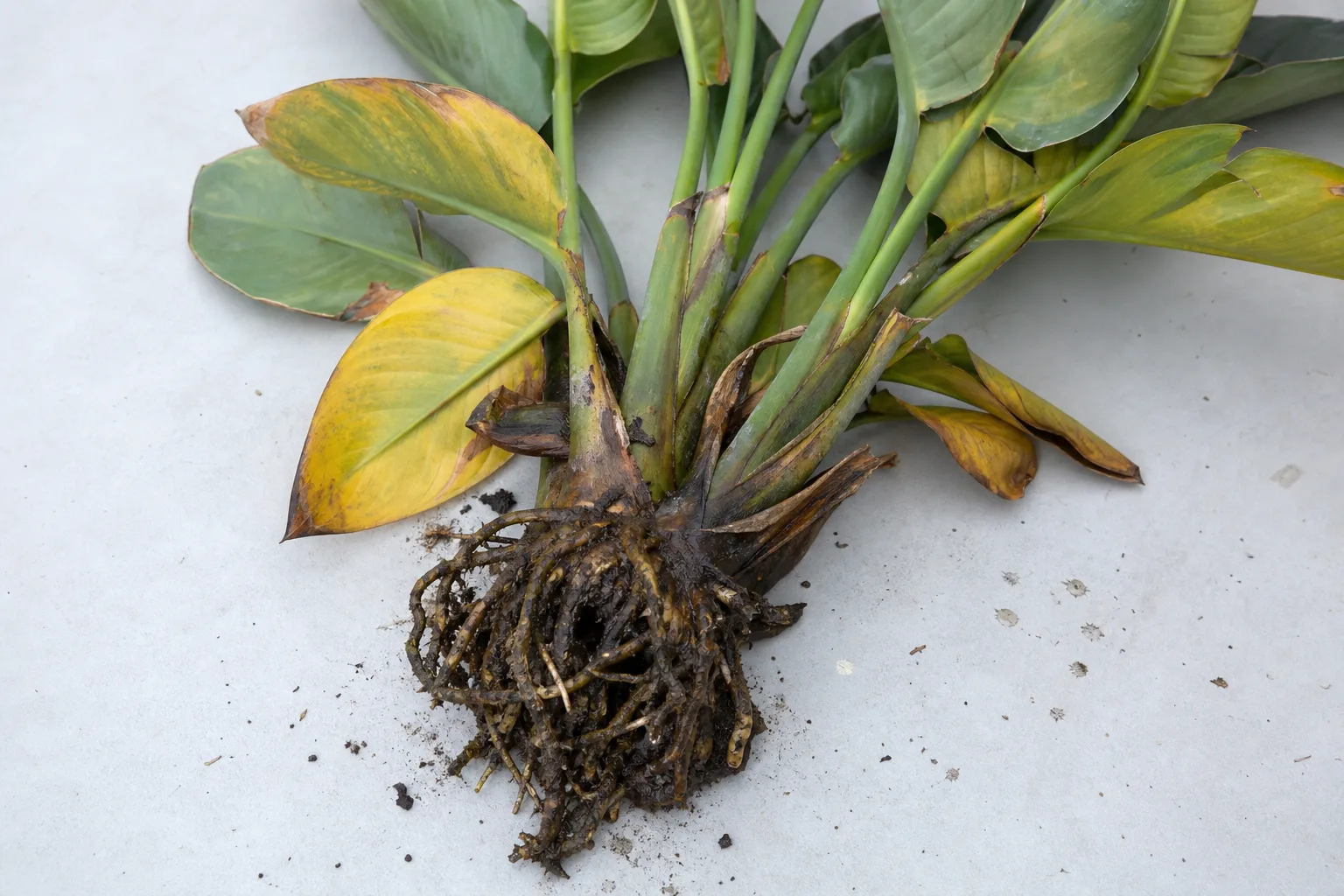
Root Rot on Bird of Paradise: Causes, Checks & Fixes
This guide covers root rot on Bird of Paradise. See also the general Root Rot guide, watering, and light pages for this plant.
Root Rot on Bird of Paradise: Causes, Checks & Fixes
Quick answer
Root rot on Bird of Paradise (Strelitzia reginae and large indoor S. nicolai specimens) is decay of the thick rhizome and feeder roots in soil that stays airless and wet too long-not a random fungal curse. This clumping perennial with underground rhizomes stores water in fleshy stems, yet root rot still occurs from overwatering or poorly drained soils when mix never dries and oxygen cannot reach the root zone.
First step: stop watering immediately. Do not add another drink because paddle leaves look limp on already-wet soil. Lift the pot-if it stays heavy for days, lower leaves yellow, and the mix smells sour, unpot and inspect rhizome firmness at the soil line before you repot or fertilize.
For wet soil without confirmed mushy tissue, start with the overwatering guide. This page is for confirmed rhizome or root decay needing trim-and-repot rescue.
Root rot vs. overwatering on Bird of Paradise
These problems share yellow lower paddles and a heavy pot, but the fix diverges once you unpot.
| Stage | Rhizome at soil line | Roots on rinse | Best next step |
|---|---|---|---|
| Early overwatering | Firm, cream-colored | White, firm feeder roots | Stop watering; dry-down per watering guide |
| Advancing stress | Slightly soft spots | Some brown tips, most firm | Unpot, trim minor losses, repot into airy mix |
| Confirmed root rot | Mushy, dark, collapses on squeeze | Brown, slimy, translucent | Full rescue protocol below |
| Fatal decline | Black slime through crown | No firm tissue left | Division salvage or discard |
Rule of thumb: if the rhizome squishes when you press the crown at the soil line, treat root rot as confirmed-even when upper paddles still look acceptable. Firm rhizome with only yellow leaves usually means you caught overwatering before rot set in.
What root rot looks like on Bird of Paradise
Strelitzia shows root failure through its heavy paddle leaves and thick petioles, not through a tight rosette crown like a succulent. Symptoms often start low while the upper clump still looks upright.
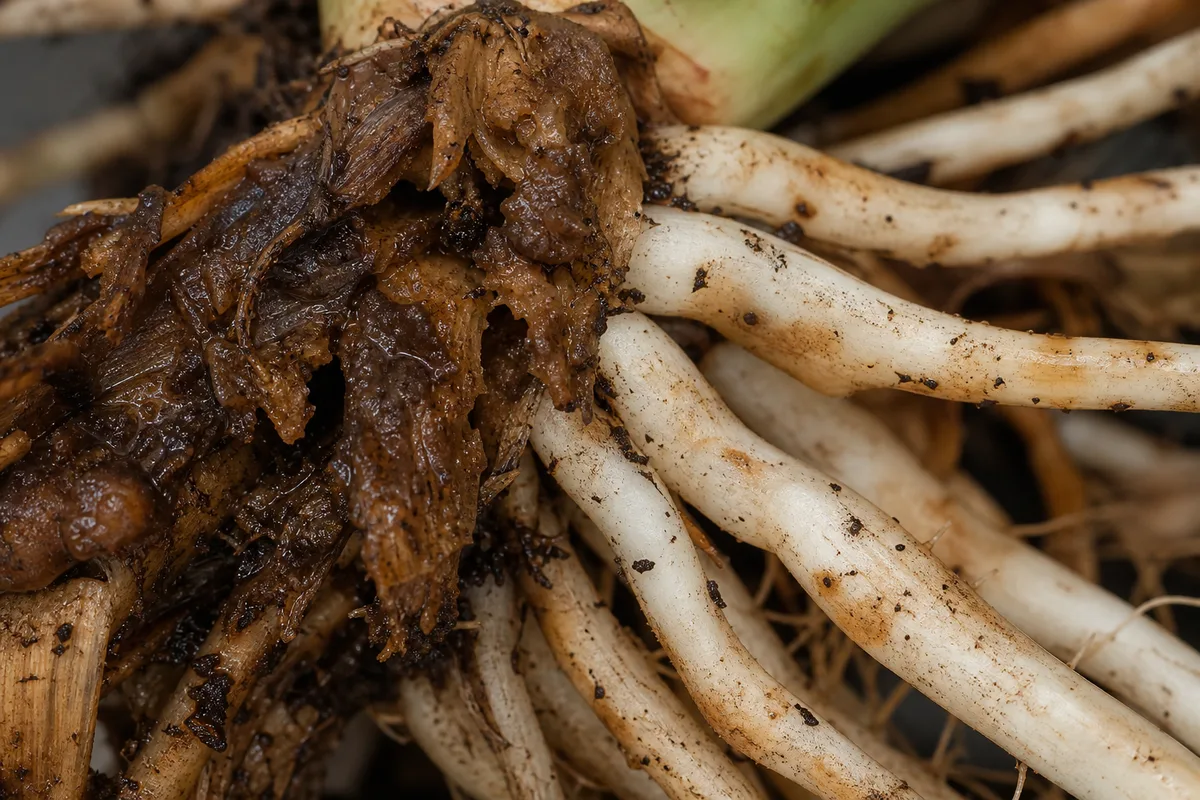
Root Rot symptoms on Bird of Paradise - compare with healthy tissue on the same plant.
Early signs
- Yellowing lower paddle leaves while mix stays damp-not one normal aging leaf
- Limp foliage that does not firm within 24 hours after watering on wet soil
- Heavy pot that never lightens between scheduled drinks
- Slowed or stalled new spear emergence from the clump center
- Fungus gnats hovering over constantly damp surface mix
Advanced signs
- Soft, foul-smelling rhizome tissue at the soil line when you unpot
- Brown or black mushy bases where petioles join the rhizome
- Sour odor from drainage holes
- Whole-clump collapse-paddles fold despite moisture in the pot
- Translucent, slimy feeder roots that pull away when rinsed
How this differs from underwatering on Bird of Paradise
Underwatered Bird of Paradise usually shows a lightweight pot, dry mix at 5 cm depth, and crisp brown edges or fold along the midrib-not a sour smell or mushy crown. Wilt on dry soil points to thirst; wilt on wet soil with a heavy pot points to failing roots.
Why Bird of Paradise gets root rot
Rhizome storage and the wet-soil paradox
Strelitzia builds a clumping, rhizomatous root system with thick underground stems that store moisture. That storage helps the plant survive short dry spells, but it also confuses diagnosis: paddles can look wilted while soil is wet because damaged roots cannot move water even though the rhizome still holds some reserves. Watering again suffocates the few healthy roots left and accelerates decay.
Oversized pots and heavy mix indoors
The most common indoor failure mode is an oversized glazed ceramic pot plus dense peat mix without enough perlite or grit. Strelitzia performs well slightly rootbound in routine care, but after rot rescue an even larger pot creates a ring of unused wet soil the trimmed root ball cannot colonize-keeping the rhizome zone saturated for weeks. See the repotting guide for one-pot-size rules in normal care; after rot, go same size or smaller, not larger.
Winter low-light overwatering
Water freely in spring and summer but keep Strelitzia drier in winter is the extension pattern most indoor growers miss. The RHS recommends letting compost get fairly dry between waterings from late November onward. When light drops and growth slows, the same weekly watering schedule that worked in July keeps mix wet through December. Cool, dim rooms evaporate slowly while feeder roots sit in stale, airless soil-the classic route to rot on floor-sized S. nicolai as well as tabletop S. reginae.
Poor drainage mechanics
Blocked drainage holes, cachepots holding runoff, and garden soil in containers all produce the same outcome: roots die from lack of oxygen when overwatering decreases available oxygen for root growth. Fungi such as Pythium and Phytophthora often colonize already-stressed tissue in wet mix, but the primary fix is drying, trimming, and resetting drainage-not chasing a mystery disease.
How to confirm the cause
Work through these checks in order before you cut tissue or repot.
- Pot weight and smell - Heavy days after the last watering plus sour odor from drain holes strongly supports rot over thirst.
- Soil probe - Finger or skewer 5 cm deep near the pot edge. Persistent wet cling with yellow lower leaves means the root zone is not drying.
- Rhizome squeeze test - Unpot and press the crown at the soil line. Firm cream tissue means early stress or overwatering; squishy dark tissue means rot rescue.
- Root rinse - Wash mix away with lukewarm water. Healthy Strelitzia roots are firm and pale; rotted roots are brown, translucent, or slide off the rhizome.
- Wilt response - If paddles stay limp on already-wet mix, wilting with root or stem rot means damaged roots cannot absorb water-do not water again until you inspect.
First fix - stop the wet cycle
Stop all watering the moment you suspect rot. Move the pot to Bird of Paradise light guide with good airflow-not hot direct sun through glass on a stressed plant. Empty saucers and cachepots. Do not fertilize, mist heavily, or repot on day one unless rhizome tissue is already soft.
If the rhizome is still firm on unpotting, you may only need dry-down and drainage fixes from the overwatering page. If tissue is mushy, proceed to the surgery sequence below-one clear escalation, not both at once.
Step-by-step rhizome and root recovery
Wear gloves when trimming: Bird of Paradise is toxic to cats and dogs, and cut rhizome tissue can irritate skin. Keep pets away from trimmings and the work surface.
- Unpot and rinse - Knock the plant out gently; wash away old mix so you can see every rhizome section and feeder root.
- Assess salvage scope - Mark mushy rhizome, black petiole bases, and slimy roots. If more than half the clump stays firm, in-place rescue is realistic. If only small firm offsets remain, plan division instead of saving a collapsed center.
- Trim to firm tissue - Sterilize shears with rubbing alcohol between cuts. Remove every soft, dark, or hollow rhizome section and dead feeder roots. Cut until you reach firm, pale tissue with no dark streaking inside.
- Air-dry cuts - Let trimmed rhizomes sit on newspaper in shade for two to four hours so cut surfaces callus slightly before repotting.
- Choose pot size - Use the same pot or one size smaller with open drainage holes. Match volume to the trimmed root mass, not the leaf spread.
- Repot into fresh airy mix - The RHS recommends peat-free loam-based compost such as John Innes No. 3 with added grit for strelitzia; a standard indoor mix amended with 20–30% perlite or coarse grit per the soil guide also works. Do not reuse sour mix or a dirty pot without scrubbing and rinsing.
- Hold water initially - Wait five to seven days, then water lightly only if the top 5 cm of fresh mix is dry and leaves are not collapsing from drought. Resume normal 5 cm dry-check watering only after new growth stabilizes.
- Remove hopeless foliage - Cut fully yellow or mushy-base paddles at the rhizome. They will not re-green; recovery shows in new center spears, not saved lower leaves.
Recovery timeline and what to expect
Mild rot with firm core rhizome and limited root loss may stabilize within two to four weeks after repot, with the pot lightening on a normal schedule again. Moderate cases where you trimmed 20–40% of roots often need four to eight weeks before a new paddle spear unfurls cleanly-common on S. reginae in an 18–22°C room with bright indirect light.
Scale matters: tabletop S. reginae in a 25–30 cm pot recovers faster than a floor-sized S. nicolai in a heavy 40 cm+ planter-the larger root mass and wet-soil volume in big containers slow dry-down and extend the watch period by several weeks.
Signs recovery is working:
- New spear emerging from the clump center
- Firm rhizome when you check at the soil line after four weeks
- Pot weight dropping predictably between waterings
- No spreading black tissue on re-inspection
Signs the rescue is failing:
- Rhizome softens further after repot despite dry-down
- New spears brown before unfurling
- Sour smell returns within two weeks
- Entire clump collapses on moist mix
Severe crown involvement can be fatal. Judge success by firm new growth and stable roots, not by saving every old paddle.
Rescue case note
A typical indoor rescue: a tabletop S. reginae in a 30 cm glazed ceramic pot-two nursery sizes too large-kept on a weekly winter watering schedule in a 19°C north-facing room. Lower paddles yellowed over three weeks; the rhizome felt soft on one side at the soil line while the opposite half stayed firm. After unpotting, roughly 30% of feeder roots were slimy; the rhizome core remained solid. Mushy tissue was trimmed back to cream-colored flesh, cuts air-dried two hours, and the plant went into a 25 cm plastic pot with 25% perlite-amended mix. Water was held five days, then resumed only when the top 5 cm dried. The first new center spear appeared at week five-not from any saved lower paddle.
Lookalike symptoms on Strelitzia
| Pattern | Pot weight | Soil at 5 cm | Rhizome | Likely cause |
|---|---|---|---|---|
| Root rot | Heavy | Wet, sour | Soft, dark | Decayed rhizome/feeder roots |
| Overwatering (early) | Heavy | Wet | Firm | Saturated mix, roots intact |
| Underwatering | Light | Dry | Firm | Drought stress |
| Low humidity | Normal | On schedule | Firm | Dry air-brown tips, not mushy crown |
| Cold damage | Normal | Variable | Firm | Winter chill-see light and placement guides |
What not to do
- Do not keep watering because paddles look wilted when soil is already wet-overwatering causes roots to die from lack of oxygen.
- Do not upsize the pot during rot rescue; unused wet soil volume repeats the problem.
- Do not repot into garden soil or a container without drainage holes.
- Do not fertilize until new paddles open at full size and roots have re-established for four to six weeks.
- Do not leave the plant in a cachepot that collects runoff after bottom-watering.
- Do not assume fungicide alone fixes rot without trimming dead tissue and fixing drainage-Clemson HGIC notes that repotting into sterile soil is often more practical than fungicide programs that may cost more than replacing the plant when roots are severely infected.
How to prevent root rot next time
Prevention on Bird of Paradise is mostly watering discipline tied to Strelitzia biology, not a monthly fungicide routine.
- Follow the watering guide: top 5 cm dry before each soak, longer intervals in winter, pot-weight checks before every drink.
- Use well-drained mix with perlite or grit; avoid heavy peaty blocks that stay wet in dim rooms.
- Size pots to the root mass-routine upsizing only one nursery size per the repotting guide, never jumping to a decorative oversized planter.
- Empty saucers within 30 minutes; never let the inner pot sit in a full cachepot.
- Catch early wet-soil stress on the overwatering page before rhizome tissue softens.
When to worry - salvage vs. discard
Salvage in place when the rhizome core stays firm after trimming, at least one healthy growth point remains, and you can repot into an appropriately sized container with fresh mix.
Divide instead when one or more firm offsets sit beside a dead center-cut them away with sterilized shears per the propagation guide and pot separately.
Discard or replace when the entire rhizome collapses to black slime, no firm tissue remains after trimming, or new spears repeatedly rot at the base despite corrected care. Starting from a healthy division or new plant is sometimes cheaper than weeks of failed rescue on a floor-sized specimen.
Related Bird of Paradise problems
- Overwatering - wet soil before rhizome decay; dry-down first fix
- Yellow leaves - lower paddle loss on dry vs. wet soil
- Wilting - limp paddles when the pot is heavy or light
- Fungus gnats - clue that surface mix never dries
- Watering - seasonal 5 cm dry-check rhythm that prevents rot
When to use this page vs other Bird of Paradise guides
- Bird of Paradise watering guide - Use for routine moisture checks before assuming root rot is the main issue.
- Bird of Paradise problems hub - Browse all 20 common issues on this species.
- Overwatering on Bird of Paradise - Different entry point when symptoms overlap with root rot.
- Yellow Leaves on Bird of Paradise - Different entry point when symptoms overlap with root rot.
- Wilting on Bird of Paradise - Different entry point when symptoms overlap with root rot.