Bougainvillea Care Guide: Light, Water, Soil, and Bloom
Bougainvillea spectabilis
Bougainvillea needs full sun (6+ hours daily), drought stress between waterings (every 5–7 days in containers), hard pruning after each flower flush, and high-potassium fertiliser every 2–3 weeks during the growing season.
Bougainvillea Care Guide: Light, Water, Soil, and Bloom
Start with wateringThe most common care mistake for BougainvilleaWatering guide → →Bougainvillea care essentials
Light
full sun - minimum 5–6 hours of direct sunlight daily
Water
Every 5–7 days in containers during growing season (allow top 5 cm to dry). More frequent in very hot weather. Reduce significantly in winter.
Soil
Well-draining potting mix with 20% perlite. pH 5.5–6.5. Does not tolerate waterlogged roots.
Humidity
Low to moderate; thrives in dry sunny conditions
Temperature
20°C to 38°C (68–100°F)
Fertilizer
Use high-phosphorus and high-potassium fertilizer (NPK 6-12-12); avoid high nitrogen and stop if the plant is stressed, newly repotted, or not actively growing. High-nitrogen fertilizers - produce lush green growth with almost no colourful bracts.
About Bougainvillea
Bougainvillea is native to South America (Brazil, Peru, Argentina), typically reaches 3–12 m as climber; 1–2 m compact in containers indoors, with fast once established and in full sun growth. Bougainvillea has a climbing growth habit and part of the Nyctaginaceae family. It is also known as Paper Flower, Bugambilia, and Bougainvillea glabra.
| Detail | Information |
|---|---|
| Also known as | Paper Flower, Bugambilia, Bougainvillea glabra |
| Native region | South America (Brazil, Peru, Argentina) |
| Mature size | 3–12 m as climber; 1–2 m compact in containers |
| Growth rate | Fast once established and in full sun |
| Growth habit | Climbing |
| Scientific name | Bougainvillea spectabilis |
| Family | Nyctaginaceae |
Bougainvillea Care Guide: Light, Water, Soil, and Bloom
What Bougainvillea Actually Is (and Why Bracts Are Not Flowers)
Bougainvillea is a woody, thorny evergreen climber in the family Nyctaginaceae - the same family as four o’clocks - not a true vine in the grape or pea sense. The species most often sold in garden centers is Bougainvillea spectabilis, though Bougainvillea glabra and countless hybrids and cultivars share the same basic care rules. The plant is native to the dry scrublands and coastal hills of South America, particularly Brazil, Peru, and Argentina, where it evolved to survive intense sun, lean soil, and long dry spells between rains.
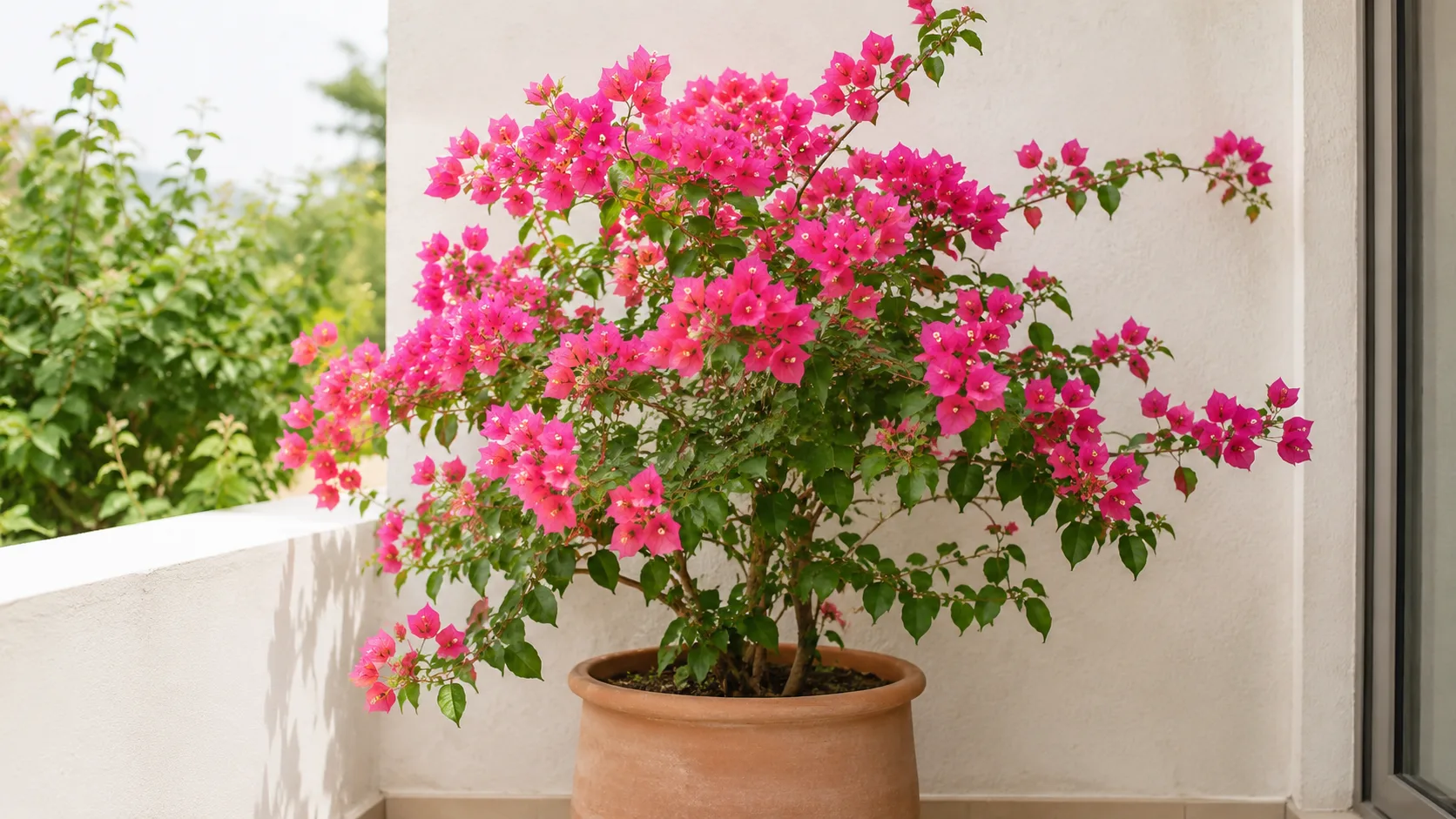
The first thing that confuses new growers is what they are actually looking at when the plant “flowers.” The brilliant magenta, orange, purple, or white displays are bracts - modified leaves - wrapped around the plant’s true flowers, which are small, tubular, and usually white or cream. Those papery bracts persist for three to six weeks on many outdoor specimens in warm weather before gradually bleaching and dropping, which is why bougainvillea looks like it blooms continuously in the right conditions. Understanding that distinction matters for care because bract production is tied to light intensity, root stress, and seasonal rhythm in ways that leaf growth alone is not.
Bracts vs. True Flowers - Why the Distinction Changes Your Care
When the tiny true flowers inside a bract cluster finish their brief life - often within a day or two per flower - the surrounding bracts remain the visible “bloom” for weeks. That is why fertilizer, light, and watering decisions target bract initiation on new wood, not the microscopic flowers themselves. A plant can carry lush green leaves and still fail to produce bracts if sun, water, or nitrogen are wrong. Conversely, a slightly stressed, sun-soaked vine on a fast-draining mix often colors up when a pampered indoor specimen will not. If you want a mental model, think of bracts as the plant’s billboard and the true flowers as the brief signal flares at the center.
In cultivation, bougainvillea can reach 3–12 meters (10–40 feet) as a wall-climbing specimen or stay around 1–2 meters (3–6 feet) in a container if you prune and root-restrict it deliberately. Growth is fast once the plant is established and receiving full sun, but slow and leggy in shade. Treating bougainvillea like a generic leafy houseplant - steady moisture, moderate light, rich soil - is the single fastest way to get a green blob that never colors up.
For related Bougainvillea care, see Spider Mites on Bougainvillea, Mealybugs on Bougainvillea.
Bougainvillea at a Glance
A quick reference card for the plant, in plain English:
- Botanical name: Bougainvillea spectabilis (also B. glabra and hybrids in commerce)
- Family: Nyctaginaceae
- Type: Thorny woody climber; evergreen in frost-free climates
- Mature size: 3–12 m as a climber; 1–2 m compact in containers
- Light: Full sun - minimum 5–6 hours of direct sunlight daily; more sun means more bracts
- Water: Soak-and-dry; allow the top 3–5 cm of mix to dry between waterings
- Soil: Fast-draining mix; pH 5.5–6.5; hates waterlogged roots
- Temperature: Ideal 20–38 °C (68–100 °F); damaged below ~5 °C (41 °F)
- Humidity: Low to moderate; thrives in dry sunny conditions
- Fertilizer: High-phosphorus, high-potassium formula every 2–3 weeks in active growth; avoid heavy nitrogen
- Toxicity to pets: Not listed on the ASPCA toxic plants database; thorns and sap are separate risks; any plant ingestion can upset some pets
- Hardiness outdoors: USDA zones 9–11 as a perennial; container plants overwintered indoors in colder zones
Indoor vs Outdoor: Where Bougainvillea Actually Belongs
Bougainvillea is marketed as a patio plant, a balcony specimen, and occasionally as a houseplant. All three can work temporarily, but the plant’s biology favors outdoor full sun over long-term indoor life. The Royal Horticultural Society and University of Florida IFAS Extension both describe bougainvillea as a sun-loving plant best suited to warm, frost-free gardens, with container culture as a practical option for colder climates where the pot moves indoors for winter.
If you live in USDA zones 9–11, bougainvillea can live outdoors year-round against a south-facing wall, over an arbor, or in a large patio container. In zones 8 and colder, treat it as a container plant that spends the warm season outside and comes in before the first frost. Indoors, the challenge is not temperature alone but light: a bougainvillea parked in a living room with ambient brightness will survive for a while, drop bracts, stretch toward the window, and eventually weaken. A south- or west-facing window with direct sun for most of the day, or a full-spectrum grow light delivering strong intensity for 10–12 hours, is the minimum for acceptable indoor performance. For sun-hour counting, window placement, and grow-light setups, see our bougainvillea light guide.
| Placement | Best for | Main risk | Winter move? |
|---|---|---|---|
| In-ground zone 10–11 | Wall climbers, large color displays | Over-irrigation in rainy microclimates | No |
| Outdoor container (warm season) | Patios, balconies, zone 8–9 growers | Saucer water, oversized pots | Yes below ~5 °C (41 °F) |
| Indoor bright window | Short cold snaps, low-bloom compromise | Leggy stretch, weak bracts | N/A - already inside |
| Cool bright overwinter room | Zone 7–8 container storage | Warm dry living room + low light | Already indoors |
Three-Question Placement Test
The honest placement test has three questions. Can the plant receive six or more hours of direct sun for most of the year? Can the pot dry down between waterings without staying wet for days? Can you accept thorny, sprawling growth that needs regular pruning? If any answer is no, bougainvillea is a poor match regardless of how much you like the color. It suits sunny patios and balconies, warm garden climbers, and Mediterranean-style gardens; it is a poor fit for shaded positions, pet-accessible floor pots, and consistently wet soils.
Light: Full Sun Is the Non-Negotiable
Bougainvillea’s bract production is directly tied to light intensity. The RHS and University of Florida IFAS Extension converge on the same baseline: at least 6 hours of full, direct sunlight daily, with more sun producing more color. Partial sun may keep the plant alive but reduces bract count noticeably. Deep shade produces leggy, weak growth and essentially no display.
Outdoors, the best placements are unobstructed south- or west-facing walls, deck rails, and pergolas where nothing casts afternoon shadow. Reflected heat from a light-colored wall often improves performance in cooler microclimates. Indoors, a south-facing window with the pot as close to the glass as heat allows is the default recommendation; east-facing windows work in hot climates where afternoon sun would scorch leaves through glass. If natural light is insufficient, a full-spectrum LED grow light positioned 12–24 inches above the canopy for 10–12 hours daily can supplement, but it is a compromise, not a substitute for real sun during the growing season. When bracts fail after a move or a dim winter, start with our not enough light guide before chasing fertilizer.
Acclimate any plant moving from shade to sun over 7–14 days, shifting exposure by an hour or two daily. Bougainvillea leaves formed in lower light burn easily when thrust into harsh midday sun. Conversely, a plant grown in strong outdoor sun will sulk and drop leaves if moved abruptly into a dim room - a common mistake when bringing containers indoors for winter. Shade-grown nursery stock needs longer acclimation than sun-grown stock; ask at purchase and stretch the transition to two weeks if the plant came from a dim garden-center corner.
Reading Light Stress Signals
Too little light shows up as long internodes, pale green leaves, sparse branching, and a complete absence of bracts despite otherwise healthy foliage. The plant may also stay wet longer in the pot because it is not using water at the rate a sun-soaked specimen would. Too much light, especially through hot glass without acclimation, produces bleached or scorched patches, leaf curl at midday, and crisp brown edges on the sun-facing side. The fix for insufficient light is more exposure, gradually applied; the fix for scorch is filtering or moving the plant back 30–60 cm from the window while still keeping it in the brightest available spot.
Watering: Soak, Dry Down, and the Blooming Cycle
Watering is the second non-negotiable after light, and it runs counter to how most people treat ornamental plants. Bougainvillea prefers deep, infrequent watering followed by a real dry-down, not a steady drip of moisture. University of Florida IFAS Extension notes that bougainvillea does not tolerate consistently wet soil and that reducing water can help trigger flowering - a pattern that mirrors its native dry-season rhythm.
The practical check: water when the top 3–5 cm (1–2 inches) of soil is dry. Insert a finger, a wooden skewer, or lift the pot - a dry pot feels noticeably lighter. Water thoroughly until excess runs from the drainage holes, wait 10–15 minutes, then empty the saucer so the root ball never sits in runoff. In active growth with strong sun, containers often need water every 3–5 days in summer; in cooler, slower months, stretch to every 7–10 days or longer. Calendar schedules are starting points only; pot size, mix, heat, and light change the interval constantly. For dry-down rhythm, saucer discipline, and automatic-irrigation mistakes, see our bougainvillea watering guide.
Overwatering is the most common cause of yellow leaves, bract drop, and root rot. underwatering on Bougainvillea shows as leaf drop, wilting bracts, and soil pulling away from the pot edges - usually recoverable with a deep soak if it has not been repeated for weeks. Automatic irrigation systems set on a fixed timer are a frequent hidden cause of non-blooming bougainvillea; hand-watering on the plant’s actual dry-down rhythm is more reliable for bract production.
Observed bloom case (May 2025, zone 9b patio): A 30 cm terracotta container on a south-facing patio received roughly six hours of direct sun daily. The grower let the top 3 cm dry between deep soaks for two weeks before the usual spring flush - a controlled dry-down, not desiccation. The first magenta bract clusters opened in week three after watering returned to the normal summer rhythm. The lesson is not to starve the plant indefinitely; it is that a brief, monitored dry window before bloom season can mirror native rhythm when light is already honest.
Seasonal Watering Adjustments
| Season | Plant state | Approximate interval | What to check before watering |
|---|---|---|---|
| Spring (active growth) | New shoots and first bract flush | Every 4–7 days in containers | Top 3–5 cm dry; pot feels light |
| Summer (peak growth) | Heavy water use in heat and sun | Every 3–5 days; more in extreme heat | Same; watch for same-day wilting in small pots |
| Pre-bloom stress window | Controlled dry-down to trigger bracts | Stretch interval slightly; do not let plant desiccate | Slight leaf wilt acceptable; resume normal watering after stress period |
| Fall (slowing) | Growth tapering | Every 7–10 days | Mix dry deeper before watering |
| Winter (semi-dormant indoors) | Minimal growth; lower light | Every 10–21 days or longer | Top inch dry; reduce further if plant is in cool storage |
These intervals assume a well-draining mix in a pot with drainage holes. Heavy soil, oversized pots, and dim indoor winter light all lengthen the dry-down time and increase rot risk if you water on a summer schedule.
Soil and Containers Built for Drainage
Bougainvillea roots demand excellent drainage. The RHS recommends a fertile, well-drained medium; IFAS emphasizes that waterlogged conditions quickly lead to decline. Clemson HGIC notes bougainvillea prefers slightly acidic soil around pH 5.5–6.5. A workable container mix is roughly 50% potting soil, 30% coarse sand or perlite, and 20% compost, adjusted for your climate - more grit in humid, rainy regions, slightly more organic matter in very hot, dry ones.
Avoid moisture-retention potting mixes, garden soil straight from the yard, and pots without drainage holes. Root restriction in an appropriately sized container actually promotes flowering; bougainvillea often colors up better slightly pot-bound than in an oversized tub where the mix stays wet for days. Choose a pot only one size larger at repotting - typically every 2–3 years - and prefer terracotta or unglazed ceramic if you tend to overwater, because porous walls pull moisture away from the root zone. Mix ratios and in-ground amendments are expanded in our bougainvillea soil guide.
For in-ground planting in zones 9–11, amend heavy clay with sand and organic matter to improve percolation, or plant on a mound so water does not pool around the crown. Raised beds and sloped sites work well in rainy subtropical climates.
Temperature, Humidity, and Frost Protection
Bougainvillea is one of the more heat-tolerant ornamental climbers, comfortable from about 20 °C to 38 °C (68–100 °F) and thriving in the hot, dry conditions of regions like Delhi, Rajasthan, and Gujarat in India, as well as the American Southwest and Florida. It tolerates low to moderate humidity and does not need misting; in fact, constantly wet foliage in stagnant air can invite fungal issues.
The cold limit is where most container growers get hurt. Frost at or below ~5 °C (41 °F) damages or kills tender growth; hard freezes destroy unprotected plants entirely. In zones 8 and colder, move containers indoors before the first frost - typically late October through November depending on latitude. The ideal overwintering spot is bright and cool, roughly 10–15 °C (50–59 °F), such as an unheated sunroom, enclosed porch, or cool greenhouse - not a warm, dry living room where low light and high heat force weak, etiolated growth.
Spring transition back outdoors should be gradual over 1–2 weeks: sheltered shade first, then morning sun, then full exposure after the last frost date. Resume normal watering and feeding only when new growth appears and nights stay consistently above 10 °C (50 °F).
Fertilizer: Phosphorus for Bracts, Not Nitrogen for Leaves
Bougainvillea is not a heavy feeder, but it responds strongly to the ratio of nutrients. High-nitrogen fertilizers produce lush green growth with few bracts - the classic “healthy but never flowers” outcome. During active growth from roughly March through October, a high-phosphorus, high-potassium formula (something in the NPK 6-12-12 range or a labeled bloom booster) applied every 2–3 weeks at the label’s recommended rate supports bract production. Always apply to already-moist soil to avoid root burn.
Pause feeding entirely during winter semi-dormancy, after repotting until new growth stabilizes, and while the plant is recovering from root rot or major pruning shock. Resume when the pot is drying on a normal summer rhythm and new shoots are visible. NPK timing, organic alternatives, and nitrogen-mistake recovery are covered in our bougainvillea fertilizer guide.
Repotting Without Killing the Bloom Cycle
Bougainvillea tolerates - and often benefits from - being slightly root-bound. Repot every 2–3 years, or when growth stalls despite good light and feeding, roots circle the drainage holes, or water runs straight through without soaking in. The best time is early spring, just before the active growth flush, so the plant has a full warm season to recover.
Go up only one pot size. An oversized container holds too much wet soil relative to the root mass and is a direct path to rot. Use fresh, fast-draining mix, water lightly once after repotting, then let the plant settle for a week before returning to the normal soak-and-dry rhythm. Expect a temporary pause in bracts while roots re-establish; do not compensate with extra nitrogen. Step-by-step repot timing is in our bougainvillea repotting guide.
Pruning, Training, and Shaping
Bougainvillea blooms on new wood, so pruning is not optional if you want repeated color flushes. Wear thick gloves - thorns cause puncture wounds and the milky sap can irritate skin. After each major bract cycle, trim back the spent shoots by one-third to one-half to stimulate fresh growth that will carry the next bract display. In frost-free climates, a harder structural prune in late winter (around February in the Northern Hemisphere) shapes the plant and sets up the spring flush.
Train stems onto a trellis, arbor, or wall wires while they are young and flexible. Bougainvillea has no tendrils; it needs tying with soft plant ties every 30–45 cm along the lead stems. For hanging baskets and compact patio forms, pinch soft tips during the growing season to branch the plant rather than letting single stems run. Avoid heavy pruning immediately before a bloom period you are trying to trigger unless you are correcting damage - you are removing the very shoots that would have flowered. Post-bloom timing, hard-prune after frost, and training detail live in our bougainvillea pruning guide.
Propagation by Semi-Hardwood Cuttings
The most reliable home propagation method is semi-hardwood stem cuttings taken in late spring or summer. Select a healthy, non-flowering shoot, cut a 10–15 cm (4–6 inch) section just below a node, remove lower leaves and thorns, and optionally dip the cut end in rooting hormone. Insert the cutting into a moist, well-draining mix of perlite and peat or a sterile propagation medium, and cover with a humidity dome or clear bag to maintain humidity without saturating the soil.
Place cuttings in bright, indirect light - not direct sun - at 21–27 °C (70–80 °F). Roots typically form in 4–8 weeks; gentle resistance when you tug the stem is the sign to pot up. Keep the medium barely moist, not wet, throughout rooting. Full humidity-dome protocol and troubleshooting are in our bougainvillea propagation guide.
Why Your Bougainvillea Won’t Bloom
“No flowers” is the most common bougainvillea complaint, and in almost every case the cause is environmental, not mysterious. Work through this list in order:
- Insufficient direct sun - fewer than 6 hours daily is the leading cause indoors and in shaded gardens.
- Overwatering - consistently moist soil keeps the plant in vegetative mode; slight drought stress before the bloom season triggers bracts.
- Excess nitrogen - lush leaves, no color; switch to a bloom formula and reduce feeding frequency.
- Wrong season or recent repot/prune - the plant may simply be recovering; wait for new mature shoots.
- Too-large pot - excess wet soil around a small root system prevents the mild stress that promotes blooming.
- Insufficient chill or rest period - in some climates, a cooler winter (without frost damage) helps set up spring color.
The fix is almost always more sun, less water, and the right fertilizer - applied together, not one at a time. When you have worked through the list and still see green growth with zero bracts, use our dedicated no flowers on bougainvillea troubleshooting page for step-by-step diagnosis.
Common Problems and How to Read Them
Most bougainvillea problems map to specific care mistakes if you read the newest growth and the moisture in the pot before reacting.
Yellow leaves usually mean overwatering, sudden light change, or root rot beginning - check soil moisture first, then inspect roots if the plant is declining despite dry surface soil. See overwatering on bougainvillea when yellowing pairs with wet mix. Leaf drop after a move indoors is often acclimation shock; stabilize light and reduce watering rather than feeding. No bracts despite green growth points to light, water, or nitrogen, as covered above. Wilting with wet soil is root rot until proven otherwise; stop watering, unpot, trim mushy roots, and repot into dry mix - details in our root rot guide.
Root Rot, Pests, and Thorn Injuries
Root rot from overwatering or poor drainage is the most serious disease issue. Early signs are yellowing lower leaves, a sour smell from the mix, and roots that are brown and soft instead of firm and pale. Trim affected roots with sterilized pruners, let the plant dry for a day, and repot into fresh gritty mix; hold water for a week, then restart cautiously.
Pests are less common outdoors in full sun but appear on stressed indoor plants: spider mites in dry air (fine webbing, stippled leaves), aphids on soft new growth, and bougainvillea looper caterpillars outdoors (chewed bracts and leaves - hand-pick or use Bacillus thuringiensis per label directions, ideally in late evening when caterpillars are active). Thorn punctures and sap contact are not pest issues but cause real harm to gardeners and pets; treat wounds promptly and wash sap off skin.
Pet Safety: Thorn Risk and What the ASPCA Lists
Bougainvillea presents two separate safety concerns for pet households: physical and chemical. Bougainvillea is not listed on the ASPCA toxic plants database as toxic to dogs, cats, or horses. The ASPCA notes that consumption of any plant material may cause vomiting and gastrointestinal upset in some pets even when a plant is not classified as toxic - so do not treat “not listed” as “safe to chew.” The milky sap can also cause contact dermatitis on sensitive skin. Those are in addition to the sharp thorns, which can puncture mouths, paws, and noses of curious animals.
Keep bougainvillea out of reach - on high walls, behind fences, or in areas pets cannot access. Wear gloves when pruning. If a pet ingests plant material or shows vomiting, lethargy, or oral irritation, contact your veterinarian or the ASPCA Animal Poison Control Center at (888) 426-4435 (consultation fee may apply). Do not assume absence from the toxic list means harmless; individual reactions vary, and thorn injuries can become infected. Nursery stock treated with pesticides or systemic fertilizers near harvest can carry residue - rinse new purchases or keep them off pet routes for the first few weeks after bringing them home.
Key Takeaways
Bougainvillea care becomes straightforward when you stop treating it like a generic flowering houseplant and start reading bracts, sun hours, and dry-down rhythm together. Three rules carry most of the weight:
- Bracts are modified leaves, not flowers - color follows new wood in full sun, not steady pampering in shade.
- Soak, then dry - let the top 3–5 cm of mix dry between deep drinks; a brief controlled dry-down before bloom season can trigger bracts when light is already honest.
- Respect frost and thorns - protect containers below ~5 °C (41 °F); keep the plant off pet routes; verify ASPCA status instead of assuming “mildly toxic” labels on old tags.
Match cultivar to placement, acclimate shade-grown nursery stock slowly, and link out to topic guides when one variable needs depth - watering, light, pruning, fertilizer, propagation, no flowers, overwatering, and root rot. Done that way, bougainvillea is one of the most spectacular color plants you can grow on a sunny patio, balcony, or warm-climate wall.
When to use this page vs other Bougainvillea guides
- Bougainvillea overview - Canonical hub for this species - care topics and problems branch from here.
- Bougainvillea problems - Symptom-first path when you already know something is wrong.
Related Bougainvillea guides
- Bougainvillea watering
- Bougainvillea light
- Bougainvillea soil
- Bougainvillea propagation
- Bougainvillea fertilizer
- Bougainvillea repotting
- Bougainvillea pruning
- No Flowers on Bougainvillea
- Root Rot on Bougainvillea
- Yellow Leaves on Bougainvillea
- Brown Tips on Bougainvillea
- Overwatering on Bougainvillea
How to care for Bougainvillea?
How much light does Bougainvillea need?
full sun - minimum 5–6 hours of direct sunlight daily
- full sun - minimum 5–6 hours of direct sunlight daily - full sun - minimum 5–6 hours of direct sunlight daily.
When should you water Bougainvillea?
Every 5–7 days in containers during growing season (allow top 5 cm to dry). More frequent in very hot weather. Reduce significantly in winter.
- Water when the top 3–5 cm of soil is dry - Every 5–7 days in containers during growing season (allow top 5 cm to dry).
- Drain excess water - Empty the saucer after watering so the roots are not sitting in standing water.
What soil works best for Bougainvillea?
Well-draining potting mix with 20% perlite. pH 5.5–6.5. Does not tolerate waterlogged roots.
- 50% potting soil - Well-draining potting mix with 20% perlite.
- 30% coarse sand or perlite - Well-draining potting mix with 20% perlite.
- 20% compost - Well-draining potting mix with 20% perlite.
Grower notes for Bougainvillea
What matters most with Bougainvillea
Bougainvillea needs enough light and seasonal rhythm to bloom well. Leaves may stay alive in mediocre light, but flowers usually reveal whether the plant is truly getting what it needs. In practice, the care checkpoint is simple: full sun - minimum 5–6 hours of direct sunlight daily. Pair that with well-draining potting mix with 20% perlite; pH 5.5–6.5. Does not tolerate waterlogged roots, and avoid changing water, pot size, and placement all at once.
Best placement in a real home
Bougainvillea belongs where full sun - minimum 5–6 hours of direct sunlight daily is realistic for most of the day, not only where the pot looks good. Every 5–7 days in containers during growing season (allow top 5 cm to dry). More frequent in very hot weather. Reduce significantly in winter. If the pot stays wet longer than expected, move the plant into better light or reassess the mix before watering again. Humidity target: Low to moderate; thrives in dry sunny conditions. Temperature comfort zone: 20°C to 38°C (68–100°F).
Before you buy this plant
Choose Bougainvillea with firm new growth, clean leaf undersides, and soil that does not smell sour or feel compacted. Be cautious if you see no-flowers, sticky residue, collapsed crowns, or a pot that is wet in poor light. Cosmetic old-leaf damage is less worrying than weak roots or active pests.
First month after bringing it home
Do not repot Bougainvillea on day one unless the mix is failing or pests are obvious. Quarantine it, learn how fast the pot dries, and keep care boring while it adjusts. Watch especially for no-flowers and root-rot. If problems appear, correct the condition first rather than stacking fertilizer, repotting, and pruning together.
Safety note for Bougainvillea
Bougainvillea is not a plant to keep within reach of pets or children. The database flags it for cats, dogs, and horses. Use gloves if sap or plant tissue is irritating, and pick a pet-safe alternative for floor pots or low shelves.
How to tell Bougainvillea is settling in
Also sold as Paper Flower, Bugambilia, and Bougainvillea glabra, this plant should be judged by stable new growth rather than label names alone. If you plan to multiply it later, common methods include Semi-hardwood cuttings. Repot only when you see extreme slowing of growth and roots densely circling pot base. If root-rot shows up early, inspect light, watering, and roots before assuming the plant is permanently weak.
Toxic to cats and dogs
Bougainvillea sap causes contact dermatitis. Mildly toxic if ingested. Thorns present physical risk. Keep away from pets.
ASPCA lists bougainvillea as mildly toxic to cats and dogs. Ingestion causes mild GI distress including vomiting and diarrhoea. The plant sap can also cause dermatitis. Handle with gloves due to sharp thorns.
Watering Bougainvillea
For Bougainvillea, water when the top 3–5 cm of soil is dry and water every 3–5 days in summer; every 7–10 days in winter. Reduce watering slightly before flowering season to stress the plant into blooming - a classic trick for bougainvillea.
| Detail | Information |
|---|---|
| How often | Every 3–5 days in summer; every 7–10 days in winter |
| How to check | Water when the top 3–5 cm of soil is dry |
| Seasonal changes | Reduce watering slightly before flowering season to stress the plant into blooming - a classic trick for bougainvillea |
Signs of overwatering
- yellow leaves
- no flowering despite sun
- root rot
- bract drop
Signs of underwatering
- leaf drop
- wilting bracts
- dry soil shrinking away from pot edges
Soil & potting for Bougainvillea
Use a mix of 50% potting soil, 30% coarse sand or perlite, 20% compost for Bougainvillea. Excellent drainage is critical - bougainvillea hates wet feet. Target soil pH around 5.5–6.5. Repot every 2–3 years; root restriction actually promotes better flowering, ideally in spring before new growth begins.
| Detail | Information |
|---|---|
| Recommended mix | 50% potting soil, 30% coarse sand or perlite, 20% compost |
| Drainage | Excellent drainage is critical - bougainvillea hates wet feet |
| Soil pH | 5.5–6.5 |
| Repotting frequency | Every 2–3 years; root restriction actually promotes better flowering |
| Best season to repot | Spring before new growth begins |
Signs it needs repotting
- extreme slowing of growth
- roots densely circling pot base
Humidity & temperature for Bougainvillea
Bougainvillea prefers low to moderate; thrives in dry sunny conditions, though normal home humidity is usually fine. Keep temperatures around 20°C to 38°C (68–100°F).
| Detail | Information |
|---|---|
| Humidity | Low to moderate; thrives in dry sunny conditions - normal home humidity is fine. |
| Ideal temperature | 20°C to 38°C (68–100°F) |
Fertilizer & pruning for Bougainvillea
Use use high-phosphorus and high-potassium fertilizer (NPK 6-12-12); avoid high nitrogen and stop if the plant is stressed, newly repotted, or not actively growing. High-nitrogen fertilizers - produce lush green growth with almost no colourful bracts. for Bougainvillea.
| Detail | Information |
|---|---|
| Fertilizer type | Use high-phosphorus and high-potassium fertilizer (NPK 6-12-12); avoid high nitrogen and stop if the plant is stressed, newly repotted, or not actively growing. High-nitrogen fertilizers - produce lush green growth with almost no colourful bracts. |
Common problems on Bougainvillea
No Flowers
MediumLikely cause: Insufficient sunlight (below 6 hours direct) or over-watering preventing drought stress that triggers flowering.
Quick fix: Maximum sun position. Allow top 5 cm to dry thoroughly before watering. Apply high-potassium fertiliser.
Full fix guide →Root Rot
MediumLikely cause: Overwatering or waterlogged container soil.
Quick fix: Ensure container has drainage holes. Allow soil to dry between waterings. Repot in well-draining mix.
Full fix guide →Yellow Leaves
MediumLikely cause: Common on this plant type; confirm with recent watering, light, and root checks.
Quick fix: Inspect the plant and correct the most likely care stressor before stacking treatments.
Full fix guide →Brown Tips
MediumLikely cause: Common on this plant type; confirm with recent watering, light, and root checks.
Quick fix: Inspect the plant and correct the most likely care stressor before stacking treatments.
Full fix guide →Overwatering
MediumLikely cause: Common on this plant type; confirm with recent watering, light, and root checks.
Quick fix: Inspect the plant and correct the most likely care stressor before stacking treatments.
Full fix guide →Underwatering
MediumLikely cause: Common on this plant type; confirm with recent watering, light, and root checks.
Quick fix: Inspect the plant and correct the most likely care stressor before stacking treatments.
Full fix guide →Spider Mites
MediumLikely cause: Common on this plant type; confirm with recent watering, light, and root checks.
Quick fix: Inspect the plant and correct the most likely care stressor before stacking treatments.
Full fix guide →Mealybugs
MediumLikely cause: Common on this plant type; confirm with recent watering, light, and root checks.
Quick fix: Inspect the plant and correct the most likely care stressor before stacking treatments.
Full fix guide →Aphids
MediumLikely cause: Common on this plant type; confirm with recent watering, light, and root checks.
Quick fix: Inspect the plant and correct the most likely care stressor before stacking treatments.
Full fix guide →Leggy Growth
MediumLikely cause: Common on this plant type; confirm with recent watering, light, and root checks.
Quick fix: Inspect the plant and correct the most likely care stressor before stacking treatments.
Full fix guide →Slow Growth
MediumLikely cause: Common on this plant type; confirm with recent watering, light, and root checks.
Quick fix: Inspect the plant and correct the most likely care stressor before stacking treatments.
Full fix guide →Wilting
MediumLikely cause: Common on this plant type; confirm with recent watering, light, and root checks.
Quick fix: Inspect the plant and correct the most likely care stressor before stacking treatments.
Full fix guide →Drooping Leaves
MediumLikely cause: Common on this plant type; confirm with recent watering, light, and root checks.
Quick fix: Inspect the plant and correct the most likely care stressor before stacking treatments.
Full fix guide →Low Humidity
MediumLikely cause: Common on this plant type; confirm with recent watering, light, and root checks.
Quick fix: Inspect the plant and correct the most likely care stressor before stacking treatments.
Full fix guide →Not Enough Light
MediumLikely cause: Common on this plant type; confirm with recent watering, light, and root checks.
Quick fix: Inspect the plant and correct the most likely care stressor before stacking treatments.
Full fix guide →Fungus Gnats
MediumLikely cause: Common on this plant type; confirm with recent watering, light, and root checks.
Quick fix: Inspect the plant and correct the most likely care stressor before stacking treatments.
Full fix guide →Mold on Soil
MediumLikely cause: Common on this plant type; confirm with recent watering, light, and root checks.
Quick fix: Inspect the plant and correct the most likely care stressor before stacking treatments.
Full fix guide →Bud Drop
MediumLikely cause: Common on this plant type; confirm with recent watering, light, and root checks.
Quick fix: Inspect the plant and correct the most likely care stressor before stacking treatments.
Full fix guide →Small Flowers
MediumLikely cause: Common on this plant type; confirm with recent watering, light, and root checks.
Quick fix: Inspect the plant and correct the most likely care stressor before stacking treatments.
Full fix guide →Faded Flowers
MediumLikely cause: Common on this plant type; confirm with recent watering, light, and root checks.
Quick fix: Inspect the plant and correct the most likely care stressor before stacking treatments.
Full fix guide →Curling Leaves
MediumLikely cause: Common curling leaves pattern on Bougainvillea under indoor care stress.
Quick fix: Inspect roots, watering, light, and pests; adjust one variable and monitor new growth.
Full fix guide →Brown Leaves
MediumLikely cause: Common brown leaves pattern on Bougainvillea under indoor care stress.
Quick fix: Inspect roots, watering, light, and pests; adjust one variable and monitor new growth.
Full fix guide →Black Spots
MediumLikely cause: Common black spots pattern on Bougainvillea under indoor care stress.
Quick fix: Inspect roots, watering, light, and pests; adjust one variable and monitor new growth.
Full fix guide →Holes in Leaves
MediumLikely cause: Common holes in leaves pattern on Bougainvillea under indoor care stress.
Quick fix: Inspect roots, watering, light, and pests; adjust one variable and monitor new growth.
Full fix guide →Pale Leaves
MediumLikely cause: Common pale leaves pattern on Bougainvillea under indoor care stress.
Quick fix: Inspect roots, watering, light, and pests; adjust one variable and monitor new growth.
Full fix guide →Distorted Leaves
MediumLikely cause: Common distorted leaves pattern on Bougainvillea under indoor care stress.
Quick fix: Inspect roots, watering, light, and pests; adjust one variable and monitor new growth.
Full fix guide →Scale Insects
MediumLikely cause: Common scale insects pattern on Bougainvillea under indoor care stress.
Quick fix: Inspect roots, watering, light, and pests; adjust one variable and monitor new growth.
Full fix guide →Thrips
MediumLikely cause: Common thrips pattern on Bougainvillea under indoor care stress.
Quick fix: Inspect roots, watering, light, and pests; adjust one variable and monitor new growth.
Full fix guide →Whiteflies
MediumLikely cause: Common whiteflies pattern on Bougainvillea under indoor care stress.
Quick fix: Inspect roots, watering, light, and pests; adjust one variable and monitor new growth.
Full fix guide →Leaf Miners
MediumLikely cause: Common leaf miners pattern on Bougainvillea under indoor care stress.
Quick fix: Inspect roots, watering, light, and pests; adjust one variable and monitor new growth.
Full fix guide →Caterpillars
MediumLikely cause: Common caterpillars pattern on Bougainvillea under indoor care stress.
Quick fix: Inspect roots, watering, light, and pests; adjust one variable and monitor new growth.
Full fix guide →Nitrogen Deficiency
MediumLikely cause: Common nitrogen deficiency pattern on Bougainvillea under indoor care stress.
Quick fix: Inspect roots, watering, light, and pests; adjust one variable and monitor new growth.
Full fix guide →Iron Deficiency
MediumLikely cause: Common iron deficiency pattern on Bougainvillea under indoor care stress.
Quick fix: Inspect roots, watering, light, and pests; adjust one variable and monitor new growth.
Full fix guide →Magnesium Deficiency
MediumLikely cause: Common magnesium deficiency pattern on Bougainvillea under indoor care stress.
Quick fix: Inspect roots, watering, light, and pests; adjust one variable and monitor new growth.
Full fix guide →Potassium Deficiency
MediumLikely cause: Common potassium deficiency pattern on Bougainvillea under indoor care stress.
Quick fix: Inspect roots, watering, light, and pests; adjust one variable and monitor new growth.
Full fix guide →Calcium Deficiency
MediumLikely cause: Common calcium deficiency pattern on Bougainvillea under indoor care stress.
Quick fix: Inspect roots, watering, light, and pests; adjust one variable and monitor new growth.
Full fix guide →