Wilting on Bougainvillea: Causes, Checks & Fixes
Quick answer
On bougainvillea, wilting usually means one of two opposite problems-dry soil with a light pot (underwatering or intentional dry-down) or wet soil with a heavy pot (overwatering or root rot). Before you water, press into the top 3–5 cm and lift the pot. Dry plus limp leaves: deep soak. Wet plus limp leaves: stop watering and inspect roots.
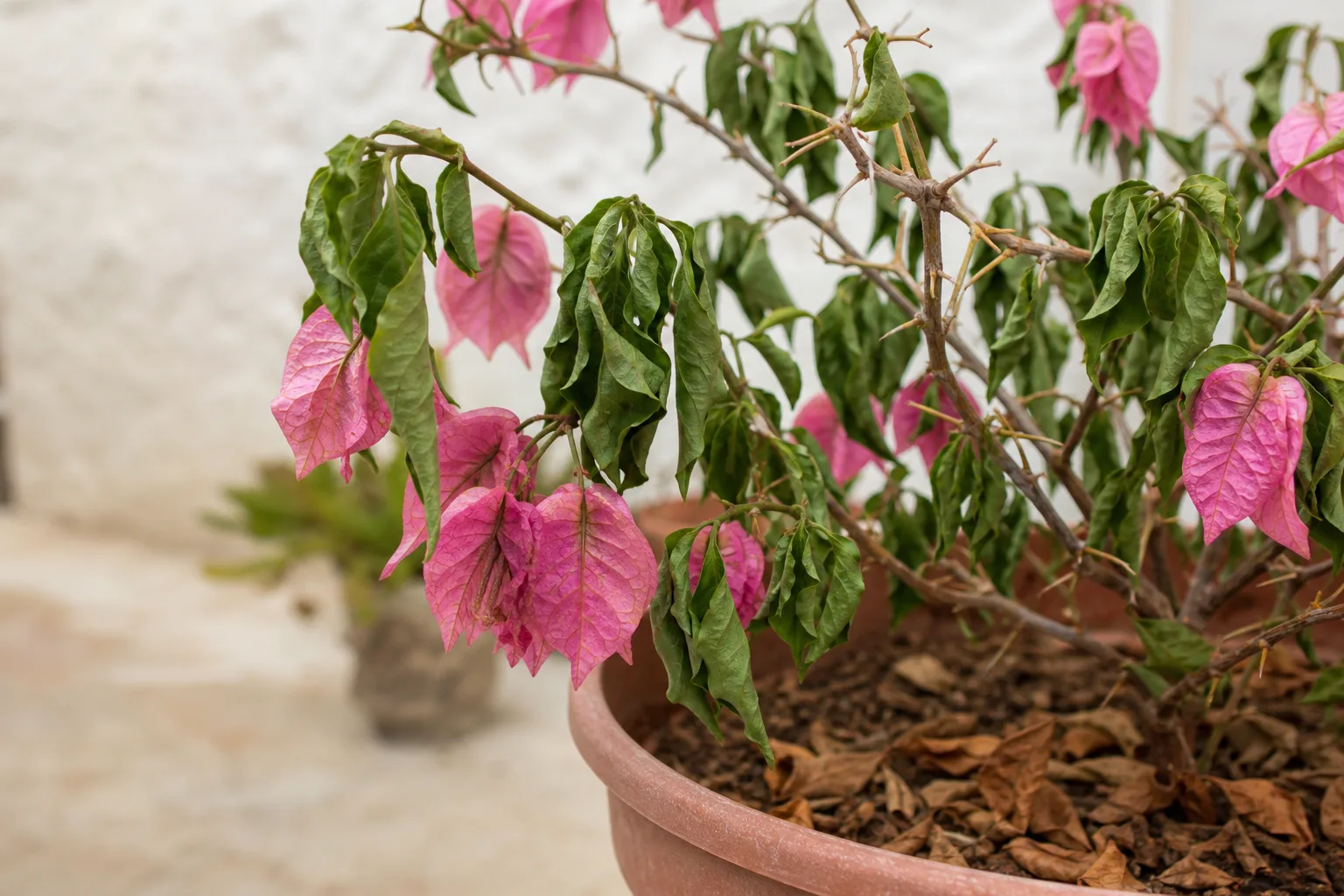
Wilting on Bougainvillea: Causes, Checks & Fixes
This guide covers wilting on Bougainvillea. See also the general Wilting guide, watering, and light pages for this plant.
Wilting on Bougainvillea: Causes, Checks & Fixes
Quick answer
Wilting on bougainvillea is one of the most urgent-and most misread-signals on this sun-loving subtropical vine. The same limp leaves can mean give a deep drink or stop watering immediately. Bougainvillea is extremely drought-tolerant and evolved for dry-down between rains, yet growers trained on houseplant habits often water wilted plants that are already drowning.
First step: check soil moisture and pot weight before you touch the watering can. Press a finger into the top 3–5 cm (1–2 inches). Lift the container. Dry soil plus a noticeably light pot with soft limp leaves → underwatering or an intentional dry-down window on an established plant; a deep soak is the first fix. Wet or cool damp soil plus a heavy pot with limp leaves → overwatering or root rot; withhold water and read the wet-soil branch below before adding more.
Never water bougainvillea because leaves drooped without confirming whether the root zone is dry or saturated. That single mistake converts reversible drought wilt into chronic root damage.
What wilting looks like on Bougainvillea
Wilting is loss of turgor-leaves and young stems go soft, hang down, and feel limp instead of firm. On bougainvillea, the symptom shows on thin true leaves and sometimes on young shoot tips; the woody thorny stems usually stay stiff unless rot reaches the crown.
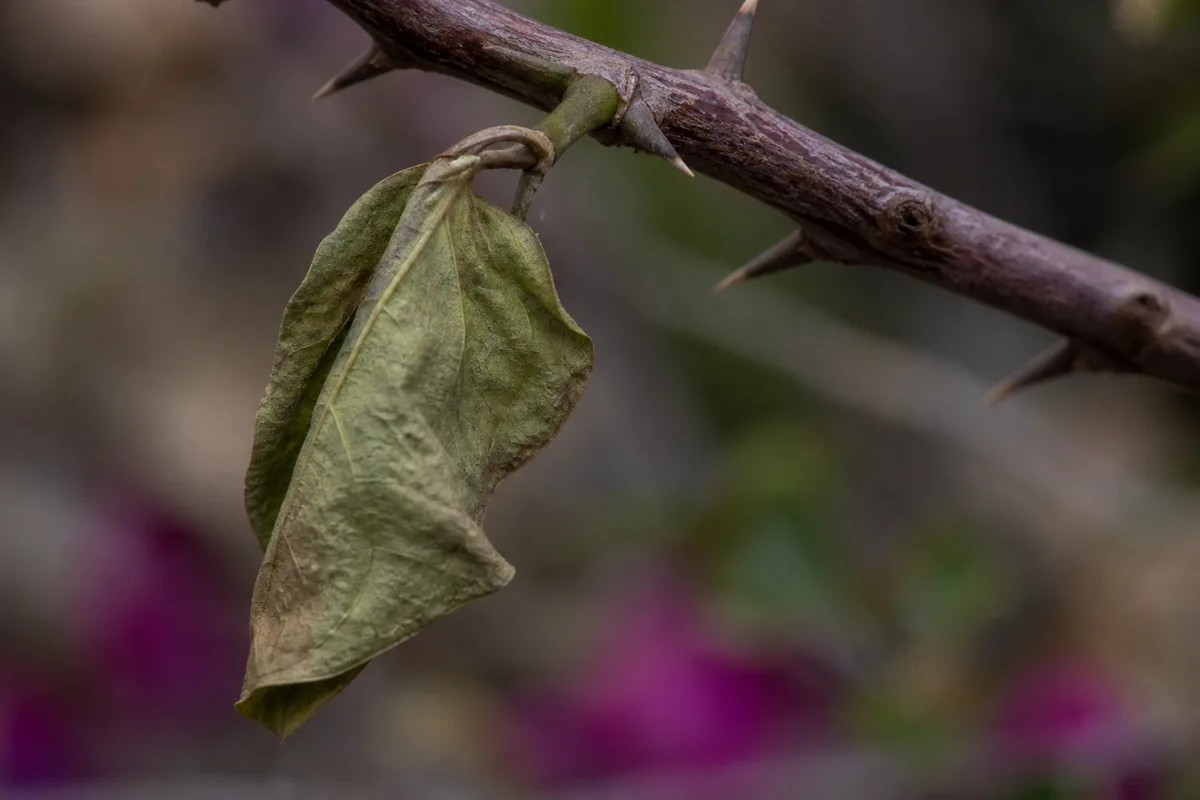
Wilting symptoms on Bougainvillea - compare with healthy tissue on the same plant.
Dry wilt (underwatering or dry-down)
- Top 3–5 cm of mix feels dry; container feels light for its size
- Leaves soften and droop; may feel thin rather than crunchy at first
- Advanced drought: crisp brown leaf edges, curled leaves, mass leaf drop
- Soil may pull away from pot sides in extreme dry-out
- On established in-ground plants, slight afternoon droop when upper soil is dry can appear during the drench-and-dry cycle that precedes bract color
Wet wilt (overwatering or root rot)
- Mix stays dark, cool, and damp at the surface for many days after watering
- Pot feels heavy; saucer may hold standing water
- Leaves wilt despite recent irrigation-the counterintuitive classic
- Yellow lower leaves, sour or musty smell from mix, fungus gnats hovering
- Stem base at soil line may soften in advanced cases
- Often overlaps with overwatering on bougainvillea and root rot
Heat and environmental wilt
- Afternoon limpness in extreme heat on a dry root zone-plant recovers by evening after soil moisture is adequate
- Sudden wilt after repotting or a move-transplant shock with disturbed roots
- Winter container wilt after cold exposure-damaged tissue on plants pulled indoors without gradual hardening
Wilting vs. drooping leaves
Wilting is acute tissue collapse from water stress or failed uptake. Drooping on bougainvillea can describe longer-term soft posture on heavy stems without full turgor loss. If your plant looks tired but soil checks are ambiguous, compare with drooping leaves on bougainvillea after you run the moisture workflow below.
Why Bougainvillea wilts (and when slight wilt is normal)
Bougainvillea (Bougainvillea spectabilis and hybrids) comes from arid subtropical regions where roots explore fast-draining soil and tolerate real dry spells. UF/IFAS Gardening Solutions notes the plant performs better when soil is left a little dry-not bone dry forever, but genuinely dry between deep soaks. That biology drives most wilt stories on this species.
Intentional dry-down before bracts (established plants only)
Commercial and extension guidance documents that controlled drought stress can stimulate flowering on bougainvillea-UF/IFAS production notes describe allowing plants to dry just to the point of wilting to induce bracts, with explicit warning that excessive drying causes leaf drop and dormancy. On a mature, well-rooted vine in Bougainvillea light guide, slight leaf droop when the upper soil has gone dry is sometimes the bloom-trigger window, not an emergency. The line between useful stress and damage is narrow: soft limp leaves on dry soil may be acceptable; crisp edges, heavy leaf fall, or wilt on wet soil are not.
Underwatering and missed soak cycles
Container bougainvillea in full sun can dry every three to five days in summer heat. Travel, windy balconies, and small pots accelerate dry-out. When the root zone desiccates, fine roots lose function and leaves collapse. One thorough rehydration usually restores turgor if you catch it before prolonged crisp wilt.
Overwatering and root oxygen loss
Bougainvillea does not tolerate soil that stays constantly wet. Calendar watering, automatic lawn sprinklers, oversized pots, and dense peat-heavy mix keep roots in low-oxygen conditions. Roots decline; the plant cannot absorb water even though mix is wet-so leaves wilt while you keep watering. UF/IFAS Extension Charlotte County links over-watering with misdirected sprinklers to leaf drop and poor health on this drought-tolerant species.
Heat-wave transpiration
In extreme heat, transpiration can briefly exceed root supply on dry or marginally dry soil, producing afternoon wilt that recovers overnight once moisture is even. This is more common on roof containers and west-facing walls than on in-ground established vines with deep roots.
Transplant and repot shock
Newly planted or recently repotted bougainvillea has a smaller working root system. Disturbed roots underperform for days to weeks-especially if repotted into an oversized wet pot or moved from sun to shade simultaneously. Wilt here is shock, not necessarily rot, but chronic wet mix after repot quickly becomes rot wilt.
Cold damage on overwintered plants
Bougainvillea is frost-sensitive. Cold-damaged leaves and stems wilt and brown after exposure; saturated cold mix compounds root stress. The RHS bougainvillea guide notes that cooler winter conditions may cause leaves to droop for several days-water less frequently until the plant adapts. Winter wilt on a plant recently moved indoors may combine temperature shock with overwatering during slow growth.
Dry wilt vs. wet wilt vs. heat wilt
| Signal | Dry wilt | Wet wilt | Heat wilt (dry soil) |
|---|---|---|---|
| Top 3–5 cm soil | Dry, dusty | Cool, damp days after watering | Dry to slightly dry |
| Pot weight | Light | Heavy | Light to moderate |
| Leaf texture | Soft limp → crisp if prolonged | Limp, may yellow at base | Limp midday, firmer by morning |
| Recent watering | Days since last soak | Watered recently | Any; heat spike same day |
| Smell | Neutral dry earth | Sour or musty | Neutral |
| First fix | Deep soak, drain fully | Stop water; inspect roots | Deep soak; verify sun and airflow |
Use the table as a decision branch, not a substitute for touching the soil. When two columns seem to fit, pot weight plus finger depth break the tie.
How to confirm the cause
Work through these checks in order. Stop when one path is clearly confirmed.
-
Finger test at 3–5 cm - Dry supports dry wilt; clearly damp supports wet wilt. If surface is dry but pot is heavy, the center is still wet-wait, do not water.
-
Pot weight - Lift the container. Light plus dry surface confirms drought branch. Heavy plus damp surface confirms wet branch. Learn the heft the day after a good soak so your hands have a baseline.
-
Recent irrigation log - Did you or a sprinkler system water within 24–48 hours while leaves wilt? Wet-soil wilt rises on that timeline.
-
Leaf and stem inspection - Yellow lower leaves on wet mix point to rot. Crisp brown margins on dry mix point to severe underwatering. Soft crown at soil line on wet mix is urgent.
-
Establishment status - Newly planted under one season? Steady moisture is expected; aggressive drought wilt is a mistake. Established over one full growing season? Dry-down wilt can be bloom-related if mild.
-
Weather context - Record-breaking afternoon heat on dry soil suggests heat wilt overlay. Prolonged rainy weeks suggest wet wilt even outdoors.
-
Drainage audit - Blocked holes, standing saucer water, or nursery pot sitting in a cachepot? Fix drainage before interpreting wilt as thirst.
-
Root spot-check (wet branch only) - If wet wilt signs stack up, slide the plant out. Firm pale tan roots support cautious drying. Mushy brown roots confirm rot-see root rot on bougainvillea.
First fix for Bougainvillea
Make one primary correction based on soil moisture-do not stack repot, prune, and fertilizer on the same day.
If soil is dry and the pot is light
Water deeply once until water runs from drainage holes. Let the pot drain five to ten minutes, then empty the saucer. Place the plant back in full sun (minimum 5–6 hours direct sun on the leaves for healthy outdoor growth). Recheck in the morning-mild drought wilt often firms within hours to overnight.
Do not switch to daily thimbles of water; partial top-ups fail to rewet a desiccated root ball. For hydrophobic dry-out where water runs off the surface, water in slow passes at the sink until mix accepts moisture.
If soil is wet and the pot is heavy
Stop watering immediately. Move the pot to full sun and airflow if it was shaded-slow evaporation worsens wet soil. Empty saucers and confirm drainage holes are open. Wait until the top 3–5 cm dries before any next drink.
If wilt persists more than 72 hours while mix stays damp, or lower leaves yellow and mix smells sour, unpot and inspect roots before the next watering. Trim only mushy tissue; repot into fresh well-draining mix only if a substantial portion of roots remain firm. Full protocol lives on the overwatering and root rot pages.
If slight wilt on dry soil during bloom season (established plant)
On a mature, full-sun, well-rooted vine with dry upper soil and soft-not crisp-leaves, you may be at the dry-down window described in the bougainvillea watering guide. You can either deep soak now to restore turgor or, if you are deliberately cycling for bracts, soak within 24 hours before crisp edge damage appears. Never push intentional drought on newly planted vines.
If wilt followed repotting within the last month
Provide bright full sun, one settling soak if mix was dry on repot day, then normal dry-down checks-not daily saturation. Wobble and wilt without sour soil often improve in two to three weeks as roots re-anchor. Repot shock details align with bougainvillea repotting guidance.
Recovery timeline
Mild dry wilt after one deep soak: improvement often visible within hours; leaves firm overnight. Severe crisp wilt: several days to a week; some leaves may drop permanently.
Wet wilt with early root damage: progress measured in days to weeks after watering stops; judge by firm new tips, not old collapsed leaves. Advanced rot: uncertain; softwood cuttings from healthy stems above damage may be the realistic salvage path.
Heat afternoon wilt: often resolves same evening once soil moisture is adequate; if it repeats daily, increase check frequency without keeping mix constantly wet.
Post-bloom leaf drop: UF/IFAS Extension Charlotte County notes some leaf drop after flowering can be normal if followed by new growth-do not confuse that with emergency wilt if soil and sun are otherwise correct.
Lookalike symptoms to rule out
| What you see | Likely issue | Differentiating check |
|---|---|---|
| Limp leaves, dry light pot | Underwatering / dry wilt | Top 3–5 cm dry; perks after one soak |
| Limp leaves, wet heavy pot | Overwatering / root rot | Recent watering; yellow lower leaves |
| Afternoon limp, firm by morning, dry soil | Heat stress | Heat spike; soil dry at depth |
| Wilt after repot, no sour smell | Transplant shock | Timeline under 4 weeks; roots not mushy |
| Wilt after frost or cold move | Cold damage | Temperature history; browned tissue |
| Long-term soft stems, not acute collapse | Drooping posture | See drooping leaves |
| Lush green vine, no bracts, damp soil | Overwatering vegetative mode | Not wilt alone; see watering guide |
What not to do
Do not water wilted bougainvillea without checking soil moisture-wet-soil wilt gets worse with more water.
Do not apply high-nitrogen fertilizer to stressed wilted plants; soft green growth replaces bracts and loads weak roots further.
Do not move a wilted plant from full outdoor sun into dim indoor shade to “reduce stress” unless you are protecting from active frost-shade slows drying of wet soil and weakens recovery.
Do not repot on day one for simple dry wilt; unnecessary root disturbance adds shock.
Do not punish severe dry wilt with daily micro-sips that never reach the root ball.
Do not assume wilting always means thirst-the wet-soil branch is common on bougainvillea because growers overwater drought-tolerant vines.
Wear gloves when inspecting roots or pruning-bougainvillea carries sharp thorns and sap that can irritate skin.
How to prevent wilting next time
Anchor prevention to bougainvillea’s real biology: full sun, fast drainage, and soak-and-dry rhythm.
- Grow in at least 5–6 hours direct sun daily outdoors; more sun supports stronger roots and better drought handling per UF/IFAS Nassau County Extension bloom guidance
- Use well-draining mix with perlite; target pH 5.5–6.5 per Clemson HGIC
- Water when top 3–5 cm dries and pot lightens-not on a calendar
- Deep soak until drainage runs, then empty saucers
- Disconnect from automatic sprinkler zones that keep soil moist
- Give newly planted vines steadier moisture until established; apply drought-stress bloom cycling only to mature plants
- Reduce winter watering frequency when growth slows; avoid cold plus wet mix
- Right-size containers; oversized pots stay wet around small root balls
The bougainvillea watering guide covers seasonal intervals, container vs in-ground differences, and the full dry-wilt versus wet-wilt logic this page summarizes for emergency diagnosis.
When wilt is urgent
Treat wilt as urgent when:
- Mix is wet and the crown feels soft at soil line
- Wilt spreads rapidly over 24–48 hours despite dry surface
- Most roots are mushy on inspection
- Leaves collapse with blackened stems or foul odor from mix
- Severe crisp wilt and mass leaf drop on a newly planted vine
Low urgency: slight soft droop on dry soil for an established full-sun plant during active bloom season, with firm woody stems and no sour soil-confirm dryness, soak within the dry-down window, and monitor.
Conclusion
Wilting on bougainvillea always starts with the same question: is the root zone dry or wet? Dry light pot → deep soak. Wet heavy pot → stop watering and inspect roots. This drought-tolerant subtropical vine wilts from thirst far less often than houseplant logic predicts-and far more often from overwatering that destroys the roots needed to drink.
Learn the dry-down rhythm in the watering guide, escalate wet-soil cases through overwatering and root rot, and distinguish acute wilt from longer posture issues on drooping leaves. Check soil before every soak; the vine will tell you the schedule if you read the pot instead of the calendar.
Related Bougainvillea problems
- Watering - soak-and-dry rhythm, finger test, and slight wilt before bracts
- Underwatering - severe drought wilt with crisp edges and hydrophobic dry-out
- Overwatering - wet-soil wilt and vegetative growth without bracts
- Root rot - persistent wilt when mix stays damp and roots decay
- Drooping leaves - longer-term soft posture vs. acute turgor collapse
- Bougainvillea overview - full-sun biology, thorns, and baseline care
When to use this page vs other Bougainvillea guides
- Bougainvillea watering guide - Use for routine moisture checks before assuming wilting is the main issue.
- Bougainvillea problems hub - Browse all 20 common issues on this species.
- Underwatering on Bougainvillea - Different entry point when symptoms overlap with wilting.
- Overwatering on Bougainvillea - Different entry point when symptoms overlap with wilting.
- Root Rot on Bougainvillea - Different entry point when symptoms overlap with wilting.